Wireless Power Only · Volume 1
The Wireless-Power-Only Gun — A Battery Inside, a Thin USB Lead Out
What the architecture is, the block diagram from the PC to the coil, which side powers what, the battery magazine that makes it a swappable module, and what changes against the wired gun
A recoil light gun needs a data link and a source of amps. The Fully Wired gun brings both down one umbilical: USB from the PC and a 24 V pair from a wall brick. The Fully Wireless gun replaces both with a battery and a radio. This dive is the architecture in between: the amps come from a battery in the gun, and the data still goes down a cable. It is the smallest step away from the wired gun that removes the heavy part of the tether, and it changes the electrical design in more places than its name suggests.
1.1 What “Wireless Power Only” Means
In this category, “wireless power only” means:
- No power cable. The recoil solenoid, the moving ejection port’s coil and the rumble motor run from a 6S lithium-polymer pack inside the gun. Nothing in the gun is fed from a wall outlet while it is being played.
- Data on a USB cable. The Raspberry Pi Pico still enumerates as OpenFIRE’s composite device over USB 2.0 full speed, exactly as in the wired gun (Open-Source Firmware). The cable is a USB lead and nothing else: four conductors and a shield, light enough to be a mouse cable.
- The logic still runs from the USB port. The Pico, camera, LEDs, OLED and IMU take their 5 V from VBUS, as in the wired gun. Only the 24 V-class rail, V_SOL, comes from the pack. Volume 3 argues this choice in full; it is the one that keeps the gun a plain bus-powered USB device and avoids every back-feeding rule in the USB specification.
The category plan’s one-line definition was “battery in the gun, data still on a cable (or vice versa)”. The “vice versa”, power on a cable and data by radio, is not treated as a build here: it keeps the heavy cable and adds the radio, and so combines the costs of the other two architectures with the benefits of neither. Section 1.8 records the rejection.
1.2 Three Architectures, and Where This One Sits
Table 1 — 1.2 Three Architectures, and Where This One Sits
| Architecture | Data | Logic power | Recoil power | Cable to the gun | Dive |
|---|---|---|---|---|---|
| Fully wired | USB cable | USB VBUS | 24 V brick, down the same umbilical (D31) | One umbilical, one GX plug | Fully Wired |
| Wireless power only | USB cable | USB VBUS | 6S pack in the gun | A thin USB lead | This dive |
| Fully wireless | Radio to a dongle (the ESP32-S3 trial, D25 and D30; Nordic boards on hand, D38) | The pack, through a buck regulator | 6S pack in the gun | None in play | Fully Wireless |
The LiPo Batteries dive already places this architecture in the same table (LiPo Batteries Vol 1, section 1.2) and designs the pack for it: a GNB 6S 450 mAh pack (LB-2), two stacked BQ77905 protectors (LB-3), an LM5060 rail switch (LB-4), charging out of the gun on a SkyRC B6neo (LB-5), the magazine as the pack’s home (LB-6). This dive takes all of that as given and does not repeat it. What it owns is everything around the pack: the lead, the logic supply, the rules that stop the pack and the USB port from feeding each other, the ground, the runtime with the logic off the pack, the cost, and when the architecture is worth building.
Its place in the build order is also set. The first build is the wired printed MP7 (D35, D17). Wireless power only is the natural second step, because it reuses the same carrier, the same firmware and the same USB link and changes only where V_SOL comes from. The fully wireless gun is a third step that adds the radio on top of this one’s pack.
1.3 The System, Block by Block
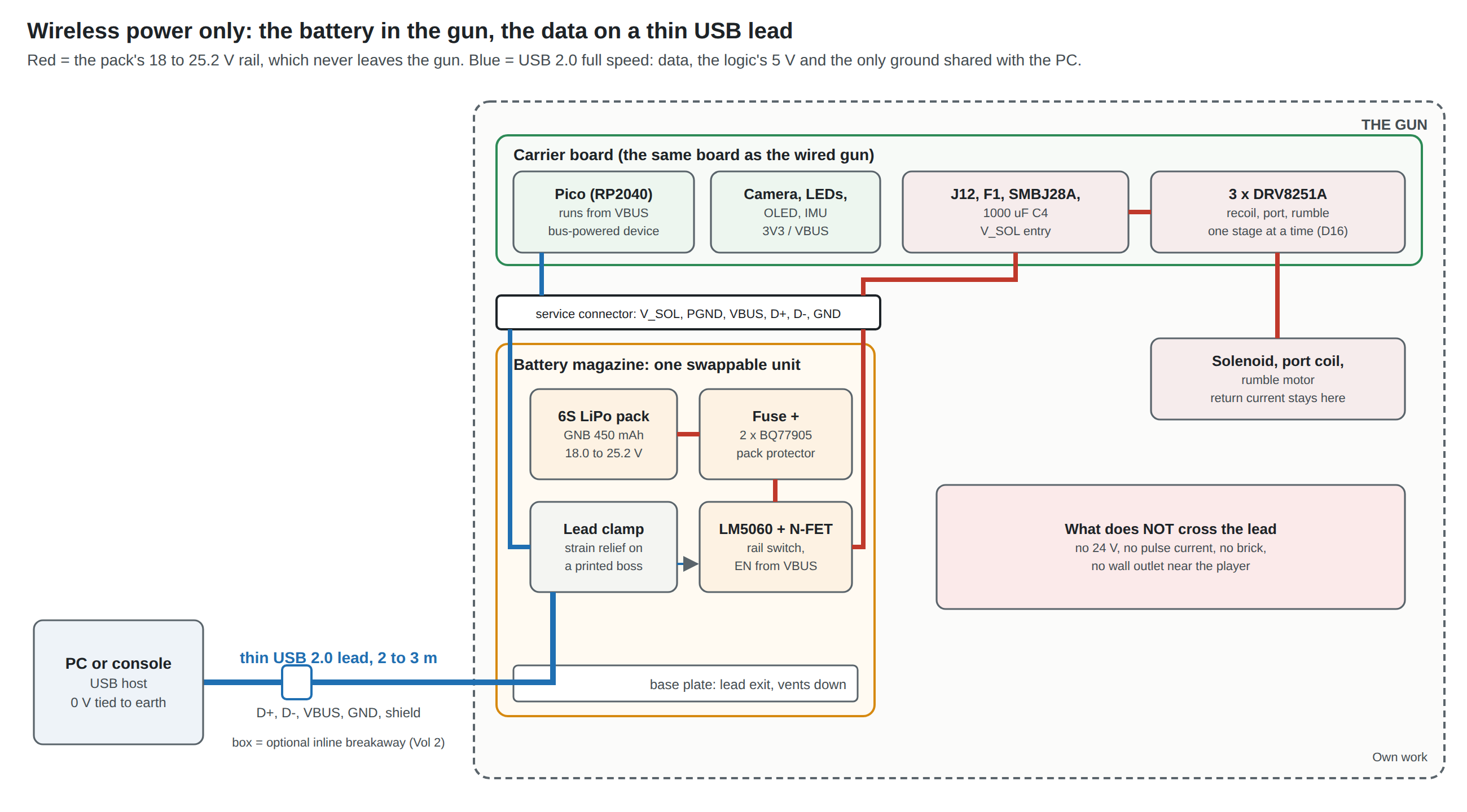
Reading the diagram from left to right:
- The PC or console. Any USB host. Its 0 V is almost always tied to mains earth through its own supply. It polls the gun’s interrupt endpoint every millisecond, as in the wired gun.
- The USB lead (Vol 2). Two to three metres of USB 2.0 cable: a 90 Ω shielded twisted pair for D+ and D−, a VBUS and ground pair, and an overall shield. It carries about 150 mA, not amps, so it can be a fraction of the umbilical’s diameter and weight. An optional breakaway near the PC end protects the host’s port if someone trips on it.
- The battery magazine (section 1.5). The lead is clamped inside the magazine on a printed boss and continues to the service connector. Beside it sit the pack, its fuse and two BQ77905 protectors, and the LM5060 rail switch (LiPo Batteries Vol 4). The rail switch’s enable is taken from VBUS, so the rail exists only while the lead is plugged into a live port (Volume 3).
- The service connector. The latched connector at the top of the magazine that the printed build already provides so the magazine can come out for service (MP7 Printed Build Vol 5, section 5.6). Here it carries six signals: V_SOL and its power ground, and the four USB lines.
- The carrier board. The Reference Electronics Stage 1 carrier, unchanged. V_SOL enters at J12, through F1, the SMBJ28A (D33) and the 1000 µF reservoir C4, to the three DRV8251A stages: recoil, ejection port and rumble (D13, D16, MR-3). USB stays on the Pico’s own micro-USB connector through a short pigtail, as in Stage 1.
- The coils. The solenoid, the port actuator and the rumble motor. Their pulse current flows from the pack, through the stages, and back to the pack, all inside the gun.
1.4 Which Side Powers What
Table 2 — 1.4 Which Side Powers What
| Load | Source | Why |
|---|---|---|
| Pico, camera, OLED, IMU, status LEDs | USB VBUS | The same as the wired gun; about 100 to 150 mA estimated (Power Supplies Vol 1), comfortably inside any USB 2.0 port; keeps the gun a bus-powered device |
| NeoPixel, if fitted | USB VBUS | The firmware’s hardware guide runs pixels from VBUS (Reference Electronics Vol 2, section 2.9) |
| Recoil solenoid, ejection-port actuator | Pack, through the LM5060 to V_SOL | Amps in pulses; the reason the pack exists |
| 34 mm rumble motor on its own DRV8251A | Pack, V_SOL | Runs from the 24 V-class rail in every architecture (MR-3) |
| Compact or coin rumble motor, if used instead | USB VBUS | Only if its start current fits the port (Motors and Rumble Vol 6) |
| The rail switch’s enable | USB VBUS | The rail is on only while the gun is plugged in (Volume 3) |
The split is the same as the wired gun’s in one respect that matters: the logic and the coils never share a supply, which is the first rule of Power Supplies Vol 5. It differs in where the coil supply’s return goes. In the wired gun, the 24 V return travels the length of the umbilical to a brick at the far end. Here it travels a few centimetres to a pack in the magazine. Volume 3 follows the consequences.
1.5 The Battery Magazine: Swap the Magazine, Swap the Architecture
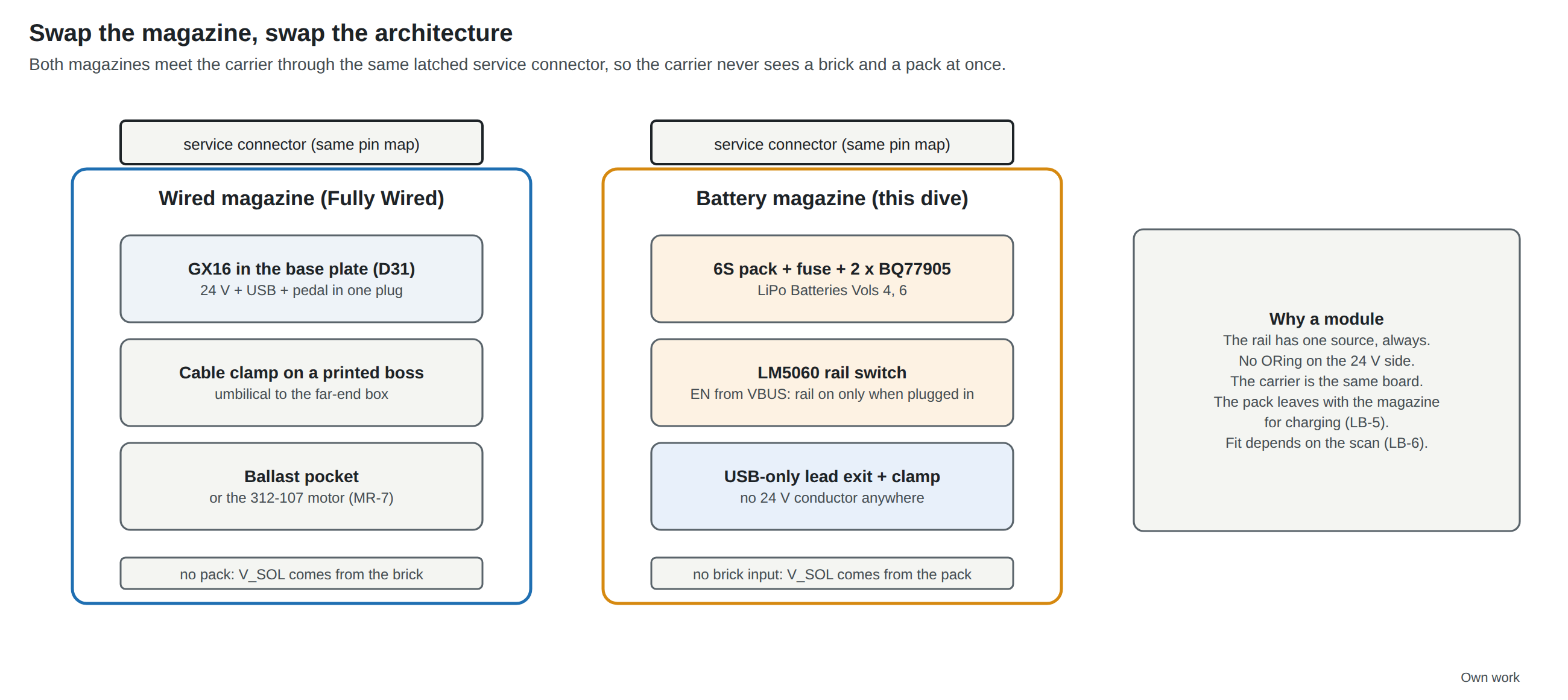
Two decisions already in the log point at one arrangement. The printed MP7 puts the cable exit, the strain relief and a latched service connector in the dummy magazine (D6, D31, MP7 Printed Build Vol 5). The LiPo dive puts the pack in the magazine, so that swapping a magazine swaps a pack (LB-6). Put together, the magazine becomes the power module:
- A wired magazine carries the GX16 and the umbilical. V_SOL comes from the brick.
- A battery magazine carries the pack, its protection, the rail switch and the USB lead’s exit. V_SOL comes from the pack.
Both present the same pin map at the service connector. The carrier board, the firmware and the shell are the same gun in both cases.
The arrangement earns its place for one reason more than any other: V_SOL only ever has one source. A gun whose rail could be fed by both a brick and a pack at once needs ideal-diode ORing on the 24 V side, or it risks the brick charging the pack, uncontrolled, through the LM5060’s MOSFET. Volume 3 works through that hazard. With the source chosen by which magazine is fitted, the hazard cannot arise, because the battery magazine has no brick input and the wired magazine has no pack.
Three things limit it, and none is settled yet:
- Fit. The pack goes in the magazine only if the magazine scan’s outside width, less its walls, clears about 19.5 mm (LiPo Batteries Vol 6). The USB lead and its clamp must share that space with the pack; the LiPo dive calls this “the tightest case”. A thin lead (Volume 2) is what makes it possible at all.
- The ballast pocket. Motors and Rumble wants the compact fallback motor in the magazine (MR-7). That conflict is open in the decision log (LB-6 vs MR-7); a battery magazine resolves it for this gun by having no room for a motor.
- The service connector’s rating. It now carries the coil’s pulse current, up to the regulated set point of about 2.5 A (D13, D16), and must be chosen for that. In the wired magazine the same connector carries the same current from the GX, so the requirement is not new; it is the printed build’s to choose.
1.6 What Changes Against the Wired Gun
Almost everything that a brick decided changes when the pack replaces it. The LiPo Batteries Vol 1 section “What a Battery Changes” sets out the electrical side; the table below adds what changes at the system level.
Table 3 — 1.6 What Changes Against the Wired Gun
| Fully wired | Wireless power only | |
|---|---|---|
| Cable to the gun | Umbilical: USB cable plus a 20 AWG power and pedal cable in one sleeve, a GX16 plug (Fully Wired Vol 2) | A USB lead, about 4.5 mm or less |
| Far-end hardware | Brick, junction box, wall outlet | None |
| Current in the cable | Up to about 2.5 A pulses on the 24 V pair | About 150 mA of steady logic current |
| Path of the pulse return | Down the cable to the brick | Inside the gun |
| What limits autofire | The brick’s trip band (D16 and MR-6 exist because of it) | The coil’s heating only (Solenoid Recoil Vol 4) |
| Fault current | Limited by the brick’s hiccup | Well over 100 A from the pack: fuse and protector are mandatory (LiPo Batteries Vol 3) |
| Runtime | Unlimited | About 9 hours of busy play on one 450 mAh pack (Volume 4) |
| Plug order | A fixed sequence, because the GX cannot be mated live (D31) | None: USB is hot-pluggable and the rail switch handles the pack |
| Latency | USB, 1 ms polling | Identical (Volume 4) |
| Firmware | No change | No change, provided the logic stays on VBUS (Volume 3) |
The last row is the one with a condition. If the logic were moved onto the pack, the gun would become a self-powered USB device, and the stock RP2040 USB driver would then break a USB rule every time the lead was unplugged with the gun switched on. Volume 3 shows why, from the driver’s source.
1.7 What This Dive Covers, and What It Leaves to Others
Table 4 — 1.7 What This Dive Covers, and What It Leaves to Others
| Question | Where it is answered |
|---|---|
| The architecture, block diagram and battery magazine | This volume |
| The USB lead: cable types and flex life, gauge and drop, length, routing and strain relief, breakaway connectors | Vol 2 |
| Logic power, back-feeding VBUS, the USB rules for self-powered devices, ideal-diode ORing, the VBUS-gated rail switch, the two-source hazard, grounding | Vol 3 |
| Charging from USB while playing, power budget, standby drain, runtime, latency | Vol 4 |
| Cost, when this architecture wins, bench tests, the decisions to log | Vol 5 |
| Chemistry, cell count, the pack, protection, charging, safety in PETG, shipping packs | LiPo Batteries |
| The umbilical, the GX16, the far-end box | Fully Wired |
| One USB-C cable carrying data and a PD contract | USB-C Power Delivery |
| Grounding in general and the diagnosis table | Power Supplies Vol 5 |
| The carrier, J12, the stages | Reference Electronics |
| The magazine, its clamp and service connector | MP7 Printed Build Vol 5 |
| The radio | Fully Wireless |
1.8 Why This, and Why Not the Others
Criteria for the second build’s architecture: remove the part of the tether players object to; reuse the wired gun’s carrier, firmware and USB link unchanged; keep latency at the wired figure; add no subsystem that has not got its own design already (the pack, protector and rail switch are designed in LiPo Batteries); keep a single source on every rail.
Table 5 — 1.8 Why This, and Why Not the Others
| Candidate | Verdict | Reason |
|---|---|---|
| Wireless power only: pack in a battery magazine, logic on USB, a thin USB lead | Proposed as the second build (row WP-1, Volume 5) | Removes the brick, the far-end box and the 20 AWG power cable; the gun’s only cable becomes a mouse-weight USB lead. No firmware change, no radio, no change of latency. Adds the pack’s cost, a charger and the pack’s safety rules, all of which the LiPo dive has already worked out. |
| Fully wired | First build, and stays | Simplest and current-limited (D35, D17). Wireless power only does not replace it; the wired magazine stays available. |
| Fully wireless | Third | Needs the pack and a radio that the D25 trial has not yet tested (Fully Wireless). |
| Pack in the gun, logic also on the pack, USB for data | Rejected for this build (Volume 3) | Makes the gun a self-powered USB device: the stock RP2040 driver then drives D+ with no host present, and the pack is drained by the logic. Its one advantage, independence from a weak port, matters only on low-power hosts. |
| Power on a cable, data by radio (“vice versa”) | Rejected | Keeps the heavy cable and adds the radio: the costs of both other architectures and the benefit of neither. |
| Pack and brick both able to feed V_SOL in one gun | Rejected for now (Volume 3) | Needs ideal-diode ORing on the 24 V side or risks the brick charging the pack; the battery magazine makes the choice mechanical instead. |
Comments (0)