.450 Bushmaster · Volume 5
Downrange: Trajectory, Wind, and How Far It Actually Reaches
The path of each factory load from the makers' own numbers, a solver that reproduces those numbers exactly, why the subsonic load drifts less in a crosswind than the fast ones, and three independent limits on range that mostly agree
5.1 The model, and the check it passed
Every trajectory, drift and range figure in this volume comes from a G1 point-mass solver, the same one the .45-70 Government and .450 Bushmaster AR-15 dives used, with one defect corrected (last section). It takes three inputs: the maker’s muzzle velocity, the maker’s ballistic coefficient and the bullet weight, in standard air at 59 °F and sea level.1
Before any number was used, the solver was asked to reproduce what the makers themselves publish:
- Velocity: every one of the eight published downrange tables in Volume 3, to within 4 fps at 100, 200 and 300 yards.
- Trajectory: Hornady’s Sub-X, 100-yard zero: model −1.5 / 0 / −34.9 / −110.7 inches at the muzzle, 100, 200 and 300 yards, against Hornady’s −1.5 / 0 / −34.9 / −110.8.2 Federal’s Power-Shok: model +0.7 / 0 / −12.4 / −44.6 at 50, 100, 200 and 300 yards, against Federal’s +0.7 / 0 / −12.4 / −44.5.3
- Wind: Federal’s and Remington’s published 10-mph drift for the Fusion, Power-Shok and AccuTip, to within 0.2 inch at every range.34
So within the makers’ own assumptions the model is the makers’ tables. That makes it safe for what this volume uses it for, which is re-zeroing and comparing loads on a common basis. It does not make it a chronograph: every figure inherits the maker’s muzzle velocity, which is a longer barrel’s (Volume 4).
One detail of the published tables is worth knowing before reading them. Hornady’s BLACK 82246 table assumes a sight 2.4 inches over the bore (its muzzle figure is −2.4), which is typical of an AR-15 scope; Federal’s and Remington’s state 1.5 inches. The model reproduces Hornady’s 200-yard-zero table with 2.4 inches (+4.1 at 100 against Hornady’s +4.1; −19.5 at 300 against −19.3). The tables below use 1.5 inches throughout, so they compare loads, not rifles.
5.2 The path
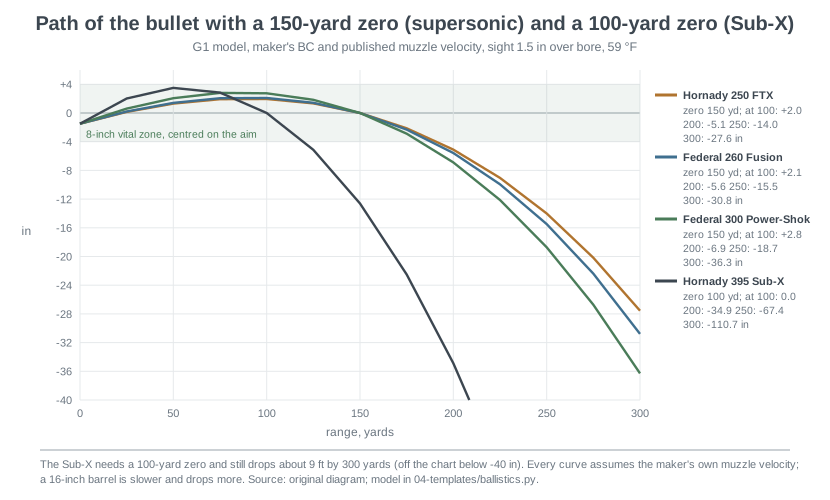
With a 150-yard zero and a 1.5-inch sight height:
Table 1 — With a 150-yard zero and a 1.5-inch sight height
| Load | 50 yd | 100 yd | 150 yd | 200 yd | 250 yd | 300 yd |
|---|---|---|---|---|---|---|
| Hornady 250 FTX, 2,200 fps | +1.3 | +2.0 | 0 | −5.1 | −14.0 | −27.6 |
| Federal 260 Fusion, 2,200 fps | +1.4 | +2.1 | 0 | −5.6 | −15.5 | −30.8 |
| Federal 300 Power-Shok, 1,900 fps | +2.1 | +2.8 | 0 | −6.9 | −18.7 | −36.3 |
The three are within two inches of each other to 200 yards and spread apart quickly beyond it. The FTX, with the best BC of the supersonic loads, is the flattest; the heavy, slow Power-Shok drops the most. Inside 200 yards the choice of load hardly moves the point of impact; past 250 it moves it by most of a foot.
The AR-15 dive’s Volume 5 makes the case for the 150-yard zero for that rifle in detail and its argument is not repeated; the next section puts a number on it.
5.3 Point-blank range
Point-blank range is the farthest distance at which the bullet stays within a given distance of the line of sight, with the zero chosen to make that distance as long as possible. For an 8-inch vital zone (the bullet never more than 4 inches high or low):
Table 2 — Point-blank range is the farthest distance at which the bullet stays within a given distance of the line of sight, with the zero chosen to make that distance as long as possible. For an 8-inch vital zone (the bullet never more than 4 inches high or low)
| Load | Best zero | Point-blank range |
|---|---|---|
| Hornady 250 FTX | 175 yd | about 209 yd |
| Federal 260 Fusion | 175 yd | about 207 yd |
| Remington 260 AccuTip | 175 yd | about 202 yd |
| Federal 300 Power-Shok | 150 yd | about 182 yd |
| Hornady 395 Sub-X | 100 yd | about 120 yd |
For a hunter who does not want to estimate range or hold over, the supersonic .450 Bushmaster is a 200-yard cartridge by trajectory alone: a 175-yard zero keeps the bullet inside an 8-inch circle from the muzzle to a little past 200 yards, and a 150-yard zero gives up a few yards at the far end for a lower mid-range. The Power-Shok, heavier and slower, is a 180-yard cartridge by the same test.
5.4 Wind
Drop can be zeroed out. Wind cannot, and the .450 Bushmaster is a wind-sensitive cartridge because its bullets have low ballistic coefficients and spend a long time in the air.
For a full-value 10-mph crosswind:
Table 3 — For a full-value 10-mph crosswind
| Load | 100 yd | 200 yd | 300 yd | Source |
|---|---|---|---|---|
| Hornady 250 FTX | 2.3 in | 10.1 in | 24.6 in | model (Hornady publishes no drift) |
| Federal 300 Power-Shok | 2.8 | 11.3 | 26.6 | Federal’s page |
| Federal 260 Fusion | 2.7 | 12.0 | 29.5 | Federal’s page |
| Remington 260 Core-Lokt | 3.3 | 14.1 | 33.8 | Remington’s page |
| Remington 260 AccuTip | 3.6 | 15.9 | 38.6 | Remington’s page |
| Hornady 395 Sub-X | 1.9 | 7.3 | 16.0 | model |
At 200 yards a 10-mph wind moves every supersonic load 10 to 16 inches, more than the width of a deer’s vitals. Inside 100 yards it is two to four inches and can be ignored on a deer. Between 100 and 200 it is a hold, which a hunter has to judge, and past 200 it is the largest single source of a miss. The AR-15 dive made the same point for the FTX alone; the makers’ own drift figures show it holds across the whole field, and that the AccuTip, with its very low published BC, is the most wind-sensitive load in it.
5.5 The subsonic load downrange
The Sub-X is a different shape of problem, and one result is counter-intuitive.
It drops like a stone. Even with a 100-yard zero it is 35 inches low at 200 yards and over 9 feet low at 300 (Hornady’s own figures). Its point-blank range for an 8-inch zone is about 120 yards. It is a woods, blind and suppressed-close-range load, and the trajectory says so before its expansion floor does.
It drifts less than any supersonic load. At 200 yards a 10-mph wind moves it 7.3 inches against 10 to 16 for the fast loads, although it takes almost twice as long to get there (0.61 s against 0.33 s for the FTX). Wind drift does not depend on time of flight alone. It depends on how far the bullet lags behind where it would be in a vacuum, and a slow bullet with a high ballistic coefficient (.300) loses very little speed in the first place. The .45-70 dive’s subsonic loads show the same thing for the same reason. This makes the Sub-X a surprisingly easy bullet to shoot in wind at 100 yards, which is where it belongs.
Volume 4’s warning still governs it: the Sub-X’s expansion floor is 900 fps, it starts at 1,050 from a 20-inch barrel, and from a short barrel its expanding range can be under 100 yards. Trajectory and expansion both put its useful range at about 100 yards, and that is the honest figure for it.
5.6 Three limits on range
The practical range of a hunting load is set by whichever of three limits arrives first: the bullet stops expanding, the bullet leaves the vital zone on a centre hold, or the wind can move it out. For the published loads:
Table 4 — The practical range of a hunting load is set by whichever of three limits arrives first: the bullet stops expanding, the bullet leaves the vital zone on a centre hold, or the wind can move it out. For the published loads
| Load | Expansion floor (maker) | Point-blank, 8 in | 10-mph drift reaches 4 in | First limit |
|---|---|---|---|---|
| Federal Fusion | ~206 yd (1,400 fps) | ~207 yd | ~120 yd | wind, then both others together at ~200 |
| Federal Power-Shok | ~414 yd (1,000 fps) | ~182 yd | ~125 yd | wind, then trajectory |
| Hornady FTX | not published | ~209 yd | ~130 yd | wind, then trajectory |
| Hornady Sub-X | ~243 yd (900 fps), less from a short barrel | ~120 yd | ~145 yd | trajectory, and expansion from a short barrel |
The 4-inch drift column is where a full 10-mph crosswind alone would take a centre hold to the edge of an 8-inch zone; computed in 5-yard steps with the same drift model.
⭐ The limits agree on about 200 yards for the supersonic loads, which is what the AR-15 dive concluded from energy and drop. The difference is that one of them is now the maker’s own published number for one load, not an inference from energy. Three cautions keep that figure honest:
- It is a figure for no wind and a known range. In a 10-mph crossing wind the supersonic loads need a hold from about 120 to 130 yards.
- The expansion floor is a property of the bullet. The Power-Shok’s floor is far beyond its trajectory limit, so for it the limit is drop; the Fusion’s floor coincides with its drop limit. The FTX has no published floor, and no number is supplied for it here.
- Energy rules of thumb (“1,000 ft-lbf for deer”) are not used. They were built around faster, smaller bullets, and the .45-70 Government dive explains why they transfer badly to big, slow ones. By energy the Power-Shok is still at 1,179 ft-lbf at 200 yards and 860 at 300 (Federal’s figures), which says nothing useful about whether it will kill cleanly there.
5.7 A correction to the AR-15 dive’s trajectory tables
The solver inherited from the AR-15 dive accepts a sight height of 1.5 inches and then does not use it: it zeroes the bore line instead of the line of sight. The AR-15 dive’s Volume 5 states that its path tables assume a 1.5-inch sight height. They do not.
Table 5 — A correction to the AR-15 dive's trajectory tables
| FTX, 150-yd zero | 100 yd | 200 yd | 250 yd | 300 yd |
|---|---|---|---|---|
| As printed in the AR-15 dive (sight height 0) | +2.5 | −5.6 | −15.0 | −29.1 |
| Corrected, sight height 1.5 in | +2.0 | −5.1 | −14.0 | −27.6 |
The error is half an inch to an inch and a half, and it changes none of that dive’s recommendations. It is recorded because the dive says one thing about its tables and the tables are another, and because after the correction the model reproduces the makers’ published trajectories exactly, which it did not before. The corrected solver is this dive’s ballistics.py.
References
Footnotes
-
Model: G1 point-mass solver, drag constant from the .45-70 Government dive, sight-height defect corrected 19 October 2026; drift by the lag rule. This dive’s
04-templates/ballistics.py. Every input is a maker’s published figure. ↩ -
Hornady Manufacturing, hornady.com product pages for items 82246 and 82247, read 19 October 2026 (published velocity, energy and trajectory tables; 20-inch test barrel). URLs: https://www.hornady.com/ammunition/rifle/450-bushmaster-250-gr-ftx-black; https://www.hornady.com/ammunition/rifle/450-bushmaster-tbd-gr-sub-x. ↩
-
Federal Ammunition, federalpremium.com product pages F450BMFS1 and 450BMB, read 19 October 2026 (velocity, energy, 10-mph wind drift, and trajectory with a 100-yard zero and 1.5-inch sight height). URLs: https://www.federalpremium.com/rifle/fusion/11-F450BMFS1.html; https://www.federalpremium.com/rifle/power-shok/11-450BMB.html. ↩ ↩2
-
Remington Ammunition, remington.com product pages 27943 and 27941, read 19 October 2026. URLs: https://www.remington.com/rifle/premier-accutip/29-27943.html; https://www.remington.com/rifle/core-lokt/29-27941.html. ↩
Comments (0)