.450 Bushmaster · Volume 2
The Specification: What SAAMI's Current Drawing Says, and the Case Head It Borrowed
The 2025 standard read off the page, what changed since the 2015 edition, a fourth reference load that is subsonic, and how to tell the .450 from the straight-walled cartridges that now crowd it
2.1 Which edition, and why it matters
There are two editions of the SAAMI centerfire rifle standard in circulation for this cartridge. The project library holds Z299.4-2015, and the AR-15 dive was written from it. The current edition is Z299.4-2025, approved on 10 February 2025 and published by SAAMI as a free download; the file read for this volume was revised on 27 April 2026.1 Every figure below was read from the page images of the 2025 edition, because the text layer of a scanned or vector drawing routinely mangles decimals and tolerances.
The two editions agree on almost everything that a shooter would measure. They differ in three places that matter to anyone citing the standard, and in one place that matters to anyone shooting the cartridge: the 2025 edition standardises two more reference loads, one of them subsonic. That is covered below.
2.2 The dimensions
From the cartridge and chamber drawing, “450 BUSHMASTER [450 BM],” printed page 156, issued 1 February 2008 and revised 23 August 2022:1
Table 1 — The dimensions
| Dimension | Cartridge (max) | Chamber (min) |
|---|---|---|
| Rim diameter | .473 −.010 | |
| Rim thickness | .054 −.010 | |
| Extractor groove diameter | .409 −.010 | |
| Head diameter, at .200 basic | .5000 | .5010 |
| Breech reference diameter | .5037 Δ | |
| Body at 1.350 basic | .4820 | .4830 |
| Mouth | .4800 *Δ | .4810 *Δ |
| Case length / headspace | 1.700 −.010 | 1.700 min, 1.710 max ⊗ |
| Throat | .453 cylinder; .447 basic | |
| Leade | 2° 30′ basic | |
| Bore / groove | .442 / .450 | |
| Bullet diameter | .4525 −.0030 | |
| Overall length | 2.000 min, 2.260 max | |
| Body diameter tolerance | −.008 unless noted | +.002 unless noted |
| Grooves, width | Δ6, Δ.148 +.002 | |
| Twist | 24.00 R.H. OPTIONAL | |
| Minimum bore and groove area | .1570 sq in |
The drawing’s legend: B is basic, Δ is a reference dimension, * is “dimensions are to intersection of lines,” ⊗ is the headspace dimension, and all calculations are at maximum material condition. A note added to the current edition reads “Bullet profile is shown for illustrative purposes only,” which is a reminder that the drawing fixes the bullet’s diameter and the round’s length, not the shape of its nose.
Three things in that table carry the rest of this dive.
The bullet is .4525 and the groove is .450. It is a .452 cartridge, the handgun-bullet diameter, not a .458 like the .45-70 and the .458 SOCOM. Every .452 bullet in the world fits it; whether every .452 bullet is suitable for it is a different question, which Loading the .450 Bushmaster, Volume 4 takes up.
The body tapers from .5000 at the head to .4800 at the mouth. Two hundredths of an inch over 1.5 inches is small, but it is why no carbide sizing die exists for the cartridge; The Reloading Bench, Volume 12 has that argument and it is not repeated here.
The headspace dimension is the case length. That gets its own section below.
2.3 What changed between the 2015 and 2025 editions
Read side by side, the two drawings differ in these places:12
Table 2 — What changed between the 2015 and 2025 editions
| Item | 2015 edition (p.147 / p.343) | 2025 edition (p.156 / p.369) |
|---|---|---|
| Cartridge drawing date block | none printed | Issued 02/01/2008, revised 08/23/2022 |
| Rim bevel | 45° ±10′ | 35° +20° |
| Chamber reference lengths | 1.900, 2.026 Δ | 1.9003 Δ, 2.0263 Δ |
| Test barrel revision | 02/01/2008 | 08/02/2023 |
| Reference loads | 250 gr, 260 gr | 250, 260, 300 and 395 gr |
None of these changes a chamber anyone has cut. The rim bevel is the chamfer on the rim’s edge; the reference lengths are rounding made exact. But the AR-15 dive quotes the 2015 rim bevel, and anyone checking a published figure against “the SAAMI drawing” needs to know which drawing. Where this dive cites SAAMI, it means the 2025 edition unless it says otherwise.
2.4 The parent case, settled by the drawings
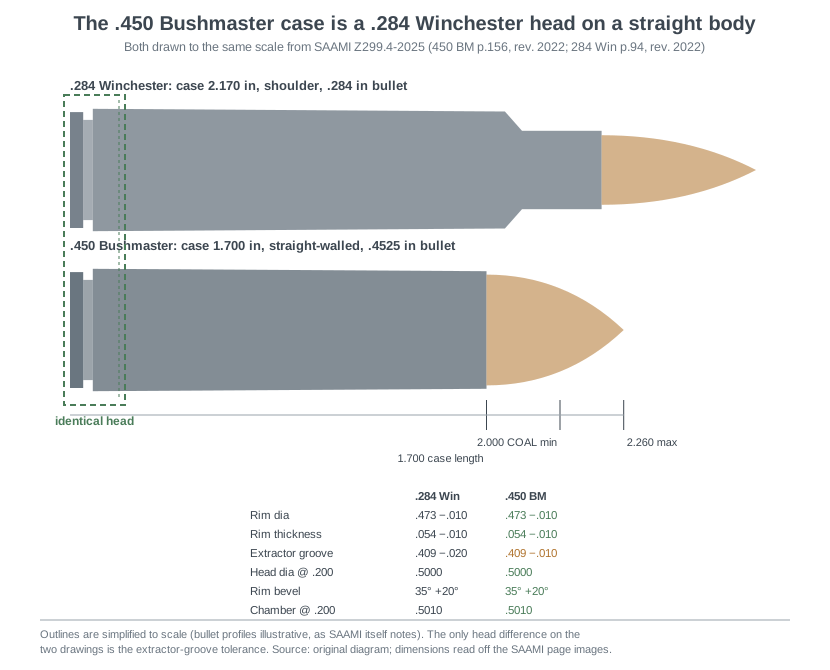
The reference literature says the .450 Bushmaster is based on the .284 Winchester (Volume 1). That is usually stated and left there. The current standard lets it be checked, because both cartridges are in it, and both drawings were revised in 2022.1
Table 3 — The parent case, settled by the drawings
| Head feature | .284 Winchester (p.94) | .450 Bushmaster (p.156) |
|---|---|---|
| Rim diameter | .473 −.010 | .473 −.010 |
| Rim thickness | .054 −.010 | .054 −.010 |
| Extractor groove diameter | .409 −.020 | .409 −.010 |
| Extractor groove widths | .039 −.010 / .040 +.010 | .039 −.010 / .040 +.010 |
| Rim bevel | 35° +20° | 35° +20° |
| Groove angle | 40° −6° | 40° −6° |
| Head diameter at .200 basic | .5000 | .5000 |
| Chamber at .200 basic | .5010 | .5010 |
| Chamber breech reference | .5042 Δ | .5037 Δ |
⭐ Line for line, the case head is the same. The only tolerance that differs is the extractor groove’s, and the .450’s is the tighter. The .284 Winchester was itself a rebated-rim design: a .500-inch body on a .473-inch rim, so that a fat, short case could use a standard bolt face. The .450 Bushmaster took that head, dropped the shoulder, and made the body straight and 1.700 inches long.
That framing is more useful than “parent case” usually is, for two reasons:
- It explains the bolt. The .450 needs a bolt face for a .473 rim, which is the .308 and .30-06 family size, and it needs nothing exotic for the head because the head was already a standard one.
- It explains why nobody forms .450 brass from .284 cases. The relationship is in the head, not the body. The body would have to be blown straight and cut to 1.700, and the primer pocket is different: Massaro gives the .450 a small rifle primer against the .284’s large rifle primer.3 Neither SAAMI drawing shows the primer pocket, so that last point rests on his article and on the load-data publishers that Loading the .450 Bushmaster cites.
2.5 Where it headspaces
The ⊗ on the chamber drawing sits on 1.700 minimum, 1.710 maximum: the distance from the breech face to the step at the front of the chamber where the case mouth stops. A rebated straight case has no rim to stop on, no shoulder and no belt, so it stops on its mouth.
SAAMI’s headspace-gauge section confirms it. Figure IV, “Mouth-breeching centerfire rifle headspace gauges,” printed page 220 of the 2015 edition, lists exactly two cartridges: the 30 Carbine and the 450 Bushmaster. The .450 row gives F, the gauge length, as 1.7000 minimum and 1.7100 maximum, on a .2000 basic datum.2
The consequences (trim length is headspace, an over-trimmed case headspaces long, a heavy roll crimp distorts the datum) are covered in full by the Headspace dive and by the AR-15 dive’s Volume 2, which reached the same reading of the same table. They are not restated.
2.6 Pressure: one tier, three numbers, transducer only
From the 2025 velocity and pressure table, printed page 28, in pounds per square inch:1
Table 4 — Pressure: one tier, three numbers, transducer only
| Value | |
|---|---|
| Maximum average pressure (MAP) | 38,500 |
| Maximum probable lot mean (MPLM) | 39,500 |
| Maximum probable sample mean (MPSM) | 41,000 |
| Crusher (CUP) | “Crusher Pressures Not Established” |
| Sample size behind the limits | 10 rounds |
These are the same figures as the 2015 edition. The cartridge has only ever been measured with a piezoelectric transducer, so there is no CUP figure to quote and none to convert to; a CUP figure attributed to the .450 Bushmaster is invented.
For scale, from the same table:1
Table 5 — Pressure: one tier, three numbers, transducer only
| Cartridge | MAP, psi | SAAMI test barrel |
|---|---|---|
| .45-70 Government | 28,000 | 24 in |
| .450 Bushmaster | 38,500 | 24 in |
| .444 Marlin | 42,000 | not footnoted (standard barrel) |
| .400 Legend | 45,000 | 16 in |
| .360 Buckhammer | 50,000 | 20 in |
| .350 Legend | 55,000 | 16 in |
The .450 runs at a modest pressure for a rifle cartridge and gets its effect from diameter and mass. The right-hand column is the finding of Volume 4, and it is worth flagging now: SAAMI standardises the two Winchester Legends on 16-inch barrels and the .360 Buckhammer on a 20-inch barrel, by footnote on the same table, while the .450 Bushmaster’s reference velocities come from 24 inches. A SAAMI velocity for the .450 cannot be set against a SAAMI velocity for the .400 Legend as if they came from the same kind of barrel.
2.7 Four reference loads, and one of them is subsonic
The 2015 edition gave two reference loads for the cartridge. The 2025 edition gives four:12
Table 6 — Four reference loads, and one of them is subsonic
| Bullet | Instrumental velocity, 24 in test barrel | In 2015 edition? |
|---|---|---|
| 250 gr | 2,250 fps | yes |
| 260 gr | 2,150 fps | yes |
| 300 gr | 1,900 fps | no |
| 395 gr | 1,050 fps | no |
⭐ The 395-grain row is a subsonic reference load. At 59 °F the speed of sound is about 1,117 fps, and 1,050 fps sits below it. SAAMI now standardises a subsonic .450 Bushmaster, at the weight and velocity of Hornady’s 395-grain Sub-X load (Volume 3), and the 300-grain row matches Federal’s Power-Shok. Neither of the hub’s earlier .450 dives could see this, because both were written from the 2015 edition. It bears directly on one of the open questions they left: whether heavy subsonic bullets belong in this cartridge at all. The standard’s answer is that the industry considers them a normal load. Whether a given rifle’s twist will stabilise them is a separate question, which SAAMI does not address and Volume 4 does.
2.8 Twist: specified, and marked optional
The drawing gives twist 24.00 inches, right hand, and the word OPTIONAL, with the six grooves and their width marked as reference dimensions.1 The test barrel itself is 1:24.1
So a 1:24 barrel is the reference, and a maker is free to choose another rate. The AR-15 dive concluded that “in practice the industry has converged on 1:24.” That is not what the makers’ own pages show. Savage’s current .450 bolt rifles are 1:24; every Ruger .450 spec sheet read in October 2026 says 1:16 (Volume 8). The twist is a choice the market has made both ways, and the choice matters most for exactly the 395-grain load that SAAMI added. Volume 4 works it through.
2.9 Telling it apart from its neighbours
A .450 Bushmaster is easy to tell from a .223 and surprisingly easy to confuse with the straight-walled cartridges written for the same hunting laws. The photograph below lines up the four that a shop in a straight-wall state is likely to stock.
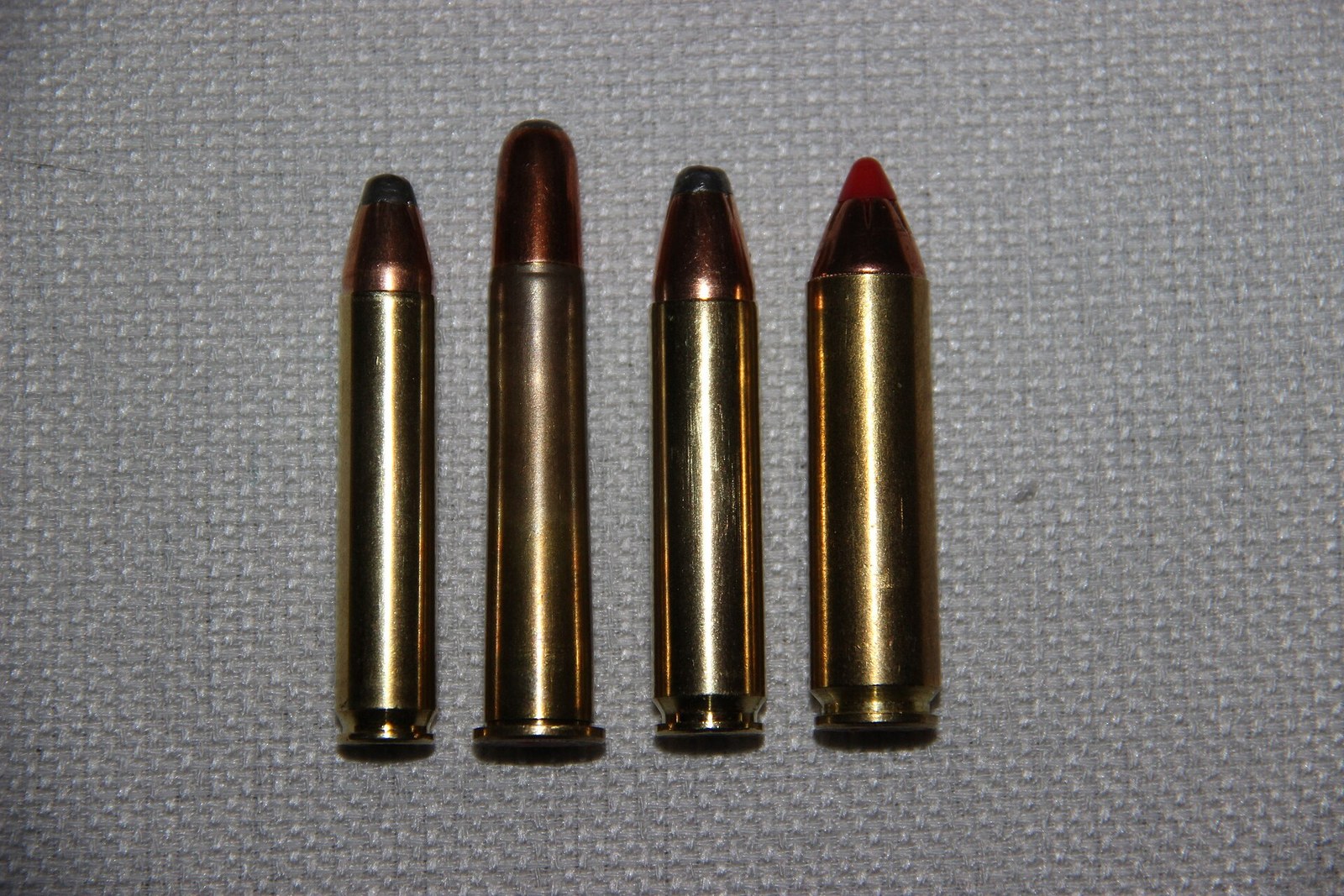
Table 7 — Telling it apart from its neighbours
| Feature | .350 Legend | .400 Legend | .450 Bushmaster | .45-70 Government | Where to look |
|---|---|---|---|---|---|
| Bullet diameter | .357 | .4005 | .4525 | .458 | the bullet, with calipers |
| Rim | .378, rebated slightly | .422 | .473 | .608, rimmed | the base, from the side |
| Head diameter at .200 | .3900 | .4400 | .5000 | .5055 Δ | calipers just above the groove |
| Case length | 1.710 | 1.650 | 1.700 | 2.105 | calipers |
| Max overall length | 2.260 | 2.260 | 2.260 | 2.550 | calipers |
| SAAMI test barrel | 16 in | 16 in | 24 in | 24 in | (the table, not the round) |
All dimensions from the SAAMI 2025 drawings for the .350 and .400 Legends and the .450, and from the 2015 drawing as reproduced in the .45-70 Government dive for the .45-70.1
Three quick tells:
- Same overall length, different heads. The two Legends and the .450 all share a 2.260-inch maximum overall length, set by the AR-15 magazine well. Laid on a table they look alike; stood on their heads, the .450’s half-inch base is obviously the fattest.
- The rim tells the bolt. The .450’s .473 rim takes a .308-family bolt face; the .350 Legend’s .378 rim is the 5.56 bolt face; the .400 Legend’s .422 is neither. A rifle that chambers one of these does not chamber another.
- The .458 SOCOM is the one that can actually fool a buyer, because it also uses a .473 rim and the same 2.260 overall length, and AR bolts are sold for both. It is a short bottleneck with a .458 bullet, where the .450 is straight with a .452. The SOCOM is not in the SAAMI standard, so its dimensions are its maker’s and are not tabulated here.
References
Footnotes
-
ANSI/SAAMI Z299.4-2025, approved 10 February 2025, file revised 27 April 2026 (saami.org), read from page images 19 October 2026: 450 Bushmaster cartridge and chamber drawing p.156; V&P test barrel p.369; velocity and pressure tables pp.26–28 (450 Bushmaster, 350 Legend, 360 Buckhammer, 400 Legend, 444 Marlin, 45-70 Government), with footnotes giving 16-inch test barrels for the 350 and 400 Legend and 20-inch for the 360 Buckhammer; 284 Winchester drawing p.94; 350 Legend p.134; 400 Legend p.146. URL: https://saami.org/wp-content/uploads/2026/04/SAAMI-Z299.4-CFR-2025-Centerfire-Rifle-Approved-2-10-2025-2026-04-27.pdf. ↩ ↩2 ↩3 ↩4 ↩5 ↩6 ↩7 ↩8 ↩9 ↩10
-
ANSI/SAAMI Z299.4-2015, project library, read from page images: 450 Bushmaster drawing p.147; test barrel p.343; velocity and pressure p.34; headspace gauges, Figure IV, p.220. Location: project Reference Library file Library/docs/references/ansi-saami-z299-4-2015-centerfire-rifle.pdf. ↩ ↩2 ↩3
-
Philip Massaro, “Behind the Bullet: .450 Bushmaster,” American Hunter, 16 November 2022, read 19 October 2026. URL: https://www.americanhunter.org/content/behind-the-bullet-450-bushmaster. ↩
Comments (0)