.450 Bushmaster · Volume 1
Origins: A Thumper Brief, a .284 Case Head, and a Name Nobody Registered
Where the .450 Bushmaster came from, what can be pinned to a dated document and what cannot, and why the company it is named after sells no rifle for it today
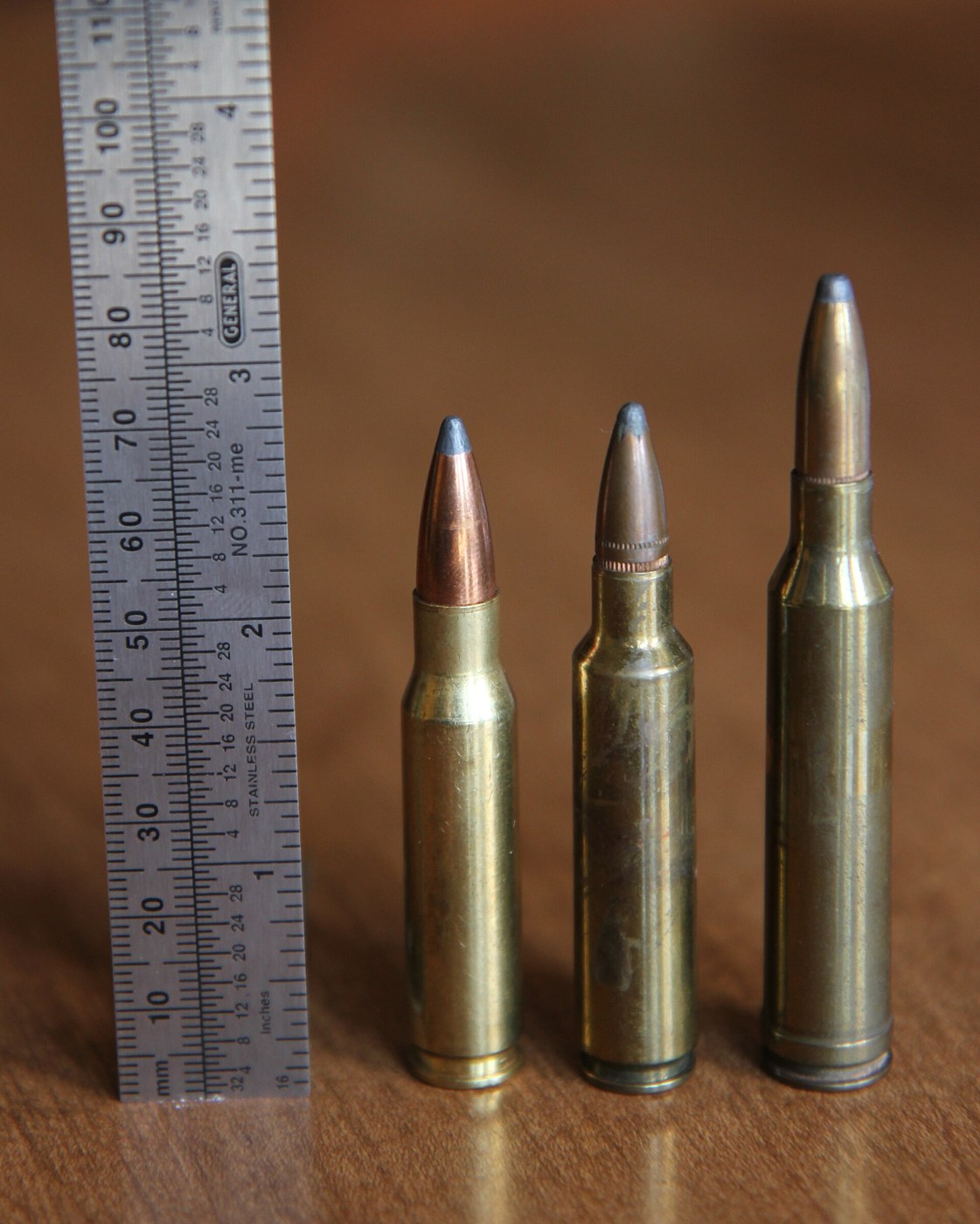
1.1 What this dive is for
The .450 Bushmaster is a straight-walled rifle cartridge that fires a .452-inch bullet of 245 to 395 grains from a 1.700-inch case. It fits an AR-15, it fits a short bolt action, and for twelve years it fitted one particular line in Michigan’s hunting regulations almost exactly. That last fact sold more rifles than anything ballistic about it, and on 12 September 2026 the line was erased.
This is the hub’s cartridge dive for it: one cartridge, every rifle. It takes over the cartridge material that the .450 Bushmaster AR-15 dive carried in its first three volumes, rechecked against primary sources in October 2026, and adds what that dive did not have: the current SAAMI standard (which changed in ways the older edition did not show), every factory load on its maker’s own page, the two expansion floors that a maker actually publishes, the twist rate the rifle makers actually use, and the law in all five states where straight-wall rules drove the cartridge’s adoption, read from each state’s own text.
Three other dives own adjacent ground, and this one links to them rather than repeating them:
- Handloading belongs to Loading the .450 Bushmaster, and the taper and carbide-die point to The Reloading Bench, Volume 12.
- Building and feeding an AR-15 in this calibre, the bolt, the gas system and the magazine, belongs to the AR-15 dive.
- Mouth headspacing as a general subject belongs to the Headspace dive.
1.2 The brief: Cooper’s Thumper
The lineage is usually traced to Jeff Cooper and what he called the “Thumper” concept. Philip Massaro’s 2022 history of the cartridge for the NRA’s American Hunter describes the .450 Bushmaster as “one of the cartridges derived from Col. Jeff Cooper’s ‘Thumper concept,’” in which Cooper wanted a cartridge for double duty, in a defensive rifle and a hunting gun, firing a heavier bullet of larger diameter to give one-shot kills on larger game.1
The common retelling adds specifics: a calibre of .44 or larger, a semi-automatic rifle, and a reach of about 250 yards. Those details circulate widely and appear in the AR-15 dive, but no writing of Cooper’s own was read for this dive, so the specification is given here as the tradition reports it rather than as his words. What is safe to say is the shape of the problem it set: a large, heavy, wide bullet, delivered by a rifle that loads itself. A big straight case is easy. Making one cycle through a magazine-fed autoloader built for something much slimmer is the hard part, and the rest of the cartridge’s design follows from that.
1.3 LeGendre and the .45 Professional
The cartridge was designed by Tim LeGendre of LeMag Firearms. Massaro’s account: the .450 Bushmaster “was developed in 2007 by Tim LeGendre of LeMag Firearms, who then licensed his brainchild to Bushmaster Firearms International, though the original incarnation of his cartridge was known as the .45 Professional.”1
The same article gives the parentage: “Based on the .284 Winchester—which was a rebated-rim design to begin with—shortened to 1.700 inches and using a small rifle primer rather than the .284’s large rifle primer.”1 Volume 2 tests that claim against the standards and finds it stronger than a reference article can make it: on SAAMI’s own drawings, the .450 Bushmaster’s case head is the .284 Winchester’s case head, dimension for dimension. What the .450 inherited from the .284 is not a vague family resemblance. It is the rim, the extractor groove and the head diameter, which is the part of a case a bolt has to fit.
One correction to the circulating story is worth making here. Massaro’s article also says the .473-inch rim “works perfectly in the AR-10 platform.”1 The .473 rim is the .308 family’s rim, so it suits an AR-10 bolt face, but the cartridge that went into production is the short one that fits the AR-15; an AR-15 needs its own bolt to take it. The sentence reads as a slip between the two platforms. It is a small thing, and it shows why a secondary history should be read for its leads, not quoted for its facts.
1.4 What the standards body recorded, and when
Where a date matters, the most reliable source for this cartridge is a dated engineering document rather than a magazine article.
The current Sporting Arms and Ammunition Manufacturers’ Institute standard for centerfire rifle ammunition, ANSI/SAAMI Z299.4-2025 (approved 10 February 2025; the copy read is the file revised 27 April 2026), carries two drawings for the cartridge:2
Table 1 — What the standards body recorded, and when
| Drawing | Issued | Last revised |
|---|---|---|
| Cartridge and chamber, “450 BUSHMASTER [450 BM]”, printed p.156 | 1 February 2008 | 23 August 2022 |
| Velocity and pressure test barrel, printed p.369 | 9 September 2007 | 2 August 2023 |
So the test barrel was drawn in September 2007 and the cartridge itself in February 2008. A standards body does not draw a test barrel for a cartridge nobody intends to make, which puts the cartridge’s standardisation in 2007 to 2008.
⚠ A dated correction to the AR-15 dive. That dive cites the 2015 edition of the same standard and gives the cartridge drawing as “issued 02/01/2008” and the test barrel as “revised 02/01/2008.” In the 2015 edition held in the project library, the cartridge drawing as printed carries no visible issue date at all, and the test barrel’s revision date is 02/01/2008. The issue date of 2008 is printed on the 2025 drawing, which also records that the drawing and the test barrel have both been revised since (in 2022 and 2023). The dates the AR-15 dive gives are right in substance; they come from two different editions.
1.5 The shortening story, and how far it can be trusted
The version of the history that most buyers meet runs like this: LeGendre’s .45 Professional was a longer cartridge, about 1.772 inches of case and 2.362 inches overall, suited to the AR-10; Bushmaster acquired it in 2007 and took it to Hornady; Hornady asked for the case and overall length to be cut so that it could load a .452-inch, 250-grain bullet it already made; the result was the 1.700-inch case and 2.260-inch overall length that SAAMI standardised.
That account is plausible, and the end of it is documented: 1.700 inches and 2.260 inches are exactly SAAMI’s case length and maximum overall length.2 But the middle of it is not. The AR-15 dive attributed the whole sequence, along with an AR-10 in .45 Professional delivered to Cooper, a 2006 sale of rights to Cerberus Capital Management, and a 2021 purchase by Franklin Armory, to “Wikipedia, citing Philip Massaro.” Massaro’s article, read on its own page in October 2026, contains none of those claims. It says 2007, LeGendre, LeMag, the .45 Professional, the licence to Bushmaster, the .284 parent and the small rifle primer, and nothing more about the sequence.1
So the honest position is:
- Documented: LeGendre designed it as the .45 Professional and licensed it to Bushmaster (Massaro); SAAMI drew the test barrel in 2007 and the cartridge in 2008 (the standard); the standardised case is 1.700 inches with a 2.260-inch maximum overall length (the standard).
- Plausible but not traced to a primary or attributable source here: the 1.772 / 2.362-inch original dimensions, the reason for the shortening (Hornady’s existing bullet), the AR-10 for Cooper, and the corporate transactions. Each may well be true. None should be repeated as fact on the strength of an encyclopaedia entry whose citation does not carry it.
The shortening story has one thing going for it that does not depend on anyone’s account. The bullet the cartridge standardised on is the .452-inch handgun bullet, the diameter of the .45 ACP, .45 Colt, .454 Casull and .460 S&W, and Hornady’s own 250-grain FTX for the cartridge is the same diameter.3 A cartridge whose case was designed around an existing bullet is exactly what the dimensions look like.
1.6 The name: a cartridge called after a rifle company
Cartridges named after companies are common (the .300 Savage, the .25 Remington, the .284 Winchester itself), but this one has an odd present tense, and three facts from primary sources say why.
The company sells no rifle for it. Bushmaster’s own site, read on 19 October 2026, has a calibre category “450BM” and a product line “450 Bushmaster Line 20in,” and both pages say: “There are no products listed under this category.”4 The ammunition is made by Hornady, Federal, Remington, Winchester and smaller loaders; the rifles by Ruger, Savage and others (Volume 8). Whatever the cartridge is called, nobody now depends on Bushmaster to feed one.
No trademark registration for “450 BUSHMASTER” was found. A search of the US Patent and Trademark Office’s trademark database for “450 BUSHMASTER” on 19 October 2026 returned the house marks but no registration of the cartridge name itself.5 The live registrations relevant to firearms are:
Table 2 — No trademark registration for "450 BUSHMASTER" was found. A search of the US Patent and Trademark Office's trademark database for "450 BUSHMASTER" on 19 October 2026 returned the house marks but no registration of the cartridge name itself.[^5] The live registrations relevant to firearms are
| Mark | Serial | Status | Goods | Owner as listed |
|---|---|---|---|---|
| BUSHMASTER | 73675765 | Live, registered | Mail and telephone order services, firearms field | Crotalus Holdings, Inc. (Nevada) |
| BUSHMASTER FIREARMS | 77099284 | Live, registered | Classes 9, 13, 16, 35 | Crotalus Holdings, Inc. (Nevada) |
| BUSHMASTER | 90650269 | Live, registered | Nine classes incl. 13 | Crotalus Holdings, Inc. (Nevada) |
| BUSHMASTER FIREARMS | 77105494 | Dead, abandoned | Class 13, “Ammunition” | Bushmaster Firearms International, LLC |
The last row is the curious one. An application to register BUSHMASTER FIREARMS for ammunition was filed in the same series of numbers as the 2007 applications and abandoned. The cartridge carries the name; the name was never registered for the thing the cartridge is.
⚠ Only the first page of 166 results was read, which is ranked by relevance and contained no “450 BUSHMASTER” mark; a registration lower in the list is unlikely but not excluded. Who stands behind Crotalus Holdings is not stated on the record and is not asserted here.
SAAMI lists it simply as “450 Bushmaster,” abbreviated “450 BM.”2 For a buyer, that is the name that matters: a box marked .450 Bushmaster made by anyone to the SAAMI standard is the cartridge, whoever owns what.
1.7 The family it belongs to
Cooper’s brief produced three widely made answers for the AR-15, and the .450 Bushmaster is the one that went mainstream. Two facts about the family are worth having before Volume 2:
- Every big-bore AR-15 cartridge rebates its rim, because the case body is too wide for any bolt face the rifle can carry. The .450 Bushmaster and the .458 SOCOM rebate to .473 inch (the .308 rim), which is why bolts are sold as “.450/.458”; the .50 Beowulf rebates to a different rim and needs a different bolt. The AR-15 dive’s Volume 6 compares the three as rifles.
- Of the three, only the .450 Bushmaster is in the SAAMI centerfire rifle standard. A check of the 2025 standard’s index finds no .458 SOCOM and no .50 Beowulf.2 Their figures come from their makers, not from a standards body, which is worth remembering when comparing published numbers.
The cartridge’s newer neighbours are not big-bore AR cartridges at all, but straight-walled deer cartridges written for the same state laws: Winchester’s .350 Legend (SAAMI drawing issued 21 January 2019) and .400 Legend (15 January 2023), and the rimmed .360 Buckhammer.2 Volume 2 sets them side by side, and Volume 7 explains why they exist.
1.8 The rifle documented in these volumes
This is a cartridge dive, so it is written in a reference voice. Where it touches a real rifle, it is mine: a home-built AR-15 in .450 Bushmaster on a Black Rain Ordnance lower, with a 16-inch Bear Creek Arsenal barrel, as recorded in my inventory in September 2026.6 The barrel’s 1:24 twist is the SAAMI reference twist (Volume 4), and its 16-inch length is shorter than every barrel any maker publishes .450 Bushmaster velocities from (Volume 4 again), which is why the velocity figures in these volumes are labelled as upper bounds for a rifle like it.
The rifle itself (bolt, gas, buffer, magazines, optic) is the AR-15 dive’s subject and is not repeated here.
1.9 How the volumes are arranged
Table 3 — How the volumes are arranged
| Vol | Subject |
|---|---|
| 1 | Origins (this volume) |
| 2 | The specification, read off SAAMI’s drawings, the .284 parent, and telling it apart from its neighbours |
| 3 | Every factory load, on its maker’s own page, dated |
| 4 | Inside the barrel: test barrels, barrel length, pressure, twist, and the subsonic loads |
| 5 | Downrange: trajectory, wind, and how far it actually reaches |
| 6 | On game: what the published record says about deer, hogs and bears |
| 7 | The straight-wall laws: Michigan’s rise and repeal, and Ohio, Indiana, Iowa and Illinois |
| 8 | Rifles, suppressors, availability and cost |
| 9 | Cheatsheet |
The volume to read first, for anyone who bought the cartridge for Michigan, is Volume 7. The volume with the most new information is Volume 3, because two makers turned out to publish numbers the cartridge’s literature says nobody publishes.
References
Footnotes
-
Philip Massaro, “Behind the Bullet: .450 Bushmaster,” American Hunter (National Rifle Association), posted 16 November 2022, americanhunter.org/content/behind-the-bullet-450-bushmaster, read 19 October 2026. URL: https://www.americanhunter.org/content/behind-the-bullet-450-bushmaster. ↩ ↩2 ↩3 ↩4 ↩5
-
ANSI/SAAMI Z299.4-2025, Voluntary Industry Performance Standards for Pressure and Velocity of Centerfire Rifle Sporting Ammunition, approved 10 February 2025; file revised 27 April 2026, saami.org, read from the page images 19 October 2026. 450 Bushmaster cartridge and chamber drawing p.156; V&P test barrel p.369; index pp.8, 12 and 17; 350 Legend p.134; 400 Legend p.146. Also ANSI/SAAMI Z299.4-2015, printed p.147 and p.343, in the project library. URLs: https://saami.org/wp-content/uploads/2026/04/SAAMI-Z299.4-CFR-2025-Centerfire-Rifle-Approved-2-10-2025-2026-04-27.pdf; project Reference Library file Library/docs/references/ansi-saami-z299-4-2015-centerfire-rifle.pdf. ↩ ↩2 ↩3 ↩4 ↩5
-
Hornady Manufacturing, product page “45 Cal .452 250 gr FTX® (450 Bushmaster)”, item 45201, hornady.com, read 19 October 2026. URL: https://www.hornady.com/bullets/rifle/45-cal-452-250-gr-ftx-450-bushmaster. ↩
-
Bushmaster Firearms, bushmaster.com, pages “Caliber - 450BM” (/shop/firearms/450/) and “450 Bushmaster Line 20in” (/shop/firearms/450-bushmaster-20/), read 19 October 2026. URLs: https://www.bushmaster.com/shop/firearms/450/; https://www.bushmaster.com/shop/firearms/450-bushmaster-20/. ↩
-
United States Patent and Trademark Office, Trademark Search (tmsearch.uspto.gov), query “450 BUSHMASTER,” first results page, 19 October 2026. URL: https://tmsearch.uspto.gov/search/search-results (search box query: 450 BUSHMASTER). ↩
-
Owner’s inventory, recorded in the hub’s sanitised inventory file from the owner’s spreadsheet, September 2026. ↩
Comments (0)