.450 Bushmaster · Volume 4
Inside the Barrel: Test Barrels, Barrel Length, Twist and the Subsonic Loads
Why no two published .450 velocities come from the same barrel, the only measured barrel-to-barrel figures that exist, the twist split between Savage and Ruger, and what a heavy subsonic bullet asks of a rifle
4.1 Every velocity comes from somewhere
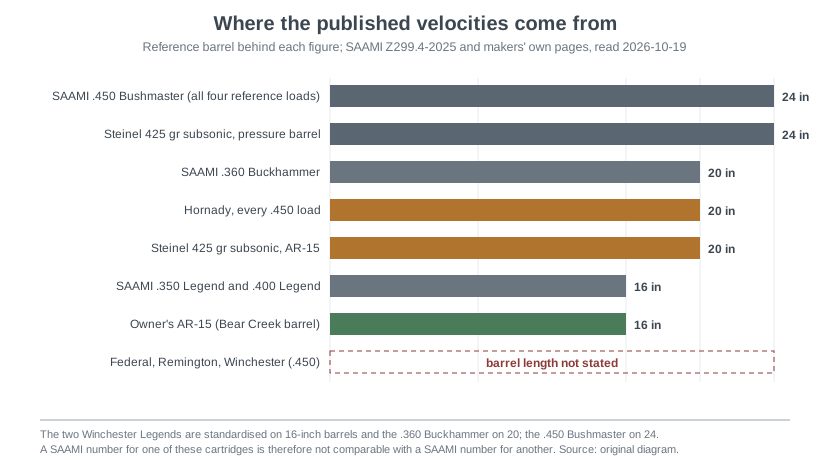
A muzzle velocity is a measurement from one barrel. For most cartridges the maker’s figure and the standard’s figure come from the same kind of barrel, so they can at least be compared with each other. For the .450 Bushmaster they come from at least three:
Table 1 — A muzzle velocity is a measurement from one barrel. For most cartridges the maker's figure and the standard's figure come from the same kind of barrel, so they can at least be compared with each other. For the .450 Bushmaster they come from at least three
| Source | Barrel | Stated where |
|---|---|---|
| SAAMI reference loads (250, 260, 300, 395 gr) | 24.000 ± .010 in, 1:24 | test barrel drawing, p.3691 |
| Hornady, all four loads | 20 in | ”Test Barrel (20”)” on each page2 |
| Federal, Remington | not stated | product pages34 |
| Winchester | no velocity published | product pages5 |
| Steinel 425 gr subsonic | 24 in pressure barrel; 20 in AR-15; 20 in Remington 700 | product page6 |
This is the AR-15 dive’s central correction, and it still stands. The current standard sharpens it in a way that dive could not see. SAAMI standardises the .350 Legend and .400 Legend on 16-inch test barrels and the .360 Buckhammer on a 20-inch barrel, by footnote to its velocity table, while the .450 Bushmaster stays on 24.1 So even SAAMI’s own reference velocities for the straight-walled deer cartridges are not like for like: the .450’s 2,250 fps for a 250-grain bullet is a figure from a barrel eight inches longer than the one behind the .400 Legend’s 2,230 fps for a 215-grain bullet. Anyone comparing the two on paper is comparing a laboratory barrel with a carbine barrel.
4.2 The only barrel-to-barrel measurements on record
No maker publishes a velocity-per-inch figure for supersonic .450 Bushmaster, and no controlled test was found. The AR-15 dive made the same search and published no number; this dive does the same for supersonic loads.
There is exactly one published set of figures that compares barrels with the same load, and it is for a subsonic load. Steinel’s 425-grain solid copper hollow point:6
Table 2 — The only barrel-to-barrel measurements on record
| Barrel | Velocity |
|---|---|
| 24 in pressure barrel | 1,080 fps |
| 20 in Remington 700 | 1,046 fps |
| 20 in AR-15 | 1,023 fps |
Two things can be read from those three lines, and they are different things.
- From 24 to 20 inches in a closed breech, the load lost 34 fps, about 8.5 fps an inch. That is a subsonic load with a small charge of fast powder that has finished burning early; it says little about a 2,200-fps load.
- Two 20-inch barrels differed by 23 fps, and the gas gun was the slower. The AR-15 bleeds gas through its port before the bullet leaves, and its chamber and throat are not the bolt gun’s. A barrel’s length is not the only thing that sets the velocity. A 20-inch AR is not a 20-inch bolt gun.
Steinel does not state how many rounds stand behind each figure or the temperature, so these are a maker’s spot figures, not a test. They are still the only measured barrel comparison anyone has published for this cartridge.
4.3 What a short barrel costs, shown as a sensitivity
Because the loss per inch is unknown, this dive shows what a given loss would do rather than guessing the loss. The figure below asks one question of each load whose maker publishes an expansion floor: how far does the bullet travel before it drops below that floor, if the rifle starts it slower than the maker’s figure?
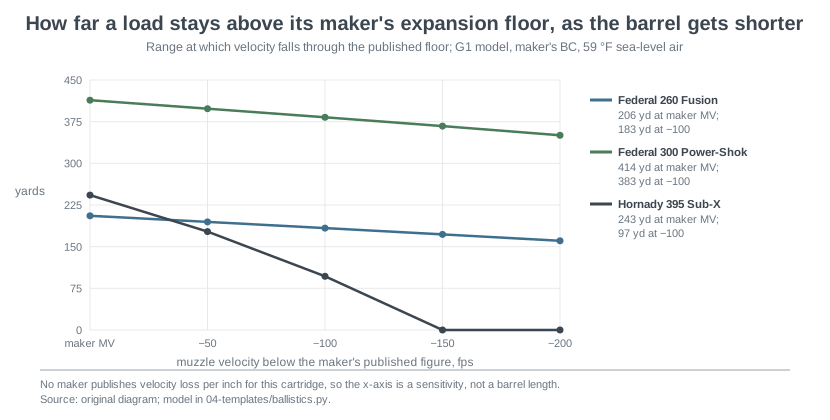
Table 3 — What a short barrel costs, shown as a sensitivity
| Muzzle velocity below the maker’s | Fusion (floor 1,400) | Power-Shok (floor 1,000) | Sub-X (floor 900) |
|---|---|---|---|
| 0 | 206 yd | 414 yd | 243 yd |
| −50 fps | 195 yd | 398 yd | 177 yd |
| −100 fps | 183 yd | 383 yd | 97 yd |
| −150 fps | 172 yd | 367 yd | at the muzzle |
| −200 fps | 161 yd | 350 yd | below the floor at the muzzle |
The supersonic loads are forgiving: 100 fps of lost velocity costs the Fusion about 23 yards of expansion range. The subsonic load is not. A Sub-X that leaves a short barrel 100 fps under Hornady’s 20-inch figure has used up most of its margin by 100 yards, and one that is 150 fps down is at its floor as it leaves the muzzle. For suppressed use, which is the reason to buy a subsonic, the barrel length decides the effective range, and Volume 5 returns to it.
4.4 Pressure
The maximum average pressure is 38,500 psi, measured by transducer only; there is no CUP figure (Volume 2).1 Barrel length does not change the chamber pressure a load generates, which peaks long before the bullet reaches the muzzle of any barrel. What a shorter barrel changes is how much pressure is left behind the bullet when it exits: more gas, more noise and more flash at the muzzle, and less of the powder’s work done on the bullet. No maker publishes muzzle pressure for a .450 load, so the size of that effect is not quantified here.
4.5 Twist: the standard, the market, and the arithmetic
The standard. SAAMI’s drawing gives a 1:24 right-hand twist and marks it OPTIONAL; its test barrel is 1:24.1
The market. The rifle makers’ own spec sheets, read on 19 October 2026, split cleanly by maker:78
Table 4 — Twist: the standard, the market, and the arithmetic
| Rifle | Barrel | Twist | Muzzle thread |
|---|---|---|---|
| Ruger American Gen II, 46905 | 20 in | 1:16 | 11/16-24 |
| Ruger American Ranch Gen II, 46922 | 16.10 in | 1:16 | 11/16-24 |
| Ruger Hawkeye Hunter, 57151 | 18 in | 1:16 | 11/16-24 |
| Ruger Hawkeye Standard, 47196 | 20 in | 1:16 | not listed |
| Savage 110 Trail Hunter Lite V2, 33012 | 20 in | 1:24 | 11/16x24 |
| Savage 110 Ridge Hunter, 32504 | 18 in | 1:24 | 11/16x24 |
| Savage 110 Scout V2, 32981 | 16.5 in | 1:24 | 11/16x24 |
| Savage 110 Haymaker, 57140 | 18 in | 1:24 | not listed |
⚠ The AR-15 dive says the industry “has converged on 1:24.” It has not. Savage, and the Bear Creek Arsenal barrel on my own AR-15, follow SAAMI’s 1:24; Ruger’s whole current .450 line is 1:16. For a supersonic hunting bullet the difference does not matter. For a heavy subsonic bullet it may be the whole question.
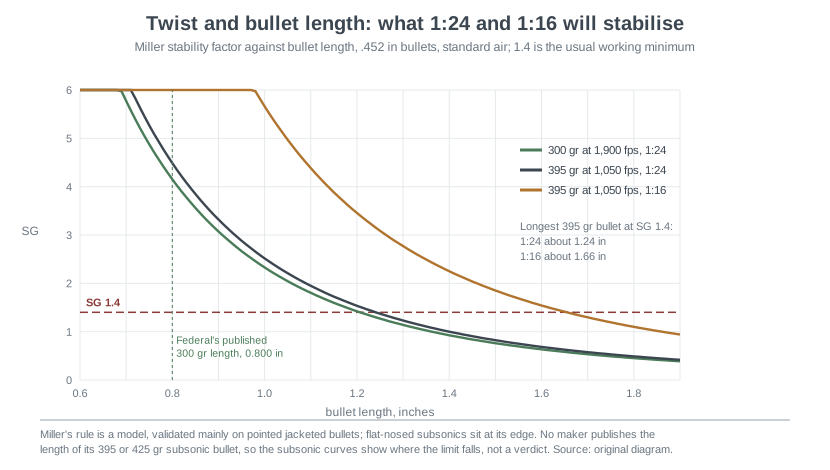
The arithmetic. How much spin a bullet needs depends mostly on its length in calibres, not its weight, and on how fast it is going. Miller’s twist rule turns that into a stability factor (SG), where about 1.4 is the usual working minimum. Federal publishes the length of two of its bullets, which makes the calculation possible for real factory bullets:3
Table 5 — Twist: the standard, the market, and the arithmetic
| Bullet | Length | Velocity | SG at 1:24 | SG at 1:16 |
|---|---|---|---|---|
| Federal Fusion 260 gr | 0.779 in | 2,200 fps | 4.0 | 9.1 |
| Federal Power-Shok 300 gr | 0.800 in | 1,900 fps | 4.2 | 9.3 |
Both are comfortably stable in a 1:24 barrel, with a factor of about three to spare. That is why SAAMI’s 1:24 is right for the cartridge as it was designed: a short, fat, supersonic bullet needs very little spin.
4.6 The heavy subsonic bullets
The question changes at 1,050 fps with nearly 400 grains. Two maker statements and one standard bear on it:
- SAAMI 2025 lists a 395-grain reference load at 1,050 fps and keeps the 1:24 test barrel.1 But a velocity and pressure standard measures speed and pressure. It does not test accuracy or stability, so its 395-grain row is not evidence that 1:24 stabilises the bullet.
- Hornady’s 395-grain Sub-X pages give no twist recommendation (the recommended-twist field is blank, ”-”, on both the cartridge and the bullet page).2
- Steinel says its 425-grain bullet “will not stabilize with 1:24 twist rates and 1:16 is optimal.”6
Neither maker publishes its bullet’s length, so the stability factor cannot be calculated for either. What the arithmetic can do is say where the line falls. At 1,050 fps, a 395-grain .452 bullet is stable at 1:24 (SG 1.4) up to about 1.24 inches long, and at 1:16 up to about 1.66 inches. For 425 grains at 1,023 fps the limits are about 1.27 and 1.69 inches.
A rough geometric argument then makes Steinel’s statement plausible, and this dive labels it as an inference, not a finding. A plain .452 cylinder of 425 grains of copper is already about 1.18 inches long before it has a nose or a hollow point, because copper is about 20 per cent less dense than lead; a monolithic copper bullet of that weight with a usable nose is plausibly past the 1:24 limit. A lead-core bullet of 395 grains is a cylinder of about 0.9 inch, and has more room. On that reasoning the Steinel copper bullet needs a fast twist and the Hornady lead-core bullet may not, which is consistent with both makers’ pages. Two caveats keep it an argument: Miller’s rule was built on pointed jacketed bullets, and flat-nosed subsonics sit at the edge of what it was validated for; and nobody has published a measured length for either bullet.
For anyone choosing a rifle for subsonic use, the practical reading is simple. A 1:16 barrel stabilises every .450 bullet in production. A 1:24 barrel stabilises the supersonic ones easily, may well stabilise the lead-core 395, and should be tested on paper before a monolithic subsonic is taken hunting. The Loading the .450 Bushmaster dive raised the same question about subsonic handloads and left it open; this volume narrows it but cannot close it without a measured bullet length or a target.
4.7 Subsonic, and how cold
A subsonic load is only quiet behind a suppressor if it stays below the speed of sound, and the speed of sound falls in cold air. In dry air it is about:
Table 6 — A subsonic load is only quiet behind a suppressor if it stays below the speed of sound, and the speed of sound falls in cold air. In dry air it is about
| Air temperature | Speed of sound |
|---|---|
| 80 °F | 1,139 fps |
| 59 °F | 1,116 fps |
| 32 °F | 1,087 fps |
| 10 °F | 1,062 fps |
| 0 °F | 1,051 fps |
| −10 °F | 1,039 fps |
Hornady’s Sub-X is published at 1,050 fps from 20 inches, so it stays subsonic down to about 0 °F and goes slightly supersonic below that. Steinel’s 425-grain load is 1,080 fps from a 24-inch pressure barrel, which would be supersonic below about 25 °F, but the same load measured 1,023 fps from a 20-inch AR-15, subsonic to about −25 °F. A shorter barrel is slower, so in this one respect it helps: a 16-inch rifle will very likely keep both loads subsonic through any Michigan November.
The .45-70 Government dive found exactly this for Hornady’s .45-70 Sub-X, which is published at 1,075 fps and is supersonic in the cold from a long barrel and subsonic from a carbine. The same logic holds here, with less margin to give away: the short barrel that keeps the .450 Sub-X quiet in the cold is also the barrel that brings it nearer its 900-fps expansion floor (previous section). Quiet and expanding pull in opposite directions as the barrel gets shorter, and the right barrel is the one that keeps the load just under the speed of sound on the coldest day it will be used, and no slower.
4.8 What a 16-inch 1:24 rifle can and cannot be expected to do
My own .450 is a 16-inch, 1:24 AR-15. From the published record, and labelled by how firm each point is:
- Every supersonic factory load will be stable in it (calculated, from Federal’s published bullet lengths; very firm).
- Every published velocity overstates it, because every published velocity comes from a longer barrel or an unstated one (firm), by an amount nobody has measured (open).
- Supersonic expansion range will be shorter than the published tables imply, but not by much: of the order of 20 yards per 100 fps lost, for the Fusion (modelled).
- The Sub-X will probably stay subsonic in the cold and will have a short expansion range, conceivably under 100 yards if the barrel is 100 fps slow (modelled; the velocity is the unknown).
- A monolithic 425-grain subsonic may not stabilise in it (maker’s statement; plausible by arithmetic; untested here).
References
Footnotes
-
ANSI/SAAMI Z299.4-2025, approved 10 February 2025, file revised 27 April 2026 (saami.org), read from page images 19 October 2026: 450 Bushmaster cartridge drawing p.156; V&P test barrel p.369 (issued 09/09/2007, revised 08/02/2023); velocity and pressure tables pp.26–28 with test-barrel footnotes. URL: https://saami.org/wp-content/uploads/2026/04/SAAMI-Z299.4-CFR-2025-Centerfire-Rifle-Approved-2-10-2025-2026-04-27.pdf. ↩ ↩2 ↩3 ↩4 ↩5
-
Hornady Manufacturing, hornady.com product pages for items 82246, 82244, 82242 and 82247, and bullet page item 45031 (45 cal .452 395 gr Sub-X), read 19 October 2026. URLs: https://www.hornady.com/ammunition/rifle/450-bushmaster-250-gr-ftx-black; https://www.hornady.com/ammunition/rifle/450-bushmaster-250-gr-ftx-tipped; https://www.hornady.com/ammunition/rifle/450-bushmaster-245-gr-interlock-american-whitetail; https://www.hornady.com/ammunition/rifle/450-bushmaster-tbd-gr-sub-x; https://www.hornady.com/bullets/rifle/45-cal-.452-395-gr-sub-x. ↩ ↩2
-
Federal Ammunition, federalpremium.com product pages F450BMFS1, 450BMB and AE450BM, read 19 October 2026. URLs: https://www.federalpremium.com/rifle/fusion/11-F450BMFS1.html; https://www.federalpremium.com/rifle/power-shok/11-450BMB.html; https://www.federalpremium.com/rifle/american-eagle/american-eagle-rifle/11-AE450BM.html. ↩ ↩2
-
Remington Ammunition, remington.com product pages 27943, 27941 and 23661, read 19 October 2026. URLs: https://www.remington.com/rifle/premier-accutip/29-27943.html; https://www.remington.com/rifle/core-lokt/29-27941.html; https://www.remington.com/rifle/umc-rifle/29-23661.html. ↩
-
Winchester Ammunition, winchester.com product pages X450DS and X4501, read 19 October 2026. URLs: https://winchester.com/Products/Ammunition/Rifle/Deer-Season-XP/X450DS; https://winchester.com/Products/Ammunition/Rifle/Power-Point/X4501. ↩
-
Steinel Ammunition, steinelammo.com, product page “425gr Solid Copper HP Subsonic 450 Bushmaster Ammo,” read 19 October 2026. URL: https://steinelammo.com/all-available-calibers/rifle-ammo/450-bushmaster/450-bushmaster-425gr-subsonic-solid-copper-hollow-point-schp/. ↩ ↩2 ↩3
-
Sturm, Ruger & Co., ruger.com spec sheets for models 46905, 46922, 57151 and 47196, read 19 October 2026. URLs: https://www.ruger.com/products/americanRifleGenII/specSheets/46905.html; https://www.ruger.com/products/americanRifleRanchGenII/specSheets/46922.html; https://www.ruger.com/products/HawkeyeHunter/specSheets/57151.html; https://www.ruger.com/products/HawkeyeStandard/specSheets/47196.html. ↩
-
Savage Arms, savagearms.com SKU pages 33012, 32504, 32981 and 57140, read 19 October 2026. URLs: https://savagearms.com/firearms/sku/33012; https://savagearms.com/firearms/sku/32504; https://savagearms.com/firearms/sku/32981; https://savagearms.com/firearms/sku/57140. ↩
Comments (0)