DIY Airsoft Gatling / Minigun · Volume 5
Sourcing & Decision Guide
5.1 Buy vs. Build — the Honest Framing
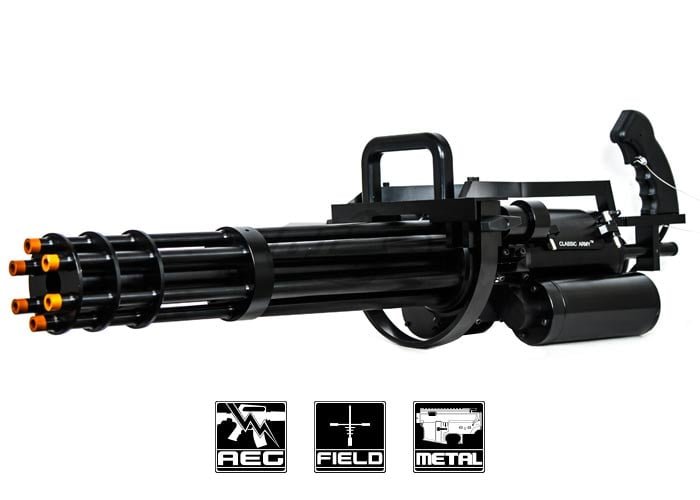
This volume exists to keep you from spending money in the wrong direction. The single decision that governs everything else is whether you want a minigun or a minigun project, because those are two completely different purchases.
If what you want is the look — the six-barrel silhouette, the spin-up whine, a wall of BBs at a party or a milsim photo op — then buy a commercial gun and stop reading the build volumes. A battery-only single-core minigun gives you the entire visual payload for the price of a mid-tier AEG, arrives chronoed and field-ready, and never asks you to certify a pressure vessel. Nothing you fabricate at Tier 1 will look meaningfully better than a Classic Army M133 Mini on the field, and the M133 costs less than the HPA engine alone.
You should build only if the build is the point: you want to understand the Classic Army architecture from the inside, tune the air system yourself, own a one-of-a-kind piece, and you have the lab to execute it (CNC, printers, laser — exactly the capability this hub is written for). The Tier-1 HPA-core build is genuinely reproducible and genuinely satisfying, but it is a fabrication and integration exercise first and a gun second. Go in knowing that. For the full design, see Volume 4; for the propulsion tiers it sits inside, Volume 1.
A blunt rule of thumb: buying wins on cost, time, and reliability; building wins on understanding, customization, and the Tier-2 mechanisms that no one sells.
5.2 The Commercial Buy Alternatives
If you land on “buy,” here is the current 6mm field. Prices are typical/approx and drift constantly — verify at the cart.
Table 1 — The Commercial Buy Alternatives
| Gun | Propulsion | Barrels | FPS (0.20g) | ~Price | Best for |
|---|---|---|---|---|---|
| WELL PRO Micro M134 | Electric AEG | 5, single-core | ~299–312 | ~$510 | Cheapest entry; light (~3.5 kg); the budget look |
| Classic Army M133 Mini | Battery only (2× 11.1V) | 4–6, single-core | ~330–350 | ~$585–650 | Best value 6mm minigun; no air rig needed |
| Classic Army M132 Micro | Green gas/HPA + electric spin | 4 | ~400–450 | ~$800 | Hybrid feel without flagship cost |
| Classic Army M134-A2 | Electric spin + HPA/CO₂ | 6, true multi-barrel | ~350–600 | ~$2,100–3,500 | The real thing — licensed Piper’s Delrin hub, fires through each rotating barrel |
The takeaway: the M133 Mini is the value anchor — it delivers the full single-core minigun look for less than most people spend building one. The M134-A2 is the only off-the-shelf gun that actually fires through rotating barrels (it licenses the Piper’s Precision hub), and you pay flagship money for that authenticity. Everything in between trades cost for a step up in FPS and a whiff of HPA.
Brand confusion to avoid before you spend:
- Tippmann “Gatling guns” are real firearms (Tippmann Ordnance), not airsoft. Do not search-and-buy on that name.
- Krytac makes no minigun. If a listing says otherwise, it is mislabeled.
- No off-the-shelf commercial minigun runs on a drop-in Polarstar or Wolverine engine. Those engines are DIY territory — the commercial HPA guns use proprietary firing systems. If a vendor claims a “Polarstar minigun,” it is a custom build, not a catalog product.
5.3 Parts Sourcing for the Tier-1 Build
For the buildable HPA-core minigun, sourcing splits cleanly into what you must buy (anything that holds or meters high pressure — never improvise these) and what the lab makes (structure and brackets). Engine/regulator/tank pricing dominates the budget; the fabricated parts cost mostly your time.
Table 2 — Parts Sourcing for the Tier-1 Build
| Subsystem | What to get | Buy or make | Notes |
|---|---|---|---|
| HPA engine / FCU | Polarstar Fusion or MSR, Wolverine Storm/Hydra, or Redline FSR | Buy | The heart of the gun. FCU sets dwell (pulse → FPS) + ROF. Working psi: MSR ~145, Storm ~200, Redline 145 (200 upgradeable) |
| Regulation | Two-stage: tank reg (~800 psi) + airsoft reg to working range | Buy | Mandatory two-stage. Raw tank pressure to a core is dangerous — see Volume 3 |
| Air tank | Certified, in-hydro 3,000 or 4,500 psi paintball tank + ASA | Buy | Never a homemade vessel. Capacity vs. burn rate is a real tradeoff at minigun ROF |
| Motor + ESC | Brushless motor + ESC sized for cluster spin/feed staging | Buy | Cosmetic spin + feed timing, not BB propulsion. Reference: 12V ~23k RPM class |
| Barrels + hop-up | Tokyo Marui-spec inner barrels + hop-up unit | Buy | TM spec keeps the hop-up that defines airsoft range |
| Bearings | Front + rear cluster bearings | Buy | Off-the-shelf; size to the hub shaft |
| Hopper + feed | Gravity hopper, feed tube, anti-double-feed detent | Buy/make | Hopper bought; feed geometry tuned in-lab |
| Battery + wiring | LiPo, Deans/XT, switch, fusing | Buy | Powers motor + FCU electronics |
| Structure | Delrin hub, tube shroud, sheet, brackets, mounts | Make | CNC/laser/3D-print — the lab’s home turf |
The honest split: the HPA engine, both regulator stages, and the tank are non-negotiable purchases and they set the floor on cost. Everything that gives the gun its shape — the hub, the barrel shroud, the mounts — is exactly what a well-equipped shop exists to produce.
5.4 Cost Tiers
Rough budgets for bought parts only — lab time and consumables are on top. Prices approx.
Table 3 — Cost Tiers
| Tier | What it is | Bought-parts cost | Where the money goes |
|---|---|---|---|
| Tier 0 | Cloud/vortex BBMG in a spinning shroud | ~$50–150 | Blower/air source, tube, BBs. Spectacle on a shoestring |
| Tier 1 | HPA single core + electric cosmetic spin | ~$400–800 | HPA engine + tank + two-stage reg dominate; structure is lab-made |
| Tier 2 | True rotary-distributor Gatling | Open-ended R&D | Custom machining, iteration, prototyping — a research project, not a parts list |
Note that a Tier-1 build’s bought-parts cost lands right on top of, or above, the price of a commercial M133 Mini. That is the whole buy-vs-build tension in one line: you are not saving money by building Tier 1, you are buying the experience and the customization.
5.5 Which Tier Suits Which Builder
Table 4 — Which Tier Suits Which Builder
| Your goal | Recommended path |
|---|---|
| The look, on a budget, today | Buy — WELL PRO Micro or CA M133 Mini (Tier 0 DIY if you’d rather tinker cheap) |
| Want to build and tune your own air system | Tier 1 build — the HPA core is the reward |
| Want the authentic per-barrel firing mechanism | Buy the CA M134-A2 (licensed hub) — or attempt Tier 2 if the R&D is the goal |
| Spectacle / party gun, max ROF, FPS irrelevant | Tier 0 cloud BBMG — cheapest, simplest, gluttonous, fun |
Most builders reading this hub belong in one of two boxes: buy the M133 if you want a minigun, or build Tier 1 if you want to build one. Tier 2 is for the person who reads the paintball patent (US 8,136,515) and thinks “that could be done” — and has the bench time to find out.
5.6 Pitfalls Checklist
Run this list before you commit money or call a build done:
- Cosmetic spin adds zero ballistic value. Barrels spinning in front of a single core just give most BBs a wall to hit unless the air pulse is timed to barrel position. Do not pay extra expecting spin to improve accuracy.
- Flywheels fight physics with 6mm. Smooth, hard BBs slip on the wheels, a symmetric pair imparts no useful hop-up backspin, and BBs abrade the wheels fast. Viable-but-compromised at best.
- Never improvise a pressure vessel. Certified, in-hydro paintball tanks only; rated regs and hose; two-stage regulation always. PVC and soda bottles at true high pressure are how people get hurt — Volume 3.
- Under-velocity double-feeds are the classic single-HPA-core failure mode. Tune dwell and the feed detent so the chamber seals one BB per pulse.
- Capacity is a trap, not a feature. A 2,000+ round hopper burns out in under a minute at minigun ROF. Plan air and BB resupply, not bragging-rights numbers.
- Joule creep is real on HPA/CO₂. Heavier BBs leave the muzzle hotter than the 0.20g chrono reading — serious fields chrono with your actual BB weight.
- Field-legality is mandatory, not optional. Detune to ~350–400 FPS, keep the blaze-orange tip (15 U.S.C. § 5001), and expect support-weapon MED rules. A 500–600 FPS, 3,000-RPM gun is field-illegal almost everywhere without detuning. Full law-and-safety treatment is in Volume 3.
Now go decide: a minigun, or a minigun project. The rest follows from that one honest answer.
Comments (0)