DIY Airsoft Gatling / Minigun · Volume 1
Overview & Why Build One
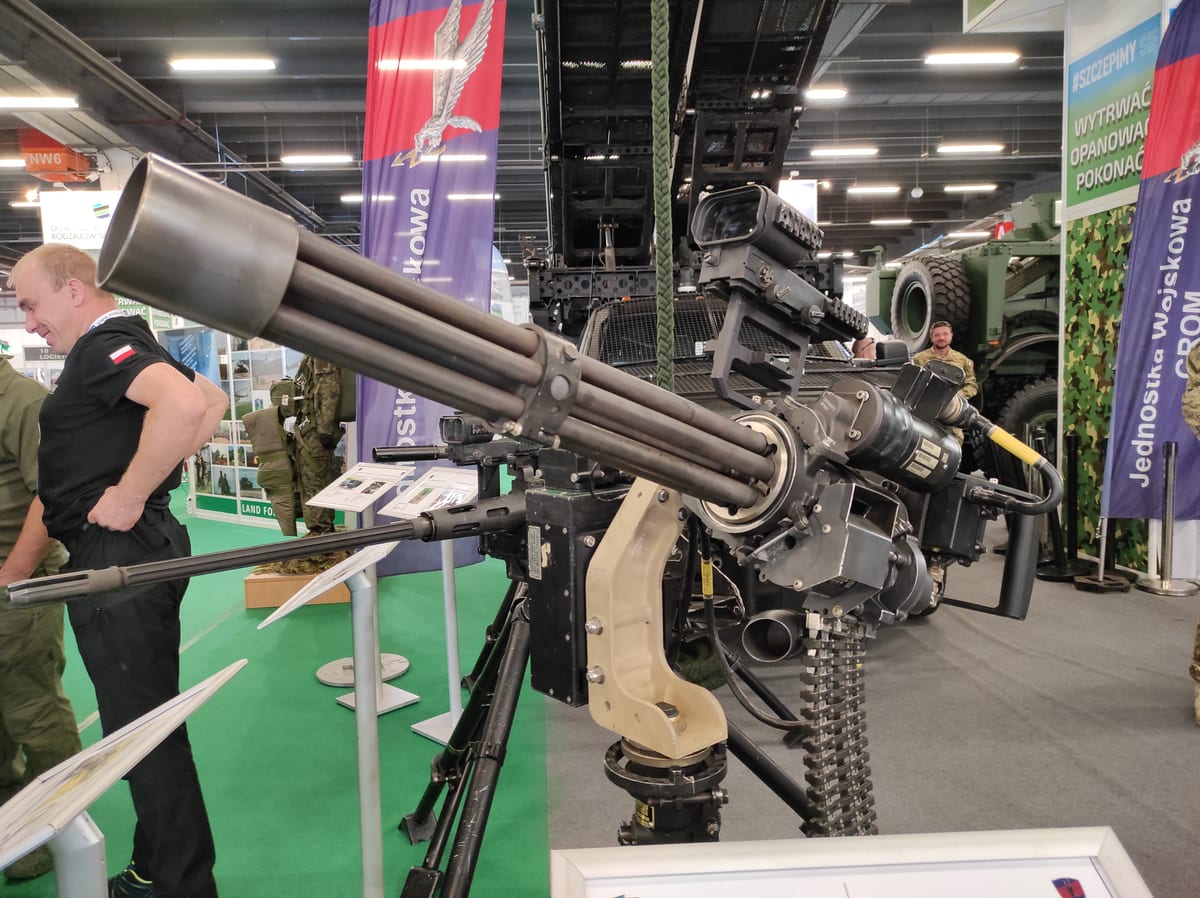
A minigun is the single most theatrical thing a person can carry onto an airsoft field, and it is also one of the most misunderstood. The look — six barrels in a spinning cluster, a brass cascade of BBs, a motorized whine spooling up before a wall of fire — promises a machine of staggering mechanical sophistication. The reality, in almost every airsoft “minigun” you can buy or build, is far simpler and a little disappointing once you know where to look. This series is about closing that gap: understanding what the real machine does, what the commercial replicas actually do, and how a well-equipped home lab can build one that genuinely earns the name. This first volume sets the stage — the engineering behind the original, the commercial landscape, the central problem that makes a true DIY Gatling so rare, and the tiered build recommendation that is the spine of the whole deep dive.
1.1 What a Gatling Gun Actually Is
The Gatling gun is one of the cleverest mechanical solutions in the history of firearms, and the cleverness has nothing to do with firing fast for its own sake. The problem Richard Gatling set out to solve in 1862 was heat. A single barrel firing continuously melts itself; the chamber fouls, the metal softens, accuracy collapses. His answer was to spread the work across a rotating cluster of barrels — usually six — where each barrel is a complete, independent single-shot action with its own bolt and lock.
The mechanism that drives them is the part worth understanding. A stationary cam surrounds the rotating cluster, and as each barrel travels its circular path the cam drives that barrel’s bolt through the full cycle: load → compression → lock and fire → unlock → eject, then back to load. Because the cam is fixed and the barrels move past it, every barrel sits at a different stage of the cycle at any given instant — one is chambering while another fires while a third ejects. Each barrel therefore fires exactly once per revolution, at the same fixed angular position every time (around the four-o’clock point on the original). This is the “rotary distributor” timing concept in its purest mechanical form, and it is the heart of why the design works: the aggregate rate of fire is high, but no single barrel fires more than a fraction of that rate, so the heat — and the wear — is spread six ways.
The original 1862 gun was hand-cranked: a pinion meshed a ring gear on the main shaft, and a strong operator could turn out roughly ~200 rpm typical/approx. The modern descendant, the M134 Minigun, replaces the crank with an electric motor and chambers 7.62×51 mm across its six barrels at 2,000–6,000 rpm (usually run around 3,000–4,000). The principle is unchanged across 160 years — only the prime mover and the materials have moved on.
1.2 The Airsoft Commercial Landscape
Airsoft miniguns split cleanly into two engineering philosophies, and the price tells you which one you’re holding before you even read the spec sheet.
At the bottom sit the battery-only single-core guns. Here a single AEG gearbox does all the actual shooting, firing BBs straight out through one fixed path, while the six-barrel cluster spins purely for show, driven by a separate motor. Nothing fires through the rotating barrels — the spin is cosmetic. The Classic Army M133 Mini ($585) and the WELL PRO Micro M134 ($510) are the archetypes: light, self-contained, no air rig required, and capped around 300–350 FPS. They put the minigun look under ~$650, and for many buyers that is exactly the point.
At the top sit the electric-spin + HPA/CO₂ hybrids. These are heavy, expensive, and — on the very best examples — genuinely fire through the rotating barrels. The Classic Army M134-A2 ($2,100–3,500, ~11.6 kg) anchors this tier, tunable across 500–600 FPS by adjusting nozzle and pressure. The engineering crown belongs to Piper’s Precision, the only maker to have patented a Delrin hub design in which each rotating barrel carries its own bolt and fires at a fixed position in the rotation — a true multi-barrel gun in the Gatling sense. Classic Army licensed that design for the M134-A2 flagship. Everyone else, at every price point, fakes the multi-barrel firing one way or another.
Table 1 — The Airsoft Commercial Landscape
| Class | Example | Propulsion | Multi-barrel firing? | FPS | ~Price |
|---|---|---|---|---|---|
| Battery-only single-core | CA M133 Mini | AEG gearbox | No — cosmetic spin | 330–350 | $585 |
| Battery-only single-core | WELL PRO Micro | AEG gearbox | No — cosmetic spin | 299–312 | ~$510 |
| Electric-spin + HPA hybrid | CA M134-A2 | Electric spin + HPA/CO₂ | Yes (Piper’s licensed hub) | 350–600 | $2,100–3,500 |
| Electric-spin + HPA hybrid | Piper’s / X-Caliber M134A2 | Electric spin + HPA/CO₂ | Yes (patented Delrin hub) | 280–600 | $3,500 |
A note on brand confusion, because it derails research fast: Tippmann “Gatling guns” are real firearms (Tippmann Ordnance), not airsoft; Krytac makes no minigun at all; and no off-the-shelf commercial minigun runs on a drop-in Polarstar or Wolverine engine — those are DIY territory, and the commercial HPA guns use proprietary firing systems.
1.3 The Central DIY Challenge
Here is the honest finding that shapes everything downstream: almost nobody has built a true per-barrel-firing electric Gatling at home. Across every serious DIY thread the same two walls appear, and they gate the whole problem.
Timing. A simple air-cloud core fires BBs at random moments. Put six spinning barrels in front of it and most BBs simply slam into a barrel wall and scatter — the spin adds nothing ballistically. To gain anything from rotation, the firing pulse must be timed to barrel position, which means a cam or a rotary valve synchronized to the cluster. That is a hard mechanical problem.
Feeding rotating barrels. Gravity can’t keep up with a spinning cluster, and BBs jam in moving breeches. The real solutions — per-barrel detents, centrifugal hoppers, individual magazines — are serious machining projects.
Because both walls are steep, working homemade “miniguns” almost always collapse into one of two honest shortcuts: a cloud/vortex BBMG (compressed air or a blower agitates a tub of loose BBs out one barrel — enormous rate of fire, low FPS, no hop-up, no accuracy) hidden inside a cosmetically spinning shroud, or a single regulated HPA core dressed up to look like a minigun. The authentic rotary air-distributor principle — where a fixed port pressurizes whichever barrel is aligned, so rotation itself is the valve — is real and proven, but only in patents and in paintball (notably US 8,136,515), not in DIY airsoft. Volume 2 dissects all of this in depth.
1.4 The Tiered Recommendation
Rather than chase a single answer, this deep dive recommends a tiered approach, because the right build depends on how much difficulty a builder wants to take on.
Tier 1 — the buildable minigun (recommended). An electric motor spins a six-barrel cluster cosmetically (and stages the feed), while a single regulated HPA core does the actual firing, triggered by an airsoft FCU and solenoid poppet, gravity-hopper fed, tuned to ~350 FPS. This is the Classic Army architecture, and it is fully reproducible in a home lab from off-the-shelf HPA parts plus fabricated structure. It is reliable, tunable, and field-legal. This is where the build volume lives.
Tier 2 — the true Gatling (stretch). An authentic rotary air-distributor — a fixed port that pressurizes the aligned barrel so the rotation is the timing mechanism — paired with per-barrel feed, scaled from the paintball patent US 8,136,515. This solves both hard problems honestly, but it is genuinely difficult and proven only in patents and paintball hardware. Documented as a stretch path, not a weekend project.
Tier 0 — budget spectacle. An electric-blower cloud BBMG in a spinning shroud: the cheapest and simplest path, very high rate of fire, low FPS, a pure party gun.
Table 2 — The Tiered Recommendation
| Tier | Architecture | Difficulty | FPS | Real firing through barrels? |
|---|---|---|---|---|
| Tier 1 (recommended) | Electric cosmetic spin + single HPA core (FCU/poppet) | Moderate | ~350 | No — single core, but field-grade performance |
| Tier 2 (stretch) | Rotary air-distributor + per-barrel feed | Hard | Tunable | Yes — true Gatling |
| Tier 0 (budget) | Electric-blower cloud BBMG in spinning shroud | Easy | ~150–250 | No — spray only |
1.5 Who This Is For
This series is written for a builder with a real shop, because Tier 1 is genuinely achievable with one. A shop with a CNC mill and router, multiple 3D printers, a 100 W laser cutter/engraver, and a full bench of gunsmithing tools has precisely the kit the Tier-1 build assumes. The barrel cluster, the hub, the receiver structure, and the mounts can be machined or printed; the HPA core and FCU are off-the-shelf; the integration is exactly the kind of fitting-and-tuning work the bench is set up for. The Tier-2 rotary distributor is within the same shop’s reach as a stretch goal. This is not a deep dive aimed at the average hobbyist assembling a kit — it assumes a maker who can hold a tolerance and tune a regulator.
1.6 What the Rest of This Series Covers
Volume 2 is the mechanism and the propulsion menu — the real Gatling cam and rotary-distributor principle, then HPA versus electric-AEG versus cloud versus flywheel versus hand-crank, with a comparison table and a full treatment of the two hard problems. Volume 3 covers performance, power, and the law — rate-of-fire math, FPS and joules, field rules (MED, support-weapon restrictions, joule creep), HPA pressures and safety, and the 15 U.S.C. § 5001 orange-tip framing. Volume 4 is the full build — the Tier-1 design end to end (architecture, BOM, barrel cluster and CAD, motor and ESC, HPA core and FCU, feeding, wiring, assembly, tuning) plus the Tier-2 true-rotary stretch path. Volume 5 is sourcing and the decision guide — buy versus build, parts sourcing, cost tiers, which tier suits which builder, and a pitfalls checklist. Where a figure is derived or variant-dependent rather than vendor-stated, it is labeled typical/approx in the text.
Comments (0)