DIY Airsoft Gatling / Minigun · Volume 2
The Mechanism & the Propulsion Menu
2.1 The Real Gatling Principle
Before any airsoft adaptation makes sense, the original mechanism has to be understood on its own terms, because the whole DIY problem is a question of how faithfully you reproduce it. A Gatling is not “one gun that spins”; it is a cluster of barrels — usually six — each of which is a complete single-shot action in its own right. Every barrel carries its own bolt and lock. The barrels are mounted on a common shaft and rotate as a group, and a stationary cam (a fixed helical track the bolts ride against) drives each lock through a fixed sequence of events as that barrel travels around the circle: load → compression → lock and fire (around the 4 o’clock position) → unlock → eject (at the bottom). Because the cam is fixed and the barrels move past it, every barrel is at a different stage of that cycle at any given instant — one is loading while another is firing while a third is ejecting. This is the “rotary distributor” timing concept: position around the circle is the timing signal.
Two consequences fall straight out of this geometry. First, each barrel fires exactly once per revolution, so each barrel works at roughly one-sixth of the gun’s aggregate rate — that is what lets the real M134 sustain 3,000–4,000 rpm without melting a single barrel, because heat is spread across six. Second, the rate of fire is purely a function of how fast the cluster turns: ROF (rpm) = barrels × cluster revolutions per minute. A six-barrel gun at 3,000 rpm is just a cluster turning 500 rev/min (about 8.3 rev/s). The full arithmetic — and what that means for BB consumption and tank duration — is worked in Volume 3. The takeaway for this volume is the engineering moral: a true Gatling solves firing-timing mechanically, through geometry, not electronically. Hold that thought, because it is exactly what most DIY airsoft “miniguns” quietly fail to do.
2.2 The Rotary Air-Distributor
The pneumatic analog of the cam is the rotary air-distributor, and it is the single most important mechanism in this entire deep dive. The idea: a fixed air inlet feeds a rotor bored with internal passages; as the cluster spins, those passages sequentially line up with the outlet port of whichever barrel is in the firing position. Rotation itself becomes the valve — no solenoids, no electronic timing, no per-barrel triggers. The aligned barrel gets the air pulse; the others are sealed. This is not speculation; it is established prior art, and the patents are public record worth citing directly:
- US 4,505,184 — the air distributor in its pure form: a stationary inlet feeds a rotor whose internal passages register with sequential outlet ports. This is the principle stripped of everything else.
- US 8,136,515 B2 — the paintball Gatling, and the most complete real-world template for an authentic multi-barrel build. It pairs a rotary gas union acting as a “1-to-6 dividing station” with a synchronously rotating centrifugal loader, gear-timed 1:1 to the barrel cluster at roughly 3,000 rpm. Crucially it solves both hard problems at once — timing the gas pulse and feeding the moving breeches — at 0.68 caliber. Anyone serious about the Tier-2 build studies this one first.
- US 3,311,022 — a gas-driven rotating-barrel firearm in which a helical cam converts piston reciprocation into cluster rotation, leaving some barrels deliberately unported to time the gas pulse. It is the gas-cycled cousin of the cam principle above.
- US 10,247,508 — the simplest rotary selector: a rotating stem aligns the intake to one barrel’s port while sealing the others. Good minimum-viable reference.
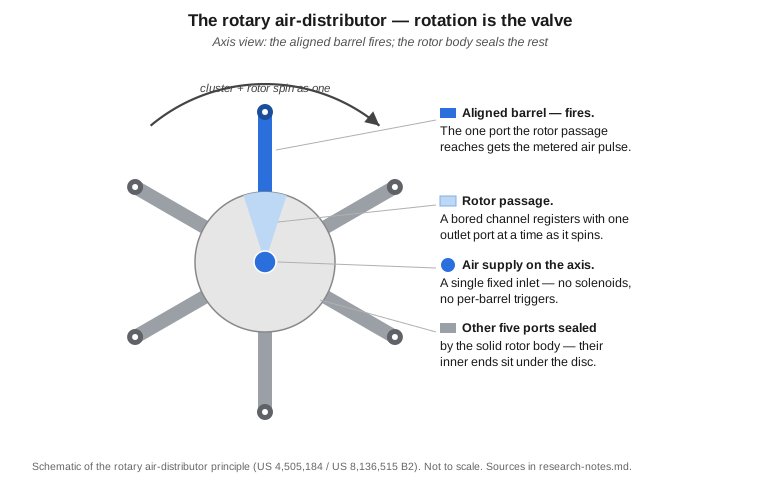
The schematic above is the whole idea in one picture: supply air enters on the axis, the rotor’s single bored passage reaches whichever port is at the firing position, and the solid rotor body seals the rest. Spin the cluster and that passage sweeps from barrel to barrel — the geometry is the firing timing, which is exactly what the cam does mechanically in the cartridge gun. Everything in Volume 4’s Tier-2 build is an attempt to fabricate this one part to a sealing tolerance.
2.3 The Propulsion / Drive Menu
“Minigun” describes a look, not a mechanism. At least seven distinct architectures can wear the shroud, and they differ enormously in how the BB is actually launched, what role (if any) the spinning barrels play, and how the gun is fed. The table below is the decision space; the verdict column is the honest engineering assessment.
Table 1 — The Propulsion / Drive Menu
| Architecture | Propels BB via | Barrel spin role | Feed | Typical ROF / FPS | Verdict |
|---|---|---|---|---|---|
| HPA single core + cosmetic spin | Regulated air pulse via FCU/solenoid poppet | Motor — cosmetic + feed staging | Hopper + hop-up | tunable / 330–600 | Best buildable “real” path (the Classic Army pattern) |
| Electric AEG core + cosmetic spin | AEG gearbox piston | Motor — cosmetic | Box / hopper | ~2,400 rpm / ~300 | Self-contained, no air rig; lower FPS |
| Electric-blower cloud/vortex BBMG | Leaf-blower / fan airflow agitates loose BBs | none / cosmetic | gravity hopper | 30–115 rps / 150–250 | Cheap spectacle; low FPS, no hop-up, gluttonous |
| HPA cloud/vortex BBMG | Compressed air agitates loose BBs | none / cosmetic | chamber / hopper | 50+ rps / ~330–400 | Simple, reliable, spray-only (NightHawkInLight pattern) |
| Brushless flywheel | Counter-rotating wheels pinch and fling | n/a | spring mag + pusher | ~5–10 rps / <150–300 | Fights physics with 6 mm (slip, no hop-up, wear) |
| Hand-crank spring (1860 pattern) | Per-barrel compression spring | crank drives rotation + fire | gravity / crank | crank-limited / low | Authentic to the original; low performance |
| True rotary-valve Gatling | Fixed port pressurizes the aligned barrel | functional — rotation IS the timing | per-barrel detent / centrifugal | up to 3,000 rpm / tunable | Authentic + hardest; proven in patents/paintball |
Only the top row (single HPA core) and the bottom row (true rotary valve) produce a real, hop-up-stabilized shot. Everything in between either trades the spin for nothing ballistic or trades accuracy for raw rate. The recommended Tier-1 path — and why — is built out in Volume 4.
2.4 HPA Specifics — the Recommended Propulsion
High-pressure air is the recommendation because it decouples power from mechanism: you can build an honest single-core gun and tune it to field-legal velocity with off-the-shelf parts. The plumbing is a strict two-stage cascade. A 3,000 or 4,500 psi paintball tank feeds a tank regulator that drops to roughly 800 psi, then a second airsoft regulator brings it down to the working range. Two-stage regulation is mandatory — feeding raw tank pressure into a homemade core is a genuine safety hazard, not a shortcut. Working FCU pressures for 6 mm are well established: Polarstar MSR around 145 psi, Wolverine Storm around 200 psi, Redline FSR at 145 psi (200 upgradeable) (all typical/approx and nozzle-dependent). The firing event itself is clean: the FCU’s electrically-timed solenoid opens a poppet valve for one metered pulse of air. The FCU sets dwell — the pulse duration, which directly governs air volume and therefore FPS — and the ROF independently. That separation of dwell from rate is exactly why HPA tunes so well, and it is detailed alongside the safety envelope in Volume 3.
2.5 Why the Flywheel Is a Trap for 6 mm
Flywheel launchers look tempting — brushless motors are cheap and a counter-rotating wheel pair is simple — but the physics fights the 6 mm BB at every step, so frame this as viable-but-compromised, not recommended. A 6 mm BB is tiny, hard, and smooth, which gives a minuscule, low-friction contact patch: the wheels slip against it, producing low and inconsistent velocity. Worse, a symmetric wheel pair imparts no useful backspin, which kills the hop-up effect that defines airsoft range — a flywheel gun throws a knuckleball. And the hard BBs abrade the wheels quickly. The best open engineering reference (Aaed Musa’s CD-launcher work) confirms the failure modes and the workarounds: two stages beat one because incremental energy transfer avoids gross slippage, and counterintuitively peak exit velocity lands around 25–31% throttle, not full — past that the wheels just slip harder. It can be made to work; it cannot be made to work well for hop-stabilized airsoft.
2.6 The Two Hard Problems
This is the heart of why DIY true-Gatlings are vanishingly rare, and it deserves to be stated plainly because every honest builder hits the same wall.
Problem 1 — Timing. A cloud or vortex core fires BBs at random instants. Put spinning barrels in front of it and you have not built a Gatling; you have built a BBMG with decorative tubes. Most randomly-timed BBs simply strike a barrel wall and scatter. Spinning adds nothing ballistically unless the air pulse is timed to barrel position — and timing it requires either the fixed cam or the rotary valve described above. There is no electronic shortcut that is simpler than the mechanical solution.
Problem 2 — Feeding rotating barrels. Gravity cannot keep pace with a cluster turning several hundred rev/min; rounds jam in the moving breeches. The real solutions — per-barrel detents or magazines, or a synchronously-spinning centrifugal hopper — are complex precision machining, not printed parts. This is precisely the problem the paintball patent (US 8,136,515 B2) solved with its 1:1 gear-timed centrifugal loader.
Because both problems are hard, most homemade “miniguns” quietly collapse into single-core BBMGs dressed in a cosmetic spinning shroud — and that is an honest, reliable gun, just not a Gatling. Only proprietary commercial gearboxes (gas propulsion plus a cam) and the paintball patent have actually cracked both at once. Knowing which problem you are choosing to solve — or to sidestep — is the single most important design decision in this entire project.
Comments (0)