DIY Airsoft Gatling / Minigun · Volume 3
Performance, Power & the Law
3.1 Reading the Rate-of-Fire Number
Every minigun spec sheet leads with the same headline figure — “3,000 RPM” — and it is worth understanding exactly what that number means before designing around it, because it is not a measure of how fast the barrel cluster spins. The governing relationship is simple:
ROF (rpm) = barrels × cluster revolutions per minute.
A six-barrel gun advertised at a 3,000 rpm aggregate rate of fire is only spinning its cluster at 500 rev/min — about 8.3 rev/s. Each barrel fires once per revolution, so six barrels passing the firing position 500 times a minute yields 3,000 shots a minute while no single barrel cycles faster than 8.3 times a second. This is precisely how the real M134 works, and it is why the spinning-barrel architecture exists at all: the firing load is spread across six barrels, so the aggregate rate is high without any single barrel cycling at a punishing speed. The practical consequence for a builder is liberating — rate of fire is controlled purely by motor RPM. There is no spring, no gearbox cycle time, and no return stroke to limit you; spin the cluster faster and the rate climbs in lockstep. Volume 2 covers the mechanism that ties the firing event to barrel position; this volume is about what comes out of the muzzle and what the field and the law will let you do with it.
That same math exposes the minigun’s defining vice. Capacities are enormous — 1,200 to 6,500 rounds across the commercial field — and they still empty in well under a minute at 3,000 rpm. A 2,000-round hopper lasts 40 seconds; a 1,200-round box mag is gone in 24 seconds. These are spectacle and support weapons, not efficient skirmish guns. A builder should size the air supply and the wallet around that reality: a minigun is a thing you bring to suppress and to impress, not to play a tight, ammo-disciplined game with.
3.2 Energy, FPS, and What the Chrono Actually Reads
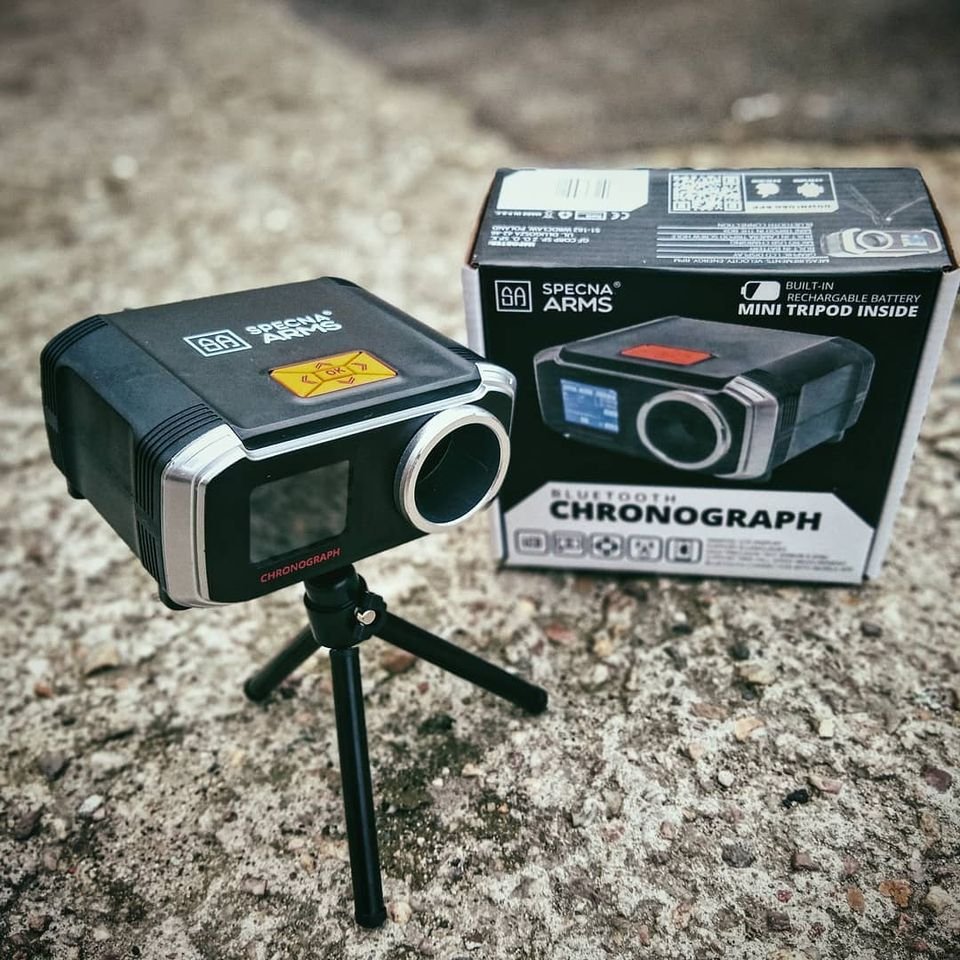
Airsoft fields do not regulate the RPM headline — they regulate muzzle energy, measured in joules off a chronograph. FPS is only a proxy, and a proxy that is meaningless without a stated BB weight. The standard reference weight is 0.20 g, and the conversions that matter are these:
Table 1 — Airsoft fields do not regulate the RPM headline — they regulate muzzle energy, measured in joules off a chronograph. FPS is only a proxy, and a proxy that is meaningless without a stated BB weight. The standard reference weight is 0.20 g, and the conversions that matter are these
| BB weight | Velocity | Muzzle energy |
|---|---|---|
| 0.20 g | 328 fps | 1.00 J |
| 0.20 g | 350 fps | 1.14 J (approx) |
| 0.20 g | 400 fps | 1.49 J |
The first row — 328 fps / 1.0 J — is the canonical anchor; 328 fps is simply 100 m/s, and most European joule limits are expressed directly in joules for exactly this reason. Everything a field allows or forbids is ultimately a statement about that joule column, not about the FPS number painted on a box.
3.3 What a Field Will Let You Run
The commercial miniguns most worth emulating advertise 350–600 fps, and the top of that range is the problem. A gun chronoing at 500–600 fps on 0.20 g is field-illegal almost everywhere without detuning. Typical field caps, which vary by site and should always be confirmed locally, run roughly like this:
Table 2 — The commercial miniguns most worth emulating advertise 350–600 fps, and the top of that range is the problem. A gun chronoing at 500–600 fps on 0.20 g is field-illegal almost everywhere without detuning. Typical field caps, which vary by site and should always be confirmed locally, run roughly like this
| Class | Typical cap (0.20 g) | Engagement rule |
|---|---|---|
| AEG / full-auto | 350–400 fps | Standard MED, often 10–25 ft |
| DMR / semi-only | 450–475 fps | Extended MED, ~50–75 ft |
| Bolt-action sniper | 500 fps | Strict MED, ~100 ft, semi/single only |
| Support weapon / box-mag SAW | site-dependent | Extended MED (e.g. no engagement within 75 ft), 2-man deployment, no full-auto up close |
A high-capacity, high-rate gun is almost always slotted into that last row. Fields tolerate the magazine size precisely because they impose an extended minimum engagement distance — the rule that you may not fire on a target closer than some threshold — and frequently require a two-person crew (gunner plus a dedicated spotter/loader) and forbid full-auto at close quarters. The honest design conclusion is unavoidable: build the gun to tune down to ~350–400 fps. A regulated HPA core does this trivially — drop the regulator pressure or shorten the solenoid dwell and the same gun that the bench-tested at 550 fps walks straight onto the field at 380. That tunability is the single biggest reason the recommended Tier-1 architecture in Volume 4 uses a regulated air core rather than a fixed spring.
3.4 Joule Creep — the Trap Built Into Air Guns
There is a subtler reason to chrono carefully on an air-powered gun. Joule creep is the phenomenon where a high-volume air system imparts more energy to a heavy BB than to a light one — a gun that reads a legal 1.49 J on 0.20 g can quietly exceed the cap on 0.30 g or 0.40 g, because the larger air charge keeps pushing the heavier, slower-accelerating BB for longer down the bore. A short-stroke AEG barely shows it; a regulated CO₂/HPA minigun with generous air volume shows it plainly. The result is that the muzzle is hotter, in joules, than the 0.20 g chrono reading suggests when you load heavy ammo. Serious fields counter this by chronoing with the actual BB weight a player intends to use, and a minigun builder should do the same on the bench. The propellant-side mechanics — why air volume and BB mass interact this way, and how CO₂ versus HPA behave across temperature — are treated in full in the Airsoft Gas deep dive; the takeaway here is operational: chrono with the BB weight you will actually shoot, not the reference weight.
3.5 High-Pressure Air — Treat It as Pressurized Gas, Because It Is
A minigun’s appetite makes a substantial air supply unavoidable, and that means living with genuine high pressure. Paintball-class tanks store 3,000 to 4,500 psi. This is not a domain for improvisation. The standing rules are non-negotiable:
- Use certified, in-hydro paintball tanks — aluminum 3,000 psi or carbon-fiber 4,500 psi vessels with a current hydrostatic-test date. Never improvise a pressure vessel from PVC, a soda bottle, or any unrated container at true high pressure. The soda-bottle cloud guns of the DIY canon survive because they run at ~100 psi, not 3,000; do not confuse the two regimes.
- Two-stage regulation is mandatory. The tank regulator drops bottle pressure to an intermediate ~800 psi; a second airsoft-grade regulator brings it down to the working pressure of the firing engine (roughly 145–200 psi depending on the FCU). Raw tank pressure must never reach a homemade core.
- Use rated regulators, hose, and fittings, and secure the quick-disconnects so a coupling cannot whip loose under pressure.
- Eye protection, always — on the bench during tuning as much as on the field.
These are the same disciplines paintball has enforced for decades, and the Airsoft Gas deep dive carries the regulator and adapter detail; none of it is exotic, but all of it is mandatory.
3.6 The Law — 15 U.S.C. § 5001
In the United States, airsoft guns are “look-alike firearms” under 15 U.S.C. § 5001, the federal imitation-firearm marking statute. The headline requirement is the blaze-orange muzzle marking: a gun sold in the US must carry an approved orange plug, permanently affixed and recessed no more than 6 mm from the muzzle. Metallic-BB and pellet air guns are statutorily exempt — the marking rule targets toy-like and look-alike replicas, not functional air guns that fire metallic projectiles. Enforcement of the statute moved to the Consumer Product Safety Commission (CPSC) in 2022.
Two distinctions keep this factual rather than alarming. First, § 5001 governs commerce — the manufacture, importation, and sale of look-alikes — not what a private owner does with a gun already lawfully purchased. Removal of the marking after purchase is a matter of state law and a legal grey area, not a federal-sale violation; some states regulate it tightly and others not at all, so the relevant state statute is the thing to check, not federal memory. Second, none of this makes an airsoft minigun a firearm: it has no frame or receiver, chambers no cartridge, and falls entirely outside the GCA and NFA framework discussed in the hub’s legal-posture notes.
What the hub’s legal posture does counsel is proportion. A six-barrel, 3,000-rpm look-alike is, by its nature, an attention-getting object — exactly the kind of high-visibility replica that draws extra scrutiny in transport and in public. The conservative, sensible response is the same discipline the rest of this volume already recommends: keep the power conservative and field-legal (~350–400 fps), observe MED discipline, leave the orange marking in place, and transport the gun cased. None of these are legal mandates on a private build; all of them are the low-friction choices that keep a spectacle gun a spectacle and nothing more.
Comments (0)