DIY Airsoft Gatling / Minigun · Volume 4
The Full Build
4.1 The Build This Volume Commits To
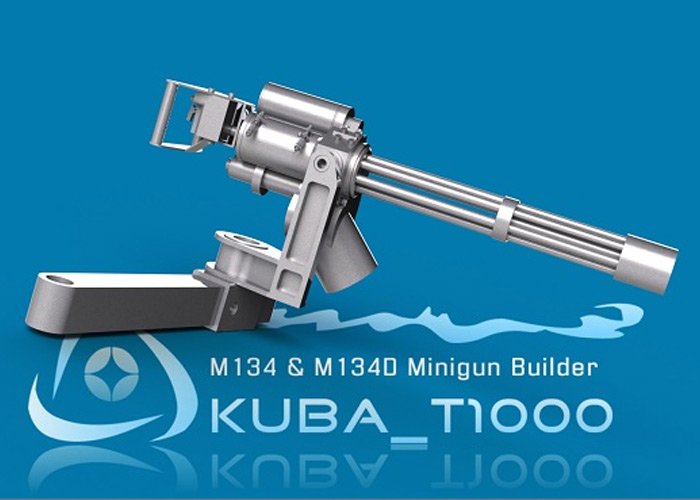
This is the centerpiece. Volume 2 laid out the propulsion menu and the two hard problems that gate every DIY true-Gatling — timing the air pulse to barrel position and feeding individual rotating barrels — and Volume 3 set the performance and legal envelope: ~350 FPS, ROF you can defend at a field, joule creep watched on the chrono. The honest engineering conclusion from all of that is that the buildable, reliable, field-legal minigun is not a true Gatling. It is the Classic Army architecture: an electric motor spins a cosmetic 6-barrel cluster for the look and the noise, while a single fixed precision inner barrel behind the cluster does all the actual shooting, fired by a regulated HPA core under an electronic trigger. That is Tier 1, and Part A builds it end to end. Part B documents the Tier-2 stretch — the authentic rotary air-distributor — honestly, as a genuine R&D project rather than a weekend build.
The reason this split works is that it sidesteps both hard problems. Nothing feeds a moving barrel (the cluster is decoupled from firing), and nothing has to time a pulse to a rotating port (one barrel, always aligned, always ready). The spinning cluster is theater bolted onto a sound, conventional HPA gun.
4.2 Architecture: How the Subsystems Relate
Six subsystems, two of which are mechanically independent of each other — that independence is the whole trick.
- Structure — a central spine/receiver that carries the bearing-supported hub at the front and the firing core + electronics behind it. Everything hangs off this.
- Cosmetic barrel cluster + hub — six outer barrels in a hub turning on two bearings, spun by the drive motor. Decorative; no BB ever travels down these.
- Drive motor + ESC — spins the cluster to cosmetic RPM. Sized for looks, not rate of fire.
- HPA firing core — regulated air → an FCU-controlled solenoid poppet → one metered air pulse per shot, pushing a BB down the single fixed inner barrel through a hop-up. This is the actual gun.
- Feed — a gravity hopper drops BBs into the single fixed firing chamber. Only one chamber to feed; the cluster doesn’t.
- Electronics + air supply — battery → ESC (spin) and FCU (fire); regulator + air tank feeding the core.
The mental model: a competent single-shot HPA rifle living inside a spinning shroud. The cluster spins; behind it, hidden on the cluster’s axis, the BB leaves a real barrel that never moves.
4.3 Bill of Materials
Make-vs-buy is the organizing question for a well-equipped shop. The rule of thumb: buy anything that is a precision pressure or safety component or a tuned airsoft assembly; make everything structural.
Table 1 — Bill of Materials
| Subsystem | Key parts | Make or buy | Lab notes |
|---|---|---|---|
| Structure / receiver | Spine, shroud panels, motor mount, core cradle | Make | CNC-mill aluminum spine; laser-cut flat brackets/shroud panels; 3D-print non-load shells |
| Barrel cluster + hub | 6 outer tubes, front + rear hub, 2 bearings | Make (bearings buy) | Mill or print the hub; lathe-cut tube stock; bearings are a stock catalog part |
| Drive motor + ESC | Brushless or 12 V DC motor, ESC/speed controller | Buy | Sized for cosmetic RPM only |
| HPA engine / FCU | Polarstar / Wolverine / Redline FSR engine + FCU | Buy (must-buy) | Tuned poppet + solenoid; do not improvise |
| Regulator | Tank reg + airsoft working-pressure reg (two stage) | Buy (must-buy) | Pressure-rated, certified |
| Air tank | 3,000 / 4,500 psi in-hydro paintball tank | Buy (must-buy) | Certified, in-hydro only — never improvise a vessel |
| Hop-up unit + inner barrel | TM-spec hop-up chamber, bucking, tightbore | Buy | Standard airsoft consumables; tune, don’t fabricate |
| Hopper / feed | Gravity hopper + feed tube to chamber | Make | 3D-print hopper + feed neck; laser-cut lid |
| Wiring / battery | LiPo, Deans/XT connectors, trigger switch | Buy | Standard AEG/HPA electrical |
The must-buys are deliberately few: the HPA engine + FCU, both regulators, and a certified air tank. Everything those touch is a high-pressure safety item or a finely tuned poppet/nozzle assembly where home fabrication buys nothing but risk. The hop-up and inner barrel are cheap, refined, and not worth reinventing. Sourcing detail for all of these is in Volume 5.
4.4 The Barrel Cluster and Hub
Six outer barrels, cut from tube stock on the lathe to identical length, deburred, and faced. They are cosmetic, so wall thickness and bore are chosen for looks and balance, not pressure — but cut them true and to matched length, because at cosmetic RPM any length or mass mismatch shows up as visible wobble and bearing chatter.
The barrels seat in a front hub and a rear hub that together define the cluster. Machine the hubs from Delrin (acetal) on the CNC mill — Delrin runs quiet, light, and self-lubricating against the bearings and is the material the patented commercial hubs use — or 3D-print them in a stiff filament for prototyping and fit checks before committing to a Delrin cut. Bore the six barrel pockets on a single setup (or a rotary indexer) so they share one datum and the cluster runs concentric.
The cluster spins on two bearings, front and rear, riding on the central spine — exactly the front/rear bearing arrangement the SpudFiles cosmetic-spin builds (e.g. t=17573) settled on. The single fixed inner barrel + hop-up live on the spine’s axis, behind the cluster, stationary, with the cluster turning around the line of fire. Use the laser for flat shroud panels, the front face plate, and any bracketry; reserve the mill for the hub and motor mount where concentricity matters.
4.5 Drive Motor and ESC
The motor’s only job is to make the cluster spin convincingly. Size it for cosmetic RPM, not firing rate — these are completely decoupled, which is the second half of why this build is tractable. A 12 V DC motor (the commercial budget guns spin the cluster with a ~23,000-rpm 12 V motor geared down) or a brushless motor + ESC both work; brushless plus an ESC gives clean throttle control and a soft spin-up. For reference, the real M134 motor is a ~24–28 V, ~1.5 kW (~2 hp) monster running the cluster at 3,000 rpm — you need none of that. A geared-down hobby motor pulling the Delrin cluster to a few hundred cluster-rpm reads as a screaming minigun on video without drawing meaningful current.
Recall the ROF identity from Volume 2: real ROF (rpm) = barrels × cluster rev/min, so a real 6-barrel at 3,000 ROF needs only 500 cluster rev/min. On a cosmetic cluster the number is purely aesthetic — pick the spin that looks right and is mechanically quiet.
4.6 The HPA Firing Core
This is the gun. Air is regulated in two stages: the paintball tank’s own regulator drops 3,000/4,500 psi down to roughly 800 psi (typical), and a second airsoft-grade regulator brings that to the engine’s working pressure. Two-stage regulation is mandatory — feeding raw tank pressure into a working core is dangerous, full stop. Working pressures depend on the engine: Polarstar MSR ~145 psi, Wolverine Storm ~200 psi, Redline FSR 145 psi (200 upgradeable) (typical).
Firing is electronic. The FCU (fire control unit) commands a solenoid that opens a poppet valve for one metered pulse of air per shot, driving the BB out of the fixed inner barrel. Two FCU parameters set behavior:
- Dwell — how long the poppet stays open per shot. Dwell meters the air volume per shot and therefore sets FPS. Tune dwell down until the chrono reads ~350 FPS on your field BB weight.
- ROF — set directly in the FCU (rounds per second / burst behavior), entirely independent of how fast the cluster spins.
HPA, regulator staging, and propellant behavior are deliberately not re-derived here — that is its own deep dive. See /airsoft/gas/ for the full treatment of HPA, regulators, two-stage setups, and the PSI-vs-temperature realities; this volume only states the working numbers it needs.
4.7 Feeding: The Gravity Hopper
Because only one fixed chamber ever fires, feeding is the easy path — this is precisely the problem the cosmetic-cluster architecture deletes. A gravity hopper sits above the firing core and drops BBs through a feed neck into the single chamber; no rotating breech to chase, no centrifugal loader, no per-barrel detents. 3D-print the hopper body and feed neck and laser-cut a lid.
The one reality to design around is capacity versus burn rate, the same arithmetic from Volume 3: a high ROF empties even a large hopper in well under a minute. Size the hopper generously (commercial guns run 1,200–2,200+ and still burn fast), keep the feed neck wide and short so gravity reliably keeps the chamber fed at your ROF, and accept that this is a spectacle/support gun by nature, not an efficient skirmisher.
4.8 Wiring, Assembly, and Tuning
Wiring. One battery (LiPo) feeds two consumers: the ESC (cluster spin) and the FCU (firing solenoid). Use low-resistance connectors (Deans/XT) throughout. The trigger is wired to the FCU as its fire input; the cluster spin can be on the same trigger (spin-then-fire), a separate switch, or an FCU-managed spin-up delay so the barrels are turning before the first BB leaves. Keep the high-current motor leads away from the FCU signal wiring.
Assembly order. (1) Build and square the spine/receiver. (2) Mount and align the fixed inner barrel + hop-up on the spine axis. (3) Install front/rear bearings and slide on the assembled cluster; check it runs true and quiet by hand. (4) Mount the drive motor and set the cluster spin. (5) Install the HPA core behind the inner barrel; plumb tank → tank reg → airsoft reg → engine. (6) Fit the hopper and feed neck to the chamber. (7) Wire battery → ESC + FCU + trigger.
Tuning. Pressurize, then chrono-tune dwell down to your field FPS (~350) on the BB weight you will actually field — watch joule creep (Volume 3). Set ROF in the FCU to something the hopper feed can keep up with. The cleanest documented single-HPA-core reference is SpudFiles t=21457: tank → ASA → chamber → detent seal → barrel at working pressure, which the builder reports “fires every time.” Note its failure mode and design against it: a double-feed (two BBs in the chamber) produces an under-velocity shot. A good detent/air-seal at the chamber mouth and a feed neck that delivers one BB at a time are what keep that from happening.
4.9 The Tier-2 Stretch: A True Rotary Distributor
Tier 1 spins barrels for show. Tier 2 makes the rotation be the gun — the authentic pneumatic-Gatling principle (Volume 2 diagrams it). Instead of one fixed barrel, a rotary air-distributor uses a fixed air inlet feeding a rotor whose internal passage sequentially aligns with each barrel’s port as the cluster turns: whichever barrel is at the firing position is the one pressurized. Rotation itself is the valve — no solenoid timing, because the geometry does the timing. This is the mechanism behind US 4,505,184 (the distributor principle in pure form) and, most usefully, US 8,136,515 B2, the paintball Gatling: a rotary gas union acting as a “1-to-6 dividing station” and a synchronously rotating centrifugal loader geared 1:1 to the cluster so feeding and firing stay in lockstep at ~3,000 rpm. That patent is the most complete real-world template because it solves both of Volume 2’s hard problems at once — timing (the rotary union) and feeding (centrifugal, 1:1 timed).
Be honest about where this lives: it is proven in patents and in paintball at 0.68 cal, not in DIY airsoft. This is the wall every honest DIY thread hits. Attempting it is a real R&D project, not a build with a known-good recipe.
4.10 What the Lab Would Need to Make It
This is squarely a CNC-mill project, and a demanding one:
- A precision rotor + manifold (distributor face). The rotor and the stationary port face must seal against each other while one rotates against the other at speed. That means tight tolerances, flat lapped sealing faces, and a seal scheme (face seal or close-fit metal-to-metal/Delrin) that holds working pressure without binding or leaking across adjacent ports. This is the make-or-break part.
- Either six timed per-barrel valves/detents or a single distributor face that ports the aligned barrel and seals the other five (the US 10,247,508 “rotating stem” selector is the simplest such scheme).
- A centrifugal feed, ideally a loader geared 1:1 to the cluster so a BB is staged into each barrel at the right angular position — the US 8,136,515 approach.
The lab can attempt the rotor/manifold on the mill and the structure as in Tier 1, but expect to iterate on the sealing face and feed timing extensively. Treat Tier 2 as the documented ambition; build Tier 1 first. Volume 5 covers sourcing for both, and which builder each tier suits.
Comments (0)