Škorpion vz. 61 · Volume 6
The Law: Machine Guns, Imports, and the Semi-Automatic Pistols
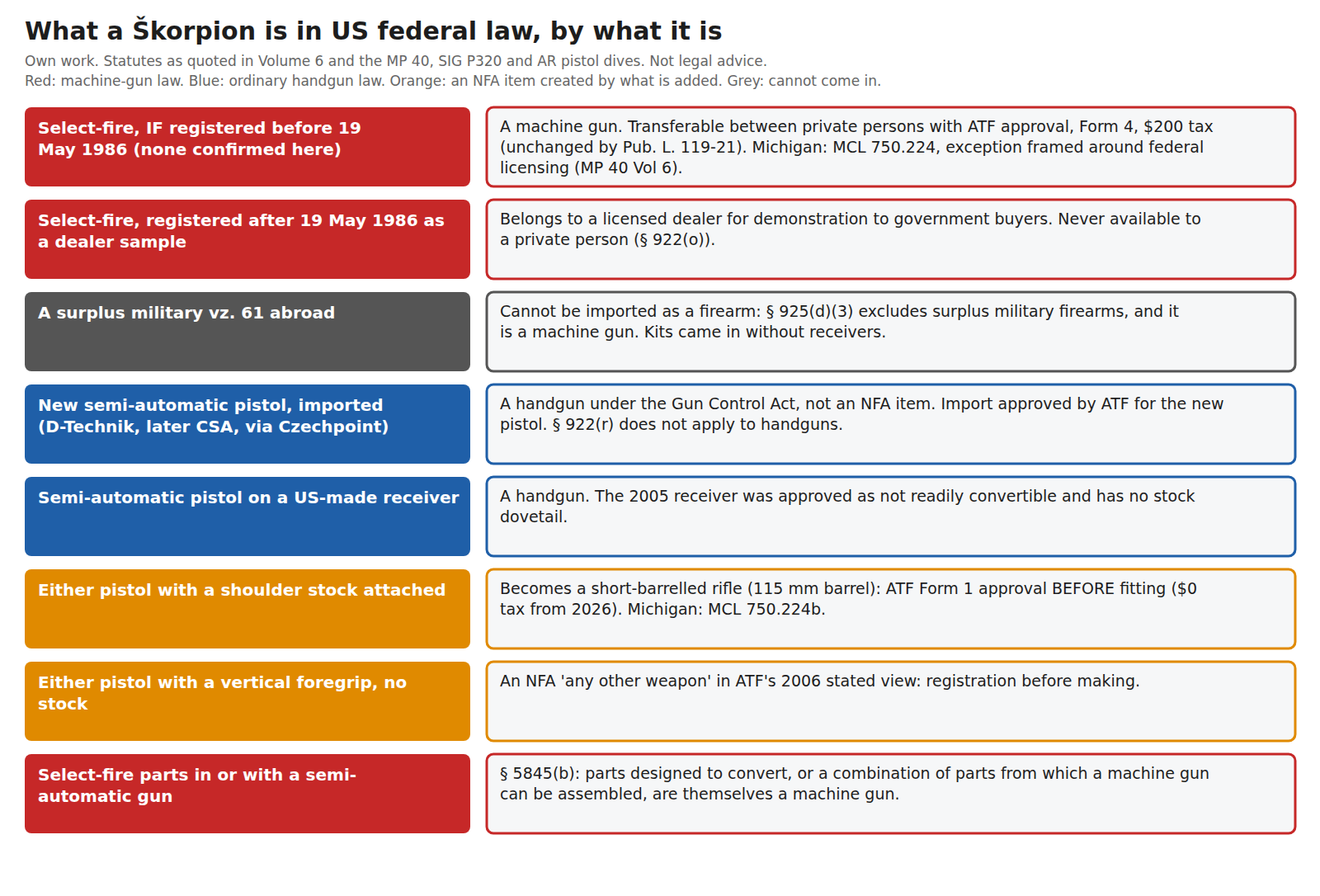
What a Škorpion is in US federal law depending on what it is: the select-fire gun under the National Firearms Act and § 922(o), why surplus guns cannot be imported, the parts-kit trap, the semi-automatic pistols from D-Technik, Czech Small Arms and US-made receivers as ordinary handguns, and how a stock, a foregrip or a suppressor changes that, with Michigan's position
6.1 The short answer
A select-fire vz. 61 is a machine gun. A private person in the United States may own one only if that particular gun was lawfully registered before 19 May 1986, and this research found no record of a transferable vz. 61. Surplus guns cannot be imported. What a private buyer can have is a semi-automatic pistol built to the vz. 61’s pattern: newly made in the Czech Republic and imported, or built on a US-made receiver. Those are ordinary handguns, not National Firearms Act items, until a stock or a foregrip is added; with a stock fitted, one becomes a short-barrelled rifle and must be registered before it is made.
Nothing here is legal advice. The statutes are quoted so that a reader can take them to someone qualified. Laws and agency positions change; this was written in October 2026.
6.2 Where the general law is
The hub’s MP 40 dive, Volume 6 sets out the federal machine-gun law in full: § 922(o) and the Hughes Amendment, the four categories of transferable, pre-1986 dealer sample, post-1986 dealer sample and everything else, the transfer and its tax, semi-automatic reproductions and “the trap in the word pistol”, and Michigan’s MCL 750.224. The MP7 and Minebea dives apply it to two post-1986 weapons, and the ZB 47 is the section’s other Czechoslovak submachine gun. This volume applies the law to the Škorpion and does not restate it.
6.3 The select-fire vz. 61 is a machine gun
The National Firearms Act defines a machine gun at 26 U.S.C. § 5845(b):1
“any weapon which shoots, is designed to shoot, or can be readily restored to shoot, automatically more than one shot, without manual reloading, by a single function of the trigger. The term shall also include the frame or receiver of any such weapon, any part designed and intended solely and exclusively, or combination of parts designed and intended, for use in converting a weapon into a machinegun, and any combination of parts from which a machinegun can be assembled if such parts are in the possession or under the control of a person.”
The vz. 61, vz. 83 and M84 have a selector position for automatic fire (Volumes 2 and 3). Each is a machine gun, and so is its receiver on its own.
Since 19 May 1986, 18 U.S.C. § 922(o) has made it unlawful to transfer or possess a machine gun that was not lawfully possessed before that date, except by or under the authority of a government.2 Public Law 119-21 cut the federal tax on making and transferring short-barrelled rifles and suppressors to $0 from 2026; it did not reach machine guns, whose $200 tax is unchanged.2
6.4 Is there a transferable Škorpion?
Unlike the MP7 and the Minebea, the vz. 61 existed before 1986: production began in 1962 or 1963 (Volume 1). So a transferable example is not ruled out by the calendar, as it is for those guns. Whether one exists is another matter.
- Small Arms Review wrote in 2006 that the vz. 61 was a weapon “of which only a few post-86 dealer samples are currently in the United States”. It mentioned no transferable gun.3
- No auction record of a transferable vz. 61 was found. The Škorpions in Rock Island Auction’s catalogue that were found are semi-automatic D-Technik pistols.45
- The ATF’s National Firearms Registration and Transfer Record is not public, and no count of registered vz. 61s was found.
The honest statement is that this research found no record of a transferable vz. 61 in the United States. That is not proof that none exists. A buyer offered one should have the registration checked before anything else, as the MP 40 dive explains.2
6.5 Dealer samples
A machine gun registered after 19 May 1986 by a licensed manufacturer or importer can be held by a dealer who pays the special occupational tax, for demonstration to government buyers. The MP 40 dive’s section on the four categories explains that such a weapon “belongs to the licensed business and never becomes available to a private citizen”.2 Small Arms Review reported in 2006 that a US maker would sell an automatic Škorpion on its US-made receiver “as a post-86 Dealer Sample”, and that 15 of its first 50 receivers were already spoken for in that form.3 Those are dealer samples and remain so.
6.6 Why surplus guns cannot be imported
The Gun Control Act’s import provision, 18 U.S.C. § 925(d)(3), lets ATF authorise the import of a firearm that:6
“is of a type that does not fall within the definition of a firearm as defined in section 5845(a) of the Internal Revenue Code of 1986 and is generally recognized as particularly suitable for or readily adaptable to sporting purposes, excluding surplus military firearms, except in any case where the Attorney General has not authorized the importation of the firearm pursuant to this paragraph, it shall be unlawful to import any frame, receiver, or barrel of such firearm which would be prohibited if assembled”.
A surplus vz. 61 fails twice: it is a machine gun, within § 5845, and it is a surplus military firearm. Its receiver cannot be imported either, under the last clause. That is why Czechoslovak and Czech surplus reached the United States only as parts kits without receivers. Small Arms Review counted 200 kits imported in the late 1990s and 200 more in 2003, estimated fewer than 550 in the country in 2006, and expected that any further kits “will not have barrels remaining intact”.3
The semi-automatic pistols that are imported are newly made for the civilian market, not surplus, which is the difference. Small Arms Review described the D-Technik pistol of 2009 as “redesigned in a semiautomatic-only capacity to allow import and sale for civilian purchase”, with modifications “that meet BATFE legal standards”.7
6.7 Parts kits and the “combination of parts”
The last words of § 5845(b) matter for anyone who owns Škorpion parts: “any combination of parts from which a machinegun can be assembled if such parts are in the possession or under the control of a person” is itself a machine gun.1 A surplus kit is the parts of a select-fire gun less its receiver. Owning a kit is not the same as owning a machine gun, but owning select-fire parts together with a receiver they would make work raises exactly the question the statute answers. This hub does not describe the assembly of any Škorpion and does not advise on how to stay on the right side of that line. A buyer should take the statute and the specific parts to a qualified lawyer.
6.8 No conversions
Converting a semi-automatic Škorpion to fire automatically makes a machine gun, which § 922(o) forbids a private person, and which is a felony under Michigan law as well (MCL 750.224, quoted in the MP 40 dive).2 The US-made receiver of 2005 was approved by ATF, Small Arms Review reported, on the basis that it “is not readily convertible” to automatic fire; “readily restored to shoot” is in the statutory definition itself.31 Nothing in this dive describes how the automatic fire control works beyond the published military sources (Volume 2), and nothing should be read as information towards a conversion.
6.9 The semi-automatic pistols
Three kinds of semi-automatic Škorpion have been sold in the United States (Volume 3).
D-Technik pistols, imported from 2009. New manufacture in the Czech Republic, distributed by Czechpoint, Inc. of Knoxville: semi-automatic only, the rate reducer removed, a new safety, the rear of the receiver “smooth”, without the stock mount; 4.5 in (115 mm) barrel; suggested price $599 in 2009.7
Czech Small Arms pistols. Czechpoint’s store lists, on 20 October 2026, a “Vz. 61 Pistol (.32 ACP) threaded chrome-lined barrel”, a “Vz. 61 Pistol .380 ACP Gen 2 Threaded” and a “Vz. 61 Pistol (.22 LR) Threaded”, each at $1,079.00, and a “Vz. 61 receiver cal. 32 acp” at $329.00; all four were out of stock that day. Its stock mounting plate is described as “designed for all Czech Small Arms VZ. 61” pistols, which identifies the maker. The .22 LR pistol’s page describes it as “semi-automatic, closed-bolt operation”, “new production”, retaining the original’s “dimensions and appearance (minus full-auto components and rate reducer)”, with a threaded barrel and a frame “drilled and tapped for optional folding stock plate (stock not included)”.8
Pistols on US-made receivers. In 2005 ATF approved a US-made semi-automatic Škorpion receiver, which Small Arms Review reported was designed to “pass ATF muster as a legal semiauto pistol”, with “no folding stock dovetail”.3 A receiver is itself a firearm in federal law, which is why Czechpoint’s separate receiver is sold as one.
All three are handguns under 18 U.S.C. § 921(a)(29): “a firearm which has a short stock and is designed to be held and fired by the use of a single hand”.9 They are not NFA firearms as sold.
6.10 How a pistol’s law differs
Set beside the machine gun, the semi-automatic pistol differs in four ways that matter.
- No registration, no tax, no 1986 cut-off. It is bought like any other handgun, through a licensed dealer with the federal background check and form. The NFA and § 922(o) do not apply to it.
- It can be imported new. § 925(d)(3) bars surplus military firearms; a pistol newly made for the civilian market and approved by ATF is not barred.67
- § 922(r) does not apply. The rule against assembling a non-importable gun from imported parts covers “any semiautomatic rifle or any shotgun”, not handguns; the Steyr AUG dive, Volume 6 quotes the statute and its parts count. The same pistol made into a short-barrelled rifle would be a rifle, and the rule would then have to be considered.
- What is added changes what it is. A pistol is a pistol only while it is designed and configured to be fired with one hand. The stock and the foregrip are the two additions that change that, below.
6.11 The stock
The vz. 61’s whole identity includes its folding wire stock, and the stock is the easiest way to turn a lawful pistol into an unregistered NFA firearm.
With a stock attached, a Škorpion pistol is designed to be fired from the shoulder, which makes it a rifle; with a 115 mm barrel it is a short-barrelled rifle, “a rifle having one or more barrels less than sixteen inches in length”.9 Making one requires an approved ATF Form 1 before the stock is fitted. Public Law 119-21 set the making tax at $0 from 2026, but did not remove the application and the approval; the Mannlicher dive, Volume 8 and the AR pistol dive, Volume 4 set out the current position.
The importer says the same thing in its own words. Czechpoint’s page for its vz. 61 stock mounting plate carries an “NFA Compliance Notice”: “Installation or possession of this product may require an approved ATF Form 1 or Form 4. Combining it with a compatible firearm without approval may be considered an unregistered SBR under the NFA.”10 Its current pistols are drilled and tapped for that plate; the 2009 D-Technik pistols and the 2005 US-made receivers had no stock mount at all.873 Small Arms Review in 2009 also referred to SBR models alongside the pistol, with the stock’s locking mechanism “at the rear of the SBR receiver”, which would be registered NFA firearms.7
Owning a stock without fitting it. The Supreme Court’s Thompson/Center decision of 1992 held that a pistol sold with a kit that could also be assembled into a lawful configuration had not been “made” into a short-barrelled rifle. Whether that protects a stock whose only use is to make a short-barrelled rifle is uncertain; the SIG P320 dive, Volume 5 and the Borchardt C-93 dive, Volume 8 discuss it. Czechpoint’s “Form 1 or Form 4” notice for the bare plate reflects the same caution.
6.12 A foregrip, a brace, a suppressor
A vertical foregrip on a pistol, in ATF’s open letter of April 2006, means the handgun “is no longer designed to be held and fired by the use of a single hand”, and the person who fits one is “making” an NFA “any other weapon” that must be registered first. The SIG P320 dive quotes and discusses the letter.11
A pistol brace is the subject of the AR pistol dive, Volume 4: ATF’s 2023 rule was vacated in Mock v. Garland, and in 2026 ATF proposed to delete it. No Škorpion-specific brace or ruling was found.
A suppressor is itself an NFA firearm, now with a $0 making and transfer tax but still registered. The current pistols are sold with threaded barrels (1/2×28 on the .22 LR pistol) and a thread protector, which is lawful federally; the suppressor is not part of the gun.8 The hub’s suppressor law dive covers the law, and some states restrict threaded barrels on semi-automatic pistols by statute; a buyer outside Michigan should check his own.
6.13 Michigan
Michigan is the owner’s state, and three provisions apply, each quoted in another dive.
- The machine gun. MCL 750.224 prohibits possession of “a machine gun or firearm that shoots or is designed to shoot automatically more than 1 shot without manual reloading, by a single function of the trigger”, with an exception framed around federal licensing; the MP 40 dive quotes it and notes the open question of how the exception applies to a private owner of a registered machine gun.2 With no transferable vz. 61 found, the question is academic for this gun.
- The pistol. A semi-automatic Škorpion is a pistol under MCL 28.421, “a loaded or unloaded firearm that is 26 inches or less in length”, and the ordinary Michigan pistol rules apply: the licence to purchase under MCL 28.422 or the concealed pistol licence exemption, with the seller’s record. The Mannlicher and AR pistol dives quote them.
- The stock. MCL 750.224b permits a short-barrelled rifle only if it is “lawfully made, manufactured, transferred, or possessed under federal law”, and adds Michigan duties that turn on whether the weapon is 26 inches or less in length; a Škorpion with its stock unfolded is about 20.5 inches (522 mm), so the 26-inch rule applies. The AR pistol dive quotes the section in full.2
6.14 The options at a glance
Table 1 — The options at a glance
| What | In federal law | Available to a private buyer? | Price, dated |
|---|---|---|---|
| Select-fire vz. 61, vz. 83 or M84 | machine gun | only if registered before 19 May 1986; none found | no record found |
| Post-1986 dealer sample | machine gun | no; licensed dealers only | – |
| Surplus vz. 61 abroad | machine gun, surplus | cannot be imported | – |
| D-Technik pistol (from 2009) | handgun | yes, used | MSRP $599 (2009); RIA estimates $750–1,100 for one (June 2018) |
| Czech Small Arms pistol, .32 ACP, .380 ACP or .22 LR | handgun | yes; out of stock at Czechpoint on 20 Oct 2026 | $1,079.00 (Czechpoint, 20 Oct 2026) |
| Pistol on a US-made receiver | handgun | yes, as made by the manufacturer | not found |
| Any of the pistols with a stock | short-barrelled rifle | yes, after an approved Form 1; $0 tax from 2026 | – |
| CZ Scorpion EVO 3 S1 | a different design (Volume 3) | not covered here | – |
6.15 What could not be verified
- Whether any transferable vz. 61 exists in the United States.
- The ATF classification letters for the D-Technik and Czech Small Arms pistols, and for the 2005 US-made receiver; only Small Arms Review’s account of the last was read.
- The current makers of US-made Škorpion receivers.
- Which states restrict the current pistols by their features, for example threaded barrels.
References
Footnotes
-
26 U.S.C. § 5845(b), Legal Information Institute, Cornell Law School, https://www.law.cornell.edu/uscode/text/26/5845 (accessed 2026-10-20). ↩ ↩2 ↩3
-
“MP 40”, Volume 6, in this hub: /actual-firearms/rifles/mp-40/vol-6/ (18 U.S.C. § 922(o); 26 U.S.C. § 5845(b); the four categories; the transfer and tax; Public Law 119-21; MCL 750.224 and 750.224b). ↩ ↩2 ↩3 ↩4 ↩5 ↩6 ↩7
-
William R. Bishop, “The Skorpion Comes to America”, Small Arms Review vol. 9 no. 11, August 2006, https://smallarmsreview.com/?p=4361 (accessed 2026-10-19). ↩ ↩2 ↩3 ↩4 ↩5 ↩6
-
Rock Island Auction Company, lot 1048, 21 June 2018, https://www.rockislandauction.com/detail/1031/1048/dtechnk-scorpion-pistol-765-mm (accessed 2026-10-20). ↩
-
Rock Island Auction Company, lot 456, 18 November 2020, https://www.rockislandauction.com/detail/2037/456/two-dtechnik-vz-61-scorpion-semiautomatic-pistols-with-cases (accessed 2026-10-20). ↩
-
18 U.S.C. § 925(d)(3), Legal Information Institute, Cornell Law School, https://www.law.cornell.edu/uscode/text/18/925 (accessed 2026-10-20). ↩ ↩2
-
Jeff W. Zimba, “SA VZ. 61 Scorpion from Czechpoint, Inc.”, Small Arms Review vol. 12 no. 6, March 2009, https://smallarmsreview.com/?p=14942 (accessed 2026-10-20). ↩ ↩2 ↩3 ↩4 ↩5
-
Czechpoint, Inc., “Vz. 61 Pistols”, https://czechpoint-usa.com/vz-61-pistols/ , and “Vz. 61 Pistol (.22 LR) Threaded”, https://czechpoint-usa.com/vz-61-pistol-22-lr-threaded/ (read 2026-10-20). ↩ ↩2 ↩3
-
18 U.S.C. § 921(a)(29) (handgun) and § 921(a)(8) (short-barreled rifle), Legal Information Institute, Cornell Law School, https://www.law.cornell.edu/uscode/text/18/921 (accessed 2026-10-20). ↩ ↩2
-
Czechpoint, Inc., “VZ. 61 Stock Mounting Plate”, SKU 61-1-091X, https://czechpoint-usa.com/vz-61-stock-mounting-plate/ (read 2026-10-20). ↩
-
“SIG Sauer P320 / M17”, Volume 5, in this hub: /actual-firearms/pistols/sig-p320-m17/vol-5/ (quoting ATF, “Adding a Vertical Fore Grip to a Handgun”, open letter, April 2006, and United States v. Thompson/Center Arms Co., 504 U.S. 505, 1992). ↩
Comments (0)