Škorpion vz. 61 · Volume 1
Origins: A Police Requirement, Rybář's Prototype and the Production Record
How a one-page request from the Czechoslovak Ministry of the Interior in September 1958 became the Škorpion: the requirement, the cover name, Miroslav Rybář and his team, adoption in 1961, the factory at Uherský Brod, and production totals that the sources do not agree on
1.1 The short version
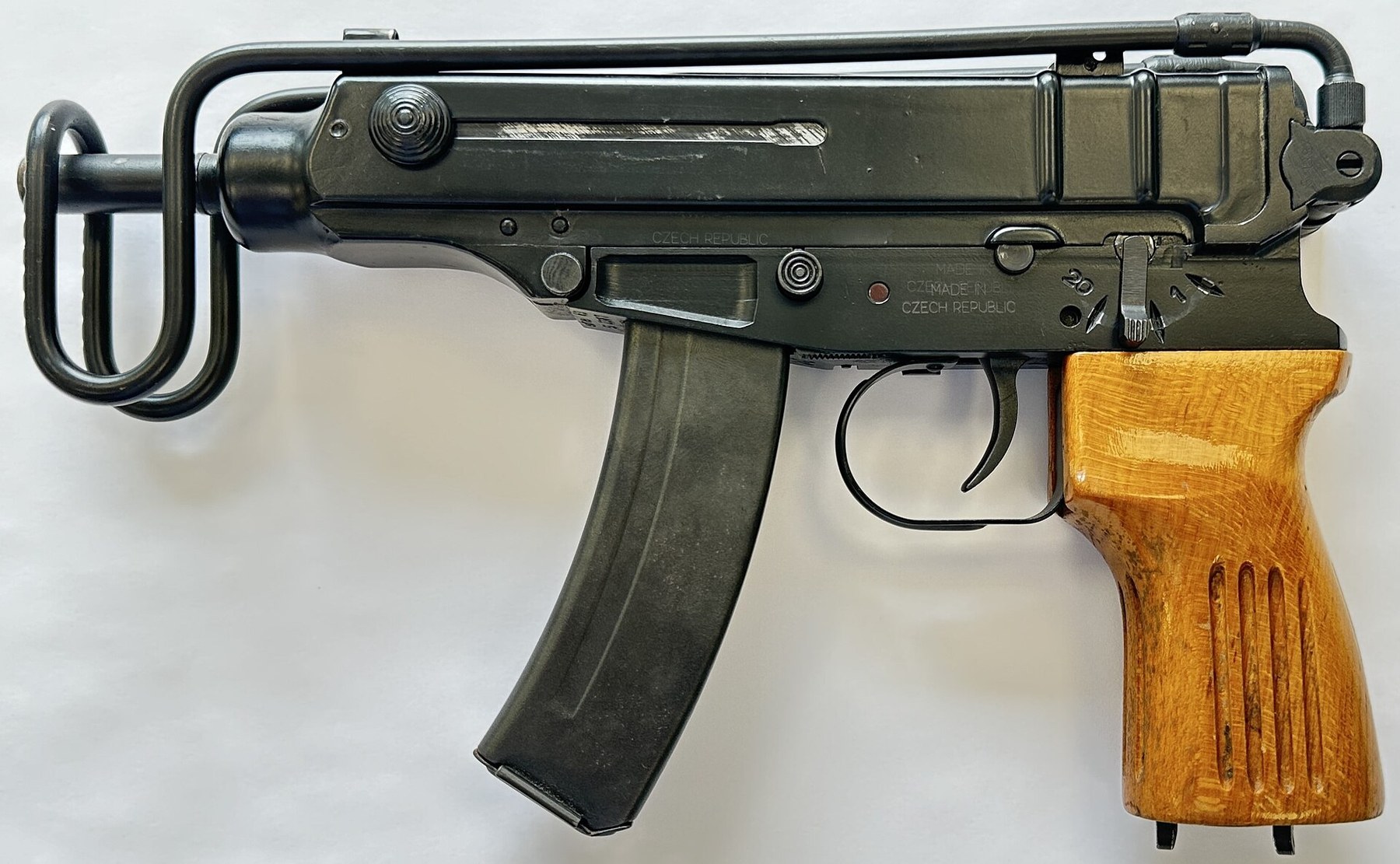
The Škorpion was not an army project. It began with a letter of 26 September 1958 from the Czechoslovak Ministry of the Interior asking the Ministry of National Defence for a “special submachine gun” in 7.65 mm, the cartridge the police already carried in their pistols. The requirement fitted on one typed page: about a kilogram, 250 mm long with the stock folded, 100 metres of useful range, and the ability to fire both single shots and bursts so that it could also serve as a pistol.1 The task was given the cover name Škorpion in the development record. A young engineer, Miroslav Rybář, led the design; his prototype was the Š-59, and the weapon entered service as the 7.65 mm samopal vzor 61 in 1961.21 Česká zbrojovka at Uherský Brod made it from 1962 or 1963 until 2000, in total somewhere around 200,000 guns, but the published totals and dates disagree, and they are set out side by side below rather than reconciled.
1.2 What the sources are
The history here rests on four kinds of source, in descending order of weight.
- The archival account. David Pazdera’s article in Střelecká revue for January 2022, marking sixty years since the gun’s introduction in December 1961, publishes the Ministry of the Interior’s original request and the development task record from the files. Only its first page is online.1
- The maker’s own account. Česká zbrojovka’s history article of 28 November 2022 names the design team and the prototype and gives a production total.2 CZ’s 1990s catalogue pages give the technical data for the vz. 61 and its 9 mm sister (Volume 3).3
- The armies’ data. The Czech Ministry of Defence’s own page on the vz. 61 (archived 2009),4 and the US Army Foreign Science and Technology Center’s Small Arms Identification and Operation Guide: Eurasian Communist Countries, published in July 1967, the earliest Western technical description found.5
- Secondary accounts by named authors: Forgotten Weapons (Ian McCollum), Small Arms Review, and Czech defence journalism. Encyclopedia entries are used only as leads and are cited where they are the only source for a figure.
No primary source for the production run by year was found. Jiří Fencl’s monograph Škorpion (Naše vojsko, 2004) and Pazdera’s series “Vývoj samopalů Škorpion” in Střelecký magazín (2000–2001) are cited in Czech reference works but were not available for this dive.
1.3 A request from the Ministry of the Interior
In 1952 Czechoslovakia had settled that all weapons for the internal security forces would be planned and procured by the Ministry of National Defence (MNO); the “power” ministries only paid for what they received. If the Ministry of the Interior (MV) wanted a weapon, it had to ask MNO.1
On 26 September 1958 the chief of the MV’s main rear services, Lieutenant-Colonel Jan Svoboda, wrote to the MNO’s artillery command under the heading Žádost o vývoj speciálního samopalu ráže 7,65 mm, “request for the development of a special submachine gun of calibre 7.65 mm”. He cited a resolution of the Communist Party’s Politburo of August 1958 on research and development, which required difficult tasks to be done in two stages, a study first and then an economic analysis and a firm schedule. The letter reached the artillery command on 1 October 1958 and the Artillery Research Centre (Výzkumné dělostřelecké středisko, VDS) in Prague three days later. VDS directed the development of infantry weapons for the Czechoslovak forces in its short life, 1956 to 1960. Someone at the artillery command, Pazdera notes, pencilled a question mark against the subject line.1
CZ’s own history puts the request “back in the mid-1950s”.2 The file letter is dated 1958, and that date is used here.
1.4 What was asked for
Svoboda’s letter gave the requirement in a few lines. Pazdera prints them:1
Table 1 — What was asked for
| Requirement, 1958 | Value |
|---|---|
| Calibre | 7.65 mm |
| Weight | 1 to 1.2 kg |
| Length, shoulder rest folded | 250 mm |
| Length, shoulder rest unfolded | 440 mm |
| Height including the grip | 150 mm |
| Effective range | 100 m |
| Magazines | two: 8 to 10 rounds, and 20 to 25 rounds |
| Fire | single shots and bursts, “so that this submachine gun also fulfils the function of a pistol”, with simple handling |
What came out of Uherský Brod three years later missed the paper requirement in every dimension, and not by much. CZ’s catalogue gives the production gun as 270 mm long with the rest folded and 522 mm with it unfolded, 167 mm high, and 1.30 kg without a magazine.3 The magazines were 10 and 20 rounds, inside the requested ranges. The army later rated the effective range at 50 m from the hand and 200 m from the shoulder (Volume 2).4
1.5 The name came first
Discussion with the MV refined the requirement into a research-and-development record, number VD 1410, titled 7,65mm speciální samopal, “7.65 mm special submachine gun”, abbreviated 7,65mm SS, “and with the cover name Škorpion”.1
That matters for a story often told about the gun. CZ’s 2022 article describes the folding stock as “shaped like, you already know, a tail of a scorpion”.2 The resemblance is real, and the name may have been chosen with a sting-in-the-tail weapon in mind. But on Pazdera’s reading of the file, Škorpion was the cover name of the development task, attached to the project before any prototype existed. Nothing in the sources consulted says who chose it or why.
The official service name was the plain one: 7,65mm samopal vzor 61, abbreviated Sa vz. 61. The Czech Ministry of Defence’s page writes the nickname with a long vowel, Škorpión.4
1.6 Why 7.65 mm Browning
The cartridge was the MV’s choice, and Pazdera’s explanation is short: Czechoslovak police had used the 7.65 mm Browning since the 1920s, and it was then the cartridge of the most numerous pistol in the MV’s forces, the ČZ vz. 50.1 CZ makes the same point, adding that the police had carried pistols in the calibre “since the late 1920s”, and that the choice disposes of a common myth that the vz. 61 was an army weapon in a strange calibre: it was a police weapon in the police calibre.2
CZ is candid about the cartridge’s limits. It calls it “the rather anemic cartridge that also caused problems with its semi-rimmed case”.2 The US Army’s 1967 guide called it “relatively weak”, and credited its mild recoil, together with the rate reducer, with making the gun “very comfortable” to fire.5
The cartridge itself, John Browning’s .32 ACP, with its SAAMI dimensions and what it does in a pocket pistol, is covered in the hub’s Ruby pistol dive, Volume 7, and is not repeated here.
1.7 Rybář and his team
CZ’s account of the design is the fullest available:2
- Once the requirement was settled, the task went to “the state-controlled research and development institute in the city of Brno”. CZ does not name the institute.
- The institute “entrusted this project to a young engineer Miroslav Rybář”. He worked with two colleagues, Otakar Galaš and Jiří Čermák, and the result was a prototype called the Š-59.
- There was “no other dedicated subcompact submachinegun in existence at that time”, so the design started from nothing.
- Rybář “also used the project as a base for analysis, that was a core of his final dissertation at the Military Technical Academy in Brno”.
The last point is often stated more strongly. Forgotten Weapons writes that the Škorpion “was actually his thesis project for his post-graduate studies at the Czech Military Technical Academy”.6 On Pazdera’s archival account the project was a ministry requirement routed through VDS, and CZ says only that Rybář drew on it for the analysis in his dissertation. The narrower wording is CZ’s and is preferred here.
Rybář’s dates are usually given as 1924 to 1970; CZ confirms only that he died “prematurely” in 1970.2 The 1924 birth year was not found in a primary source.
A Jiří Čermák is also the designer the Czech defence press credits with the vz. 58 assault rifle, made at the same Uherský Brod works.7 CZ’s article does not say that its Čermák is the same man, and this dive does not assert it.
CZ tells one story about the acceptance commission. Its members doubted that a submachine gun could be small enough to hide under clothing. Galaš answered the doubt by walking into the meeting room with the gun under his jacket and placing it on the table in front of them.2 The story is the maker’s, and no second source for it was found.
1.8 Adoption, 1961
The prototype “passed all mandatory tests”, CZ says, “and just very little was changed before it was introduced in the service of the Czechoslovak M&LE forces in 1961”.2 Pazdera dates the introduction to December 1961.1
Who it was for is clearest in the Czech Ministry of Defence’s own description, written decades later for a gun still in its inventory: “a universal automatic individual weapon”, “ideal for special units and the crews of ground combat vehicles”, which can be carried in a belt holster and fired one-handed as a pistol.4 The original users were the MV’s forces, the National Security Corps (SNB) above all; the Czechoslovak People’s Army bought it later.7 The US Army’s guide of 1967 already listed both: “used by the Czechoslovak Army and security forces”, and “offered for sale to other countries”.5 Volume 4 follows it abroad.
1.9 Machine pistol or submachine gun?
The Czech word is samopal, submachine gun, and the service name says so. English-language sources split. The US Army in 1967 called it a “machine pistol”, and its table of technical data lists it with the Stechkin and the Makarov rather than with the submachine guns.5 Small Arms Review in 2006 thought it “more properly classified as a machine pistol than true a SMG”.8 CZ in 2022 claimed it as the ancestor of the personal defence weapon.2
The argument is mostly about words. The gun is the size of a large pistol, fires a pistol cartridge from a 115 mm barrel, can be carried in a holster and fired with one hand, and also has a shoulder rest for aimed fire at longer range. This dive uses “machine pistol” and “submachine gun” interchangeably where a source does, and otherwise calls it what its makers did, the vz. 61.
1.10 Production at Uherský Brod
The maker was Česká zbrojovka’s works at Uherský Brod in Moravia, then a national enterprise.7 Production was not continuous. The Czech defence journal Armádní zpravodaj puts it at “with breaks” from 1963 to 1979.7 CZ itself counts production from 1962 to 2000.2 The difference is consistent with an initial series in 1962 before full-rate production in 1963, and with later batches after 1979, but no primary document giving the years of each batch was found.
Small Arms Review (2006), describing the parts kits that reached the United States, gives the run as “1961-1976” and says the guns were made on manually controlled machinery; it identifies a later type of 1975 to 1976 by its “tough, dark grey-blue powder paint finish”.8 Czech Wikipedia describes runs of about 100,000 to mid-1966, 55,000 in 1973 to 1976 and 45,000 in 1978 to 1979, with a 1962 trial series of 200, but cites no document for them, and they are not relied on.9
The original grips were wood; plastic grips appear on later guns. Czech reference works date the change to 1978, without a primary source.
After the end of CZ production, the Škorpion was revived by a different company. Czech Small Arms of Jablůnka nad Bečvou began new manufacture after 2008, Pazdera says, when demand from civilian buyers outran the supply of guns sold off by the armed forces, in semi-automatic and fully automatic forms and in four calibres.1 Its products, and the earlier D-Technik pistols exported to the United States, are in Volume 3.
1.11 How many were made
The published totals do not agree, and they are given separately.
Table 2 — How many were made
| Source | Total | Years |
|---|---|---|
| Česká zbrojovka, 2022 | ”over 207.000” | 1962–2000 |
| Forgotten Weapons (Ian McCollum) | “approximately 210,000” | 1961–1979 |
| Czech Wikipedia, “Samopal vzor 61” (runs not cited to a document) | “cca 210 000” | 1963–1979, with a further run in 1992–1994 unquantified |
The maker’s figure is the best-sourced, but CZ does not say whether it counts semi-automatic guns or the 9 mm variants, and it gives no breakdown. The two “about 210,000” figures may share an origin; neither cites a document. Exports and the Yugoslav licence production (Volume 4) are additional to all three.
1.12 After Rybář
Rybář went on to design 9 mm versions in the 1960s: the vz. 64 in 9 mm Browning (.380 ACP) and the vz. 65 in 9 mm Makarov, both prototypes, and before his death in 1970 the vz. 68 in 9×19 mm, which CZ calls “the last and most advanced design of the whole Škorpion family”.2 None was adopted. Later developments by CZ, among them the 9 mm Browning vz. 83 that CZ’s catalogue offered for sale, the semi-automatic CZ 91 S, a 9×19 mm Škorpion of the 1990s and the CZ 868, are described and illustrated in Volume 3.
The modern CZ Scorpion EVO 3 shares the name and nothing else of substance; it is a different design, also in Volume 3.
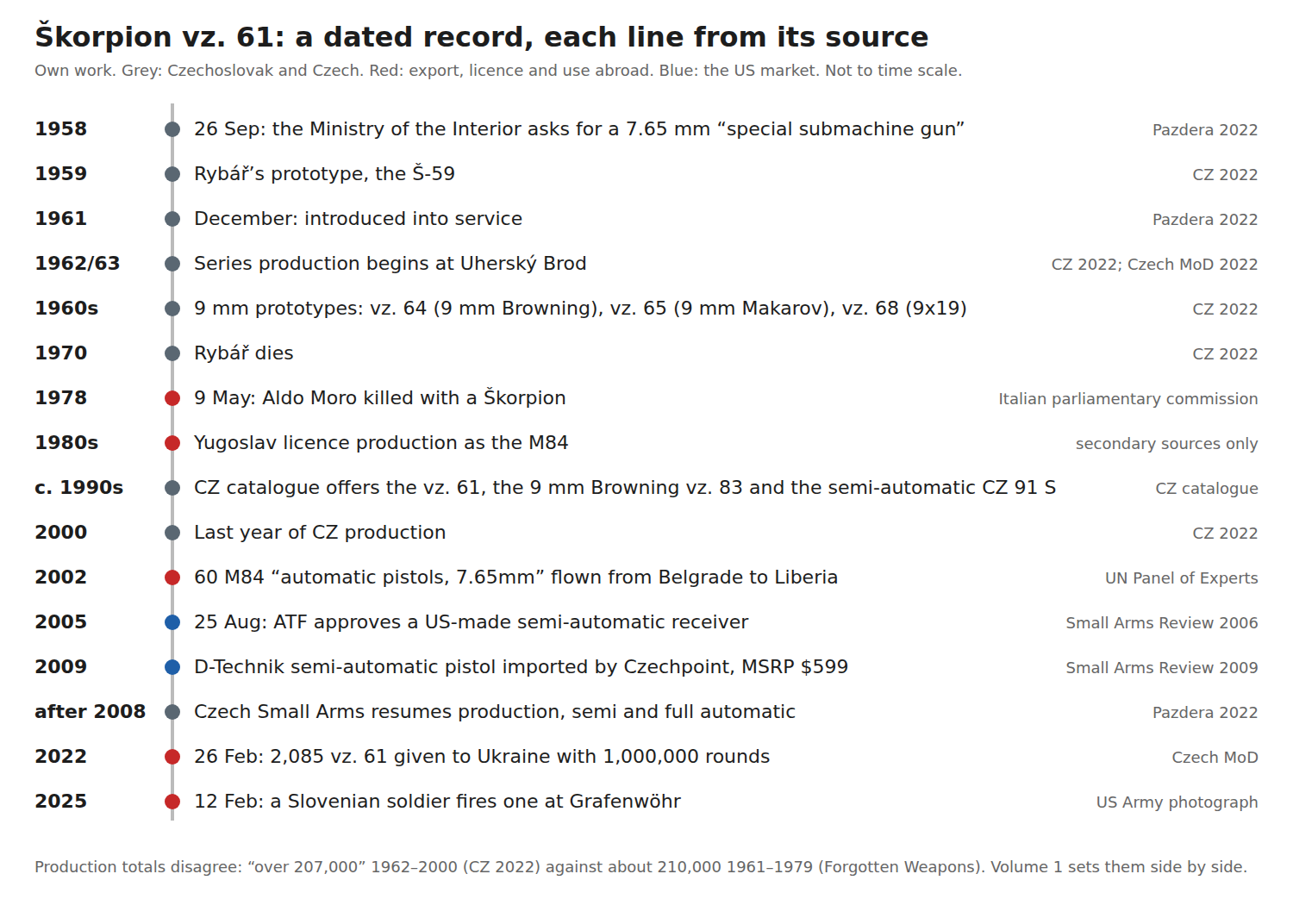
1.13 A dated record
1.14 What could not be verified
- Who chose the cover name Škorpion, and why.
- The name of the Brno institute where Rybář worked, and the title of his dissertation.
- Rybář’s year of birth (1924 in reference works).
- Whether the Jiří Čermák of the Škorpion team is the vz. 58’s designer.
- Production by year, by grip material and by calibre. The three totals above are not reconciled.
- The date grips changed from wood to plastic.
- The Galaš story, which only CZ tells.
References
Footnotes
-
David Pazdera, “Jak vznikl Škorpion: žádost o vývoj”, Střelecká revue, January 2022, p. 74, https://www.streleckarevue.cz/wp-content/uploads/2021/12/74-skorpion.pdf (accessed 2026-10-19). Only the first page of the article is online. Translations for this dive. ↩ ↩2 ↩3 ↩4 ↩5 ↩6 ↩7 ↩8 ↩9 ↩10
-
Česká zbrojovka a.s., “Vz. 61 Škorpion – The PDW Founding Father”, 28 November 2022, https://www.czfirearms.com/news/vz-61-skorpion-the-pdw-founding-father (accessed 2026-10-19). ↩ ↩2 ↩3 ↩4 ↩5 ↩6 ↩7 ↩8 ↩9 ↩10 ↩11 ↩12 ↩13
-
Česká zbrojovka, catalogue pages 17 to 19 (“CZ 91 S”, “Samopal vz. 83 - Škorpion”, “Samopal vz. 61 - Škorpion”), undated, 1990s, reproduced in Ian McCollum, “Czech vz.61 Photos and Catalog”, Forgotten Weapons, 9 October 2013, https://www.forgottenweapons.com/czech-vz-61-photos-and-catalog/ (accessed 2026-10-20). ↩ ↩2
-
Ministerstvo obrany ČR, “7,65mm samopal vzor 61 Škorpión”, army.cz, page dated 2004, archived 7 February 2009, https://web.archive.org/web/20090207201124/http://www.army.cz/scripts/detail.php?id=5081 (accessed 2026-10-19). ↩ ↩2 ↩3 ↩4
-
US Army Foreign Science and Technology Center, Small Arms Identification and Operation Guide: Eurasian Communist Countries, FSTC-CS-07-35-66, July 1967, section E, paragraphs 25 to 30 and Table I, https://archive.org/details/fstc-cs-07-35-66-small-arms-identification-and-operation-guide-eurasian-communist-countries (accessed 2026-10-19). ↩ ↩2 ↩3 ↩4
-
Ian McCollum, “Vz61 Skorpion”, Forgotten Weapons, undated (about 2011–2013), https://www.forgottenweapons.com/submachine-guns/vz61-skorpion/ (accessed 2026-10-19). ↩
-
Lukáš Vít, “ČR dodala Ukrajině lehké zbraně”, Armádní zpravodaj, 1 March 2022, https://armadnizpravodaj.cz/vyzbroj/cesko-ukrajine-dodalo-lehke-zbrane/ (accessed 2026-10-20). ↩ ↩2 ↩3 ↩4
-
William R. Bishop, “The Skorpion Comes to America”, Small Arms Review vol. 9 no. 11, August 2006, https://smallarmsreview.com/?p=4361 (accessed 2026-10-19). ↩ ↩2
-
“Samopal vzor 61”, Czech Wikipedia, https://cs.wikipedia.org/wiki/Samopal_vzor_61 (accessed 2026-10-19). Used only for figures it gives without a document, and labelled as such. ↩
Comments (0)