Škorpion vz. 61 · Volume 5
Field Strip, Maintenance and Repair
Clearing and stripping the vz. 61 by the US Army's 1967 drill, with no tools, as its makers promised; cleaning, lubrication and storage from the current maker's manual; what goes wrong and why, from both sources side by side; the parts that wear, and where magazines and spares come from today
5.1 The sources, and the manual that was not found
The Czechoslovak army issued a manual for the vz. 61. The training chart reproduced in Volume 2 is numbered as figure 127 of something larger, and the Czech Ministry of Defence’s description lists “simplicity of disassembly (without the use of any tools), maintenance, and the possibility of complete exchange of individual parts” among the gun’s virtues.1 But the manual itself, its title and its number, were not found for this dive, in print or online.
This volume therefore rests on two documents, and says which one each step comes from:
- The US Army’s 1967 guide, FSTC-CS-07-35-66, which gives a clearing drill, a field strip, a reassembly sequence, maintenance guidance and a malfunction table for the select-fire gun.2
- Czech Small Arms’ manual for its semi-automatic Sa vz. 61 Pistol (2016), which gives storage, a “partial disassembly” for the user, inspection, cleaning and preservation, and a fuller troubleshooting table.3 It describes a gun with the same receiver, bolt, springs and takedown, but without automatic fire or the rate reducer. Where it is used for the military gun, that is said.
The two agree on the field strip in every step that both describe.
5.2 Clearing the gun
The US Army’s drill, paragraph 27f, in order:2
- Remove the magazine: press the magazine catch, in front of the trigger guard, and the magazine is released.
- Press up on the bolt stop and pull the bolt fully to the rear with the cocking knobs. The bolt stop catches and holds it.
- Set the selector to 0 (safe) and look into the chamber and the magazine well to make sure that no cartridge is present.
- Move the selector off 0, pull the knobs slightly back and let the bolt go forward.
- Set the selector back to 0.
The current manual adds a rule for a failure to fire with a cartridge in the chamber: wait 10 seconds before pulling the bolt back to remove it, because of the “danger of delayed ignition”.3
5.3 Field strip
The US Army’s sequence, paragraph 28, for the select-fire gun:2
- Extend the shoulder brace. The folded stock lies over the top of the upper receiver and must be out of the way.
- Clear the gun as above, and leave the magazine out.
- Pull the takedown pin out to the left as far as it will go. It is captive and does not come out of the gun.
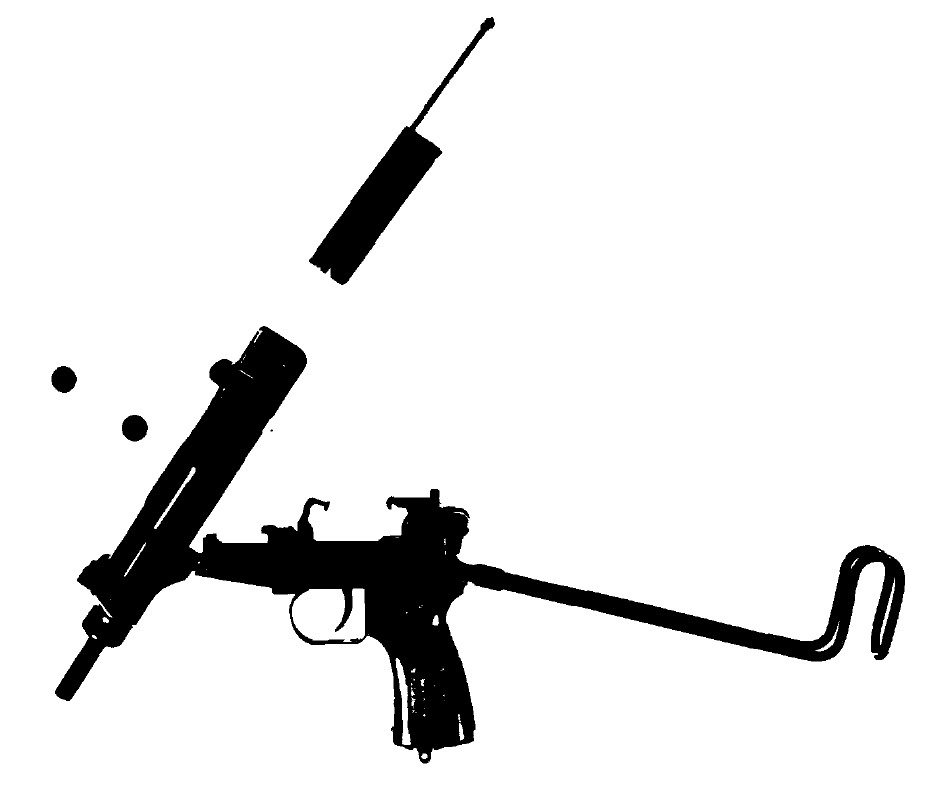
- Pull the upper receiver forward about three-sixteenths of an inch (about 5 mm), and swing the barrel end down away from the body.
- Pull the bolt fully to the rear and pull the two cocking knobs out sideways. The bolt is now free.
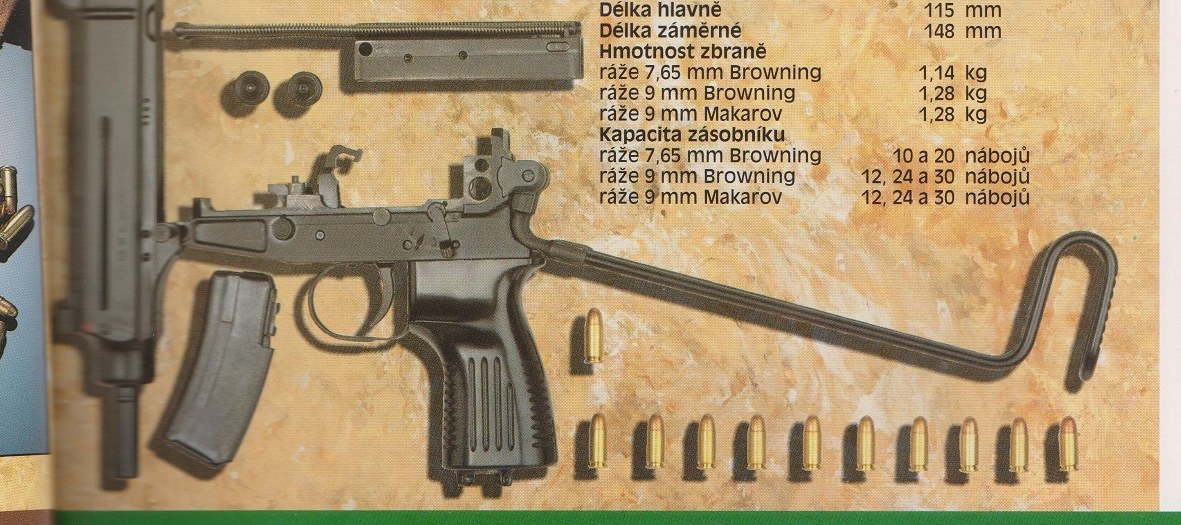
- Pull the bolt and the driving springs out of the upper receiver.
“No further disassembly is necessary or desirable.”2
The current manual’s “partial disassembly” for the semi-automatic pistol is the same in substance. To free the receiver cover, press the protruding end of the cover pin on the right side, pull the connecting pin out to the left until it stops, push the cover forward and tilt it; then draw the bolt to the rear, remove both cocking knobs and take the bolt out. It adds that “regular check and maintenance require opening of the bolt and receiver cover only”, which “provides sufficient access to trigger mechanism and receiver”.3 The pressing of the pin’s right-hand end releases the spring latch that the Czechoslovak chart shows on the connecting pin (Volume 2).
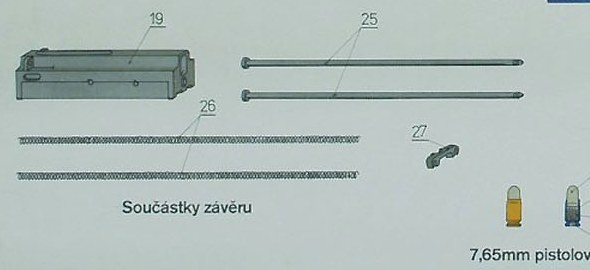
The bolt group as it comes out is shown on the Czechoslovak chart: bolt (19), the two return-spring guide rods (25), the two return springs (26) and the spring retainer (27).4
5.4 Reassembly
The US Army’s sequence, paragraph 28e and f:2
- Put the bolt and its driving springs into the upper receiver.
- Line up the elongated holes in the bolt with the enlarged part of the slot in the upper receiver, and insert the cocking knobs.
- Slide the bolt fully forward.
- Swing the upper receiver into place on the body and slide it to the rear until the takedown pin can be pushed back in.
- Insert the magazine and fold the shoulder brace forward.
The current manual says only: “Follow up the reverse procedure to assemble the Pistol after all components are entirely cleaned, dry and preserved.”3
5.5 Further disassembly
The two sources take the same position from different directions. The US Army: “No further disassembly is necessary or desirable”, and “these weapons should be disassembled only to the extent necessary for adequate cleaning, in order to prevent breakage and subsequent loss of use”.2 Czech Small Arms divides disassembly into “partial”, which “can be performed by each individual user”, and “complete”, which “is executed only in specialized workshops for repair reasons by authorized gunsmiths”.3
The manual’s complete-disassembly procedure covers the bolt, the extractor, the receiver-cover pin, the trigger group and the ejector, bolt catch and magazine catch, using a punch.3 It describes the semi-automatic pistol’s fire control, not the military gun’s, and is not reproduced here; in keeping with this hub’s rule for select-fire weapons, no detail strip of the automatic fire-control group or the rate reducer is given. On a registered machine gun that work belongs with a qualified armourer in any case.
5.6 Cleaning and lubrication
The US Army’s guidance of 1967 is general: “The procedures and materials prescribed for cleaning standard U.S. Army pistols also apply to Eurasian Communist pistols.”2
The current manual is specific:3
- Clean after every use. “The gun should be disassembled, cleaned and assembled after each use. Special attention must be paid to cleaning of the barrel and cartridge chamber.”
- Materials. “Clean and soft cloths are recommended for cleaning the gun and accessories.”
- Preservation. Vaseline (petroleum jelly) “should be used for preservation to protect the pistol against corrosion during long term storage”.
- Cold weather. Below 0 °C, “a mixture of gun oil and vaseline (3:1 ratio)”.
- Moving parts are to be oiled, and the barrel and chamber “cleaned and wiped dry”.
The 1967 guide lists the issue cleaning equipment as a cleaning rod, an oil container and a front-sight adjustment tool.2
Neither source lists lubrication points by name. On the evidence of the mechanism (Volume 2), the moving surfaces are the bolt in the upper receiver, the return springs on their guide rods, and the trigger group; the rate reducer in the grip is not accessible in a field strip.
5.7 Storage
The current manual: “The Pistol has to be stored with bolt in front position in order not to overstrain the springs; the safety must be in position ‘0’.”3 The reason applies equally to the military gun, whose two return springs CZ describes as “not very stiff” (Volume 2).5
5.8 Inspection
The current manual’s inspection, in two stages:3
Assembled: the condition of components (corrosion, dirt, completeness); the sights; free movement of the bolt and the trigger; magazines undamaged.
Disassembled: clean every component first; look for corrosion, dirt and “excessive wear-out”; inspect the bore and grooves for powder remnants, corrosion, dark stains, worn lands, bulges or cavities and mechanical damage; check that every component is present before reassembly.
Zeroing is the maker’s: “Each pistol is zeroed by the producer”, and re-zeroing is needed only after damage, chiefly to the sights, and is to be done “only by highly qualified staff”.3 On the military gun, the front-sight screw is the adjustment and the issued tool turns it (Volume 2).2
5.9 Malfunctions: the two published tables
The US Army’s table, 1967:2
Table 1 — Malfunctions: the two published tables
| Condition | Cause | Remedy |
|---|---|---|
| Fails to fire, cartridge in chamber | defective cartridge | reload |
| Fails to fire, no cartridge in chamber | defective magazine | replace magazine |
| Fails to extract or eject | fouled weapon | clean and lubricate |
and the general rule: “Most malfunctions and stoppages are caused by defective magazines or ammunition.”2
The current manual’s table, for the semi-automatic pistol:3
Table 2 — Malfunctions: the two published tables
| Failure | Cause | Remedy |
|---|---|---|
| No shot when the trigger is pulled | defective firing pin; fatigued hammer spring; defective cartridge | replace the firing pin; replace the hammer spring; after 10 seconds remove the cartridge by hand |
| Bolt does not close fully | dirt in bolt or receiver; defective cartridge; dirt in chamber | open, clean and oil; remove the cartridge by hand; clean the chamber |
| No cartridge fed | dirt in the magazine; defective magazine body; fatigued or broken follower spring; “recoil too short” | clean or replace the magazine; replace the follower spring; clean the gun |
| Case not ejected | bolt travel too short; defective cartridge rim | clean the gun; replace the cartridge |
| Cartridges not held in the magazine | magazine spring too strong, or feed lips too wide | replace the spring or the magazine |
| Bolt not held open after the last round | defective follower; clogged bolt catch | replace the follower; replace or adjust the bolt catch |
Read together, the two tables point at the same things. Most stoppages come from the magazine or the cartridge. Short recoil, which the CSA table lists under both feeding and ejection, means a fouled gun or weak ammunition, not a mechanical fault. And the parts the current maker expects an owner to replace are the firing pin, the hammer spring, the follower and its spring, and the magazine.
5.10 Parts that wear
No replacement interval for any vz. 61 part is published in any source found. The parts named as failing in the maker’s table are the firing pin, the hammer spring, the magazine follower and follower spring, and the magazine body and lips.3 The return springs are light by design.5 Volume 1’s note on the semi-rimmed case (CZ: “problems with its semi-rimmed case”) suggests the extractor and magazine lips as the places to look when extraction or feeding goes wrong, but no source quantifies their wear.5
5.11 What an owner can do, and what needs a gunsmith
On the current maker’s division: the user may do the partial disassembly, cleaning, preservation, inspection, magazine changes and the replacement of the magazine follower and spring; complete disassembly for repair belongs to “authorized gunsmiths”; and re-zeroing to “highly qualified staff”.3 The 1967 guide drew the line in the same place: “No repairs should be attempted on foreign pistols other than replacement of parts, and this should be done only by a competent armorer.”2
For a registered machine gun in the United States, the fire-control group and the rate reducer are the parts that make it what it is in law (Volume 6). Work on them is for a qualified armourer who knows the gun, and nothing in this volume describes it.
5.12 Spares and magazines today
Magazines and accessories are sold in the United States. Arsenal Inc.’s catalogue, read on 20 October 2026, listed a 20-round .32 ACP vz. 61 magazine at $22.99 (on sale from $29.99), packs of five 20-round magazines at $159.99 and of five 10-round magazines at $109.99, a cleaning kit at $6.99 (on sale from $19.99), and leather holsters and magazine pouches, one described as surplus.6 The catalogue does not say whether the magazines are new or surplus. The US importer of the current Czech Small Arms pistols, Czechpoint, listed on the same day surplus 7.65 mm magazines (20-round “Grade 2” at $19.50, 10-round at $30.00), new clear-polymer and black 20-round magazines for its .380, 9×18 and .22 LR pistols at $22.50, and individual parts such as a safety lever ($9.50), a barrel pin ($19.50), a trigger guard ($39.00) and a surplus upper receiver, repainted ($119.00).7 Federal law does not regulate magazines; some states do. Whether a given magazine fits a given semi-automatic pistol was not checked for this dive, and the 9 mm guns use their own straight magazines (Volume 3).
Internal spare parts for the military fire control are a different matter. Small Arms Review estimated in 2006 that fewer than 550 Czech parts kits were in the United States, and expected later imports to come without intact barrels.8 Parts kits are covered, as a legal matter only, in Volume 6.
5.13 Ammunition
The vz. 61 is chambered for the 7.65 mm Browning, the .32 ACP. The cartridge, its SAAMI dimensions and pressures, and what to feed an old pistol, are in the hub’s Ruby pistol dive, Volume 7. The current maker asks for “high quality, commercially manufactured ammunition” that complies with SAAMI’s standards.3 The Czech army’s issue was the náboj NB 7,65-Browning, of which a million went to Ukraine with the guns in 2022 (Volume 4).9
5.14 What could not be verified
- The title, number and date of the Czechoslovak army manual for the vz. 61, and its field-strip, cleaning and inspection procedures.
- Replacement intervals for any part.
- Whether Arsenal Inc.’s magazines are new manufacture or surplus.
- Whether surplus military magazines fit the current semi-automatic pistols.
- Lubrication points named by any maker.
References
Footnotes
-
Ministerstvo obrany ČR, “7,65mm samopal vzor 61 Škorpión”, army.cz, page dated 2004, archived 7 February 2009, https://web.archive.org/web/20090207201124/http://www.army.cz/scripts/detail.php?id=5081 (accessed 2026-10-19). Translations for this dive. ↩
-
US Army Foreign Science and Technology Center, Small Arms Identification and Operation Guide: Eurasian Communist Countries, FSTC-CS-07-35-66, July 1967, paragraphs 27 to 30, sections F and G, figure 11 and Table II, https://archive.org/details/fstc-cs-07-35-66-small-arms-identification-and-operation-guide-eurasian-communist-countries (accessed 2026-10-19). ↩ ↩2 ↩3 ↩4 ↩5 ↩6 ↩7 ↩8 ↩9 ↩10 ↩11 ↩12
-
Czech Small Arms s.r.o., Sa vz. 61 Pistol Instructions Manual, Part II, chapters 2 to 5, PDF dated 29 September 2016, https://csa.co.cz/files/files/texty/1639562589_sa_vz_61_pistol_instructions_manual.pdf (accessed 2026-10-19). A semi-automatic pistol; quoted as published, including its English. ↩ ↩2 ↩3 ↩4 ↩5 ↩6 ↩7 ↩8 ↩9 ↩10 ↩11 ↩12 ↩13 ↩14
-
Czechoslovak army training chart, “7,65mm samopal vz. 61”, Obr. 127, undated, published in Ian McCollum, “Czech vz.61 Photos and Catalog”, Forgotten Weapons, 9 October 2013, https://www.forgottenweapons.com/czech-vz-61-photos-and-catalog/ (accessed 2026-10-20). ↩
-
Česká zbrojovka a.s., “Vz. 61 Škorpion – The PDW Founding Father”, 28 November 2022, https://www.czfirearms.com/news/vz-61-skorpion-the-pdw-founding-father (accessed 2026-10-19). ↩ ↩2 ↩3
-
Arsenal Inc., “VZ61 Skorpion” parts and accessories, https://www.arsenalinc.com/usa/product-category/parts-accessories/vz61-skorpion/ (read 2026-10-20). ↩
-
Czechpoint, Inc., online store, https://czechpoint-usa.com/ and https://czechpoint-usa.com/vz-61-parts-accessories/ (read 2026-10-20). ↩
-
William R. Bishop, “The Skorpion Comes to America”, Small Arms Review vol. 9 no. 11, August 2006, https://smallarmsreview.com/?p=4361 (accessed 2026-10-19). ↩
-
Ministerstvo obrany ČR, “Vláda schválila další dar v podobě vojenského materiálu Ukrajině”, 26 February 2022, https://mocr.army.cz/informacni-servis/zpravodajstvi/vlada-schvalila-dalsi-dar-v-podobe-vojenskeho-materialu-ukrajine-233798/ (accessed 2026-10-20). ↩
Comments (0)