Škorpion vz. 61 · Volume 4
In Service and in the News: Users, Exports, the Moro Murder and Ukraine
Who carried the vz. 61, from the Czechoslovak police and army crews to a Slovenian tank crew in 2025, as far as primary records show it; the Yugoslav licence and an embargo-breaking consignment to Liberia; the Red Brigades and the killing of Aldo Moro; and the 2,085 the Czech Republic sent to Ukraine in 2022
4.1 What counts as evidence here
Reference works print long lists of countries said to have used the vz. 61, usually without a source for any line. This volume uses only what a government, an international body, a museum or the maker records, or what a dated, credited photograph shows. A user that appears only in an uncited list is not repeated as fact. The result is a shorter list, and every line of it can be checked.
4.2 Czechoslovakia: police first, then the army
The weapon was ordered by the Ministry of the Interior (Volume 1), and its first users were the ministry’s own forces. The Czech defence journal Armádní zpravodaj, writing in 2022: “The weapon was ordered first by the Czechoslovak Ministry of the Interior, and hence the calibre 7.65 mm, which was the standard pistol calibre of members of the MV and the SNB; later the ČSLA bought it too.”1 The SNB was the National Security Corps, the uniformed police; the ČSLA was the Czechoslovak People’s Army.
The army’s use was specialised. The Czech Ministry of Defence’s own description calls it “ideal for special units and the crews of ground combat vehicles”, carried in a belt holster and usable as a pistol.2 Armádní zpravodaj adds officers and the crews of armoured vehicles.1 The US Army’s 1967 guide already recorded both sets of users: “used by the Czechoslovak Army and security forces”.3
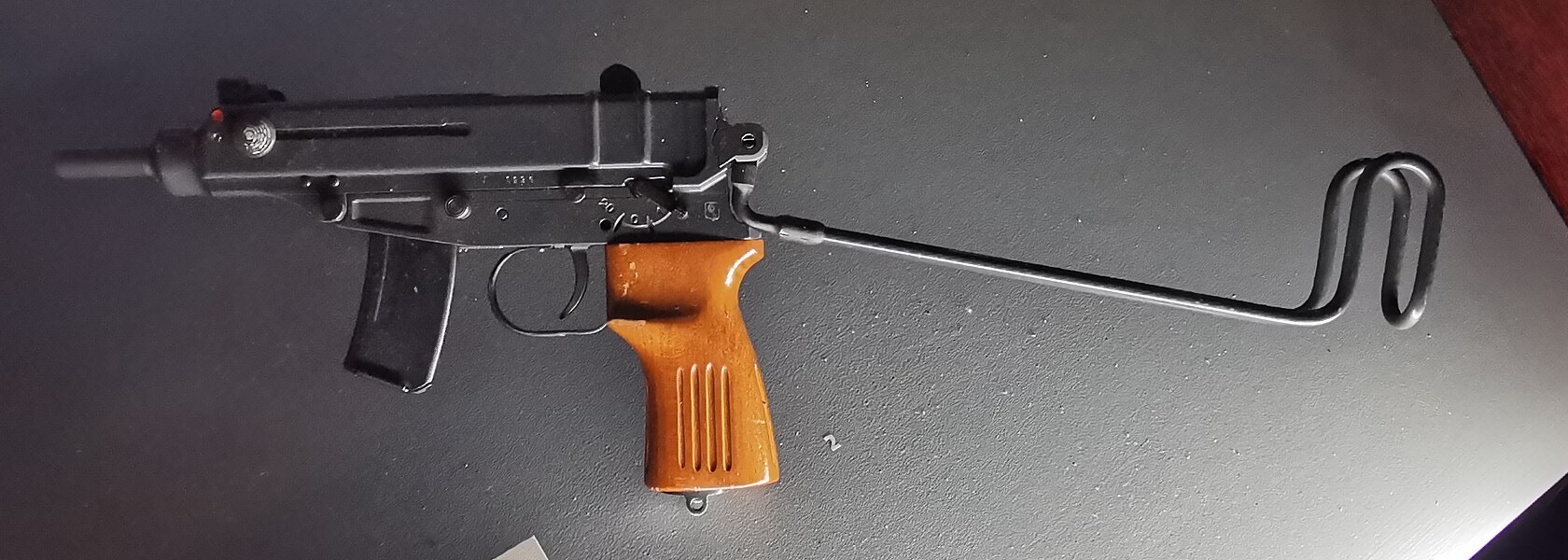
The Prague Castle Guard, the unit that guards the seat of the head of state, displays a vz. 61 in its exhibition at the castle.4 The photograph’s description gives a period of service of “1948 until 1989”, which is the period of the exhibit, not of the gun: the vz. 61 did not exist before 1961.
4.3 The Czech Republic
The Czech Republic inherited the guns in 1993. The Czech Ministry of Defence still described the vz. 61 on its website in 2004 as a current weapon, with its issue scale of one short and four long magazines, and its data.2 How long it remained on issue, and in which units, was not found in an official document.
4.4 Ukraine, 2022
On 26 February 2022, two days after the Russian invasion, the Czech government approved a gift of small arms and ammunition to Ukraine. The Ministry of Defence published the list. It included:5
Table 1 — Ukraine, 2022
| Item | Quantity |
|---|---|
| 7.65 mm samopal vz. 61 Škorpion | 2,085 |
| 7.65 mm Browning cartridges | 1,000,000 |
| 9 mm pistol vz. 82 | 30,150 |
| 7.62 mm assault rifle vz. 58 | 5,000 |
| 7.62 mm universal machine gun vz. 59 | 3,200 |
with sniper rifles and other ammunition, to a total book value of 188,106,550 Czech crowns. The ministry noted that the gift required an exception from the condition that the material be “permanently surplus”.5 Armádní zpravodaj reported that the weapons had reached Ukraine by 27 February.1 So in 2022 the Czech army still held at least 2,085 vz. 61s and a million rounds for them.
4.5 Exports and the Yugoslav licence
The US Army knew by 1967 that the vz. 61 “has also been offered for sale to other countries”.3 Which countries bought it, and how many, is not in any primary document found for this dive.
The one export that is well attested is the licence to Yugoslavia. CZ names the licence copy the Zastava M-84; Small Arms Review calls the Yugoslav guns “M61(j)”.67 Volume 3 sets out what is and is not known about it, and the name collision with Zastava’s M84 machine gun. Czech Wikipedia states that 30,000 guns of the second Czechoslovak production series went officially to Yugoslavia; it cites no document for the figure, and it is given here only as an unconfirmed claim.8
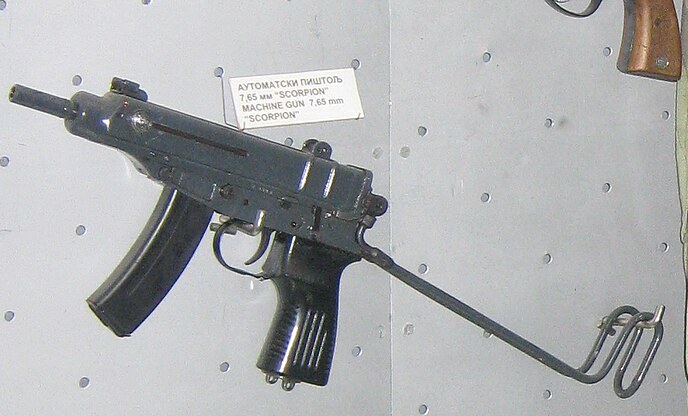
The Belgrade Military Museum exhibits a Škorpion in the display case of equipment of the Yugoslav Army’s 72nd Special Brigade from the Kosovo war of 1999. Its label reads “АУТОМАТСКИ ПИШТОЉ 7,65 мм ‘SCORPION’”, automatic pistol 7.65 mm, and in English “MACHINE GUN 7,65 mm ‘SCORPION’”. Whether it was made in Czechoslovakia or Yugoslavia cannot be told from the photograph.9
4.6 Liberia, 2002
In 2002 Liberia was under a United Nations arms embargo. The Security Council’s Panel of Experts on Liberia traced six flights from Belgrade, via a fuel stop in Tripoli, to Roberts International Airport near Monrovia, between 1 June and 25 August 2002, and inspected copies of the packing lists. The fourth flight, landed on 5 July 2002, carried among other things “60 automatic pistols M84, 7.65mm” and 75,000 rounds of 7.65 mm ammunition; the fifth carried another 6,000 rounds of 7.65 mm.10 The same list includes “machine guns M84, 7.62mm”, Zastava’s general-purpose machine gun (Volume 3).
4.7 Still in use: a Slovenian soldier in 2025
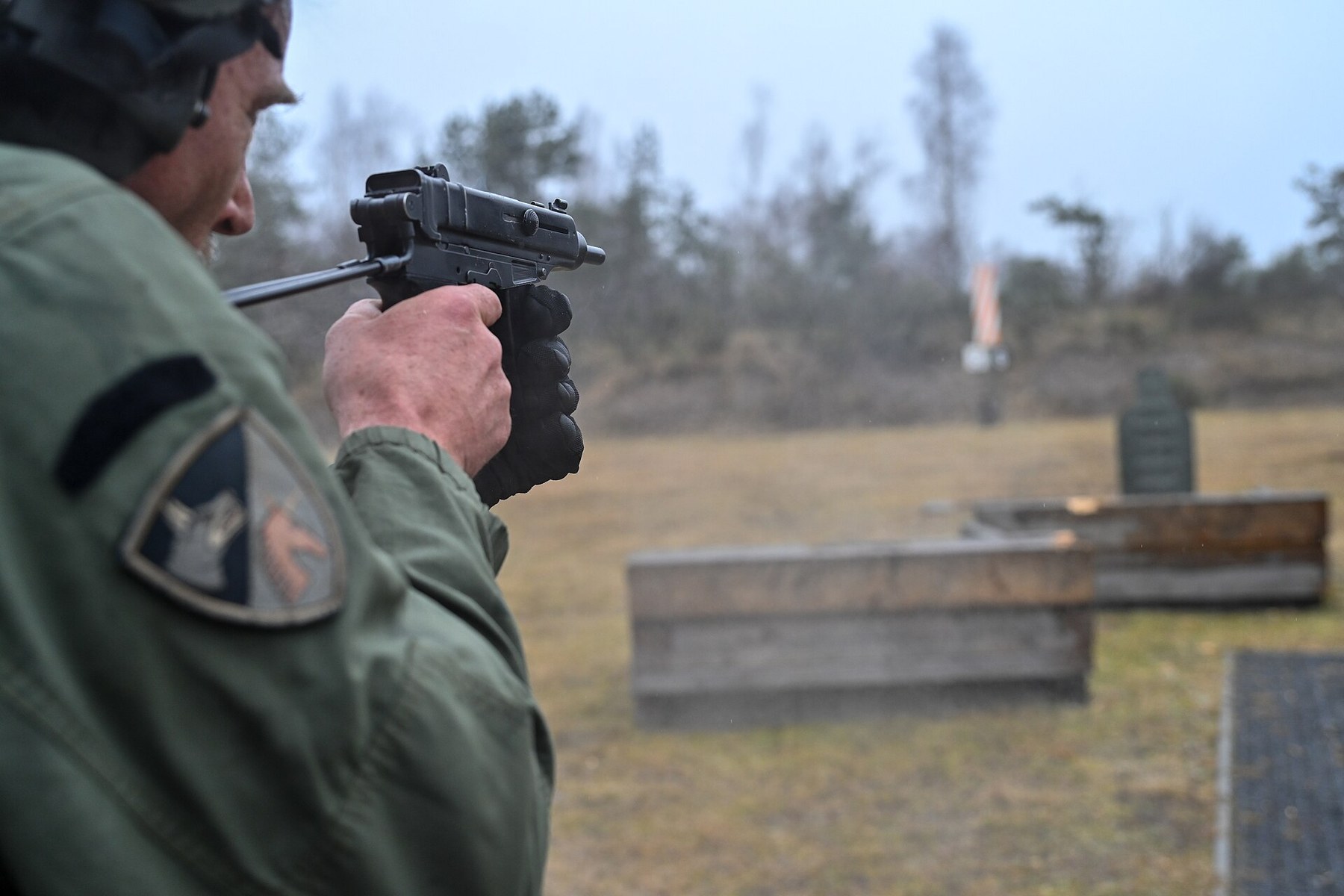
A US Army photograph of 12 February 2025 shows a Slovenian soldier firing a Škorpion in a pistol stage of the International Tank Challenge, a competition for tank crews.11 It is the clearest recent picture of the role the Czech Ministry of Defence described: a compact automatic weapon for the crew of a combat vehicle.2 The photograph’s caption names the soldier’s country but not the weapon’s model or maker. Slovenia was part of Yugoslavia until 1991, and a Yugoslav-made M84 is as likely as a Czechoslovak gun; the photograph does not settle which.
4.8 Museums
Besides the Prague and Belgrade displays above, the Swedish Army Museum holds a vz. 61 with its detachable suppressor (Volume 2), catalogued as “a fully and semi-automatic submachine gun of Czech manufacture” with a 20-round magazine, in 7.65 mm Browning.12 A museum holding is not evidence that Sweden used the gun.
4.9 Notoriety: the Red Brigades and Aldo Moro
Its best-known use is a crime. Aldo Moro, a founder of Italy’s Christian Democrats, several times prime minister and from 1976 president of the party’s national council, was kidnapped in Via Fani in Rome on 16 March 1978 by a Red Brigades commando that killed the men of his escort. His body was left in the boot of a car in Via Caetani, where it was found on 9 May 1978.13 He had been shot with a Škorpion.
The attribution rests on the Italian state’s own record. The Italian Parliament’s commission of inquiry into the kidnapping and death of Aldo Moro, in the legislature of 2013 to 2018, treated it as settled and investigated the gun itself: at its meeting of 25 July 2017 it agreed to task its consultants “to examine further the question of the Skorpion submachine gun used to kill Aldo Moro” (la mitraglietta Skorpion utilizzata per uccidere Aldo Moro).14 The commission’s findings on the gun were not read for this dive, and the details that circulate, the number of shots, a second weapon, and claims that the same gun was used on other victims, are not repeated here because no primary source for them was found.
The Škorpion’s later reputation in Western Europe, as the weapon of choice of terrorists, is rooted in cases like this one. The Czech defence press puts it more bluntly, saying that in export form it serves many police forces worldwide “and is very popular with members of the underworld”.1
4.10 Why it suited the wrong hands
No source found analyses why criminals and terrorists chose the vz. 61, and this dive offers none of its own. What the sources do record is what the gun was designed to be. The 1958 requirement asked for a weapon of about a kilogram, 250 mm long folded, that could also serve as a pistol.15 The army describes a gun that can be carried in a belt holster and fired with one hand.2 CZ tells how a member of the design team convinced the acceptance commission that it could be concealed by carrying it into the meeting under his jacket (Volume 1).6 Those are the properties the design was built for, and they are the same properties that made it attractive to anyone who needed a concealed automatic weapon.
4.11 The user lists in reference works
The longer lists, in Czech and English Wikipedia and in game and film databases, name more than twenty countries and several non-state groups, among them the Viet Cong and North Korean special forces. Most lines cite nothing or cite another reference work. This dive found primary support for the users named above and no others. The lists are not reproduced.
Film and video-game appearances are many and are catalogued by the Internet Movie Firearms Database. They are part of why the gun is famous, and are not covered here.
4.12 What could not be verified
- Export customers and quantities other than Yugoslavia, and the 30,000 figure for Yugoslavia.
- Which Czech units carried the vz. 61, and when it was withdrawn.
- Whether the Slovenian soldier’s gun is Czechoslovak or Yugoslav.
- The Moro commission’s findings on the gun: its origin, the shots fired, and any link to other crimes.
- Any primary source for the users in the reference-work lists.
References
Footnotes
-
Lukáš Vít, “ČR dodala Ukrajině lehké zbraně”, Armádní zpravodaj, 1 March 2022, https://armadnizpravodaj.cz/vyzbroj/cesko-ukrajine-dodalo-lehke-zbrane/ (accessed 2026-10-20). Translations for this dive. ↩ ↩2 ↩3 ↩4
-
Ministerstvo obrany ČR, “7,65mm samopal vzor 61 Škorpión”, army.cz, page dated 2004, archived 7 February 2009, https://web.archive.org/web/20090207201124/http://www.army.cz/scripts/detail.php?id=5081 (accessed 2026-10-19). ↩ ↩2 ↩3 ↩4
-
US Army Foreign Science and Technology Center, Small Arms Identification and Operation Guide: Eurasian Communist Countries, FSTC-CS-07-35-66, July 1967, paragraph 25, https://archive.org/details/fstc-cs-07-35-66-small-arms-identification-and-operation-guide-eurasian-communist-countries (accessed 2026-10-19). ↩ ↩2
-
Mateus2019, “Prague Castle Guard museum, Sa vz. 61 ‘Škorpion’”, photograph, 25 January 2024, Wikimedia Commons, CC BY 3.0 DE, https://commons.wikimedia.org/wiki/File:CZE_%E2%80%93_St%C5%99edo%C4%8Desk%C3%BD_kraj_%E2%80%94_Praha_%E2%80%94_Oblast_1_%E2%80%94_Hrad_I._%E2%80%94_Vik%C3%A1%C5%99sk%C3%A1_38_(Pra%C5%A1n%C3%A1_v%C4%9B%C5%BE_Mihulka_%C2%B7_St%C3%A1l%C3%A1_expozice_Hradn%C3%AD_str%C3%A1%C5%BEe_%C2%B7_Sa_vz._61_%E2%80%9C%C5%A0korpion%E2%80%9D)_2024-01-25_Mattes.jpg (accessed 2026-10-19). ↩
-
Ministerstvo obrany ČR, “Vláda schválila další dar v podobě vojenského materiálu Ukrajině”, 26 February 2022, https://mocr.army.cz/informacni-servis/zpravodajstvi/vlada-schvalila-dalsi-dar-v-podobe-vojenskeho-materialu-ukrajine-233798/ (accessed 2026-10-20). ↩ ↩2
-
Česká zbrojovka a.s., “Vz. 61 Škorpion – The PDW Founding Father”, 28 November 2022, https://www.czfirearms.com/news/vz-61-skorpion-the-pdw-founding-father (accessed 2026-10-19). ↩ ↩2
-
William R. Bishop, “The Skorpion Comes to America”, Small Arms Review vol. 9 no. 11, August 2006, https://smallarmsreview.com/?p=4361 (accessed 2026-10-19). ↩
-
“Samopal vzor 61”, Czech Wikipedia, https://cs.wikipedia.org/wiki/Samopal_vzor_61 (accessed 2026-10-19). ↩
-
Boksi, “72nd Special Brigade equipment 1999, Belgrade Military Museum”, photograph, Wikimedia Commons, CC BY-SA 3.0, https://commons.wikimedia.org/wiki/File:72nd_Special_Brigade_equipment_1999,_Belgrade_Military_Museum_.jpg (accessed 2026-10-19). The label is read from the photograph. ↩
-
United Nations Security Council, letter of 24 October 2002 transmitting the report of the Panel of Experts on Liberia, S/2002/1115, 25 October 2002, annex, paragraphs 64 and 65 and Table 1, https://documents.un.org/api/symbol/access?s=S/2002/1115&l=en&t=pdf (accessed 2026-10-20). ↩
-
Staff Sgt. Randis Monroe, US Army, “USAREUR-AF International Tank Challenge - Endurance Lanes and Pistols”, 12 February 2025, DVIDS ID 250212-A-XB890-1374 and the next frame, public domain, https://commons.wikimedia.org/wiki/File:USAREUR-AF_International_Tank_Challenge_-_Endurance_Lanes_and_Pistols_(8869240).jpg (accessed 2026-10-19). ↩
-
Armémuseum (Swedish Army Museum), “Kulsprutepistol m/1961”, AM.096440, via DigitaltMuseum, https://digitaltmuseum.se/011024462869/kulsprutepistol-m-1961 (accessed 2026-10-19). Catalogue text in Swedish, translated for this dive. ↩
-
“Moro, Aldo”, Enciclopedia on line, Istituto della Enciclopedia Italiana (Treccani), https://www.treccani.it/enciclopedia/aldo-moro/ (accessed 2026-10-20). ↩
-
Camera dei deputati, Commissione parlamentare di inchiesta sul rapimento e sulla morte di Aldo Moro, Bollettino delle Giunte e delle Commissioni parlamentari, 25 July 2017, p. 212, https://documenti.camera.it/leg17/resoconti/commissioni/bollettini/pdf/2017/07/25/leg.17.bol0860.data20170725.com68.pdf (accessed 2026-10-20). ↩
-
David Pazdera, “Jak vznikl Škorpion: žádost o vývoj”, Střelecká revue, January 2022, p. 74, https://www.streleckarevue.cz/wp-content/uploads/2021/12/74-skorpion.pdf (accessed 2026-10-19). ↩


Comments (0)