Škorpion vz. 61 · Volume 2
How It Works: Blowback from a Closed Bolt, and the Rate Reducer in the Grip
The vz. 61 part by part from the Czechoslovak army's own training chart, the US Army's 1967 guide and CZ's account: the two receivers, the small bolt and its two return springs, the hammer, the selector marked 0, 1 and 20, the weight in the grip that holds the bolt back, the wire stock, the sights and the suppressor, with the published performance figures side by side
2.1 The sources for the mechanism
Three documents describe the vz. 61 from the inside, and each does a different job.
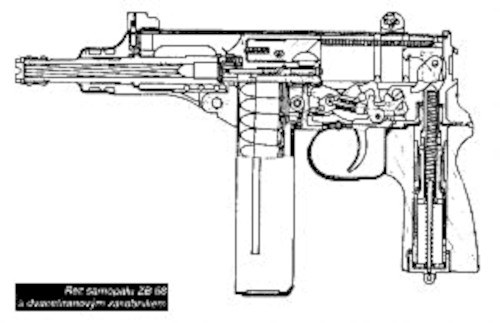
- The Czechoslovak army’s training chart, 7,65mm samopal vz. 61, figure number 127 of a series, marked Výhradně pro služební potřebu, “exclusively for service use”. It shows the gun whole, in section with the trigger parts in three positions, and the trigger and bolt parts laid out, with a numbered list of 64 parts. It is undated. The copy used here was published by Forgotten Weapons in 2013, from a reader.1 It is the source for every part name in this volume.
- The US Army Foreign Science and Technology Center’s guide of July 1967, which gives the operating drill, the field strip and a one-paragraph explanation of the rate reducer.2
- Česká zbrojovka’s own description of 2022, which adds the materials and the purpose of several features.3
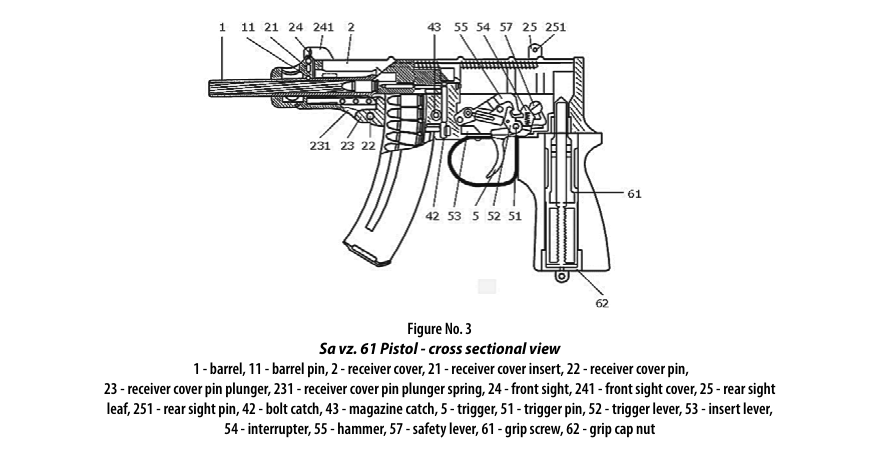
Two further documents help with parts the sources above do not describe: the Czech Ministry of Defence’s data page,4 and the instruction manual of the current semi-automatic Sa vz. 61 Pistol by Czech Small Arms.5 The second describes a different gun, without automatic fire or the rate reducer, and it is used only for the parts both guns share.
No armourer’s manual or factory drawing for the military gun was found. This volume describes the mechanism as far as those documents do, and says so where they stop. In keeping with this hub’s rule for select-fire weapons, it does not go further into the automatic fire control than the published military sources.
2.2 The training chart
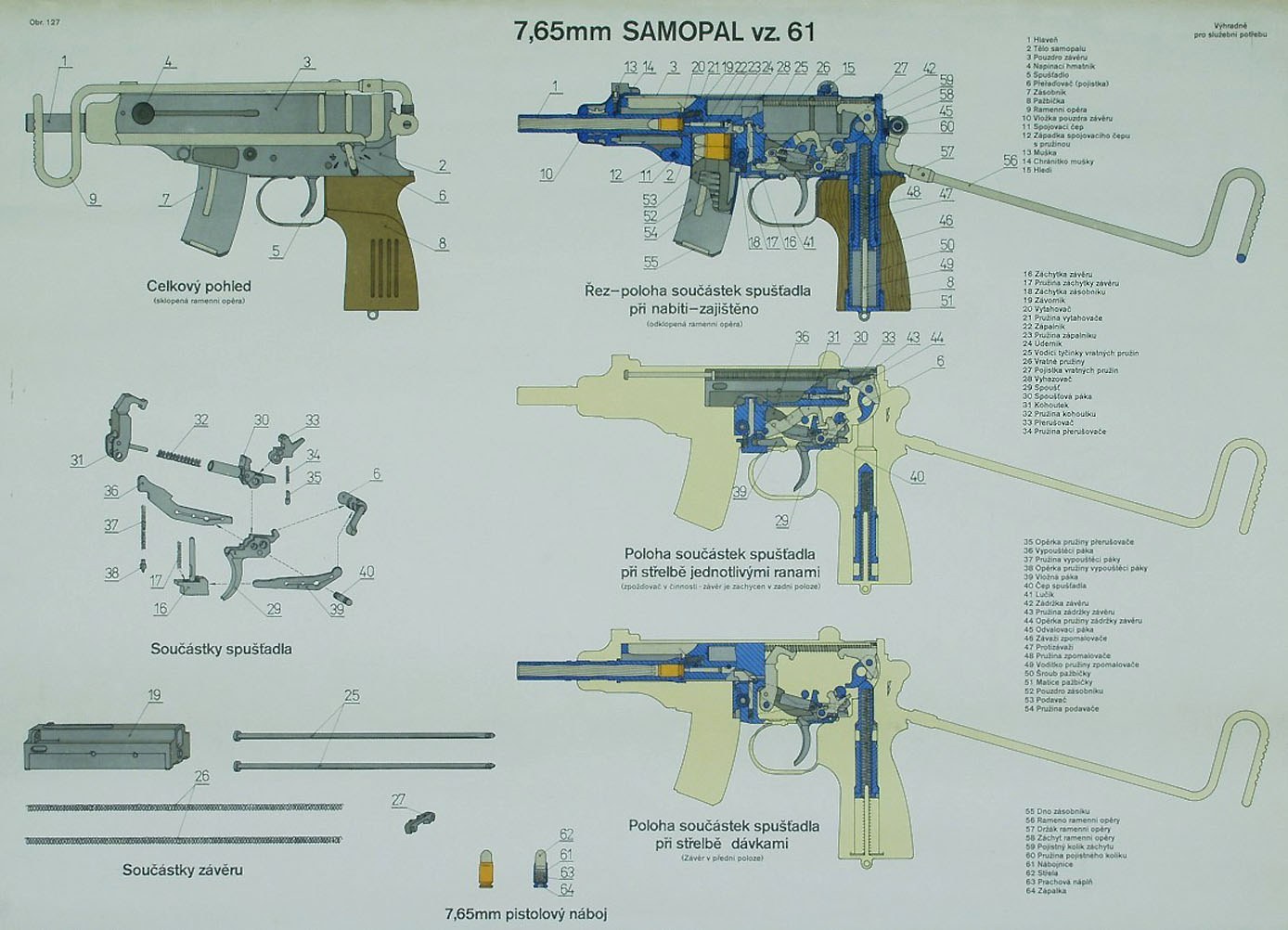
The chart’s three captions are worth translating in full, because the last two say something about the rate reducer that the American description does not:
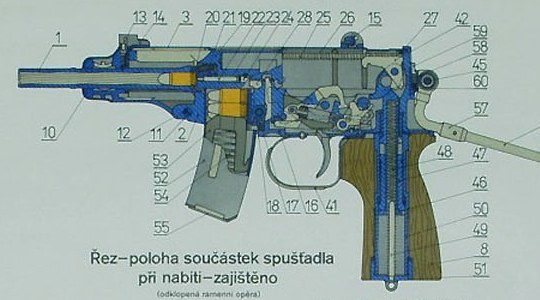
- Řez – poloha součástek spušťadla při nabití – zajištěno (shoulder rest unfolded): “Section: position of the trigger parts when loaded, on safe.”
- Poloha součástek spušťadla při střelbě jednotlivými ranami (zpožďovač v činnosti – závěr je zachycen v zadní poloze): “Position of the trigger parts in single-shot fire (the delay device acting; the bolt is held in the rear position).”
- Poloha součástek spušťadla při střelbě dávkami (závěr v přední poloze): “Position of the trigger parts in burst fire (bolt in the forward position).“
2.3 The main groups
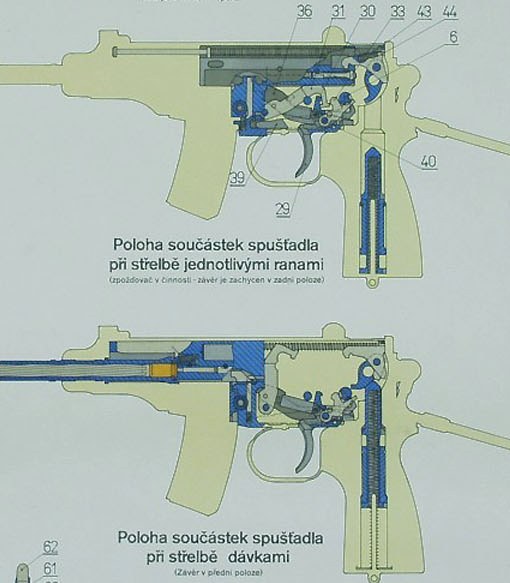
The chart’s first fifteen numbers name the major assemblies and fittings:1
Table 1 — The main groups
| No. | Czech | Part |
|---|---|---|
| 1 | hlaveň | barrel |
| 2 | tělo samopalu | body (the lower receiver and frame) |
| 3 | pouzdro závěru | bolt housing (the upper receiver) |
| 4 | napínací hmatník | cocking knob |
| 5 | spušťadlo | trigger mechanism |
| 6 | přeřaďovač (pojistka) | selector (safety) |
| 7 | zásobník | magazine |
| 8 | pažbička | grip |
| 9 | ramenní opěra | shoulder rest (the stock) |
| 10 | vložka pouzdra závěru | bolt-housing insert |
| 11 | spojovací čep | connecting pin |
| 12 | západka spojovacího čepu s pružinou | connecting-pin latch with spring |
| 13, 14, 15 | muška, chránítko mušky, hledí | front sight, front-sight guard, rear sight |
The Czech Ministry of Defence lists the main parts the same way: barrel, body, bolt housing, bolt, trigger mechanism with hammer, grip, shoulder rest and sights, with a suppressor as an option.4
2.4 Receiver, barrel and the connecting pin
The gun is in two halves. The upper, the bolt housing, is pressed from sheet steel; the lower, the body, is “a machined piece of steel” carrying the trigger group, the magazine well and the grip.3 Czech Small Arms still advertises its frames as steel.6
The barrel is fixed in the upper. On the current Sa vz. 61 Pistol, which keeps the original’s layout, it is pressed into an insert welded into the front of the receiver cover, bears against the insert with a ring about halfway along, and is held by a pin; it has six grooves and a right-hand twist of 350 mm.5 The chart shows the same insert (10) in the military gun.1 Barrel length is 115 mm in every source that gives it.735
The two halves are held together at the front by the connecting pin (11), “a captive pin” above the magazine, as CZ puts it, retained by a spring latch (12).31 To open the gun the pin is pulled out to the left, the upper is moved forward a few millimetres and swung clear (Volume 5).2 Ejection is upward through a port in the top of the upper. CZ’s advice to anyone firing it on automatic is to wear a cap.3
2.5 The bolt and its springs
CZ describes the bolt as “rather small” and “of a telescoping style”, which it calls a signature of Czechoslovak design of the 1950s.3 The chart shows its parts (Volume 5 has the crop): the bolt itself (19), extractor (20) and its spring (21), the firing pin (22) and its spring (23), and the striker (24).1
There is no single return spring behind the bolt. There are two, above it: the chart’s return springs (26) on their guide rods (25), held by a retainer (27).1 CZ: “Two recoil springs are placed on top of the bolt and are not very stiff.”3 The Czech Ministry of Defence names the same “return mechanism made up of two return springs”.4
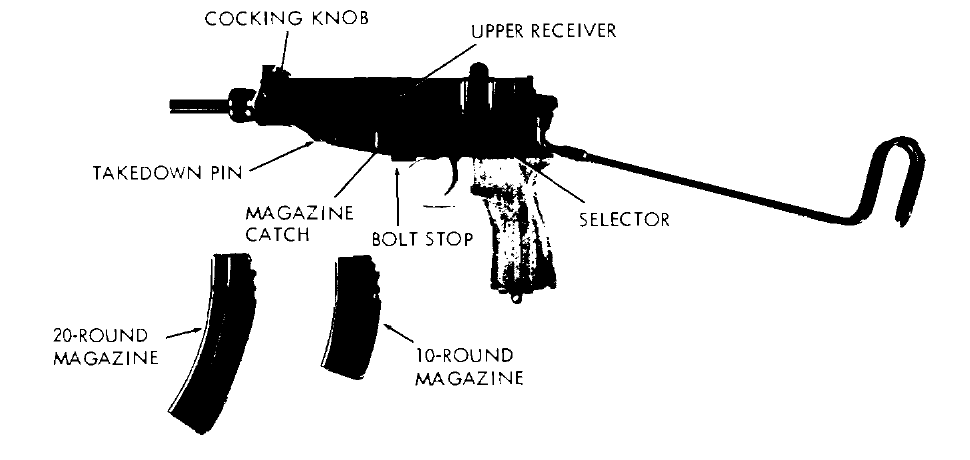
The bolt is cocked by two knobs, one each side, which pass through slots in the upper into the bolt. They are not fixed to it: at takedown they are pulled out sideways and the bolt slides out (Volume 5).2 CZ says that they “pinch your thumb if you are not careful when shooting it”.3
2.6 Hammer, firing pin and the trigger group
The vz. 61 fires from a closed bolt with an internal hammer (31).31 The hammer strikes the striker (24) at the rear of the bolt, which drives the firing pin (22) forward to the primer; the firing pin spring returns it.15
The US Army in 1967 judged the trigger mechanism “similar in function to that of the AK-47 assault rifle”.2 CZ calls the lower’s trigger group “rather complex”.3 The chart names its parts: trigger (29), trigger lever (30), hammer (31) and its spring (32), disconnector (33) and its spring (34) and seat (35), a release lever (36) with its spring and seat (37, 38), an insert lever (39), the trigger-group pin (40) and the trigger guard (41).1 It shows how they sit in single-shot and burst fire but does not explain each part’s function in words, and this volume does not go beyond that. The firing pin and hammer spring are the parts the current pistol’s manual names first when the gun will not fire.5
2.7 The selector
The selector is on the left side above the grip.32 Its three positions are stamped on the receiver:
Table 2 — The selector is on the left side above the grip.[^cz2022][^fstc] Its three positions are stamped on the receiver
| Mark | Position of lever | Function |
|---|---|---|
| 0 | middle | safe |
| 1 | rearward | single shots |
| 20 | forward | automatic |
The positions and their order are from the US Army’s 1967 operating instructions: “Swing the selector to its mid or ‘O’ position (to make the pistol safe)”, “Rotate the selector forward to ‘20’ for automatic fire, or rearward to ‘1’ for semiautomatic fire.”2 The current CSA pistol’s manual says that on “0” the safety also blocks the bolt through the bolt catch and the insert lever.5 What the figure 20 signifies is not explained in any source found; the 9×19 mm CZ Škorpion of the 1990s is marked 30 instead (Volume 3).
The Czech Ministry of Defence describes the fire the selector allows as “single shots, short bursts (3 to 5 rounds) or long bursts (10 to 20 rounds)”.4 These are firing drills controlled by the trigger finger, not mechanical settings. The chart shows one automatic position, and none of the sources mentions a burst limiter.
CZ found the switch “rather stiff”.3
2.8 The cycle of operation
The vz. 61 is a straight blowback: nothing locks the bolt. The Czech Ministry of Defence: “for the rearward movement of the bolt it uses the pressure of the gases formed by the burning of the propellant charge. The forward movement of the bolt is provided by the return mechanism, formed by two return springs.”4
On the sources above, one cycle runs as follows.
- With the bolt closed on a loaded chamber and the selector off safe, the trigger releases the hammer, which strikes the striker and so the firing pin.
- The cartridge case, pressed back by the propellant gas, drives the light bolt rearward against the two return springs. The extractor (20) holds the case to the bolt face until the ejector (28) throws it up through the top port.
- At the rear of its stroke the bolt is caught and held by the rate reducer (next section).
- Released, the bolt runs forward under the two springs, strips the next round from the magazine and chambers it.
- In single-shot fire the hammer is then held until the trigger is released and pulled again. In automatic fire it falls again when the bolt closes, for as long as the trigger is held and there are cartridges in the magazine.
Two things set the vz. 61 apart from most blowback submachine guns of its era: it fires from a closed bolt, which makes single shots more accurate, and its light bolt and short travel would make it cycle very fast without the reducer. CZ makes the link explicitly: the soft springs, the compact bolt and the short travel mean “this simple blowback submachine gun would cycle very fast. For that purpose, it features an ingenious rate reducer placed inside the pistol grip.”3
2.9 The rate reducer
The US Army’s description of 1967 is the clearest in English:2
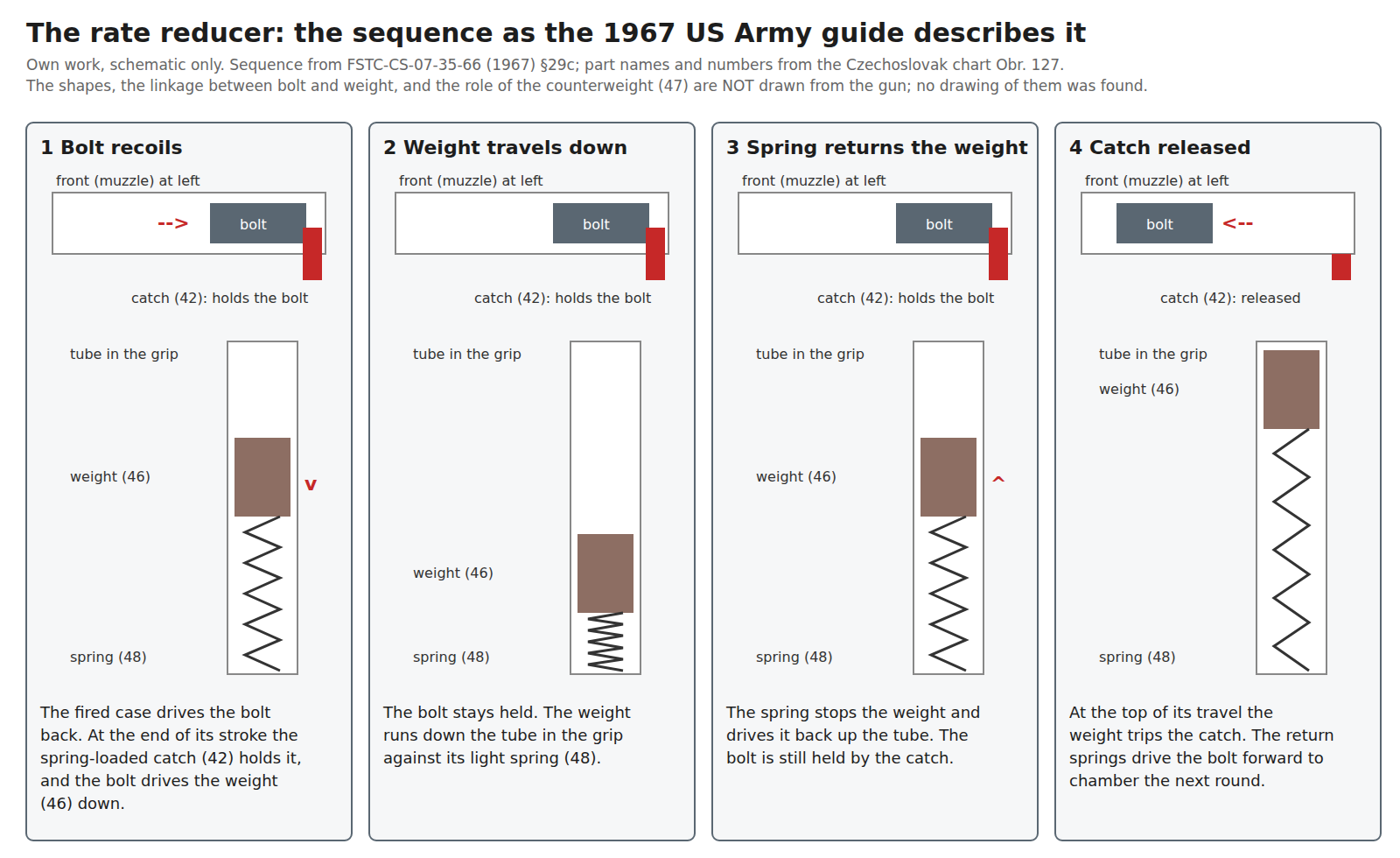
“This weapon has a cyclic-rate reducer incorporated in it. The bolt is caught at the rear of its stroke by a spring-operated catch; the bolt also forces an inertia block (inside the grip) down against a light spring. When the spring drives the block up, the block causes the catch to release the bolt. The time lapse between the catching and releasing of the bolt causes a distinct reduction in the cyclic rate of fire.”
The Czechoslovak chart names the parts. Above the grip, a bolt retainer (zádržka závěru, 42) with its spring (43) and spring seat (44), and a rolling lever (odvalovací páka, 45). In a tube in the grip, a reducer weight (závaží zpomalovače, 46), a counterweight (protizávaží, 47), the reducer spring (pružina zpomalovače, 48) and its guide (49). The grip itself is held by a screw (50) and a nut (51), drawn at its base.1
So the “inertia block” of the American description is, on the Czechoslovak chart, a weight and a counterweight, not one block. How the two move relative to each other, and the exact way the rolling lever couples the bolt to the weight, are not described in words in any source found, and the schematic below does not attempt them.
Two further points follow from the sources.
It acts on every shot. The chart’s caption for single-shot fire reads “the delay device acting; the bolt is held in the rear position”.1 The reducer is therefore not a feature of automatic fire alone: in single shots too, each recoil stroke ends with the bolt held briefly at the rear before it is released to chamber the next round.
It is why the grip is upright. CZ: “This is, after all, why it is placed square to the receiver.”3 The weight needs a straight tube with room to travel, and the vertical grip provides it.
2.10 How fast it fires: the figures side by side
Every source agrees that the reducer slows the gun; they do not agree on the result.
Table 3 — How fast it fires: the figures side by side
| Source | Cyclic rate |
|---|---|
| CZ catalogue, 1990s; Czech Ministry of Defence | 750 rounds per minute |
| US Army FSTC guide, 1967 | 835 rounds per minute |
| CZ history article, 2022 | about 850, reduced from “1200+“ |
| CZ catalogue, vz. 83 in 9 mm Browning (for comparison) | 900 rounds per minute |
The 750 figure is the one the Czechoslovak and Czech services and the maker printed in their own data.47 The 835 is the US Army’s.2 CZ’s 2022 article gives “1200+” without the reducer and “a more rational 850” with it.3 Nothing found says how the 1,200 was measured. The figures are given as published; none is an average.
The practical rates are lower and agree better. The Czech Ministry of Defence gives 35 rounds a minute in single shots, 100 in short bursts and 250 in long bursts; CZ’s catalogue gives 35 and 100; the US Army gives 35 in single shots.472
2.11 Magazines and hold-open
Magazines are curved box magazines of 10 and 20 rounds. The short one is meant for carrying the gun in its holster.3 The Czech Ministry of Defence issued each gun with one short and four long magazines, and gives their loaded weights as 150 g and 250 g; CZ’s catalogue gives the empty weights as 70 g and 100 g.47 The magazine catch is in front of the trigger guard.23
After the last round the bolt stays open. The bolt stop (chart 16, with its spring 17) holds it, and the 1967 drill uses the same stop to lock the bolt back for inspection: “press up on the bolt stop, and retract the bolt fully; it will be caught by the bolt stop.”21 With a fresh magazine in place, the bolt is released by pulling the knobs slightly back and letting go.2 The current pistol’s manual traces a failure to hold open to the magazine follower or a clogged bolt catch.5
2.12 Sights
The front sight is a round-headed screw with an eccentric post, under a hood. Turning the screw moves the post sideways and up or down to zero the gun; a front-sight adjustment tool was issued.52 The rear sight is a two-position flip leaf marked 75 and 150 metres.27 Sight radius is 148 mm in CZ’s catalogue; the current CSA pistol’s manual gives a “sightline” of 165 mm.75 The two figures are for different guns and may be measured differently; they are given as published.
2.13 The wire stock
The shoulder rest is a folding frame of steel wire. Folded, it lies along the top of the gun with its looped butt over the muzzle; unfolded, it swings back on a pivot at the rear of the body and locks in line.1 The chart names its arm (56), holder (57), catch (58) and the catch’s safety pin and spring (59, 60).1 Folded, the stock “locks over the ears of the front sight”, and gentle upward pressure frees it; extended, it locks into a catch at the rear of the receiver, and is released by pushing it forward against the receiver before folding it back over the top.8 CZ thinks it “quite short and does not provide much comfort”, but says accuracy is much better with it in use.3
The stock is what makes the long effective range possible: the army’s figures are 50 m fired from the hand and 200 m from the shoulder, and the US Army’s 1967 guide gives 200 m “with stock in use”. CZ’s catalogue gives 150 m from the shoulder.427
2.14 The suppressor
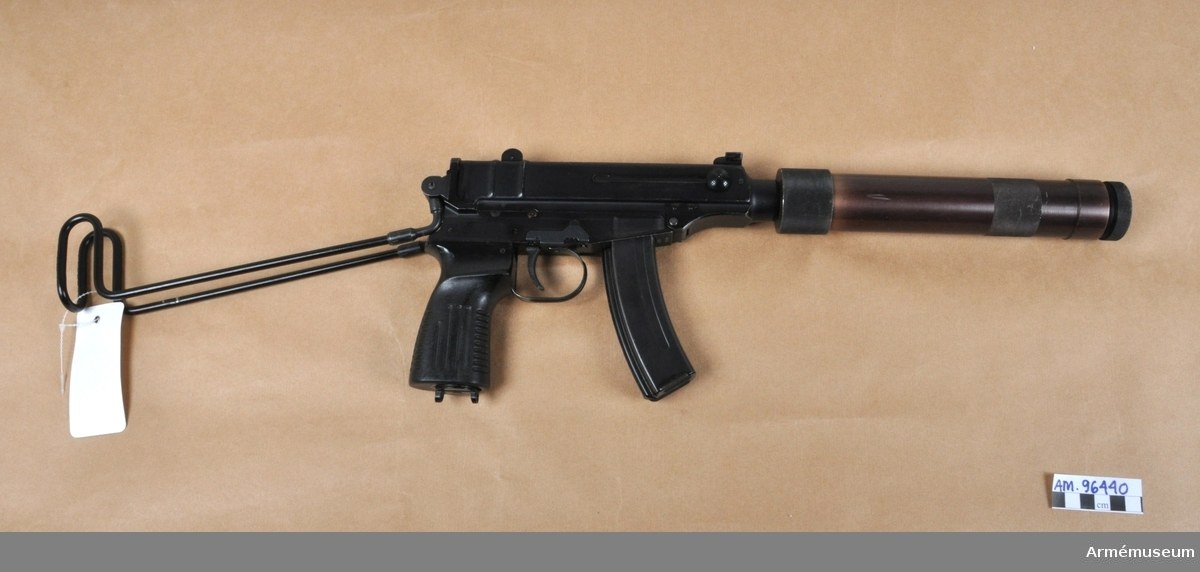
A suppressor was developed with the gun “for special operations purposes” and is mounted on the barrel “via a collet system”.3 The 1967 US Army guide lists a “silencer” among the accessories, with a night-sighting device, a bayonet, hip and shoulder holsters, a cleaning rod, an oil container and the front-sight tool.2 The Swedish Army Museum holds an example with its suppressor fitted.9
2.15 The published performance figures
Table 4 — The published performance figures
| Item | Czech MoD (army.cz) | CZ catalogue | US Army FSTC, 1967 |
|---|---|---|---|
| Weight | 1,300 g without cartridges | 1.30 kg without magazine | 3.42 lb (1.55 kg) with empty 20-round magazine |
| Length, stock folded / unfolded | – / 522 mm | 270 / 522 mm | 10.6 in (269 mm) / 20.2 in (513 mm) |
| Barrel | – | 115 mm | 4.4 in (112 mm) |
| Muzzle velocity | 317 m/s | – | 305 m/s |
| Cyclic rate | 750 rpm | 750 rpm | 835 rpm |
| Effective range, hand / shoulder | 50 / 200 m | up to 50 / up to 150 m | 50 / 200 m |
| Maximum range | 1,500 m | about 1,500 m | – |
Sources: Czech Ministry of Defence,4 CZ catalogue,7 FSTC Table I.2 Metric conversions of the FSTC’s inch and pound figures are this dive’s. CZ’s catalogue adds a height of 167 mm and a width of 43 mm with the stock folded.7
2.16 What the semi-automatic pistols leave out
The commercial semi-automatic versions (Volume 3) share the receiver, bolt, springs, sights and magazines, but not the fire control. Describing the D-Technik pistol imported into the United States in 2009, Small Arms Review reported a semi-automatic-only fire-control group, a new safety, and the rate reducer removed.8 The current CSA pistol’s manual shows the grip in section holding only the grip screw and nut, with no reducer; its selector has two positions, 1 and 0 (Volume 3).5
2.17 What could not be verified
- Each trigger-group part’s function in words. The chart shows them; no text explaining them was found.
- How the weight and counterweight move relative to each other, and how the rolling lever couples bolt and weight.
- What the selector’s “20” stands for.
- How CZ’s unrestrained “1200+” rounds a minute was measured.
- The chart’s date and its manual. “Obr. 127” implies a series of training charts or a manual of which this is figure 127; the series was not found.
References
Footnotes
-
Czechoslovak army training chart, “7,65mm samopal vz. 61”, Obr. 127, marked “Výhradně pro služební potřebu”, undated. Published in Ian McCollum, “Czech vz.61 Photos and Catalog”, Forgotten Weapons, 9 October 2013, https://www.forgottenweapons.com/czech-vz-61-photos-and-catalog/ ; image https://www.forgottenweapons.com/wp-content/uploads/2013/10/Sa.Vz_.61.jpg (accessed 2026-10-20). Part names translated for this dive. ↩ ↩2 ↩3 ↩4 ↩5 ↩6 ↩7 ↩8 ↩9 ↩10 ↩11 ↩12 ↩13 ↩14
-
US Army Foreign Science and Technology Center, Small Arms Identification and Operation Guide: Eurasian Communist Countries, FSTC-CS-07-35-66, July 1967, paragraphs 25 to 30, figures 10 and 11, Table I, https://archive.org/details/fstc-cs-07-35-66-small-arms-identification-and-operation-guide-eurasian-communist-countries (accessed 2026-10-19). ↩ ↩2 ↩3 ↩4 ↩5 ↩6 ↩7 ↩8 ↩9 ↩10 ↩11 ↩12 ↩13 ↩14 ↩15 ↩16 ↩17
-
Česká zbrojovka a.s., “Vz. 61 Škorpion – The PDW Founding Father”, 28 November 2022, https://www.czfirearms.com/news/vz-61-skorpion-the-pdw-founding-father (accessed 2026-10-19). ↩ ↩2 ↩3 ↩4 ↩5 ↩6 ↩7 ↩8 ↩9 ↩10 ↩11 ↩12 ↩13 ↩14 ↩15 ↩16 ↩17 ↩18 ↩19
-
Ministerstvo obrany ČR, “7,65mm samopal vzor 61 Škorpión”, army.cz, page dated 2004, archived 7 February 2009, https://web.archive.org/web/20090207201124/http://www.army.cz/scripts/detail.php?id=5081 (accessed 2026-10-19). Translations for this dive. ↩ ↩2 ↩3 ↩4 ↩5 ↩6 ↩7 ↩8 ↩9 ↩10
-
Czech Small Arms s.r.o., Sa vz. 61 Pistol Instructions Manual (cal. 7.65 mm Br., 9 mm Br., 9 mm Makarov, .22 LR), PDF dated 29 September 2016, https://csa.co.cz/files/files/texty/1639562589_sa_vz_61_pistol_instructions_manual.pdf (accessed 2026-10-19). A semi-automatic pistol; cited only for shared parts and for the pistol itself. ↩ ↩2 ↩3 ↩4 ↩5 ↩6 ↩7 ↩8 ↩9 ↩10
-
Czech Small Arms, home page, https://csa.co.cz/ (accessed 2026-10-19): “sa vz. 61 pistols … frames are steel”. ↩
-
Česká zbrojovka, catalogue pages 17 to 19, undated (1990s), reproduced in McCollum 2013 (see the chart reference above). ↩ ↩2 ↩3 ↩4 ↩5 ↩6 ↩7 ↩8 ↩9
-
Jeff W. Zimba, “SA VZ. 61 Scorpion from Czechpoint, Inc.”, Small Arms Review vol. 12 no. 6, March 2009, https://smallarmsreview.com/?p=14942 (accessed 2026-10-19). ↩ ↩2
-
Armémuseum (Swedish Army Museum), “Kulsprutepistol m/1961”, inventory AM.096440, via DigitaltMuseum, https://digitaltmuseum.se/011024462869/kulsprutepistol-m-1961 ; image on Wikimedia Commons, CC BY-SA 4.0 (accessed 2026-10-19). ↩

Comments (0)