H&K MP7 · Volume 4
Telling Them Apart: PDW, MP7, MP7A1, MP7A1-KSK, MP7A2 and the Replicas
The prototypes and production variants identified from H&K's own documents and from photographs, the features that separate them and where to look, the dimension figures that never agree, and how to tell a real MP7 from the licensed airsoft copies that outnumber it in every image library
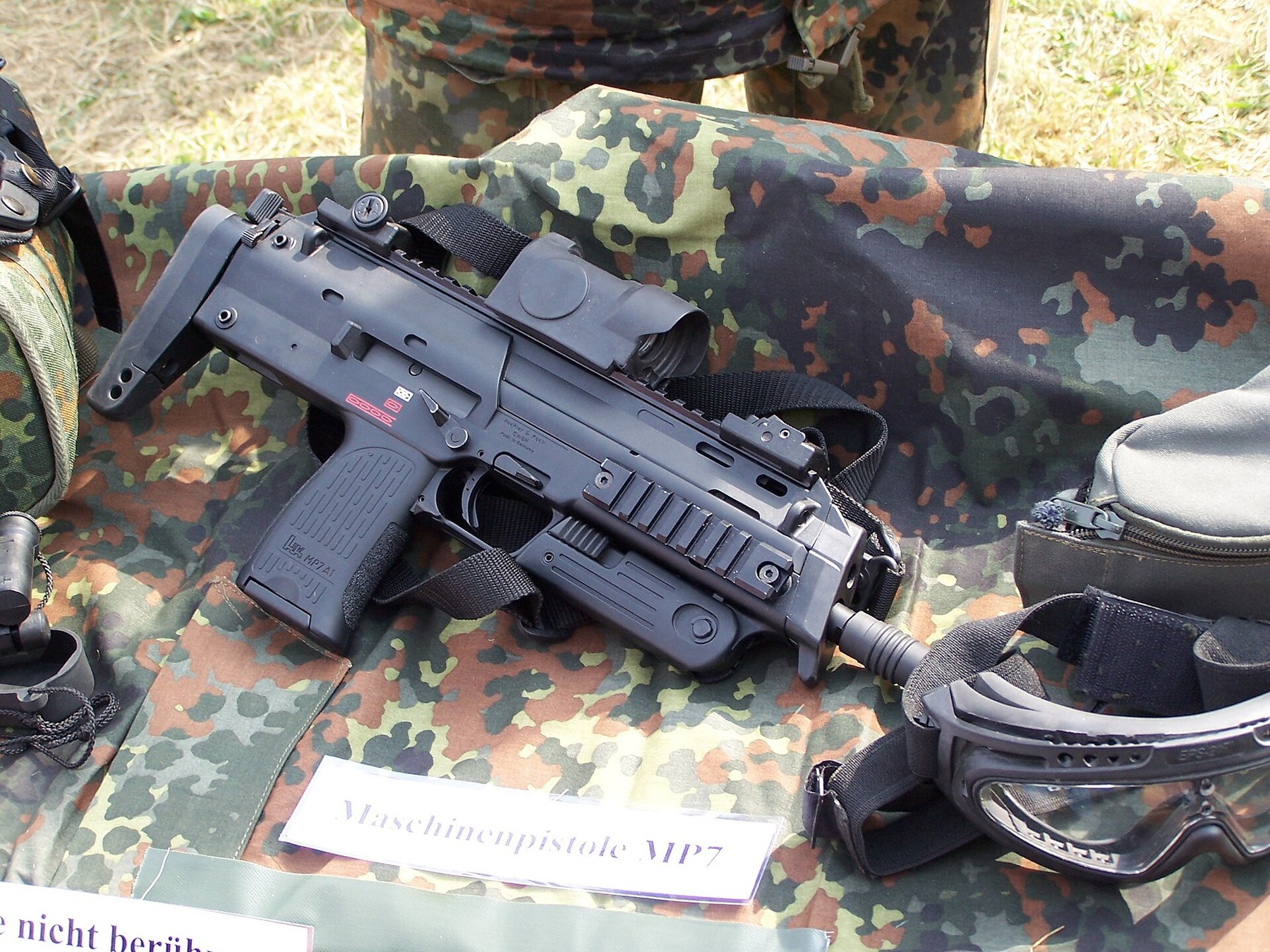
4.1 Why identification needs care with this weapon
Three things make MP7s hard to identify from pictures.
First, the variants differ in details rather than in silhouette. Every production MP7 has the same receiver shape, the same magazine in the grip, the same sliding stock. What separates an A1 from an A2 is the part under the fore-end; what separates an early A1 from a late one is the stock catch and the sights.
Second, the licensed airsoft copies are faithful. Deutsches Waffen-Journal reported in 2015 that the Umarex gas-blowback replicas, made by Vega Force Company in Taiwan, copied the real weapon’s dimensions, weight, markings and pictograms “1:1”.1 They dominate free image libraries; the Commons category for the MP7 alone contains cosplay photographs with replicas.
Third, H&K’s own documents disagree about the weapon’s dimensions, so a measurement does not settle a variant (below).
4.2 The identification rule used in this volume
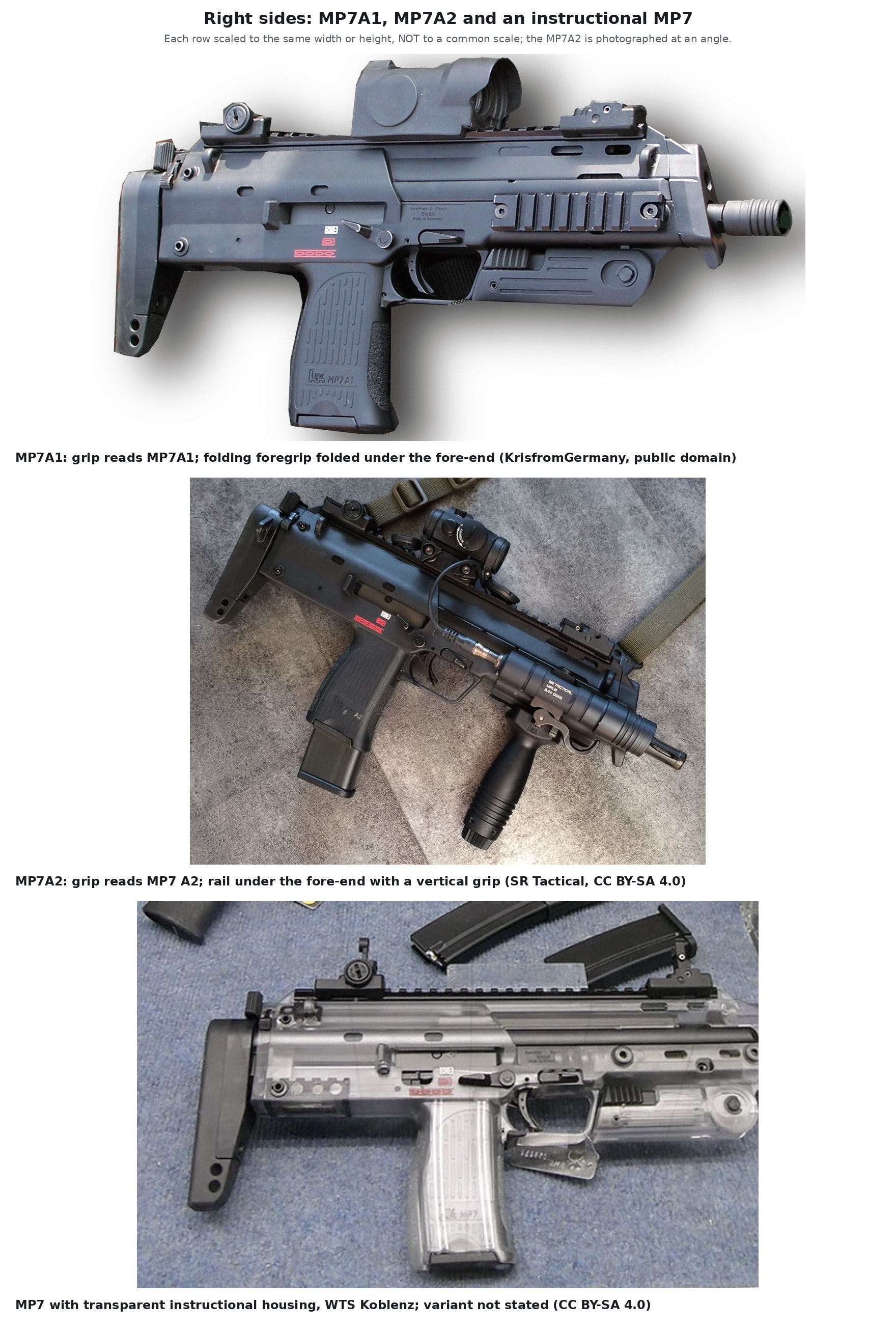
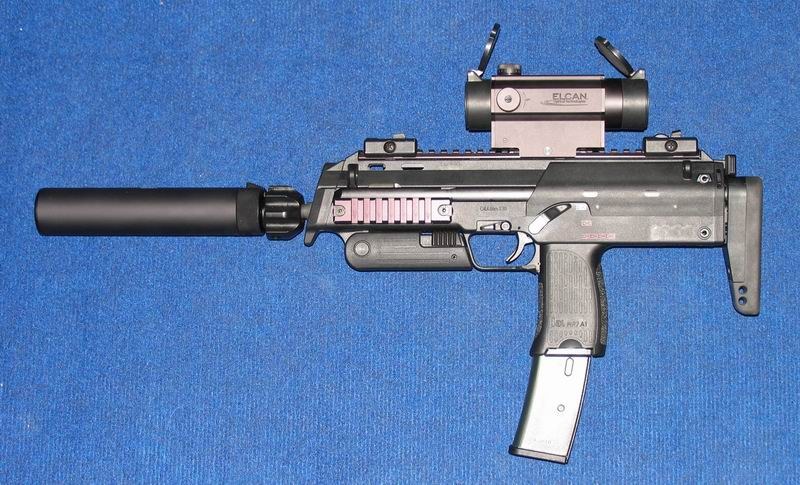
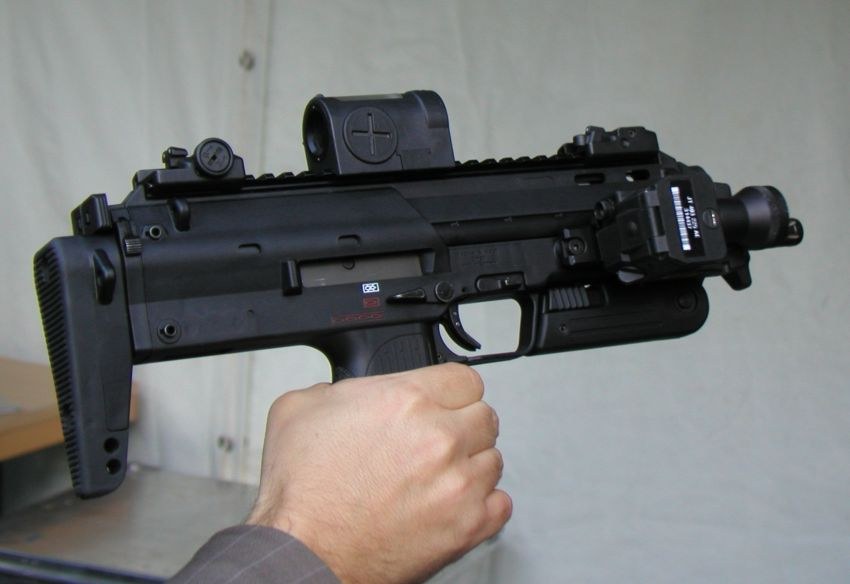
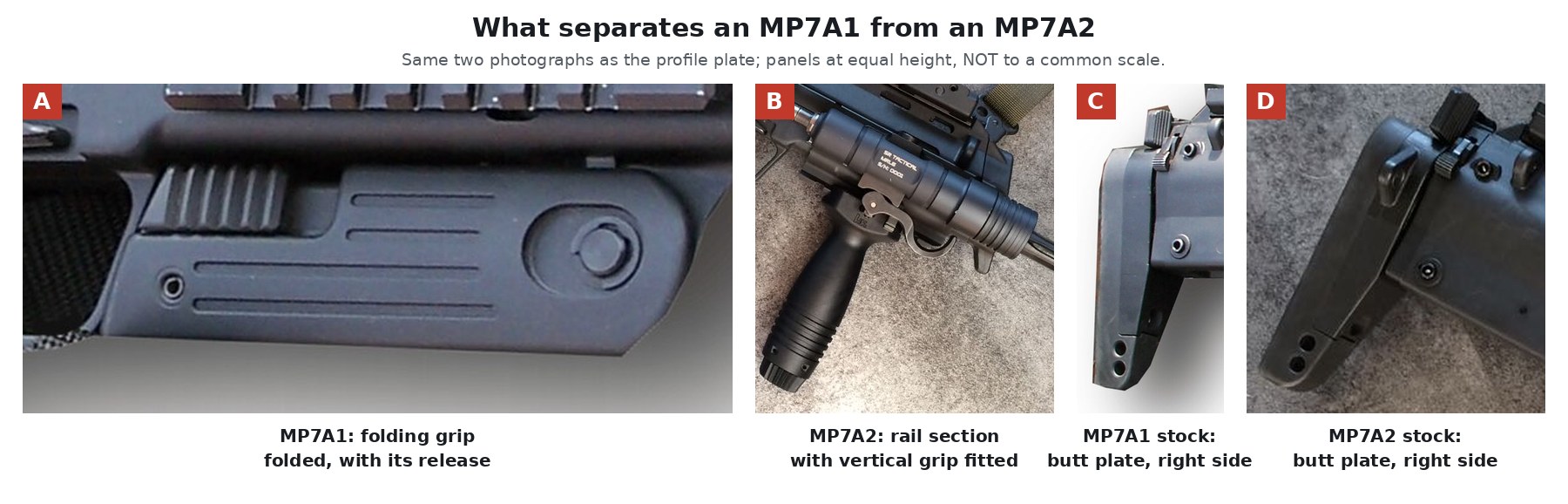
A weapon is called an MP7A1 only if its grip moulding reads “MP7A1” or its photographer or institution names it, and it shows a folding vertical foregrip under the fore-end. It is called an MP7A2 only if its grip moulding reads “MP7 A2” or its owner names it, and, in place of the folding grip, it carries a rail section under the fore-end (with or without a grip fitted to it). A weapon whose variant cannot be read is called an MP7. The PDW prototype appears in Small Arms Review’s photographs of 2000 and 2001; no photograph of a 2001 first-pattern MP7 was found, so that variant appears only in description. Airsoft replicas are excluded from the photographs altogether.
4.3 The variants in one table
Table 1 — The variants in one table
| Variant | Period | Defining features | Evidence |
|---|---|---|---|
| PDW (Configurations 5 and 6) | 1999–2001 | 340/541 mm; 1,500 g bare; chromium-plated barrel, 6.03 in (153 mm) twist; sights to 250 m | H&K Inc. presentation, Dec 20002 |
| MP7 | 2001–2003 | Name adopted 2001; detail differences from the A1 not documented by H&K | H&K lineage slide3 |
| MP7A1 | 2003 to date | Folding vertical foregrip; reshaped grip; trigger with a safety element; evolving stock and sights | H&K manuals 2006 and 2011; data sheets456 |
| MP7A1-KSK | by 2006 | Folding sights; four-position stock; sling loops on the butt plate; “limited quantities” to special forces | H&K Spanish manual 20064 |
| MP7A2 | listed by H&K today | Rail section under the fore-end in place of the folding grip | H&K product page and images; Commons photograph78 |
| MP7 for the UK MDP (“MP7-SF”) | 2005 | Single-shot-only specification | MoD Police release, 20059 |
4.4 The PDW prototypes, 1999 to 2001
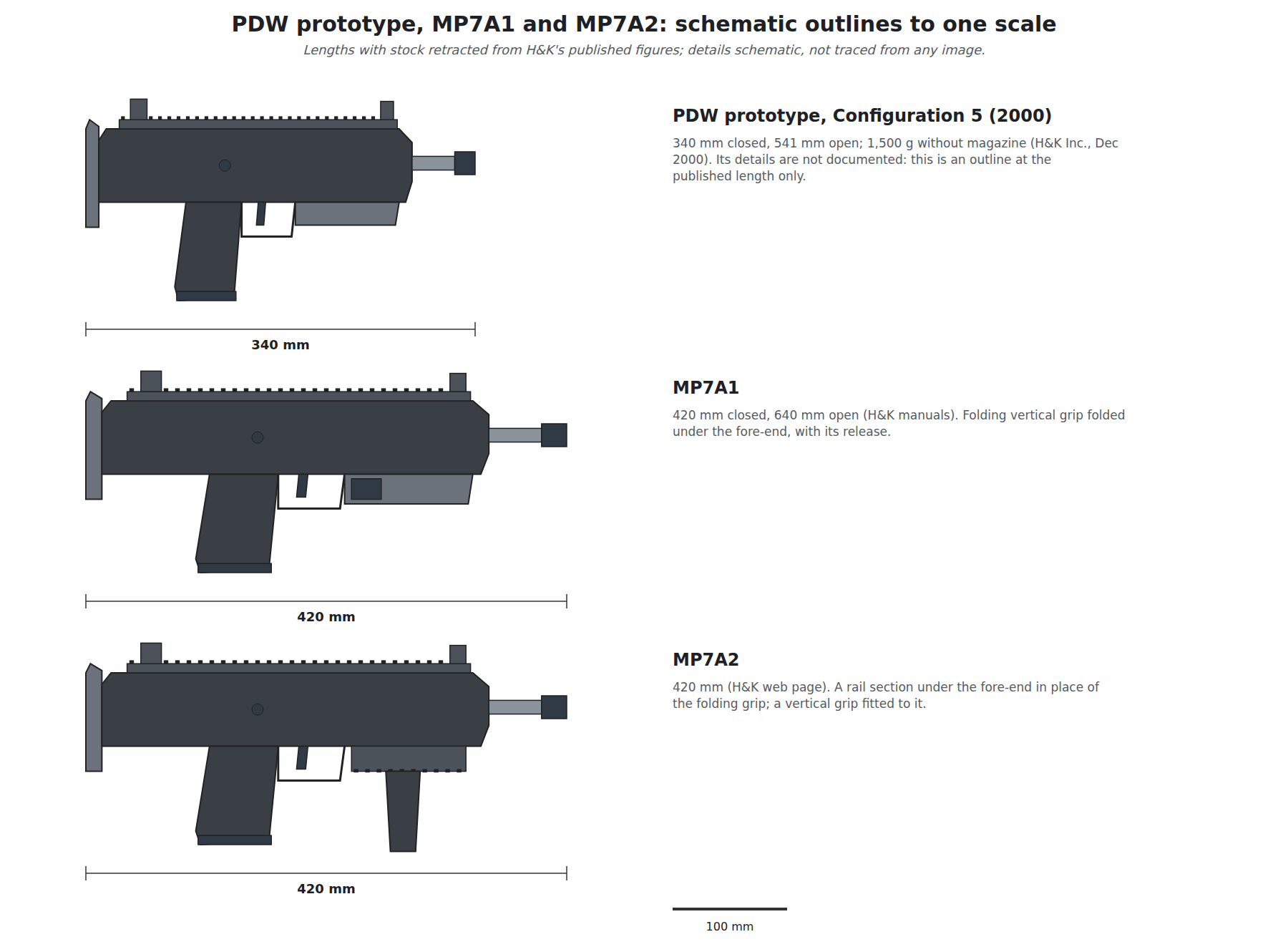
The PDW is known from H&K’s December 2000 presentation and from Small Arms Review’s contemporary reports and photographs (Volume 1). The presentation’s slides describe a “one-piece polymer housing”, a front sight base, a quick-release rail grabber for the Hensoldt reflex sight, an end cap, a retractable buttstock, disassembly pins and a vertical foregrip, and give it a chromium-plated 180 mm barrel with a 6.03 in twist.2 Its dimensions and weight, 340 mm closed and 541 mm open, 1,500 g without magazine, are smaller and lighter than any later H&K figure for the MP7A1, and its twist (about 153 mm) is quicker than the later 160 mm.24
Small Arms Review’s photographs of 2000 and 2001 show the prototype plainly, and bear out Wikipedia’s description of it, “a short Picatinny rail on the top and a smooth pistol grip surface”:10 the top rail covers only the rear of the receiver, the grip has none of the A1’s moulded texture, and the receiver is marked “HK PDW, Kal. 4.6mm x 30” in a panel above the trigger. A 40-round magazine was already planned.
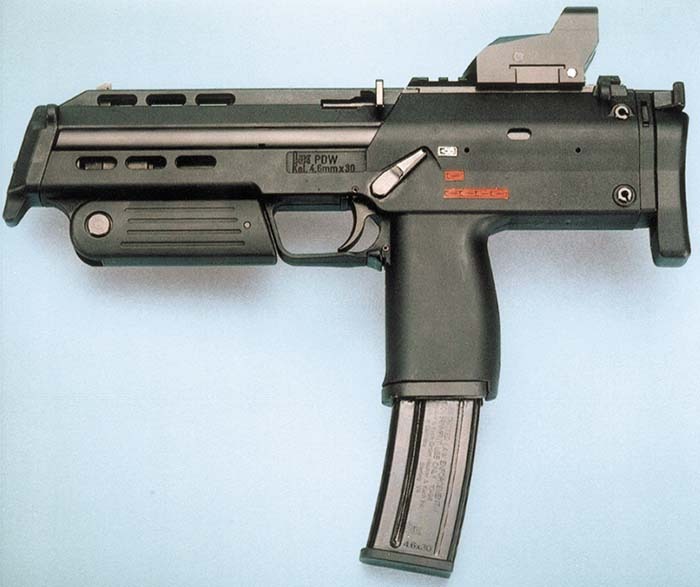
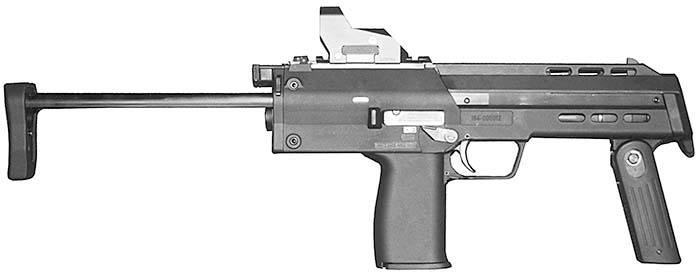
H&K’s 2004 presentation lists among the MP7A1’s advantages a length of “54/34 cm”.3 Those are the PDW’s figures, 541 and 340 mm, not any MP7A1’s. A 2004 sales slide repeating 2000 prototype numbers is the likeliest source of the shorter lengths that still circulate.
4.5 The first MP7, 2001 to 2003
H&K’s lineage slide gives the MP7 name to 2001 and the MP7A1 to 2003.3 None of the H&K documents found describes the first MP7 as distinct from the A1. Wikipedia says the 2001 MP7 introduced a full-length top rail, “a thick curved stock” and an anti-slip grip surface “much like the HK USP”, and that the A1 brought a redesigned grip, “a smaller stock with a straight buttpad”, side rails as standard and more compact folding sights, with the weapon “made slightly longer” but the overall length unchanged because the stock was shortened.10 Those details are plausible and could not be confirmed; the dimension table below shows that H&K’s own published lengths did change over the A1’s life, which a reader trying to use length to separate an MP7 from an MP7A1 should bear in mind.
4.6 The MP7A1, and how it changed
The MP7A1 is the weapon in every H&K manual and data sheet found, and those documents show that “MP7A1” covers a weapon that changed in at least three respects between 2006 and 2012. Because the documents are dated, the changes can be dated too.
The stock. H&K’s Spanish manual of 2006 describes the standard MP7A1’s stock as locking automatically in the retracted and extended positions, released by a catch lever at the right rear of the receiver that is pressed upward.4 H&K’s English manual (a fax dated 2011) adds that the stock “can be fixed in an intermediate and fully extended position”, three positions in all.5 H&K’s September 2012 accessory list offers both: a retractable buttstock with “3 locking positions” and one with “1 locking position”.11 The Bundeswehr’s page describes four lengths,12 which matches the KSK stock (below). Stock catches are therefore a guide to age and user, not to variant.
The sights. The 2006 manual’s standard MP7A1 has fixed notch-and-post iron sights on the top rail, whose point of impact coincides with the Hensoldt RSA-S reflex sight issued with it; only the KSK version has folding sights.4 The 2011 manual’s standard MP7A1 has “Sight, foldable”, a laterally adjustable notch and a height-adjustable front sight, “designed for distances of up to 200 m”, which in the raised position “aligns with the reticle of ‘Eo Tech’ reflex sight”.5 The 2012 accessory list carries both, fixed and folding, with folding rear apertures in 3.2 mm and 2 mm bores.11
The trigger. The 2006 manual’s parts key names item 5 “disparador con trinquete del seguro”, trigger with safety pawl, and the 2011 English manual names it “Trigger with safety latch”.45 H&K’s brochure parts key calls it “Safety trigger”.13 It is a blade in the centre of the trigger that must be pressed before the trigger can move, and it is visible in good photographs as a separate centre piece in the trigger’s face.
4.7 The MP7A1-KSK
H&K’s 2006 Spanish manual covers “MP7 A1” and “MP7 A1-KSK” together, and its last chapter describes the second as a special version “delivered in limited quantities to special forces”, identical in data and handling except for two things.4
- Stock: besides the extended position, “two intermediate locking positions, which permit individual adaptation to the shooter and his equipment (fragmentation vest, etc.)”, about 6 cm and 3 cm short of full extension, and two sling loops on the shoulder plate.
- Sights: a folding mechanical sight with a laterally adjustable aperture and a height-adjustable front sight. Folded, it is an open notch-and-post sight that coincides with the RSA-S; raised, it coincides with Aimpoint and EOTech dot sights, with the advantage that “the weapon can be used without any problem with protective goggles and respirator masks” because the sight line is higher. The folding front sight is H&K part 203 057, the folding rear 203 058.
Both features are in the later standard MP7A1: the folding sights by the 2011 manual and the 2012 accessory list (which lists the same part numbers, 203 057 and 203 058),511 and an intermediate stock position by the 2011 manual. The inference, from H&K’s own documents, is that the KSK’s modifications became standard between 2006 and 2011. No document states it.
4.8 The MP7A2
H&K’s current product page lists two variants, “MP7 A1” and “MP7 A2”, and illustrates the A2 in a brown RAL finish.7 It publishes no description of the difference. H&K’s own product images, reproduced below at a common scale, show it plainly: where the A1 has its folding vertical grip and the grip’s release under the fore-end, the A2 has a rail section, carrying rails on the bottom and sides, and H&K shows it fitted with an H&K vertical grip.7 The A2 thereby lets a user choose a grip, a light or nothing at all under the muzzle end.
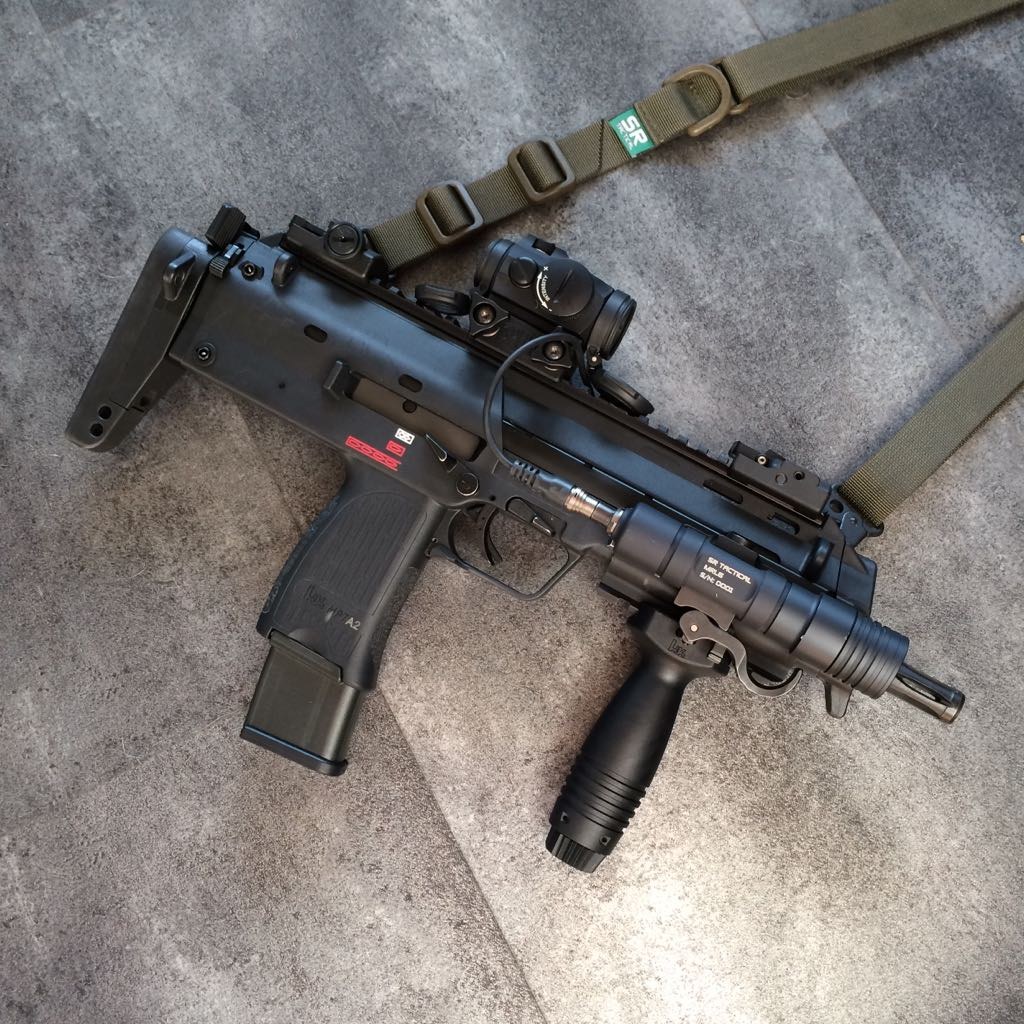
A Commons photograph by SR Tactical shows an MP7A2 with “SR Tactical MRL6 weapon light and SR Tactical light weapon belt, H&K vertical foregrip, as well as an Aimpoint Micro T-2 on a mount from Spuhr AB”.8
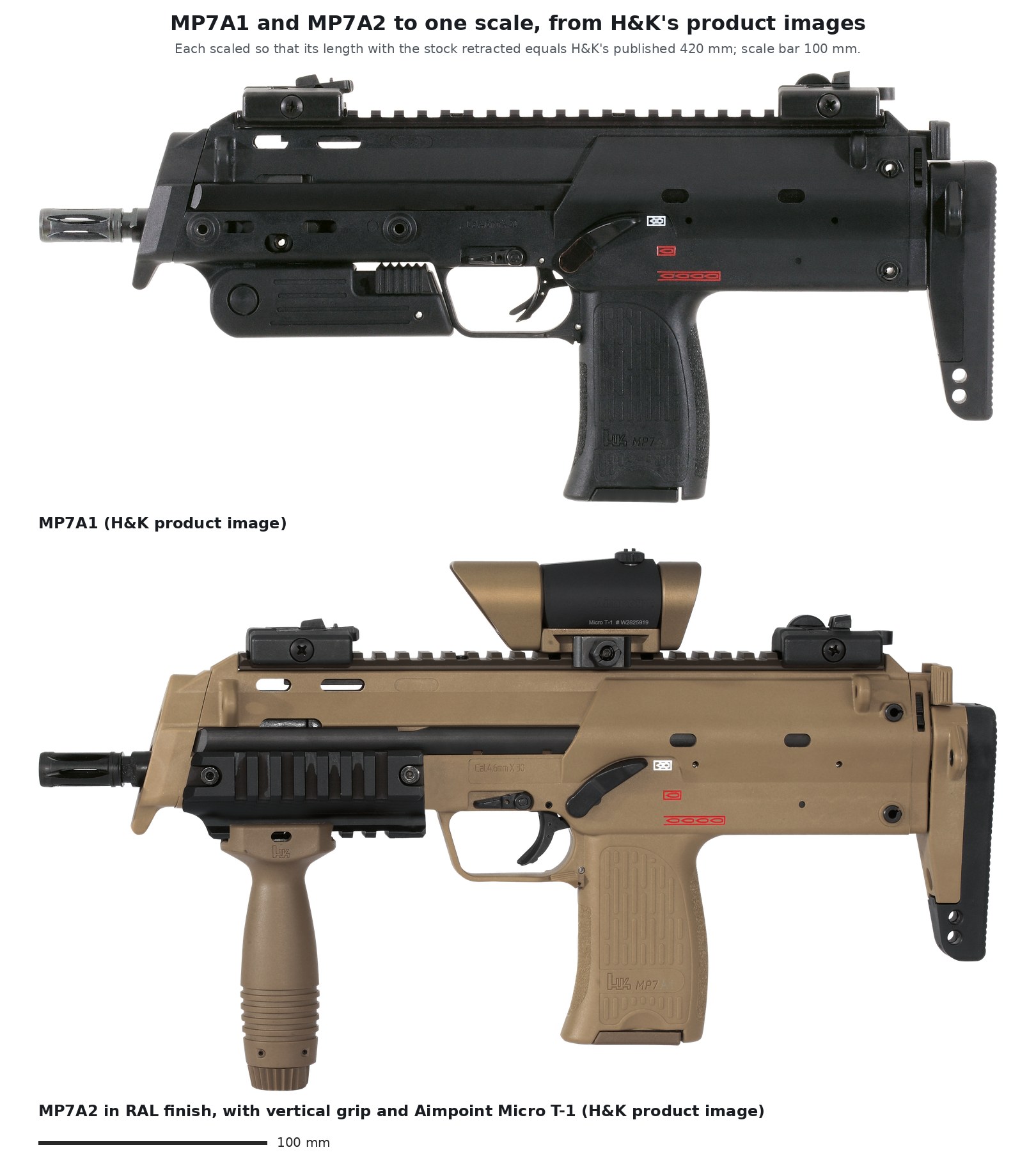
H&K’s A1 image also shows that the side rails are an option, not a fixture: the fore-end carries only the threaded bushes, and the rail sections seen in most photographs are fitted to them (Volume 7).
When the A2 was introduced was not established; no dated H&K document naming it was found.
4.9 The MP7-SF
The Ministry of Defence Police bought its MP7s in 2005 to a specification of single shot only (Volume 2).9 Reference works call the result the MP7-SF. Whether it is externally distinguishable, for instance by a selector with different markings or positions, was not established; no document describing it, and no photograph showing its selector clearly, was found. Photographs of MDP officers cannot be taken as photographs of the single-shot variant, and in Volume 2 they are not.
4.10 Finish
H&K’s image of the A2 is filed under the name “MP7A2_links_RAL”, and shows a brown finish;7 DWJ’s 2015 article reports that Umarex offered its licensed A1 replica “in der Farbe RAL 8000” for “the many fans of this colour”.1 RAL 8000 is a standard green-brown shade. A brown MP7 is therefore not necessarily an A2, and a brown A1 is a real H&K configuration as well as a replica.
4.11 The dimensions that never agree
H&K has published at least five sets of dimensions for the production weapon, and the Bundeswehr a sixth. None is an error in the sense of a misprint; they describe different stocks, different measuring conventions or different years. They are given separately and never averaged.
Table 2 — The dimensions that never agree
| Source | Length, stock in / out | Width | Height | Weight without magazine |
|---|---|---|---|---|
| H&K Inc., PDW prototype, Dec 20002 | 340 / 541 mm | 42 mm | 172 mm | 1,500 g |
| H&K brochure “Innovation for the future” (PDF 2007)13 | 380 / 590 mm | 42 mm | 172 mm | 1,900 g |
| H&K Spanish manual (PDF 2006)4 | 420 / 640 mm | 45 mm | 172 mm | about 1.8 kg |
| H&K English manual (fax 2011)5 | 420 / 640 mm | 45 mm | 172 mm | 1.8 kg |
| H&K technical data V002.02.116 | 415 / 638 mm | 51 mm | 169.5 mm | about 1,900 g |
| NATO AEP-97, MP7 as nominated weapon14 | ”420/460 mm” (as printed) | — | — | 1.89 kg |
| Bundeswehr web page12 | 415 / 638 mm | 42 mm | — | 1.9 kg |
| H&K web page, 2026 (values rounded)7 | 420 / 640 mm | — | — | — |
Four things stand out. The barrel is 180 mm in every source. The 2007 brochure’s 380/590 is 40 mm shorter than the manuals, and its 42 mm width matches the PDW’s and the Bundeswehr’s; it is probably an early-A1 or brochure figure carried over. NATO’s “420/460” is evidently a misprint for 420/640. And width, 42, 45 or 51 mm, depends on what is counted (side-rail bushings, levers, or a fitted rail).
4.12 Markings
What is visible on a real MP7, from H&K’s documents and the photographs used here:
- Grip: the H&K logo and the model, moulded into the grip; on the A1 photographed here it reads “MP7A1”, and on the A2 photographed here “MP7 A2”.
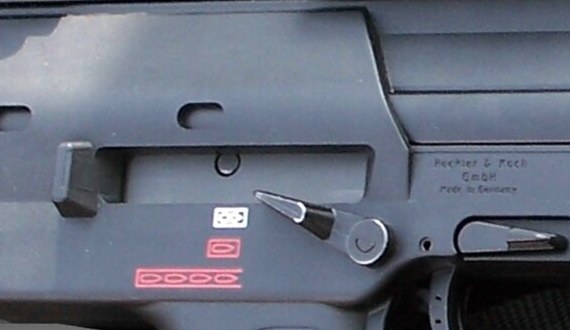
- Receiver: “Cal. 4.6mm x 30” moulded into the receiver side above the trigger (legible on H&K’s product images).
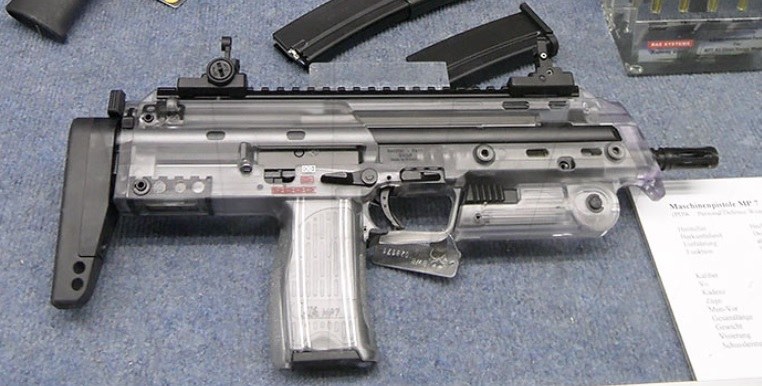
- Selector pictograms: three markings on each side behind the selector, a white symbol for safe and red symbols for single and continuous fire. H&K’s 2006 manual describes the positions as “Seguro”, “Tiro a tiro” and “Tiro continuo”, marked with pictograms; its 2011 English manual names them “SAFE”, “SEMI AUTO” and “BURST FIRE” (Volume 5 explains that “burst” there means continuous fire).45
- Serial and proof marks: their location was not found in any H&K document, and it is not guessed at here.
4.13 Replicas: the airsoft MP7
Licensed airsoft MP7s are far more numerous than real ones outside armed forces, and a reader is more likely to meet one than the weapon. The full survey of what is on sale belongs to the MP7 light-gun donor dive’s Volume 1, which compares every airsoft MP7 currently sold; it is not repeated. What matters for identification:
- They copy the markings. DWJ reported that the Umarex gas-blowback A1 had the original calibre marking, maker’s name and weapon name moulded into the plastic, and that the German-market version had “6 mm BB”, the “F” in a pentagon (the German mark for a low-energy air gun) and a serial number laser-engraved.1 A real MP7 has no “6 mm BB” and no F-in-pentagon; a replica sold outside Germany may have neither German mark.
- A replica “Navy” looks like an A2. The same article describes the Umarex “MP7 A1 Navy” as having “keinen Vordergriff, dafür im vorderen Bereich gleich drei zusätzliche Picatinny-Schienen”.1 A railed fore-end without a folding grip is therefore not proof of a real A2.
- The weights are close. DWJ gives 1,940 g for the replica A1 and 1,730 g for the Navy; the real A1 is 1.8 to 1.9 kg without magazine. Weight does not separate them in the hand.
- The bore gives it away. A replica fires 6 mm BBs; the muzzle of a real MP7 shows a 4.6 mm bore behind its flash hider.
4.14 Tell them apart: the table
Table 3 — Tell them apart: the table
| Feature | PDW (2000) | MP7A1, early (2006 manual) | MP7A1, later (2011–2012) | MP7A1-KSK | MP7A2 | Airsoft replica | Where to look |
|---|---|---|---|---|---|---|---|
| Under the fore-end | vertical grip (folding?) | folding vertical grip with release | folding vertical grip with release | folding vertical grip | rail section; grip optional | depends on model; “Navy” has rails | in front of the trigger guard |
| Stock positions | retractable | 2 (in, out) | 3 (in, intermediate, out) | 4 (in, two intermediate, out) | as later A1 (not documented) | 3 detents (Umarex) | catch lever at right rear; butt plate loops |
| Iron sights | adjustable | fixed notch and post | folding, align with EOTech | folding, align with Aimpoint/EOTech | folding (H&K image) | copies | top rail, front and rear |
| Trigger | not documented | with safety pawl | with safety latch | as A1 | as A1 | copies | centre of trigger face |
| Length (stock in) | 340 mm | 420 mm | 415–420 mm | as A1 | 420 mm (H&K web) | about 418 mm | measure |
| Weight without magazine | 1,500 g | about 1.8 kg | 1.8–1.9 kg | as A1 | not published | 1.73–1.94 kg | — |
| Markings | not documented | ”MP7A1” on grip | ”MP7A1” on grip | not documented | ”MP7 A2” on grip (owner’s photograph) | copied, plus “6 mm BB” / F-in-pentagon in Germany | grip, receiver side |
| Bore | 4.6 mm | 4.6 mm | 4.6 mm | 4.6 mm | 4.6 mm | 6 mm BB | muzzle |
4.15 What could not be verified
- Any photograph of a 2001 first-pattern MP7.
- H&K’s own description of the differences between the MP7 and the MP7A1 (Wikipedia’s account is reported, not confirmed).
- When the MP7A2 was introduced.
- How the MDP’s single-shot weapons are marked or whether they differ externally; whether “MP7-SF” is an H&K designation.
- The location of the serial number and proof marks.
- Whether the A2’s stock and sights follow the later A1’s (H&K’s image suggests folding sights).
References
Footnotes
-
Timo Lechner, “Schlagkraft: Neue MP7-Modelle von Umarex”, Deutsches Waffen-Journal 3/2015, pp. 52–55, https://www.umarex.de/fileadmin/testreports/DWJ_03-15_MP7.pdf , accessed 2026-10-18 (translated). ↩ ↩2 ↩3 ↩4
-
Jim Schatz, H&K Inc., “HK Personal Defense Weapon — 4.6 × 30mm PDW Weapon System”, presentation revised 12/00, https://s3.amazonaws.com/hk-manuals/files/Military/MP7/MP7_Presentation.pdf , accessed 2026-10-18. ↩ ↩2 ↩3 ↩4
-
Heckler & Koch GmbH, “Close Range Weapon — From ‘NBW’ to ‘MP7 A1’”, 2 March 2004, https://s3.amazonaws.com/hk-manuals/files/Military/MP7/MP7_Close_Range_Weapon.pdf , accessed 2026-10-18. ↩ ↩2 ↩3
-
Heckler & Koch, “MP7 A1 / MP7 A1-KSK … Instrucciones para el manejo” (PDF dated 3 August 2006), chapters 2, 3, 4.1, 12 and 16, https://s3.amazonaws.com/hk-manuals/files/Military/MP7/MP7A1_Instruction_Manual_Spanish.pdf , accessed 2026-10-18 (translated). ↩ ↩2 ↩3 ↩4 ↩5 ↩6 ↩7 ↩8 ↩9
-
Heckler & Koch, “Close Range Weapon MP7 A1 … Operators Manual”, fax copy dated 08/08/11, https://s3.amazonaws.com/hk-manuals/files/Military/MP7/MP7A1_Operators_Manual.pdf , accessed 2026-10-18. ↩ ↩2 ↩3 ↩4 ↩5 ↩6 ↩7
-
Heckler & Koch, MP7 A1 technical-data brochure, Id.-Nr. 978076/V002.02.11, https://s3.amazonaws.com/hk-manuals/files/Military/MP7/MP7A1_Technical_Data.pdf , accessed 2026-10-18. ↩ ↩2
-
Heckler & Koch GmbH, MP7 product page and its product images “MP7A1_links” and “MP7A2_links_RAL”, https://www.heckler-koch.com/en/Products/Military%20and%20Law%20Enforcement/Submachine%20guns/MP7 , accessed 2026-10-18. ↩ ↩2 ↩3 ↩4 ↩5
-
SR Tactical, “MP7 A2.jpg”, Wikimedia Commons, 23 July 2018, CC BY-SA 4.0, https://commons.wikimedia.org/wiki/File:MP7_A2.jpg ↩ ↩2
-
Ministry of Defence Police press office, “MOD Police takes delivery of 21st century weapon”, 2 March 2005, https://www.wired-gov.net/wg/wg-news-1.nsf/54e6de9e0c383719802572b9005141ed/9cc0b258f0a47da7802572ab004bae28 , accessed 2026-10-18. ↩ ↩2
-
“Heckler & Koch MP7”, English Wikipedia, “Variants”, accessed 2026-10-18 (reported, not confirmed). ↩ ↩2
-
Heckler & Koch, “accessories programme MP7 A1 4.6 mm x 30”, v003.09.12, https://s3.amazonaws.com/hk-manuals/files/Military/MP7/MP7A1_Accessories.pdf , accessed 2026-10-18. ↩ ↩2 ↩3
-
Bundeswehr, “Ausrüstung und Technik: Die Maschinenpistole MP7”, https://www.bundeswehr.de/de/ausruestung-technik-bundeswehr/ausruestung-bewaffnung/mp7 , accessed 2026-10-18. ↩ ↩2
-
Heckler & Koch, “MP7 A1 — Innovation for the future”, brochure (image PDF dated 2007), https://s3.amazonaws.com/hk-manuals/files/Military/MP7/MP7_Description.pdf , accessed 2026-10-18. ↩ ↩2
-
ČOS 130511, 1st ed. (STANAG 4823 / AEP-97(A)), Prague 2023, Annex 10-A1, https://oos-data.army.cz/cos/cos/130511.pdf , accessed 2026-10-18. ↩

Comments (0)