H&K MP7 · Volume 3
The 4.6×30 Cartridge
Dimensions from the NATO standard, every loading H&K and its ammunition makers have published, the hardened-steel bullet and the patent that kept it from eating barrels, and the armour argument kept in its two halves: what the bullet does, and what the law calls it
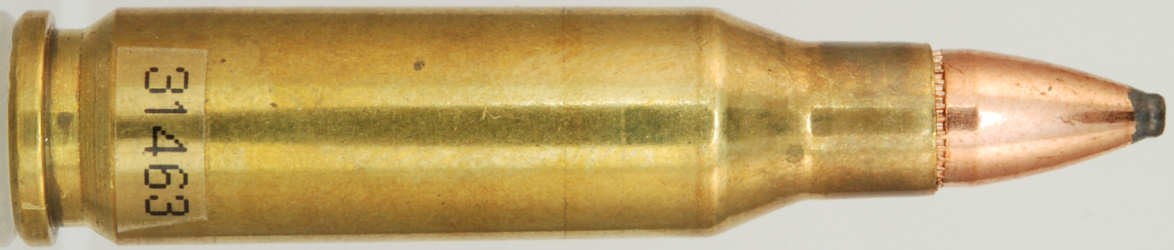
3.1 The cartridge in one table
Table 1 — The cartridge in one table
| Item | Figure | Source |
|---|---|---|
| Designation | 4.6 mm × 30; “4.6 mm x 30 NATO” | STANAG 4820;1 H&K2 |
| Overall length | 38.5 mm (+0, −0.8) | STANAG 4820 Annex A1 |
| Case length | 30.5 mm (+0, −0.3) | STANAG 4820 Annex A |
| Rim diameter | 8.0 mm | STANAG 4820 Annex A |
| Bullet diameter | 4.65 mm | H&K 20003 |
| Bullet (H&K’s first ball) | copper-plated hardened steel, about 16.5 mm long, 1.6 g (24.7 gr) | H&K 20003 |
| Case | brass, Boxer-primed, about 3.8 g | H&K 20003 |
| Loaded round | 6 g (H&K 2000); 6.1 g, “standard combat cartridge” (H&K manuals) | 34 |
| Maximum pressure | 4,000 bar (H&K manuals, RWS); 400 MPa corrected mean case-mouth pressure at +21 °C (STANAG 4820) | 561 |
| Rifling (MP7) | polygonal, 6, right-hand; twist 160 mm | H&K;24 NATO AEP-977 |
The two pressure figures are the same number in different units, 4,000 bar being 400 MPa; STANAG 4820 adds that the corrected mean plus three standard deviations must not exceed 460 MPa.1
3.2 Dimensions, from the standard
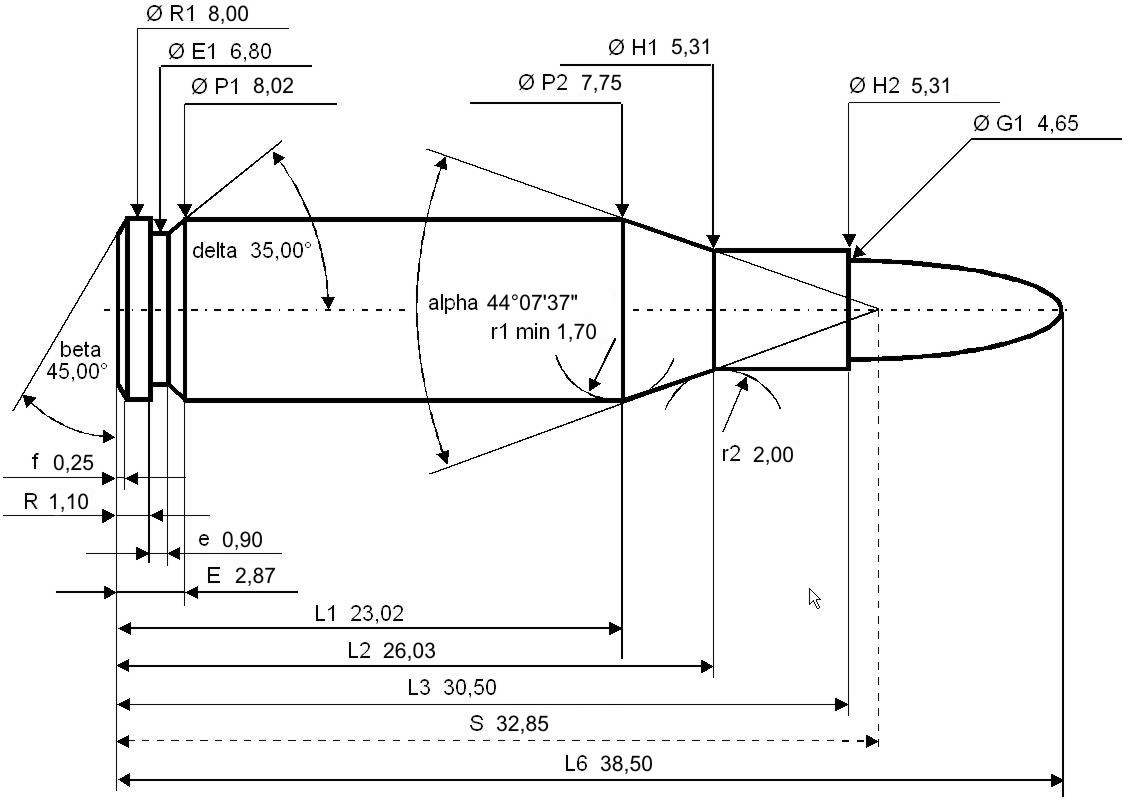
The authoritative public source for the cartridge’s dimensions is STANAG 4820, the NATO interchangeability specification, as reproduced by the Czech defence standards office in its 2025 implementation, ČOS 130512.1 Its Annex A is labelled informative and “not to scale”, and it refers manufacturers to the published drawings in the companion proof manual, but it gives the figures that matter: overall length 38.5 mm, case length 30.5 mm, a body diameter of 7.98 mm near the base and 7.65 mm at the shoulder, a rim of 8.0 mm over an extraction groove of 7.0 mm, a shoulder datum at 23.02 mm and a shoulder whose sides include an angle of 44° 7′ 37″, about 22° each side. The same drawing specifies that any coloured tip marking “must not appear on the bearing surface of the bullet”, and that the headstamp carries the supplier’s mark, the last two digits of the year, and optionally the NATO design-type mark.1
The case is rimless with an extraction groove, bottlenecked, and short in the body: the shoulder begins about three-quarters of the way along a 30.5 mm case. A drawing of the maximum C.I.P. dimensions, uploaded to Commons by a contributor, gives the same overall and case lengths and a neck diameter of 5.31 mm.8
3.3 At scale against its rivals
The cartridge is easiest to understand drawn beside the others in the argument. The figure below draws four cartridges at one scale from standards documents: the 4.6×30 from STANAG 4820; the 9×19 and the .223 Remington (the commercial counterpart of 5.56×45) from the SAAMI standards; and the 5.7×28 from its case and overall lengths as the P90 dive gives them, with diameters from the NATO test-barrel chamber drawing for 5.7 mm in the proof manual, which are fractionally larger than the cartridge itself.19107
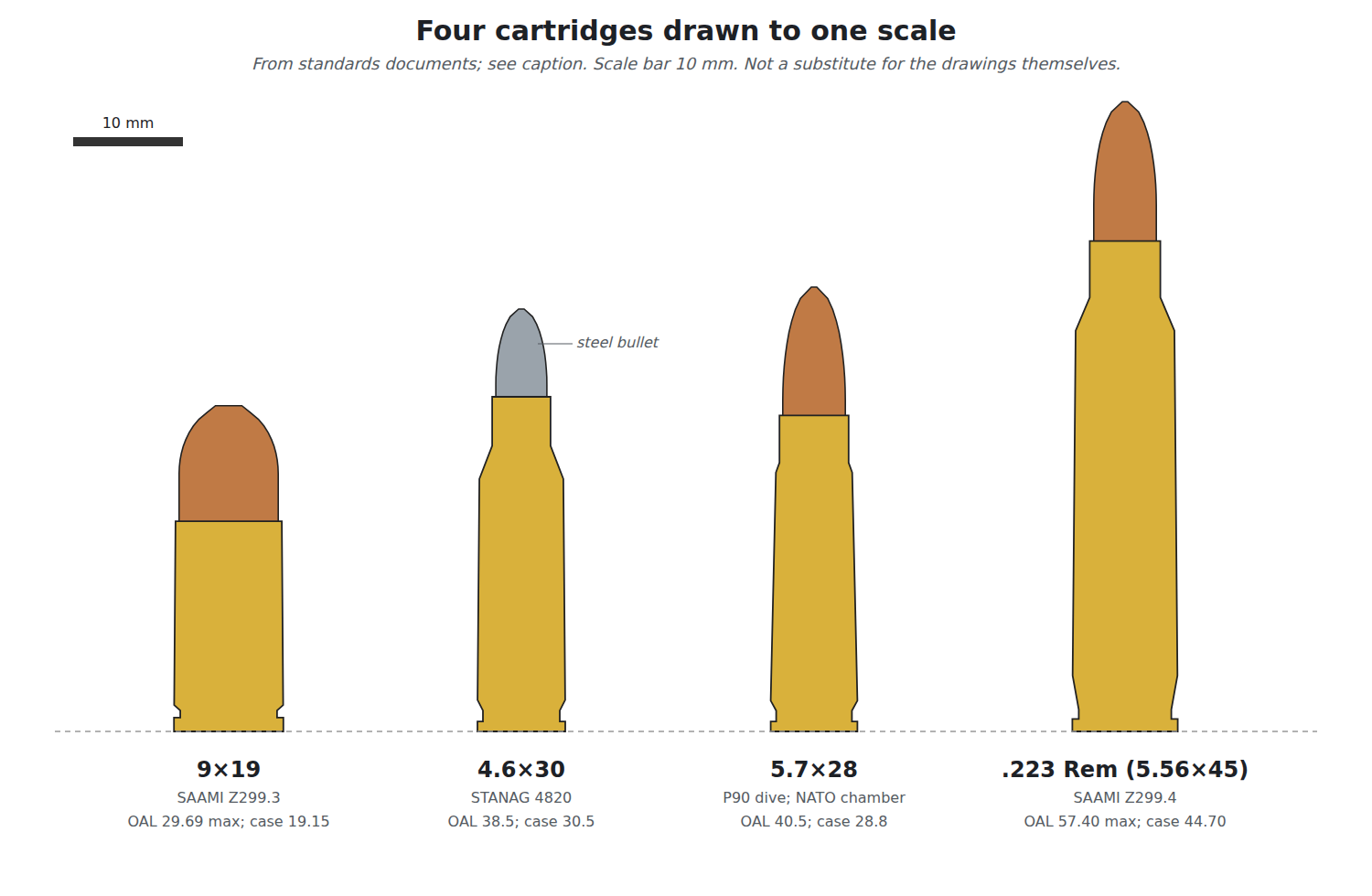
Three things show at once. The 4.6×30 and the 5.7×28 are close relatives in size: both have a case head of about 8 mm, close to the 9 mm pistol’s 10 mm, so both suit a magazine in a pistol grip. The 4.6 has the longer case (30.5 mm against 28.8) and the shorter overall length (38.5 against 40.5), because its bullet is seated deeper and is shorter. And both are a fraction of a 5.56×45; H&K’s 2004 presentation put the 4.6 at 6.2 g a round against 12.3 g for 5.56 NATO and 12.4 g for 9×19 NATO, and claimed on that basis that a soldier could carry twice as many rounds for the same weight.11
3.4 The bullet: hardened steel, and the barrel-wear problem
The bullet is what makes the cartridge. H&K’s first ball round, in 2000, was “Copper-plated steel bullet (hardened)”, 1.6 g, about 16.5 mm long and 4.65 mm in diameter.3 H&K’s current page describes what the shape is meant to do: “The geometry of the bullet with its rear centre of gravity ensures that the projectile rolls over in the target and releases most of its energy there. The risk of a potential overpenetration for uninvolved third parties is thus significantly reduced.”2 That is H&K’s claim; it is examined below.
A solid hardened-steel bullet raises an obvious problem. Rifling has to engrave the bullet to spin it; a bullet hard enough to defeat titanium is hard enough to resist being engraved, and the force needed to push it down the bore, and the wear it causes, rise accordingly. The NATO evaluation’s concern about “a greater potential risk of barrel erosion” with the 4.6 (Volume 1) was this concern, inferred from the design.12
The answer is in a patent. US 7,210,411, “4.6 mm small arms ammunition”, was filed by three BAE Systems inventors at Crewe, which is Radway Green’s town, with a British priority date of 27 March 2003, and granted on 1 May 2007.13 Its claims describe a projectile of steel or another metal with a Vickers hardness of at least 550, coated in copper or copper alloy, with a forward body about the diameter of the rifling lands, a rearward body about the diameter of the groove roots, and a coating at least as thick as the grooves are deep, “so that the rifling engraves the coating but does not significantly engrave the underlying steel”. The body carries three annular grooves into which displaced coating can flow. The patent says the invention “has been successfully applied to 4.6 mm gun and ammunition”, that the hard body “is highly effective at penetration of targets such as titanium/kevlar body armour”, and it gives the one hard number in the whole public record of this problem: “A 4.6 mm projectile as described … but without the grooves 12 was found to require an unduly high axial force of the order of 6000 N; addition of the grooves 12 reduced this force to 2000 N.”13
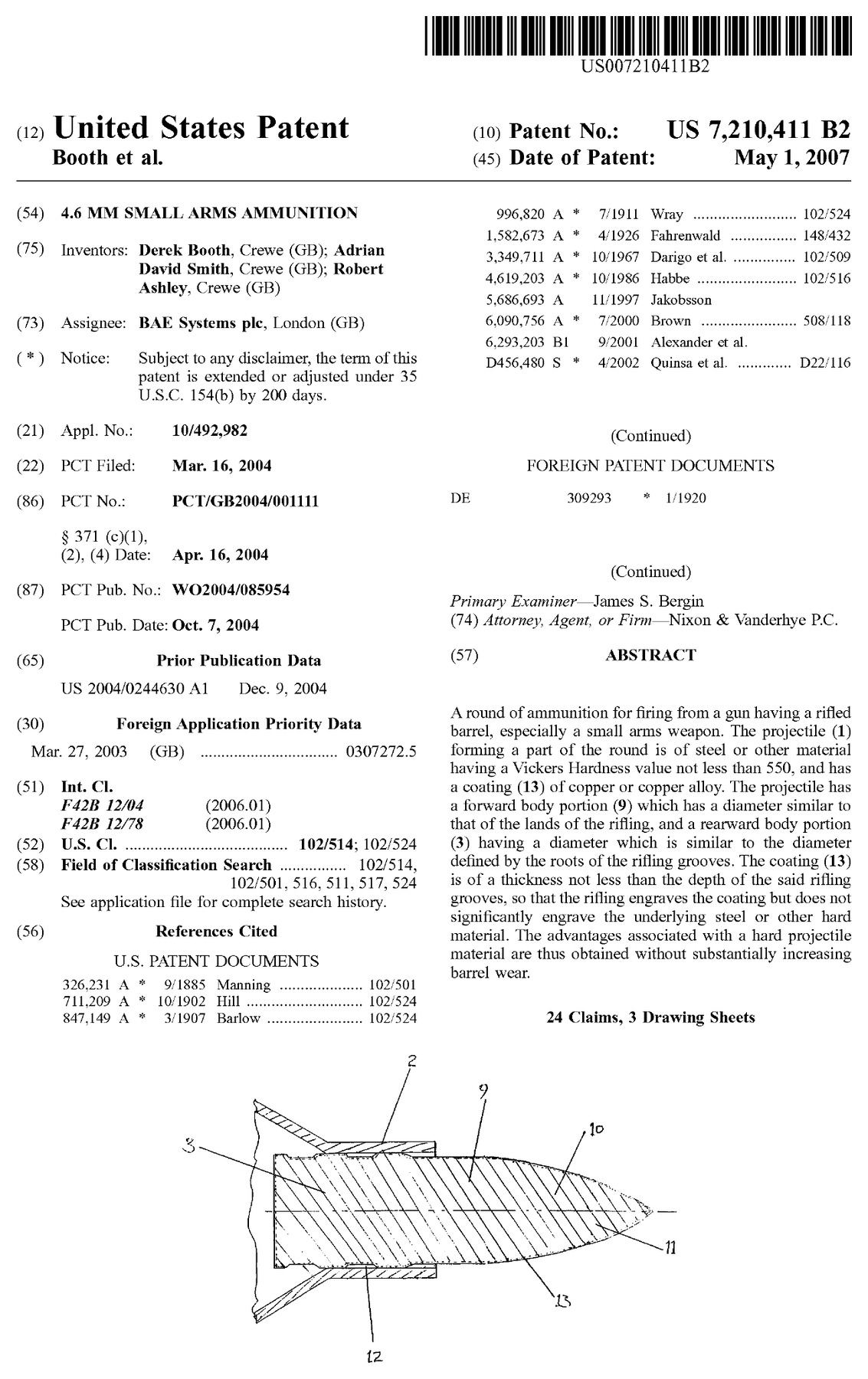
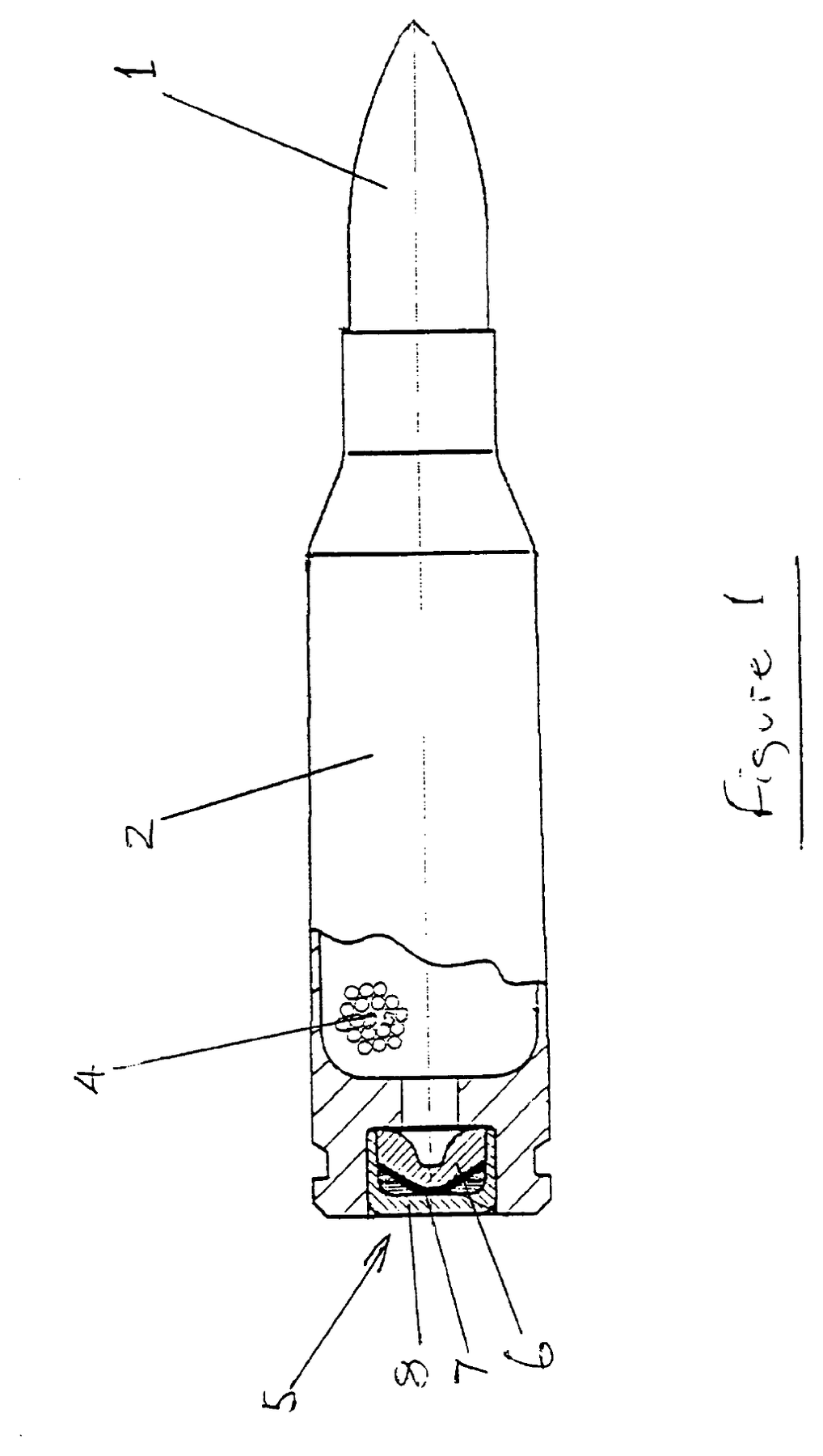
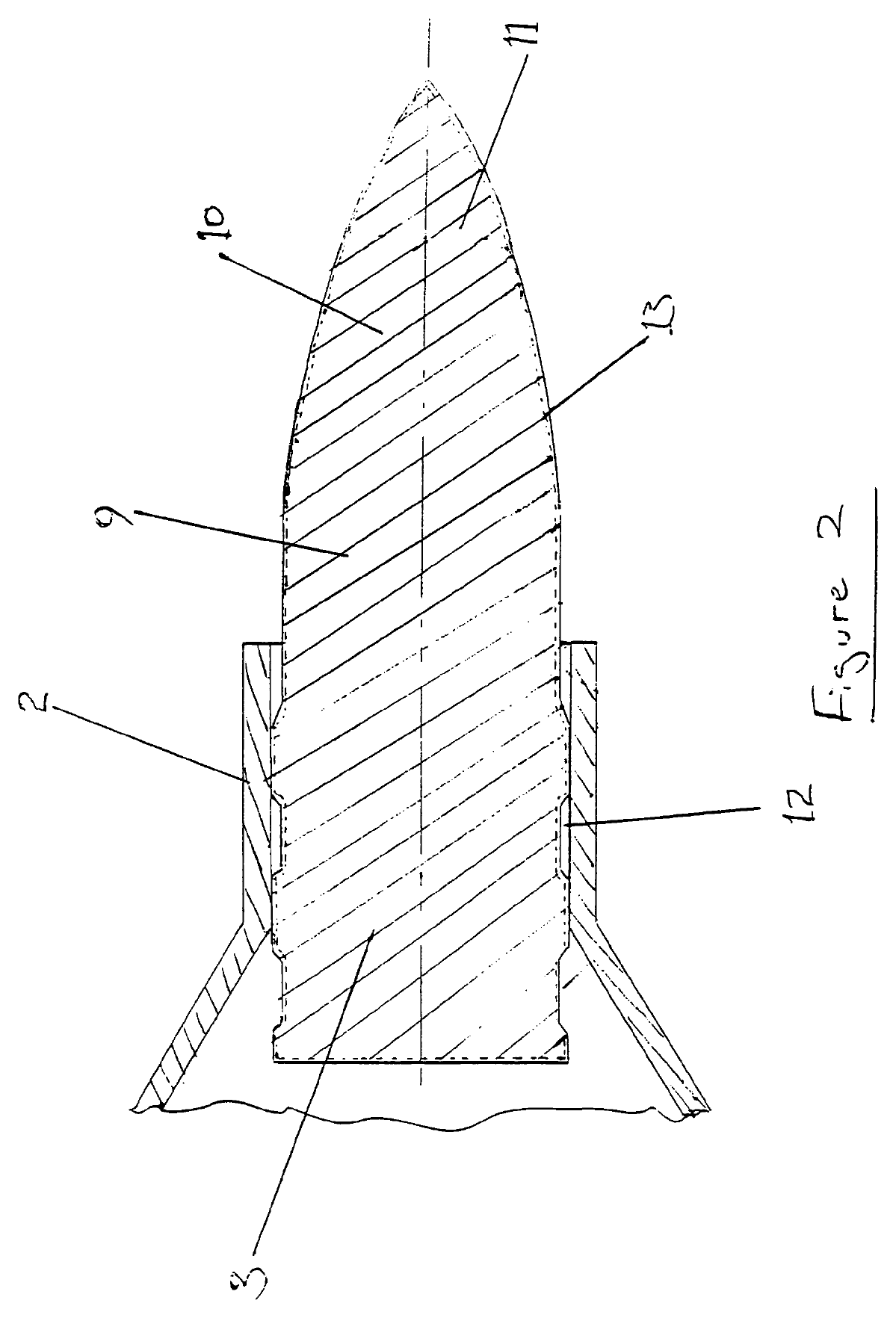
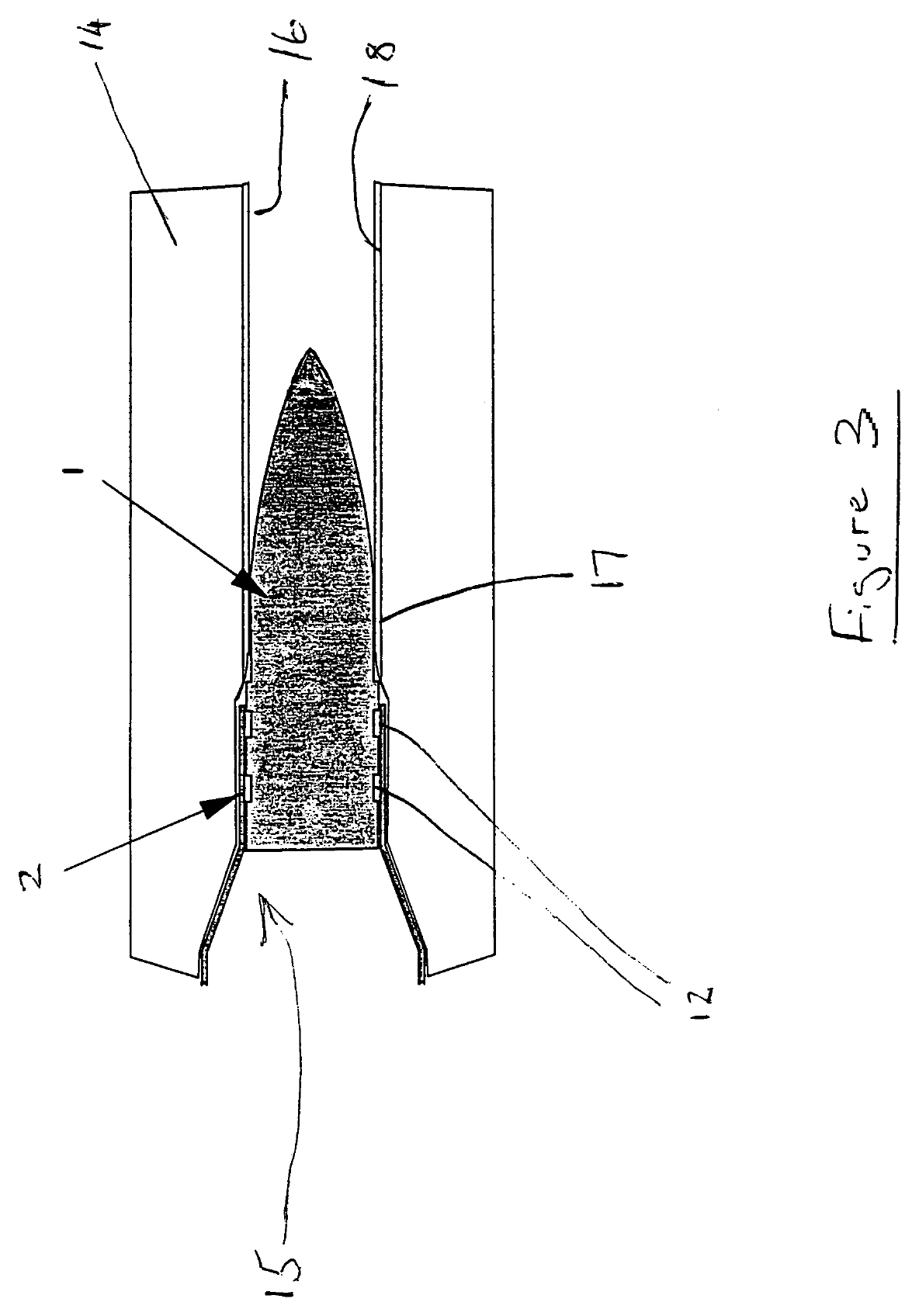
The patent’s date is worth noting. It was filed in the same months as the NATO evaluation’s quick-reaction team was weighing barrel wear, and a year after the first MP7s were in production. It describes an improvement, not the original 1999 bullet; whether a given lot of service ammunition uses it is not stated anywhere found. The connection between the patent and the “Ultimate Combat” round that H&K’s 2004 presentation lists as a Radway Green product “available soon” is likely but is an inference.11
3.5 Every loading, by who published it
The 4.6×30 has been loaded in more varieties than almost any cartridge of its size, because H&K treated it as a system and its makers chased police as well as military buyers. The tables below are grouped by the document that publishes each figure, because the documents do not agree and must not be merged. Velocities are muzzle velocities as each source defines them; masses are bullet masses.
H&K Inc., December 2000 (status of each load at that date)3
Table 2 — Every loading, by who published it
| Load | Bullet | Status (Dec 2000) | H&K’s remark |
|---|---|---|---|
| Ball | steel, hardened, copper-plated | in production | ”Penetrates at 200 m the NATO Titanium / Kevlar-Plate” |
| Ball, tracer | brass with hollow base | limited pre-series; available July 2001 | Ti/Kevlar to about 50 m; tracer to 200 m |
| Training | solid copper | in production | Kevlar vests and Ti/Kevlar at 50 m |
| Blank | — | available Sept 2000 | — |
| Frangible | frangible | available March 2001 | reduced-range training |
| Spoon-nosed | solid copper, spoon nose | available Sept 2000 | ”Maximum energy transfer, minimal soft target penetration” |
| Drill | plastic | available Sept 2000 | — |
| Subsonic | steel with hardened tip | test lots | CRISAT at 50 m; “100 dB with sound suppressor” |
H&K GmbH and Radway Green, March 2004 (maker named as Radway Green, UK, for every load)11
Table 3 — Every loading, by who published it
| Load | Bullet | v0 | E0 | H&K’s penetration claim |
|---|---|---|---|---|
| Combat Steel | 1.7 g steel, copper-clad | 725 m/s | 447 J | CRISAT beyond 200 m; German protective classes I and II to 25 m |
| Ultimate Combat (“available soon”) | 2.0 g steel, copper-clad | 690 m/s | 476 J | CRISAT beyond 300 m |
| Full Metal Jacket (“available soon”) | 2.7 g, lead core | 600 m/s | 540 J (as printed) | — |
| Police (“available soon”) | 2.0 g solid hollow point | 700 m/s | 480 J | protective class I |
| Spoon Nose | 1.7 g solid copper | 725 m/s | 447 J | — |
| Subsonic (“available soon”) | 5.0 g copper-plated solid | 326 m/s | 270 J | CRISAT to 90 m |
| Tracer (“available soon”) | 1.3 g, red | — | — | visible to 300 m |
| Copper Training | 1.7 g solid copper | 725 m/s | 445 J | CRISAT to 100 m |
| Soft Frangible | 1.2 g metal-powder and plastic | 825 m/s | 408 J | — |
| Blank, Drill | — | — | — | — |
H&K brochure “Innovation for the future” (undated; PDF of 2007)14
Table 4 — Every loading, by who published it
| Load | Bullet | v0 | E0 |
|---|---|---|---|
| Combat Steel | 1.7 g copper-plated steel | 750 m/s | 478 J |
| Ultimate Combat | 2.0 g copper-plated steel | 710 m/s | 504 J |
| Full Metal Jacket | 2.5 g | 640 m/s | 512 J |
| Hollow Point | 2.0 g | 680 m/s | 462 J |
| Hard Frangible | (about 1.7 g by its energy) | 760 m/s | 491 J |
| Subsonic | 4.3 g | 320 m/s | 220 J (CRISAT at 30 m) |
H&K data sheet, February 2011: “Steel 2 g”, “Full Metal Jacket 2,6 g”, “Action 2 g”, a blank “in development”, a lead-free tin-bullet training round, and a drill round, without velocities.15 H&K accessory list, September 2012: a monolith steel bullet (RUAG), a copper-plated steel bullet (Fiocchi), a full-metal-jacket and a hollow-point bullet (both RUAG), and Nammo’s NM249 plastic training round with its own blank-firing attachment.16
RWS GmbH (the former RUAG Ammotec), current product pages, read 2026-10-18
Table 5 — RWS GmbH (the former RUAG Ammotec), current product pages, read 2026-10-18
| Load | Bullet | Velocity | Energy | RWS’s description |
|---|---|---|---|---|
| 4.6MMx30 DM21 Soft Core | 2.6 g (40 gr); lead core in a tombac-plated steel jacket | 612 m/s at 10 m | 487 J | ”the world’s first load in 4.6x30 calibre”, developed “in close cooperation” with H&K, “engineered for the polygon barrel” of the MP76 |
| 4.6x30 FMJ SX | 2.6 g; same construction | 612 m/s at 10 m | 487 J | the non-DM version of the same load17 |
| 4.6x30 Action SX | 2.0 g (31 gr); solid lead-free tombac, “controlled deformation” | 678 m/s at 10 m | 460 J | police use, “specially adapted to the requirements of the Heckler & Koch MP7”18 |
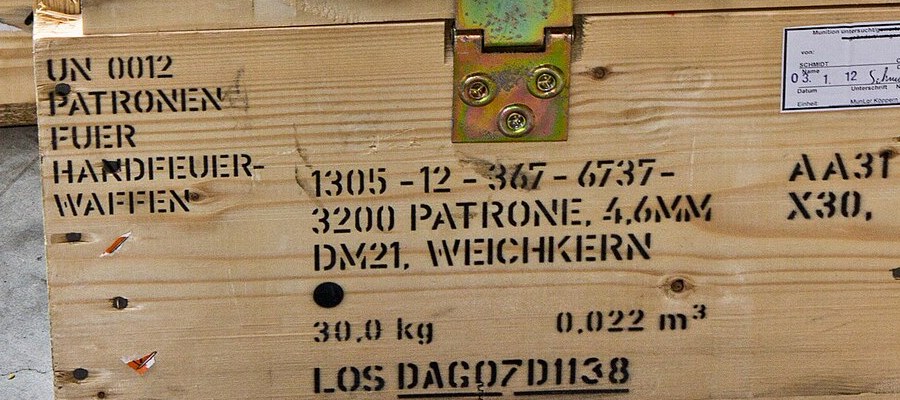
| 4.6MMx30 DM18 Manöver | blank | — | — | the Bundeswehr’s current blank, used “across the board by all German military police corps”; needs a blank-firing device19 |
All four RWS pages give a 180 mm test barrel and a 160 mm (1 in 6.3 in) twist, the MP7’s own figures, and a maximum mean gas pressure of 4,000 bar at 21 °C. RWS’s pages also list a “4.6x30 AP SX” (“a high penetration cartridge for government and military use”) and a “4.6MMx30 DM41 DEA” (lead-free, for soft targets) without data on the pages read.19
H&K’s current product page gives the MP7’s own figures with DM31: 680 m/s and 465 J, measured at 5 m (v5, E5).2 At 680 m/s, 465 J corresponds to a bullet of almost exactly 2.0 g, which is consistent with the 2 g steel bullet of the other documents. DM31 itself has no maker’s page among those read.
3.6 Why the velocity figures never agree
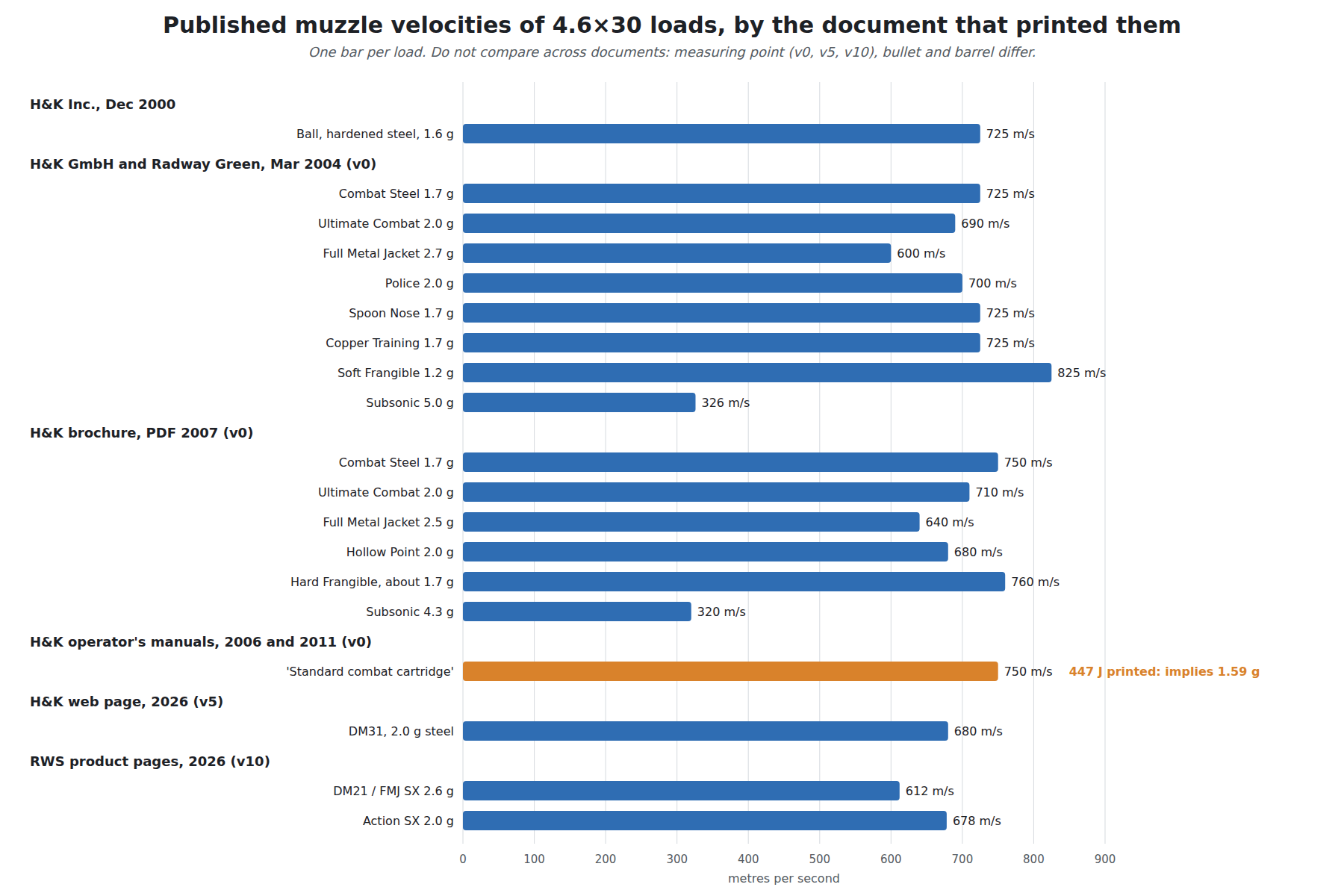
A reader comparing those tables will find the same nominal load at 690, 710, 720 and 725 m/s depending on the document. Four things explain most of it.
The measuring point. H&K’s web page gives v5, five metres from the muzzle; RWS gives v10; the older documents give v0 without saying how it was found.26
The barrel. H&K’s 2004 comparison with the 5.7 lists the 4.6 from both a 240 mm and a 180 mm barrel; the MP7’s barrel is 180 mm.11
The load. “Combat Steel” was 1.7 g, “Ultimate Combat” and the later “Steel” 2.0 g; the ball bullet of 2000 was 1.6 g.311
Errors. Two H&K figures cannot be right as printed. The operator’s manuals, English and Spanish, give “approx. 750 m/s” and “approx. 447 Joule” for the standard combat cartridge.54 At 750 m/s, 447 J implies a bullet of 1.59 g; a 2 g bullet at 750 m/s would carry 563 J. The 2004 presentation shows where the 447 came from: it is Combat Steel’s energy at 725 m/s, a 1.7 g bullet.11 The manuals pair a velocity from one source with an energy from another. And the 2004 presentation’s Full Metal Jacket entry gives 2.7 g at 600 m/s and 540 J; 2.7 g at 600 m/s is 486 J.11
The manuals also print “Max. effective range: 3.000 m”. The Spanish manual’s wording shows what was meant: “Alcance máximo de tiro: 3.000 m”, maximum range, with a recommended safety area of 4,000 m and a maximum combat distance of “unos 200 m”.4 The English “effective” is a mistranslation.
3.7 Who made it first
RWS’s page calls DM21 “the world’s first load in 4.6x30 calibre”.6 H&K’s own 2000 presentation, written when RUAG was not named anywhere in the programme, records a ball round “In production” from Royal Ordnance Radway Green, and Small Arms Review’s March 2000 report said ammunition was “already in production at Royal Ordnance”.320 On the documents, the first 4.6×30 to be made in series was British and steel-bulleted, and DM21’s claim can be true only in a narrower sense, perhaps the first soft-core (lead) load, or the first German service load. RWS does not say which.
3.8 The armour question, kept in two halves
The P90 dive’s Volume 2 sets out the rule this hub follows for both PDW cartridges: “armour-piercing” has two meanings that are unrelated, a physical one (what the bullet will defeat) and a statutory one (what United States law calls it), and a round can satisfy either without the other. The same two halves are kept apart here.
3.9 The physical half: what the claims are
Every armour claim for the 4.6 is a claim by H&K, by its ammunition makers or by a user repeating them. Laid out by source:
Table 6 — Every armour claim for the 4.6 is a claim by H&K, by its ammunition makers or by a user repeating them. Laid out by source
| Claim | Source |
|---|---|
| Defeats CRISAT (1.6 mm titanium + 20 layers Kevlar) beyond 200 m; two CRISAT targets to 30 m; laminated plates “rated for .357 and .44 magnum at 200 meters” | H&K Inc., Dec 20003 |
| ”still perforates the CRISAT vest at 200 meters or two vests at 50 meters” | H&K Inc., July 200221 |
| Combat Steel: CRISAT to 200 m; Ultimate Combat: to 300 m, “Under supervision of German Procurement Authority (BWB), February 28, 2003” | H&K GmbH, March 200411 |
| At 25 m, Combat Steel perforated the titanium and all 20 Kevlar layers; German 9 mm NATO ball perforated the titanium and none of the Kevlar | H&K GmbH, March 200411 |
| ”Penetration of NATO CRISAT Target … at over 200 meters” | H&K brochures 2007 and 20111415 |
| ”perforates the NATO CRISAT target at ranges up to 200 m” | H&K operator’s manual5 |
| The smaller cross-section “enables it to penetrate modern body armour with steel-core ammunition” | H&K web page, 20262 |
| ”die Durchschlagskraft eines Sturmgewehres” (the penetrating power of an assault rifle) | Bundeswehr, 202022 |
None of those is an independent measurement. The only third-party test result found is the NATO evaluation as reported by the FN-side trade article discussed in Volume 1, which records that the ETBS tests found both cartridges perforating CRISAT beyond 200 m, above NATO’s 150 m threshold.12 That is the strongest available evidence that the 4.6’s central armour claim is true: it comes, at second hand, from the side that wanted the other cartridge to win.
Two cautions follow, as they do for the 5.7. CRISAT is a soft-armour simulant, titanium plus Kevlar; nothing in the record suggests the 4.6 defeats rifle-rated ceramic or steel plates, and the physics make it implausible. And the claims concern the steel-bullet loads; the soft-core DM21, the expanding Action SX and the US commercial FMJ are different bullets doing different jobs.
3.10 The physical half: what NATO actually requires
STANAG 4820 does not use CRISAT. Its terminal-effect requirement, for any bullet containing inert material, is that it “must completely perforate six (6) low-carbon steel plates of a nominal thickness of 1 mm” at 100 m and normal incidence, with at least 90 per cent of bullets succeeding.1 The standard’s other requirements are mechanical and ballistic: case-mouth pressure, the velocity spread between +52 °C and −54 °C (within 50 m/s of the +21 °C mean), an action time at −54 °C, accuracy (mean vertical and horizontal standard deviations of 35 mm or less at 100 m from a dispersion barrel), a bullet pull of at least 200 N, waterproofness, and barrel erosion: the round “must not contain design features that make barrels unserviceable through erosion in fewer than 5,000 rounds”, judged by yaw (fewer than 20 per cent of bullets in each 100-round group yawing more than 15° at 25 m) and by a velocity loss of less than 60 m/s.1
The erosion criterion is the one that bears on the NATO argument. The evaluation’s quick-reaction team inferred a “greater potential risk” from the 4.6’s design after 5,000 rounds had shown “no significant erosion”;12 the standard written later sets 5,000 rounds as the pass mark. The MP7, NATO’s nominated weapon for the calibre, is itself specified in NATO’s proof manual for a barrel life of at least 10,000 rounds, with a bore-wear gauge at 4.58 mm (Volume 6).7
3.11 The statutory half
United States law defines “armor piercing ammunition” by what a projectile is made of and whether it “may be used in a handgun”, not by what it penetrates. The P90 dive’s Volume 2 quotes and explains 18 U.S.C. § 921(a)(17)(B) in full. Its first limb covers “a projectile or projectile core which may be used in a handgun” and is constructed entirely, apart from traces, from listed metals that include steel and brass.23
For most of the MP7’s life the “may be used in a handgun” condition had nothing to attach to in the US market: the 4.6×30 had no commercially sold handgun, and no H&K pistol in the calibre reached production (Volume 1). That is no longer so. CMMG sells an AR-pattern “Banshee Mk4” pistol in 4.6×30, and UO Arms lists an “NT7 Pistol 4.6x30mm Semi-Automatic” for delivery in late 2026 (Volume 8).2425 A solid hardened-steel 4.6 bullet, or a solid tombac (brass-alloy) one, is the kind of projectile the statute’s first limb describes. No ATF classification of any 4.6×30 load was found, and this is a reading of the statute’s text, not a ruling. The practical point is narrower: the 4.6×30 sold to US civilians, so far as was found, is a lead-core full-metal-jacket load (Volume 8), which the first limb does not reach.
3.12 Wounding: claims, not measurements
H&K’s current page says the bullet “rolls over in the target and releases most of its energy there”, reducing over-penetration.2 Its 2004 presentation gave gelatine figures to support the claim, at 25 m into 10 or 20 per cent gelatine blocks 35 cm long:11
Table 7 — Wounding: claims, not measurements
| Load | ”Narrow channel” before the bullet yaws | Temporary cavity | Energy transfer |
|---|---|---|---|
| Combat Steel 1.7 g | about 100 mm | 80–100 mm | about 30–35 J/cm |
| Ultimate Combat 2.0 g | 50–70 mm | 90–100 mm | about 35–40 J/cm |
| Full Metal Jacket 2.7 g | 5–6 cm | 100–120 mm | about 40–45 J/cm |
| Spoon Nose 1.7 g | about 45 mm | over 100 mm | about 35–40 J/cm |
For the Police round, H&K stated design criteria taken from the German police leaders’ academy directive for the 9×19 “police cartridge”: energy transfer above 30 J/cm over at least 5 cm and below 60 J/cm, a temporary cavity over 10 cm, penetration under 30 cm and about 99 per cent retained mass, and it showed the bullet stopping inside the block.11 H&K’s 2000 presentation gave its own lethality criterion, “81 Joules is lethal”, beside a claim of 115 J transferred behind CRISAT at 100 m.3
These are a manufacturer’s tests of its own product with its own criteria. No independent gelatine test of the 4.6 to the FBI protocol, or any other published protocol, was found for this dive. The wound ballistician Martin Fackler criticised small-calibre PDW cartridges in Small Arms Review in 2002, and H&K answered;21 Fackler’s article was not read here, so his argument is not summarised. A reader should treat “rolls over and releases its energy” as the design intent H&K claims, plausibly true of a light bullet with a rearward centre of mass, and unproven in the public record.
3.13 H&K’s numbers against FN’s
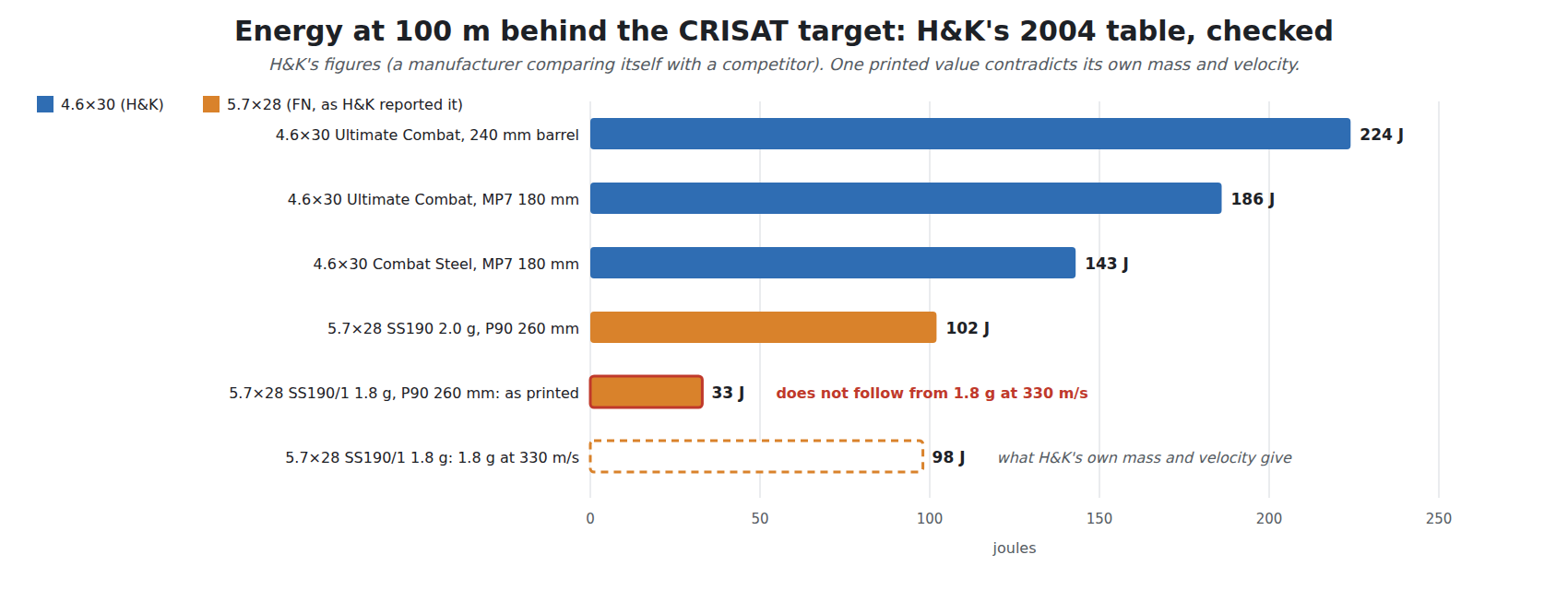
H&K’s 2004 presentation includes a table headed “Ballistic Potential compared to 5.7 x 28”, which ends “The superiority of the ballistic performance potential of the 4.6 x 30 compared to 5.7 x 28 is obvious!”11 It is reproduced here because it is the H&K side of the argument the P90 dive tells from FN’s, and because checking it is instructive.
Table 8 — H&K's numbers against FN's
| Cartridge and barrel (as printed) | V100 | E100 | V100 behind CRISAT | E100 behind CRISAT |
|---|---|---|---|---|
| 4.6×30 Ultimate Combat, 240 mm | 625 m/s | 365 J | 504 m/s | 224 J |
| 4.6×30 Ultimate Combat, 180 mm (MP7) | 545 m/s | 297 J | 432 m/s | 186 J |
| 4.6×30 Combat Steel, 180 mm (MP7) | 545 m/s | 248 J | 414 m/s | 143 J |
| 5.7×28 SS190 (2 g), P90 260 mm | 539 m/s | 290 J | 319 m/s | 102 J |
| 5.7×28 SS190/1 (1.8 g), P90 260 mm | 620 m/s | 345 J | 330 m/s | 33 J |
Every energy in the table follows from its mass and velocity except one. A 1.8 g bullet at 330 m/s carries 98 J, not 33 J. The figure H&K printed for FN’s lighter bullet behind armour is a third of what its own velocity implies. The error flatters H&K; whether it was a slip or something else cannot be told from the slide. Corrected, the table still has the MP7’s Ultimate Combat retaining more energy behind CRISAT at 100 m than either FN bullet from a P90, which is H&K’s claim, but by 186 J to 98 J or 102 J rather than 186 J to 33 J.
3.14 Corrections
- The operator’s manual’s “approx. 750 m/s” and “approx. 447 Joule” do not belong together; 447 J is Combat Steel’s energy at 725 m/s (H&K 2004). Its “Max. effective range 3.000 m” is the maximum range, mistranslated (Spanish manual).
- “The world’s first load in 4.6x30” (RWS, for DM21) conflicts with H&K’s own 2000 record of Radway Green ball ammunition in production.
- H&K’s 2004 comparison with the 5.7 misprints FN’s SS190/1 retained energy behind CRISAT as 33 J; the slide’s own figures give 98 J.
- The NATO interchangeability standard’s terminal test is six 1 mm steel plates at 100 m, not the CRISAT target that every armour claim uses.
- Barrel erosion: STANAG 4820 sets 5,000 rounds; the evaluation’s concern was an inference after 5,000 rounds showed no significant erosion; BAE’s 2003 patent addresses the problem directly, with a measured reduction in engraving force from about 6,000 N to 2,000 N.
3.15 What could not be verified
- The full STANAG 4820 drawing set (in AEP-97 Part 6), beyond the informative Annex A.
- DM11 and DM31 from a maker’s own page; the composition and maker of DM31.
- Whether service lots use the construction of US 7,210,411.
- Any independent measurement of penetration, or any gelatine test to a published protocol.
- Any ATF classification of a 4.6×30 load.
- The AP SX and DM41 DEA data (RWS pages listed them without figures).
- Fiocchi’s own page for its 4.6×30 loads (Volume 8 uses a retailer’s listing).
References
Footnotes
-
ČOS 130512, 1st ed., “Požadavky na zaměnitelné náboje 4,6 × 30 mm”, implementing STANAG 4820 Ed. 1 / AOP-4820(A), Úřad pro obrannou standardizaci, katalogizaci a státní ověřování jakosti, Prague 2025, sections 7.1–7.19 and Annex A, https://oos-data.army.cz/cos/cos/130512.pdf , accessed 2026-10-18 (translated). ↩ ↩2 ↩3 ↩4 ↩5 ↩6 ↩7 ↩8 ↩9
-
Heckler & Koch GmbH, MP7 product page, https://www.heckler-koch.com/en/Products/Military%20and%20Law%20Enforcement/Submachine%20guns/MP7 , accessed 2026-10-18. ↩ ↩2 ↩3 ↩4 ↩5 ↩6 ↩7
-
Jim Schatz, H&K Inc., “HK Personal Defense Weapon — 4.6 × 30mm PDW Weapon System”, presentation revised 12/00, https://s3.amazonaws.com/hk-manuals/files/Military/MP7/MP7_Presentation.pdf , accessed 2026-10-18. ↩ ↩2 ↩3 ↩4 ↩5 ↩6 ↩7 ↩8 ↩9 ↩10
-
Heckler & Koch, “MP7 A1 / MP7 A1-KSK … Instrucciones para el manejo” (PDF dated 3 August 2006), chapter 2, https://s3.amazonaws.com/hk-manuals/files/Military/MP7/MP7A1_Instruction_Manual_Spanish.pdf , accessed 2026-10-18. ↩ ↩2 ↩3 ↩4
-
Heckler & Koch, “Close Range Weapon MP7 A1 … Operators Manual”, fax copy dated 08/08/11, technical data, https://s3.amazonaws.com/hk-manuals/files/Military/MP7/MP7A1_Operators_Manual.pdf , accessed 2026-10-18. ↩ ↩2 ↩3
-
RWS GmbH, “4.6MMx30, DM21, Soft Core”, https://www.rws-technology.com/en/armed-forces-law-enforcement/product/46mmx30-dm21-weichkern-40gr-2315832 , accessed 2026-10-18. ↩ ↩2 ↩3 ↩4
-
ČOS 130511, 1st ed., implementing STANAG 4823 / AEP-97(A), Prague 2023, Annex 6-A figure 6-A.14 (5.7 mm test barrel and chamber) and Annex 10-A1 (MP7), https://oos-data.army.cz/cos/cos/130511.pdf , accessed 2026-10-18. ↩ ↩2 ↩3
-
Francis Flinch, “4,6 x 30.jpg”, “4.6x30mm maximum C.I.P. cartridge dimensions”, Wikimedia Commons, CC BY 3.0, https://commons.wikimedia.org/wiki/File:4,6_x_30.jpg ↩
-
ANSI/SAAMI Z299.3-2022, centerfire pistol and revolver, 9mm Luger cartridge and chamber drawing (revised 23 June 2021). ↩
-
ANSI/SAAMI Z299.4-2015, centerfire rifle, 223 Remington maximum cartridge / minimum chamber drawing (Library copy). ↩
-
Heckler & Koch GmbH, “Close Range Weapon — From ‘NBW’ to ‘MP7 A1’”, 2 March 2004, https://s3.amazonaws.com/hk-manuals/files/Military/MP7/MP7_Close_Range_Weapon.pdf , accessed 2026-10-18. ↩ ↩2 ↩3 ↩4 ↩5 ↩6 ↩7 ↩8 ↩9 ↩10 ↩11 ↩12
-
“In the line of fire”, Global Defence Review, © 2006, archived https://web.archive.org/web/20061016074936/http://www.global-defence.com/2006/Utilities/article.php?id=40 , accessed 2026-10-18. ↩ ↩2 ↩3
-
D. Booth, D. Smith and R. Ashley (BAE Systems plc), “4.6 mm small arms ammunition”, US Patent 7,210,411 B2, 1 May 2007, https://patents.google.com/patent/US7210411B2/en ; PDF https://patentimages.storage.googleapis.com/pdfs/US7210411.pdf ↩ ↩2
-
Heckler & Koch, “MP7 A1 — Innovation for the future”, brochure (image PDF dated 2007), https://s3.amazonaws.com/hk-manuals/files/Military/MP7/MP7_Description.pdf , accessed 2026-10-18. ↩ ↩2
-
Heckler & Koch, MP7 A1 technical-data brochure, Id.-Nr. 978076/V002.02.11, https://s3.amazonaws.com/hk-manuals/files/Military/MP7/MP7A1_Technical_Data.pdf , accessed 2026-10-18. ↩ ↩2
-
Heckler & Koch, “accessories programme MP7 A1 4.6 mm x 30”, v003.09.12, https://s3.amazonaws.com/hk-manuals/files/Military/MP7/MP7A1_Accessories.pdf , accessed 2026-10-18. ↩
-
RWS GmbH, “4.6x30 FMJ SX”, https://www.rws-technology.com/en/armed-forces-law-enforcement/product/46x30-fmj-sx-40gr-2316732 , accessed 2026-10-18. ↩
-
RWS GmbH, “4.6x30 Action SX”, https://www.rws-technology.com/en/armed-forces-law-enforcement/product/46x30-action-sx-31gr-2316731-1 , accessed 2026-10-18. ↩
-
RWS GmbH, “4.6MMx30, DM18, Manöver”, with related-product listings, https://www.rws-technology.com/en/armed-forces-law-enforcement/product/46mmx30-dm18-manoever-2317553 , accessed 2026-10-18. ↩ ↩2
-
Small Arms Review editorial staff, “HK Unveils New Personal Defense Weapon”, SAR V3N6, March 2000, https://smallarmsreview.com/hk-unveils-new-personal-defense-weapon/ , accessed 2026-10-18. ↩
-
Jim Schatz, “Puny Bullets: A Manufacturers Response”, Small Arms Review V5N10, July 2002, https://smallarmsreview.com/?p=2788 , accessed 2026-10-18. ↩ ↩2
-
Bundeswehr, “Der Alleskönner”, 6 July 2020, https://www.bundeswehr.de/de/mediathek/maschinenpistole-mp7-274984 , accessed 2026-10-18. ↩
-
18 U.S.C. § 921(a)(17)(B), via Legal Information Institute, https://www.law.cornell.edu/uscode/text/18/921 , accessed 2026-10-18. ↩
-
CMMG, “Pistol, Banshee, Mk4, 4.6X30MM, 8"", product 46A870D, https://cmmg.com/pistol-banshee-mk4-4-6x30mm-8 , accessed 2026-10-18. ↩
-
UO Arms LLC, “NT7 Pistol 4.6x30mm Semi-Automatic Gas Operated Firearm”, https://www.uoarms.com/nt7-pistol , accessed 2026-10-18. ↩

Comments (0)