H&K MP7 · Volume 1
From NBW to MP7: H&K's Answer to the PDW Requirement
How Heckler & Koch got from a caseless close-range weapon and a joint study with GIAT to the 4.6×30 PDW, the MP7 and the MP7A1, told from H&K's own presentations of 2000 and 2004, with the NATO evaluation as it touched the weapon and the dates H&K itself could not keep straight
1.1 The weapon in one paragraph
The Heckler & Koch MP7 is a gas-operated, locked-breech, select-fire personal defence weapon firing the 4.6×30 cartridge from a 180 mm barrel. Its magazine sits in the pistol grip, its stock slides out of the receiver, its fore-end carries a folding vertical grip (the MP7A2 replaces the grip with a rail), and it weighs about 1.8 to 1.9 kg empty according to H&K’s own documents. H&K’s current product page gives a rate of fire of 950 rounds a minute and an effective range of 200 metres.1 It was designed against NATO’s personal defence weapon requirement, the same requirement FN Herstal answered with the P90 and the 5.7×28. That requirement belongs to the FN P90 dive, which tells it in full; this volume starts on H&K’s side of the fence.
1.2 What this volume rests on
Two H&K documents carry most of the weight. The first is a presentation by Jim Schatz of Heckler & Koch, Inc., titled “HK Personal Defense Weapon — 4.6 × 30mm PDW Weapon System” and marked “Revised 12/00”; its product-comparison slides are dated November 2000 and say they use prototype configuration data.2 The second is a seventy-slide H&K GmbH presentation, “Close Range Weapon — From ‘NBW’ to ‘MP7 A1’”, dated 2 March 2004.3 Both survive as files in a public storage bucket that mirrors H&K documents; neither has been found on an H&K server, and both are sales documents. Every figure taken from them is H&K’s claim about its own product, and is attributed as such.
Around those two sit four contemporary Small Arms Review pieces (one by its editorial staff, three by Schatz, who was an H&K employee), H&K’s brochures and operator’s manuals, the Bundeswehr’s own pages, the NATO standard for the cartridge as published by the Czech defence standards office, and a 2006 trade article that is the root source of nearly everything printed about the NATO evaluation. Where they disagree, the disagreement is shown, not resolved by averaging.
1.3 The requirement, briefly
NATO’s document D/296 asked for a weapon to replace the pistol and the submachine gun in the hands of soldiers who are not riflemen, and for it to defeat body armour at ranges a pistol cartridge could not. The FN P90 dive’s Volume 1 covers the document, the CRISAT target and FN’s answer, and it is not re-derived here. Three details from H&K’s side add to it.
First, the date. The reference literature gives 1989 for the requirement. A 2006 trade article puts “the publication of NATO Doc D296” in 1990,4 and H&K’s 2000 presentation says its own programme started in 1990 “in response to NATO D29” (sic).2 The document itself was not found, so the year is not settled here.
Second, the target changed under H&K’s feet. Schatz’s 2000 timeline records that in 1992 “NATO target changed from 48 layers Kevlar to Ti/Kevlar combo”,2 and his 2002 reply to a critic in Small Arms Review says the same and adds that H&K modified its cartridge to suit.5 The target that became the standard, CRISAT, is 1.6 mm of titanium backed by 20 layers of Kevlar, as every H&K document from 2000 onwards describes it.26
Third, the people the weapon was for. H&K’s 2004 slide on user groups lists personal-defence military users (“non combatants 70% of the armed forces”), law enforcement, VIP protection and special forces.3 Schatz’s 2000 slide draws them as medics, drivers, ship, aircraft and armoured-vehicle crews, radio operators, supply, artillery and maintenance troops, military police and special operations.2 The Bundeswehr still describes its MP7 in those terms: designed for soldiers “who are not normally involved in infantry combat, such as medics, drivers and close-protection personnel”.7
1.4 Before the PDW: HK36, the NBW and the GIAT study
H&K’s 2004 presentation opens with a lineage slide that sets out the company’s own account of where the MP7 came from:3
Table 1 — Before the PDW: HK36, the NBW and the GIAT study
| Year (as given by H&K) | Programme | Calibre |
|---|---|---|
| 1989 | HK/GIAT Close Range Weapon Program | 5.7 × 22 GIAT |
| 1989 | NBW — Nahbereichswaffe (close-range weapon) | 4.73 × 25 caseless |
| 1999 | PDW — Personal Defence Weapon | 4.6 × 30 |
| 2001 | MP7 — Close Range Weapon | 4.6 × 30 |
| 2003 | MP7 A1 — Close Range Weapon | 4.6 × 30 |
Two things in it are worth drawing out. The NBW was a close-range companion to H&K’s caseless G11 programme, in a 4.73 mm caseless calibre; the caseless timeline belongs to the Daisy dive’s Volume 15 and is not repeated here. And the joint study with GIAT, in a 5.7 × 22 calibre, shows that H&K’s first answer to the close-range problem was not a solo effort.
The same presentation reaches further back, to a slide headed “4.6 mm x 36 — Predecessor of caliber 4.6 x 30 — 1968–1973: ‘HK36’ Assault Rifle Program”.3 Schatz’s 2000 presentation makes the same link in different words: “Experience with HK36 & 4.6 X 36 mm cartridge in 1960’s”.2 H&K’s own account, then, is that the 4.6 mm bore was not new to the company when it chose it for the PDW; it had worked in that calibre a generation earlier for a rifle that was never adopted.
1.5 The PDW programme, 1990 to 1995
The clearest account of how the cartridge was chosen is a slide in Schatz’s 2000 presentation headed “Current Program Status”.2 Its entries, in H&K’s words:
- 1990 — “PDW Program started at HK GmbH with 5.56, 4.85 & 4.6 mm calibers in response to NATO D29”
- 1992 — “NATO target changed from 48 layers Kevlar to Ti/Kevlar combo”
- 1993 — “Hit probability tests conducted”
- 1994 — “Settled on 4.6 mm after caliber studies”
- 1995 — “First 4.6 x 30 mm ammunition produced”; “First prototype completed”
Two calibres that lost are worth noting. The 5.56 mm would have shared a bullet diameter with the rifle the rest of an army carried; the 4.85 mm was the calibre Britain’s Enfield had proposed for its own small-calibre rifle in the 1970s. H&K’s slide gives no reason for preferring 4.6 mm beyond “caliber studies”, and the studies themselves were not found.
The partners are named on the presentation’s programme-management slide: H&K GmbH in Oberndorf for the weapon; BAe Systems with Royal Ordnance’s Radway Green factory in Cheshire for the ammunition; Hensoldt Systemtechnik in Wetzlar for the reflex sight; and H&K Inc. in Sterling, Virginia, for the carrying rig.2 The British connection runs through the whole story. Radway Green is named as the maker of every cartridge in H&K’s 2004 presentation,3 it was still the named ammunition supplier when the UK Ministry of Defence Police bought the weapon in 2005 (Volume 2),8 and the 2003 patent for an improved 4.6 mm projectile was filed by BAE Systems inventors at Crewe (Volume 3).9
1.6 Unveiled: 1999 and 2000
When the PDW was first shown in public is less certain than it should be. English Wikipedia says the first prototype was shown at the 1999 SHOT Show, that is, in January 1999.10 Small Arms Review’s March 2000 report, written at the time, says the weapon was first shown publicly at a small-arms symposium in the United Kingdom the previous September, having been “Rumored for some time to be in development at HK’s ‘skunk works’ in Oberndorf Germany”, and that firing prototypes had since been appearing at US defence exhibitions.11 The contemporary report is the better witness of the two, but it does not exclude an earlier private showing, and the SHOT Show claim’s source was not found. Both are given.
The 2000 report also records the claims H&K was making at the time: a cartridge “developed jointly by HK and Royal Ordnance”, a 25-grain bullet at 2,378 ft/s and 310 ft-lb, defeat of the titanium-and-Kevlar target, a loaded weight of 2.86 lb with 20 rounds (“nearly the same as the MK23” with 12), 3.39 lb with 40, about 950 rounds a minute, and production “scheduled for late 2000”.11 The magazine added a caution that is rare in that trade: “SAR has not yet seen the gelatin tests or ballistics on this round.”11
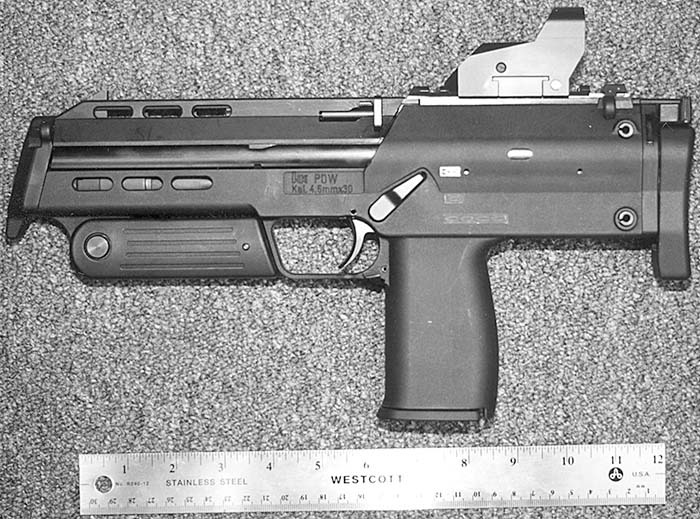
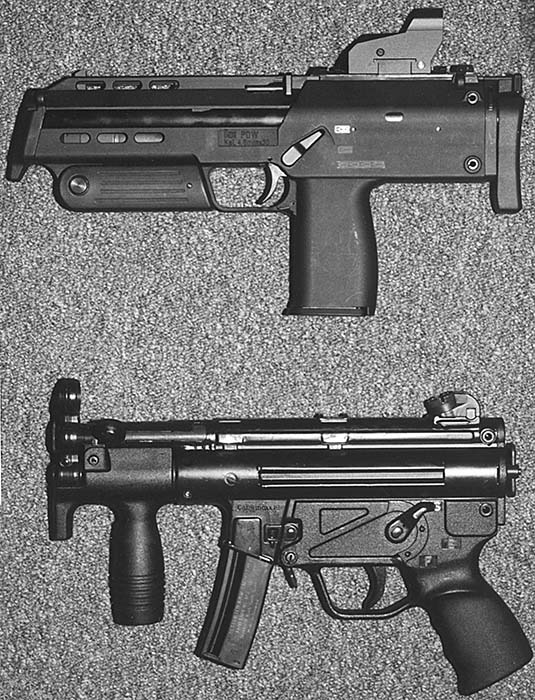
By December 2000 the prototypes had a configuration number. Schatz’s slide records that “Configuration 5 prototypes” were assembled in August 2000, and that 50 “Configuration 6” prototypes would be available for test and evaluation in March 2001.2
1.7 The PDW as H&K sold it in 2000
Schatz’s 2000 presentation is the best surviving description of the weapon before it became the MP7. Its technical-specification slides give:2
Table 2 — The PDW as H&K sold it in 2000
| Item | PDW, as specified by H&K Inc., December 2000 |
|---|---|
| Type | ”Personal Defense Weapon for shoulder supported and hand-held applications” |
| Operation | Gas-operated; “Locked breech with rotating bolt head” |
| Barrel | ”Chromium-plated barrel”, 7.09 in / 180 mm; twist 6.03 in (about 153 mm) |
| Modes | Semi-automatic and fully automatic |
| Magazine | Double-row box, 20 and 40 rounds |
| Rate of fire | About 950 rounds a minute, theoretical |
| Sights | Optical and iron sights “up to 250 m” |
| Length | 13.38 in / 340 mm (stock closed); 21.29 in / 541 mm (open, from the comparison slide) |
| Width / height | 42 mm / 172 mm |
| Weight | 1,500 g without magazine; 1,600 g with an empty 20-round magazine |
Three numbers in that table differ from every later H&K document, and they are the first evidence that the PDW and the MP7A1 are not the same weapon in different paint. The twist, 6.03 in, is about 153 mm, where every later document gives 160 mm. The length, 340/541 mm, is shorter than any later figure (380/590, 415/638 or 420/640 mm, depending on the document; Volume 4 tabulates them). And the weight, 1,500 g bare, is 300 to 400 g lighter than the 1.8 to 1.9 kg of the production weapon. Volume 4 returns to these as identification points.
H&K also published a comparison table against the weapons the PDW was meant to replace or outclass: the US M9 pistol, the Mk 23 Mod 0, the MP5K-PDW, the FN P90 and the M4 carbine.2 It credits the PDW with a maximum effective range beyond 200 m and CRISAT penetration beyond 200 m, against 150 m for the P90 and none for the pistols and the MP5K. It is a manufacturer’s table about its own prototype set against a competitor’s product, and two of its P90 entries differ sharply from what FN publishes: it gives the P90 2,855 ft/s, where the P90 dive’s Volume 2 has FN’s SS190 at 716 m/s, about 2,350 ft/s. It is reproduced here as evidence of how H&K argued its case, not as a measurement.
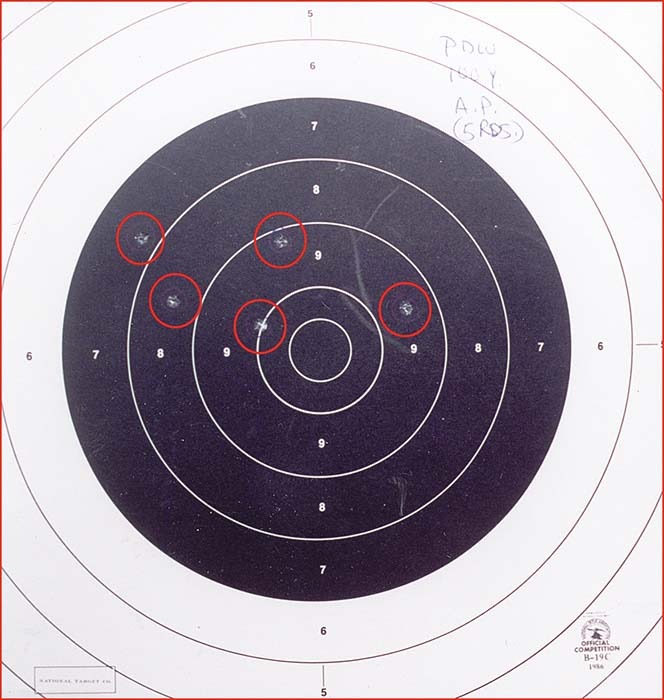
The one published accuracy result from the period is a single target. Schatz’s April 2001 article shows a “5-shot 100-yard group measuring not quite 5 inches”, fired prone with the Hensoldt reflex sight and its 7.5 MOA dot, and adds that at 200 metres the group “remains well within the confines of a man sized target”.12 It is one group, shot by an H&K employee, from a prototype.
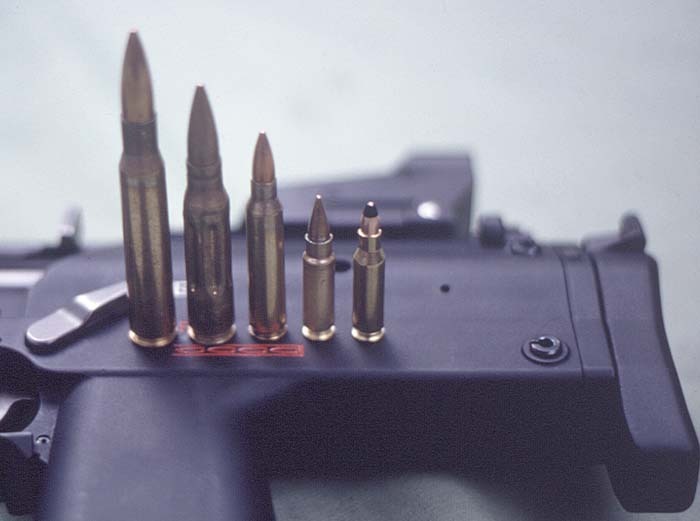
The presentation’s most quotable line sums the argument up: “Near 5.56X45mm rifle effectiveness out to 200 meters from a handgun-size weapon.”2 Its supporting claims are, in H&K’s words: a hit probability of 50 per cent at 200 m against a STANAG 4512 requirement of 90 per cent at 50 m and 50 per cent at 100 m; incapacitation of protected soft targets beyond 200 m against a STANAG 4513 requirement of 100 m; and a bolt-face recoil impulse of 1.93 N·s for the gas-operated, locked-breech PDW against 3.94 N·s for the blowback P90.2 The last is a real design argument, taken up in Volume 5: a locked breech lets the bolt be light, because the bolt is not what holds the case in the chamber.
1.8 From PDW to MP7, and the dates that kept moving
The weapon became the MP7 in 2001, by H&K’s own lineage slide.3 Schatz’s July 2002 article says the German military had by then type-classified it under that name.5 Deutsches Waffen-Journal later wrote that the MP7 had been produced in Oberndorf since 2001 and was introduced into the Bundeswehr in that year.13
When series production actually began is less clear, and the uncertainty is H&K’s own. Four statements, all by H&K or quoting it, give four dates:
Table 3 — When series production actually began is less clear, and the uncertainty is H&K's own. Four statements, all by H&K or quoting it, give four dates
| Date of statement | What it said about series production | Source |
|---|---|---|
| March 2000 | ”scheduled for late 2000” | Small Arms Review staff report11 |
| December 2000 | ”Late 2001 — Series production commences”; “Early 2002 — First series production weapons available” | Schatz presentation2 |
| April 2001 | production weapons “not expected before mid-2001” | Schatz, Small Arms Review12 |
| July 2002 | ”series production scheduled to commence in mid-2002” | Schatz, Small Arms Review5 |
Read together, they show a date that slipped by about eighteen months while the weapon was being shown, tested and type-classified. That is unremarkable for a new weapon and a new cartridge developed together; what matters for the reader is that “production began in 2001” is a simplification, and that early weapons in service may have been pre-series pieces. The 2002 article also mentions that a 2001 report by the US Naval Surface Warfare Center, Crane Division, on a prototype and early pre-production ammunition had been prepared for US Army special operations forces, and quotes it as finding 100-metre accuracy under four inches, rivalling an M4A1.5 The Crane report itself was not found; the claim is H&K’s quotation of it.
1.9 The MP7A1, 2003
H&K’s lineage slide dates the MP7A1 to 2003.3 What changed is a matter for Volume 4, which works from photographs and from H&K’s own documents rather than from the descriptions that circulate. In outline, the A1 is the weapon in every surviving H&K manual and data sheet: a reshaped grip, a slimmer stock, side rails, and, in the manuals from 2006 onwards, a trigger with a separate safety element. H&K’s 2004 presentation, written a year after the A1 appeared, already lists the users it was proud of: “Adopted by german special forces (KSK), VIP protection group of german Military Police and US Forces for VIP protection”, “Combat prooven (Afghanistan)”, and VIP-protection work for the Chairman of the NATO Military Committee, in Bosnia and Kosovo, and for Dubai Police at the 2003 World Bankers’ Conference.3 Volume 2 follows the service history from there.
1.10 The companion pistol that did not follow
FN had a pistol for its cartridge; H&K planned one. The 2004 presentation carries “Preliminary Datas (Pistol under development)” for an “Ultimate Combat Pistol”: delayed blowback, 4.6 × 30, 180 mm long, a 122 mm barrel, 34 mm wide, 590 g without magazine, 10- and 20-round magazines, a choice of trigger systems, a rail, exchangeable grip inserts, and a “Universal suppressor fits MP7A1, UCP”.3 A one-page H&K data sheet for the same pistol, now called P46 and dated “Stand: Dezember 2004”, gives different figures: a lever- or transmission-delayed blowback (“Übersetzter Masseverschluss”), 20+1 rounds, 843 g, 212 mm long, a 130 mm barrel, 603 m/s and 363 J, and a service life of 10,000 rounds.14 Nine months had added a quarter of a kilogram and 32 mm. No later H&K document describing the pistol was found, and no production pistol in 4.6 × 30 is known; the circulating account of why it was dropped could not be traced to a primary source and is not repeated.
The absence mattered. The trade article that reported the NATO evaluation (below) listed among the 5.7’s advantages that “A 5.7x28mm pistol family exists whereas the 4.6x30mm pistol project is only a paper concept.”4
1.11 The NATO evaluation, as it touched the MP7
English Wikipedia reports the evaluation’s result as: tests in the United Kingdom and France in 2002–2003, an expert group from France, the United States, Canada and the United Kingdom, a finding that the 5.7 was about 27 per cent more effective against unprotected targets and equivalent against protected ones, less sensitive to temperature and less likely to erode barrels, and a German rejection that stopped standardisation. Seen from H&K’s side, the source of those figures needs a closer look.
The source chain. The Wikipedia passage cites a single article, “In the line of fire”, published by Global Defence Review (GDR Publications) and archived in October 2006; Wikipedia attributes it to David Oliver and dates it 2007, but the archived page carries no byline.4 It sits in the magazine’s “What’s new” section and its first sentence is: “FN Herstal’s 5.7 System has proved itself through an extensive series of tests overseen and verified by organisations and authorities from around the world.” It is, on its face, a piece written from FN’s side. No NATO document reporting the evaluation was found. Everything in circulation about the result therefore rests on one article by an interested party, published after the event.
What the article actually says is more detailed than the summary that circulates, and in two places it is more favourable to the 4.6 than the summary:4
- First tests were made in the UK; “the main evaluation was performed in France in 2002 by the ETBS” (six months, 22 tests), followed by a “quick reaction team (QRT)” set up by the NATO Army Armaments Group in 2003.
- The ETBS found the 5.7 more effective against unprotected targets “and equal against protected targets”, CRISAT perforation beyond 200 m (above the 150 m NATO threshold), and better internal ballistics with less sensitivity to temperature; it described the 4.6 as “much more aggressive in relation to the weapon: higher internal pressure, variations and deviations are more important”.
- The QRT weighted effectiveness at 80 per cent, ammunition cost at 15 and barrel wear at 5, and found the 5.7 “27 per cent more effective (Pi/h) against unprotected targets at 100m” and “11 per cent more effective than the 4.6 against CRISAT protected targets at the same range”.
- On erosion: “despite the fact that no significant erosion had been highlighted by the ETBS tests (5,000 rounds), the design of the 4.6x30mm ammunition would suggest a greater potential risk of barrel erosion.”
- A reliability score of 127 for the 5.7 and 107 for the 4.6, or 96 and 83 “without taking into consideration the Belgian and German values”.
Two corrections follow for anyone using the circulating summary. The protected-target finding was “equal” in one stage of the evaluation and an 11 per cent margin in another; “equivalent” is half of it. And the barrel-erosion point was an inference from the 4.6’s design after 5,000 rounds had shown no significant erosion, not an observed result. Volume 3 shows why the inference was reasonable, and what Radway Green’s own patent did about it.
1.12 The argument after the evaluation
H&K did not accept the result, and its 2004 presentation is in part a reply. It carries a slide headed “Penetration of CRISAT target at 300 meter! Under supervision of German Procurement Authority (BWB), February 28, 2003”, for the “Ultimate Combat” round, and a table headed “Ballistic Potential compared to 5.7 x 28” that ends “The superiority of the ballistic performance potential of the 4.6 x 30 compared to 5.7 x 28 is obvious!”3 Volume 3 reproduces the table and points out that one of its own P90 figures is arithmetically impossible. The point here is only that both sides published their own numbers, both are interested, and neither side’s underlying test reports were found.
The argument had a scholarly front as well. In 2002 Small Arms Review printed a critique of small-calibre PDW cartridges by the wound ballistician Martin Fackler, and Schatz answered it for H&K in an article titled “Puny Bullets: A Manufacturers Response”.5 His reply cites “two independent European test facilities” without naming them, claims that the cartridge “still perforates the CRISAT vest at 200 meters or two vests at 50 meters”, and that the steel ball round penetrates more than 6 in of 20 per cent gelatine at 100 m and more than 12 in of unprotected gelatine at 50 m.5 Fackler’s article itself was not read for this dive; Volume 3 treats the wound-ballistics question with the claims separated from measurements.
1.13 Standardised in the end: STANAG 4820
The P90 dive records that both cartridges were eventually standardised separately, the 5.7 under STANAG 4509 and the 4.6 under STANAG 4820. The second half of that is confirmed by a primary document. The Czech defence standards office published ČOS 130512 in 2025, implementing “STANAG 4820, Ed. 1 — Technical Performance Specification Providing for the Interchangeability of 4.6 mm × 30 Ammunition” and its allied publication AOP-4820(A).15 It sets case-mouth pressure, velocity, accuracy, erosion and terminal-effect limits for combat ammunition, and Volume 3 uses it.
A second Czech implementation, of NATO’s multi-calibre proof and inspection manual AEP-97, adds the detail that closes the circle: its list of NATO Nominated Weapons, the guns in which candidate ammunition must function to be accepted, names a single weapon for 4.6 mm, the “MP7, 4,6 mm”, nominated by Germany, with a NATO stock number of 1005-12-375-3866.16 Two decades after the evaluation that went against its cartridge, the MP7 is the weapon NATO uses to test that cartridge.
1.14 The timeline
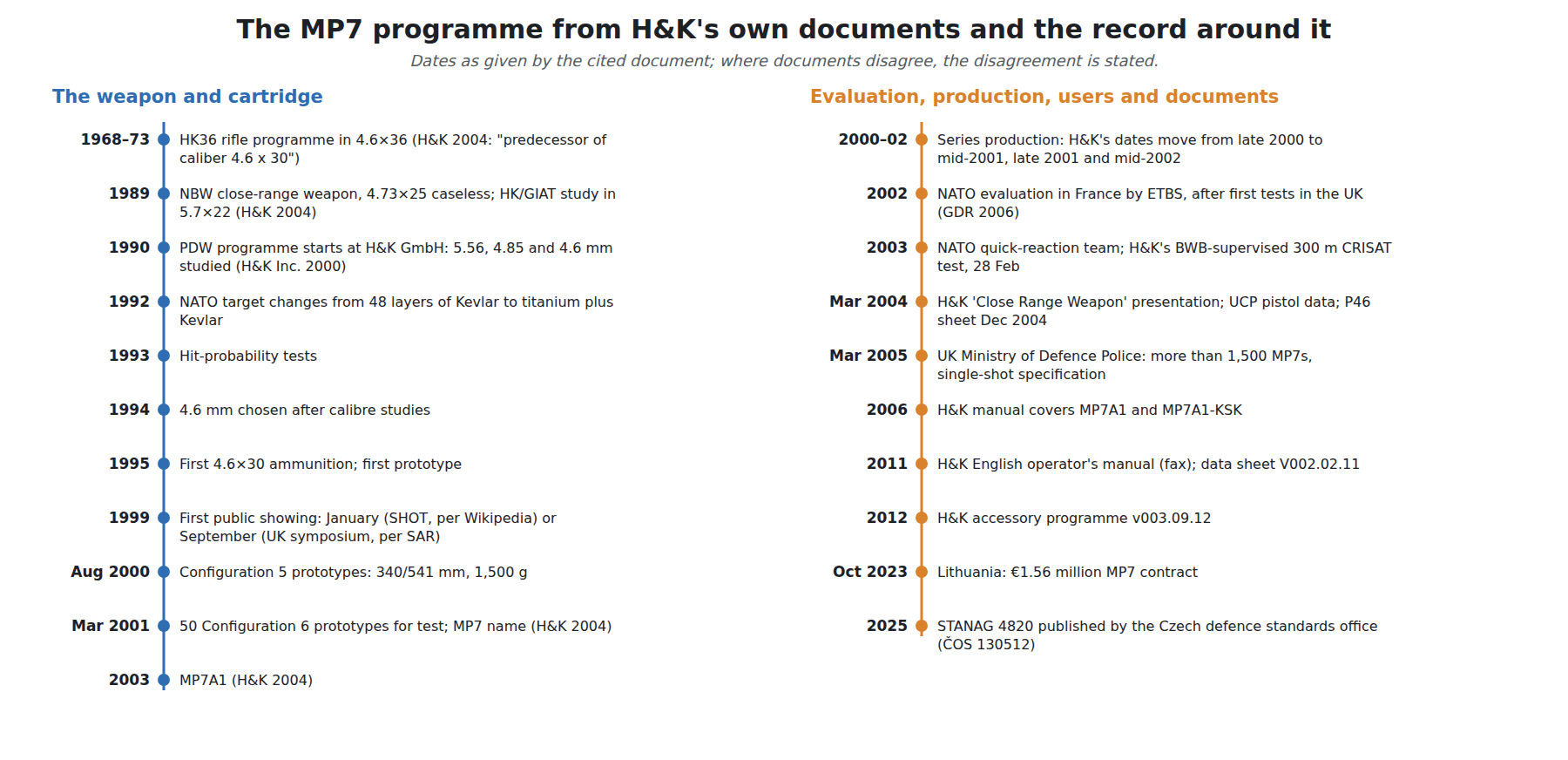
1.15 What could not be verified
- NATO document D/296 itself, and therefore its year (1989 in the reference literature, 1990 in two other sources).
- H&K’s calibre studies of 1990 to 1994, and the hit-probability tests of 1993.
- The first public showing of the PDW: January 1999 (SHOT Show, per Wikipedia, unsourced) or September 1999 (a UK symposium, per Small Arms Review, March 2000).
- The 2001 NSWC Crane report, known only from H&K’s quotation of it.
- Any NATO report of the 2002–2003 evaluation. Everything published about its result traces to one 2006 article written from FN’s side.
- H&K’s February 2003 BWB-supervised 300 m CRISAT test, known only from H&K’s slide.
- When and why the UCP/P46 pistol was abandoned.
- Martin Fackler’s 2002 critique (not read; known from Schatz’s reply).
References
Footnotes
-
Heckler & Koch GmbH, “MP7 — Compact. Lightweight. Close range.”, product page, https://www.heckler-koch.com/en/Products/Military%20and%20Law%20Enforcement/Submachine%20guns/MP7 , accessed 2026-10-18. ↩
-
Jim Schatz, Heckler & Koch, Inc., “HK Personal Defense Weapon — 4.6 × 30mm PDW Weapon System”, presentation, “Revised 12/00”, product-comparison slides dated 11/00 and 11/28/00 (“Using Proto. Conf. Data”). Copy in the public hk-manuals storage bucket, file
files/Military/MP7/MP7_Presentation.pdf, https://s3.amazonaws.com/hk-manuals/files/Military/MP7/MP7_Presentation.pdf , accessed 2026-10-18 (image PDF; read by OCR and by eye). ↩ ↩2 ↩3 ↩4 ↩5 ↩6 ↩7 ↩8 ↩9 ↩10 ↩11 ↩12 ↩13 ↩14 -
Heckler & Koch GmbH, “Close Range Weapon — From ‘NBW’ to ‘MP7 A1’”, presentation dated 02.03.04 (conception RA Marc Roth), 70 slides. Copy at https://s3.amazonaws.com/hk-manuals/files/Military/MP7/MP7_Close_Range_Weapon.pdf , accessed 2026-10-18. ↩ ↩2 ↩3 ↩4 ↩5 ↩6 ↩7 ↩8 ↩9 ↩10
-
“In the line of fire”, Global Defence Review, GDR Publications, © 2006, archived 16 October 2006, https://web.archive.org/web/20061016074936/http://www.global-defence.com/2006/Utilities/article.php?id=40 , accessed 2026-10-18. No byline on the archived page; Wikipedia gives David Oliver, 2007. ↩ ↩2 ↩3 ↩4
-
Jim Schatz, “Puny Bullets: A Manufacturers Response”, Small Arms Review V5N10, July 2002, https://smallarmsreview.com/?p=2788 , accessed 2026-10-18. ↩ ↩2 ↩3 ↩4 ↩5 ↩6
-
Heckler & Koch, “Close Range Weapon MP7 A1, Caliber 4.6mm x 30, Operators Manual”, fax copy dated 08/08/11, https://s3.amazonaws.com/hk-manuals/files/Military/MP7/MP7A1_Operators_Manual.pdf , accessed 2026-10-18. ↩
-
Bundeswehr, “Der Alleskönner”, Mediathek, 6 July 2020, https://www.bundeswehr.de/de/mediathek/maschinenpistole-mp7-274984 , accessed 2026-10-18 (translated). ↩
-
Ministry of Defence, “Ministry of Defence Police to get new specialised firearm”, news release, 2 March 2005, as republished at https://www.wired-gov.net/wg/wg-news-1.nsf/54e6de9e0c383719802572b9005141ed/1f8a563335d39e2b802572ab004bae22 , accessed 2026-10-18. ↩
-
D. Booth, D. Smith and R. Ashley (BAE Systems plc), “4.6 mm small arms ammunition”, US Patent 7,210,411 B2, granted 1 May 2007, GB priority 27 March 2003. https://patents.google.com/patent/US7210411B2/en ↩
-
“Heckler & Koch MP7”, English Wikipedia, accessed 2026-10-18 (used only for the claim it makes, which is attributed to it). ↩
-
Small Arms Review editorial staff, “HK Unveils New Personal Defense Weapon”, Small Arms Review V3N6, March 2000, https://smallarmsreview.com/hk-unveils-new-personal-defense-weapon/ , accessed 2026-10-18. ↩ ↩2 ↩3 ↩4
-
Jim Schatz, “HK’s Personal Defense Weapon”, Small Arms Review V4N7, April 2001, https://smallarmsreview.com/?p=2069 , accessed 2026-10-18. ↩ ↩2
-
Timo Lechner, “Schlagkraft: Neue MP7-Modelle von Umarex”, Deutsches Waffen-Journal 3/2015, pp. 52–55 (PDF hosted by Umarex, https://www.umarex.de/fileadmin/testreports/DWJ_03-15_MP7.pdf ), accessed 2026-10-18. ↩
-
Heckler & Koch, P46 data sheet, “Stand: Dezember 2004”, https://s3.amazonaws.com/hk-manuals/files/Military/MP7/HK_MP7A1_P46_Brochure.pdf , accessed 2026-10-18. ↩
-
Úřad pro obrannou standardizaci, katalogizaci a státní ověřování jakosti, ČOS 130512, 1st edition, “Požadavky na zaměnitelné náboje 4,6 × 30 mm” (implements STANAG 4820 Ed. 1 and AOP-4820(A)), Prague 2025, https://oos-data.army.cz/cos/cos/130512.pdf , accessed 2026-10-18. ↩
-
ČOS 130511, 1st edition, “Příručka pro zkoušení a kontrolu malorážových nábojů” (implements STANAG 4823 and AEP-97(A)), Prague 2023, Annex 10-A1, https://oos-data.army.cz/cos/cos/130511.pdf , accessed 2026-10-18. ↩
Comments (0)