Thompson/Center HotShot · Volume 5
First Rifles — the HotShot Against the Crickett, the Mini Bolt and the Rascal, and the Rifle Documented Here
Three answers to the same design problem, what the break-open answer does better and worse, a first rifle under Michigan law, and the unit on hand as recorded in September 2026
The HotShot was a late entrant to a category that another company had defined, and it left the market while that company kept making its rifle. This volume places the HotShot in that category, compares it with the three youth .22s most often named as its alternatives, sets out the Michigan law that governs a child using one, and records what is known of the rifle on hand.
5.1 The Category: “My First Rifle”
The dominant name in American youth rimfires is not a large gunmaker. It is Keystone Sporting Arms of Milton, Pennsylvania. Its own history: in the winter of 1994 Bill and Steve McNeal, a father and son who ran an auction house, set out to buy a youth-rifle company, failed, and designed their own instead, “the Davey Crickett® single shot .22 caliber youth rifle”, securing the rights to the slogan “My First Rifle®”. Keystone “opened its doors in January 1996, with only four employees”, and “that year 4,000 Crickett® rifles were produced”. In 2007 it bought Rogue Rifle Company of Oregon, “the original maker of Chipmunk® rifles”. It now reports producing “an average of 60,000 Crickett® and Chipmunk® rifles each year”.1
The figures are Keystone’s own, and they make the scale of the category clear. When Thompson/Center announced the HotShot in January 2010, the Crickett had been in production for fourteen years under the slogan that named the whole market segment. T/C’s answer was not to undercut it. At $229–$249 the HotShot was announced above the Crickett’s current $195 even before inflation.23 Instead T/C offered something the Crickett could not: a first rifle that looked like the family’s T/C (Volume 2 § 2.2).
5.2 Four Rifles in One Table
Each figure is from the maker’s own page, with the date it was read. The HotShot’s are from T/C’s 2010 documents; the others are current models read on 2026-09-19. A blank means the figure was not on the maker’s page as read, not that it does not exist.
Table 1 — 5.2 Four Rifles in One Table
| T/C HotShot | Keystone Crickett | Henry Mini Bolt G2 | Savage Rascal | |
|---|---|---|---|---|
| Status | Discontinued c. 2013 | Current | Current | Current |
| Action | Break-open, exposed hammer | Bolt, single-shot | Bolt, single-shot | Bolt, single-shot |
| Chambering | .22 LR | .22 S, L, LR; .22 WMR | .22 S/L/LR | .22 LR |
| Barrel | 19 in | 16.1 in | 16.25 in | 16.1 in |
| Overall length | 30 in (30¼ in press release) | 30 in | 30.25 in | — |
| Length of pull | 11.5 in (+1 in spacer) | 11½ in | 11.5 in | — |
| Weight | 3 lb | ”Under 3 lbs.” | 3.25 lb | — |
| How it is readied to fire | Thumb-cock the hammer | ”Separate cocking mechanism” (knob) | “Exposed cocking knob at the rear of the bolt" | "Cocks by lifting bolt” |
| Safety | None to operate; “automatic” (hammer at rest cannot fire) | “Rebounding firing pin automatically blocked” | Manual thumb safety | Manual safety; “Unload without pulling the trigger” |
| Trigger | Not specified by T/C (3 lb 12 oz measured by NRA Family) | — | — | User-adjustable AccuTrigger |
| Sights | Adjustable peep, ramp post | Adjustable peep, fixed post | Fibre optic | Adjustable peep |
| Scope | Barrel drilled and tapped for T/C mounts | — | Drilled and tapped | — |
| Price | $229–$249 anticipated (Jan 2010); $204 MSRP black (Jan 2014) | $195.00 (maker’s shop, Sept 2026) | $335.00 MSRP (Sept 2026) | $179 MSRP (Sept 2026) |
Sources: T/C product page, specification table and press release, 2010;24 NRA Family, January 2014;5 Keystone product page;3 Henry product page;6 Savage product pages.7
Two points in the table are worth noticing before the argument. Every rifle in it is a single-shot. The category has settled that question. And the HotShot is the only one that is not a bolt action.
5.3 Same Length, More Barrel
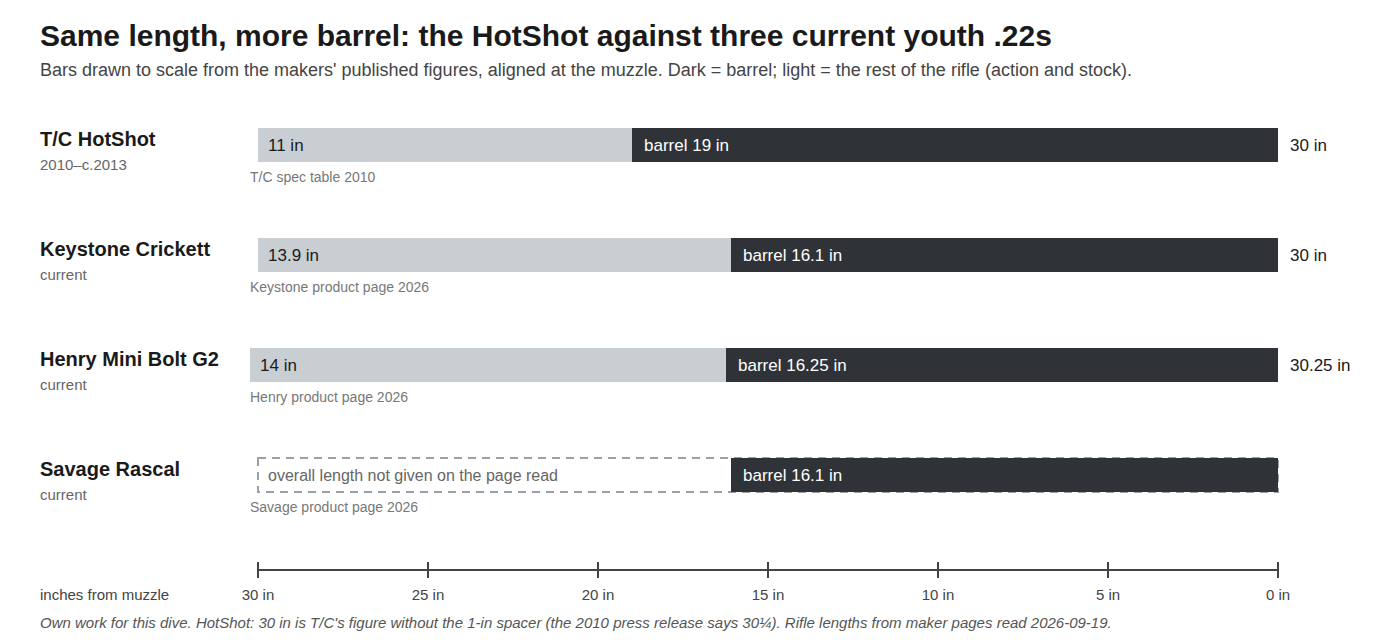
The figure at the head of this volume draws the table’s lengths to scale. The Crickett puts a 16.1-inch barrel into a 30-inch rifle, and the Henry a 16¼-inch barrel into 30¼. That leaves about 14 inches for action and stock. The HotShot puts a 19-inch barrel into 30 inches and leaves 11. The stocks are the same length of pull, so the three inches come out of the action.
Volume 3 § 3.9 gives the reason. A bolt action has a bolt and receiver behind the chamber; a break-open has only the standing breech of a short frame. The practical consequence for a beginner is a longer sight radius. The HotShot’s rear peep sits at the breech and its front post at the muzzle, so the sight line is roughly as long as the barrel, about three inches longer than a 16-inch rifle’s. A longer sight radius makes a given error in aligning the sights smaller at the target. The ballistic consequence is small; the .22 Rimfire dive’s Volume 4 covers what barrel length does and does not do in .22 LR.
This is the one respect in which the HotShot is objectively different from every competitor in the table, and it follows directly from the action type rather than from any claim T/C made. The company never mentioned it.
5.4 Three Answers to the Safety Question
Every youth rifle has to answer one question: what stands between a child’s finger and a discharge? The four rifles give three different answers.
The cocking-piece answer (Crickett, Henry). The bolt closes on a chambered round without cocking the rifle. A separate knob at the rear of the bolt must be pulled back before the rifle will fire. The Crickett adds a firing pin that is “automatically blocked” when not cocked, and no manual safety; the Henry adds a manual thumb safety on top.36 The ready state is visible: the knob is back.
The manual-safety answer (Rascal). The bolt cocks as it is lifted, the familiar bolt-rifle arrangement, and a manual safety blocks the trigger. Savage’s page stresses that the rifle can be unloaded “without pulling the trigger”.7 The child learns the adult’s rifle routine from the start: safety on, safety off.
The hammer answer (HotShot). No manual safety. The rifle is inert with the hammer down, and ready with it back. The ready state is the most visible of all four, a tall hammer standing up at the rear of the frame, but nothing blocks the trigger once it is cocked, and decocking needs a controlled thumb (Volume 3 §§ 3.5–3.6).
None of these is simply safer than the others. Each moves the risk to a different moment. The cocking-knob rifles and the HotShot share the principle that a loaded rifle is inert until a separate deliberate act readies it. That act is visible to a supervising adult, and it is the principle that the youth category has settled on. The Rascal instead teaches the manual safety that the child will meet on almost every later rifle. The HotShot’s particular burden is the decock, because the other three can be made safe again without lowering a spring-loaded hammer by hand.
5.5 What the Break-Open Answer Does Better, and Worse
Argued from the table and from the manual, not from any published head-to-head test (none was found):
Better.
- Proof of an empty chamber. Open the action and the chamber is in plain view from the breech; there is no bolt face or ejection port to peer past. The manual’s “every time a firearm leaves your hand” check is as easy on this rifle as on any rifle made (Volume 3 § 3.2).
- Barrel length and sight radius in the same overall length (§ 5.3).
- Cleaning from the breech, so the crown is never touched by a rod (Volume 4 § 4.4).
- The family rifle’s controls. A child who learns the trigger-guard latch and the thumb-cocked hammer on a HotShot has learned the controls of the Contender and Encore. That was the whole of T/C’s pitch, and for a T/C family it is a real point.
Worse.
- The decock (§ 5.4).
- The one hazard mode: forcing the barrel closed on a proud rim (Volume 3 § 3.3). Bolt actions have their own versions of this risk. The break-open’s particular one is leverage: with one hand on the barrel and one on the grip, a child can apply a great deal of closing force without meaning to.
- Support. The three competitors are current products with current parts. The HotShot is a discontinued rifle with no published parts list, from a maker that has changed hands twice since it was built (Volume 4 § 4.11).
- Chambering. .22 LR only, where the Crickett also comes in .22 WMR. For a first rifle this hardly matters.
The honest conclusion is that the HotShot is a good first rifle with one real handling burden and one real ownership burden. The handling burden, the decock, is the supervising adult’s to manage. The ownership burden, no parts, argues for keeping the one on hand clean, dry and undamaged, because it will not be easy to repair.
5.6 A First Rifle in Michigan
The owner of the rifle documented here is in Michigan. Two Michigan statutes bear directly on a child using a .22 rifle. Both are quoted from the Legislature’s site as read on 2026-09-19. The .22 Rimfire dive’s Volume 6 covers the rules for hunting with a .22 in Michigan. This section covers only the child.
Possession. MCL 750.234f(1): “an individual less than 18 years of age shall not possess a firearm in public except under the direct supervision of an individual 18 years of age or older.” Subsection (2) exempts possession under the wildlife-conservation and hunting-licence parts of the Natural Resources and Environmental Protection Act, and adds that a minor “may possess a firearm without a hunting license while at, or going to or from, a recognized target range or trap or skeet shooting ground if, while going to or from the range or ground, the firearm is enclosed and securely fastened in a case or locked in the trunk of a motor vehicle.” A violation is a misdemeanour punishable by up to 90 days, a fine of up to $100, or both.8
Hunting. MCL 324.43517 governs when a parent may let a minor hunt under a licence. For a child under 10, the statute’s answer is: “the individual hunts only with a mentor in compliance with the mentored hunting program established by the commission”. A mentor must be “at least 21 years of age”, hold a valid non-apprentice hunting licence, and show “proof of previous hunting experience”. An apprentice licence requires an accompanying parent, guardian or authorised adult of at least 21 who holds a regular licence. Otherwise, a minor must hunt on land where a parent or guardian lives, or be accompanied by a parent, guardian or authorised adult of at least 18.9 The statute sets no minimum age for the mentored program. The program’s working rules — species, how many firearms may be carried between mentor and youth, how close the mentor must be — are in the Natural Resources Commission’s order. That order was not obtained for this dive, and the current DNR digest is the controlling document.
On federal law, a .22 LR rifle raises nothing unusual: it is a Title I long gun, and neither the NFA nor the handgun-specific juvenile provisions apply to it.
5.7 The Rifle Documented Here
As recorded in September 2026. The owner’s inventory (last modified 2026-09-17) lists the rifle as a “Thompson Hot Shot”, 19-inch barrel, .22 LR. The stock, trigger, scope and scope-mount fields are blank. The only entry in its modifications column is “Bolt Release”, which Volume 1 § 1.1 shows is very probably carried over from the tab of a bolt-action .17 HMR rifle copied from this one.
So the configuration of this rifle is not recorded, and nothing is claimed about it beyond what the sheet says. In particular, none of the following is known, and each would change something in these volumes:
- The catalogue number and colour (3400, 3401, 3402, 3409 or 3411; Volume 2 § 2.4). A brown stock with a Scout logo would make it the BSA centennial rifle; a grey barrel would make it the Weather Shield distributor exclusive.
- The barrel marking. “ROCHESTER, NH, USA”, as in the manual’s photograph, dates it to before or during the 2011–12 move to Springfield; a Springfield marking, if any exist, would date it after (Volume 1 § 1.7).
- Whether the 1-inch spacer is fitted, and whether any mount or scope is on the barrel.
- Whether it has an extractor (Volume 3 § 3.7).
References
Footnotes
-
Keystone Sporting Arms, LLC, “About Us”, https://keystonesportingarmsllc.com/about-us/ (crickett.com redirects there). Accessed 2026-09-19. ↩
-
Thompson/Center Arms, “Thompson/Center Arms Introduces New HotShot™ Youth Rifle”, press release, Rochester, N.H., 19 January 2010. Internet Archive capture 2011-03-04. Accessed 2026-09-19. ↩ ↩2
-
Keystone Sporting Arms, “Crickett Rifle – Webbed Synthetic ‘My First Rifle’ S/S” (KSA2441–KSA2446), https://keystonesportingarmsllc.com/product/crickett-rifle-webbed-synthetic-my-first-rifle-s-s/ Accessed 2026-09-19. Price as displayed in the maker’s shop on that date. ↩ ↩2 ↩3
-
Thompson/Center Arms, “Hot Shot” product page and specification table,
tcarms.com/firearms/rimfireHotShot.php, © 2010, Internet Archive capture 2010-08-17. Accessed 2026-09-19. ↩ -
Daniel McElrath, “Test Fire: Thompson/Center HotShot”, NRA Family, 2 January 2014. https://www.nrafamily.org/content/test-fire-thompson-center-hotshot/ Accessed 2026-09-19. ↩
-
Henry Repeating Arms, “H005 Mini Bolt Youth G2 Rifle” (H005R, H005RMG), https://www.henryusa.com/firearm/h5-mini-bolt-youth-g2-rifle/ Accessed 2026-09-19. ↩ ↩2
-
Savage Arms, “Rascal”, https://savagearms.com/firearms/model/rascal and the Rascal family page https://savagearms.com/firearms/family/rascal Accessed 2026-09-19. Base Rascal SKU 13775 et seq.; family MSRPs $179–$489 on that date. ↩ ↩2
-
Michigan Penal Code, MCL 750.234f, https://www.legislature.mi.gov/Laws/MCL?objectName=mcl-750-234f Accessed 2026-09-19. ↩
-
Natural Resources and Environmental Protection Act, MCL 324.43517, https://www.legislature.mi.gov/Laws/MCL?objectName=mcl-324-43517 Accessed 2026-09-19. ↩
Comments (0)