Thompson/Center HotShot · Volume 1
The Maker — Warren Center, K. W. Thompson Tool, and Two Changes of Owner in Seventeen Years
What the rifle is, who made it, and the company history as the filings tell it rather than as the anniversary copy does
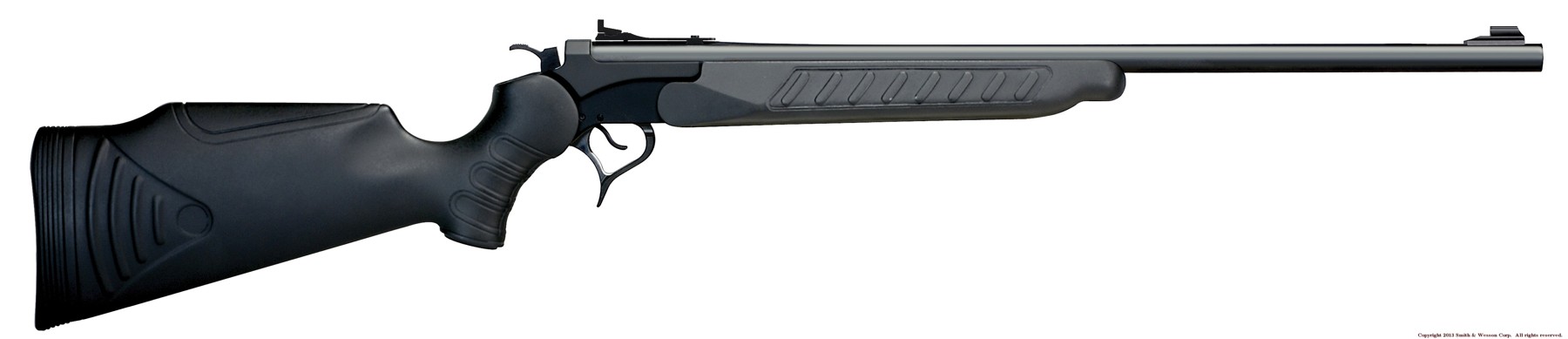
The Thompson/Center HotShot is a single-shot, break-open .22 Long Rifle rifle built for children. It was announced in January 2010, sold for a few years, and dropped out of the catalogue without ceremony. It is a small, cheap gun made by a company better known for interchangeable-barrel hunting handguns and in-line muzzleloaders, and very little has been written about it beyond a handful of short reviews.
That thinness is the reason for these volumes. What exists about the HotShot is scattered across a press release, a 28-page safety manual, three versions of a product page preserved by the Internet Archive, and a few magazine tests, and the secondary summaries of it already disagree on the overall length, the production span, and whether the scope holes are in the barrel or the receiver. The company behind it has changed hands twice since the rifle was made, and the popular chronology of those changes is wrong in two places that matter to anyone who owns one and wants parts or service.
This first volume identifies the rifle and sets out the company history. Volume 2 covers the HotShot’s design, variants and production span. Volume 3 explains the mechanism. Volume 4 covers disassembly, maintenance and repair. Volume 5 places it among the other first rifles and documents the one on hand.
1.1 What the Rifle Is
The owner’s inventory records this gun as a “Hot Shot”, maker “Thompson”, in .22 LR with a 19-inch barrel. Every one of those fields matches the Thompson/Center HotShot and nothing else found:
- The name. Thompson/Center’s own press release of 19 January 2010 introduced the “T/C HotShot” youth rifle. The press release and the barrel marking run it as one word, “HotShot”; the manual’s cover and headings, and some T/C web pages, split it as “Hot Shot”. Both spellings are the maker’s.12
- The calibre. .22 LR only. The barrel is marked “22 L.R.” in the maker’s own photograph of the marking.2
- The barrel. 19 inches, blued, “precision rifled”, with a “target style crown”, in every T/C source located.13
- The maker’s name. “Thompson” is how the sheet records the maker; the barrel reads “THOMPSON / CENTER”.2
One field on the sheet does not fit. Its configuration column is blank apart from a note reading “Bolt Release”. The HotShot has no bolt. It opens by pulling the spur of the trigger guard up and back, which unlatches the barrel and lets it tip down at the muzzle.2 The sheet itself suggests where the note came from. The same inventory has a tab for a bolt-action .17 HMR rifle whose title cell also reads “Thompson Hot Shot”, and whose rifle carries the identical note “Bolt Release”, where it makes sense. One tab was evidently copied from the other and the note came with it. That reading is recorded as a question for the owner rather than settled here, and nothing in these volumes depends on it.
1.2 The Rifle in One Table
Figures from Thompson/Center’s own documents unless the row says otherwise.
Table 1 — 1.2 The Rifle in One Table
| Maker | Thompson/Center Arms Company, Inc., “a Smith & Wesson company” at introduction; Rochester, New Hampshire |
| Announced | 19 January 2010; “available in April” 2010 |
| Type | Single-shot, break-open (dropping-barrel) rifle |
| Cartridge | .22 Long Rifle |
| Barrel | 19 in, blued steel, target-style crown |
| Opening | Trigger-guard spur, pulled up and back |
| Ignition | Exposed hammer, manually cocked |
| Safety | None to operate. T/C: “always ‘on safe’ until the hammer is cocked” (Volume 3 explains what that does and does not mean) |
| Sights | Adjustable rear peep, ramp front post; drilled and tapped for T/C mounts |
| Stock | Composite, ambidextrous; 11.5 in length of pull, with a 1-inch spacer supplied |
| Weight | 3 lb |
| Overall length | 30 in (T/C specification table); 30¼ in (T/C press release) — both are the maker’s figures |
| Launch price | ”$229 to $249” anticipated (press release, January 2010) |
| Catalogue numbers | 3400, 3401, 3402, 3409, 3411 — Volume 2 |
The two overall lengths are both Thompson/Center’s and are not reconciled anywhere found. The Boy Scouts of America version’s specification row gives “30” (31” with spacer)”, which suggests the 30-inch figure is taken without the spacer; the extra quarter-inch in the press release is unexplained.134
1.3 1965: A Tool Company and a Gun Designer
Thompson/Center’s own account of its origin, as it stood on the company’s website in 2005 and 2006, is brief and specific:
“In 1965, K. W. Thompson Tool was looking for a product to build and a gun designer, Warren Center, was looking for someone to build his Contender pistol. It was a perfect match. The facilities at K. W. Thompson Tool were expanded and Thompson/Center Arms was formed. Two years later, the first Contender Pistol was shipped.”5
That gives two dates, and both are the company’s: 1965 for the formation, 1967 for the first shipped Contender. They matter because later sources use one or the other as “the founding” without saying which event they mean. Smith & Wesson’s 2021 press release refers to “its founding in 1965”.6 Thompson/Center’s 2025 marketing celebrated a 60th anniversary, which counts from 1965.7 The company’s current home page, read in September 2026, says it “has been a cornerstone of the firearms industry since 1967”.8 Neither is wrong; they date different things. The 1967 figure is the first product; the 1965 figure is the firm.
The same page gives the company’s view of its own centre of gravity at that date: “over 400,000 Contender pistols have been shipped”, a line of single-shot pistols and rifles, a full muzzleloader line, and “All made in the USA at our Rochester, New Hampshire facility.”5
1.4 The Contender, Briefly
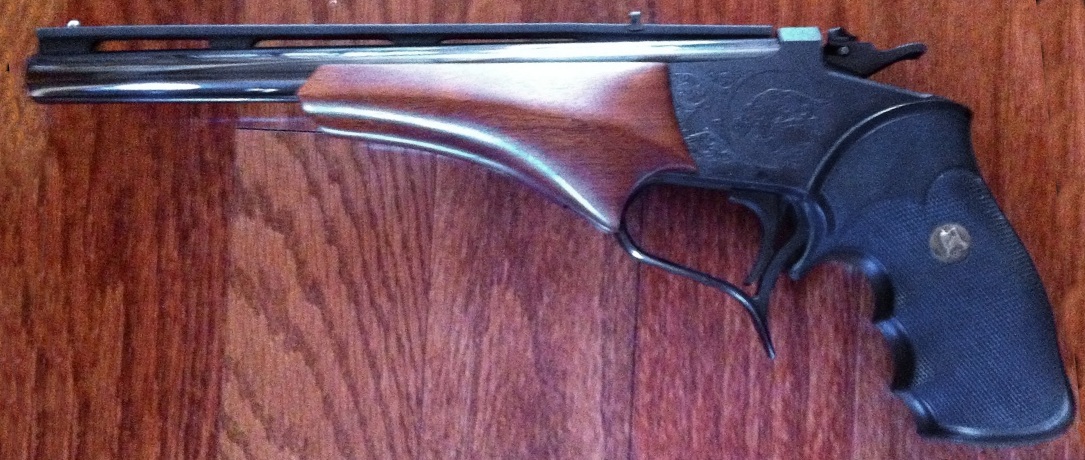
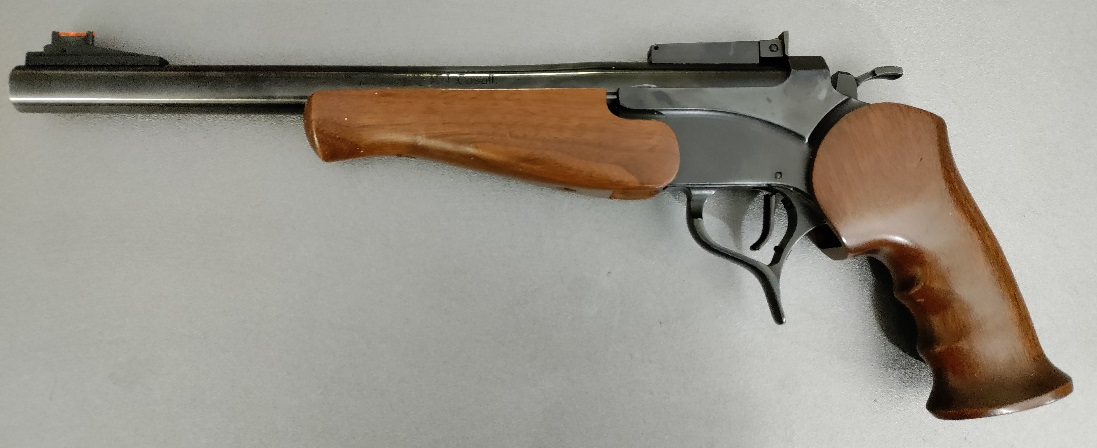
The Contender is the reason Thompson/Center exists, and it is the ancestor of the HotShot’s action type: a single-shot pistol whose frame accepts interchangeable barrels, opened by the trigger guard, fired by an exposed hammer. Everything that makes the HotShot recognisable as a Thompson/Center — the tall hammer, the guard that doubles as a latch, the barrel that tips down on a hinge — descends from it.
This hub already treats the Contender where it matters most. The Remington XP-100 dive sets out how the Contender came to dominate the handgun-hunting market from the 1970s, and why, as a result, most published “handgun” load data for rifle cartridges was developed in Contender barrels and gets quoted for other guns without anyone noticing the substitution — see XP-100 Vol 1 and XP-100 Vol 4. It is not re-told here.
1.5 Muzzleloaders, the Encore and the Pro Hunter
The company’s second line came in 1970. By its own account, “Thompson/Center entered the Black Powder market with the introduction of their first muzzleloading rifle, the Hawken”, into a market where interest “was minimal” and original rifles were too valuable to shoot.5 By the mid-2000s muzzleloaders were the bulk of the business; Smith & Wesson’s acquisition announcement lists black powder firearms and accessories first among T/C’s “core product categories”, ahead of “interchangeable firearm systems” and “a presence in precision rimfire rifles”.9
The Encore is the Contender scaled up: “a slightly larger version, with a longer and thicker frame”, built to take cartridges the Contender could not.5 The Pro Hunter is the premium Encore, and it is the rifle the HotShot was dressed to imitate. The press release says the HotShot was “Designed to look just like Dad’s T/C Pro-Hunter”; the product page says “Sized right, looks just like dads!”.13 T/C published a side-by-side graphic of the two, giving the HotShot’s overall length as 30 inches and the Pro Hunter’s as 42.5.10 Volume 2 takes up what that resemblance was for, and Volume 3 what it does and does not mean mechanically.
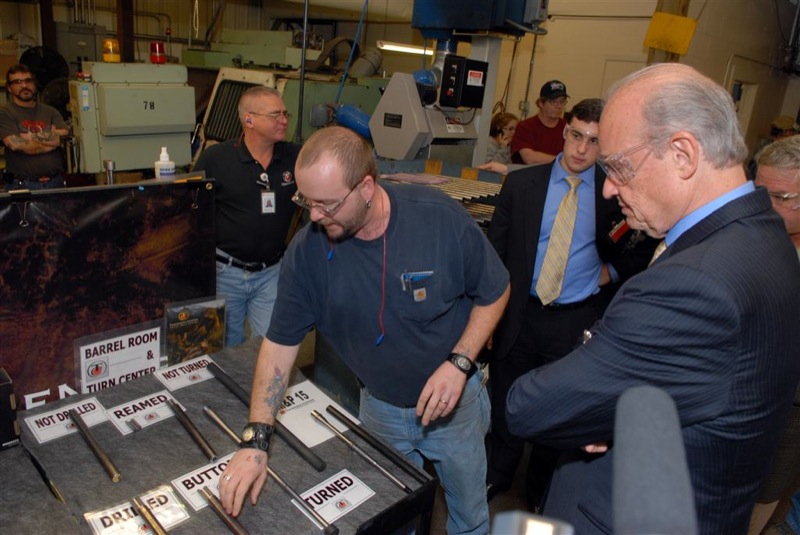
1.6 Smith & Wesson, 2007
Smith & Wesson Holding Corporation announced on 18 December 2006 that it had agreed to buy Thompson/Center Arms, “a 40-year old, privately held, New Hampshire-based designer, manufacturer and marketer of premium hunting firearms, for $102 million in cash”. The same release explained what Smith & Wesson wanted: immediate entry into hunting rifles and black powder, which it put at about $600 million of domestic sales, and T/C’s “tremendous expertise in manufacturing long-gun barrels”.9
The purchase closed on 4 January 2007, with T/C’s results counted from 3 January. The completion notice records one fact that the next section turns on: “The purchase includes Thompson/Center Arms’ Rochester, New Hampshire facility, which produces all of the company’s products.”11 Gregg Ritz was T/C’s president and chief executive at the time of the sale.12
The HotShot is therefore a Smith & Wesson-era product from the start. Its press release, three years after the purchase, describes the maker as “Thompson/Center Arms Company, Inc., a Smith & Wesson company”, datelined Rochester.1
1.7 Rochester to Springfield
The common short version is that production “moved to Springfield, Mass. in 2010”.12 The filings give a more useful account, because they date the move itself rather than the decision.
- December 2010. Smith & Wesson reported that “In the third quarter, the company made the strategic decision to relocate its Thompson/Center Arms operations from Rochester, New Hampshire to the company’s Springfield, Massachusetts facility”, with about $9.0 million of cash outlays expected.13
- June 2011. The annual report for the year to 30 April 2011 said Smith & Wesson would “relocate the operating activities within the Rochester, New Hampshire facility to existing available space within our Springfield, Massachusetts facilities. The move will be completed during fiscal 2012 and, thereafter, we plan to sell the Rochester facility.” It also planned to sell the foundry.14
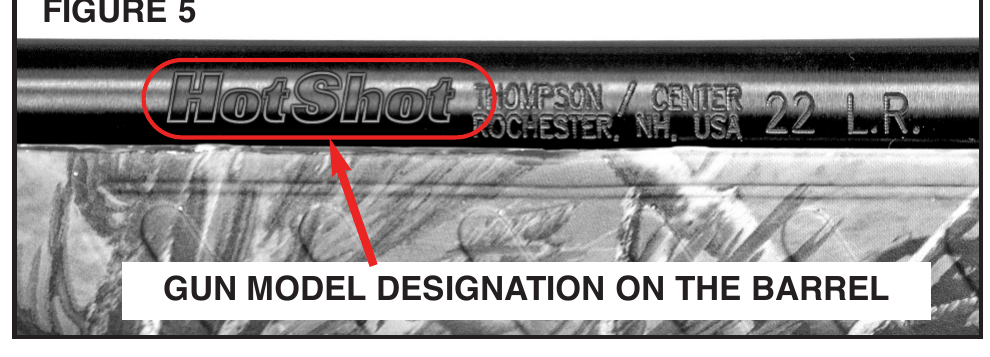
Smith & Wesson’s fiscal 2012 ran from May 2011 to April 2012. So the decision was taken at the end of 2010 and the move was completed during 2011–12. The HotShot straddles it exactly. It was introduced from Rochester in January 2010, and its manual, revised 30 July 2011, already gives the address as 2100 Roosevelt Avenue, Springfield — Smith & Wesson’s plant.2 The barrel marking shown in that same manual still reads “ROCHESTER, NH, USA”.2 Whether HotShots finished in Springfield carried a Springfield marking has not been established.
1.8 2021: The Sale That Did Not Happen
On 3 May 2021 Smith & Wesson Brands announced that it “plans to divest its Thompson/Center Arms brand”, as part of a strategy focused “on its core Smith & Wesson brands”. It said a buyer had not been identified, that the move would free manufacturing capacity, and that there would be no workforce reduction.6 Much of the press coverage at the time, and some since, treats that announcement as the sale.
It was not. The annual report for the year to 30 April 2022 says: “After careful consideration and evaluation of offers received, we have decided that we will no longer market the Thompson/Center brand for sale.”15 The same report describes lower long-gun shipments “as a result of our discontinuation of that product line”. Smith & Wesson kept the brand and stopped making the guns. From 2022 until 2024 Thompson/Center was a dormant brand inside Smith & Wesson rather than a company owned by someone else. By the 2024 annual report Smith & Wesson listed its brands as “Smith & Wesson and Gemtech” only.16
For an owner that gap matters. For about three years there was no Thompson/Center production and no separate Thompson/Center company.
1.9 2024: The Former Owner Buys It Back
In spring 2024 Gregg Ritz, T/C’s chief executive at the 2007 sale, announced that he had reacquired the brand from Smith & Wesson. The trade press dates the announcement 30 April 2024 and the report 7 May 2024.1217 American Hunter’s 60th-anniversary piece of July 2025 says Ritz “and two other investors acquired the assets of Thompson/Center Arms from Smith & Wesson in 2024”.7
On where the guns are now made, the secondary sources disagree, and the disagreement is reported here rather than resolved. American Hunter (July 2025): “Production was moved to Wabash, Ind., afterward, although the company’s headquarters and design team remain in Rochester, N.H.”7 Other 2025 coverage says production returned to Rochester.18 The company’s own warranty page, read in September 2026, gives a service address of 39 Old Dover Rd, Rochester, NH 03867, and a support number of 603-994-3831, but does not say where manufacturing happens.19
The relaunch has so far covered the Encore Pro Hunter (announced April 2025), with the Contender and the Triumph muzzleloader said to follow.20 The HotShot is not in the current catalogue. The HotShot manual, however, is still on T/C’s website: the company’s User Guides page links a copy uploaded in November 2024, byte-identical to the July 2011 revision.21 Volume 4 takes up what the change of ownership means for warranty and parts.
1.10 Two Things the Chronology Is Not
Two further claims attach themselves to this history and neither survives the record.
Thompson/Center was never part of American Outdoor Brands, Inc. — but its parent did once carry nearly that name, which is where the confusion comes from. Smith & Wesson’s own annual report sets out the sequence: “In January 2017, we changed the name of our company from Smith & Wesson Holding Corporation to American Outdoor Brands Corporation. In May 2020, in preparation for the spin-off of our outdoor products and accessories business … which was completed on August 24, 2020, we changed our name to Smith & Wesson Brands, Inc.”15 The spun-off company, American Outdoor Brands, Inc., took the accessories. Thompson/Center firearms stayed with the gun company.
So from January 2017 to May 2020 T/C’s owner was called American Outdoor Brands Corporation, and after August 2020 an unrelated-in-ownership company called American Outdoor Brands, Inc. existed that never owned T/C. A reader who wants T/C parts or records from the 2020s should be looking at Smith & Wesson (to 2024) and then at the Ritz-owned company, not at American Outdoor Brands, Inc.
No Arkansas connection was found. No source located places Thompson/Center manufacturing, headquarters or service in Arkansas at any point. Smith & Wesson’s own relocation was to Maryville, Tennessee, where it began manufacturing and distribution during fiscal 2024; Thompson/Center was not part of it, having already been discontinued.16 The post-2024 company is in Rochester, New Hampshire, with manufacturing reported variously as Rochester and Wabash, Indiana (§ 1.9).
1.11 What These Volumes Argue
Four points run through the dive.
- The HotShot’s barrel is three inches longer than its competitors’ in the same overall length, because it has no bolt. The current youth .22s surveyed in Volume 5 — Crickett, Henry Mini Bolt, Savage Rascal — all have barrels of about 16 inches, and the two whose makers publish an overall length put that 16 inches into 30 to 30¼ inches at an 11½-inch pull. The HotShot has 19 inches in the same 30. A break-open action puts no receiver or bolt behind the chamber, so the length goes into the barrel.
- “Always on safe until the hammer is cocked” is a statement about the hammer, not a safety. There is no safety to apply and none to check. The rifle’s protection is that its hammer cannot reach the firing pin except from full cock (Volume 3). That is a real feature, and it also means a cocked HotShot has nothing between the shooter and a discharge except the trigger.
- Thompson/Center says the rifle has no user-serviceable parts, and it means it. The manual permits removal of the butt pad and stock spacer and nothing else (Volume 4). Every repair beyond that was a factory job. Given the change of owner, that is now the practical constraint on keeping one working.
- The company history is simpler and stranger than the summaries. T/C was not sold in 2021; it was never owned by American Outdoor Brands, Inc., although its parent carried the name American Outdoor Brands Corporation from 2017 to 2020; it has no Arkansas chapter; and the man who ran it in 2007 owns it again.
References
Footnotes
-
Thompson/Center Arms, “Thompson/Center Arms Introduces New HotShot™ Youth Rifle”, press release, Rochester, N.H., 19 January 2010 (Blue Heron Communications). Archived copy of
tcarms.com/media/assets/pressReleases/012_Hot Shot/pdf/T-C HotShot.pdf, Internet Archive capture 2011-03-04. Accessed 2026-09-19. ↩ ↩2 ↩3 ↩4 ↩5 -
Thompson/Center Arms, Hot Shot™ Rifle Safety & Instruction Manual, REV: HOTSHOT_073011, © 2011, 28 pp. Current copy at https://tcarms.com/wp-content/uploads/2024/11/TC_HotShot_Manual_07-30-2011.pdf (accessed 2026-09-19); byte-identical to the 2013 copy archived from
tcarms.com/assets/manuals/current/HotShot_Manual.pdf. Figure 5 (barrel marking), pp. 11–15, 21. ↩ ↩2 ↩3 ↩4 ↩5 ↩6 -
Thompson/Center Arms, “Hot Shot” product page,
tcarms.com/firearms/rimfireHotShot.php, © 2010, Internet Archive capture 2010-08-17; and “Youth Models”,tcarms.com/firearms/youth_models.php, capture 2010-01-30. Accessed 2026-09-19. ↩ ↩2 ↩3 -
Thompson/Center Arms, “Boy Scouts of America® Youth Rifle”,
tcarms.com/firearms/youth_boy_scout_rifle.php, © 2010, Internet Archive capture 2010-05-17. Accessed 2026-09-19. ↩ -
Thompson/Center Arms, “About Thompson Center Arms”,
tcarms.com/TC_HTML/TC_AboutUs01.htm(capture 2005-08-01) andtcarms.com/about/index.php(capture 2006-11-09); identical text. Accessed 2026-09-19. ↩ ↩2 ↩3 ↩4 -
Smith & Wesson Brands, Inc., “Smith & Wesson Brands, Inc. Announces Intent to Divest Thompson/Center Arms™ Brand”, Springfield, Mass., 3 May 2021. Form 8-K Exhibit 99.1, SEC accession 0001193125-21-148073. Accessed 2026-09-19. ↩ ↩2
-
Guy Sagi, “Thompson/Center Arms Celebrating 60th Anniversary”, American Hunter, 11 July 2025. https://www.americanhunter.org/content/thompson-center-arms-celebrating-60th-anniversary/ Accessed 2026-09-19. ↩ ↩2 ↩3
-
Thompson/Center Arms home page, https://tcarms.com/, “Our Story” panel. Accessed 2026-09-19. ↩
-
Smith & Wesson Holding Corporation, “Smith & Wesson Holding Corporation to Acquire Thompson/Center Arms, Inc.”, Springfield, Mass., 18 December 2006. Form 8-K Exhibit 99.1, SEC accession 0000950153-06-003026. Accessed 2026-09-19. ↩ ↩2
-
Thompson/Center Arms, “HotShot vs. Pro Hunter” comparison graphic,
tcarms.com/firearms/images/hotShotComparison.jpg, Internet Archive capture 2011-12-06. Accessed 2026-09-19. ↩ -
Smith & Wesson Holding Corporation, “Smith & Wesson Holding Corporation Completes Acquisition of Thompson/Center Arms, Inc.”, Springfield, Mass., 4 January 2007. Form 8-K Exhibit 99.1, SEC accession 0000950153-07-000059. Accessed 2026-09-19. ↩
-
“Thompson/Center Arms Acquired By Former Owner”, American Rifleman, 7 May 2024. https://www.americanrifleman.org/content/thompson-center-arms-acquired-by-former-owner/ Accessed 2026-09-19. (Source of the “2010” relocation date that the filings refine.) ↩ ↩2 ↩3
-
Smith & Wesson Holding Corporation, quarterly results release, December 2010. Form 8-K Exhibit 99.1, SEC accession 0000950123-10-112012, filed 2010-12-08. Accessed 2026-09-19. ↩
-
Smith & Wesson Holding Corporation, Annual Report on Form 10-K for the fiscal year ended 30 April 2011, SEC accession 0000950123-11-063347, filed 2011-06-30. Accessed 2026-09-19. ↩
-
Smith & Wesson Brands, Inc., Annual Report on Form 10-K for the fiscal year ended 30 April 2022, SEC accession 0000950170-22-012043, filed 2022-06-23. Accessed 2026-09-19. ↩ ↩2
-
Smith & Wesson Brands, Inc., Annual Report on Form 10-K for the fiscal year ended 30 April 2024, SEC accession 0000950170-24-075584, filed 2024-06-20. Accessed 2026-09-19. ↩ ↩2
-
“Thompson/Center Arms Is Back”, The Firearm Blog, 1 May 2024. https://www.thefirearmblog.com/blog/2024/05/01/thompson-center-arms/ Accessed 2026-09-19. ↩
-
“Gregg Ritz acquires Thompson/Center Arms… T/C is back in business”, Brownfield Ag News, March 2025. https://www.brownfieldagnews.com/2025/03/gregg-ritz-acquires-thompson-center-arms-t-c-is-back-in-business/ Reported via search listing, not read in full; the Rochester production claim is attributed to it on that basis. ↩
-
Thompson/Center Arms, “Limited Lifetime Warranty”, https://tcarms.com/limited-lifetime-warranty/. Accessed 2026-09-19. ↩
-
“Thompson/Center Arms ENCORE PROHunter Returns”, American Rifleman, April 2025. https://www.americanrifleman.org/content/thompson-center-arms-encore-prohunter-returns/ Title and date from search listing. ↩
-
Thompson/Center Arms, “User Guides”, https://tcarms.com/user-guides/. Accessed 2026-09-19. ↩
Comments (0)