Thompson/Center HotShot · Volume 3
How It Works — Trigger-Guard Latch, Exposed Hammer, and a Safety That Is Really a State
The cycle of operation from Thompson/Center's own manual, what \"always on safe until the hammer is cocked\" does and does not mean, and what the maker never published
Volume 2 described the HotShot as a product. This volume describes how it works. Every operating step comes from Thompson/Center’s own Safety & Instruction Manual (revision of 30 July 2011, still the current download on T/C’s website).1 Where the manual is silent and the argument rests on the physics of a break-open rimfire rather than on a T/C document, the text says so.
3.1 The Action in One Paragraph
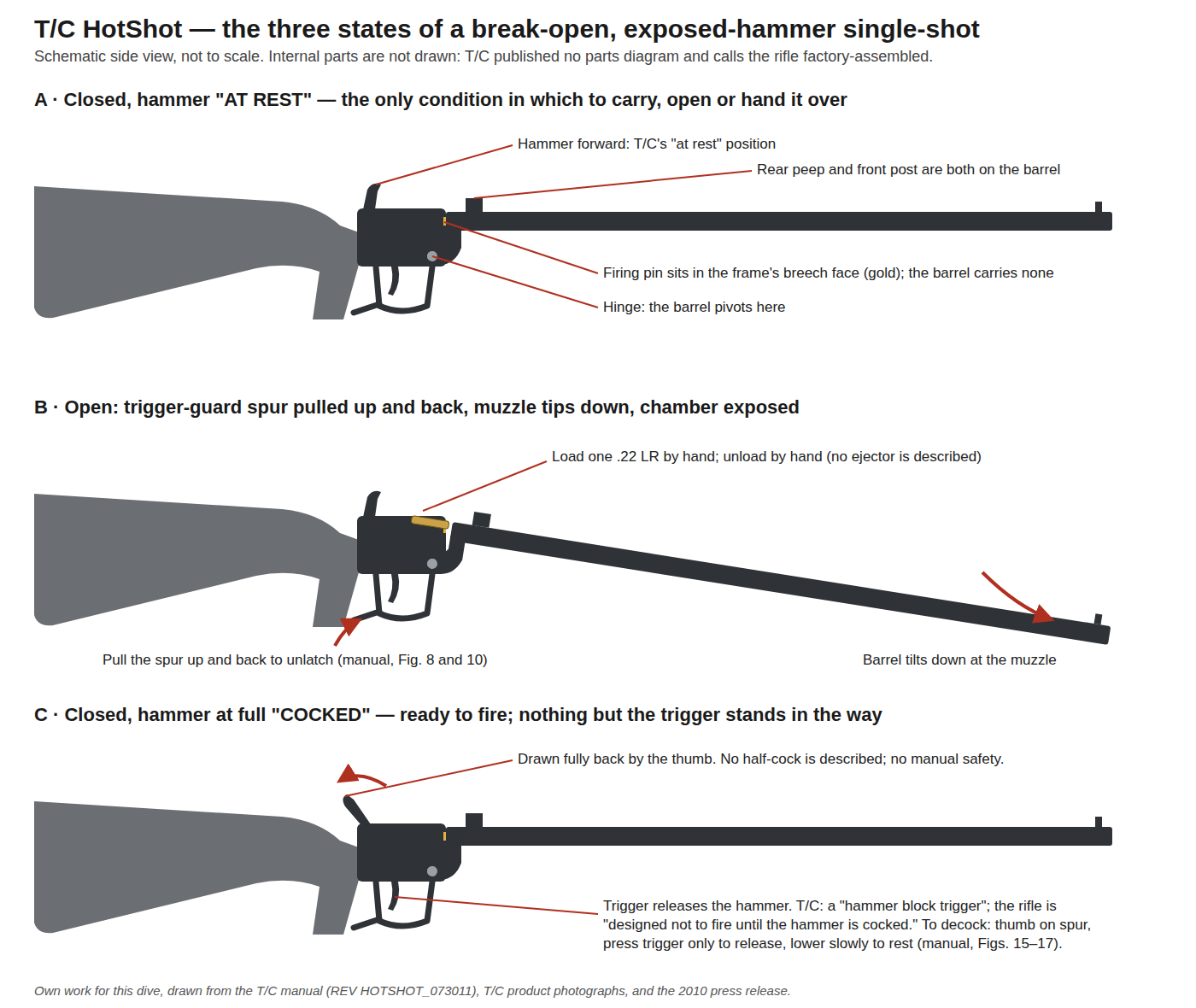
The HotShot is a single-shot, break-open, exposed-hammer rimfire rifle. The barrel is hinged to the frame at the front and latched at the rear. Pulling the spur of the trigger guard up and back releases the latch and lets the barrel tip muzzle-down, exposing the chamber. One .22 LR cartridge is pushed in by hand, and the barrel is swung up until it latches. The shooter draws the hammer back to full cock with the thumb. The trigger releases the hammer, the hammer drives the firing pin in the frame into the cartridge rim, and the rifle fires. The shooter opens the action again and removes the empty case. There is no magazine, no bolt, no feed, no ejection and no manual safety. Every step of the cycle is done by hand, and every state of the rifle can be seen from outside it.
3.2 Opening: the Trigger Guard Is the Latch
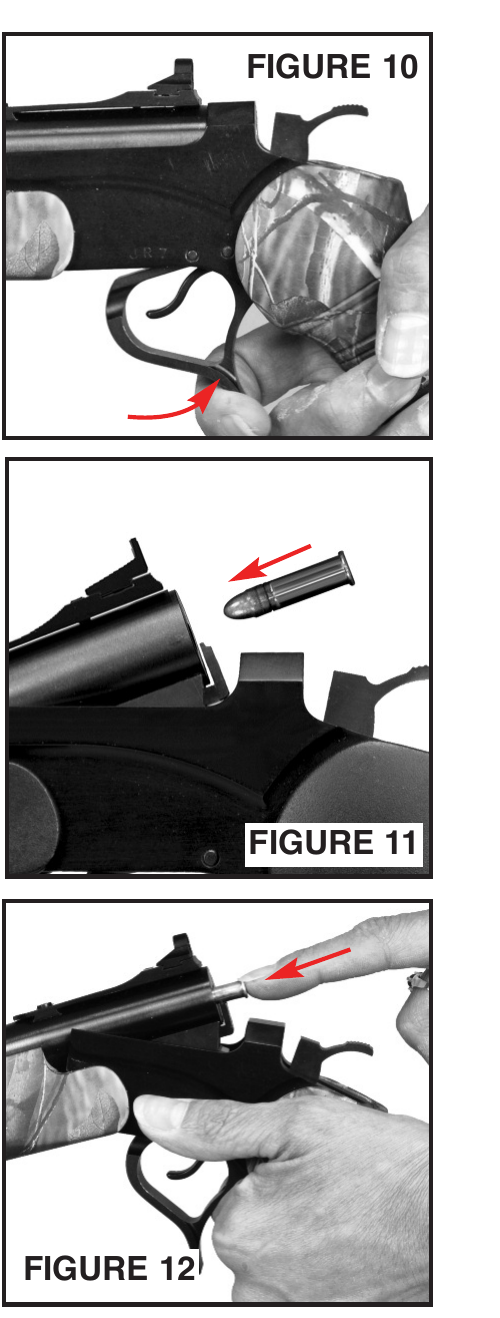
The manual’s feature diagram labels the trigger guard “TRIGGER GUARD — MOVES UP AND BACK TO OPEN THE ACTION”. The loading instructions give the motion: “open the action by pulling up and back on the spur of the trigger guard … The barrel tilts downward at the muzzle.”1 The press release calls it “an easy to operate break-open design, accessible via the trigger guard release”.2
This is the Contender’s control, carried down to a child’s rifle (Volume 1 § 1.4). It has a teaching advantage that is easy to miss: the hand already on the pistol grip opens the gun without leaving it, and the trigger finger never has to go near the trigger to do so. The manual’s inspection sequence depends on this. With “your finger away from the trigger and with the hammer in the ‘AT REST’ position”, open the action, look into the chamber, verify the bore is clear, and do it “every time a firearm leaves your hand, is cleaned, handed to you or another person, transported or stored”.1
3.3 Loading and Closing, and the Warning About Forcing It
The manual’s loading instruction is three steps: open, “Push the cartridge forward into the chamber”, “Rotate the barrel up to close the action.” The instruction that follows is the important one:
“Do not force the barrel closed on a live round. If the barrel doesn’t close smoothly, remove the cartridge from the chamber and inspect it and the gun’s chamber.”
and, in a boxed warning: “FORCING THE ACTION CLOSED ON A LIVE ROUND MAY CAUSE ACCIDENTAL DISCHARGE.”1
The manual does not explain why, and the reason is worth understanding because it is peculiar to rimfire. A rimfire cartridge has no separate primer: the priming compound is spun into the hollow of the rim, and it fires when the rim is crushed. On a break-open action the rim ends up trapped between the rear face of the barrel and the standing breech of the frame as the barrel swings shut. If a cartridge is not fully seated — a burr on the rim, fouling in the chamber, a long case, a tired child’s thumb — the rim stands proud of the barrel face. Forcing the barrel closed then crushes the rim between two steel faces, and that is exactly what a firing pin does. The warning is not boilerplate. It describes the one way this rifle can fire without the hammer.
The practical rule follows. If the barrel will not close with the pressure of one hand, stop, open it, and look. The .22 Rimfire dive’s Volume 3 covers how the priming is put into the rim.
3.4 The Hammer: Two Positions, No Half-Cock
The manual names exactly two hammer positions, and its photographs label them: “AT REST”, fully forward, and “COCKED”, fully back.1 It never mentions a half-cock or intermediate notch, and none of its instructions uses one. To fire: “Draw the hammer back to the full rearward ‘Cocked’ position … The Hot Shot™ will now fire when pressure is applied to the trigger.”1
This matters because an older single-shot with a half-cock notch teaches the habit of “safe” at half-cock. No HotShot document describes such a notch, and the manual’s procedures never use one. A child taught from the manual therefore learns two states for the hammer: it is down, or it is ready to fire. Whether the lockwork has any intermediate catch is not stated anywhere found, and it should not be tested on a loaded rifle.
The spur is tall and stands above the line of the frame. On the Pro Hunter that the HotShot imitates, T/C offered a “Swing Hammer” that could be offset for use under a scope.3 No HotShot document mentions an offset or extension spur. With a scope mounted low over the frame, the thumb’s access to the spur is something to check before buying mounts (Volume 4).
3.5 “Always On Safe”: What the Automatic Safety Is
Thompson/Center’s specification table gives the HotShot’s safety as “Automatic”. The product page explains: “HotShot by design is always ‘on safe’ until the hammer is cocked.” The press release, quoting T/C’s marketing vice president: “With the rifle’s single shot design and hammer block trigger, the HotShot is designed not to fire until the hammer is cocked.”24
Read closely, that is a claim about the hammer rather than a description of a safety. It says two things:
- The hammer at rest cannot fire the rifle. A blow to the hammer spur when the hammer is down — a dropped rifle, a spur caught on a branch — is not supposed to reach the firing pin. That is what a hammer block (or a rebounding hammer, or a transfer bar) exists to do.
- The hammer does not fire the rifle unless it falls from full cock under the trigger. An independent review of the rifle states the corollary plainly: “Hammer must be all the way back to make contact with the firing pin when the trigger is pulled. A slip while cocking the hammer will not contact the firing pin.”5
What the phrase does not mean is equally important. Once the hammer is at full cock there is nothing to engage. No lever, button, or crossbolt blocks the trigger. A cocked HotShot is ready to fire, and the only thing between it and a discharge is the trigger. The “automatic safety” is really a description of the rifle’s resting state. The shooter’s safety is the order of operations: load only when about to fire (the manual: “The instant before firing, when your complete attention is devoted to making a safe shot, load the Hot Shot™”), cock only when the rifle is shouldered and on target, and decock or fire, never carry cocked.1
The manual illustrates the point itself: the firing sequence has the rifle raised and “the stock firmly into the shoulder” before the hammer is drawn back.1 That order is the safety.
What is not known. Thompson/Center does not describe the internal part that does this. “Hammer block trigger” could describe a block that is withdrawn only while the trigger is held, as on a transfer-bar revolver, or an interrupter tied to the trigger’s travel. No parts diagram, patent, or armourer’s document for the HotShot was located, and the manual’s patent page lists the patents for a different T/C gun entirely (Volume 2 § 2.10). The mechanism is therefore described here by what it does, as the maker and one reviewer describe it, and not by an assumed internal layout.
3.6 Decocking — the Riskiest Routine Act on the Rifle
Every exposed-hammer single-shot has the same weak point. When the shooter decides not to fire, the cocked hammer has to be let down by hand. The manual’s procedure, with its own photographs, is:
“Hold your thumb securely on the hammer spur so you can control its movement … pull the trigger back (only long enough to disengage the hammer) and allow the hammer to move forward slowly — with your finger now fully away from the trigger and outside the trigger guard … until the hammer is fully forward in the ‘At Rest’ position.”1
Then open the barrel and remove the cartridge.
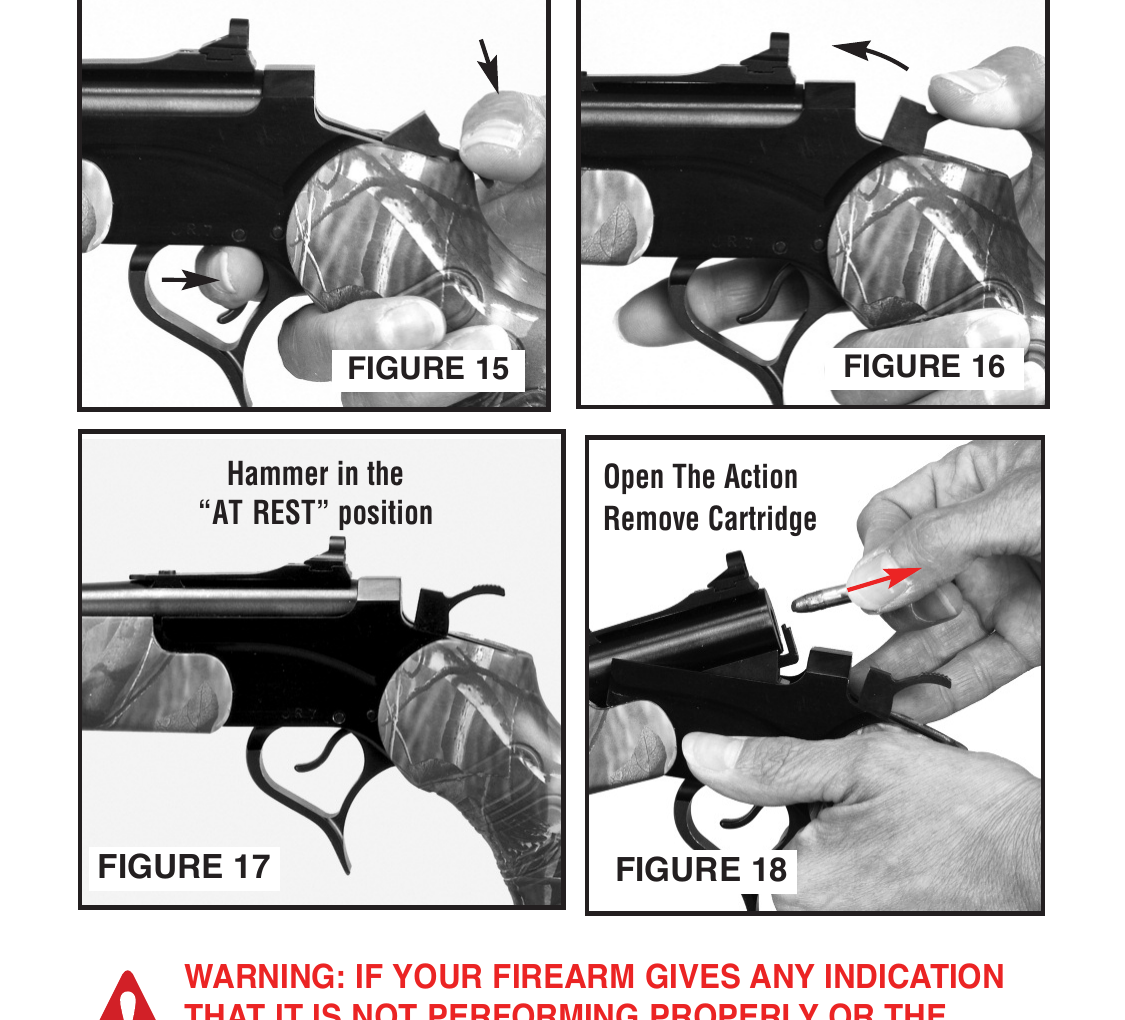
The detail that matters is the instruction to take the finger off the trigger as soon as the hammer is released, before the hammer has travelled. The manual gives no reason, but the logic follows from how any trigger-linked hammer block works. While the trigger is held back, whatever blocks the hammer from the firing pin is withdrawn, and a hammer that slips from the thumb falls on the pin. Once the trigger is released, the block returns, and a slip thereafter should be caught. The dangerous interval is the moment between pressing the trigger and lifting the finger, and the manual’s sequence makes that interval as short as possible.
For a child the practical conclusions are an adult’s to enforce. A young child’s thumb may not be strong or large enough to control a hammer spring through that interval. On a HotShot, the alternative to decocking a loaded rifle is to fire it into a safe backstop, and a supervising adult may reasonably make that the rule: a cocked rifle is fired, or it is decocked by the adult. That is a judgement for the adult on the line. The manual itself sets no age.
3.7 Firing, Extraction and the Empty Case
The firing pin is in the frame. On any break-open action the barrel swings away from the frame, so the firing pin has to live in the standing breech, behind the rim. The manual does not name the part, but the geometry leaves no alternative. The pin strikes the edge of the rim, the rim is crushed against the rear face of the barrel, and the priming fires.
Extraction is by hand. The manual’s only unloading instruction is: “With the hammer in the ‘At Rest’ position, open the action and remove the cartridge from the chamber”, and its Figure 18 shows fingers lifting the cartridge out.1 None of Thompson/Center’s documents mentions an extractor or an ejector, and none of the reviews located describes one. A break-open .22 usually has a small extractor that lifts the rim clear of the barrel face as the action opens, and the HotShot may well have one. Whether it does is not established by any source here. A photograph of the breech face of the rifle documented here would settle it.
Misfires. Rimfire misfires are common enough that the manual gives them their own procedure: “keep the muzzle pointed in a safe direction and wait 10 seconds before opening the barrel and removing the suspect cartridge.”1 On a single-shot a misfire is harmless to diagnose, because the rim can be inspected. A shallow dent means a weak strike, and a deep dent with no ignition means a dud round. Firing the same round again with the rim rotated, a common habit, is not in the manual.
Dry firing. The manual says nothing about it. On any rimfire the firing pin, with no rim in front of it, can strike the edge of the chamber, which is why rimfire makers generally advise a snap cap for practice. The Ruger 10/22 dive’s Volume 7 sets out how Ruger handles the question in its own manuals. For the HotShot, no T/C position was found. On a rifle whose manual says it has “no user serviceable parts”, avoiding dry fire is the cautious course.
3.8 Why the Sights Are on the Barrel
Both the rear peep and the front post are mounted on the barrel. The manual’s sight-adjustment photograph shows the rear sight on the barrel just ahead of the frame, and T/C’s product images show the front post near the muzzle. The manual says: “The barrel is factory drilled and tapped for T/C mounts.”1
On a break-open rifle that is the correct arrangement, and it matters for accuracy. The barrel moves every time the rifle is opened, and its return to the same position depends on the hinge and latch fit. A rear sight or scope mounted on the frame would measure the barrel’s position against a part that the barrel does not stay rigidly attached to. With both sights, or the scope, on the barrel, the zero moves with the bore, and any small play in the hinge moves the whole sighting system together. Frame-mounted optics are unworkable on a break-open for the same reason, which is why Gun Digest’s “receiver drilled and tapped for optics” is not merely a misplaced word (Volume 2 § 2.10).
The rear sight adjusts for elevation with a screw (“clockwise (as viewed from the top) to raise it”) and for windage by sliding the blade after loosening a lock screw (“moving the sight blade to the right moves your shots to the right”).1 Volume 4 reproduces the figure.
3.9 Why 19 Inches Fits in 30
The HotShot’s 19-inch barrel is about three inches longer than the barrel of any current youth .22 surveyed in Volume 5 (16.1 to 16¼ inches), yet its overall length is essentially the same: 30 inches, against 30 inches for the Crickett and 30¼ for the Henry Mini Bolt, all three at an 11½-inch pull. (Savage’s page, as read, gives the Rascal’s barrel but not its overall length.)
The difference is the action. A bolt action puts the bolt, its handle and the receiver that guides it behind the chamber, between the chamber and the shooter’s cheek. On a youth bolt gun that is several inches of the rifle’s 30 that are not barrel. A break-open action puts nothing behind the chamber except the standing breech of a short frame, because the chamber is reached by moving the barrel rather than by withdrawing a bolt. The inches a bolt rifle spends on its action, the HotShot spends on barrel.
What the extra barrel buys is modest and should not be overstated. In .22 LR, velocity gains beyond about 16 inches are small and depend on the load. The .22 Rimfire dive’s Volume 4 covers barrel length properly. The more useful gain for a beginner is sight radius: with the front post near the muzzle and the peep at the breech, the HotShot’s sight line is longer than a 16-inch rifle’s, and a longer sight radius makes a given aiming error smaller.
3.10 What Thompson/Center Never Published
For a reader who wants to know how it works inside, the list of absences is itself a finding.
- No exploded view or parts list. The manual contains none, and none was found on any archived T/C page.
- No disassembly procedure beyond the butt. The manual’s disassembly section consists of a warning: “THE T/C HOT SHOT RIFLE IS A FACTORY ASSEMBLED FIREARM THAT HAS NO USER SERVICEABLE PARTS. IT SHOULD NOT BE DISASSEMBLED OTHER THAN THE STOCK BUTT PAD AND STOCK SPACER.”1
- No identified patent. The “patented hammer and trigger mechanism” of the press release is tied to no patent number in any T/C document.
- No trigger specification. T/C never published a trigger pull weight. The only measured figure found is NRA Family’s: 3 lb 12 oz, single-stage, which the reviewer called “very good”.6 That is one measurement on one rifle.
- No twist rate. No T/C document states the barrel’s rifling twist. A figure from a retailer or forum is not reproduced here.
These gaps shape Volume 4. With no parts diagram and a manual that forbids disassembly, the question is what an owner can actually do to keep one working.
References
Footnotes
-
Thompson/Center Arms, Hot Shot™ Rifle Safety & Instruction Manual, REV: HOTSHOT_073011, © 2011, 28 pp. https://tcarms.com/wp-content/uploads/2024/11/TC_HotShot_Manual_07-30-2011.pdf Accessed 2026-09-19. Features identification p. 11; inspecting p. 13; loading p. 15; firing and decocking pp. 16–17; misfires and unloading p. 18; disassembly p. 21; sights and scope pp. 22–23; patent page p. 28. ↩ ↩2 ↩3 ↩4 ↩5 ↩6 ↩7 ↩8 ↩9 ↩10 ↩11 ↩12 ↩13 ↩14
-
Thompson/Center Arms, “Thompson/Center Arms Introduces New HotShot™ Youth Rifle”, press release, Rochester, N.H., 19 January 2010. Internet Archive capture 2011-03-04. Accessed 2026-09-19. ↩ ↩2
-
Thompson/Center Arms, “T/C Tech”,
tcarms.com/about/technology, © 2013 Smith & Wesson Corp., Internet Archive capture 2013-09-23: “SWING HAMMER® — A rotating hammer design currently available on the Encore Pro Hunter.” ↩ -
Thompson/Center Arms, “Hot Shot” product page and specification table,
tcarms.com/firearms/rimfireHotShot.php, © 2010, Internet Archive capture 2010-08-17. Accessed 2026-09-19. ↩ -
“Thompson Center Hot Shot .22LR”, Firearms Insider, undated. https://www.firearmsinsider.tv/gun-gear-reviews/tchotshot Accessed 2026-09-19. ↩
-
Daniel McElrath, “Test Fire: Thompson/Center HotShot”, NRA Family, 2 January 2014. https://www.nrafamily.org/content/test-fire-thompson-center-hotshot/ Accessed 2026-09-19. ↩
Comments (0)