Thompson/Center HotShot · Volume 2
The HotShot — A Pro Hunter Sized for a Child
Why a youth single-shot exists, the five catalogue numbers, the Scout and Weather Shield versions, and how short the production run was
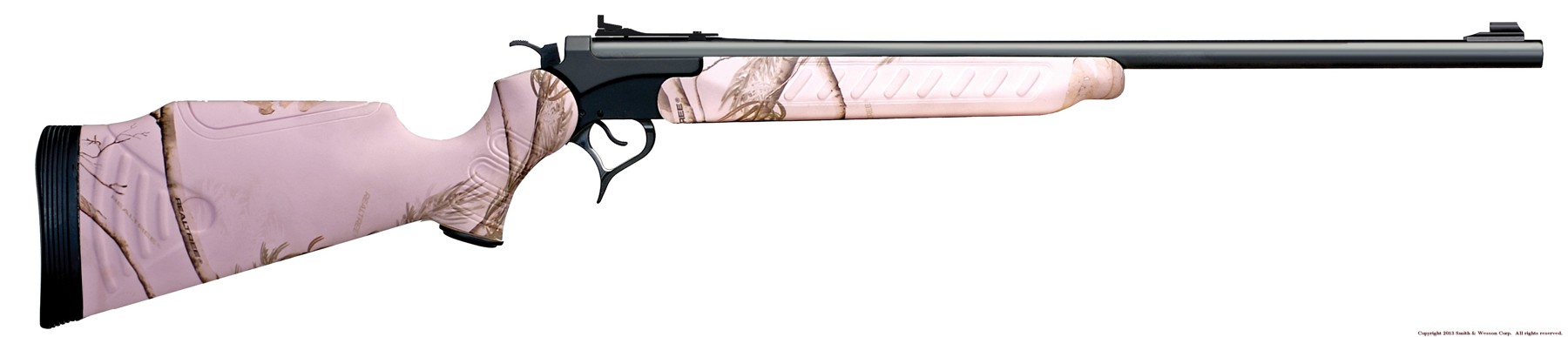
Volume 1 identified the rifle and set out the company history. This volume covers the rifle as a product: the brief it was designed to, the versions it was sold in, the fit arithmetic, and how long it lasted. Volume 3 takes it apart mechanically.
2.1 What a Youth Single-Shot Is For
A youth single-shot .22 is a specific product with a specific job. The job is not plinking economy or small-game efficiency, though it can do both. It is teaching, and three properties follow from that.
- One cartridge at a time. A single-shot cannot fire a second round without the shooter opening the action, loading, closing and, on a hammer gun, cocking. Every shot is a separate sequence of deliberate acts that an adult standing alongside can see. A repeater lets a child fire faster than an instructor can react. A single-shot does not.
- A visible state. On a break-open gun the question “is it loaded?” is answered by opening it and looking straight down the chamber. On an exposed-hammer gun, “is it ready to fire?” is answered by looking at the hammer. Both states can be read from a few feet away.
- Size. A child’s arms are short. A full-size stock at 13½–14 inches of pull cannot be shouldered properly by a young child, and a rifle that is held wrongly is neither safe nor accurate. The whole category exists because length of pull, weight and overall length all have to shrink together.
Thompson/Center’s own documents say all of this in their own words. The product page opens with “Safety is paramount”. The manual’s cover says “The Hot Shot™ is not a toy and must be used under adult supervision at all times.” The youth-models page ends: “T/C youth models are not toys and must be used under adult supervision”.123
2.2 The Brief T/C Wrote for Itself
The January 2010 press release sets out what the company thought it was building, and it is more candid than most launch copy:
“Designed to look just like Dad’s T/C Pro-Hunter, the Thompson/Center HotShot features an easy to operate break-open design, accessible via the trigger guard release.”4
Tom Kelly, T/C’s vice president of marketing, named the priorities: “The most important features on the HotShot are safety and accuracy. With the rifle’s single shot design and hammer block trigger, the HotShot is designed not to fire until the hammer is cocked.”4 The product page adds the pitch to the child rather than the parent: “HotShot has all the features young shooters need and the cool looks of dad’s hunting gun.”1
That appearance was the commercial idea. Thompson/Center’s customer was a hunter who already owned an Encore Pro Hunter or a Contender. The HotShot put the same silhouette in the child’s hands: a tall exposed hammer, a trigger guard that opens the action, a slim fore-end and a sporter-profile stock. It made the first rifle a scaled version of the family rifle rather than a toy-coloured object from another maker. T/C published a comparison graphic of the two side by side.5
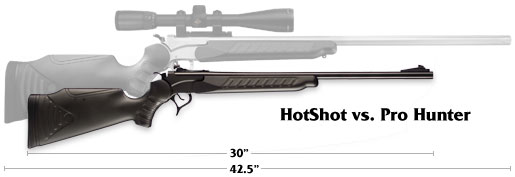
The resemblance is cosmetic and should be read that way. The HotShot does not take Encore or Contender barrels, and none of T/C’s documents say it shares any part with either. It is a separate, much smaller action styled to look like its elder. Volume 3 sets out what is known of its internals.
2.3 The Youth Line It Joined
The HotShot was the newest item in a “Youth Models” section that T/C’s website carried in January 2010. The same page lists what else the company offered small shooters that year:3
Table 1 — 2.3 The Youth Line It Joined
| Model | Type | Length of pull | Chambering |
|---|---|---|---|
| HotShot (3400/3401/3402) | Break-open single-shot rifle | 11.5 in | .22 LR |
| Impact (6680/6681) | Muzzleloader | 12.5–13.5 in | .50 |
| G2 Contender youth (1241, 3556) | Break-open single-shot (3556 listed with a 12-in barrel) | 14 in (1241) | .223 Rem |
| R-55 (6893, 6851, 6855) | Semi-automatic rimfire rifle | 13.75 in | .22 LR |
The table makes the HotShot’s position clear. It was the only T/C youth rifle with a pull short enough for a young child, and the only one aimed at the first years of shooting rather than a first deer season. The Impact muzzleloader and the youth G2 Contender were starter hunting guns for older children. The R-55 was a semi-automatic .22 with a 13¾-inch pull, a youth model in name only. The HotShot was the one rifle in the line meant to come first.
2.4 The Five Catalogue Numbers
Thompson/Center’s product pages list three numbers at launch. Two more turn up in other T/C material.
Table 2 — 2.4 The Five Catalogue Numbers
| No. | Barrel finish | Stock | Source |
|---|---|---|---|
| 3400 | Blued | Black composite | T/C specification table, 20101 |
| 3401 | Blued | Realtree AP HD camouflage | T/C specification table, 20101 |
| 3402 | Blued | Realtree AP HD Pink camouflage | T/C specification table, 20101 |
| 3409 | Blued | Brown; Boy Scouts of America licensed | T/C BSA page, 20106 |
| 3411 | Weather Shield | Realtree AP camouflage; distributor exclusive | T/C dealer-model sell sheet, 20117 |
All five share the 19-inch barrel, the .22 LR chambering, the peep sight and the 3-pound weight, so far as the maker’s tables show. None of T/C’s documents lists a stainless barrel, a stock colour beyond the five listed, a left-hand version (the stock is described as ambidextrous and the action has no side to hand), or any other chambering. Some retailer listings describe the 3401 as “Camo/Fixed Stock”. The phrase is a retailer’s and does not appear in any T/C document.
2.5 The Boy Scouts of America Rifle
In 2010 Thompson/Center offered “Officially Licensed Boy Scouts of America® Rifles”. This was the Scouts’ centennial year, and the page refers to the “official 100th Anniversary logo”. It lists three guns. The first is a HotShot:6
“3409 — Blued/Brown — .22 LR — 19” — 30” (31” with spacer) — 3 lbs. — Peep Sights, Drilled & Tapped for Scope”
The page says “Each model carries the Boy Scouts of America® logo on the frame or is embossed with the official 100th Anniversary logo in the stock”. It does not say which of those two treatments the 3409 received. The other two BSA rifles on the page are .50-calibre muzzleloaders. No production figure for the 3409 was found. It is a variant for a collector to look for: a brown-stocked HotShot with a Scout logo is the 3409, and one without the logo is not.
The BSA row also answers a small question about the maker’s dimensions. It gives the overall length as 30 inches, or 31 with the spacer, so the 30-inch figure in T/C’s specification tables is the rifle without the spacer.
2.6 The Weather Shield Dealer Exclusive
A 2011 sell sheet hosted on T/C’s own server, carrying the Ellett Brothers and JSC distributor marks, shows a HotShot with a grey metal finish and camouflage furniture, captioned “HOT SHOT Weather Shield/AP Camo T/C ITEM #3411”.7 The same item number appears in a later T/C file path under “specialModels”, a section the site used for dealer exclusives.8
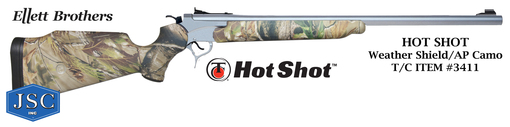
Weather Shield was Thompson/Center’s own corrosion-resistant finish. The company’s technology page of 2013 described it as “an advanced, tough-as-nails, corrosion protection system” and claimed, on its own testing, that it was “50 times more corrosion resistant than stainless steel alone”.9 That figure is T/C’s and no independent test of it was found. On the HotShot, the practical point is simpler. The 3411 is the only HotShot whose metal is not blued, which matters for cleaning and storage (Volume 4).
No production quantity, date range or price for the 3411 was located.
2.7 Fit: Length of Pull and the Spacer
The HotShot’s length of pull is 11.5 inches in every T/C source. A 1-inch spacer between the butt plate and the stock lengthens it to 12.5.12 The manual gives the construction: “The butt plate is held to the spacer by 2 screws and the spacer is held to the stock by 2 screws”.2 Volume 4 gives the procedure.
NRA Family’s January 2014 test put the rifle’s target user at “ages 6–12, with potential use extending to age 15 with included 1-inch spacer”.10 The age range is the reviewer’s, not T/C’s; the maker’s documents never state one. Firearms Insider’s review took a narrower view and called it “a perfect size for a small youth to learn on but would be too small for even a young teenage male”.11 Both are opinions. What the numbers support is this: 11.5 inches is the pull the whole youth-rimfire category has settled on (all three competitors in Volume 5 quote the same figure), and 12.5 inches is still well short of the 13½–14 inches of an adult sporter. A spacer buys a year or two of growth, not a teenager’s worth.
2.8 How Long It Was Made
The start is documented. The press release of 19 January 2010 said the rifle “will be available in April”.4 A Gun Tests item of 20 January 2010 reported the introduction the next day.12
The end is not. No Thompson/Center announcement of the rifle’s discontinuation was found. Three pieces of evidence bracket it and they do not agree exactly:
- Firearms Insider, in an undated review: “The Hot Shot was discontinued by TC in early 2013.”11 This is the only direct statement located, and it is secondary.
- NRA Family published a test on 2 January 2014 quoting current MSRPs, as if the rifle were still in the catalogue.10 Test articles are often written months before publication, so this weakly suggests the rifle was still listed during 2013.
- Thompson/Center’s own media library held large product photographs of the 3400 and 3402 in February–March 2014, and those images carry a “Copyright 2013 Smith & Wesson Corp.” notice.13 Someone at T/C was producing HotShot catalogue imagery in 2013.
Snapshots of T/C’s /firearms/ index taken each June from 2014 to 2021 do not contain the word “HotShot”. That index may only have listed product families, so the absence is weak evidence. The honest statement is that the HotShot was catalogued from 2010 to about 2013. A production run of roughly three to four years is consistent with every source found, and a precise end date is not established.
The run coincides almost exactly with the move from Rochester to Springfield (Volume 1 § 1.7). It is the kind of low-margin line a company rationalising two factories into one drops early. No source says that was the reason, and it is recorded here as a coincidence of dates, not a cause.
2.9 What It Cost
Prices are dated and attributed. None is current, because the rifle is not in production.
Table 3 — 2.9 What It Cost
| Date | Figure | Source |
|---|---|---|
| January 2010 | ”anticipated retail price of $229 to $249” | T/C press release4 |
| January 2014 | MSRP $204 (black), $234 (Realtree) | NRA Family test10 |
| c. 2013 (undated) | “Retail = $185 - $200” | Firearms Insider review11 |
The rifle got cheaper over its life: the January 2014 MSRP for the black rifle was $25 below the bottom of the 2010 launch range. For comparison with current youth rifles at their makers’ current prices, see Volume 5. No used-market figure is given here. The one published price guide consulted (Gun Digest’s Gun Values) keeps its values behind a login, and a figure copied from a listing site would be exactly the kind of unattributed price this hub has been burned by before.
2.10 Four Things the Summaries Get Wrong
1. The scope holes are in the barrel, not the receiver. Gun Digest’s Gun Values description says “receiver drilled and tapped for optics”.14 The manual is explicit: “The barrel is factory drilled and tapped for T/C mounts”, followed by a warning not to “drill additional holes in the barrel”.2 On a break-open rifle this is the only arrangement that works. The optic has to move with the bore when the gun opens, and on the HotShot both iron sights are on the barrel too (manual Figure 21, reproduced in Volume 4). Volume 3 explains why this matters for zero.
2. “Patented hammer and trigger mechanism” is not tied to any patent. The press release says the HotShot “employs Thompson/Center’s patented hammer and trigger mechanism”.4 Two T/C sources should name the patent and neither does. The HotShot manual’s patent page is headed “The T/C IMPACT™ is covered by one or more of the following Patents”, which is the list for T/C’s Impact muzzleloader, carried into the HotShot manual unchanged.2 T/C’s own virtual patent marking page of 2013 lists patents product by product and has no HotShot entry.15 Whatever patent the release had in mind, the maker never marked the rifle with it in any document found. Volume 3 treats the mechanism on what the sources actually describe.
3. The overall length is two numbers, both T/C’s. 30 inches in the specification tables, 30¼ inches in the press release. The BSA table’s “30” (31” with spacer)” shows the 30-inch figure is without the spacer. The extra quarter-inch is unexplained (Volume 1 § 1.2).
4. The .22 Short and Long question belongs to the barrel marking, not a review. NRA Family’s test says the rifle handles .22 Short and .22 Long as well as Long Rifle.10 Thompson/Center’s documents never say so. The barrel is marked “22 L.R.” and the manual says three times that the marking on the barrel designates the ammunition.2 In a .22 LR chamber the shorter cases are generally safe to fire. The reasons, and the carbon-ring caveat that comes with them, are set out in the .22 Rimfire dive’s Volume 2. On this rifle the maker’s instruction is the marking, and the marking says Long Rifle.
References
Footnotes
-
Thompson/Center Arms, “Hot Shot” product page,
tcarms.com/firearms/rimfireHotShot.php, © 2010, Internet Archive capture 2010-08-17. Accessed 2026-09-19. ↩ ↩2 ↩3 ↩4 ↩5 ↩6 -
Thompson/Center Arms, Hot Shot™ Rifle Safety & Instruction Manual, REV: HOTSHOT_073011, © 2011. https://tcarms.com/wp-content/uploads/2024/11/TC_HotShot_Manual_07-30-2011.pdf Accessed 2026-09-19. Cover; pp. 15, 21–23, 28. ↩ ↩2 ↩3 ↩4 ↩5 ↩6
-
Thompson/Center Arms, “Youth Models”,
tcarms.com/firearms/youth_models.php, © 2010, Internet Archive capture 2010-01-30. Accessed 2026-09-19. ↩ ↩2 -
Thompson/Center Arms, “Thompson/Center Arms Introduces New HotShot™ Youth Rifle”, press release, Rochester, N.H., 19 January 2010. Internet Archive capture 2011-03-04 of
tcarms.com/media/assets/pressReleases/012_Hot Shot/pdf/T-C HotShot.pdf. Accessed 2026-09-19. ↩ ↩2 ↩3 ↩4 ↩5 -
Thompson/Center Arms, “HotShot vs. Pro Hunter”,
tcarms.com/firearms/images/hotShotComparison.jpg, Internet Archive capture 2011-12-06. ↩ -
Thompson/Center Arms, “Boy Scouts of America® Youth Rifle”,
tcarms.com/firearms/youth_boy_scout_rifle.php, © 2010, Internet Archive capture 2010-05-17. Accessed 2026-09-19. ↩ ↩2 -
Thompson/Center Arms / Ellett Brothers / JSC, dealer-model sell sheet “HOT SHOT Weather Shield/AP Camo T/C ITEM #3411”,
tcarms.com/assets/dealerModels/1TC_HotShot_camo_WSx2000.jpg, Internet Archive capture 2011-12-06. ↩ ↩2 -
tcarms.com/assets/specialModels/images/TC_HotShot_camo_WS3411x550.jpg, Internet Archive CDX record 2018-01-09 (301 redirect; file name only). ↩ -
Thompson/Center Arms, “T/C Tech”,
tcarms.com/about/technology, © 2013 Smith & Wesson Corp., Internet Archive capture 2013-09-23. Accessed 2026-09-19. ↩ -
Daniel McElrath, “Test Fire: Thompson/Center HotShot”, NRA Family, 2 January 2014. https://www.nrafamily.org/content/test-fire-thompson-center-hotshot/ Accessed 2026-09-19. ↩ ↩2 ↩3 ↩4
-
“Thompson Center Hot Shot .22LR”, Firearms Insider, undated. https://www.firearmsinsider.tv/gun-gear-reviews/tchotshot Accessed 2026-09-19. ↩ ↩2 ↩3
-
“Thompson Center’s Hotshot Youth Rifles”, Gun Tests, 20 January 2010. https://www.gun-tests.com/rifles/thompson-centers-hotshot-youth-rifles/ Accessed 2026-09-19. ↩
-
Thompson/Center Arms media assets
3400-TC_HotShot_Black.jpgand3402-TC_HotShot_Pink_Camo.jpg,tcarms.com/images/uploads/media-asset/_large/, Internet Archive captures 2014-02-10 to 2014-03-30; image footer “Copyright 2013 Smith & Wesson Corp.” ↩ -
“THOMPSON/CENTER ARMS HotShot Youth Rifle”, Gun Values by Gun Digest. https://gunvalues.gundigest.com/thompson-center-arms/14110/hotshot-youth-rifle/ Accessed 2026-09-19. ↩
-
Thompson/Center Arms, “T/C Virtual Patent Marking”,
tcarms.com/about/virtual-patent-marking, © 2013 Smith & Wesson Corp., Internet Archive capture 2013-09-29. Accessed 2026-09-19. ↩
Comments (0)