Thompson/Center HotShot · Volume 4
Keeping It Working — Breakdown, Maintenance and Repair on a Rifle With No User-Serviceable Parts
What Thompson/Center's manual allows, how to clean a break-open .22 properly, what wears, and where repair goes now that the maker has changed hands twice
The owner asked for every dive in this hub to cover field breakdown, detail strip, maintenance and repair. For most rifles that means reproducing a maker’s or armourer’s procedure. For the HotShot the maker’s procedure is one sentence long, and it says not to. This volume sets out what Thompson/Center’s manual permits, what it requires, what the design implies about wear, and where an owner turns for repair now that the company has changed hands twice since the rifle was made.
The manual is the July 2011 revision (part 00084009, REV: HOTSHOT_073011). It is still the current download on Thompson/Center’s website, so it remains the maker’s standing instruction for this rifle.1 Volume 3 explains the mechanism that this volume maintains.
4.1 The Rule That Governs Everything Else
The manual’s disassembly section, in full:
“WARNING: THE T/C HOT SHOT RIFLE IS A FACTORY ASSEMBLED FIREARM THAT HAS NO USER SERVICEABLE PARTS. IT SHOULD NOT BE DISASSEMBLED OTHER THAN THE STOCK BUTT PAD AND STOCK SPACER. • NEVER DISASSEMBLE YOUR FIREARM beyond the procedures outlined in this manual.”1
Three further instructions reinforce it. Never “manipulate, adjust or change any of the internal components … unless specifically directed to do so in this manual”. Any “maintenance, adjustment or service not specified in this manual … must be performed by a qualified gunsmith using genuine Thompson/Center parts”. And, in the warranty exclusions, the maker will not be responsible for defects resulting from “unauthorized adjustments or modifications made or attempted by anyone other than a qualified gunsmith following Thompson/Center Arms authorized procedures”, or for “Use of replacement parts, including but not limited to barrels and springs, other than Thompson/Center Arms factory or authorized parts.”1
That is stricter than many makers. Ruger’s 10/22 manual, for comparison, walks an owner through removing the barrelled action, the trigger group and the bolt (10/22 Vol 7). The HotShot’s maker drew the line at the butt plate. For a child’s rifle that line is sensible: the fewer things a household takes apart, the fewer are put back wrongly. For an experienced gunsmith it simply means that anything inside the frame is done without a maker’s procedure, at the owner’s risk, and outside the warranty.
4.2 Field Breakdown: What the Manual Permits
There is no field strip in the usual sense. The barrel does not come off the frame in any procedure T/C describes, the fore-end is not removed, and the stock is not taken off the frame. What the manual does allow is:
1. Opening the action. The inspection and cleaning position. Hammer at rest, finger off the trigger, spur of the trigger guard pulled up and back; the barrel tips down and the chamber and bore are exposed (Volume 3 § 3.2).1
2. Removing or fitting the stock spacer. The manual: “The Hot Shot allows the length of pull to be altered by one inch. The butt plate is held to the spacer by 2 screws and the spacer is held to the stock by 2 screws (FIGURE 20).” So the sequence it implies is: unload and verify; remove the two butt-plate screws through the recoil pad; lift off the butt plate; remove the two spacer screws; remove the spacer; refit the butt plate directly to the stock. Fitting the spacer is the reverse. The manual adds one practical tip that is easy to skip and costly to ignore: “When inserting a Phillips head screwdriver into the holes of the recoil pad, a few drops of silicone lubricant on the screwdriver shaft will keep the recoil pad material from breaking away around the screw hole.”1
The manual does not say whether the screws for the spacer-fitted and spacer-removed configurations are different lengths, or whether one screw set serves both. Anyone removing the spacer should keep whatever screws came out of each layer together until that is known for the rifle in hand.
That is the whole of the maker’s breakdown.
4.3 Detail Strip: Why None Is Given
No detail-strip procedure is given here, for three reasons that are worth stating plainly.
- None was published. Thompson/Center’s manual contains no exploded view, parts list or detail-strip procedure, and none was found in any archived T/C page, catalogue, or dealer document for the HotShot.
- The maker forbids it. The disassembly section quoted in § 4.1 is the maker’s entire position.
- Reconstruction from memory, or by analogy with a Contender or Encore, would be unsafe and possibly wrong. The HotShot is styled like a Pro Hunter but T/C never says it shares parts or construction with one (Volume 2 § 2.2). A Contender detail-strip sequence applied to a HotShot frame assumes a lockwork layout that has not been documented.
What any correct procedure would have to deal with, if one is ever located, can be stated from the design (Volume 3): the hinge by which the barrel pivots on the frame; the latch that the trigger-guard spur operates; the hammer and its spring; the trigger and whatever “hammer block” the maker describes; the firing pin in the frame’s standing breech; and the attachment of the stock to the frame. A procedure that does not account for restraining the hammer spring, and for the parts of the hammer block, is incomplete. A gunsmith working on one is working from the rifle, not from a document.
4.4 Cleaning a Break-Open .22
The manual’s cleaning instructions are general: clean before first use, because the rifle “was treated at the factory with either a preservative or oil”; “Remove excessive firing residue from the bore and chamber using a properly fitted brush”; clean the exterior with a non-abrasive cloth; “lightly coat the metal parts, internal and external with a high quality gun oil”; and clean and lubricate after exposure to “sand, dust, extreme humidity, water or other adverse conditions”.1
Two cautions in the manual are specific to Thompson/Center and easy to miss:
“Ammoniated solvents or other strong alkaline solvents, should not be used on any Thompson/Center firearm.”
“You should avoid prolonged solvent immersion and prolonged ultrasonic cleaning of your firearm.”1
The ammonia prohibition matters because the copper solvents that many shooters keep for centrefire rifles are often ammoniated. A .22 LR bore fouls with lead and bullet lubricant rather than jacket copper, so an ammonia copper solvent has no job to do in it anyway. The manual’s broader restriction to “products specifically developed for firearms maintenance” covers the rest.
The break-open advantage. The manual does not say so, but the design gives a cleaning advantage every owner should use. With the action open, the chamber and the whole bore are exposed from the breech. A rod, brush or pull-through can go in at the chamber and out at the muzzle, in the direction the bullet travels, without passing over the crown. Cleaning a rifle from the muzzle drags the rod across the crown on every stroke, and the crown is the part of the barrel most sensitive to wear. On the HotShot there is no reason to clean from the muzzle at all.
The chamber mouth. If the rifle has been fired with .22 Short or Long, fouling builds up at the point in the chamber where those shorter cases end. Enough of it makes Long Rifle cases tight to chamber, and on this rifle a tight chamber means a barrel that will not close easily, which is exactly the condition the manual warns about (Volume 3 § 3.3). The .22 Rimfire dive’s Volume 2 covers this “carbon ring” and its cure: clean the chamber when switching back to Long Rifle.
The Weather Shield 3411. The one HotShot with a non-blued finish (Volume 2 § 2.6) takes the same cleaning. Thompson/Center’s corrosion claims for Weather Shield are the maker’s and were not independently tested. Treat it as coated steel rather than stainless.
4.5 Lubrication and Storage
Lubrication. The manual names no lubrication points. Its instruction is to “lightly coat the metal parts, internal and external” after cleaning, and, for cold climates, to use an oil “of an appropriate weight so that it will not congeal in cold temperatures, causing the interaction of important parts to be slowed or halted.”1 On a rifle that is not to be disassembled, “internal” can only mean what an owner can reach with the action open: the barrel’s breech face and hinge area, the standing breech of the frame, and the latch surfaces. A light film is the manual’s word, and it is the right one. Surplus oil on the breech face and in the chamber collects the powder fouling that .22 LR produces in quantity.
Storage. The manual:
“When storing, do not encase your firearm in anything that will attract or hold moisture, for example, leather or heavy cloth. Also, do not store guns with a plug inserted in the barrel for this can be a contributing factor to moisture accumulation. If your firearm is to be stored for an extended period, the bore, chamber and internal surfaces should be oiled with a high-quality lubricating oil or preservative intended for firearms.”1
It also says, with a force unusual even for a manual: “NEVER LOCK A LOADED FIREARM AND NEVER LOAD A LOCKED FIREARM!!”, and that ammunition must be stored “in a separate, secure location”. A youth rifle lives in a house with children by definition. The storage chapter of its manual is not boilerplate for this gun.
“Before using your firearm again, be sure to clean it”, meaning remove the storage oil from the bore and chamber before firing.1
4.6 The Inspection Schedule
Thompson/Center publishes no service interval, no round-count schedule, and no replacement interval for any part. Its inspection instruction is event-based:
- Every handling: open the action and check the chamber is empty and the bore is clear, “every time a firearm leaves your hand, is cleaned, handed to you or another person, transported or stored”.1
- Every cleaning: “check it for signs of wear. If wear is noted, do not use the firearm. Return it to Thompson/Center for service or have it checked by a qualified gunsmith.”1
- Any change in behaviour: “If your firearm gives any indication that it is not performing properly or the operation of your firearm has changed ‘the way it feels or sounds’, stop firing … unload the firearm and have it inspected by a factory technician.”1
- With a scope fitted: “Observe the condition of all the scope mount screws after firing. If the mounting screws show signs of loosening do not fire the firearm again”.1
For a working owner, “check for wear” needs translating into things that can be seen without disassembly. The list below is derived from the design (Volume 3), not from a T/C document:
Table 1 — For a working owner, "check for wear" needs translating into things that can be seen without disassembly. The list below is derived from the design ([Volume 3](/actual-firearms/rifles/tc-hotshot/vol-3/)), not from a T/C document
| Check | How | What is wrong |
|---|---|---|
| Lock-up | Close the empty action; try to wiggle the barrel against the frame | Any perceptible play, or a barrel that closes with no resistance |
| Latch | Close the empty action firmly several times | A barrel that fails to latch, or opens without the spur being pulled |
| Hammer rest | Hammer at rest, empty; press gently on the spur | A spur that moves forward toward the frame under light pressure |
| Cocking | Draw to full cock, empty | Hammer that will not hold at full cock, or holds only intermittently |
| Firing pin | Action open; look at the standing breech | A pin tip protruding with the hammer at rest; a burred or chipped tip |
| Chamber edge | Action open; look at the rear face of the barrel at the chamber | A dent where the firing pin would strike the barrel with no rim present (dry-fire damage) |
| Crown | Look at the muzzle under light | Nicks or uneven wear on the target-style crown |
| Stock screws and pad | Check for looseness; look at the pad around the screw holes | Torn pad material (see the silicone tip in § 4.2) |
Anything in the right-hand column is, in the manual’s words, a reason to stop using the rifle and send it for service. The hammer-rest and cocking checks are about the one feature that makes the rifle safe to carry (Volume 3 § 3.5). A HotShot whose hammer does not behave exactly as described there should not be fired until it has been seen by a gunsmith.
4.7 Adjustments an Owner May Make
The manual authorises three adjustments.
Length of pull, by fitting or removing the 1-inch spacer (§ 4.2).
Iron sights. “Move the rear sight up to raise the shot’s point of impact. To do this, turn the Elevation Adjustment Screw … clockwise (as viewed from the top) to raise it”, and counter-clockwise to lower it. “To adjust the windage it is necessary to slide the rear sight blade assembly left or right after loosening the Windage Adjustment Lock Screw … moving the sight blade to the right moves your shots to the right”. Retighten the lock screw after adjusting.1 The manual gives no click value or movement per turn.
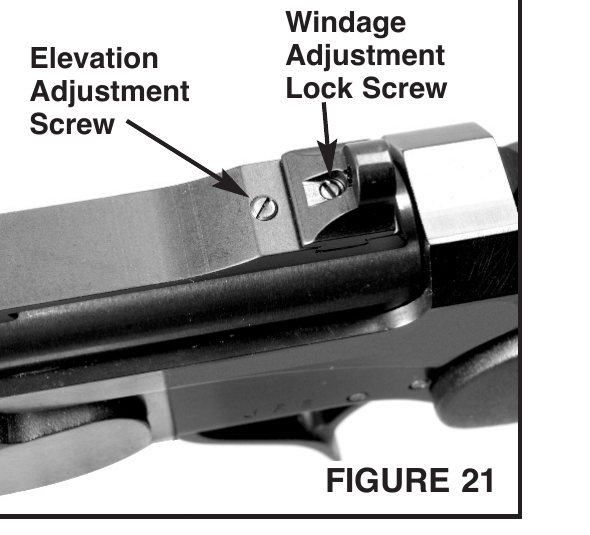
A scope. “We recommend that you have a competent gunsmith install your scope and mount … The barrel is factory drilled and tapped for T/C mounts.” And: “DO NOT DRILL ADDITIONAL HOLES IN THE BARREL AS THIS COULD WEAKEN ITS STRUCTURE”.1 The manual does not name a specific base, give the hole spacing or thread, or state a screw torque. None of those is supplied here, because none was found in a T/C source. Two practical points follow from the design. The mount goes on the barrel, so the zero is held by the barrel rather than the frame. And the exposed hammer has to be reachable under the scope’s ocular bell (Volume 3 § 3.4). Check the thumb’s path to the spur with the scope in place before tightening anything down. Scope selection itself is covered in the Scopes dive.
Nothing else. Trigger weight, hammer spring, latch tension and hinge fit are not owner adjustments on this rifle, by the maker’s instruction.
4.8 Malfunctions and Their Diagnosis
No list of HotShot-specific failures appears in any T/C document, and no published survey of failures in the rifle was found. The table below is therefore a diagnostic framework built from the rifle’s mechanism and the manual’s own warnings. Each cause is reasoned rather than reported, and the table says what the manual directs where it directs anything.
Table 2 — 4.8 Malfunctions and Their Diagnosis
| Symptom | Likely causes | First step |
|---|---|---|
| Barrel will not close on a cartridge | Round not fully seated; burred or oversized rim; fouling at the chamber mouth (carbon ring from Shorts/Longs) | Do not force it — manual: “may cause accidental discharge”. Open, remove the round, inspect the round and chamber, clean the chamber |
| Barrel will not close empty, or will not latch | Debris at the breech face or hinge; latch or hinge wear | Clean the breech face and hinge area. If it persists, stop, factory or gunsmith |
| Click, no fire (misfire) | Dud round; weak strike (hammer spring, firing pin, fouling in the pin channel); hammer not at full cock | Manual: wait 10 seconds, open, remove the round. Look at the rim: deep dent = ammunition; shallow or no dent = rifle |
| Hammer will not stay cocked | Hammer or sear engagement fault | Stop. Do not load. Factory or gunsmith |
| Hammer falls when released from full cock without the trigger | Worn or damaged engagement | Stop. Do not load. Factory or gunsmith |
| Case will not come out | Dirty chamber; swollen case; no extractor lift (if none is fitted, which is unconfirmed) | Hammer at rest, muzzle safe. A fired case can be pushed out from the muzzle with a cleaning rod; a live round is a gunsmith’s job, never a rod’s |
| Point of impact wanders | Loose sight lock screw or scope mount; play at the hinge; dirty bore | Tighten the lock screw; check mount screws (manual: do not fire if loosening); check lock-up (§ 4.6) |
| Behaviour “feels or sounds” different | Anything | Manual: stop firing, unload, have it inspected |
Two of these are worth emphasising because a youth rifle is the setting in which they are most likely to be mishandled. A barrel that “won’t close” is the rifle’s one hazard mode, and the correct response is always to open it again (Volume 3 § 3.3). And a hammer that does not hold at full cock, or falls on its own, defeats the only safety mechanism the rifle has.
4.9 What Wears, and What Breaks
With no parts list and no published failure data, the honest statement is short. On a break-open rimfire of this kind the parts that do mechanical work are few:
- The hinge and the latch. They take the load of every opening and closing and of every shot. Wear shows first as play between barrel and frame (§ 4.6).
- The hammer, its spring and the sear surfaces. They carry the rifle’s only safety function.
- The firing pin and the chamber edge. Rimfire firing pins strike close to the chamber edge; dry firing is the usual way both get damaged (Volume 3 § 3.7).
- The crown. Protected by cleaning from the breech (§ 4.4).
- The recoil pad screw holes. The one wear point the manual itself anticipates.
No replacement interval for any of these is published. A .22 LR single-shot fired by a child is also, by any measure, lightly used, and wear in a gun like this is far more likely to come from dirt, rust, dry firing and forcing than from round count.
4.10 Owner, Gunsmith or Factory
The manual draws the line, and this table just applies it.
Table 3 — 4.10 Owner, Gunsmith or Factory
| Job | Who | Authority |
|---|---|---|
| Open, inspect, clean bore and chamber, oil | Owner | Manual, cleaning section |
| Remove/fit stock spacer and butt plate | Owner | Manual, stock spacer section |
| Adjust iron sights | Owner | Manual, sight adjustment |
| Mount a scope on T/C mounts | Owner, but manual recommends a gunsmith | Manual, mounting a scope |
| Replace a broken or lost sight part | Gunsmith, with genuine T/C parts | Manual: alterations or parts “by a qualified gunsmith using genuine Thompson/Center parts” |
| Anything inside the frame: hammer, trigger, block, sear, springs, firing pin, latch | Gunsmith or factory | Manual: “no user serviceable parts”; warranty excludes unauthorised adjustment |
| Hinge play, lock-up, headspace | Factory (or a gunsmith who can assess break-action lock-up) | Manual: “If wear is noted, do not use the firearm. Return it to Thompson/Center” |
| Any fault in how the hammer holds or falls | Factory or gunsmith, before firing again | Manual; Volume 3 |
For a household with a CNC mill and a gunsmithing bench, the temptation will be to open the frame. The manual forbids it, the warranty excludes it, and no document of the internal layout exists to work from. If it is done, it is done as an original investigation, and the result should be recorded, because it would be the first published account of the HotShot’s lockwork.
4.11 Warranty and Parts After Two Changes of Owner
The original warranty. The manual’s “Limited Lifetime Warranty” lasts “for the Lifetime of the original owner”, and is “established by the return of the Thompson/Center Arms authorized warranty card within thirty (30) days of purchase”. Claims had to go, in writing and with the rifle, to 2100 Roosevelt Avenue, Springfield — Smith & Wesson’s plant — with a bill of sale or ATF Form 4473 showing the date of purchase.1 So the warranty never covered a second owner, and it depended on a card having been sent in.
The current warranty. Thompson/Center’s website in September 2026 carries a warranty with the same structure: for “the lifetime of the original retail purchaser”, registration by card or online within 30 days, and an RMA required before shipping. Service goes to Thompson/Center Arms, 39 Old Dover Rd, Rochester, NH 03867; customer service is 603-994-3831 or [email protected]. It adds that T/C “may change the availability of this Limited Lifetime Warranty at Thompson/Center Arms’ discretion, but any changes will not be retroactive.”2
What the current page does not say is whether the company that bought Thompson/Center’s assets from Smith & Wesson in 2024 honours warranties, or supplies parts, for rifles made under Smith & Wesson between 2007 and 2021. An asset purchase does not by itself carry over a seller’s warranty obligations, and nothing on the page addresses the point. The HotShot was made entirely under Smith & Wesson ownership (Volume 1). Whether a HotShot will be repaired, and at what cost, is therefore a question to put to T/C’s customer service by phone before shipping anything, not something to assume from the warranty text.
Two facts are encouraging. The new company still hosts the HotShot manual on its User Guides page, re-uploaded in November 2024, so it has not written the rifle out of its records.3 And Smith & Wesson’s 2021 divestiture release promised that T/C’s customers “will continue to receive the world-class firearms, accessories, and customer service support that the brand has been known for”4 — though that promise was made by a company that then kept the brand dormant for three years, and it binds nobody now.
Parts. No source was found offering HotShot parts for sale, from Thompson/Center or anyone else, and no parts list exists from which to look them up. The manual’s rule is genuine T/C parts only, and it names barrels and springs specifically. In practice that means a HotShot with a broken internal part is a factory job or a gunsmith fabrication job. For a gunsmith, parts made to fit are a real option on a single-shot this simple, provided they are recorded and the owner understands the manual’s warning. A HotShot’s value does not justify much factory freight either way.
References
Footnotes
-
Thompson/Center Arms, Hot Shot™ Rifle Safety & Instruction Manual, REV: HOTSHOT_073011, © 2011, part 00084009, 28 pp. https://tcarms.com/wp-content/uploads/2024/11/TC_HotShot_Manual_07-30-2011.pdf Accessed 2026-09-19. Safety responsibilities pp. 3–6; storage pp. 7–8; inspecting p. 13; firing p. 17; misfires p. 18; cleaning and maintenance pp. 19–21; disassembly p. 21; stock spacer and sight adjustment p. 22; scope and warranty pp. 23–26. ↩ ↩2 ↩3 ↩4 ↩5 ↩6 ↩7 ↩8 ↩9 ↩10 ↩11 ↩12 ↩13 ↩14 ↩15 ↩16 ↩17
-
Thompson/Center Arms, “Limited Lifetime Warranty”, https://tcarms.com/limited-lifetime-warranty/ Accessed 2026-09-19. ↩
-
Thompson/Center Arms, “User Guides”, https://tcarms.com/user-guides/ Accessed 2026-09-19. ↩
-
Smith & Wesson Brands, Inc., “Smith & Wesson Brands, Inc. Announces Intent to Divest Thompson/Center Arms™ Brand”, 3 May 2021. Form 8-K Exhibit 99.1, SEC accession 0001193125-21-148073. Accessed 2026-09-19. ↩
Comments (0)