Savage 93R17 (.17 HMR) · Volume 6
On the Rifle — The Crossfire, the Mounts, a Suppressor, and the Michigan Position
Three Vortex scopes share one name, a fixed-parallax 4-12×44 on a rimfire, an unthreaded barrel and a can that must be rated for the cartridge, and where a .17 HMR fits Michigan's rimfire rules
6.1 On the Rifle — The Crossfire, the Mounts, a Suppressor, and the Michigan Position
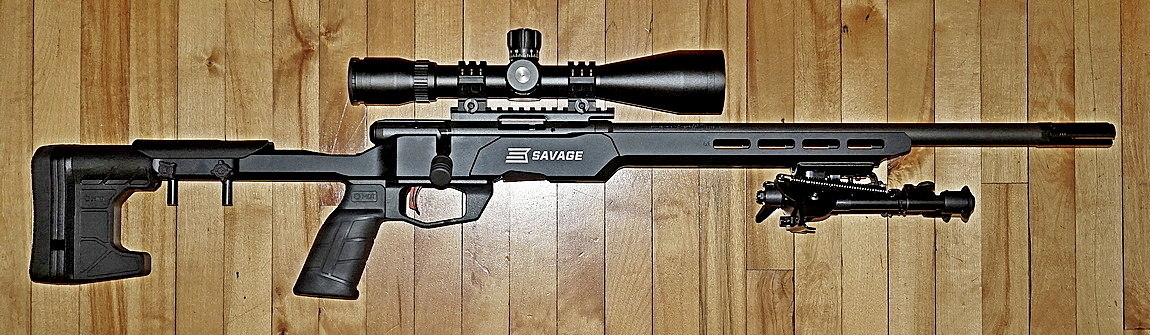
This volume covers what is fitted to the rifle rather than the rifle itself: the scope and its mounts, a suppressor, and the Michigan rules that apply when the rifle is taken hunting. All three are configuration, and configuration changes. Where this volume says what is on the rifle documented here, it says so as of September 2026, from the owner’s inventory sheet, and it keeps what is recorded separate from what is not. Optical theory belongs to the hub’s Types of Scopes dive, suppressor theory and law to the three Suppressors dives, and both are linked rather than restated.
6.1.1 What the sheet records
As of September 2026 the owner’s sheet records a Vortex Crossfire 4-12×44 on this rifle, with the scope mount entered as the single letter “M”. No suppressor is recorded against it.
Two things are not recorded and matter below: which Crossfire it is (Vortex has sold three scopes under that name in 4-12×44), and what the mount is. The “M” is not interpreted. The scope’s reticle is not recorded either.
6.1.2 Three scopes called “Crossfire 4-12×44”
Vortex’s own pages, as archived, show three distinct products with this name and magnification.1
Table 1 — 6.2 Three scopes called "Crossfire 4-12×44"
| Crossfire (first generation) | Crossfire II | Crossfire (2025) | |
|---|---|---|---|
| Archived page | 2012 (“Coming Soon”) | 2012, 2019, 2024–25 | 2025 |
| Tube | 1 in | 1 in | 1 in |
| Turrets | capped, ¼ MOA, 15 MOA per turn | capped, ¼ MOA, 15 MOA per turn | not extracted |
| Max elevation / windage | 50 / 50 MOA | 50 / 50 MOA | not extracted |
| Parallax | 100 yards (fixed) | 100 yards on the 2019 page; “10 to Infinity” on a 2012 page | not extracted |
| Eye relief | 3.9–4.4 in | 3.9 in (2019 page) | not extracted |
| Field of view | 24.7–8.4 ft at 100 yd | 24.7–8.4 ft at 100 yd | not extracted |
| Length, weight | 13.1 in, 17.2 oz | 13.1 in, 17.2 oz | not extracted |
| Reticles | V-Plex (MOA), Dead-Hold BDC (MOA) | V-Plex (MOA), Dead-Hold BDC (MOA) | Dead-Hold BDC MOA, illuminated Dead-Hold 2A BDC MOA, WideRange Plex MOA |
| Focal plane | not extracted | second | not extracted |
The first two share every published figure except one line on one page. Which the rifle wears is visible only on the scope: the name ring and turret markings.
The parallax line is the one that matters, and Vortex’s own pages disagree about it. A 2012 Crossfire II 4-12×44 specification page reads “Parallax Setting 10 to Infinity”. The 2019 page for the same scope reads “Parallax Setting 100 yards”, as does the first-generation 4-12×44. The sister model tells the likely story: the Crossfire II 4-12×40 AO carries “AO”, adjustable objective, in its name and is specified at “10 yards to Infinity”, 13.6 inches and 19.2 ounces; the 4-12×44 is never called AO, and it is shorter and lighter.1 The weight of the evidence is that the 4-12×44 is a fixed-parallax scope set at 100 yards, and the 2012 line is an error on Vortex’s page. It is still Vortex’s page, so the question is settled on the scope itself: an adjustable objective has a graduated ring on the objective bell, and a fixed-parallax scope does not.
The hub’s .22 Rimfire dive documents a Crossfire 4-12×40 on a different rifle in the same collection, the Ruger Precision Rimfire.2 That is a different scope: in its Crossfire II form the 4-12×40 is the adjustable-objective model, while Vortex’s first-generation Crossfire 4-12×40 was sold both with and without AO. The two magnifications should not be confused when optics are moved between rifles.
6.1.3 A fixed-parallax scope on a rimfire
Parallax is the apparent movement of the reticle against the target when the eye moves behind the scope. It is zero only at the distance the scope is focused for; the hub’s Types of Scopes dive explains the optics and the adjustable-objective and side-focus remedies.
A 100-yard fixed setting is a centrefire hunting convention. A .17 HMR is used from inside 50 yards to 200. At the short end of that band a fixed-100-yard scope at 12× will show parallax, and a shooter whose head position varies will see point of impact wander with it. Two practical consequences, neither of which needs a new scope:
- Consistent head position is the cure. Parallax error is zero when the eye is on the optical axis. A cheek weld that puts the eye in the same place every shot removes most of it, which is one reason a thumbhole stock with a fixed grip position suits this rifle.
- Less magnification at short range. The usual advice is to turn down from 12× for close targets, where residual parallax is most visible; it is advice, not a measured correction.
If the scope turns out to be an AO model after all, the adjustable ring should be set to the target’s distance, and the problem goes away.
6.1.4 The reticle and the .17 HMR’s drop
Vortex’s page gives the Crossfire II as a second-focal-plane scope, and the focal plane of the other two was not extracted. In a second-focal-plane scope the reticle stays the same size as the magnification changes, so its subtensions are only true at the magnification Vortex specifies them for. The hub’s .22 Rimfire dive works through the same effect on a second-focal-plane BDC scope used with the “wrong” ammunition.2
A Dead-Hold BDC reticle’s hash marks are Vortex’s; they are not calibrated to the .17 HMR, and nothing on Vortex’s pages says they are. The cartridge’s own drop is known from Hornady’s table (Volume 2): from a 100-yard zero with a 1.5-inch sight height, the 17-grain V-MAX is 8.5 inches low at 200 yards. One minute of angle at 200 yards is about 2.09 inches, so that is about 4.1 MOA of hold or dial at 200 yards, for that load, from Hornady’s 24-inch test barrel. With ¼-MOA clicks, it is about 16 clicks. That is arithmetic on Hornady’s figure, not a measurement from this rifle; the rifle’s own zero and drop should be confirmed on paper.
6.1.5 The mounts
Savage’s rimfires come with, or accept, Weaver-style two-piece bases. Savage’s service desk: “The mounts that are included with some of our rimfire models are standard weaver-style bases. You should be able to use them with a standard weaver ring … If your gun does not have bases, a Weaver #16 or 24 will fit.” The scope base (item 504) and its screws (506) are on the Model 93’s owner-purchasable parts list.34
What rings and bases are on the rifle documented here is not recorded: the sheet’s “M” is not a model. Mounting, ring alignment and torque belong to the hub’s Types of Scopes dive. Savage’s manual adds only that the scope rings are to be checked for looseness as part of routine inspection (Volume 5 §5.5).
6.1.6 Suppressing a .17 HMR
6.1.6.1 It is supersonic, and it stays loud
Every .17 HMR load in Volume 2 leaves the muzzle between 2,375 and 2,650 fps, more than twice the speed of sound, and there is no subsonic load. The hub’s suppressor dives state the consequence directly: “.22 WMR and .17 HMR are supersonic in every normal loading. A can on them is a comfort device, not a quiet one, and no subsonic option meaningfully exists. The .17 HMR in particular is a small, fast, loud cartridge and stays loud.”5 The supersonic crack of the bullet travels with it downrange and no muzzle device removes it. What a suppressor does on this rifle is take the muzzle blast off the shooter’s ears and reduce flash and recoil; the How Suppressors Work dive explains the three noise sources.
6.1.6.2 The can must be rated for the cartridge
The Suppressors by Caliber dive’s rule is plain: a .22 LR can that is also rated for .22 WMR, .17 HMR and 5.7×28 is worth having, “because those cartridges are considerably more energetic than .22 LR and a can rated only for .22 LR should not see them.”5 It records Mack Brothers’ current rimfire can, the VAPOR, as rated for .22 LR, .22 WMR, .17 HMR and 5.7×28.5
The rimfire can shared across the owner’s .22 rifles, a Mack Brothers Lima, is not recorded against this rifle, and its rating for .17 HMR is not recorded anywhere in the hub. It is out of production. Before it goes on this rifle, its .17 HMR rating needs to be confirmed with Mack Brothers in writing, the same step the Suppressors by Caliber dive already recommends for any service question on that can.5 If it is not rated for the cartridge, it does not go on.
A .17 bullet through a can built for .22 has more bore clearance, not less, so bore diameter is not the constraint. Pressure, gas volume and velocity are.
6.1.6.3 The barrel is probably not threaded
Savage threads only its “SR”, suppressor-ready, rimfires: in the 93R17 family that means the FV-SR, the TRR-SR and similar models, and the service desk states that current rimfire threading is 1/2-28, with “some older rimfire guns … found with 1/2-20 threading”.3 None of the thumbhole 93R17s in Volume 1 is an SR model, and the sheet records no threading. Whether this barrel is threaded is a question to settle by looking at the muzzle.
An unthreaded heavy varmint barrel can be threaded by a gunsmith. The job is to cut the thread concentric with the bore, not with the outside of the barrel, which is the whole subject of the How Suppressors Work dive’s threading volume. Savage’s own position on adding muzzle devices is that some models can be sent to the factory and that sporter-barrelled hunting models generally cannot; it publishes nothing specific to rimfire threading.3 Threading by anyone other than Savage is a modification under the warranty’s exclusion (Volume 5 §5.7).
6.1.6.4 The law, briefly
The federal making-and-transfer tax on suppressors fell to $0 for applications from 1 January 2026 under Public Law 119-21; the registration and approval process itself is unchanged. The hub’s Suppressor Law dive sets out exactly what changed and what did not. In Michigan, suppressor ownership needs nothing beyond the federal process, and hunting with a lawfully possessed suppressor is permitted; the same dive’s state volume covers it.
6.1.7 The Michigan position for hunting
Michigan’s general hunting rules are in Chapter II of the Wildlife Conservation Order. The .17 HMR is not named in it. What the order does name, repeatedly, is “a rimfire firearm .22 caliber or smaller”, and a .17 HMR is a rimfire smaller than .22 calibre. That reading is this dive’s, applying the plain words; no DNR statement about the .17 HMR specifically was found. The provisions it brings in, quoted from the order as published in September 2026:6
- Night hunting of predators and small furbearers (§2.5(2)). A person “traveling afoot at night and in possession of only … a rimfire firearm .22 caliber or smaller” (among other permitted arms) “may take within their specified open seasons skunk, weasel, raccoon, opossum, coyote, and fox”. The loaded-firearm condition applies: the hunter may not carry it loaded unless hunting with dogs and at the point of kill, or hunting with a game or predator call or bait. The separate ban on centrefire rifles at night in state parks and recreation areas (§2.5(3)) does not, by its terms, reach a rimfire.
- Lights (§2.4(1)). A hand-held or worn light may be used by a person afoot carrying, among others, “a rimfire firearm .22 caliber or smaller”, subject to the same loaded-firearm conditions.
- The five days before 15 November (§2.1(3)). The ban on carrying a rifle or shotgun with buckshot, slug, ball load or cut shell in deer country in those five days “shall not prohibit a resident who holds a fur harvesters license from carrying a rimfire firearm .22 caliber or smaller while hunting or checking a trap line during the open season”.
- Trapped furbearers during firearm deer season (§2.3(3)). A rimfire firearm .22 calibre or smaller may be carried and used “to kill legally trapped furbearers … during the firearm deer season if the firearm is loaded only at the point of kill.”
Those are the provisions where the cartridge’s classification matters. The .22 Rimfire dive covers Michigan small game and the general season restrictions.2 This dive does not treat the .17 HMR as a deer cartridge (Volume 2 §2.5) and says nothing about deer seasons. The order is amended regularly, and the current digest and order control; these are pointers, not advice.
6.1.8 What could not be verified
- Which Crossfire 4-12×44 is on the rifle, and its reticle.
- Whether the Crossfire II 4-12×44 is fixed at 100 yards or adjustable; Vortex’s own pages disagree.
- What the sheet’s “M” mount entry refers to.
- Whether the barrel is threaded.
- The Lima suppressor’s rating for .17 HMR.
- Any Michigan DNR statement applying the “.22 caliber or smaller” rimfire language to the .17 HMR by name.
6.1.9 Bibliography
Footnotes
-
Vortex Optics product pages, as archived by the Internet Archive: Crossfire 4-12×44 V-Plex (vortexoptics.com/product/crossfire-4-12x44-with-v-plex-moa-reticle, 13 January 2012); Crossfire II 4-12×44 Dead-Hold BDC specifications (vortexoptics.com/product/crossfire-II-4-12x44-with-dead-hold-bdc-moa-reticle/specs, 9 November 2012); Crossfire II 4-12×44 (vortexoptics.com/vortex-crossfire-ii-4-12x44-riflescope.html, 24 July 2019); Crossfire II 4-12×40 AO Dead-Hold BDC specifications (vortexoptics.com/product/crossfire-II-4-12x40-ao-with-dead-hold-bdc-moa-reticle/specs, 24 May 2014); Crossfire 4-12×44 (vortexoptics.com/crossfire-4-12x44-riflescope.html and reticle variants, September–December 2025). Figures as stated on each page. ↩ ↩2
-
The hub’s .22 Rimfire dive, Vol 9 (a Crossfire 4-12×40 on the Ruger Precision Rimfire), Vol 11 (second-focal-plane BDC reticles used off their calibration), Vol 6 §6.6 (Michigan small game). ↩ ↩2 ↩3
-
Savage Arms service FAQ, service.savagearms.com/hc/en-us/articles/: rimfire scope mounts (214237423) and bases (214239863), 11 April 2013; muzzle brakes (214238023), 11 April 2013; “Threaded Muzzle FAQ” (25779967723405), as archived 20 May 2024. ↩ ↩2 ↩3
-
Savage Arms rimfire bolt-action instruction manual, §6 Model 93 parts list (items 504, 506) and §14 routine maintenance, as archived 19 December 2022. ↩
-
The hub’s Suppressors by Caliber dive, Vol 3 §3.4 (the Mack Brothers Lima; the VAPOR’s ratings, checked 29 July 2026) and §3.7 (other rimfire cartridges; the quoted rating rule and the supersonic note); Vol 9 (.22 WMR / .17 HMR). ↩ ↩2 ↩3 ↩4
-
Michigan Department of Natural Resources, Wildlife Conservation Order, Chapter II, “General Hunting and Trapping Regulations”, michigan.gov/-/media/Project/Websites/dnr/Documents/Orders/Wildlife-Conservation-Order/ChapterII.pdf, retrieved 19 September 2026 (PDF dated 16 September 2026): §§2.1(3), 2.3(3), 2.4(1), 2.5(2)–(3). ↩
Comments (0)