North American Arms Mini-Revolver · Volume 5
Carrying It: The Deep-Concealment Niche, Its Honest Limits, and Michigan Law
What a six-ounce single action is for, what its sights, trigger and reload cost, how to carry it safely, and the Michigan statutes that apply the moment it leaves the house
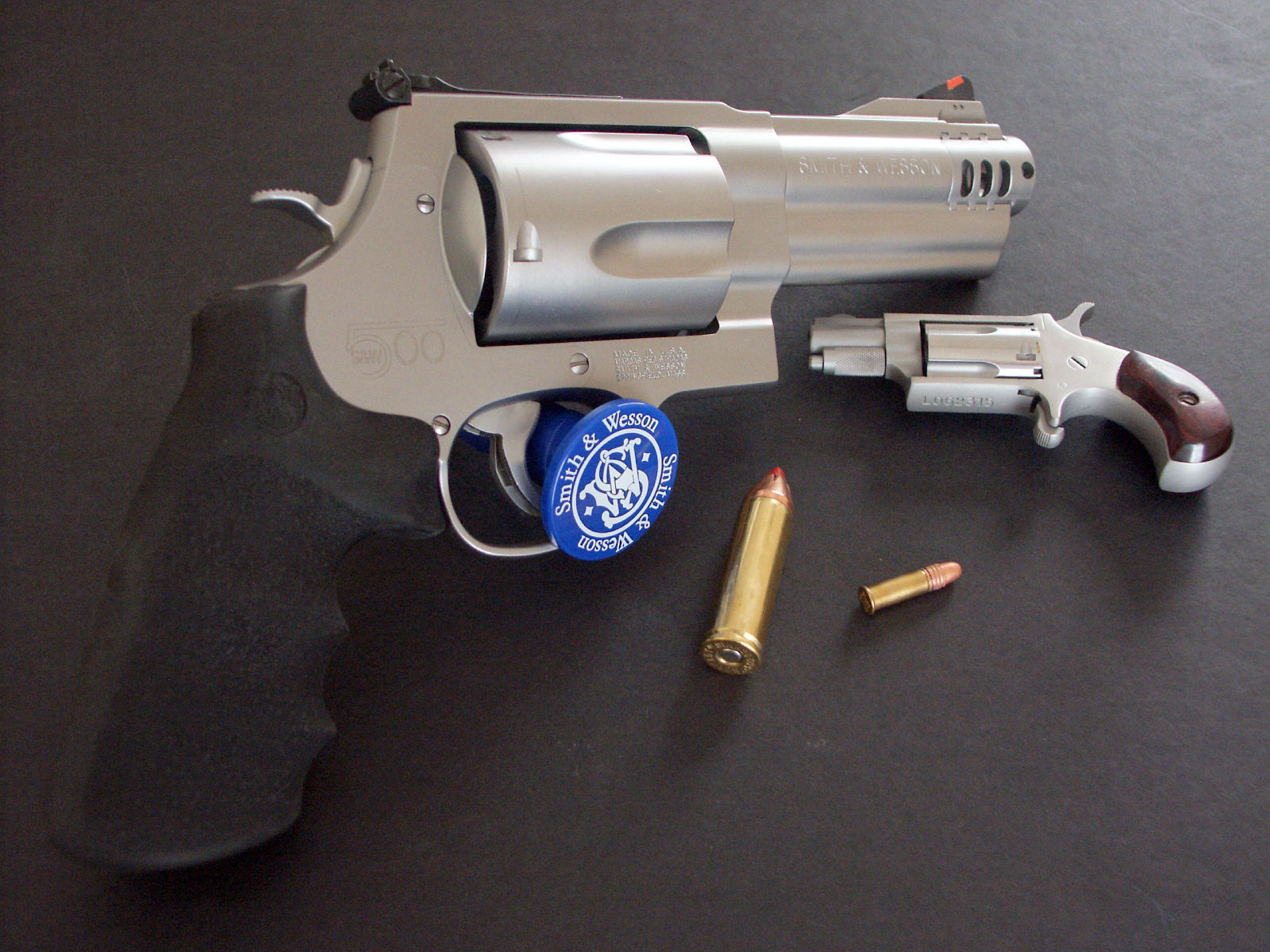
Every account of the NAA mini-revolver, from the maker’s to the most sceptical review, agrees about what it is for. It is the gun for when no other gun can be carried. Where they differ is on how much that is worth. This volume sets out the case and its costs from the published tests, and then the Michigan law that applies to it. That law does not change because the gun is small. If anything, the gun’s size is what brings it into play.
5.1 What it is for
Walt Rauch, reviewing the NAA-22MS, drew the line most reviewers draw:
“There’s a significant difference between carrying a backup handgun and toting a ‘last-ditch’ defensive arm. The North American Arms 22MS revolver chambered in .22 Winchester Magnum Rimfire (.22WMR) fits in the latter category. While the NAA 22MS is suitable for concealed carry, its size, caliber and method of operation are not optimal for first line defense.”
He also listed what the design gets right: “its diminutive size means it can be hidden or concealed almost anywhere; there’s no safety to disengage; no magazine to pop loose; no slide to fail to cycle.”
David Higginbotham, who carries one, calls it “a backup, or even as a backup to a backup”, and “For deep concealment—when there’s no way you could conceal even a mouse gun—this may be it.” Gil Horman, who has reviewed several of the family for American Rifleman, describes the minis as “the definition of a close-range defensive handgun”.
The numbers explain why that niche belongs to the mini. At 4.63 in long, 2.81 in tall, 1.06 in wide and 6.2 oz (Volume 1), the NAA-22MS-P fits places a pocket pistol cannot: a watch pocket, a shirt pocket, a belt buckle, a closed fist. Richard Mann summed up the minis as “about as small as small gets.”
What it gives up for that, the rest of this volume counts.
5.2 Sights
The NAA-22MS-P has what NAA calls a “Half-moon Sight”: a low blade at the muzzle. The rear sight is a notch cut in the frame’s top strap. Horman, describing the same arrangement on the .22 Short: “There is no rear sight. However, it’s easy to form a sight picture by using the squared-off edges at the back of the frame, on either side of the hammer slot.” Higginbotham: “The rear sight is milled into the frame. The combination is more effective on larger revolvers, but it is—and always has been—lacking.” He adds a point every single-action shooter will recognise: “Like an old Colt, they can only be seen with the hammer cocked.” With the hammer down, it fills the notch.
What published tests got with those sights:
Table 1 — What published tests got with those sights
| Tester | Gun | Distance | Result |
|---|---|---|---|
| Rauch | NAA-22MS | 5 yd, one hand, no laser | ”four inch to six inch five shot groups” |
| Rauch | NAA-22MS | 7 yd | ”the gun shot about six inches low at seven yards” |
| Horman | NAA-22S (.22 Short) | 3 yd / 7 yd | about 2 in / “nearly 4.5"" |
| Horman | Pug-type short-barrel Magnum minis | 7 yd | ”around 1.5” to 2"" |
| Horman | Sidewinder (1 3/8 in) | 7 yd | 2.75 in average, Winchester PDX1 |
| Higginbotham | NAA-22MS | ”10 feet" | "capable”; farther, “My groups were sporadic at best” |
Two things follow. First, the gun is mechanically accurate enough for its purpose. Horman’s bench groups from the Pug-type guns show the barrels and chambers will group. Second, the sights are the limit, and they are fixed. The only correction is the shooter’s hold, since the sights cannot be adjusted without factory or gunsmith work. Rauch’s conclusion was “Point shooting was more effective,” and it is the common one.
The family’s answer to the sight problem is the Pug, with its XS white-dot sights on a 1-inch barrel, and the Black Widow, with Marble Arms sights on 2 inches (Volume 2 §2.7). A grip laser is the other answer. Rauch shot his NAA-22MS with a LaserLyte laser fitted, and Horman notes that the LaserLyte V-Mini grip laser fits the minis. Rauch found that with the laser, hits were made “(or not) based on how steady the gun was held”. On the NAA-22MS-P as catalogued, none of these is fitted. Whether any has been added to the revolver documented here is not recorded.
5.3 Trigger, grip and recoil
The trigger is a stud with no guard, about 1/8 in of travel, and published weights from 4 lb 5 oz to 5.5 lb (Volume 3 §3.3). Horman on the .22 Short: “The trigger is not much more than a textured stud that sticks out from the frame. However, it has a smooth, short stroke that breaks cleanly.” A clean, short, light single-action release is the easiest trigger to shoot well. The difficulty is everything around it.
Every shot begins with the thumb. The gun must be cocked before each shot. The hammer spur is good. Higginbotham: “The hammer has a decent spur. Despite its size, it can be cocked one-handed or two-handed.” But the cocking stroke is a change of grip on a gun that offers very little to hold. He sees an advantage in it: recoil “is less of an obstacle to repeat accuracy than you might think, as you have to cock again, and that motion allows you to reposition your grip if you need to.” The cost is time. No published timing of a mini’s follow-up shots was found. That a thumb-cocked follow-up is slower than a double-action or semi-automatic one is inherent in the action, not a measured figure.
The grip is the bird’s head, and it holds “just enough for a one or one-and-a-half-finger hold” (Horman). His technique after years of shooting minis: “you have to bear down on the grip with the middle finger while tucking in the ring and little finger tightly to provide a stable platform for the rounded base of the birdshead grip.” The boot grips, holster grip, or the Black Widow’s full-size grip exist because of this. The revolver documented here has had its bird’s head replaced with a folding grip (Volume 2 §2.6, most probably NAA’s GHG-M). Opened, that grip gives the whole hand something to hold, which NAA describes as “a full-sized gripping surface for comfortable, secure handling and more positive recoil control”. It is the largest single change an owner can make to how this gun shoots, and it costs a folding step on the draw.
Recoil from .22 WMR in a six-ounce gun is not heavy, but it is sharp and it is accompanied by flash and noise that surprise first-time shooters (Volume 4 §4.6). Higginbotham: “snappy little rounds, and the lighter weight and lack of control surfaces result in a gun that moves around a bit.” A practice cylinder in .22 LR, the NAA-22MSC-P configuration, would make practice cheaper and milder. Volume 2 §2.5 explains why that means a factory-fitted cylinder and not a loose one.
5.4 Reloading, or rather not
The NAA-22MS-P holds five rounds. To reload it, per NAA’s manual (Volume 3 §3.5):
- half-cock;
- hold the knurled pin, press the button, withdraw the pin completely;
- take the cylinder out;
- use the pin to push each of the five fired cases out, one at a time;
- load five cartridges;
- put the cylinder back, and seat the pin “firmly against the frame”;
- cock, or lower into a slot.
With the gun in pieces in two hands, a pin is loose in one of them. Horman’s point about the Sidewinder, that its swing-out cylinder “eliminates the opportunity of hunting for a dropped cylinder pin”, applies to every push-pin mini. No published timed reload of a push-pin mini was found, and none is invented here. The procedure alone makes the practical conclusion clear: for defensive purposes, the NAA-22MS-P is a five-shot gun, full stop. Horman found the Sidewinder’s swing-out cylinder faster to reload than a pop-out mini. Even so, it is a single action loading one chamber at a time.
That is not an argument against the gun. It is an argument about what the gun is: five rounds, in the place where no other gun would have been.
5.5 Carrying it safely
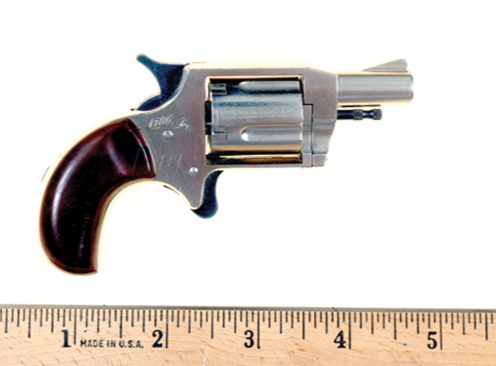
The safety rules for carrying a mini come from its design, and NAA’s manual states all of them:
- Carry only with the hammer in a safety slot. “Do not carry this handgun with the hammer resting above a live cartridge or in the half-cock position.” Check it by trying to turn the cylinder (Volume 3 §3.4).
- Never cocked. There is no manual safety to hold a cocked hammer and no trigger guard to cover the trigger. Higginbotham: “There’s no lock on one of these for carrying it cocked-and-locked. And there’s no trigger guard. No matter how form-fitting your holster is, you’re likely to fire the gun if you try to put a cocked NAA into a holster.”
- Always in a holster. “NAA STRONGLY RECOMMENDS that all NAA firearms be carried in an appropriate holster— even/especially when carried in a purse or pants pocket.” A loose mini in a pocket has an exposed trigger and a hammer that can be caught on things.
- Re-seat the slot after every shooting session. “Place the hammer in the safety slot immediately after loading and after finishing firing.”
Carry options in NAA’s own range: pocket holsters, the folding holster grip that closes over the trigger and clips to a belt, and belt buckles that hold the gun. The revolver documented here has both a folding grip and an NAA belt buckle (Volume 2 §2.6). The two are alternative ways to carry. Whether the gun fits its buckle with the folding grip fitted is not recorded.
5.5.1 The belt buckle in practice
The sources on how a buckle actually carries are thin: NAA’s two product listings, NAA’s product photographs, and the FBI Law Enforcement Bulletin photographs in this volume. No tested draw, no retention test and no review of carrying an NAA buckle day to day was found. What the sources support:
- Draw. The gun is not fired from the buckle. It is released and drawn out. NAA’s oval buckle lists a “Secure Clip Release”. The FBI’s caption for its photograph says the revolver “is released from a belt buckle by the press of a button.” A buckle draw is therefore a two-step, two-hand-friendly motion at the centre of the waist: release, then get a firing grip on a bird’s-head gun. With the standard grip that hold is the one and a half fingers of §5.3, since the folding grip may not fit a buckle at all (Volume 2 §2.6). No timing for it was found.
- Retention. NAA’s oval buckle claims a “Secure Clip Release”. The skeleton buckle’s listing says only that it is “designed to securely carry”. Neither states a retention force, and neither says how the gun is held against a blow, a fall, or a hand grabbing at the belt. A buckle is at the front of the body, where it is easiest for someone else to reach. That is a point about position, not a tested finding.
- Muzzle direction. In NAA’s product photographs of both Magnum buckles, and in the FBI photographs, the revolver lies horizontally along the belt line with its muzzle pointing to one side. Worn, the muzzle points sideways across the wearer’s waist, at the flank and at anyone standing beside the wearer. This is read from the photographs, not stated by NAA. It is the direction in which a discharge in the buckle would go, and it is why the safety slot is not optional in a buckle.
- The hammer is exposed. In the skeleton buckle the whole gun is exposed on the front of the belt, and in the oval buckle it is visible through the cut-out. A buckle does not cover the hammer the way a pocket holster does. With the hammer seated in a slot, a blow to it is carried by the cylinder (Volume 3 §3.4). With the hammer on a rim, it is the condition NAA’s danger box describes.
- Fit and belt. The buckles are made for specific configurations: “1 1/8″ Magnum only” (oval); “standard Magnum models”, not boot or oversized grips, not the Pug, Sheriff, Ranger or Sidewinder (skeleton). They also set a belt width: 1 to 1 1/2 in (oval); “1 to 1 ¼ inches” (skeleton).
5.6 The honest limits, in one table
Table 2 — 5.6 The honest limits, in one table
| Attribute | The mini’s position | Source |
|---|---|---|
| Size | Smallest regular-production revolver; 4.63 × 2.81 × 1.06 in, 6.2 oz | NAA |
| Energy | 34–54 ft-lb from a 1-inch mini, measured | Mann (Vol 4) |
| Expansion | Unreliable from 1 in, even with defensive loads | Mann |
| Penetration | 10–15.75 in for 40–45 gr loads from 1 in | Mann |
| Capacity | Five | NAA |
| Reload | Cylinder out, cases punched out one at a time | NAA manual |
| Sights | Fixed blade and frame notch; shot 6 in low at 7 yd in one test | NAA; Rauch |
| Practical accuracy | 4–6 in at 5 yd one-handed (Rauch); 1.5–2 in at 7 yd from a rest (Horman, Pug-type) | as named |
| Trigger | Short, light single action; thumb-cock every shot | Vol 3 |
| Safety on carry | Only the slot; no transfer bar, no guard | NAA manual |
| Reliability | Tight tolerances; fouled chambers caused misfires and swollen cases in one test; PMC and Armscor banned | Rauch; NAA |
Read together, the table describes a gun that trades almost every property of a defensive handgun for concealment. It keeps a few things: a clean trigger, a reliable mechanism with the right ammunition, and enough penetration from the non-expanding loads. Mann’s framing is the fair one: “I still believe any gun is better than no gun. I also believe there are a lot of cartridges better suited for personal protection than a .22 Magnum.” The mini exists for when the choice really is between it and nothing.
5.7 Michigan: a pistol in law, whatever its size
The owner of the revolver documented here is in Michigan. The two Michigan definitions that matter use the same words. The Penal Code, MCL 750.222(f):
“‘Pistol’ means a loaded or unloaded firearm that is 26 inches or less in length, or a loaded or unloaded firearm that by its construction and appearance conceals itself as a firearm.”
The firearms licensing act, MCL 28.421(1)(i), has the same definition (“conceals it as a firearm”). At 4.63 in, the NAA-22MS-P is a pistol on the first limb and needs no further analysis. The second limb, a firearm that “by its construction and appearance conceals itself as a firearm”, becomes directly relevant because the revolver documented here has a belt buckle. §5.9 sets out that question.
Buying, and “registration.” Michigan’s purchase licence, the exemption for CPL holders, the seller’s record, and the pistol entry database, the Michigan State Police record that serves as the state’s handgun registration, are covered in full with the statutory text in the hub’s Remington XP-100 dive, Vol 5 §5.8: /actual-firearms/pistols/remington-xp-100/vol-5/. They apply to a six-ounce revolver exactly as to a bolt-action pistol, and they are not repeated here. MCL 28.422 was amended by 2023 PA 19 and 2023 PA 37, both effective 13 February 2024 (the section’s own history note). A buyer should confirm the current procedure with the issuing agency.
5.8 Michigan: carrying it concealed
A mini-revolver has no open-carry use. It exists to be concealed. So from the moment it leaves home, the governing statute is the concealed-weapons section of the Penal Code, MCL 750.227(2):
“A person shall not carry a pistol concealed on or about his or her person, or, whether concealed or otherwise, in a vehicle operated or occupied by the person, except in his or her dwelling house, place of business, or on other land possessed by the person, without a license to carry the pistol as provided by law and if licensed, shall not carry the pistol in a place or manner inconsistent with any restrictions upon such license.”
Subsection (3) makes a violation a felony, “punishable by imprisonment for not more than 5 years, or by a fine of not more than $2,500.00”. The vehicle clause applies “whether concealed or otherwise”. A mini in a car’s console is covered.
The licence. A concealed pistol licence (CPL) is issued by the county clerk. MCL 28.425c(3):
“Subject to section 5o and except as otherwise provided by law, a license to carry a concealed pistol issued by the county clerk authorizes the licensee to do all of the following: (a) Carry a pistol concealed on or about his or her person anywhere in this state. (b) Carry a pistol in a vehicle, whether concealed or not concealed, anywhere in this state.”
The licensee’s duties, MCL 28.425f, matter more for a gun nobody can see:
- (1) carry the licence and a state-issued driver licence or ID card “at all times” while carrying a concealed pistol; (2) show both to a peace officer on request. A violation of either is a $100 civil infraction.
- (3) a licensee “who is stopped by a peace officer shall immediately disclose to the peace officer that he or she is carrying a pistol … concealed upon his or her person or in his or her vehicle.” Under (5), failure is a civil infraction with a $500 fine and a six-month licence suspension for a first offence, and $1,000 and revocation for a second within three years.
The disclosure duty falls hardest on a gun this small. An officer will not notice a six-ounce revolver in a watch pocket or a belt buckle. The statute makes disclosure the carrier’s job, immediately, on any stop.
Where a licensee may not carry, MCL 28.425o(1): school property (with a parent’s vehicle drop-off exception), child care centres, sports arenas and stadiums, bars whose primary income is liquor by the glass, places of worship unless the presiding official allows it, entertainment facilities seating 2,500 or more, hospitals, and college dormitories and classrooms. Casinos are covered by rule under (3). Parking areas are excluded by (4). Under (6), a first violation is a civil infraction of up to $500 with a six-month suspension, a second is a misdemeanour with revocation, and a third or later is a felony.
⚠ This is a summary of statutes as published by the Michigan Legislature “complete through PA 91 of 2026”. It is not legal advice. Training, eligibility, fees, the alcohol provisions (MCL 28.425k) and safe storage around minors (MCL 28.429) also apply, and a licensee should read the current text.
5.9 Michigan: the belt buckle and the “conceals itself” limb
Because an NAA belt buckle has been bought for the revolver documented here, one question in Michigan law applies directly to it. The definition quoted in §5.7, MCL 750.222(f), again:
“‘Pistol’ means a loaded or unloaded firearm that is 26 inches or less in length, or a loaded or unloaded firearm that by its construction and appearance conceals itself as a firearm.”
MCL 28.421(1)(i), the licensing act’s definition, is the same except that it reads “conceals it as a firearm”.
What was checked. The Michigan Legislature’s text of the Penal Code’s weapons sections, MCL 750.224 to 750.224f, 750.226, 750.227 to 750.227c, 750.230, 750.231, 750.231a, 750.237 and 750.237a, was searched for any other provision using “appearance”, “disguise” or “conceals itself”. None was found. As far as those sections go, the “conceals itself” words appear only in the definition of a pistol. Michigan case law was not researched for this dive.
The reading on one side: the limb does no work here. The second limb exists to bring a firearm into the “pistol” category when it would not otherwise be there, for instance a gun longer than 26 inches that is disguised as something else. The NAA-22MS-P is already a pistol by its length. Adding a buckle cannot make it more of a pistol. On this reading, the buckle raises no separate “disguised firearm” issue. Carrying the gun in it is simply carrying a pistol. The operative questions are the ordinary ones in §5.8: whether it is carried “concealed on or about his or her person” (MCL 750.227(2)), and whether the carrier holds a CPL. The same reading notes that the limb speaks of a firearm whose own “construction and appearance” conceals it. An NAA buckle does not change the revolver’s construction or appearance. It holds an ordinary, recognisable revolver, which in the skeleton buckle stays entirely visible.
The reading on the other side: the limb signals a category the legislature treats as significant. The legislature chose to define concealment of a firearm’s identity as a mark of a pistol. A revolver worn inside a decorative buckle, especially the enclosed oval buckle, is arguably a firearm carried so that its “appearance” does not read as a firearm. A prosecutor or court could treat the gun-and-buckle combination as a unit. On that view, the combination is not simply a pistol in a holster, and it bears on how a stop, a charging decision or a CPL restriction might be approached. The question of whether a buckle-carried gun is “concealed” at all under MCL 750.227(2) sits alongside it. The skeleton buckle leaves the gun in plain view on the front of the belt, and the enclosed buckle does not. NAA’s own copy on some buckle listings, “(Remember to have your concealed weapon permit!)”, treats buckle carry as concealed carry. That is marketing, not law, but it shows how the product is presented.
🔴 This dive does not resolve how MCL 750.222(f), and the concealment test in MCL 750.227(2), apply to carrying the revolver documented here in an NAA belt buckle. The statutory words above do not settle it. No Michigan case law was examined, and whether and how a buckle changes the analysis, for a CPL holder and for someone without one, needs a Michigan lawyer. The text is quoted here so it can be taken to one. Until then, the conservative position is the one NAA’s own listing implies: treat buckle carry as concealed carry, with a CPL and every duty in §5.8, including immediate disclosure at a stop.
5.10 Federal law
Federally the NAA-22MS-P is an ordinary handgun under the Gun Control Act, sold through licensed dealers (NAA’s FAQ: “Because firearms are regulated items, purchases must be completed through a licensed dealer”). It is not an NFA item as made. No ATF ruling concerning the mini or NAA’s holster grip or buckles was located. For the buckle, the relevant federal definition is the NFA’s “any other weapon” (26 U.S.C. § 5845(e)), which begins “any weapon or device capable of being concealed on the person from which a shot can be discharged”. It also provides that “Such term shall not include a pistol or a revolver having a rifled bore”. The hub’s FP-45 Liberator dive, Vol 7, reads that section in full (/actual-firearms/pistols/fp-45-liberator/vol-7/). The NAA buckle is a holster from which the gun is removed before firing (the FBI caption: “released from a belt buckle by the press of a button”), and the revolver has a rifled bore. Even so, no ruling was located and none is asserted. The NFA material elsewhere in the hub (short-barrelled rifles, braces, the Public Law 119-21 tax change) has no bearing on this gun.
5.11 The revolver documented here
As documented in September 2026: an NAA-22MS-P, bought about 2022, with the safety slots confirmed, the factory grip replaced by a folding grip (probably NAA’s GHG-M), and an NAA belt buckle bought for carrying it (which of the two Magnum buckles is not recorded). Whether a .22 LR conversion cylinder has been fitted is not known. Volume 2 §2.11 gives the two checks. Whether the gun fits its buckle with the folding grip on, whether a laser grip is used, and whether the owner holds a Michigan CPL are not recorded, and nothing here assumes them. The configuration is kept in 00-inventory/naa-22ms-p.md.
5.12 Bibliography
- Walt Rauch, “North American Arms 22MS Revolver Review”, Police & Security News, reproduced at https://www.bluesheepdog.com/north-american-arms-22ms-revolver/ (accessed 2026-09-19).
- David Higginbotham, “Micro Magnums: The NAA-22MS”, The Mag Life, https://gunmagwarehouse.com/blog/north-american-arms-naa-22ms/ (accessed 2026-09-19).
- Gil Horman, American Rifleman: “North American Arms NAA-22S Mini Revolver: A Short Review” (1 March 2017); “NAA Sidewinder .22 Mag. Mini Revolver” (16 January 2013); “Tested: North American Arms Sidewinder Revolver”. URLs in Volume 2.
- Richard Mann, “The .22 Magnum for Self-Defense?”, American Rifleman, June 2013 (online 17 June 2020), https://www.americanrifleman.org/content/the-22-magnum-good-for-self-defense/.
- North American Arms, 2025 manual, FAQ and product pages. URLs in Volumes 2 and 3.
- FBI Law Enforcement Bulletin, belt-buckle revolver photographs (public domain), via Wikimedia Commons, Category:North American Arms. See
photo_credits.txt. - Michigan Legislature, Michigan Compiled Laws, “complete through PA 91 of 2026”: MCL 750.222 (definitions), MCL 750.227 (concealed weapons), MCL 28.421 (definitions), MCL 28.425c (licence), MCL 28.425f (licensee duties), MCL 28.425o (premises), https://www.legislature.mi.gov/Laws/MCL?objectName=mcl-
(accessed 2026-09-19). Quoted verbatim. - North American Arms, accessory listings GHG-M “.22 Magnum Folding Holster Grip” https://www.northamericanarms.com/shop/ghg-m/, BBO-MS “Magnum Oval Ornate Belt Buckle” https://www.northamericanarms.com/shop/bbo-ms/, BBS-M “Magnum Skeleton Belt Buckle” https://www.northamericanarms.com/shop/bbs-m/, and the Long Rifle buckle listings (BBO-L-AB, BBS-L) (accessed 2026-09-19). Product photographs read for orientation only; not reproduced.
- Michigan Legislature, MCL 750.224–750.224f, 750.226, 750.227a–c, 750.230, 750.231, 750.231a, 750.237, 750.237a, searched for “appearance”, “disguise” and “conceals itself” (accessed 2026-09-19).
- 26 U.S.C. § 5845(e), as quoted in the hub’s FP-45 Liberator dive, Vol 7:
/actual-firearms/pistols/fp-45-liberator/vol-7/. - The hub’s Remington XP-100 dive, Vol 5 §5.8 (Michigan purchase licence and pistol entry database):
/actual-firearms/pistols/remington-xp-100/vol-5/.
Comments (0)