North American Arms Mini-Revolver · Volume 2
The Family: Three Frames, a Hundred Variations, and What \"NAA-22MS-P\" Means
Short, Long Rifle and Magnum frames; the model code decoded from NAA's own catalogue; porting, conversion cylinders, the Black Widow, Pug, Sidewinder, Ranger II and Earl
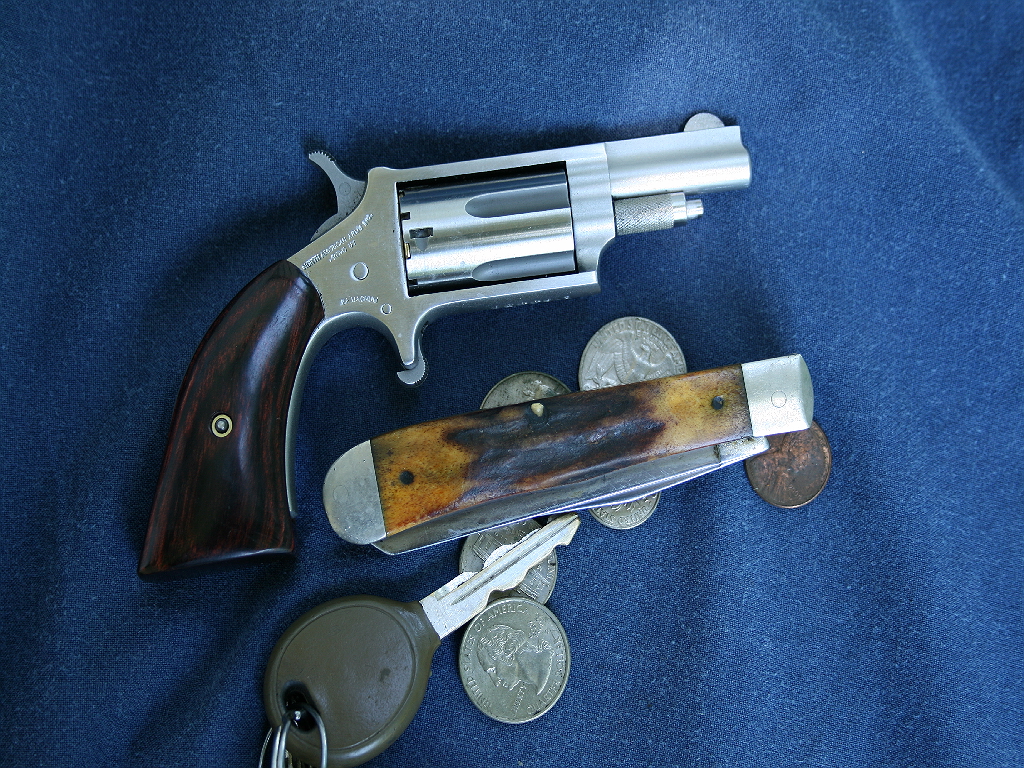
North American Arms sells what GUNS Magazine counted as “nearly 100 variations” of a revolver that is, underneath, one mechanism in three sizes. Most of the variation is finish, grips, barrel length and sights. The model codes carry all of it in a compact scheme that NAA never spells out anywhere, but that can be read straight off its catalogue. This volume reads the code, covers the family, and establishes what the owner’s inventory entry, NAA-22MS-P, actually specifies.
2.1 Three frames
The minis come in three frame sizes, one per cartridge length. These figures are NAA’s own, from its product pages as read on 19 September 2026.
Table 1 — 2.1 Three frames
| Model | Cartridge | Barrel | Length | Height | Width | Weight | Price |
|---|---|---|---|---|---|---|---|
| NAA-22S | .22 Short | 1.13 in | 3.63 in | 2.38 in | 0.88 in | 4.0 oz | $255 |
| NAA-22LR | .22 LR | 1.13 in | 4.00 in | 2.38 in | 0.88 in | 4.6 oz | $255 |
| NAA-22LLR | .22 LR | 1.63 in | 4.50 in | 2.38 in | 0.88 in | 4.8 oz | $255 |
| NAA-22MS | .22 WMR | 1.13 in | 4.63 in | 2.81 in | 1.06 in | 6.2 oz | $269 |
| NAA-22M | .22 WMR | 1.63 in | 5.13 in | 2.81 in | 1.06 in | 6.5 oz | $269 |
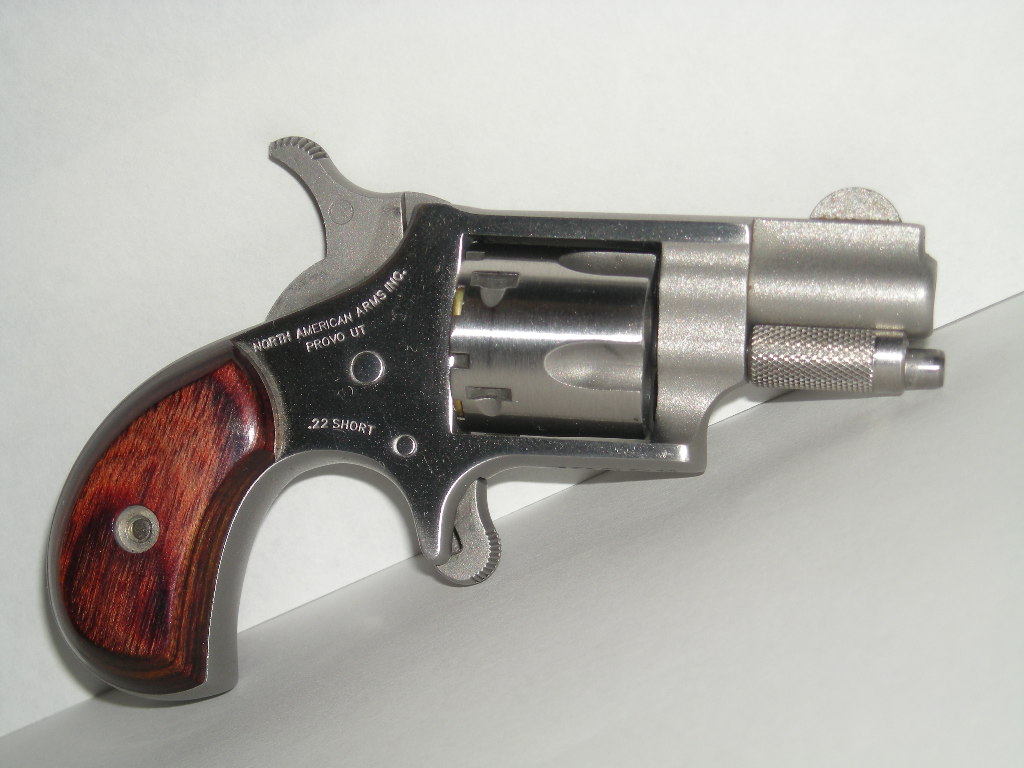
The Short and Long Rifle frames share a grip profile and a height. The Long Rifle frame is simply longer in the cylinder. The Magnum frame is larger in every direction: 0.43 in taller, 0.18 in wider, and about a third heavier than the LR. That frame is the base for every variant later in this volume. Only the Magnum frame takes a conversion cylinder (§2.5), which is why American Rifleman’s Gil Horman, having shot the .22 Short, sent readers looking for a defensive mini to the Magnum models: “Their larger grips are easier to manage and they can be fitted with .22 LR conversion cylinders to cut down on practice ammunition costs.”
Every mini in the table is stainless steel, single action, five shots, with a spur trigger and no trigger guard, and loads by removing the cylinder. The older NAA manual begins: “This handgun has been manufactured from the highest quality, rust resistant stainless steel, in the United States. NAA buys American.”
2.2 Reading an NAA model code
NAA’s .22 Magnum catalogue page lists 23 current models. Laid side by side, the codes decode consistently:
Table 2 — NAA's .22 Magnum catalogue page lists 23 current models. Laid side by side, the codes decode consistently
| Element | Meaning | Evidence on NAA’s page |
|---|---|---|
22 | .22 calibre rimfire | every model |
M | Magnum (.22 WMR) frame and cylinder | ”NAA-22M — .22 Magnum – (1 5/8″ Barrel)“ |
S after M | Short barrel, 1 1/8 in | ”NAA-22MS — .22 Magnum Short Barrel (1 1/8″)“ |
no S | the 1 5/8 in barrel | NAA-22M, 1.63 in |
C | a second cylinder, .22 LR, supplied fitted | ”NAA-22MSC — .22 Magnum / LR Conversion” |
-P | Ported | ”NAA-22MS-P — .22 Magnum Ported (1 1/8” Barrel)”; “NAA-22M-P — .22 Magnum, Ported” |
-HG | Folding holster grip | ”NAA-22MS-HG — .22 Magnum – Folding Holster Grip” |
-TW, -PB, -ROSE, -BB… | finishes (Wasp, turquoise and pink Cerakote, burnt bronze) | named in each listing |
-BBS, -BBO | sold with a belt buckle (skeleton, ornate oval) | “Skeleton Belt Buckle and Gun Combo” |
⚠ This key is read off the catalogue. NAA does not publish it as a key. It is consistent across every Magnum listing, but it is an observation, and the letters are not guaranteed to mean the same thing on the LR frame or on older guns. One irregularity: NAA lists both an NAA-22MC and an NAA-22MSC, and both are titled “.22 Magnum / LR Conversion”. By the pattern, the first has the 1 5/8 in barrel and the second the 1 1/8 in, but the listing titles do not say so. Check the product page’s barrel length rather than trusting the letters.
2.3 NAA-22MS-P, decoded from the maker’s page
NAA’s product page for the model, read 19 September 2026:
Table 3 — NAA's product page for the model, read 19 September 2026
| NAA-22MS-P | NAA-22MS (for comparison) | |
|---|---|---|
| NAA’s title | ”.22 Magnum Ported (1 1/8” Barrel)" | ".22 Magnum Short Barrel (1 1/8″)“ |
| Barrel | 1.13 in | 1.13 in |
| Length / height / width | 4.63 / 2.81 / 1.06 in | same |
| Weight | 6.2 oz | same |
| Grips | Rosewood bird’s head | same |
| Sights | Half-moon | same |
| Porting | ”Functional Porting” | none |
| Price | $289.00 | $269.00 |
So the inventory entry specifies a .22 WMR Magnum-frame mini with the 1 1/8-inch barrel, ported, with rosewood bird’s-head grips, and without a conversion cylinder (the conversion version is a different model, the NAA-22MSC-P at $350). The porting adds $20 at list and, on NAA’s figures, nothing to the weight or dimensions.
🔴 A retailer error worth knowing about. At least one dealer lists the same UPC (744253002151) as “NAA22MSP 22 Mag Revolver Ported 1.63"". That is wrong. 1.63 in is the long barrel, the NAA-22M and NAA-22M-P. NAA’s own page gives the MS-P as 1.13 in, and so do other dealer listings under the same UPC. Anyone checking a gun against a listing should use NAA’s page.
2.4 Porting on a barrel one inch long
NAA’s page says “Functional Porting” and nothing more. It gives no port count, no port geometry and no claim about what the porting does. Nothing published about the ported minis could be found that measured recoil, muzzle rise or flash with and without the ports. So this dive makes no claim about how much the porting helps.
What can be said follows from the numbers in Volume 4. A port can only vent gas that is still behind the bullet when the bullet passes it. On a 1.13-inch barrel, the bullet is past any port almost as soon as it starts moving. Richard Mann’s 1-inch-barrel measurements show .22 WMR loads leaving at roughly half their rifle velocity (Volume 4), which means a large share of the powder is still burning at the muzzle. That is why these guns have the “fireball” muzzle flash testers keep describing. How much of that gas the ports divert upward, and whether that changes what a shooter feels, is an empirical question nobody located has answered.
2.5 Conversion cylinders: a factory job, not a part
The Magnum frame can take a second cylinder chambered for .22 LR, so the owner can practise on cheap ammunition and carry magnums. NAA is unusually firm that the cylinder is not a part an owner buys and fits.
From NAA’s conversion-cylinder page:
“All conversion cylinders must be fitted and timed to your specific firearm by our gunsmiths. Because of normal manufacturing tolerances, cylinders are not drop-in parts and should not be interchanged between revolvers, even if they are the same model and caliber. For safety and proper function, we do not recommend purchasing used cylinders or installing cylinders from another firearm.”
And from its FAQ: “Cylinders are not drop-in parts and must be timed and fitted at the factory, so they are not sold for home installation.”
The price is $50 plus shipping for a standard mini (on 19 September 2026), and the gun goes to Provo. The owner cannot send in just the cylinder. Bought with the gun, the NAA-22MSC-P costs $61 more than the NAA-22MS-P, so the difference is small either way. What matters is that a loose conversion cylinder for sale, or one moved from another gun, is exactly what NAA tells owners not to use.
Marking, and a discrepancy between NAA’s own documents. The 2025 manual says the LR cylinder is “stamped on the muzzle end ‘L’”. The FAQ says “the caliber designation is stamped on the cylinder face”. Those describe the same front face in different words. An older manual says the two cylinders of a convertible were “marked ‘LR’ and ‘M’ respectively”. The marking has evidently changed over the years. The safe rule does not depend on it: a WMR cartridge will not enter an LR chamber, so NAA’s FAQ suggests using one as a gauge (“If uncertain, a .22 Magnum cartridge can be used as a reference check. It will not chamber in a .22 LR cylinder”).
🔴 The reverse is the dangerous case, and it needs no gauge because it must simply never happen. A .22 LR or .22 Short cartridge will drop into a Magnum chamber, and NAA’s FAQ says what follows: “they will have excessive clearance and may result in case failure when fired.” The hub’s .22 Rimfire dive (Vol 2) explains why, from the case dimensions: the Magnum case is larger in diameter, so an LR case fired in a Magnum chamber is unsupported. See /ammo-and-ballistics/22-rimfire/vol-2/.
2.6 Grips: bird’s head, boot, holster grip, belt buckle
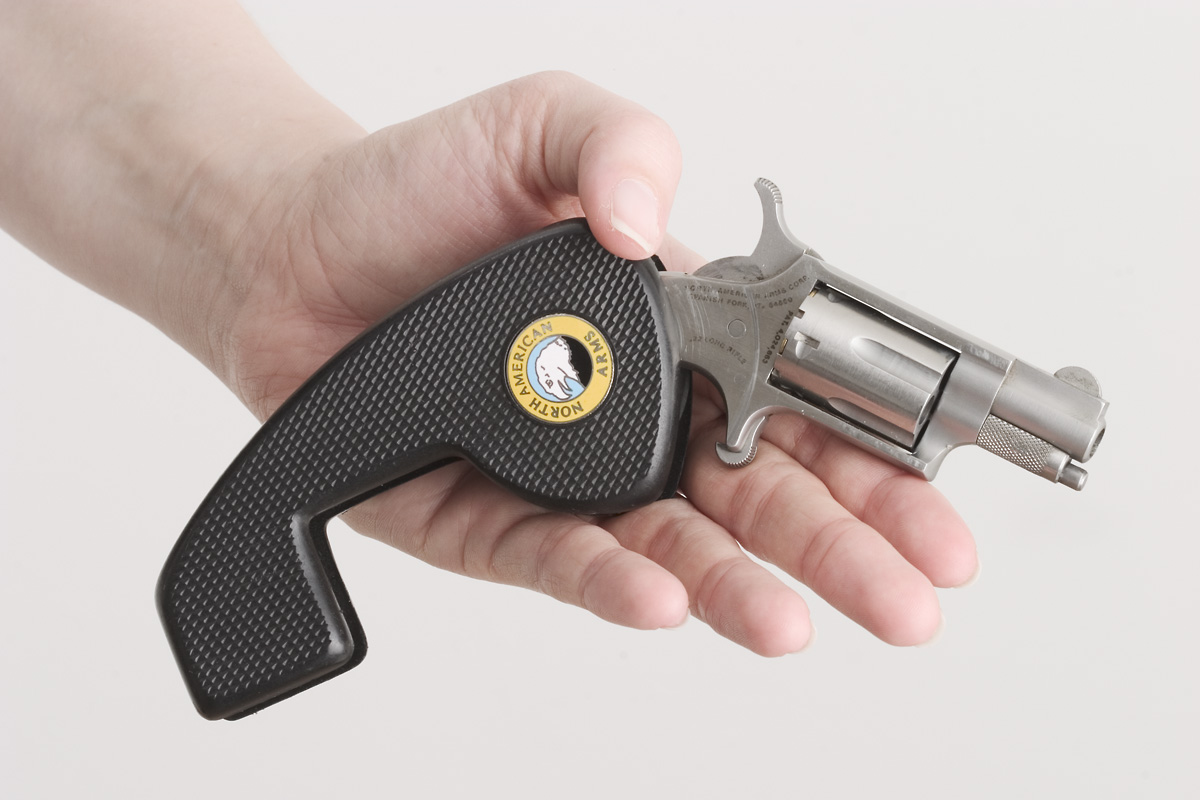
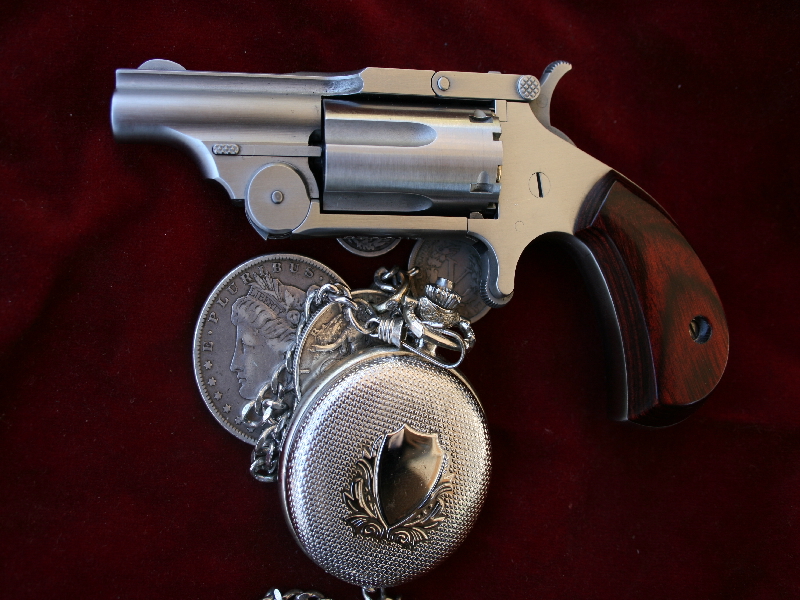
The standard grip is a small bird’s head in laminated rosewood, held by one screw. It leaves room for “a one or one-and-a-half-finger hold”, in Horman’s description of the Sidewinder. Alternatives in NAA’s catalogue:
- Boot grips, longer rosewood panels that give the little finger somewhere to go (hero image above).
- The folding holster grip (
-HGmodels, +$31 over the base Magnum at list, or sold separately; below). - Oversized rubber grips (GMM-M, “Magnum Oversized Rubber Grip”) and slip-on rubber grips (GSO-M), which do not fold.
- Belt buckles that hold the revolver (below).
2.6.1 The GHG-M folding holster grip
NAA’s accessory catalogue (19 September 2026) lists exactly one folding grip for the Magnum frame: the GHG-M “.22 Magnum Folding Holster Grip”, $38.00. There is a separate GHG-LC for the .22 LR and Short frames, and a GHG-SW for the swing-out guns. NAA’s description:
“Made from durable high-impact plastic, this custom carry folding holster grip acts as both a trigger guard and holster. Simply fold it open, and you’re ready to fire. With its ambidextrous clip, it’s designed for right- or left-handed use, fitting all Magnum sized models (except Sidewinder, Sentinel, Recluse). This versatile grip provides a larger, more secure hold”.
and, of the design generally:
“the rugged plastic sheath (with ambidextrous clip) folds knife-like against the bottom of the gun, creating a great variety of additional concealed opportunities/modes. When positively locked open, the ‘Holster Grip’ provides a full-sized gripping surface for comfortable, secure handling and more positive recoil control.”
What it changes, on NAA’s description and the photographs:
- Purchase. The bird’s head gives, in Horman’s words, “a one or one-and-a-half-finger hold”. Opened and locked, the holster grip is a full-length handle with a textured surface, long enough for the whole hand. That is the main answer in NAA’s catalogue to the grip complaint in Volume 5 §5.3, short of changing to a Black Widow.
- Concealment and carry. Folded, the grip swings forward under the frame and its sheath covers the trigger stud. The gun becomes a closed, clip-on package, a little like a folding knife, with no exposed trigger. The ambidextrous clip lets it ride inside a pocket or on a waistband. A pocket or belt-clip holster is then unnecessary, which is how NAA can say it “acts as both a trigger guard and holster”.
- Size in the pocket. The package is longer than the gun alone, because the grip lies along the frame, and bulkier than a rosewood-gripped mini. NAA does not publish the folded dimensions, and none are invented here. The MS-HG is listed at the same 6.2 oz as the rosewood gun.
- The draw. The grip has to be swung open and “positively locked open” before a firing grip is possible. That adds a step to the draw that a bird’s-head gun in a pocket holster does not have. No published timing was found.
- Fitting. On a standard mini the grip panels are held by a single screw, and the rosewood panels come off with it. NAA links an installation video from the product page. It sells the grip loose, not as a factory service.
⚠ Identification of the grip on the revolver documented here. The owner describes it as “the larger foldable rubber grips”. The GHG-M is NAA’s only folding grip for this frame, and in NAA’s photographs it is a black, heavily textured part that looks like rubber, but NAA describes its material as “high-impact plastic”. The identification as the GHG-M is therefore probable, not confirmed. A non-NAA folding grip cannot be ruled out from the description alone.
2.6.2 The belt buckles
For a 1 1/8-inch Magnum mini, NAA’s buckle catalogue (19 September 2026) lists two buckles that fit. Both are sold without the gun:
Table 4 — For a 1 1/8-inch Magnum mini, NAA's buckle catalogue (19 September 2026) lists two buckles that fit. Both are sold without the gun
| BBO-MS “Magnum Oval Ornate Belt Buckle” | BBS-M “Magnum Skeleton Belt Buckle” | |
|---|---|---|
| Price | $99.00 | $51.00 |
| Fits | ”1 1/8″ Magnum only" | "standard Magnum models”; “not compatible with the Pug, Sheriff, Ranger, or Sidewinder models, nor will it fit firearms with boot or oversized grips” |
| Retention | ”Secure Clip Release” | not specified beyond “designed to securely carry” |
| Belt width | 1 to 1 1/2 in | ”1 to 1 ¼ inches” and, in the same listing, “up to 1.4 inches” |
| Form | An ornate cast oval, “Custom Carry Belt Buckle enclosed”, with a revolver-shaped window. NAA’s photograph shows the banner “EST. 1975” | An open bracket. The gun is carried across the front of the belt, fully visible |
NAA also sells both as gun-and-buckle sets (NAA-22MS-BBO “Chuckwagon”, NAA-22MS-BBS). Casull patented a belt-buckle holster for a mini (US 4,450,992, 1984, per secondary sources), and American Rifleman’s history of Freedom Arms records a belt-buckle model there too, so the idea is as old as the gun.
⚠ Which buckle the revolver documented here uses is not recorded. The owner reports buying NAA’s belt-buckle “holster” for it. Both buckles fit the model. The skeleton buckle’s listing also says it will not fit guns “with boot or oversized grips”, and neither listing mentions the folding holster grip. A gun wearing the GHG-M is a much larger package than the standard-gripped gun these buckles are made for. Whether it fits a buckle with the folding grip fitted, or whether the standard grip goes back on for buckle carry, is a question for the owner, not an assumption made here.
NAA declines to say whether wearing a buckle-mounted gun counts as concealed carry: “North American Arms cannot provide legal determinations regarding carry status or licensing requirements.” Some of its own buckle listings (the Long Rifle versions) end “(Remember to have your concealed weapon permit!)”. Volume 5 §5.9 sets out the Michigan question.
2.7 The big-grip guns: Black Widow, Mini-Master, Pug
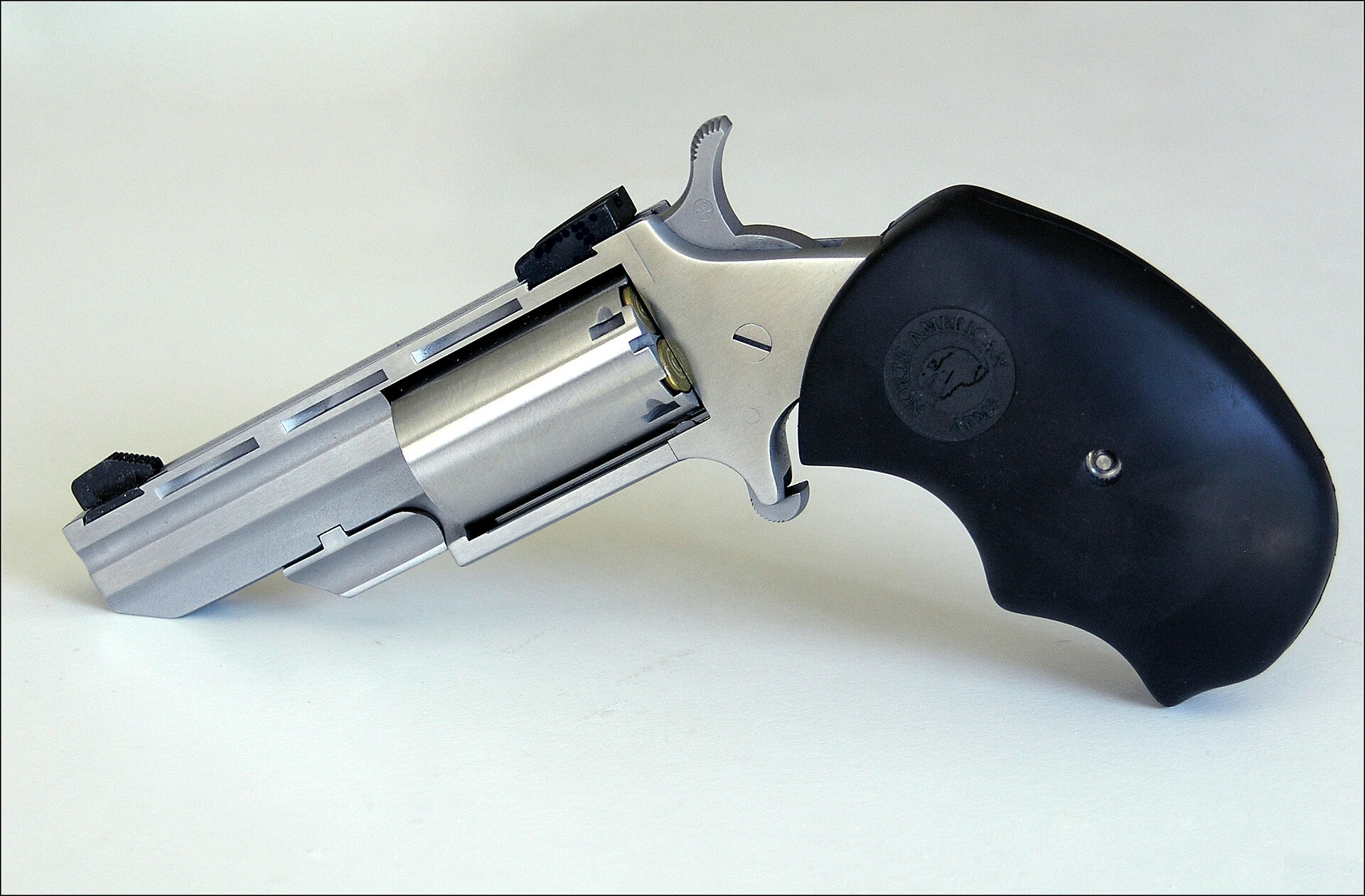
The next group keeps the Magnum frame and cylinder but addresses the two things minis are criticised for, grip and sights. On NAA’s figures (19 September 2026):
Table 5 — The next group keeps the Magnum frame and cylinder but addresses the two things minis are criticised for, grip and sights. On NAA's figures (19 September 2026)
| Model | Barrel | Length | Weight | Sights | Grip | Price |
|---|---|---|---|---|---|---|
| Black Widow (NAA-BWM) | 2 in | 5.88 in | 8.9 oz | Marble Arms | Oversized rubber | $325 |
| Black Widow conversion (NAA-BWC) | 2 in | 5.88 in | 8.9 oz | Marble Arms | Oversized rubber | $389 |
| Mini-Master (NAA-MM-M) | 4 in | 7.88 in | 10.8 oz | Marble Arms | Oversized rubber | $339 |
| Pug (NAA-PUG-D) | 1 in | 4.56 in | 6.4 oz | XS white dot | Slip-on rubber, pebbled | $370 |
The Pug is the interesting one here. It has a shorter barrel than the NAA-22MS-P (1 in against 1.13) and is about the same length and weight, but it has a full-length barrel shroud and XS sights. It is a concealment gun with usable sights, and it is the design answer to the sight complaint that Volume 5 examines. Horman reports keeping five-shot groups “to around 1.5” to 2” at 7 yards” with “short-barrel .22 Magnum frame Minis, like the Pug Carry”.
These guns load differently from the standard minis. NAA’s 2025 manual gives the Mini-Master, Black Widow and Pug a cylinder pin block that is pulled down, turned 90 degrees and slid out towards the muzzle, in place of the push-button pin on the NAA-22MS-P. NAA sells a separate “Pug/Black Widow/Mini-Master Cylinder Pin Assembly” (item 3300). The mechanisms are close relatives, but the pin procedures are not the same.
2.8 Loading without pulling the pin: Sidewinder and Ranger II
Every mini above loads the same way: half-cock, pull the pin, take the cylinder out, load it in the hand, put it back. It is slow, and it puts a loose pin and a loose cylinder in the shooter’s hands. NAA has made two families that avoid it.
The Sidewinder (announced 2012) keeps the Magnum frame and single action but puts the cylinder on a crane that swings out to the right, with an ejector star in place of the loose pin. American Rifleman followed it from prototype to production, and its three articles disagree about the original barrel. The pre-production gun in April 2012 had “a 1 5/8-inch barrel”, with a shorter one planned. The January 2013 review of a production gun gives “a 1 3/8-inch barrel”. A later review says “The original version ships with a 1.5” barrel”. NAA’s current page for the NAA-SW lists 1.5 in. The three figures come from the same author and publication across three articles, and they are given here as they stand. The same later review dates the 2-inch and 4-inch options to 2015. NAA lists the base Sidewinder at $399.
Horman’s view after shooting it: “reloading is more quickly accomplished than when using a Mini with a pop-out cylinder,” with one more benefit: it “eliminates the opportunity of hunting for a dropped cylinder pin on a grassy plain or shooting range floor.” The Sidewinder still uses the safety slots, with “two notches” on the cylinder shroud “to indicate when the cylinder is properly aligned for the hammer to be set into one of the slots”. NAA’s current catalogue adds two more swing-out models, the Sentinel and the Recluse (2 in barrel, XS sights, 8.8 oz, $495).
The Ranger II is a top-break. The barrel and cylinder tip down on a hinge, like a Schofield or a Webley, which also ejects the cases. The Magnum-frame NAA-22M-R lists at 1.63 in, 7.2 oz, $535, and a 4-inch Ranger II (NAA-22M-R4) at 8.8 oz, $620. NAA’s newsletter index includes a February 2016 “Ranger II Early Bird Program”, which suggests launch timing but is not a documented launch date. The Wikipedia article’s caption for the Commons photograph below calls an earlier “Ranger” top-break “a limited tool room run”. No primary source for that earlier gun was found.
2.9 The Earl, the Sheriff and the Hogleg
The Earl reshapes the Magnum mini to look like an 1860-pattern percussion revolver: octagon barrel, a loading lever under it, boot grips. The loading lever is fake. NAA’s manual says so plainly: “Your quality ‘The Earl’ revolver is equipped with a faux or ‘false’ loading lever in keeping with the 1860’s-era styling of this piece. Instead of being used to seat a bullet into a cylinder chamber (as it is on black powder revolvers), ‘The Earl’s’ loading lever is cosmetic. Its real function is to secure the grooved cylinder pin which it captures against the frame.”
NAA publishes the gun’s origin under the title “Earl’s Story”. Earl Hubbard, a former Marine and graduate of the Trinidad School of Gunsmithing, joined NAA in October 2006. From about April 2007 he spent his breaks cutting down a Mini-Master frame on a manual mill, and by late July 2007 he had two working samples with the octagon barrel and an early multi-piece loading lever. He died in August 2007, before the gun was shown. NAA’s machinists worked from his notes and prototypes, and “The Earl” entered production in 2009. Two of his sons, Dustin and Dalton, now work on NAA’s production floor, and a third, Duncan, has also worked there.
NAA lists the Earl with a 3-inch or 4-inch barrel. The 4-inch NAA-1860-4 is 7.75 in long, 8.9 oz, $340. It lists the Sheriff (NAA-1860-250, 2.5 in, 7.7 oz, $340) and the Hogleg (NAA-1860-6, 6 in, 9.7 oz, $350) in the same family. The Earl and Hogleg share the faux-lever pin. The Sheriff’s pin has a hook released by pushing up on grooves beneath it.
Outside the cartridge minis, NAA also makes Companion percussion revolvers on the mini frames, and the Guardian semi-automatic pistols. Neither is covered here.
2.10 The family in one table
Table 6 — 2.10 The family in one table
| Group | How it loads | Barrels | What it answers |
|---|---|---|---|
| Standard minis (22S, 22LR, 22LLR, 22MS, 22M) | Push-button pin out, cylinder out | 1.13 / 1.63 in | Smallest possible gun |
| Holster-grip and belt-buckle versions | Same | 1.13 / 1.63 in | Carrying it with the trigger covered |
| Black Widow, Mini-Master, Pug | Pin block: down, turn 90°, out | 1 / 2 / 4 in | Grip and sights |
| Sidewinder, Sentinel, Recluse | Swing-out crane, star ejector | 1.5 to 4 in | Reload speed, no loose pin |
| Ranger II | Top-break | 1.63 / 4 in (a 2.5 in model code also appears) | Reload speed, no loose pin |
| Earl, Sheriff, Hogleg | Pin held by faux lever or hook | 2.5 to 6 in | Nineteenth-century looks |
All use the safety-slot cylinder, all are single action, and all are five-shot.
2.11 The revolver documented here
As documented in September 2026, the owner’s inventory records the model code NAA-22MS-P. Read against NAA’s catalogue, the code specifies the standard push-button-pin Magnum mini with the 1 1/8-inch ported barrel and rosewood bird’s-head grips, sold without a conversion cylinder. It is the smallest .22 WMR in the family except the Pug. The owner added the following on 19 September 2026:
- Bought about 2022. That is a purchase date, not a manufacture date. NAA’s serial-to-date information was not consulted, and the serial is not recorded in this dive.
- Grips: changed from the factory rosewood to “the larger foldable rubber grips”. Most probably NAA’s GHG-M folding holster grip (§2.6), not confirmed.
- Carry: an NAA belt buckle has been bought for it. Which of the two Magnum buckles (§2.6) is not recorded.
- Safety slots: confirmed present.
- .22 LR conversion cylinder: not known. Two checks settle it. Is there a second cylinder? A conversion is a separate cylinder, supplied with the gun or fitted later by NAA, so a gun with only the one cylinder in it has no conversion. What is stamped on the cylinder? NAA’s 2025 manual says the LR conversion cylinder “is stamped on the muzzle end ‘L’”; its FAQ says the “caliber designation is stamped on the cylinder face”; an older manual describes cylinders marked “LR” and “M”. And the physical test from NAA’s FAQ, done with the gun unloaded: a .22 WMR cartridge “will not chamber in a .22 LR cylinder”. A cylinder that accepts a magnum cartridge fully is the Magnum cylinder.
2.12 Bibliography
- North American Arms, product category “.22 Magnums”, https://www.northamericanarms.com/product-category/firearms/22-magnums/ (accessed 2026-09-19). Model titles and prices used in §2.2.
- North American Arms, product pages NAA-22MS-P, NAA-22MS, NAA-22M, NAA-22MSC, NAA-22MS-HG, NAA-22S, NAA-22LR, NAA-22LLR, NAA-BWM, NAA-BWC, NAA-MM-M, NAA-PUG-D, NAA-SW, NAA-RECLUSE, NAA-SNT, NAA-22M-R (Ranger II), NAA-22M-R4, NAA-1860-4, NAA-1860-250, NAA-1860-6, all at https://www.northamericanarms.com/shop/
/ (accessed 2026-09-19). Specifications and prices as displayed that day. - North American Arms, “.22 LR Conversion Cylinder Installation”, https://www.northamericanarms.com/22-lr-conversion-cylinder-installation/ (accessed 2026-09-19).
- North American Arms, “Frequently Asked Questions”, https://www.northamericanarms.com/frequently-asked-questions/ (accessed 2026-09-19).
- North American Arms, “Mini-Revolver Operation and Safety Manual” (2025), https://www.northamericanarms.com/wp-content/uploads/2025/09/ownersm.pdf, and the older “Owner & Instruction Manual: .22 Magnum, .22 Long Rifle, .22 Short, Mini-Master & Black Widow” (undated), copy at http://pdf.textfiles.com/manuals/FIREARMS/northamerican_minis.pdf (both accessed 2026-09-19).
- North American Arms, “Earl’s Story”, https://www.northamericanarms.com/earls-story/ (accessed 2026-09-19).
- North American Arms, Sidewinder owner’s manual addendum, https://northamericanarms.com/wp-content/uploads/2023/07/Owner-s-Manual-Sidewinder.pdf (accessed 2026-09-19).
- Gil Horman, “North American Arms NAA-22S Mini Revolver: A Short Review”, American Rifleman, 1 March 2017, https://www.americanrifleman.org/content/north-american-arms-naa-22s-mini-revolver-a-short-review/.
- Gil Horman, “North American Arms Sidewinder .22 Mag”, American Rifleman, 11 April 2012, https://www.americanrifleman.org/content/north-american-arms-sidewinder-22-mag/.
- Gil Horman, “NAA Sidewinder .22 Mag. Mini Revolver”, American Rifleman, 16 January 2013, https://www.americanrifleman.org/content/naa-sidewinder-22-mag-mini-revolver/.
- Gil Horman, “Tested: North American Arms Sidewinder Revolver”, American Rifleman, https://www.americanrifleman.org/content/tested-north-american-arms-sidewinder-revolver/ (accessed 2026-09-19).
- GUNS Magazine, “NAA Mini Revolvers: A Fistful Of Convenient Thunder”, https://gunsmagazine.com/our-experts/naa-mini-revolvers-fistful-of-convenient-thunder/ (accessed 2026-09-19). Source of “nearly 100 variations” only.
- Dealer listing showing the 1.63 in error: vizardsgunsandammo.com, “Naa NAA22MSP 22 Mag Revolver Ported 1.63” 5 744253002151” (seen in search results, 2026-09-19).
Comments (0)