North American Arms Mini-Revolver · Volume 1
Origins: Dick Casull's Smallest Revolver, and a Company Older Than the One It Supposedly Came From
Rocky Mountain Arms, North American Arms, Talley, Freedom Arms and the 1990 story, checked against the maker's own account and the patents
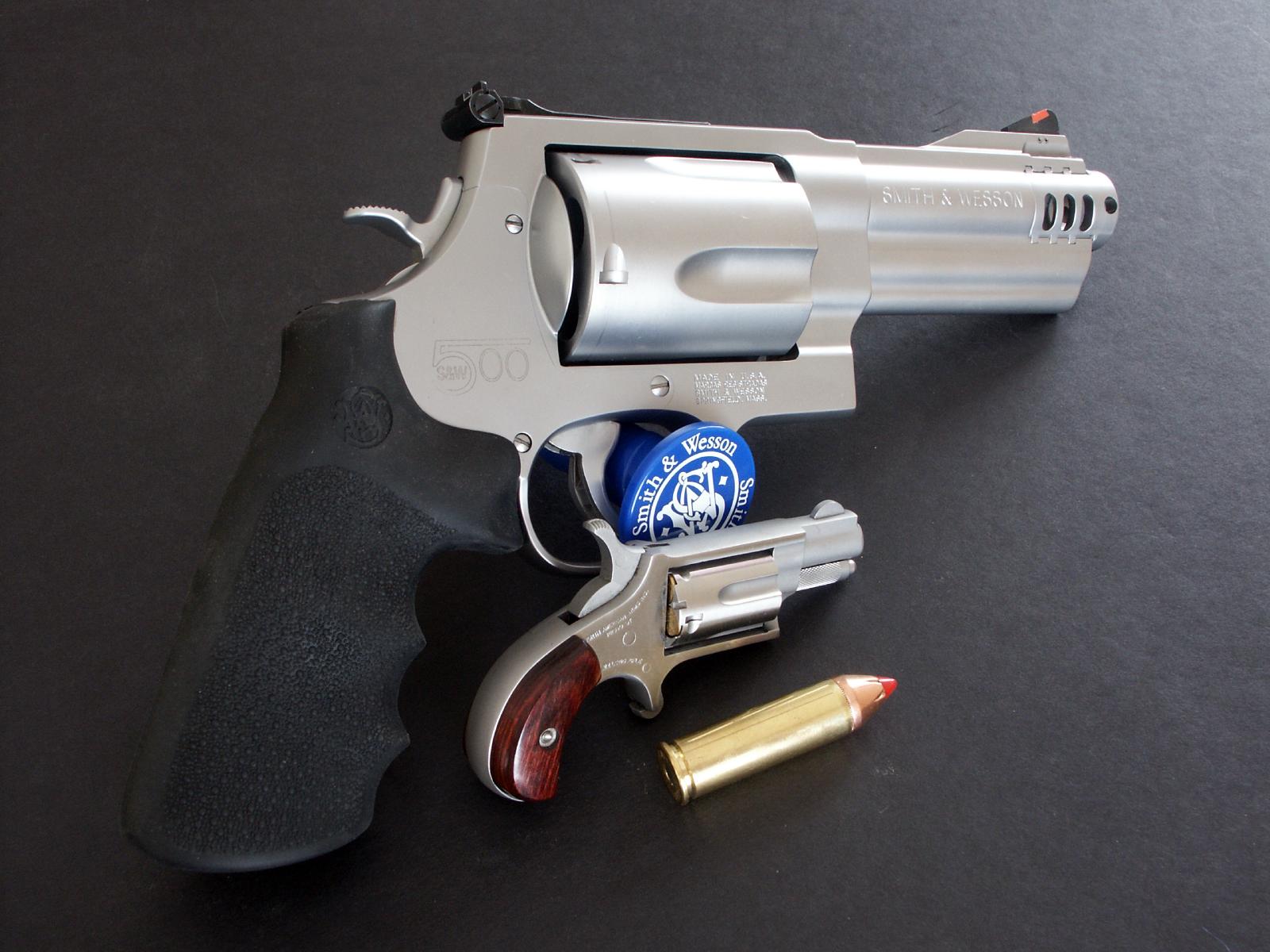
The North American Arms mini-revolver is the smallest revolver in regular American production. It weighs about six ounces, fires five rimfire cartridges from a cylinder that comes out of the frame to be loaded, and sells in something close to a hundred catalogue variations. It is also one of the longest-lived designs on the market, and its origin is told wrongly in most places it is told at all.
This volume sorts out that origin. The short version is that the widely repeated account, in which Freedom Arms designed the mini-revolver and sold it to North American Arms in 1990, gets the order of events backwards on the maker’s own evidence. Both companies descend from the same designer and the same 1971 prototype, and North American Arms was the first of the two, not the second.
1.1 The revolver in one table
The figures are North American Arms’ own, from its product page for the model the owner’s inventory records, the NAA-22MS-P. Volume 2 decodes the model number.
Table 1 — The revolver in one table
| Maker | North American Arms, Inc., 2150 South 950 East, Provo, Utah |
| Model | NAA-22MS-P, listed by NAA as “.22 Magnum Ported (1 1/8” Barrel)“ |
| Cartridge | .22 Winchester Magnum Rimfire (.22 WMR) |
| Action | Single action, spur trigger, no trigger guard |
| Capacity | Five, carried in all five chambers with the hammer in a safety slot (Volume 3) |
| Barrel | 1.13 in, with what NAA calls “Functional Porting” |
| Overall length | 4.63 in |
| Height / width | 2.81 in / 1.06 in |
| Weight | 6.2 oz |
| Sights | ”Half-moon” front blade; rear notch cut in the frame |
| Grips | Rosewood bird’s head |
| Price | $289.00 on NAA’s page, 19 September 2026 |
1.2 The story as it is usually told
The account in circulation runs as follows. Dick Casull and Wayne Baker founded Freedom Arms in Wyoming in the late 1970s. Its first product was a five-shot mini-revolver. Freedom Arms made the minis until 1990 and then sold the design to North American Arms of Provo, Utah, which has made it ever since.
That account appears in the Wikipedia articles on Freedom Arms, on Dick Casull and on North American Arms. It appears in a 2020s GUNS Magazine feature, which adds that NAA “was originally founded as Rocky Mountain Arms in 1972”. It appears on retail listings in more or less the same words. Some versions add that Freedom Arms’ mini sales were “so brisk” that it stopped making them.
Almost every clause of it needs qualification, and the central claim, that NAA inherited the design from Freedom Arms, is not what NAA’s own long-serving owner describes.
1.3 Rocky Mountain Arms, fall 1971
The oldest document NAA itself cites is an article by Clair Rees in the April 1973 issue of Shooting Industry. Sandy Chisholm, who owned North American Arms from the early 1990s until 2022, reproduced it in a company newsletter in October 2019. According to Chisholm’s summary, Rees described the formation “in the Fall of 1971” of a new manufacturer, Rocky Mountain Arms Corp., whose products included “a .22 Short caliber mini-revolver”. The designer was Dick Casull. The product that got first billing was something else entirely, “a large-frame single-action revolver chambered in the eponymous .454 Casull, which ultimately became the foundation of Freedom Arms product line”. The article gave the .22 Short mini a suggested retail price of $69.50.
That pairing is the thread through the whole history. The largest and the smallest single-action revolvers of their day came from the same designer at the same time, and the two products kept travelling together through three companies.
Secondary accounts add a detail about the first mini: that Casull’s original design “featured a lever on the hammer to lock the cylinder”. This dive has not seen a primary source for it and does not rely on it.
1.4 North American Arms under Casull and Baker
Here the usual account starts to go wrong. In a second newsletter, in November 2019, Chisholm addressed the relationship between Rocky Mountain Arms and North American Arms directly. His conclusion was blunt: the 1973 article, he wrote, “makes very clear … that there was no legal transition from Rocky Mountain Arms to North American Arms.”
“It’s my understanding that RMA simply went caput, but clearly Dick Casull survived and took much of his engineering – specifically for the smallest and biggest single-action revolvers – with him.”
What came next, in Chisholm’s account, was a partnership:
“Upon the dissolution of RMA, my understanding is that Dick Casull then formed a partnership with a fellow named Wayne Baker. … Dick and Wayne ran this new business – then called North American Arms – on a shoestring and depended on suppliers to help fund their business.”
That is the point the usual account inverts. In the maker’s own telling, Casull and Baker ran North American Arms first. Freedom Arms came later.
Two cautions go with that. First, Chisholm hedges throughout (“my understanding”, “I assume”) and says plainly that NAA’s early history is “somewhat vague (to me)”. He bought the business in the early 1990s and was reconstructing events of the 1970s from old files. Second, he does not give a founding date for NAA. A 2006 interview with him, published by Randy Wakeman, has NAA “created a couple of years later” than Rocky Mountain Arms’ fall-1971 start. A 2020s Firearm Blog piece gives 1975, without a source. The Wikipedia article gives 1972, and describes a renaming in 1974 that Chisholm’s “no legal transition” rules out. NAA’s own merchandise gives a date: its current Magnum oval belt buckle (BBO-MS) is cast with the banner “EST. 1975” in NAA’s product photograph. That is the company’s own claim, made on a product rather than in a history, and it agrees with the Firearm Blog’s 1975. This dive puts the founding in the mid-1970s, 1975 by NAA’s own buckle, and notes that Chisholm, reconstructing from files, gave no year.
1.5 Frank Talley’s gun company
The Casull–Baker business did not survive on its own. Chisholm names the firm that kept it alive:
“One of their primary suppliers was a firm run by a fellow named Frank Talley who was building a pretty successful business manufacturing highly-engineered and precisely-machined electro-mechanical assemblies (bomb racks, missile launchers, etc.) for defense/aerospace customers. As well as having a fleet of the highest-tech NC machines as well as his own investment casting facility, Talley Manufacturing could/did become a critical supplier to NAA.”
Then the business changed hands, in a way that reads like a debt settlement:
“It’s my understanding that Dick and Wayne were not successful with running the NAA business and ultimately gave the business to Frank Talley in lieu of satisfying the growing obligations to Talley that NAA had incurred. ‘Frank, you now own a gun company’, which he ran showing it little time, attention &/or resources, and the business muddled along with modest success for several years.”
In the Wakeman interview, Chisholm dates this: “In the early 80s, NAA became a subsidiary of Talley Manufacturing, an aerospace manufacturing company.” In a later newsletter he describes what NAA was at that point: a “2-model firearms industry ‘titan’ operating in the back bowels of a large, high-precision electro-mechanical engineering and manufacturing firm (think bomb racks, missile rails and the like).”
That detail matters to anyone who owns one. The mini was an investment-cast, precisely machined stainless part set from early on, made by a defence contractor’s shop rather than a gun company’s. Chisholm credits two employees with carrying the business through that period and afterwards: Ken Friel, who joined NAA twelve years before Chisholm bought it and served 41 years, and Carl Prokop.
1.6 Freedom Arms, 1978
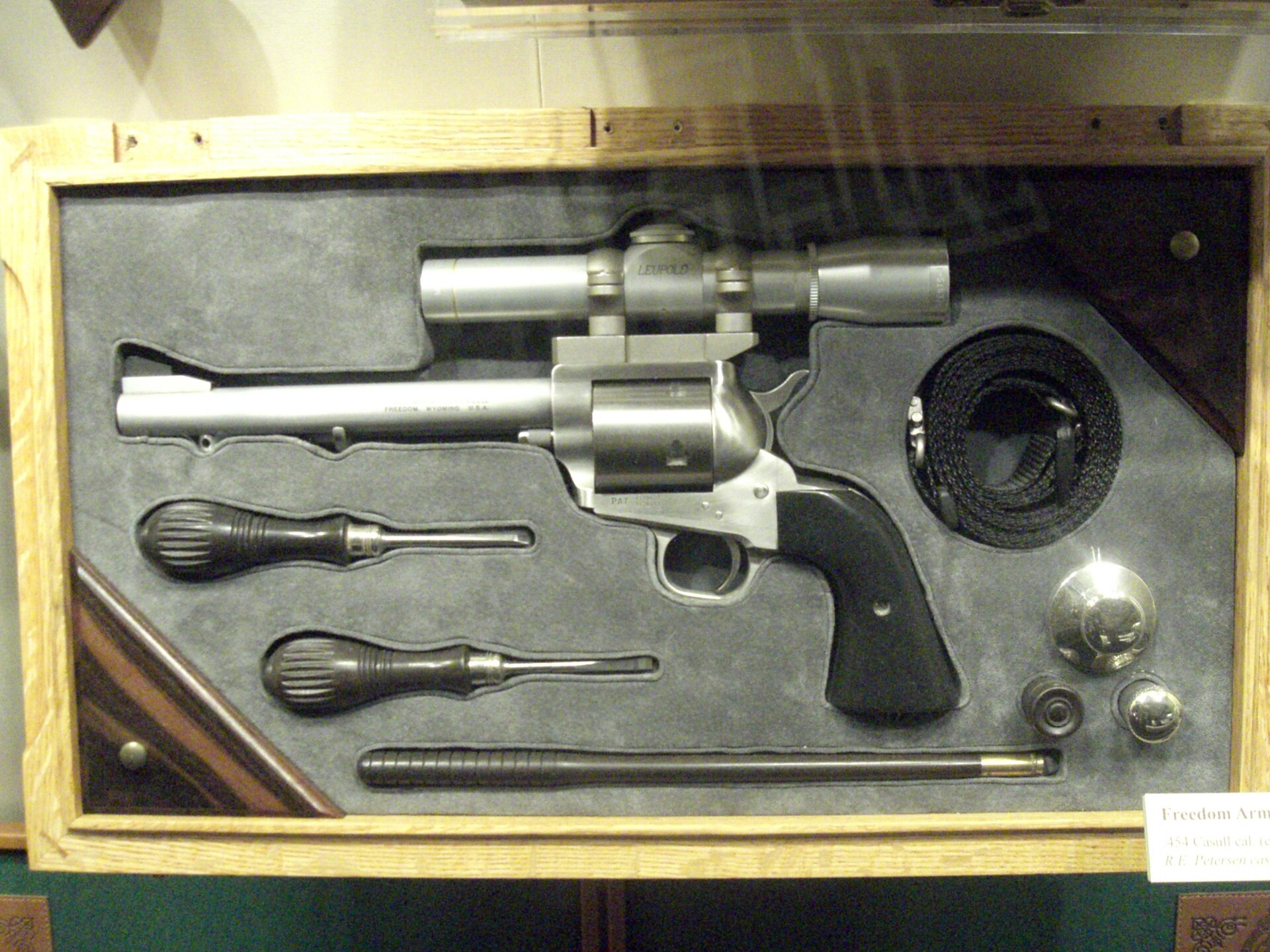
Chisholm’s November 2019 newsletter goes on:
“In the meantime, Dick and Wayne regrouped and moved themselves and their business interests to the Star Valley of Wyoming and once again attempted to bring to market both the biggest and smallest frame single-action revolvers, this time calling their business Freedom Arms, located in a town of the same name.”
American Rifleman’s history of Freedom Arms (Guy J. Sagi, July 2022) dates the founding to 1978, in Freedom, Wyoming, by Wayne Baker and Dick Casull, and confirms the order of products: “The first firearm to roll out of the factory was a five-shot, mini-revolver chambered in .22 LR.” Various calibres followed, along with a belt-buckle model. Secondary sources name the .22 LR mini “The Patriot” and say it was also offered in .22 Short and .22 WMR, plus a four-shot version. Sagi ends the mini chapter this way: “Sales were so brisk that Freedom Arms stopped producing mini-revolvers by 1990.” Read in context, what was selling briskly was the .454 revolver, which pushed the minis out of a small shop’s production.
So by the early 1980s there were two lines of Casull-designed mini-revolvers. One was made by North American Arms in Provo under Talley ownership. The other was made by Freedom Arms in Wyoming by the same two men who had started NAA. Chisholm’s January 2021 newsletter puts it in one sentence: NAA’s minis were “designed, engineered and manufactured by the storied team of Dick Casull, the designer of the eponymous .454 cartridge and Wayne Baker, founder of Freedom Arms.”
1.7 The 1990 sale, examined
That leaves the claim at the centre of the usual account, that Freedom Arms “sold the design” to North American Arms in 1990. It comes down to one sentence in the Wikipedia article on Freedom Arms:
“A four-shot mini-revolver was produced by Freedom Arms, but production ceased in 1990, and the design was sold to North American Arms.”
As of September 2026 that sentence carries a [citation needed] tag. The two cited sources in the paragraph support the Patriot and its calibres, not the sale. The sentence is also about a four-shot revolver, not the five-shot design NAA makes. American Rifleman’s history of Freedom Arms says only that the minis stopped by 1990 and says nothing about NAA. NAA’s own history pieces never mention buying anything from Freedom Arms.
What can be said. North American Arms was making Casull’s five-shot mini-revolver in Provo before 1990, under Talley, having been founded by Casull and Baker before they founded Freedom Arms. Whether any Freedom Arms tooling, drawings, patent rights or the four-shot design passed to NAA when Freedom Arms stopped making minis could not be confirmed from any primary source. It is not asserted here. What is wrong is the idea that NAA’s mini originated at Freedom Arms. On the maker’s own account it did not.
1.8 The patents: what Casull filed, and from where
The patent record is the one fully primary source in this history, and it bears on Volume 3.
Table 2 — 1.7 The patents: what Casull filed, and from where
| Patent | Title | Filed | Granted | What it covers |
|---|---|---|---|---|
| US 4,126,953 | Single Action Revolver with Safety Locking Cylinder | 14 Jan 1977 | 28 Nov 1978 | Holes between the chambers that the hammer’s firing pin drops into, locking the cylinder with no chamber in line with the barrel |
| US 4,228,606 | Means for Mounting Cylinder to Frame of Small Hand Gun | 20 Nov 1978 | 21 Oct 1980 | A cylinder axis pin held in the frame by a lug, a lip and a coil spring |
| US 4,228,608 | Cylinder Locking Mechanism for Small Revolvers | 20 Nov 1978 | 21 Oct 1980 | A spring-loaded cylinder latch in the frame, tripped by a part on the hammer or hand during cocking |
All three name one inventor, Richard J. Casull, and give his address as Freedom, Wyoming. The first was filed in January 1977, a year before the 1978 founding date given for Freedom Arms. That fits Chisholm’s account of Casull and Baker leaving NAA and regrouping in Star Valley before starting the new company.
The first patent is the one that matters to an owner. Its stated problem is the one every single-action carrier knows. Even with a hammer safety notch, “the chambers in the cylinder are so regulated by the hand that one chamber is always in alignment with the barrel”, so instruction sheets tell owners to carry with an empty chamber under the hammer. Casull’s answer:
“Apertures 38 drilled in cylinder web 37 between the chambers are of approximately the same diameter as the head of firing pin 25 … the hammer 11 is slowly removed from notch 35 and let forward pressing firing pin 25 into aperture 38 forming a cylinder lock holding the cylinder 21 in place out of battery. Thus there is no way that the hammer can accidently slip and discharge a cartridge since the cartridges are locked out of alignment with the hammer and the barrel.”
The patent’s drawings show a conventional loading-gate single action, not a mini, and the patented version uses holes drilled in the cylinder web to take a firing pin. The NAA mini has slots milled in the rim of the cylinder that take the hammer’s blade. Those are different embodiments of one idea. NAA’s 2025 manual says “NAA’s engineers designed a solution that did not require one fewer round in the cylinder”. The patent record shows the principle came from the company’s co-founder, filed as a patent in January 1977. The two statements do not conflict, since Casull was NAA’s engineer when the company began, but the patent is the documentary origin. A 2006 interview with Chisholm calls it “a patented safety notch”.
⚠ Two further Casull patents are credited in secondary sources to the mini: US 4,385,463 (1983, a floating firing pin for mini-revolvers) and US 4,450,992 (1984, a belt-buckle holster). This dive has not read them and records only their numbers and subjects.
1.9 Teleflex, Sandy Chisholm, and a date that will not settle
Talley Manufacturing was later acquired by Teleflex Inc. Chisholm’s 2006 account: “In the late 80s, Talley was acquired by Teleflex Inc. Shortly after the acquisition, Teleflex chose to sell the non-strategic and somewhat threatening (liability) small gun business.” The buyer was Chisholm, a remote owner who ran the business from suburban Philadelphia and later Naples, Florida. He built the company a new home in Provo.
He dated his own purchase two different ways:
- November 1991, in the 2006 Wakeman interview (“in November of 1991”).
- 1992, in his 2022 employee-ownership announcement (“since I purchased the business in 1992”). His January 2021 newsletter supports this: “this November will mark the 29th year since I purchased this business”, which points to November 1992.
Both are the owner’s own statements. They are given here separately. No attempt is made to settle them.
The company’s scope grew under Chisholm. The minis were joined in 1997 by the Guardian, a small semi-automatic in .32 ACP and later .380 and NAA’s own necked cartridges (the date is secondary). NAA added the Black Widow, Mini-Master, Pug, Sidewinder, Ranger II and the 1860-styled Earl, which Volume 2 covers.
1.10 Employee ownership, 2022
On 26 April 2022 NAA announced that it had become employee-owned. Chisholm “sold the company to an Employee Stock Ownership Trust which, over the course of the next ‘several’ years, will annually distribute equity ownership pieces of the company to the employees of NAA, at no cost to the employees.” Mike Griffin, who had arrived from Fort Knox Security Products as president in early 2021, became president and CEO. Chisholm stayed on NAA’s board and on the boards of NSSF and SAAMI.
Chisholm gave his reasons in the release. He had received “several unsolicited ‘expressions of interest’ from other manufacturers,” and he judged that a sale to one of them “would almost certainly lead to a relocation of this business and the loss of jobs.” The trust kept the company independent and in Provo.
One more line from Chisholm’s January 2021 newsletter is worth recording, because makers rarely say such things in public. NAA had been successful, he wrote, “admittedly … while leaving an expensive trail of scrap and rework. Our methods have not been very sophisticated and our ‘fixes’ have not always been long-lasting nor permanent.” Griffin was hired to fix that. The same newsletter mentions a backlog NAA had “enjoyed for most of the past 10 years”.
1.11 The revolver documented here
As documented in September 2026, the owner’s inventory sheet (last modified 17 September 2026) records one North American Arms revolver in .22 WMR under the model code NAA-22MS-P. The owner supplied further details on 19 September 2026:
Table 3 — As documented in September 2026, the owner's inventory sheet (last modified 17 September 2026) records one North American Arms revolver in .22 WMR under the model code NAA-22MS-P. The owner supplied further details on 19 September 2026
| As documented, September 2026 | |
|---|---|
| Model (sheet) | NAA-22MS-P: .22 WMR, 1 1/8-inch ported barrel, per NAA’s catalogue |
| Acquired | Bought about 2022. This is a purchase date, not a date of manufacture |
| Grips | The factory rosewood bird’s head has been replaced by “the larger foldable rubber grips”, in the owner’s description. Volume 2 §2.6 identifies these as, most probably, NAA’s GHG-M .22 Magnum Folding Holster Grip |
| Carry | An NAA belt buckle “holster” has been bought for it (Volume 2 §2.6; Volume 5 §5.5 and §5.9) |
| Safety slots | Confirmed present. The cylinder is the slotted safety cylinder (Volume 3 §3.4) |
| .22 LR conversion cylinder | Not known. Volume 2 §2.5 explains how to tell |
The rest of the configuration (barrel, sights, porting) comes from the model code and NAA’s catalogue description, not from an inspection of the gun.
1.12 How the rest of this dive is organised
Table 4 — 1.11 How the rest of this dive is organised
| Vol | Title |
|---|---|
| 1 | Origins (this volume) |
| 2 | The Family: frames, models, and what “NAA-22MS-P” means |
| 3 | How It Works, and How to Keep It Working |
| 4 | .22 WMR from an Inch and an Eighth |
| 5 | Carrying It: the deep-concealment niche, its honest limits, and Michigan law |
Volume 3 is the working core: the single-action lockwork part by part, the safety slot, loading, what NAA permits an owner to take apart and what it does not, maintenance, and repair. Volume 4 is the ballistics, and leans on the hub’s .22 Rimfire dive for principles rather than re-deriving them. Volume 5 is the case for and against carrying a six-ounce single action, and the Michigan statutes that apply the moment it leaves the house.
1.13 Bibliography
- North American Arms, “October 2019 Soapbox – The Early History of NAA” (Sandy Chisholm), https://northamericanarms.com/soapbox/october-2019-soapbox-the-early-history-of-naa/ (accessed 2026-09-19). Summarises Clair Rees, Shooting Industry, April 1973.
- North American Arms, “November Soapbox – Early History, Part 2” (Sandy Chisholm), https://www.northamericanarms.com/november-soapbox-early-history-part-2/ (accessed 2026-09-19). Source of all the quoted passages on RMA, Casull and Baker, Talley, and Freedom Arms.
- North American Arms, “January 2021 Soapbox – End of an Era” (Sandy Chisholm), https://northamericanarms.com/soapbox/january-2021-soapbox-end-of-an-era (accessed 2026-09-19).
- North American Arms, “Sandy’s Press Release” (employee ownership, 26 April 2022), https://www.northamericanarms.com/sandys-press-release/ (accessed 2026-09-19). Year confirmed by contemporary trade coverage dated 27 April 2022.
- Randy Wakeman, “A Visit with Sandy Chisholm: North American Arms CEO” (©2006, 2016), https://chuckhawks.com/visit_sandy_chisholm.htm (accessed 2026-09-19).
- Guy J. Sagi, “Freedom Arms: A Custom-Grade Revolver Company”, American Rifleman, 9 July 2022, https://www.americanrifleman.org/content/freedom-arms-a-custom-grade-revolver-company/ (accessed 2026-09-19).
- Wikipedia, “Freedom Arms”, “Dick Casull” and “North American Arms” (accessed 2026-09-19). Cited only as the source of the claims examined in §1.1 and §1.6. The 1990 sale sentence is marked [citation needed] on the page itself.
- R. J. Casull, US Patent 4,126,953, “Single Action Revolver with Safety Locking Cylinder”, filed 14 January 1977, granted 28 November 1978. PDF via patentimages.storage.googleapis.com.
- R. J. Casull, US Patent 4,228,606, “Means for Mounting Cylinder to Frame of Small Hand Gun”, filed 20 November 1978, granted 21 October 1980.
- R. J. Casull, US Patent 4,228,608, “Cylinder Locking Mechanism for Small Revolvers”, filed 20 November 1978, granted 21 October 1980.
- North American Arms, product page NAA-22MS-P, https://www.northamericanarms.com/shop/naa-22ms-p/ (accessed 2026-09-19).
- North American Arms, “Mini-Revolver Operation and Safety Manual” (PDF titled “Full owner’s manual 2025”), https://www.northamericanarms.com/wp-content/uploads/2025/09/ownersm.pdf (accessed 2026-09-19).
Comments (0)