North American Arms Mini-Revolver · Volume 4
.22 WMR from an Inch and an Eighth
Measured velocity from a one-inch mini-revolver barrel against the box, what the numbers do in gelatin, muzzle flash, and NAA's own ammunition rules
The .22 Winchester Magnum Rimfire is a rifle cartridge that happens to fit a revolver. In a rifle it is a 2,000 ft/s varmint round. From the NAA-22MS-P’s 1.13-inch barrel it is something else, and the figures that decide what it is are almost never the ones on the box. This volume sets out the only published measurements from a one-inch mini-revolver barrel that this dive could find, and what follows from them.
4.1 What the hub already establishes
The hub’s .22 Rimfire dive covers the cartridge and the principles. This volume does not repeat it.
- The cartridge. 1959, Winchester. 0.224 in jacketed bullet, 1.055 in case, 24,000 psi maximum, 1:16 twist. Published rifle loads run 30 gr at 2,300 ft/s, 40 gr at 1,875, 50 gr at 1,530. See
.22 RimfireVol 2,/ammo-and-ballistics/22-rimfire/vol-2/. - What never goes in a WMR chamber. .22 LR and .22 Short, because the Magnum chamber does not support their cases. Same volume, and Volume 2 §2.5 of this dive for NAA’s version of the warning.
- Why barrel length matters so much in a rimfire. A small, fast-burning charge behind a light bullet. The .22 LR barrel-length curve and “What a Pistol Actually Delivers” are in
.22 RimfireVol 4,/ammo-and-ballistics/22-rimfire/vol-4/. That dive’s handgun data is .22 LR only. It holds no .22 WMR velocity from any handgun barrel, which is the gap this volume fills. - Terminal behaviour and the defensive question.
.22 RimfireVol 6,/ammo-and-ballistics/22-rimfire/vol-6/, including Federal Punch .22 LR (29 gr, 1,070 ft/s from 2 in, 13.75 in of gel) and the reasoning behind a penetration-first design.
4.2 The one measured data set from a one-inch mini
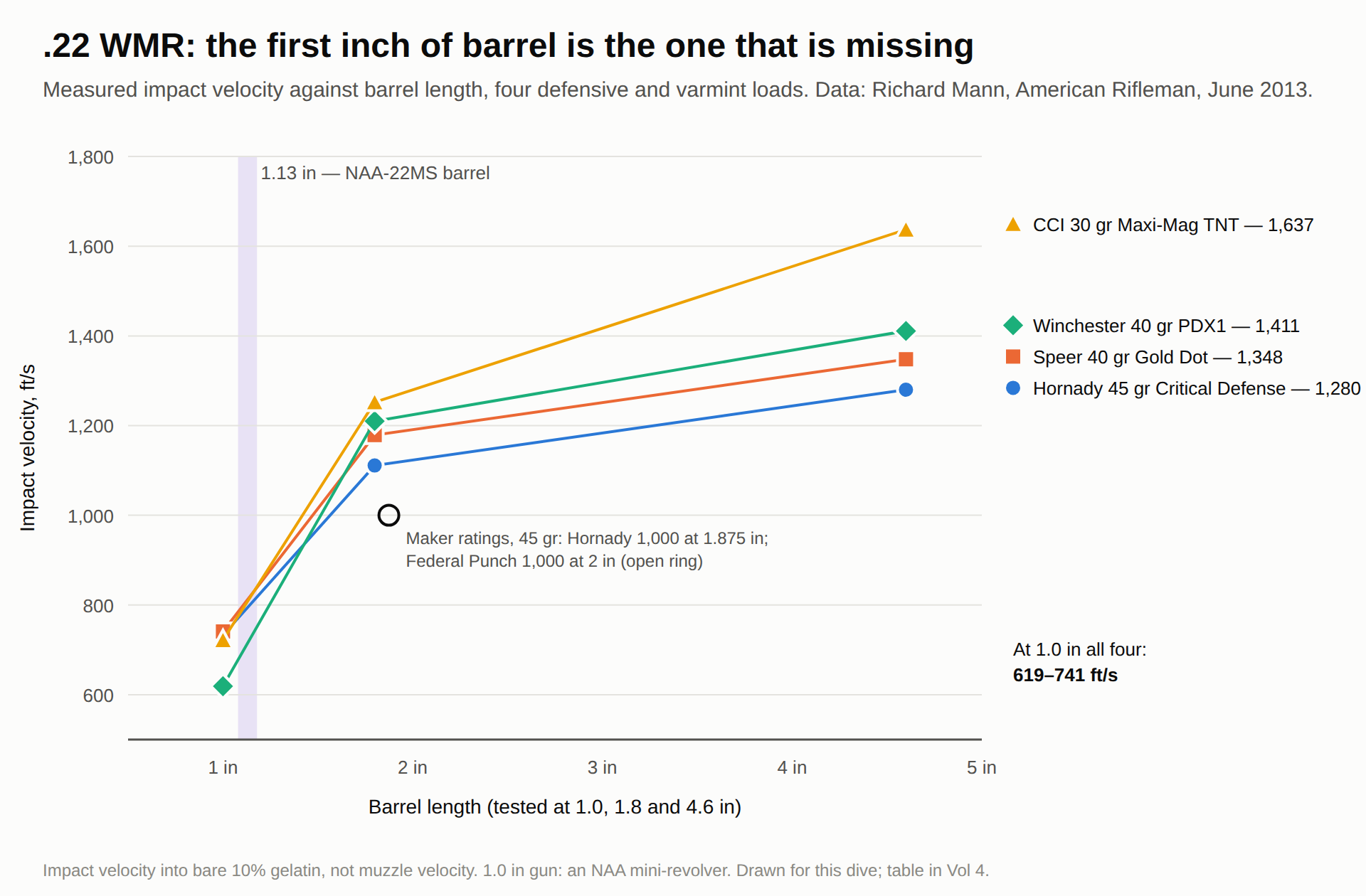
Richard Mann’s article “The .22 Magnum for Self-Defense?” (American Rifleman, June 2013, republished online in June 2020) fired .22 WMR loads “from barrels as short as 1” to as long as 22"" into 10 percent ordnance gelatin. The 1-inch gun was, in the article’s own caption, “a 1”-barreled North American Arms revolver”. His table’s bare-gelatin results, in full:
Table 1 — Richard Mann's article "The .22 Magnum for Self-Defense?" (American Rifleman, June 2013, republished online in June 2020) fired .22 WMR loads "from barrels as short as 1" to as long as 22"" into 10 percent ordnance gelatin. The 1-inch gun was, in the article's own caption, "a 1"-barreled North American Arms revolver". His table's bare-gelatin results, in full
| Load | Barrel | Velocity (ft/s) | Recovered diameter (in) | Recovered weight (gr) | Penetration (in) |
|---|---|---|---|---|---|
| CCI 30 gr Maxi-Mag TNT | 1.0 | 722 | 0.33 | 30 | 8.25 |
| 1.8 | 1,252 | 0.33 | 21 | 8.50 | |
| 4.6 | 1,637 | 0.34 | 19 | 7.25 | |
| 22 (rifle) | 2,326 | 0.35 | 19 | 4.50 | |
| Remington 33 gr AccuTip | 1.0 | 751 | 0.22 | 33 | 12.00 |
| 1.8 | 1,150 | 0.22 | 33 | 15.50 | |
| 4.6 | 1,430 | 0.22 | 33 | 17.00 | |
| 22 (rifle) | 2,065 | 0.42 | 19 | 10.00 | |
| Speer 40 gr Gold Dot | 1.0 | 741 | 0.26 | 40 | 10.75 |
| 1.8 | 1,179 | 0.33 | 35 | 12.50 | |
| 4.6 | 1,348 | 0.33 | 28 | 12.25 | |
| CCI 40 gr FMJ | 1.0 | 723 | 0.22 | 40 | 13.75 |
| 1.8 | 1,062 | 0.22 | 40 | 16.00 | |
| 4.6 | 1,380 | 0.22 | 40 | 20.50 | |
| 22 (rifle) | 1,983 | 0.39 | 24 | 18.50 | |
| CCI 40 gr HP | 1.0 | 740 | 0.22 | 40 | 15.75 |
| 1.8 | 1,068 | 0.22 | 40 | 16.00 | |
| 22 (rifle) | 1,998 | 0.37 | 31 | 12.50 | |
| Hornady 45 gr FTX Critical Defense | 1.0 | 733 | 0.31 | 45 | 10.75 |
| 1.8 | 1,111 | 0.36 | 44 | 15.00 | |
| 4.6 | 1,280 | 0.30 | 40 | 15.00 | |
| Winchester 40 gr PDX1 Defender | 1.0 | 619 | 0.22 | 34 | 10.00 |
| 1.8 | 1,210 | 0.31 | 38 | 13.00 | |
| 4.6 | 1,411 | 0.35 | 38 | 13.00 |
Three cautions govern how the table is read.
- The velocity column is impact velocity, not muzzle velocity. Mann’s key defines it: “VEL = Impact Velocity”. Muzzle velocity would be slightly higher. Over the few feet of a gelatin test the difference is small, but these are not chronograph-at-the-muzzle figures and are not quoted as such.
- The 1.0-inch gun is not the NAA-22MS-P. It is a 1-inch NAA mini, which matches the Pug’s barrel (Volume 2 §2.7), against the MS-P’s 1.13 inches. The curve between 1.0 and 1.8 inches is so steep that an eighth of an inch is not nothing. No published measurement from a 1.13-inch barrel was found. No figure is interpolated here. The MS-P will do slightly better than the 1.0-inch column, by an unmeasured amount.
- It is one tester, one gun per length, published without shot counts or standard deviations. It is the best data located, not a definitive data set.
⚠ Porting. The NAA-22MS-P is ported and Mann’s gun, as far as the article says, was not. Nobody located has measured what the ports do to velocity on a mini. Volume 2 §2.4 explains why the question is open.
4.3 The box number and the pocket number
The most common short-barrel figure for .22 WMR is 1,000 ft/s, and it comes from two makers who rate defensive loads from short barrels:
- Hornady 45 gr FTX Critical Defense — the product page gives its test barrel as 1.875 in: 1,000 ft/s and 100 ft-lb at the muzzle.
- Federal Personal Defense Punch 22 WMR, 45 gr (part PD22WMR1) — “22 WMR offers 1,000 fps muzzle velocity through 2-inch barrel, 1,800 fps through rifle barrels.”
Both are honest numbers for the barrels named, and Mann’s 1.8-inch column agrees: the Hornady load struck at 1,111 ft/s from 1.8 inches. But neither maker rates any load from a barrel as short as the mini’s, and the 1,000 ft/s figure is regularly carried over to the minis anyway. A review of the NAA-22MS published by Police & Security News says the gun “drives a 25- to 45-grain lead or jacketed hollow point bullet out of its 1 1/8″ barrel just shy of 1000 fps.” The same review mentions a chronograph sidebar that is missing from the online copy, so the source of that figure cannot be checked. It is not a measurement anyone can cite, and Mann’s one-inch results, 619 to 751 ft/s for every load, say it is about 250 to 380 ft/s too high.
🔴 The correction this volume turns on: from a one-inch mini-revolver barrel, .22 WMR loads measured 619–751 ft/s, not the 1,000 ft/s printed for 1.875- and 2-inch barrels. Against Mann’s own 1.8-inch figures, the missing eight-tenths of an inch costs a third to a half of the velocity and 52 to 74 percent of the energy.
The shape of the curve is the reason. In Mann’s data, going from 1.0 to 1.8 inches adds 328 to 591 ft/s depending on load. Going on from 1.8 to 4.6 inches, nearly three more inches, adds only 169 to 385. The first inch past the cylinder is where the magnum’s powder does most of its work, and the mini doesn’t have it.
The same thing happens with the smaller cartridges. Gil Horman chronographed Aguila’s hot .22 Short (29 gr, rated 1,095 ft/s from a rifle) from the NAA-22S’s 1.125-inch barrel and got an average of 771 ft/s and 38 ft-lb over ten shots, “a velocity drop of more than 300 fps”.
4.4 Energy, worked out
Kinetic energy from Mann’s one-inch impact velocities, E = w·v² / 450,240 (grains, ft/s, ft-lb), computed for this dive:
Table 2 — Kinetic energy from Mann's one-inch impact velocities, E = w·v² / 450,240 (grains, ft/s, ft-lb), computed for this dive
| Load | 1.0 in | 1.8 in | 4.6 in | Rifle (22 in) |
|---|---|---|---|---|
| Hornady 45 gr Critical Defense | 54 | 123 | 164 | — |
| Speer 40 gr Gold Dot | 49 | 123 | 161 | — |
| CCI 40 gr HP | 49 | 101 | — | 355 |
| CCI 40 gr FMJ | 46 | 100 | 169 | 349 |
| Remington 33 gr AccuTip | 41 | 97 | 150 | 313 |
| CCI 30 gr Maxi-Mag TNT | 35 | 104 | 179 | 360 |
| Winchester 40 gr PDX1 | 34 | 130 | 177 | — |
From one inch, the whole range is 34–54 ft-lb. That is the same order as the .22 Short from the NAA-22S (38 ft-lb, Horman) and well under the .22 LR from a 2-inch barrel that .22 Rimfire Vol 6 discusses (29 gr at 1,070 ft/s is 74 ft-lb). The step from 1.0 to 1.8 inches multiplies energy by 2.1 to 3.8 times.
The conclusion is plain, and it is arithmetic, not opinion. The NAA-22MS-P’s .22 WMR delivers roughly .22 Short to .22 LR-pistol energy, not magnum energy. What the magnum case buys in this gun is a jacketed bullet and a margin of pressure, not the ballistics its name suggests. It makes the gun somewhat louder and much brighter (§4.6).
4.5 What it does in gelatin
Mann’s one-inch results, read for terminal behaviour:
- Penetration was adequate or better for most loads. 10.0 to 15.75 in for every load except CCI TNT (8.25 in). The two non-expanding CCI loads went deepest: FMJ 13.75 in, plain HP 15.75 in. The FBI protocol’s 12-inch minimum is the benchmark the hub’s
.22 RimfireVol 6 uses. By that measure, three of the seven loads cleared it from one inch: AccuTip at 12.00, FMJ at 13.75, CCI HP at 15.75. - Expansion mostly did not happen. Mann’s summary: “Barrels of about an inch in length did not generate enough velocity for reliable expansion with most .22 Magnum loads.” The purpose-built defensive loads (Hornady, Speer, Winchester) “performed well and even expanded through denim—except from the 1” barrel”. From one inch, their recovered diameters were 0.31, 0.26 and 0.22 in: slight, marginal, none.
- The only load that expanded everywhere was a varmint load. “The 30-gr. CCI TNT load was the only load that expanded from every firearm, in every test.” From one inch it opened to 0.33 in and stopped at 8.25 in, the shallowest result in the set.
Mann draws the practical conclusion himself: “It might make just as much sense to use loads with non-expanding projectiles such as the 40-gr. full metal jacket or common hollow point, which should penetrate slightly deeper.” From one inch, his data support that. The two CCI 40-grain non-expanders gave the deepest penetration, and the defensive loads’ expansion, which is their reason to exist, largely failed to happen.
His overall verdict on the cartridge, for any barrel: “Where the .22 Magnum appears to fall short is in its ability to bring about instant involuntary incapacitation. You’ll definitely need something that makes a bigger hole if that’s your goal.” Volume 5 considers what follows for carrying the gun.
⚠ Gelatin limits, in Mann’s own words: “10-percent ordnance gelatin … is not the same as a bad guy. … It does not replicate skin, ribs, cartilage or fat.” And, as §4.2 notes, this is one test series.
4.6 Flash and noise
The powder that has not burned when the bullet leaves a one-inch barrel burns in front of it. Every account of shooting these guns mentions the result:
- Mann: the Hornady, Speer and Winchester loads “utilize flash-retarding propellants”, but “the muzzle flash from [the CCI TNT] and the other loads was like a fireball. That might scare your attacker more, but it does nothing for your night vision.”
- Horman, on a 4-inch Sidewinder: “The amount of muzzle flash and noise produced by .22 WMR ammunition when fired from NAA’s diminutive wheelgun may be surprising since it seems out of proportion to the gun’s size.”
- Higginbotham, on the NAA-22MS: “The .22 Mags kick a bit. They’re snappy little rounds, and the lighter weight and lack of control surfaces result in a gun that moves around a bit.”
The revolver adds a second source. The cylinder-barrel gap vents gas sideways at every shot, which is why NAA’s manual tells shooters to keep “all fingers … behind the muzzle and away from the cylinder-barrel gap”. On a gun held with one and a half fingers, where the support hand goes is a real question.
For a gun that would be used, if ever, at close range and possibly in the dark, a flash-reduced defensive load has a real advantage from one inch even when it fails to expand. That is an argument from Mann’s observation, not a measurement of night vision.
4.7 NAA’s ammunition rules, old and new
NAA’s ammunition guidance has changed, and copies of the old manual are still in circulation.
Table 3 — 4.7 NAA's ammunition rules, old and new
| Older manual (naaminis.com era, undated) | 2025 manual | |
|---|---|---|
| Recommended | ”CCI and Winchester ammunition has proven to be the most suitable and is therefore recommended” | For .22 LR cylinders: “CCI, Federal or Remington brands” |
| High velocity | ”Hyper velocity ammunition may be used as well as .22 shot loads" | "NAA does not recommend the use of commercially available VARMINT ammunition with Mini-Revolvers … the casings may swell and jam and/or cause interference with the cylinder’s rotation” |
| Banned | none | ”DO NOT USE ANY ‘PMC’ OR ‘ARMSCOR PRECISION’ BRANDED AMMUNITION IN ANY NAA Mini-Revolver!”, as they have “RESULTED IN OUT-OF-BATTERY DISCHARGES” |
| WMR in general | ”Only .22 WMRF (Magnum) ammunition should be used in the cylinder marked ‘M’" | "Any .22 caliber Winchester Magnum Rimfire (WMR) ammunition can be used in this Magnum mini-revolver— EXCEPT” the two brands |
The PMC ban is older than the current manual. Walt Rauch’s review sample came with a supplemental sheet dated 17 May 2004, which he quoted: “NAA has become aware of a phenomenon where an inadvertent, double-discharge (two rounds simultaneously discharging, one aligned with the barrel and the other out of battery) may occur when PMC brand ammunition is used in NAA .22 revolvers.” Neither the sheet nor the manual explains the mechanism. An out-of-battery discharge in a revolver means a cartridge in a chamber that is not aligned with the barrel, so the case is not supported by the barrel’s breech. Among the possible ways it could happen, a rim that ignites too easily would fit NAA’s description, but NAA gives no cause and none is asserted here. The rule is simple enough: never those two brands, in either calibre.
“Varmint” is undefined, and it collides with Mann’s data. NAA does not say which loads it means. The obvious candidates are the light, fast, thin-jacketed hunting loads such as CCI’s Maxi-Mag TNT. That is exactly the load Mann found to be the only one that “expanded from every firearm, in every test”, including the one-inch mini. So the maker advises against, on mechanical grounds (swelling cases, a binding cylinder), the one load that expanded from its gun. For this gun, the maker’s mechanical guidance wins. A load that can bind the cylinder is no use in a five-shot single action, whatever it does in gelatin. If in doubt, ask NAA which loads it means.
NAA will supply its own velocity data. The FAQ: “North American Arms does not endorse or recommend specific ammunition brands or loads. However, we maintain an extensive velocity reference chart based on in-house testing across a wide range of commercially available ammunition. This information is available upon request.” That chart would be the only maker’s data from these barrels. It is not published, and it is the obvious thing for an owner to request.
Shot loads. The older manual allowed “.22 shot loads”. The FAQ still does: “Yes, provided the ammunition matches the caliber marked on the firearm.”
4.8 Choosing a load for this gun
Table 4 — 4.8 Choosing a load for this gun
| Consideration | What the sources support |
|---|---|
| Brand exclusions | No PMC, no Armscor Precision, ever (NAA) |
| Varmint loads | Not recommended by NAA (case swell, cylinder binding), even though one expanded in Mann’s test |
| Expansion from 1–1.13 in | Not reliable with any defensive load tested (Mann) |
| Penetration from 1 in | 10–15.75 in for 40–45 gr loads. The non-expanding CCI 40 gr FMJ and HP went deepest (Mann) |
| Flash | Hornady, Speer and Winchester defensive loads use flash-reduced powder (Mann) |
| Function | Test the chosen load in the gun: cocking, extraction and case swell after a full cylinder, several times (Rauch, Horman) |
| Velocity | Expect about 620–750 ft/s from one inch, not 1,000 (Mann). Ask NAA for its chart |
A 40–45 grain load that functions cleanly in the gun, preferably with flash-reduced powder, is the choice the sources support. Whether it expands matters less than the maker of an expanding bullet would like, because from this barrel it mostly will not.
4.9 Bibliography
- Richard Mann, “The .22 Magnum for Self-Defense?”, American Rifleman, June 2013; online as “The .22 Magnum: Good for Self-Defense?”, 17 June 2020, https://www.americanrifleman.org/content/the-22-magnum-good-for-self-defense/ (accessed 2026-09-19). Table: “22 WMR Terminal Performance Testing”, bare-gelatin section, read from the published chart image.
- Hornady, “22 WMR 45 gr FTX Critical Defense”, https://www.hornady.com/ammunition/rimfire/22-wmr-45-gr-ftx-critical-defense (accessed 2026-09-19). Ballistics listed for a 1.875 in barrel.
- Federal Premium, “Personal Defense Punch Rimfire, 22 WMR, 45 Grain”, part PD22WMR1, https://www.federalpremium.com/handgun/punch/11-PD22WMR1.html (accessed 2026-09-19).
- Gil Horman, “North American Arms NAA-22S Mini Revolver: A Short Review”, American Rifleman, 1 March 2017, https://www.americanrifleman.org/content/north-american-arms-naa-22s-mini-revolver-a-short-review/.
- Gil Horman, “Tested: North American Arms Sidewinder Revolver”, American Rifleman, https://www.americanrifleman.org/content/tested-north-american-arms-sidewinder-revolver/ (accessed 2026-09-19).
- Walt Rauch, “North American Arms 22MS Revolver Review”, Police & Security News, reproduced at https://www.bluesheepdog.com/north-american-arms-22ms-revolver/ (accessed 2026-09-19).
- David Higginbotham, “Micro Magnums: The NAA-22MS”, The Mag Life, https://gunmagwarehouse.com/blog/north-american-arms-naa-22ms/ (accessed 2026-09-19).
- North American Arms, 2025 and older owner’s manuals, and FAQ. URLs in Volume 3.
- The hub’s
.22 Rimfiredive, Vols 2, 4 and 6:/ammo-and-ballistics/22-rimfire/vol-2/,/vol-4/,/vol-6/.
Comments (0)