North American Arms Mini-Revolver · Volume 3
How It Works, and How to Keep It Working
The single-action lockwork part by part, the safety slot, loading, what NAA lets an owner take apart, maintenance, the failures actually on record, and what the lifetime warranty covers
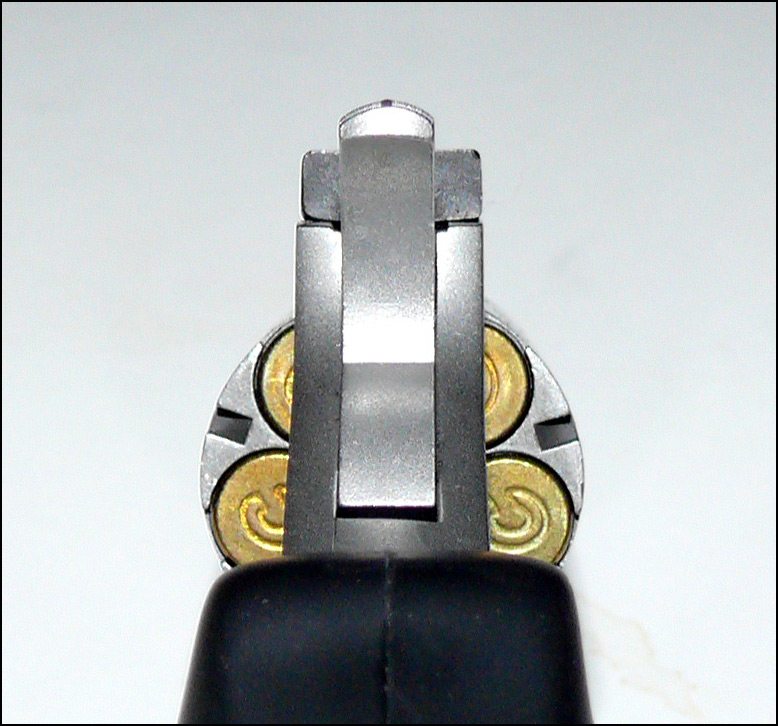
The mini-revolver has less mechanism than almost any handgun made: a hammer, a trigger, a hand, a bolt, a few springs and a cylinder on a removable pin. Owners rarely have to understand it, and the maker does its best to make sure they never open it. This volume explains how it works from the sources that exist, and keeps a strict line between what North American Arms has published and what it has not.
3.1 The ground rules: what NAA publishes, and what it forbids
Two facts set the limits of this volume.
First, NAA forbids disassembly beyond loading, and says so in every document. The 2025 manual: “Disassembly of this handgun beyond that required for loading and unloading will render this warranty null and void.” The older manual says the same in different words. NAA’s parts shop attaches the warning even to a grip screw’s neighbours: “North American Arms does not recommend disassembling your NAA firearm. Internal components should only be replaced by individuals with proper knowledge and experience. Disassembly may affect warranty coverage and can result in improperly installed or missing parts.”
Second, NAA publishes no detail-strip procedure and no functional description of the lockwork. It publishes an exploded view of the Magnum frame with the parts numbered 1 to 19 and no names on the page. It publishes a named parts list for one close relative, the Sidewinder. It publishes loading instructions. That is the whole technical record from the maker. No armourer’s manual for the mini was found, and none of the reviews located describe taking the lockwork apart.
This volume therefore does three things and no more. It names the parts from NAA’s own lists. It describes the cycle of operation from the parts that exist and the conventional single-action cycle they implement, and marks where the description rests on that convention rather than on an NAA statement. And where a procedure would normally be given, it says what the procedure has to account for instead of writing one from memory.
3.2 The parts, named from NAA’s own lists
NAA’s exploded view of the Magnum mini shows nineteen numbered parts. Three of the numbers are named in NAA’s online parts shop: Part 1, Grip Screw (item 1510, $3.00), Part 13, Main Spring (item 1406, $3.00) and Part 17, Magnum Cylinder Pin Assembly (item 2300, $25.00). The drawing shows the architecture. The identifications below go by shape, using the names from NAA’s Sidewinder list, except for the three parts NAA names itself:
- a frame with barrel and top strap in one piece;
- a cylinder that lifts out of the frame’s window;
- the cylinder pin assembly, running through the front of the frame, under the barrel and through the cylinder;
- a flat side cover held on by one screw, covering the lockwork on the left of the frame;
- a hammer carrying the striking blade and the hammer spur;
- a hand with a small wire spring;
- a trigger on a pin, with a coil spring;
- a cylinder bolt with its own wire spring and pin;
- a small spring-loaded plunger pair;
- a curved leaf mainspring lying in the grip frame, which Part 13 confirms;
- two grip panels and one grip screw.
For names, NAA’s printed parts list for the Sidewinder is the nearest primary source. American Rifleman notes that on the Sidewinder “the trigger, hammer and grip shape remain unaltered” from the standard Magnum mini. The Sidewinder list names Main Screw, Side Cover, Cylinder Hand (Mag), Hand Spring, Hammer, Index Pin, Index Spring, Trigger, Trigger Spring, Trigger Pin, Bolt Pin, Main Spring, Bolt Spring, Cylinder Bolt, Grip Screw and Wood Grip Set (Mag). It marks some of them “Requires Factory Installation”: the frame, barrel, side cover, cylinder hand, index pin, trigger and cylinder assembly.
⚠ That list is the Sidewinder’s, not the NAA-22MS-P’s. It is used here for part names only. Matching each number on the Magnum drawing to a name, beyond the three NAA itself names, would be inference, so no number-to-name table is printed. NAA does not say what the index pin and spring do, and this dive does not guess.
3.3 The cycle of operation
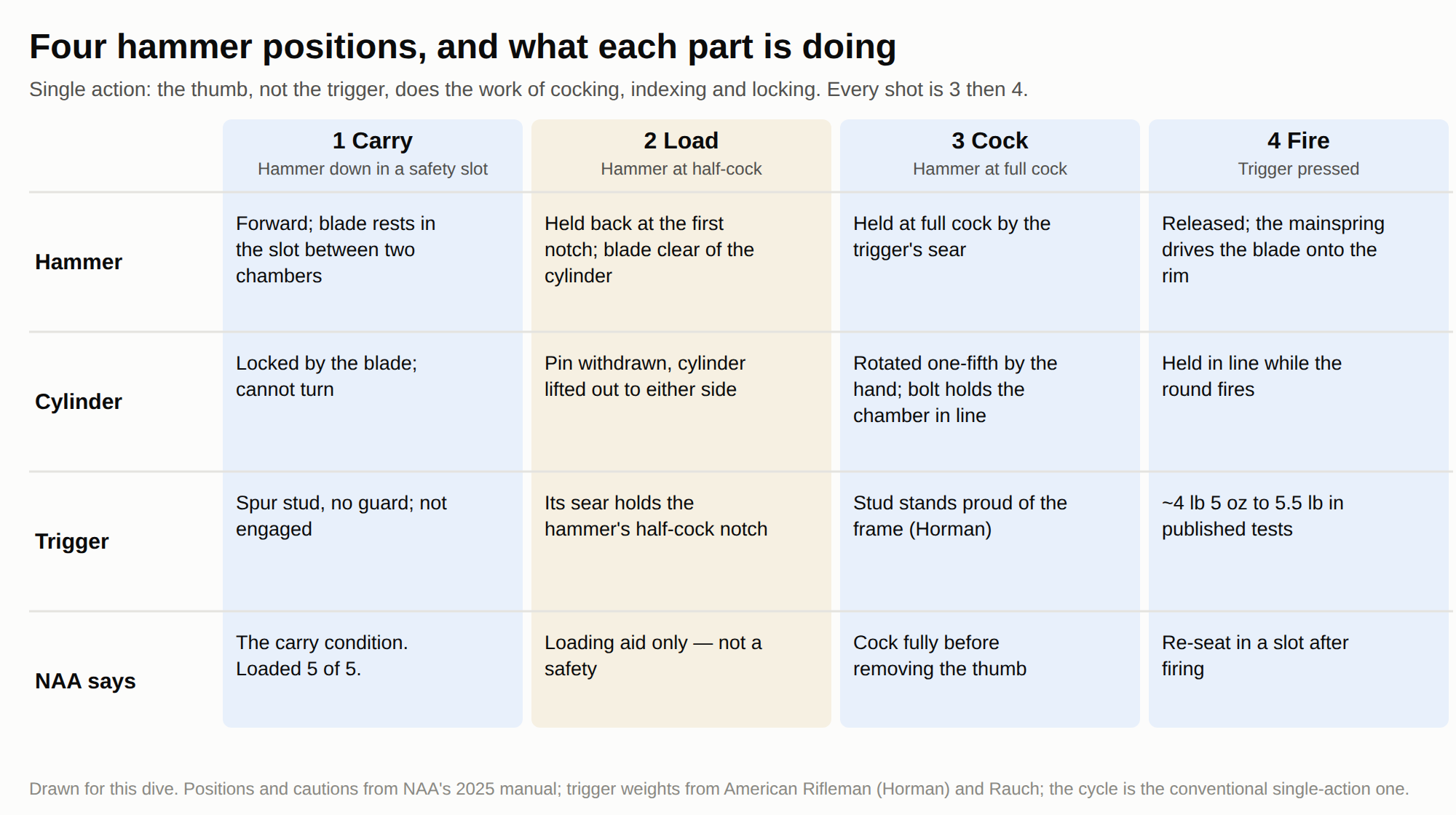
A single-action revolver puts all the mechanical work into the thumb. The trigger only releases a hammer that is already cocked. On the mini that division is extreme: the trigger is a stud with an eighth of an inch of travel, and everything else happens during cocking.
Carry: hammer down in a slot. The hammer is fully forward. Its blade is not on a cartridge rim but in one of five slots milled into the rear rim of the cylinder between the chambers (§3.4). Because the blade sits inside the slot, the cylinder cannot turn. There is no chamber in line with the barrel and no cartridge under the hammer. NAA’s FAQ describes this as the adjacent chambers sitting “approximately at the 1 and 11 o’clock positions.”
Cocking, first stage: half-cock. Drawing the hammer back lifts the blade out of the slot. The first notch the trigger’s sear catches is half-cock, which NAA calls the “first hammer stop”. At half-cock the pin can be withdrawn and the cylinder removed for loading. NAA is explicit that this is not a safety: “The traditional half-cock (first hammer stop) position is not intended to serve as a safety; its purpose is soley [sic] as an aid to loading and unloading.” To turn the cylinder by hand, for instance to line up a slot, NAA’s older manual has the owner go further: “pull the hammer back slowly until you can turn the cylinder freely.” Its FAQ puts that point at “approximately halfway back”.
Cocking, second stage: indexing and locking. As the hammer continues to full cock, three things happen. This is the conventional single-action sequence, and the parts that do it are the ones on NAA’s list. NAA does not publish a description of the sequence.
- The hand, driven by the hammer, rises against the ratchet at the rear of the cylinder and turns the cylinder one-fifth of a turn. The cylinder moves from its slot position, half a chamber off, to the next chamber in line with the barrel. The FAQ confirms the result: “When the hammer is subsequently cocked, the cylinder indexes to the next chamber, placing the revolver in the firing position.”
- The cylinder bolt, held clear of the cylinder while it turns, drops back into a locking notch and holds the chamber in line with the bore. Casull’s 1978 patent for small revolvers (US 4,228,608) describes exactly this job for a spring-loaded latch that is lifted “during the initial cocking movement of the hammer” and re-engages “as the hammer approaches the fully cocked position”. Whether the current NAA bolt is that patented design is not documented, so it is not asserted.
- The trigger’s sear drops into the hammer’s full-cock notch. The manual: “draw the hammer back as far as possible, making sure that it locks in the fully cocked position before removing your thumb from the hammer.” American Rifleman notes that the stud trigger “moves forward when the gun is cocked”, so a cocked mini can be told from an uncocked one by feel.
Firing. Pressing the trigger lifts the sear from the full-cock notch, and the leaf mainspring drives the hammer forward. Its blade strikes the rim of the cartridge in the aligned chamber. NAA’s own descriptions differ in wording here. The manual speaks of “the blade of the hammer”. The FAQ says that in the slot “the firing pin rests between chambers”. No separate firing pin appears among the nineteen parts of the exploded view, so the “firing pin” in the FAQ appears to mean the blade.
Published trigger weights for the minis run 4 lb 5 oz (a 4-inch Sidewinder, measured on a Lyman digital gauge), 4 lb 7 oz (a production Sidewinder, 2013), 4 lb 8 oz (the .22 Short) and 5.5 lb (Walt Rauch’s NAA-22MS). The travel is about 1/8 in.
After firing. The hammer is down on a fired case. To carry the gun again, NAA’s instruction is to go back to the slot: “place the hammer in the safety slot immediately after loading and after finishing firing.” NAA’s safety design depends on the owner doing that every time.
What the design does not have. There is no transfer bar, no hammer block and no firing-pin block. The slot is the only thing between a blow to the hammer and a live rim, and it works only when the hammer is in it. NAA’s danger box is specific about the other positions: “This handgun may discharge if it is dropped or struck on the hammer with a live round under the hammer, or if the thumb slips while cocking or uncocking the handgun with the trigger depressed.”
3.4 The safety slot
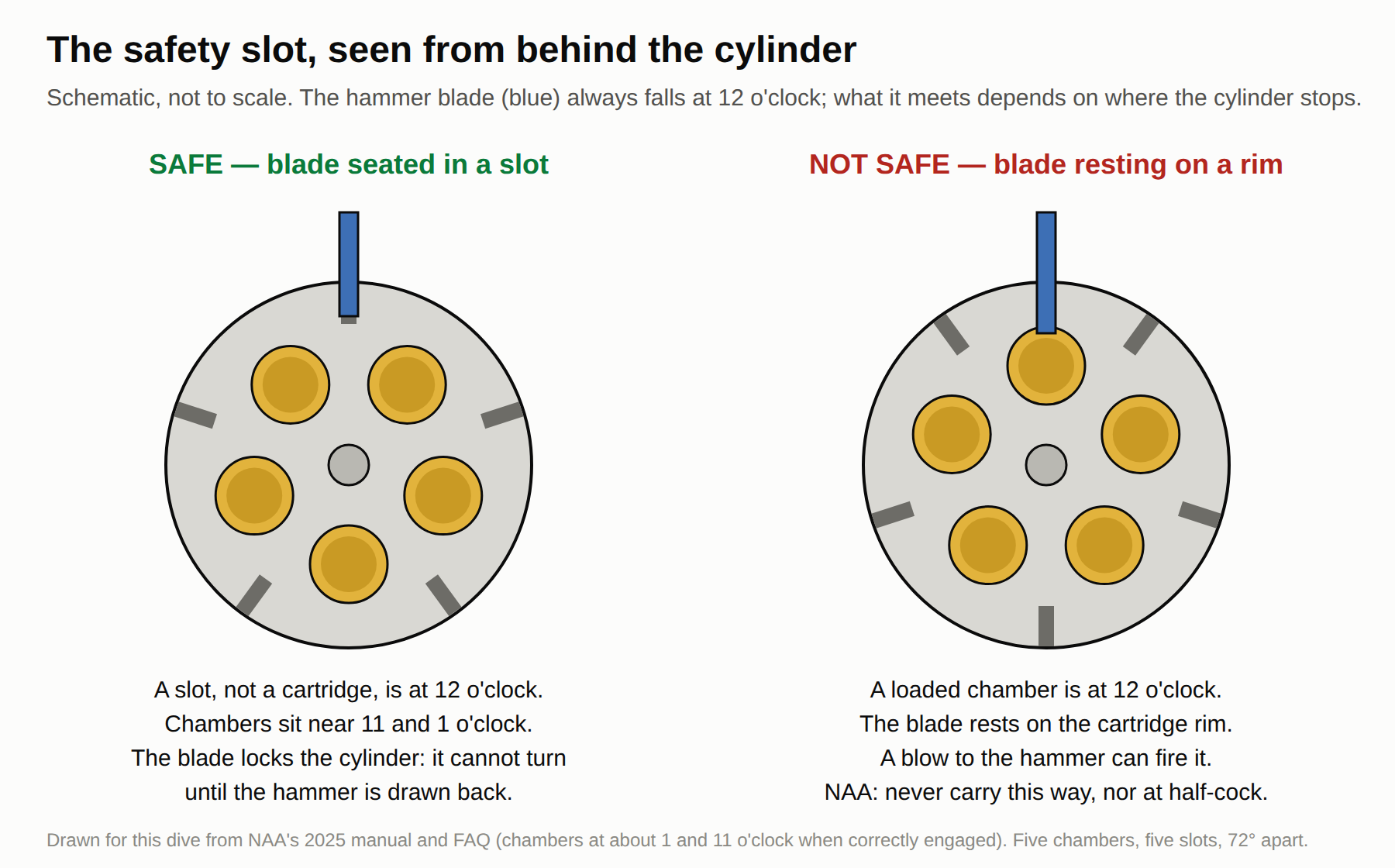
The slot is the mini’s whole answer to the single-action carry problem, and its origin is in Volume 1 §1.7: Casull’s 1977 patent for locking the cylinder “out of battery” with the striker in a recess between chambers. NAA’s 2025 manual explains it this way:
“For years, the conventional way to safely carry a single-action revolver (like an NAA mini-revolver) was to rest the hammer over the top of an empty chamber in the cylinder … NAA’s engineers designed a solution that did not require one fewer round in the cylinder. They began to mill a small notch (the safety slot) in the rim of the cylinder. The blade of the hammer is then fit into that notch and any energy or impact on the hammer is then harmlessly transferred to the wall of the cylinder instead of the rim of the cartridge. When the hammer is cocked, the cartridge simply and automatically aligns itself into proper battery.”
The procedure, verbatim from the 2025 manual, which says to practise it “several times with an unloaded mini-revolver”:
- “the hammer is slowly pulled back beyond the half-cock position until the cylinder turns freely. Make absolute certain that you have full control of the hammer and that it does not slip from your grasp, falling forward.”
- “Rotate the cylinder to a position where the hammer is aligned with a safety slot.”
- “While holding the hammer securely, fully squeeze the trigger and lower the hammer slowly forward into a safety slot. Do not squeeze the trigger unless the hammer is aligned with the safety slot. You must continue to squeeze the trigger until the hammer is firmly and fully seated in a safety slot.”
- “Make certain that the hammer blade is resting securely in a safety slot and that the cylinder does not rotate.”
NAA’s FAQ adds the check and the usual cause of failure. Check: “Confirm engagement by attempting to rotate the cylinder. If it rotates, the hammer is not seated correctly and the process should be repeated. Visually confirm that no chamber is aligned with the bore.” Cause: “Most engagement issues occur when the trigger is not fully depressed while lowering the hammer.” The Sidewinder’s manual describes alignment marks, “large and small slots on the cylinder” matching slots on the recoil shields, and says the cylinder “should not rotate more than a degree or two in either direction” when the blade is seated.
The danger in step 3 is the one NAA’s danger box names: lowering a hammer with the trigger held back and a thumb that slips. The slot procedure is the one moment in normal handling where the owner deliberately lowers a hammer over a loaded cylinder by hand. It is done with the muzzle in a safe direction or not at all.
🔴 A published review gets this wrong. A review of the NAA-22MS on The Mag Life (undated in the copy read) says the gun “does have a half-cock with a positive and audible click that locks the hammer off of a live shell”, and that “The half-cock is the extent of the safeties.” NAA’s manual says the opposite on both counts. Half-cock “is not intended to serve as a safety”, and the safety is the slot. The same manual says: “Do not carry this handgun with the hammer resting above a live cartridge or in the half-cock position.” An owner who learned the gun from that review would carry it in the one condition NAA singles out.
Older guns may not have slots. NAA’s FAQ: “Customers with older Mini-Revolver models should confirm that their firearm is equipped with the current safety cylinder,” and “My mini revolver does not have safety notches. Can this be updated? Yes. We can install a replacement cylinder with safety notches. The firearm must be returned to the factory.” When the slotted cylinder was introduced is not stated anywhere this dive located. A mini of unknown age should have its cylinder looked at before anything else. For the revolver documented here, bought about 2022, the owner confirmed on 19 September 2026 that the slots are present.
3.5 Loading and unloading, from NAA’s manual
For the standard .22 Magnum, .22 LR and .22 Short minis, which includes the NAA-22MS-P, the 2025 manual’s procedure, verbatim, practised “by hand motions only” first:
- “To remove the cylinder, first place hammer in the half-cock position.”
- “Grasp the knurled portion of the cylinder pin between the thumb and middle finger, depress the release button with the forefinger to the inward position and withdraw the pin completely. The cylinder can now be easily removed from either side of the gun.”
- “After loading the cylinder with five shells, insert the cylinder, making sure the cylinder pin seats firmly against the frame for proper functioning.”
- “After firing, follow the same procedure to unload. Use the cylinder pin for extracting empty cases.”
Then, per §3.4, the hammer goes into a slot.
Four practical points follow from the sources:
- The cylinder pin is also the ejector rod. There is no ejector. Fired cases are pushed out one at a time with the pin, with the cylinder out of the gun. Volume 5 works through what that means for reloading speed.
- Hands end up near the muzzle. David Higginbotham, reviewing the NAA-22MS, wrote that seating the loaded cylinder “will be difficult to do, at first, without putting your hands in front of the muzzle,” and that “As the gun is small, you’ll be near the trigger while changing out the cylinder.” NAA’s manual: “All fingers must be kept behind the muzzle and away from the cylinder-barrel gap.” Both are arguments for practising with an empty cylinder.
- The fit is tight on purpose. Higginbotham: “If anything is out of alignment, it will catch or hang up.” Horman found some fired cases “tough to eject” from a Sidewinder “due to the tight tolerances North American Arms adheres to in building its guns.”
- The Mini-Master, Black Widow and Pug are different. Their pin is a block pulled down, turned 90 degrees and slid forward. The Earl’s is held by its faux loading lever. The procedure above belongs to the push-button guns only.
3.6 Field breakdown and detail strip
Field breakdown is the loading procedure. Pin out, cylinder out, is as far as NAA’s manual takes the gun, and as far as the warranty allows (“beyond that required for loading and unloading will render this warranty null and void”). With the cylinder and pin out, the bore, chambers, cylinder faces, the frame window and the pin can all be cleaned and inspected. For routine care nothing more is needed.
Detail strip: no maker’s or armourer’s procedure exists in the sources located, and none is given here. NAA publishes the exploded view and nothing else. What follows is not a procedure. It is what any procedure a reader obtains, from NAA or from a gunsmith who knows these guns, has to deal with, drawn from the parts NAA lists. A reader can use it to judge whether a procedure is complete.
- The lockwork is behind one side cover held by one main screw. Everything else sits on pins and springs in the frame. A procedure that does not start there is describing a different gun.
- The mainspring is a leaf in the grip frame (Part 13), under the grip panels. It is loaded whenever the hammer is anywhere but fully forward, and a correct procedure says what hammer position it starts from and how the spring is relieved.
- Several small springs are under compression: the hand spring, bolt spring, trigger spring, and the index spring behind its pin. Parts this small, in a frame this small, are easily lost. NAA’s shop warning about “missing parts” is a practical warning.
- NAA marks the hand, trigger and index pin “Requires Factory Installation” on the Sidewinder list. These are the parts that set timing and let-off. A procedure that treats them as owner-replaceable is at odds with the maker.
- Timing is fitted, not assembled. NAA says a cylinder “must be timed and fitted” to each gun and cannot be moved between guns (Volume 2 §2.5). Hand and bolt work affects exactly that timing.
The conclusion is not caution for its own sake. It is what the maker’s documents add up to. On this gun, anything past pin-out is factory work.
3.7 Maintenance
Cleaning, per NAA, in full. The 2025 manual’s maintenance section is two sentences: “As with other fine revolvers, the mini requires care when it is used. It is recommended that the bore and chamber be cleaned gently after firing and coated with a very light film of oil.” NAA publishes no lubrication points, no solvent guidance, no inspection schedule and no replacement intervals. None are invented here.
What the documented failures say to clean. Every service problem in §3.8 that has a stated cause points to the same places, all reachable with the cylinder out:
- The chambers. Walt Rauch put his case-swelling and misfire problems down to “not firmly seating fresh cartridges in the now fouled charge holes” after more than fifty rounds. Clean chambers let a cartridge seat fully, and a fully seated rim is what the blade has to strike.
- The cylinder’s rear face and the recoil shield. They carry the slots and the ratchet. Fouling there is what the Sidewinder manual’s “a degree or two” of play check would reveal.
- The front of the cylinder and the barrel’s breech face. On a revolver, the cylinder-barrel gap is where a rimfire’s lead and powder residue collect. The manual’s own warning about fingers and “the cylinder-barrel gap” shows how much gas comes out there.
- The pin and its bore. The pin is the axle, and the only published “wear” part (§3.9).
- The ports. On the NAA-22MS-P, the ports will foul like any muzzle device. NAA gives no guidance for them.
Dry firing. The 2025 manual: “Excessive dry firing is to be avoided!” The FAQ is more specific: “Dry firing with the cylinder removed is acceptable for familiarization with trigger pull. Dry firing with the cylinder installed is not recommended.” The FAQ does not give a reason. On a rimfire, a blade that falls on an empty chamber strikes the chamber mouth’s edge, which is the usual reason rimfire makers give. That reasoning is general, not NAA’s.
Ammunition as maintenance. Two items in the 2025 manual are really service instructions (Volume 4 has the details):
- “DO NOT USE ANY ‘PMC’ OR ‘ARMSCOR PRECISION’ BRANDED AMMUNITION IN ANY NAA Mini-Revolver!”, because of out-of-battery discharges.
- “NAA does not recommend the use of commercially available VARMINT ammunition with Mini-Revolvers. Because of the Minis’ size and the pressures VARMINT rounds create, the casings may swell and jam and/or cause interference with the cylinder’s rotation.”
Storage. The manual’s holster rule applies at rest too: “NAA STRONGLY RECOMMENDS that all NAA firearms be carried in an appropriate holster— even/especially when carried in a purse or pants pocket.” A gun this small in a pocket, with no guard, is protected only by the slot and the holster.
3.8 Repair: the failures actually on record
Every malfunction below is taken from a named source. Where a source gives a cause, it is quoted. Where none does, the entry says so.
Table 1 — 3.8 Repair: the failures actually on record
| Symptom | Source | Stated cause / NAA position | Owner action |
|---|---|---|---|
| Two rounds fire at once, one out of battery | NAA supplemental sheet, 17 May 2004 (quoted by Rauch); NAA 2025 manual | NAA: “a phenomenon where an inadvertent, double-discharge (two rounds simultaneously discharging, one aligned with the barrel and the other out of battery) may occur when PMC brand ammunition is used.” The 2025 manual extends the ban to Armscor Precision | Never use either brand. Stop and contact NAA if it happens with any ammunition |
| Case head swells; cocking becomes hard or the cylinder binds | Rauch (NAA-22MS, after >50 rounds); NAA 2025 manual | Rauch: cartridges not fully seated in fouled chambers. NAA: varmint loads, “the casings may swell and jam and/or cause interference with the cylinder’s rotation” | Clean the chambers; seat each round fully; no varmint loads |
| Misfires | Rauch: “two misfires” | Rauch attributes them to the same fouling and seating problem | As above; test the carry load |
| Fired cases hard to eject | Horman, Sidewinder, 2013 | ”due to the tight tolerances”; hot magnums and cheap LR worst | Choose ammunition that extracts cleanly; clean chambers |
| Bullets keyholing | Higginbotham, NAA-22MS: “five shots in four holes. It looks like the rounds are keyholing” | Not established. No cause given | Try another load. A gun that keyholes with everything is a factory question |
| Shoots low | Rauch: “about six inches low at seven yards” | Fixed sights; no adjustment possible | Learn the hold. Sight changes are factory work (Volume 5) |
| Hammer will not stay in the slot / cylinder still turns | NAA FAQ | ”Most engagement issues occur when the trigger is not fully depressed while lowering the hammer” | Repeat the procedure; if it persists, NAA |
| No slots at all | NAA FAQ | An older gun without the “current safety cylinder” | Factory replacement cylinder; not carried loaded until then |
| Cylinder hangs when seating | Higginbotham | Tight fit: “If anything is out of alignment, it will catch or hang up” | Patience and alignment. Damage to the pin or its seat is a factory matter |
3.9 Parts that break, and the cylinder-pin question
The hand, the bolt and the springs. These are the parts that wear first in any single-action revolver, because they take the impact of every cocking stroke. For the NAA mini, however:
- No breakage rate, service bulletin or recall for the hand, bolt or springs was found in NAA’s documents or in the reviews consulted.
- NAA classifies the hand, trigger and index pin as “Requires Factory Installation” (Sidewinder list). A worn hand, which shows up as a cylinder that does not carry fully up to lock, is a factory repair by NAA’s own rules.
- The bolt, bolt spring, hand spring and mainspring carry no factory-install marking on that list. But NAA’s online shop sells only the grip screw, the mainspring and the cylinder pin assemblies for the minis, and the Magnum exploded-view page says “Parts cannot be ordered online. Please contact the factory.” Those two statements from NAA’s own website disagree. In practice, parts other than those three come by telephone from Provo, if at all.
- The only spring NAA prices publicly is the mainspring, $3.00.
So the honest answer on hand and bolt failure is that it is not documented for this gun. The owner-level symptoms are the general single-action ones: a cylinder that does not lock at full cock (hand or bolt), a cylinder that turns backwards or will not index, or a hammer that will not hold at half or full cock (sear or notch). NAA’s warranty, below, is how each of these gets fixed.
The cylinder pin. The pin is the part an owner handles most. It is pulled on every reload, used as the ejector rod, and carries the cylinder as its axle. NAA sells the Magnum pin assembly (item 2300, $25.00) “Whether replacing a worn component or keeping a spare on hand”. That is the only statement from the maker that the pin wears. NAA does not describe how it wears, how to judge wear, or when to replace it. No measured wear figure or failure mode was found in the reviews consulted. What the documents do support:
- the pin must “seat firmly against the frame for proper functioning” (manual), so a pin that no longer latches fully is a pin that needs attention;
- the pin is sold separately, so a lost or bent pin, the Sidewinder article’s “dropped cylinder pin on a grassy plain”, can be replaced by the owner without disassembly, at $25;
- Casull’s 1980 patent for a small revolver’s pin (US 4,228,606) used a lug, a lip and a coil spring. The current push-button pin is a different design, and how or when the change was made is not documented, so the patent says nothing about the current pin’s wear.
A spare pin is the one piece of repair kit NAA sells for this gun, and it costs less than a box of the ammunition.
3.10 What the lifetime warranty covers
From the 2025 manual:
“All North American Arms firearms carry a lifetime warranty to the original registered owner which covers defects in materials, workmanship, and mechanical function. This warranty does not cover normal wear or damage resulting from neglect, abuse, customizing or repairs not made by NAA. … Under the terms of this warranty, NAA will repair or replace, at its option, the handgun or any part thereof, without charge, provided that the handgun is returned pre-paid to the factory. NAA does not cover return shipping on firearms manufactured more than two years prior to the factory’s manufactured date of this handgun.”
Read closely:
- “Original registered owner.” Registration is by the card in the box or online. A second-hand mini, or one never registered, falls outside the wording. The FAQ and customer-service page call it “a no-hassle Lifetime Warranty” and state no such condition, so NAA’s own documents differ on this point too.
- “Normal wear” is excluded. A hand or pin that has simply worn out is not a defect in the manual’s terms. Whether NAA charges for such repairs in practice is not published.
- Disassembly voids it, but not permanently. FAQ: “If a firearm has been disassembled, the warranty is void; however, we will still service the firearm for a standard fee to reinstate coverage.” The fee is not published.
- Shipping. The gun goes to NAA prepaid by the owner. NAA’s customer-service page gives return shipping of $25 to $50 depending on recipient. Guns within two years of manufacture have return shipping covered. It also says the gun must not be disassembled before it is sent.
- Process. NAA asks owners to contact customer service first, and provides an online repair request form. Customer service hours are Monday to Thursday, 9 to 5 Mountain. The form offers Cerakote in a range of colours “for an additional fee” while the gun is in.
3.11 Owner, gunsmith or factory
Table 2 — 3.11 Owner, gunsmith or factory
| Job | Who, per NAA’s documents |
|---|---|
| Load, unload, remove and refit the cylinder | Owner (manual) |
| Clean bore, chambers, cylinder, pin | Owner (manual) |
| Replace grip panels, grip screw | Owner (parts sold) |
| Replace the cylinder pin assembly | Owner (sold as a complete assembly, no disassembly needed) |
| Fit a .22 LR conversion or any additional cylinder | Factory only (“not sold for home installation”) |
| Retrofit a slotted safety cylinder to an older gun | Factory only |
| Hand, trigger, index pin | Factory (“Requires Factory Installation”) |
| Anything behind the side cover | Factory, or a gunsmith at the cost of the warranty (reinstated for a fee) |
| Mainspring | Sold online, but it sits under the grips inside the lockwork. NAA’s own warning applies |
The mini is a gun the owner cleans and the factory repairs. That is less a restriction than the design itself: parts fitted by hand into a frame the size of a matchbox, with a maker that has fitted them for fifty years and still does it for the price of shipping.
3.12 Bibliography
- North American Arms, “Mini-Revolver Operation and Safety Manual” (PDF titled “Full owner’s manual 2025”, created 2 June 2025), https://www.northamericanarms.com/wp-content/uploads/2025/09/ownersm.pdf (accessed 2026-09-19). Scanned document; text read by OCR and checked against the page images. Source of all passages attributed to “the 2025 manual”.
- North American Arms, “Owner & Instruction Manual: .22 Magnum, .22 Long Rifle, .22 Short, Mini-Master & Black Widow” (undated, naaminis.com era), copy at http://pdf.textfiles.com/manuals/FIREARMS/northamerican_minis.pdf (accessed 2026-09-19).
- North American Arms, Sidewinder owner’s manual addendum and replacement parts list, https://northamericanarms.com/wp-content/uploads/2023/07/Owner-s-Manual-Sidewinder.pdf (accessed 2026-09-19). In the printed list, Trigger Pin and Cylinder Bolt share the part number 1401. Reproduced as printed.
- North American Arms, “Parts & Exploded View – Magnum”, https://www.northamericanarms.com/parts-exploded-view-magnum/ (accessed 2026-09-19).
- North American Arms, parts shop: Magnum Cylinder Pin Assembly (Part 17), item 2300, https://www.northamericanarms.com/shop/2300/; Main Spring (Part 13), item 1406; Grip Screw (Part #1), item 1510 (prices as displayed 2026-09-19).
- North American Arms, “Frequently Asked Questions”, https://www.northamericanarms.com/frequently-asked-questions/ (accessed 2026-09-19).
- North American Arms, “Customer Service” (warranty, shipping) https://www.northamericanarms.com/customer-service/ and “Firearm Repair/Service Request” https://www.northamericanarms.com/firearm-repair-service-request/ (accessed 2026-09-19).
- R. J. Casull, US Patents 4,126,953 (1978), 4,228,606 (1980) and 4,228,608 (1980). See Volume 1.
- Walt Rauch, “North American Arms 22MS Revolver Review”, Police & Security News, reproduced at https://www.bluesheepdog.com/north-american-arms-22ms-revolver/ (accessed 2026-09-19). Quotes NAA’s supplemental sheet of 17 May 2004.
- David Higginbotham, “Micro Magnums: The NAA-22MS”, The Mag Life, https://gunmagwarehouse.com/blog/north-american-arms-naa-22ms/ (accessed 2026-09-19).
- Gil Horman, American Rifleman: “NAA Sidewinder .22 Mag. Mini Revolver” (16 January 2013); “North American Arms NAA-22S Mini Revolver: A Short Review” (1 March 2017); “Tested: North American Arms Sidewinder Revolver”. URLs in Volume 2.
Comments (0)