High Standard Sentinel · Volume 5
Telling Them Apart — R-100 to Mark IV, the Snubs, and the Private Labels
An identification volume: what each series changed, how to read the markings, which guns are not High Standard's work at all, and the photographs to check yours against
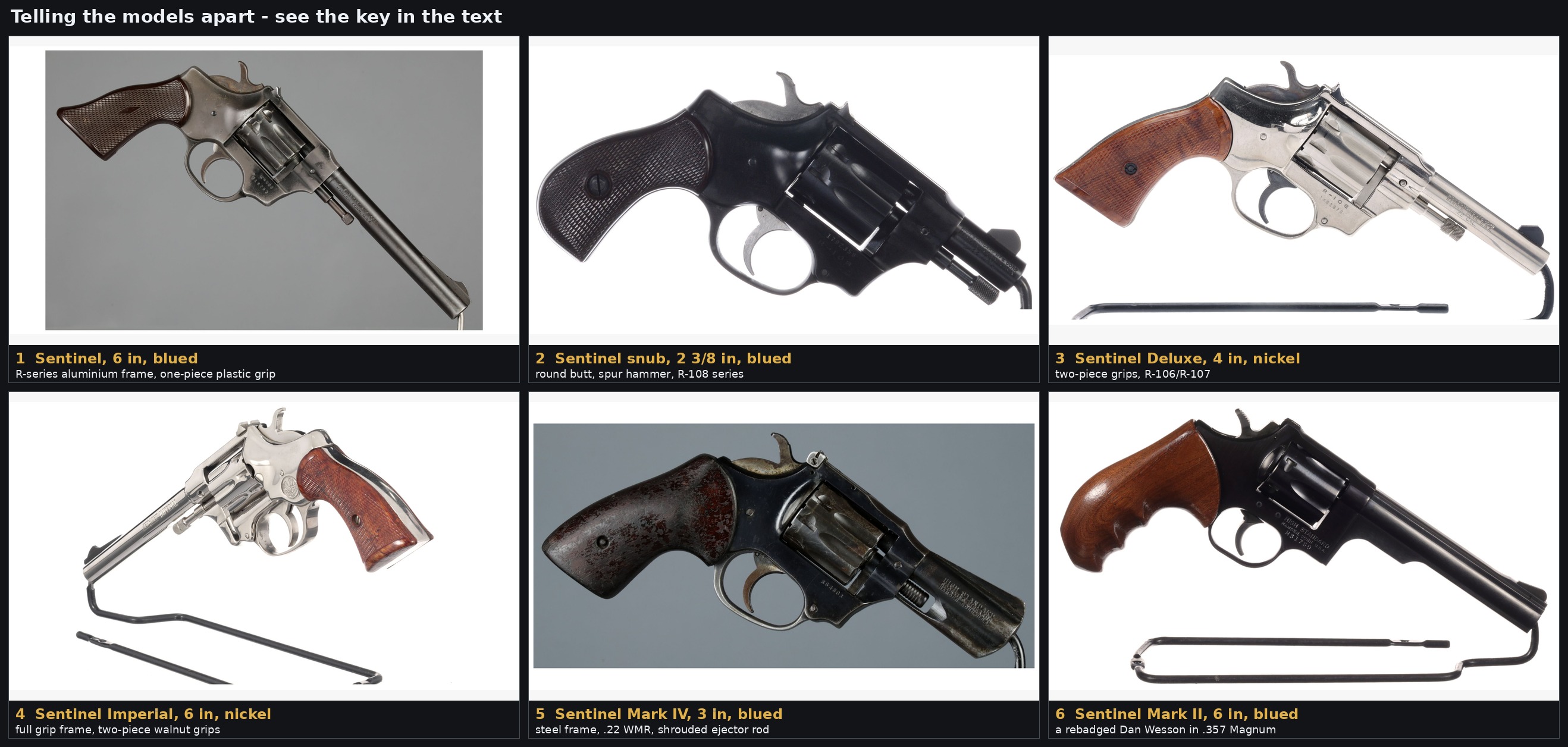
The Sentinel ran for about thirty years, in ten series, under at least five brand names, in two frame materials and in two chamberings — and its name was also put on a revolver made by a different company. This volume is the sorting key. The plate above is the starting point; the key to it runs:
- Sentinel, 6 in, blued — aluminium frame, one-piece plastic grip, plain barrel.
- Sentinel snub, 2⅜ in, blued — round butt, spur hammer, R-108 series.
- Sentinel Deluxe, 4 in, nickel — two-piece grips, R-106 or R-107.
- Sentinel Imperial, 6 in, nickel — full-size grip frame, two-piece walnut grips.
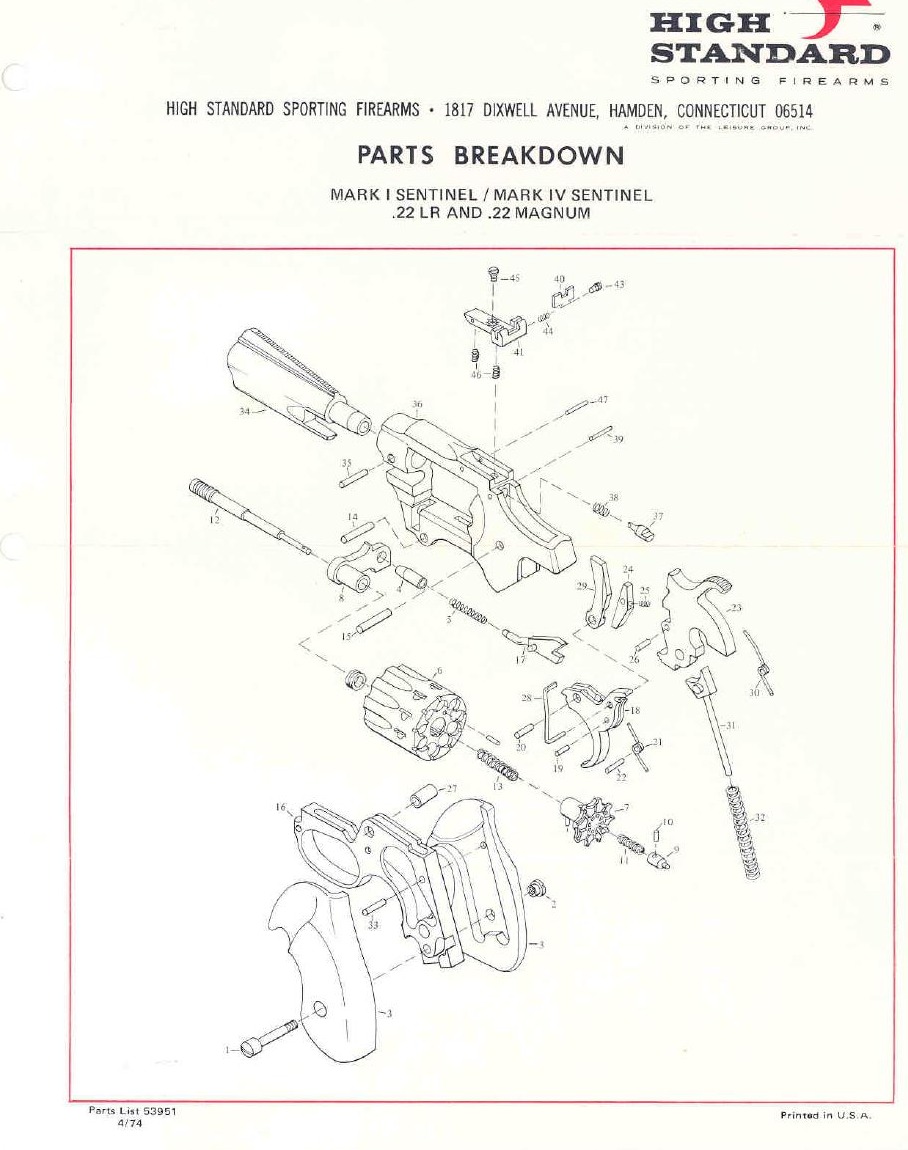
- Sentinel Mark IV, 3 in, blued — steel frame, .22 WMR, ejector rod shrouded by a barrel underlug.
- Sentinel Mark II, 6 in — a rebadged Dan Wesson in .357 Magnum, not a High Standard product.
5.1 Start Here: Four Questions
- Is there a thumb latch on the left side of the frame? If yes, it is not a Sentinel of any series. The Sentinel’s cylinder is released by pushing the ejector rod forward (Volume 3).
- Is the frame aluminium or steel? Every R-series gun is aluminium; the Mark I, Mark IV, Camp Gun and late steel “Sentinel” are steel.1 Weight tells at once — the original was about 21 ounces2 — and so does a magnet on the frame.
- Is the ejector rod shrouded? The R-series rod is exposed under the barrel; the Mark I and Mark IV have a barrel underlug covering it, and the Camp Gun of the same period does not.1
- What does the frame say? The series number is roll-stamped on the frame, and it is the single most useful mark on the gun.
5.2 The Model Plate
Compare the gun in hand with the plate at the head of this volume, from the same side. The three things that separate the groups at arm’s length are the butt shape (round on the snubs, square on everything else until the Imperial’s full grip frame), the grip (one piece on the early guns, two on the Deluxe and later), and the ejector rod (bare on the R-series, shrouded on the Marks).
5.3 Where the Markings Are
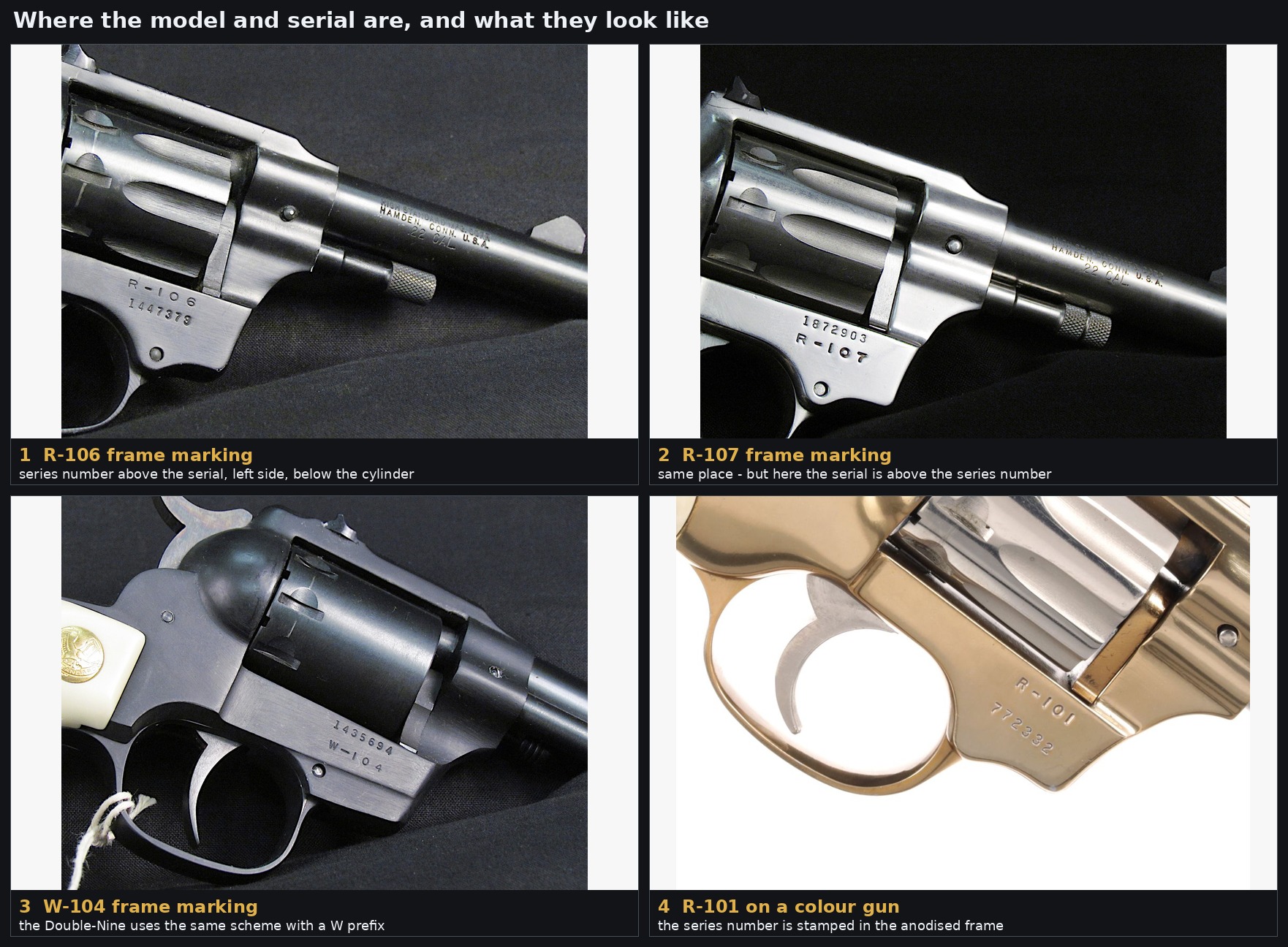
Key to the plate:
- R-106 frame marking — the series number stamped on the left of the frame below the cylinder, with the serial beneath it.
- R-107 frame marking — the same place, but here the serial is above the series number: the order of the two lines is not constant, so read both.
- W-104 frame marking — the Double-Nine uses the same scheme with a W prefix, which is how a western-style gun is placed in the family.
- R-101 on a Dura-Tone gun — the series number is stamped in the anodised frame exactly as on a blued gun, so a colour gun can be placed as precisely as any other.
The barrel carries the maker’s roll mark — “HIGH STANDARD MFG. CORP. / HAMDEN, CONN. U.S.A.” and “.22 CAL.” — in the photographs examined. Buffaloe adds two frame logos worth knowing: the R-100 carries an eagle on the frame, and the R-108 a trigger logo, with a few R-108s carrying no logo at all.1
🔴 What a Sentinel does not have is a date. No source located describes a date code or a published serial-to-year table for these revolvers, and none is invented here. Dating is done from the series number (below), and auction houses’ “manufactured circa” statements should be treated as their opinion rather than as documentation.
5.4 The Series, One by One
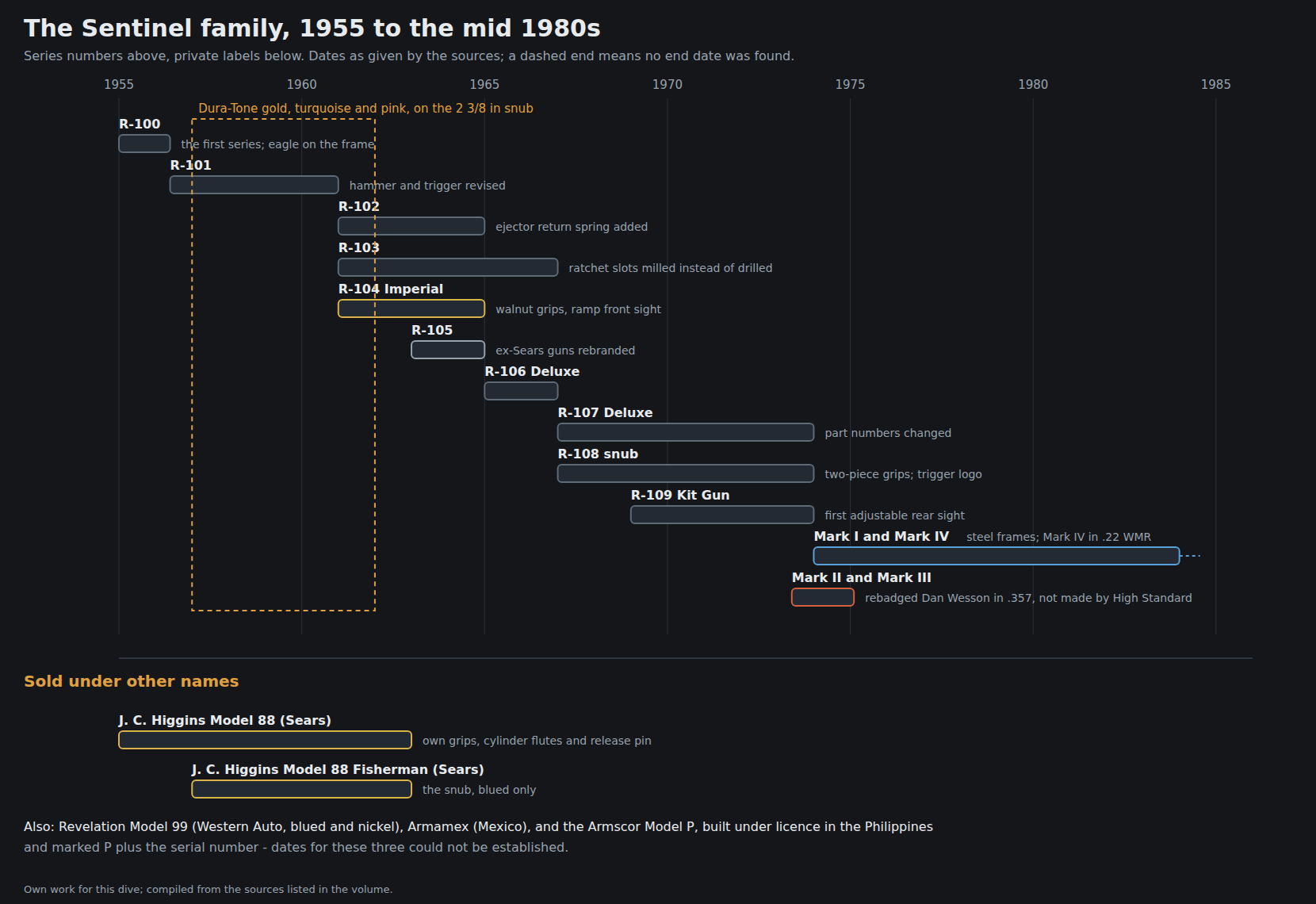
Table 1 — The Series, One by One
| Series | Introduced | What identifies it | Source |
|---|---|---|---|
| R / R-100 | 1955 | the first guns; eagle logo on the frame; hammer and trigger parts unique to this series | Buffaloe; parts sheets 990-55 and 990-93134 |
| R-101 | mid-1956 | hammer and trigger modified “for easier assembly and disassembly” | Buffaloe1 |
| R-102 | 1961 | ejector return spring — the rod springs back by itself | Buffaloe; sheet 997-9915 |
| R-103 | — | ratchet slots milled instead of drilled recesses | Buffaloe1 |
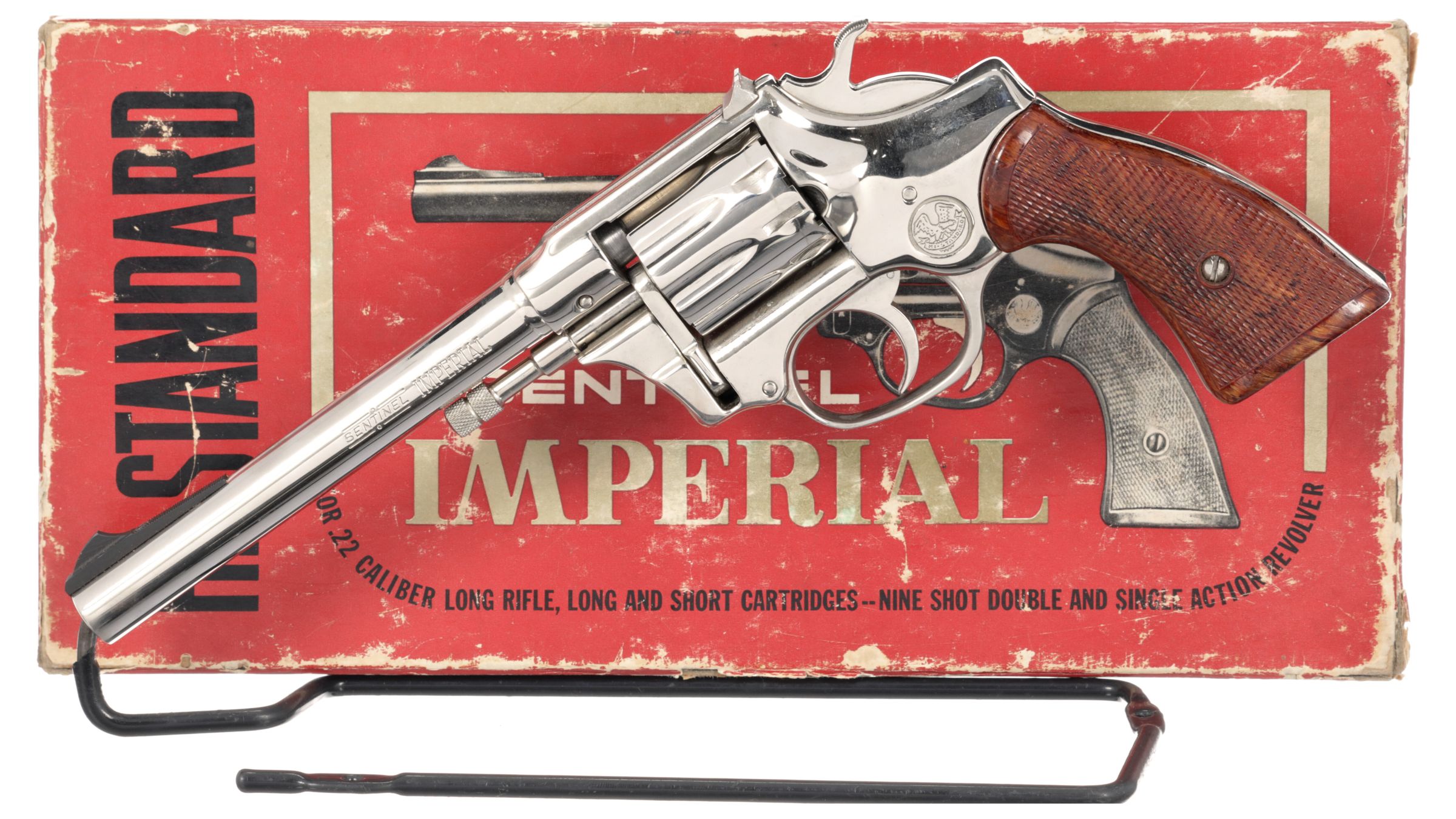
| R-104 Sentinel Imperial | 1961 | full-size grip frame, two-piece checkered walnut grips, ramp front sight, target-style trigger | Buffaloe; sheet 996-671 |
| R-105 | 1963 | ex-Sears guns returned when Sears dropped handguns, rebranded with new barrels and grips but keeping the J. C. Higgins cylinder flutes, cylinder pin and trigger guard; “one of the least common” | Buffaloe1 |
| R-106 Sentinel Deluxe | April 1965 | blade front sight, two-piece grips in a wood-grain moulding | Buffaloe; sheet 550916 |
| R-107 Sentinel Deluxe | 1967 | externally identical to the R-106; the part numbers for frame, grip, trigger and hammer all changed | Buffaloe1 |
| R-108 snub | 1967 | snub with two-piece grips; trigger logo on the frame | Buffaloe1 |
| R-109 Kit Gun | 1969 | first fully adjustable rear sight in the line | Buffaloe1 |
| Mark I / Mark IV | 1974 | steel frame; wrap-around walnut grips; optional adjustable sights; shrouded ejector rod; Mark IV in .22 WMR | Buffaloe; parts list 5395117 |
| Camp Gun | mid-1970s | as the Marks but no barrel underlug, 6 in barrel, adjustable sights, .22 LR or .22 WMR | Buffaloe1 |
| Steel “Sentinel” | later | the Mark designations dropped; interchangeable .22 LR and .22 WMR cylinders | Buffaloe1 |
⚠ The R-103 and R-104 overlap in date because they were sold side by side: when the Imperial appeared in 1961, “the regular Sentinel was still available with one-piece plastic grips and blade front sight, and it retained the old R-103 designation”.1
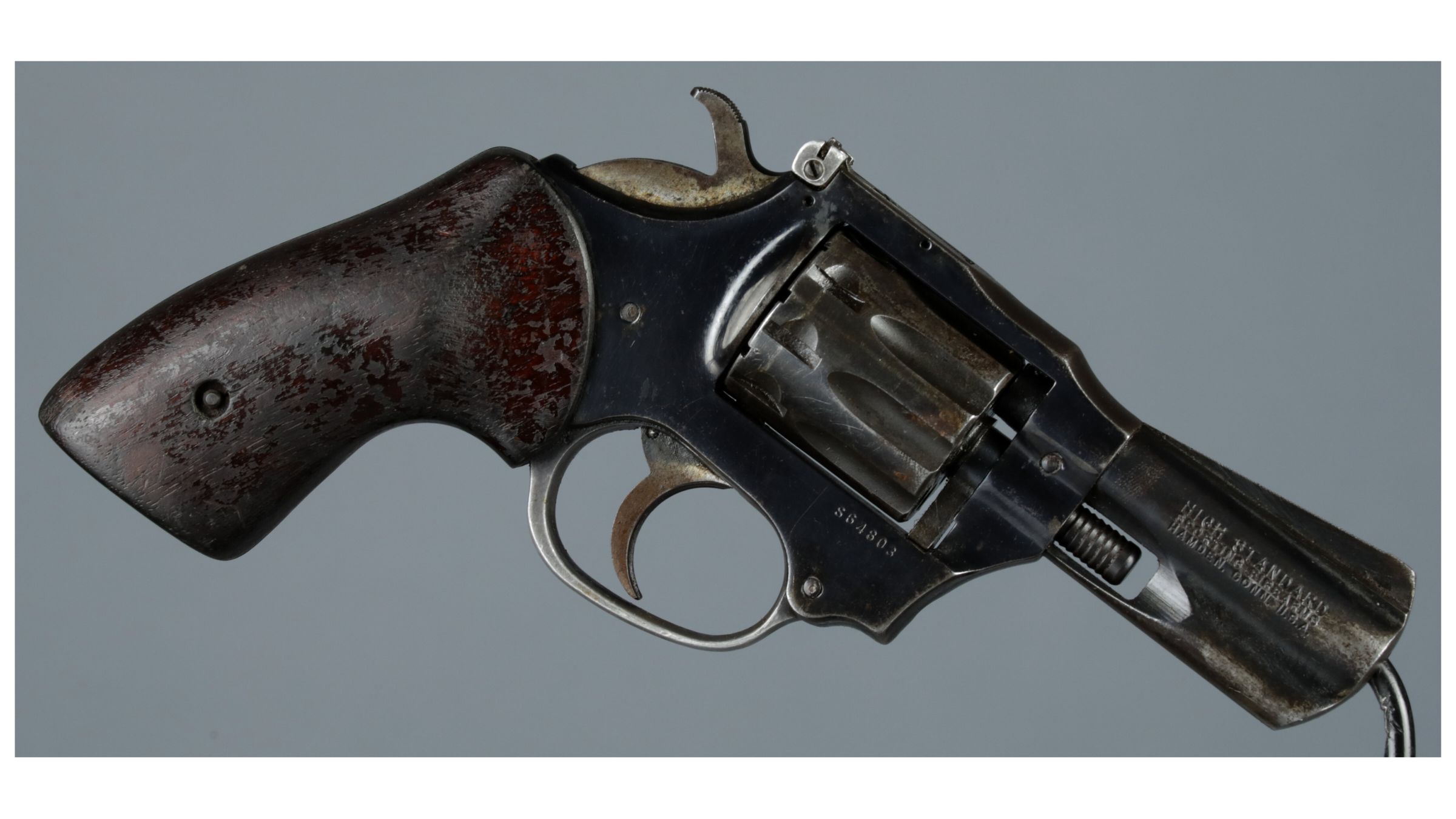
🔴 The R-105 is the trap in this list. It looks like a Sears gun because it was one: the barrels and grips were changed but the cylinder flutes, the cylinder pin and the trigger guard are the Higgins parts. A gun with Higgins cylinder flutes and a High Standard barrel is not a parts-bin mongrel; it may be the rarest series in the family.
5.5 Barrels
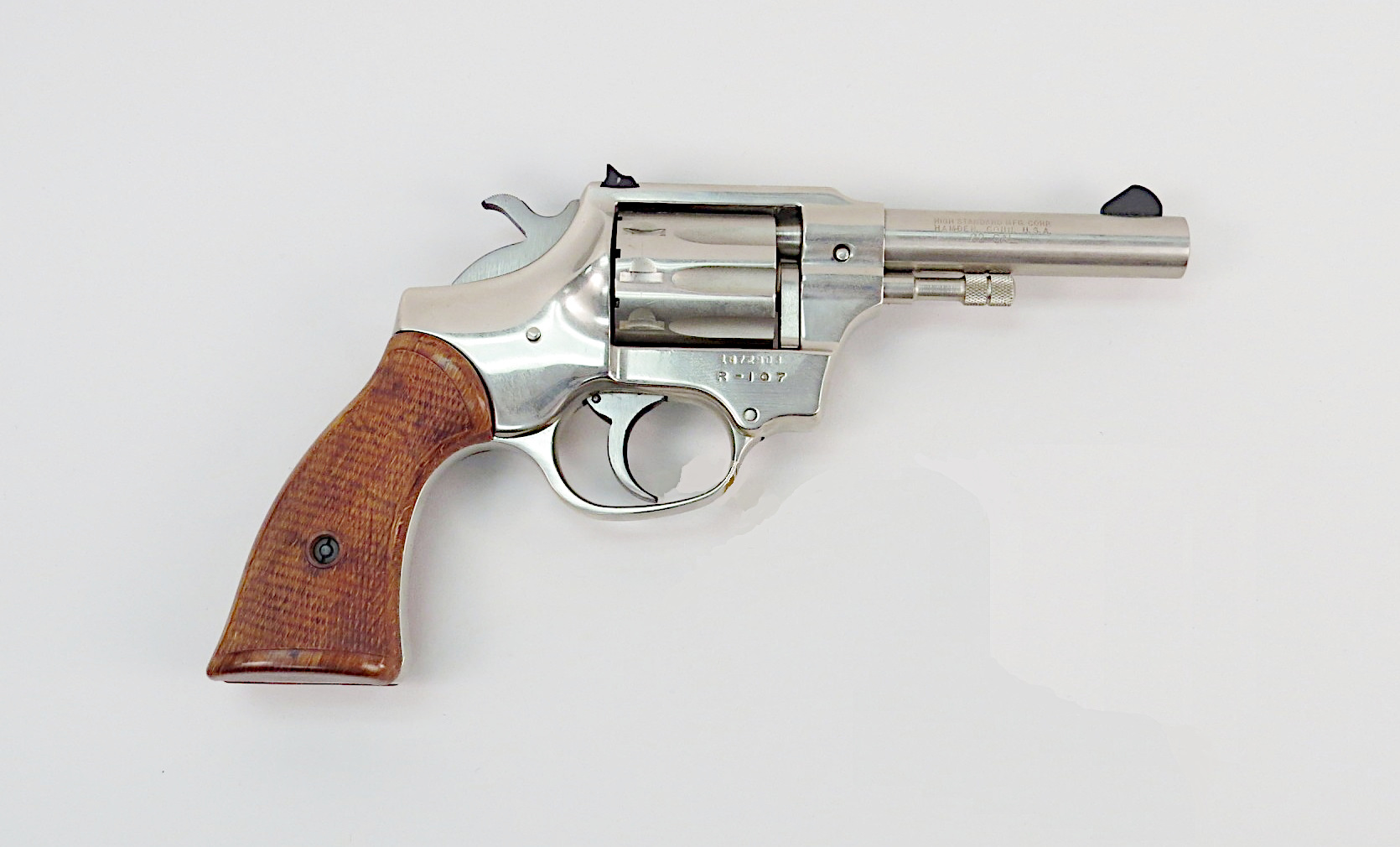
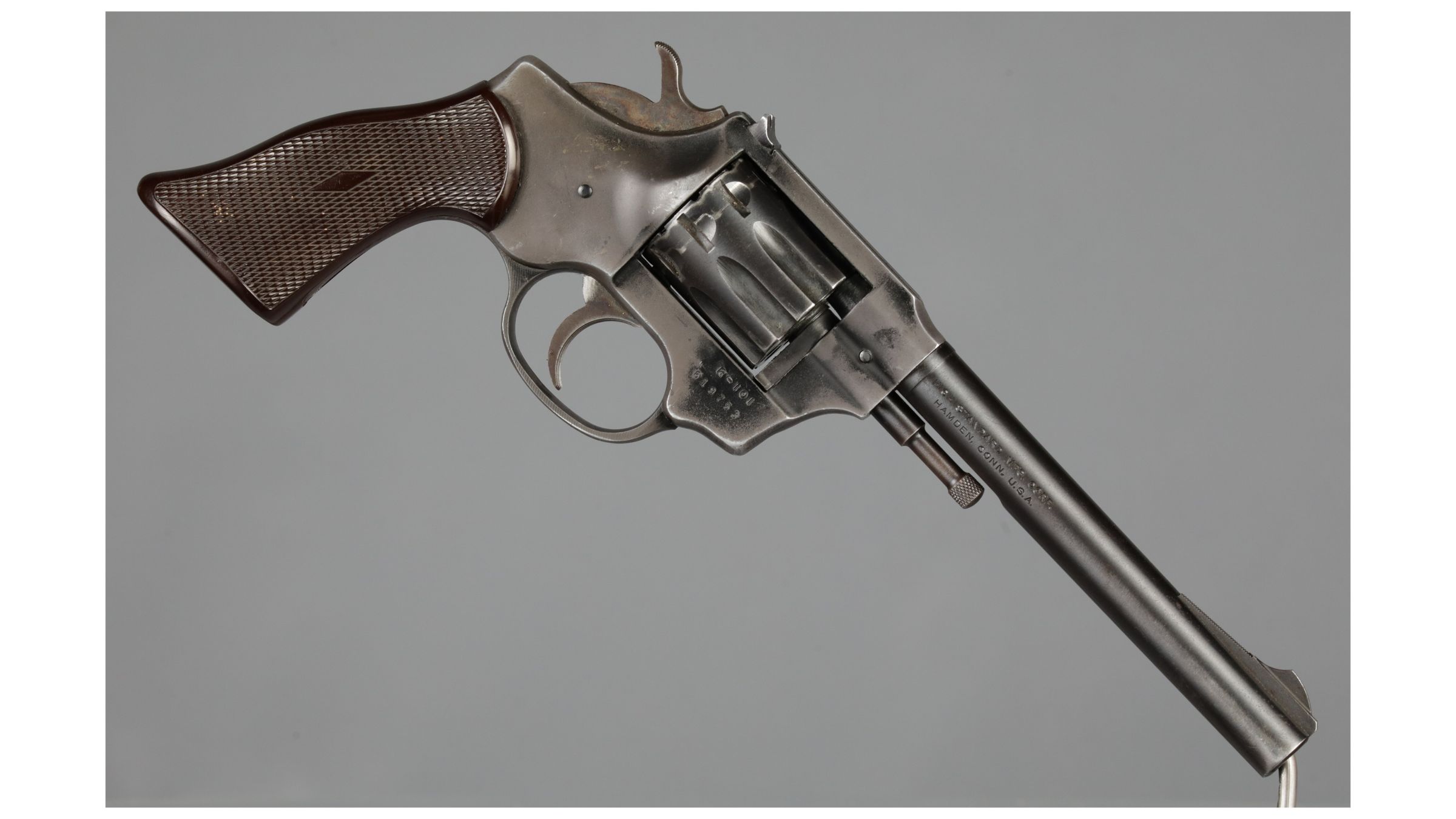
Lengths offered, from the catalogues and parts lists: 2⅜ in (the snub), 3 in, 4 in, 5 in and 6 in. Buffaloe records the 1955 catalogue offering 3 and 5 inch, a parts list of about 1957–58 showing 3, 4 and 2⅜, a 6 inch added by 1956, and the 3 inch dropped in 1964.1 The Mark series lists 2, 3 and 4 inch barrels in blue and nickel, with fixed or adjustable sights.7
Two cautions. Auction descriptions give snub barrels as “2 inch”, “2⅜ in” and “2½ in” for what appear to be the same guns, so a listed length is not a reliable identifier. And a barrel is a replaceable part that High Standard itself sold: a 6-inch gun in a snub’s box is a re-barrel or a mismatch, not a variant.
5.6 Grips, the Fastest Tell
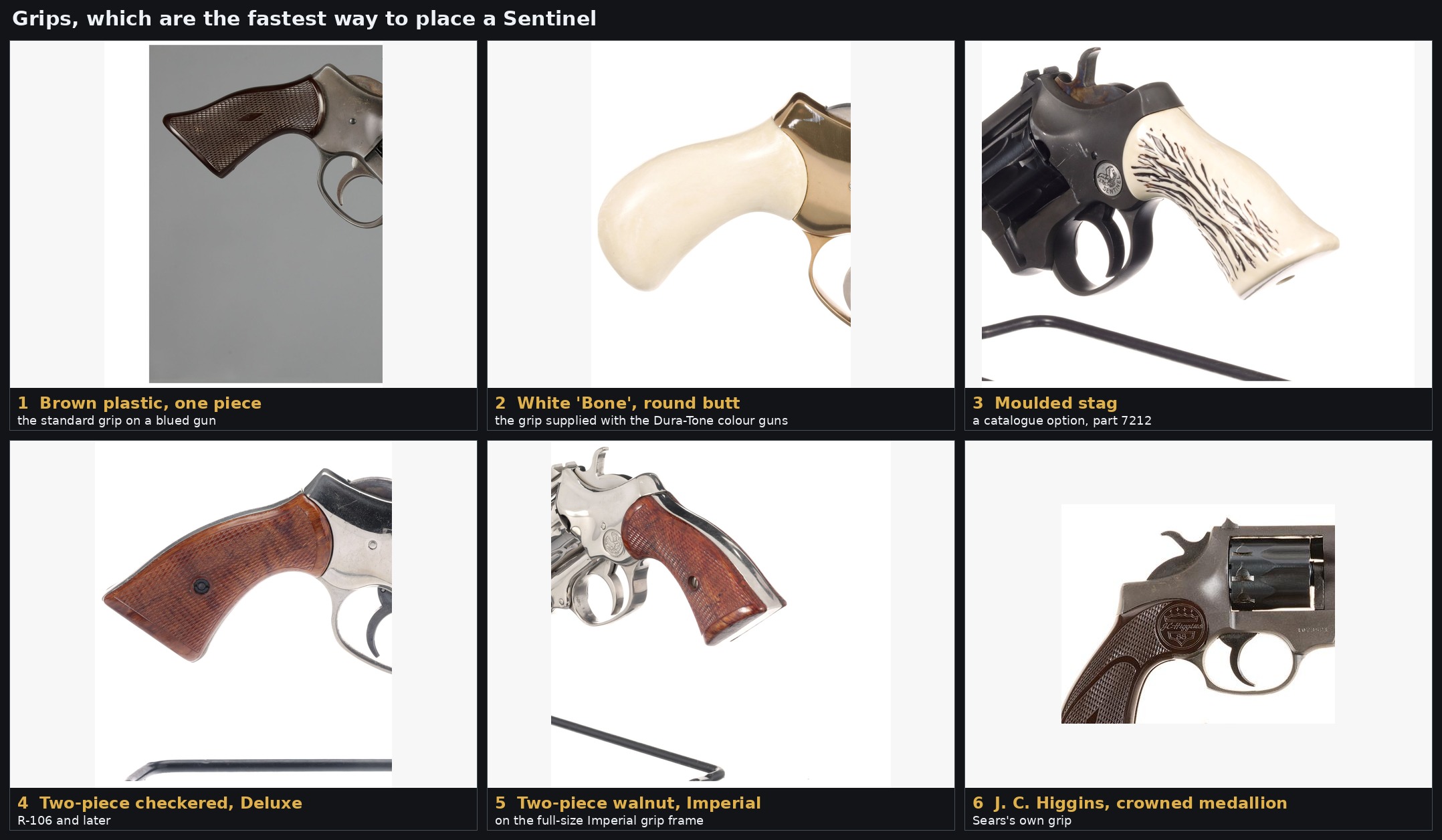
The grip places a Sentinel faster than anything except the frame stamp:
- Brown plastic, one piece — the standard blued gun. Originally the blued guns had brown grips and the nickel guns white, “but that scheme was not retained throughout production”.1
- White “Bone”, round butt, one piece — the colour guns and the nickel snubs. The factory’s own name for it is “Bone”, and it was the dearest grip in the 1961 list at $5.50.5
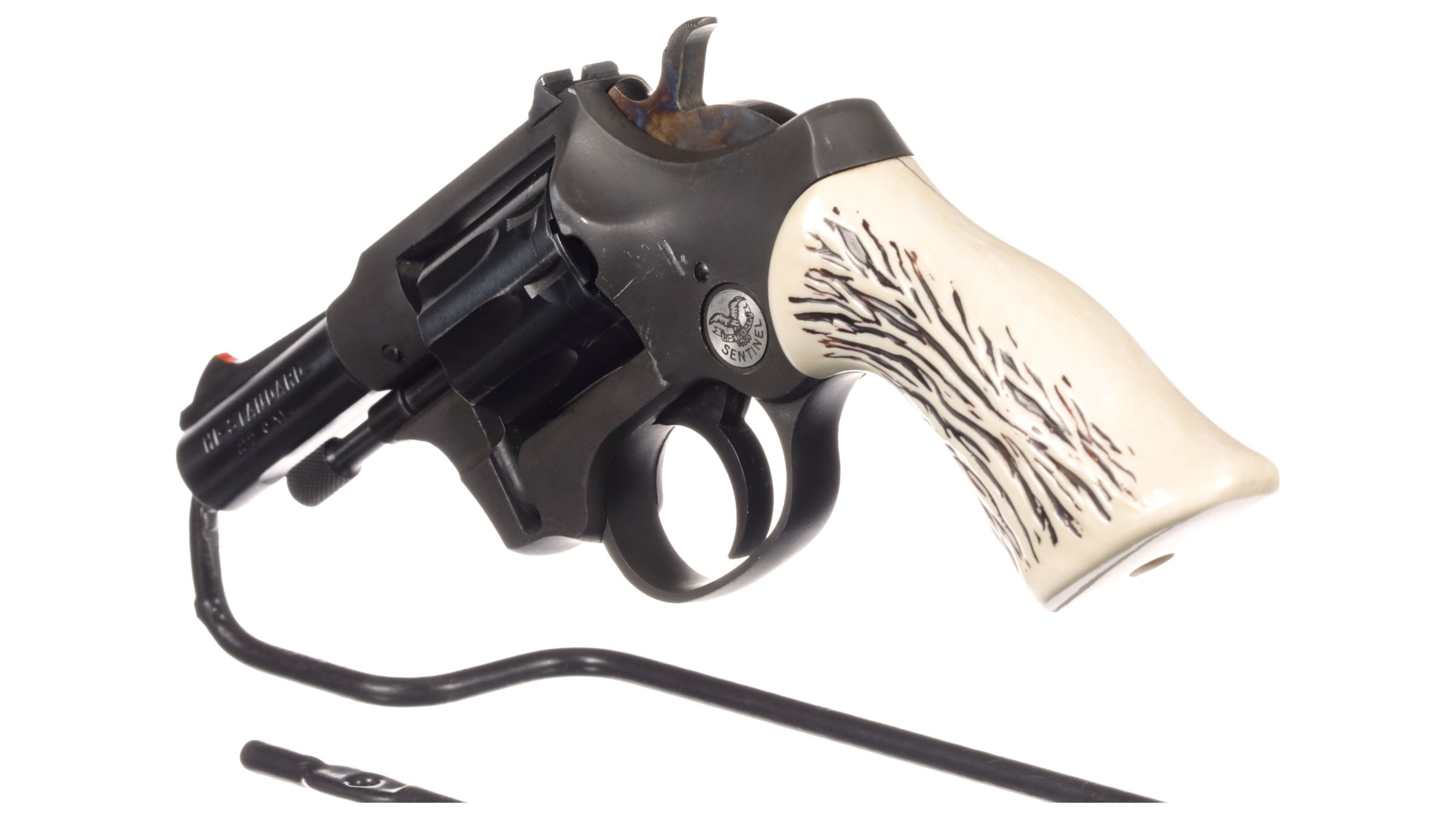
- Moulded stag — a catalogue option, part 7212, priced $5.00 in 1956 and $4.96 in 1961. “Add beauty to your Sentinel with Molded Stag Grips.”45
- Two-piece checkered, wood-grain — the Sentinel Deluxe, R-106 and later.
- Two-piece walnut on a full grip frame — the Imperial.
- J. C. Higgins — a one-piece grip with a crowned “J. C. Higgins 88” medallion.
5.7 The Snubs, and the Colour Guns
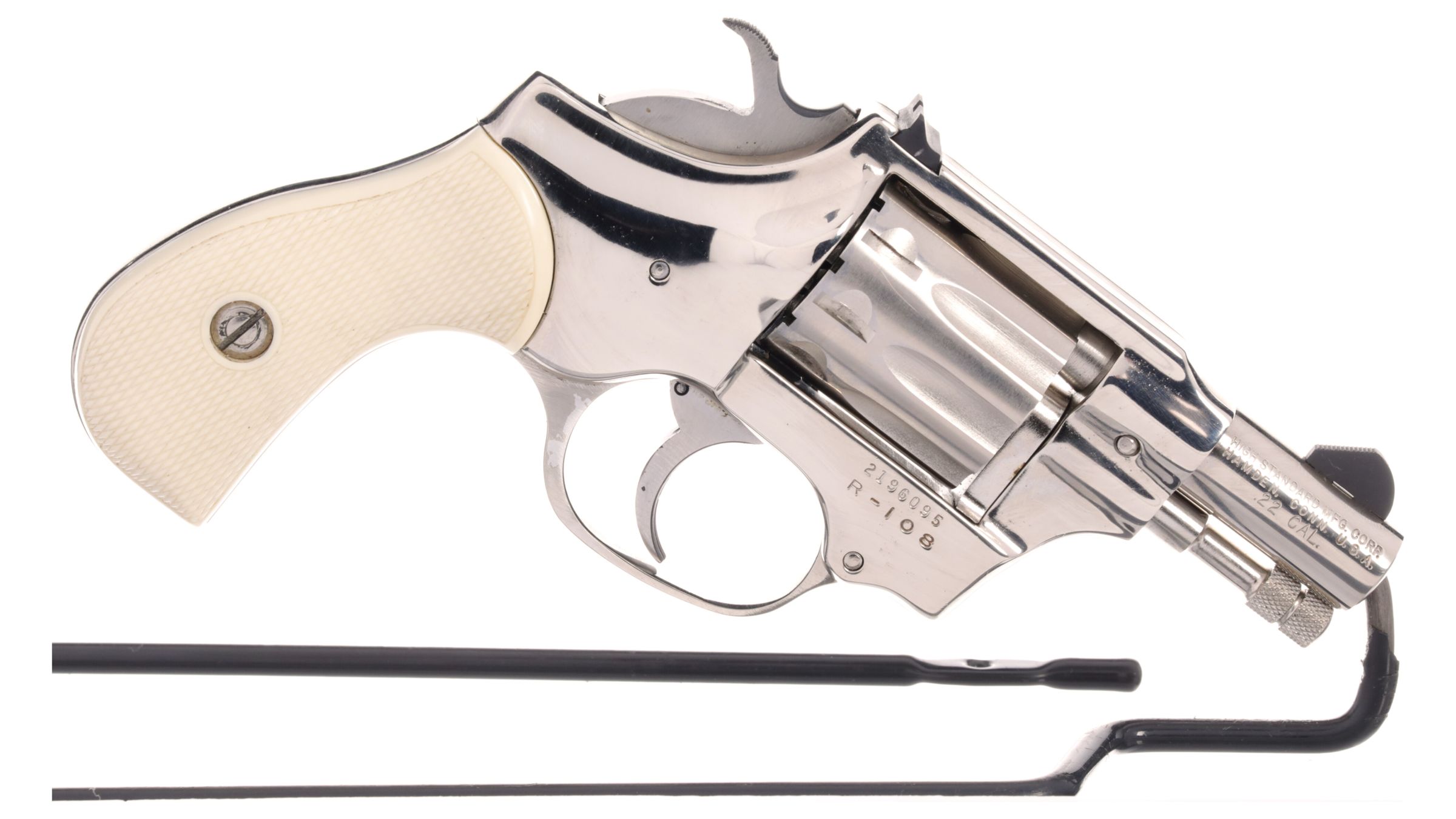
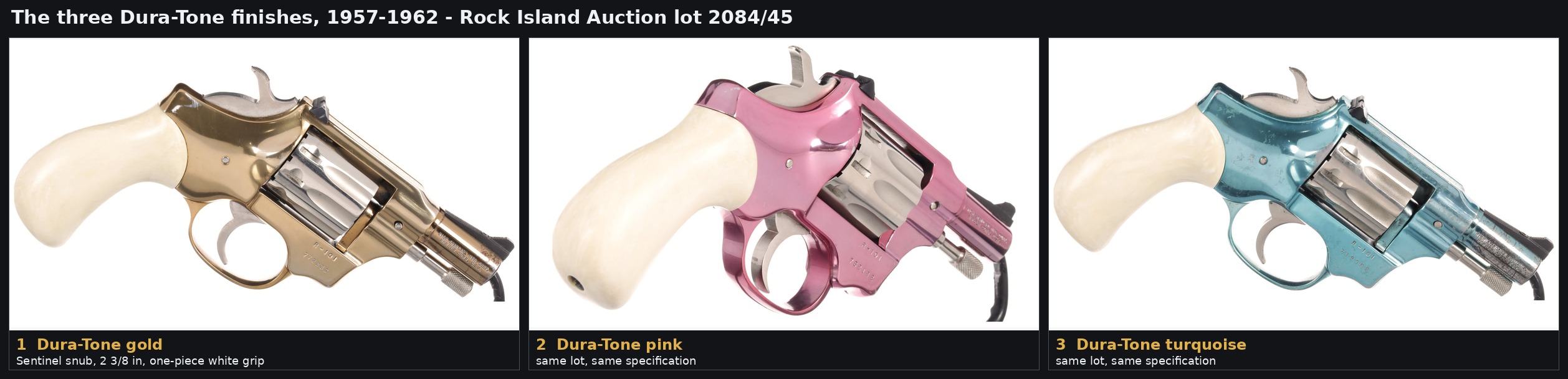
The snub arrived in 1957 with a round butt, and its hammer changed: bobbed until about 1960, spur thereafter, with no change in catalogue number.18 Catalogue numbers, from Buffaloe: blued #9144, nickel #9145, and Dura-Tone gold #9161, turquoise #9162, pink #9163; from 1967, blued #9344 and nickel #9345.1
On a genuine colour gun, from the maker’s parts list and from the photographs: the frame, trigger guard and crane are the colour; the hammer and trigger are nickel; the grip is the white “Bone” round-butt; and the barrel is colour-toned to match — Numrich still catalogues a “Barrel, 2-3/8”, Gold Tone” as a separate part.59 Volume 2 sets out how to judge whether the colour is original.
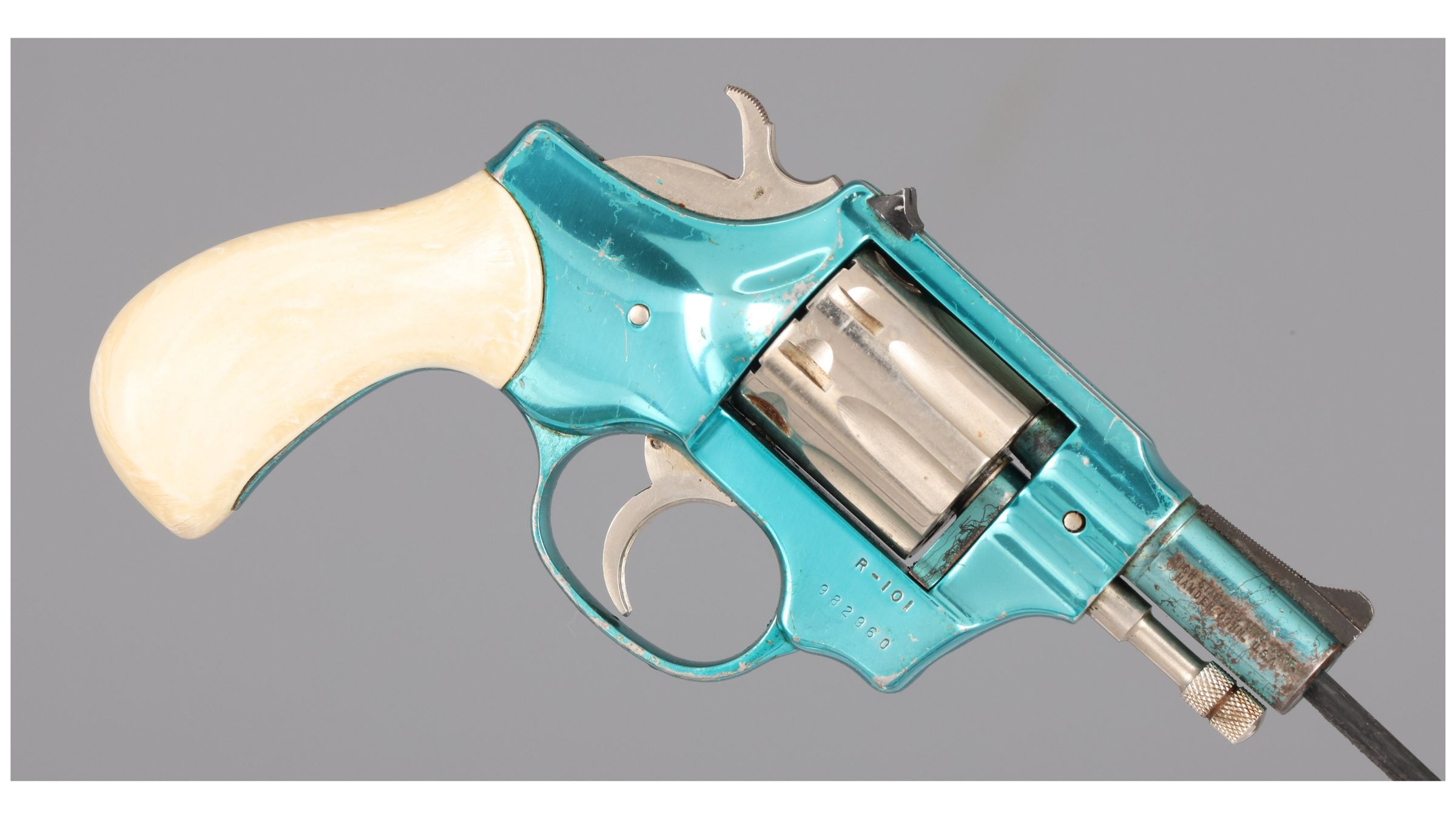
⚠ A colour gun can be mislabelled by people who ought to know. In the auction record examined for Volume 6, a turquoise Dura-Tone snub was catalogued with its finish given as “blue/bright” and its title as a plain Model R-101, with no mention of Dura-Tone; it sold on the same day as a gold one, for less than half as much. Read the photographs, not the finish field.
5.8 The Private Labels
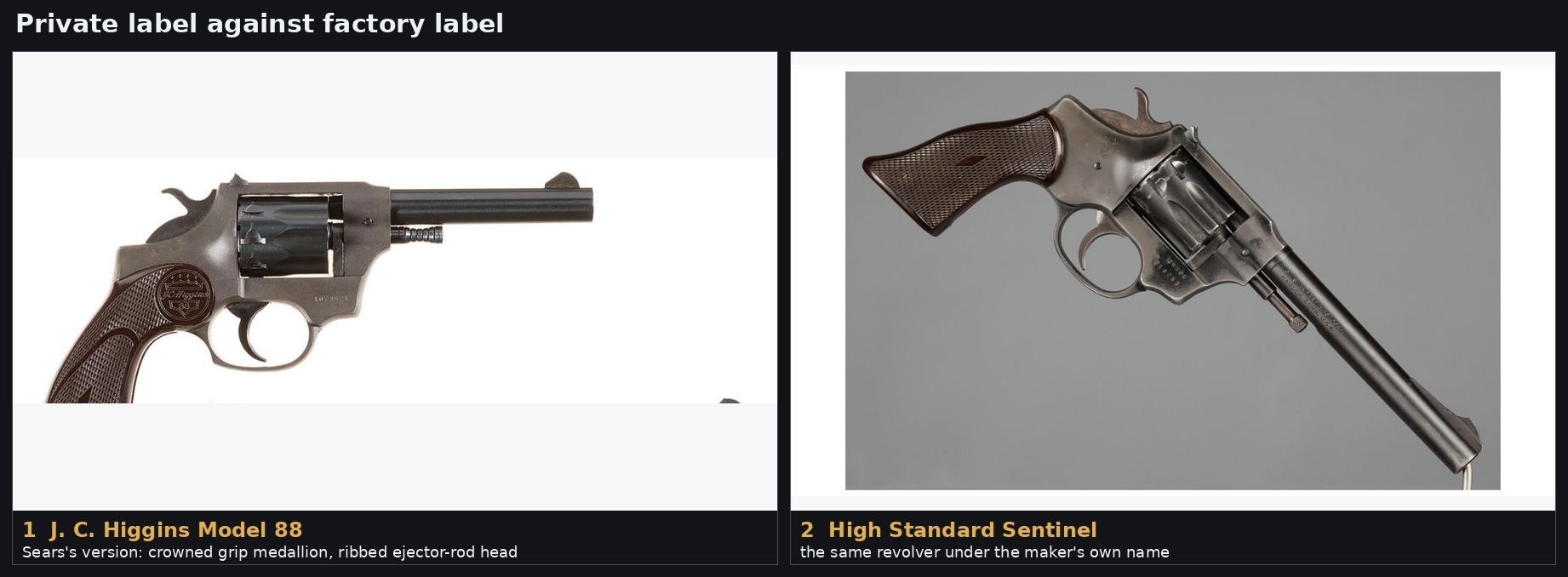
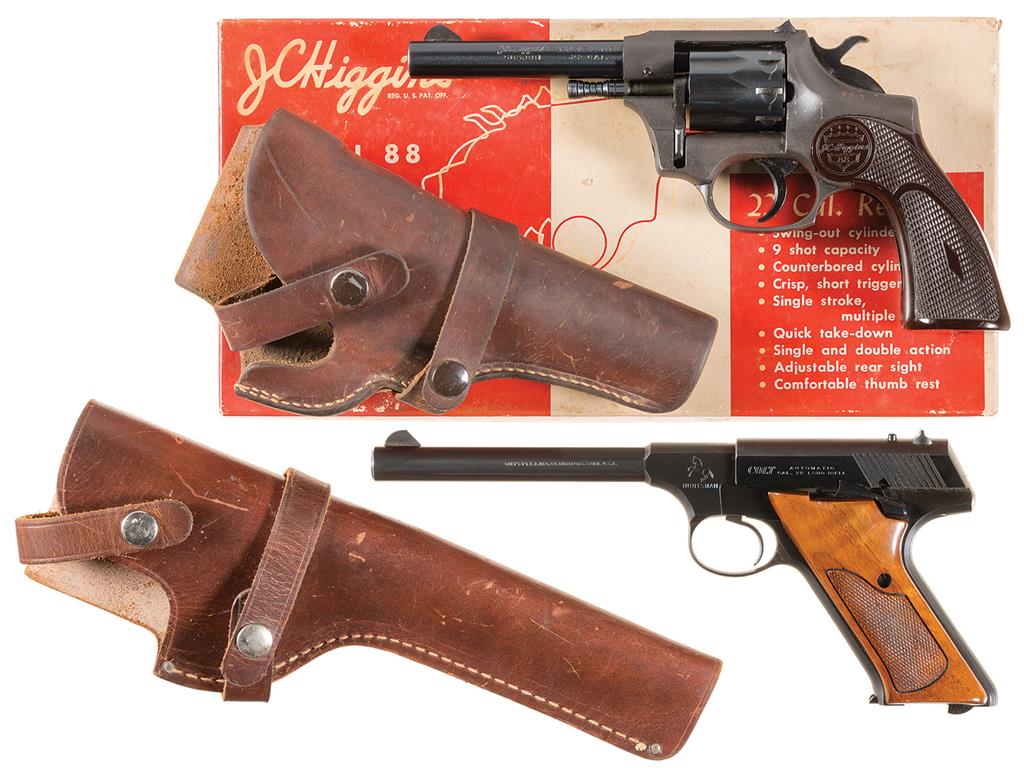
- J. C. Higgins Model 88 (Sears). The original private label, and the reason the Sentinel exists (Volume 1). Buffaloe records that the Higgins guns were given “distinctive grips, cylinder flutes, and cylinder release pins”.1 In the photographs examined the differences that show are the crowned grip medallion and the ribbed head on the ejector rod; the booklet gives Sears model number 583.880 and a choice of four- or six-inch barrel.10
- J. C. Higgins Model 88 Fisherman (Sears). The snub, blued only, with a one-piece brown checkered grip and — the identifying feature — a spur on the trigger guard.1
- Revelation Model 99 (Western Auto). The snub in blue and nickel. Early guns have the one-piece grip and the trigger-guard spur; later ones have a two-piece grip and a plain guard.1
- Armamex (Mexico). Colonel Rex Applegate’s company. No further detail was located.1
- Armscor Model P (Philippines). High Standard licensed the Sentinel to Armscor, a subsidiary of Squires Bingham, in the second half of the 1950s. The guns carry no R-series number; the right side is stamped P followed by the serial. Buffaloe suspects the parts were American and the assembly Philippine, but says so as a suspicion.1
🔴 No photograph of a Revelation 99, an Armamex or an Armscor Model P was located for this dive — Wikimedia Commons has none, and none appeared in the auction record examined. They are described here and not illustrated, rather than illustrated with a stand-in.
5.9 The Guns That Are Not Sentinels
Three things are sold as Sentinels and are not:
- The Sentinel Mark II and Mark III. Rebadged Dan Wesson .357 Magnum revolvers, sold from mid-1973 to February 1975. They are large, steel, and shaped nothing like a Sentinel — panel 6 of the model plate above shows one. Buffaloe adds the correction that runs the other way too: the rumours that High Standard made the Dan Wesson revolvers “are completely untrue”.1
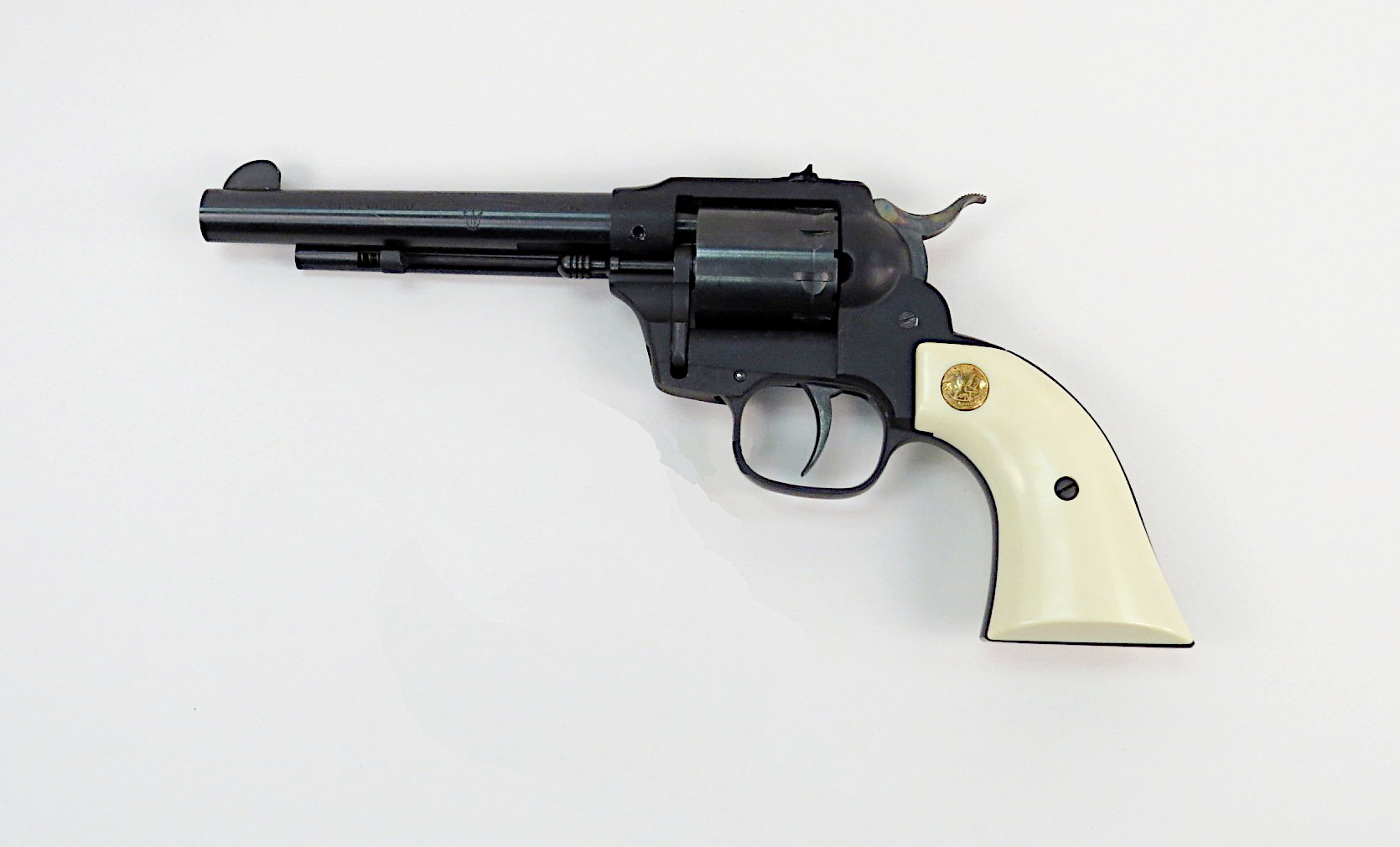
- The Double-Nine and the western line. Spun off the Sentinel in 1958 and built on the same lockwork — the W-104 parts list repeats Sentinel part numbers for the barrel pin, crane link bearing, cylinder bushing, cylinder stop, hammer pawl group, hammer safety stop and trigger pivot pin — but with a western grip frame, a dummy ejector-rod housing and an ejector latch.11 Sears sold it as the J. C. Higgins Ranger Model 90.1
- The modern NAA Sentinel. North American Arms’s current catalogue includes a swing-out-cylinder mini-revolver called the Sentinel, described in this hub’s NAA mini-revolver dive. It has nothing to do with High Standard beyond the name.
5.10 Tell Them Apart: the Table
Table 2 — Tell Them Apart: the Table
| Feature | R-series Sentinel | Sentinel Deluxe / Imperial | Mark I / Mark IV | Double-Nine | J. C. Higgins 88 | Mark II / Mark III |
|---|---|---|---|---|---|---|
| Frame material | aluminium | aluminium | steel | aluminium | aluminium | steel (Dan Wesson) |
| Cylinder release | push the ejector rod forward | same | same | ejector latch under the barrel | same as Sentinel | Dan Wesson latch |
| Ejector rod | exposed | exposed | shrouded by a barrel underlug | in a dummy housing | exposed, ribbed head | shrouded |
| Grip | one-piece plastic | two-piece; walnut on the Imperial | wrap-around walnut | two-piece, often ivory-coloured | one-piece with crowned medallion | large target grips |
| Butt | square, or round on the snub | square; full frame on the Imperial | round | western | square | square |
| Chambering | .22 S/L/LR | .22 S/L/LR | .22 LR or .22 WMR | .22 S/L/LR | .22 S/L/LR | .357 Magnum |
| Frame marking | R-100 to R-109 | R-104, R-106, R-107 | no R number | W-1xx | Sears 583.880, no R number | Mark II / III |
| Where to look | left of frame, below the cylinder | same | barrel and frame | same | grip medallion and box | barrel |
5.11 Boxes
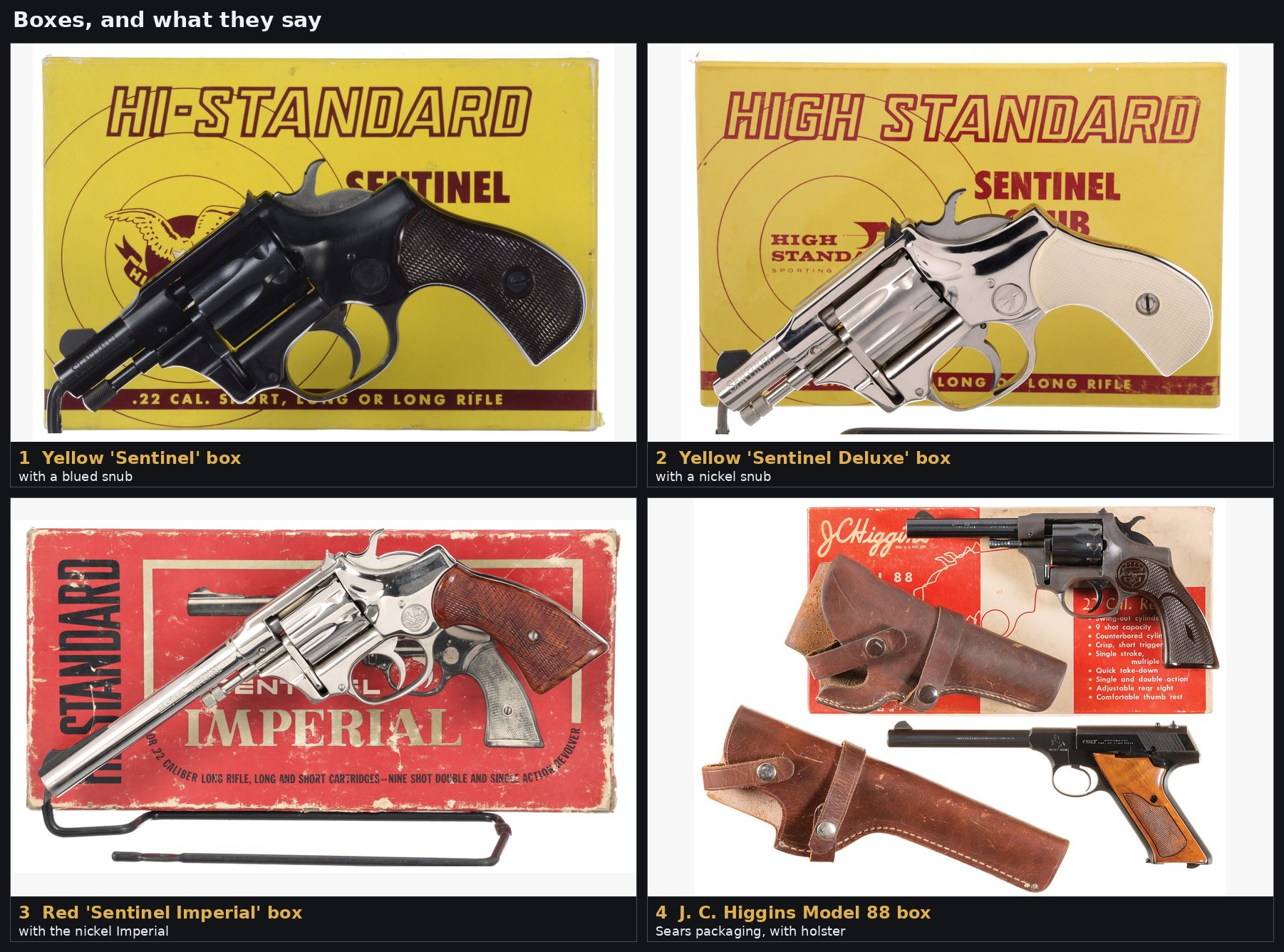
Boxes matter to value (Volume 6) and they also identify. The pattern in the photographs examined is a yellow box with a target and an eagle for the plain Sentinel and the Sentinel Deluxe, a red box for the Sentinel Imperial and for at least one Deluxe, and a red-and-white Sears box for the J. C. Higgins Model 88, whose printed feature list (“9-shot capacity — counterbored cylinder — crisp, short trigger pull — single stroke, multiple ejection — quick take-down — single and double action — adjustable rear sight — comfortable thumb rest”) is the best short description of the revolver anyone wrote. Auction lots repeatedly describe boxes as “hand numbered to match”, so a matching box is checkable.
5.12 Dating a Sentinel
With no date code and no published serial table, dating runs through the series number and the features:
- Read the series number on the frame and place it in the table above.
- Look at the ejector rod. No return spring means a gun before the R-102 of 1961 — and check the left side of the frame ahead of the cylinder for the scratch those guns wear.
- Look at the hammer on a snub. Bobbed means before about 1960; spur, after.8
- Look at the grip. One piece is early, two-piece Deluxe from 1965, wrap-around walnut from 1974.
- Look at the logo. Eagle on the frame is R-100; a trigger logo is R-108.1
- If it is steel, it is 1974 or later.
And the one number worth remembering from Volume 1: the first ten Sentinels were stamped with serials in the 350,000 range, from the automatic-pistol numbering machine, before the revolver series restarted at 1.2
References
Footnotes
-
Ed Buffaloe, “The High Standard Sentinel Revolver”, Unblinking Eye, https://unblinkingeye.com/Guns/Sentinel/sentinel.html , consulted 2026-09-19. The series-by-series account in this volume follows Buffaloe, who cites Spacek (1998) and the High Standard Collectors’ Association newsletter; neither was obtained here. ↩ ↩2 ↩3 ↩4 ↩5 ↩6 ↩7 ↩8 ↩9 ↩10 ↩11 ↩12 ↩13 ↩14 ↩15 ↩16 ↩17 ↩18 ↩19 ↩20 ↩21 ↩22 ↩23 ↩24 ↩25 ↩26 ↩27 ↩28 ↩29
-
William B. Edwards, “The First New Revolver in 50 Years”, Guns, June 1955, pp. 6–7 and 37, from https://web.archive.org/web/20120505205714/http://www.gunsmagazine.com/1955issues/G0655.pdf , retrieved 2026-09-19. ↩ ↩2
-
High Standard parts price list 990-55, Model “R” Sentinel, undated. ↩
-
High Standard parts price list 990-93, Models R-100 and R-101, 6/56. ↩ ↩2
-
High Standard parts price list 997-99, Model R102 including the Dura-Tone colours, 1/61. ↩ ↩2 ↩3 ↩4
-
High Standard parts price list 5509, Sentinel Deluxe R-106, 1965. ↩
-
High Standard Sporting Firearms parts breakdown 53951, Mark I and Mark IV Sentinel, 4/74. All six sheets from https://www.histandard.info/manuals/hprevolvers/ , retrieved 2026-09-19. ↩ ↩2
-
“HIGH STANDARD Sentinel Aluminum Frames”, Gun Values by Gun Digest, https://gunvalues.gundigest.com/high-standard/6301/sentinel-aluminum-frames/ , consulted 2026-09-19. ↩ ↩2
-
Numrich Gun Parts Corporation, “High Standard Revolvers Sentinel R-101”, Internet Archive capture of 24 June 2025. ↩
-
Sears, Roebuck and Co., “J. C. Higgins Model 88” owner’s booklet and parts list 990.50, Sears model 583.880, https://archive.org/details/gunmanual_Jchiggins_88 . ↩
-
High Standard parts price list 996-68, Model W-104 Double-Nine, undated (Internet Archive item gunmanual_Histandard_W104). ↩
Comments (0)