High Standard Sentinel · Volume 2
Cast, Anodised, and Sold by Colour — the Dura-Tone Snubs of 1957–62
Why a 1955 revolver frame was die cast in aluminium, what anodising actually is, why the gold, turquoise and pink fade, and how an original colour is told from a re-anodised one
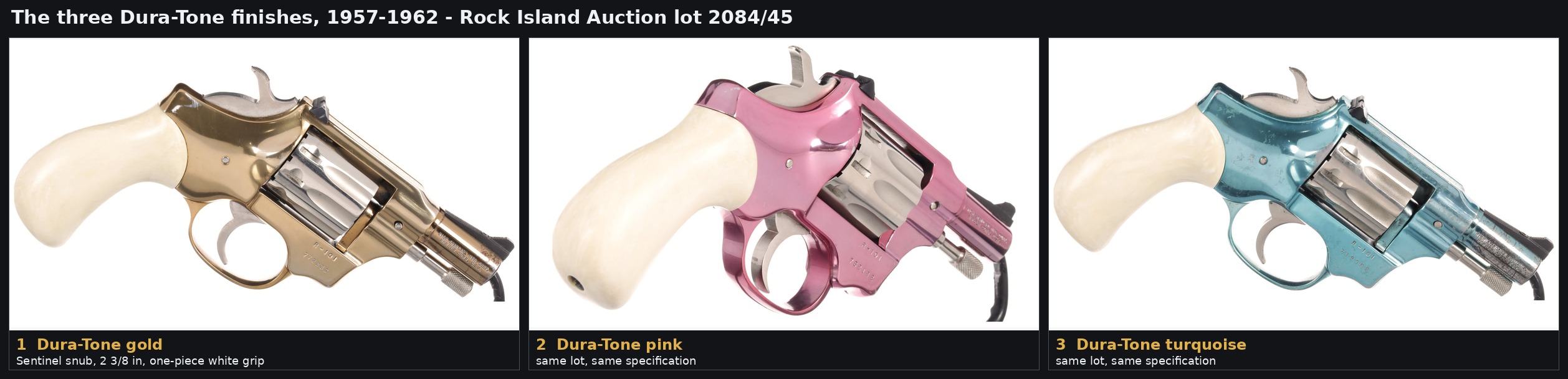
Most of the guns in this hub’s space-age series are recognisable in outline: the Whitney’s tube-topped fuselage, the AR-7 packed into its own stock, the Gyrojet’s bare rocket tube. The Sentinel is not. In silhouette it is a conventional swing-out .22 revolver, and a plain blued one is a plain blued gun. What makes it a 1950s object is what it is made of and what colour it was offered in — an anodised aluminium casting, finished for two years and a bit in gold, turquoise and pink, with imitation ivory grips and a wooden presentation case. That is the argument of this volume: the space age reaches this gun through the finishing department, not the drawing office.
2.1 The Argument: Colour, Not Silhouette
Three facts hold the argument up, and all three come from the maker or from the period press:
- The frame is die cast in aluminium, a consumer-goods process, and the designer chose it explicitly to hold down cost.1
- The finish is anodising, the finish of period cookware, camera bodies, hearing aids and car trim — not of guns.1
- From 1957 the snub-barrelled model was sold in three named colours, and the factory’s own parts list prints those names — “Dura-Tone Gold, Turquoise, Pink” — in the same line as “Blued and Nickel”.2
A blued Sentinel hides all three. A pink one announces them.
2.2 Why the Frame Was Cast
Sefried’s reasoning, as Edwards reported it in June 1955, is one paragraph and it is the whole economic argument for the gun:
“Die casting seemed to Harry a good way to make a precision part with a minimum of fuss and machining. Dies cost a fabulous amount, but in production, costs on each part can be reduced to little more than the value of the raw material. Thus the frame parts of the Sentinel are of precision-cast aluminum, anodized to a pleasing dull-gray matte finish.”1
That is the trade every die caster makes: an enormous fixed cost in tooling, bought back over a long run in parts that need almost no machining. It only works if the run is long — and Sears had effectively guaranteed the run before the first gun was made, because the advance orders matched a year’s planned production within a month of the announcement (Volume 1).1
The second argument was corrosion. “For a ‘service’ gun, to be tossed into the fishing kit or dropped in the mud accidentally, rustless aluminum has plenty on its side as a gun material,” Edwards wrote. “About the only parts likely to get rusty on Harry’s latest wonder are the easily-cleaned barrel and cylinder.”1 For a tackle-box revolver that is not marketing; it is the point of the specification.
The third was weight: 21 ounces, which Edwards called light “for a man-sized gun”.1
2.3 What Die Casting Gave the Sentinel
Casting is not merely a cheaper way to make the same shape. It changes what shapes are available, and two Sentinel features exist because of it.
The moulded thumb rests. Both sides of the frame, behind the cylinder, carry a raised thumb rest formed in the casting. Edwards singled them out — “the moulded thumb rests, integral with the frame, make the Sentinel absolutely the finest of any factory revolver grip available” — and a raised pad on each side of a frame is exactly the sort of feature that costs nothing in a die and real money in a milling setup.1
The clean sides. There is no cylinder thumb latch, no side plate and no screws but one. A conventional revolver has a machined side-plate opening for assembly; the Sentinel is assembled instead by splitting the frame horizontally into an upper housing and a trigger-guard-and-grip unit, pinned together (Volume 3). The 1955 caption makes the visual point: the Sentinel “has thin cylinder crane, which swings left, and clean frame styling, without usual revolver thumb latch”.1
A caution is owed here. Die casting is used above for what the sources actually say; the alloy High Standard cast the frames in was not stated in any source located and is not guessed at here.
2.4 Aluminium Cannot Be Blued
Bluing is controlled rusting — a black iron oxide grown on steel. There is no equivalent on aluminium, which is why every aluminium-framed gun of the period had to borrow a finish from another industry. High Standard’s answer, from the first gun, was anodising, and the early Sentinel’s “blued” finish is a trap for anyone reading auction listings: Buffaloe records that the original dark finish was a selenium black, not blue, on a frame that could not have been blued in the first place.3 The barrel and cylinder are steel and are genuinely blued or nickel-plated; the frame beside them is anodised. On a well-used gun the two age differently, and that is normal, not evidence of a refinish.
The hub’s Whitney Wolverine dive makes the same point about the other Connecticut aluminium handgun of the period, which was finished in a two-tone black-grey anodise.
2.5 What Anodising Is
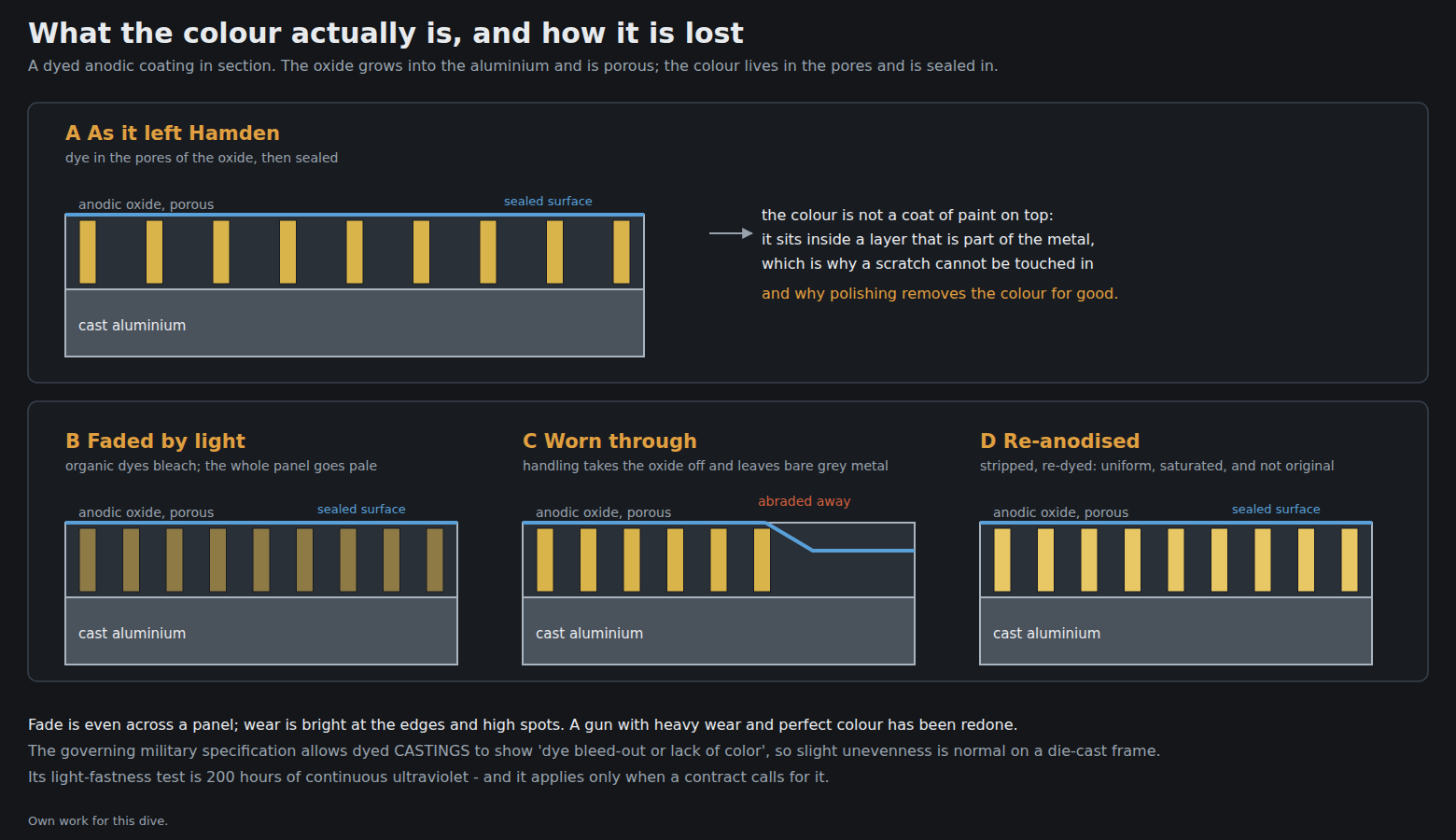
Anodising is an electrochemical process, not a coating laid on top of the metal. The part is made the anode in an acid electrolyte; oxygen liberated at its surface converts the outer skin of aluminium into aluminium oxide, which grows into the metal as well as outward, and which is porous. Colour is introduced by soaking the porous oxide in dye before the pores are closed by sealing.
No High Standard process record was located, and none of the collector literature names the type of anodising used. What can be said precisely comes from the US military specification that has governed the process for decades, MIL-A-8625, which postdates the Sentinel and is quoted here only for the general framework it sets out:4
- Coatings are divided into types (chromic, sulfuric, hard) and two classes: Class 1 non-dyed, Class 2 dyed.
- For Class 2, “the anodic coating shall be uniformly dyed or pigmented by exposure to a solution of a suitable type dye or stain”.
- 🔴 And, directly relevant to a die-cast frame: “The color on wrought alloys shall be uniform. Cast alloys may exhibit dye bleed-out or lack of color (or color uniformity) associated with the inherent porosity of the casting.”
That last clause is the single most useful technical sentence in this volume. A Sentinel frame is a casting that has been dyed: slight unevenness of colour is a property of the process, written into the standard, and not by itself evidence that a gun has been messed with.
2.6 Dye, and Why Colour Fades
Anodic dyes are, in the main, organic dyes, and organic dyes bleach in ultraviolet light. The specification treats this as a measurable property rather than an accident:4
- The light-fastness test exposes dyed specimens to 200 hours of continuous ultraviolet radiation and then measures the colour difference against unexposed duplicates.
- The requirement is that a dyed coating “shall show no more fading or discoloration than would be equivalent to a Delta (E) value of 3”.
- And the sting: “Light fastness resistance shall be determined only when specified in the contract, purchase order or applicable drawing.”
In other words, even where a standard exists, colour retention is tested only if the customer asks for it — and a 1957 sporting-goods catalogue gun sold for its looks is not a contract with a light-fastness clause. Whether High Standard’s Dura-Tone dyes were selected for light fastness is not recorded in any source located. What survives is the evidence on the guns: turquoise examples in the auction record run from a clear sky-blue to a greyed, patchy blue, and gold examples from a bright brassy tone to a pale wash. Two different pinks can be two ages of the same dye.
A second mechanism matters as much as light. The oxide layer is thin and hard but the colour lives in its pores, so anything that abrades the surface — a holster, a pocket, a cleaning cloth with grit in it — takes the colour off locally and leaves bare grey aluminium, not a faded tint. Handling wear on a colour Sentinel therefore shows as silver highlights at the edges, while light damage shows as overall fading of the whole panel. Reading which one a gun has is the first step in the authentication test below.
2.7 The Dura-Tone Snubs
The snub-barrelled Sentinel arrived in 1957: a 2⅜-inch barrel on a round butt, with a bobbed hammer at first and a spur hammer from about 1960.35 With it came the colours. Buffaloe gives the catalogue numbers, from the standard collector reference: blued #9144, nickel #9145, and in the Dura-Tone finishes gold #9161, turquoise #9162, pink #9163, the colour guns supplied in a deluxe presentation case with white faux-ivory grips.3 When the R-108 series began in 1967 the snub numbers changed to #9344 blued and #9345 nickel — by which time the colours were long gone.3
Gun Digest’s value listing dates the colour offering precisely and describes the specification independently: “From 1957 through 1962 High Standard offered 2.375” snub-barreled Sentinel in three different color anodized frames. These guns had nickel-plated cylinders, triggers and hammers. Grips were round-butt ivory-colored plastic.”5 That is the same gun as Buffaloe’s, seen from the other side, and the two agree.
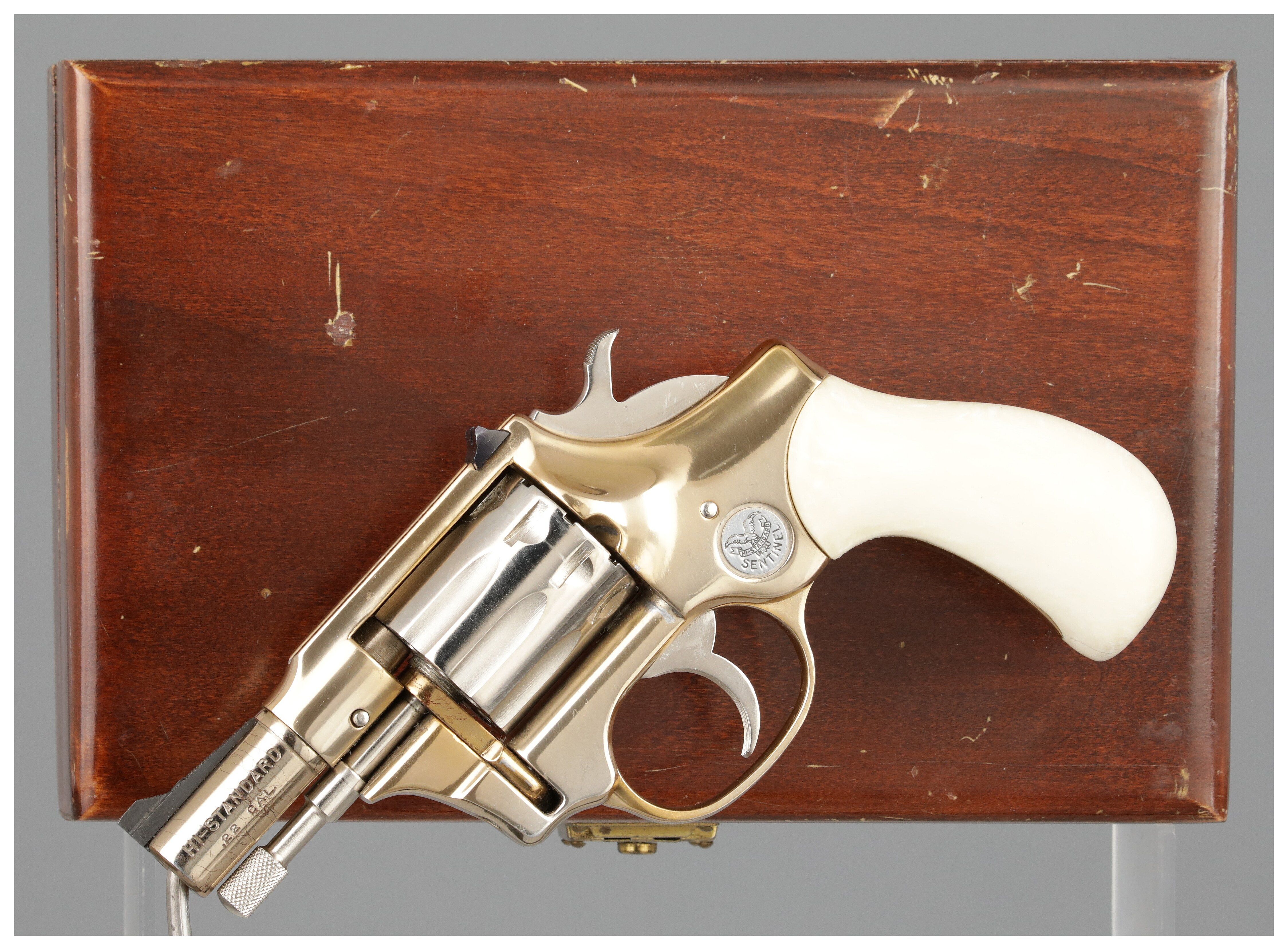
Nothing located gives a production figure for the colour guns, and none is asserted here. The circumstantial evidence for their scarcity is the auction record in Volume 6: in an examined run of forty-one Sentinel-family lots sold between 2014 and 2026, three lots contained Dura-Tone revolvers, five guns in all — and one of those three was catalogued without the word Dura-Tone anywhere in it.
2.8 What the Factory Parts List Says the Colour Guns Were
The single best document on the Dura-Tone guns is not an advertisement. It is the R-102 parts price list, sheet 997-99, dated January 1961, whose title line reads:
“‘SENTINEL’ MODEL R102 BLUED AND NICKEL, SNUB-BARREL BLUE, NICKEL; DURA-TONE GOLD, TURQUOISE, PINK — FOUR-INCH BARREL MODELS”2
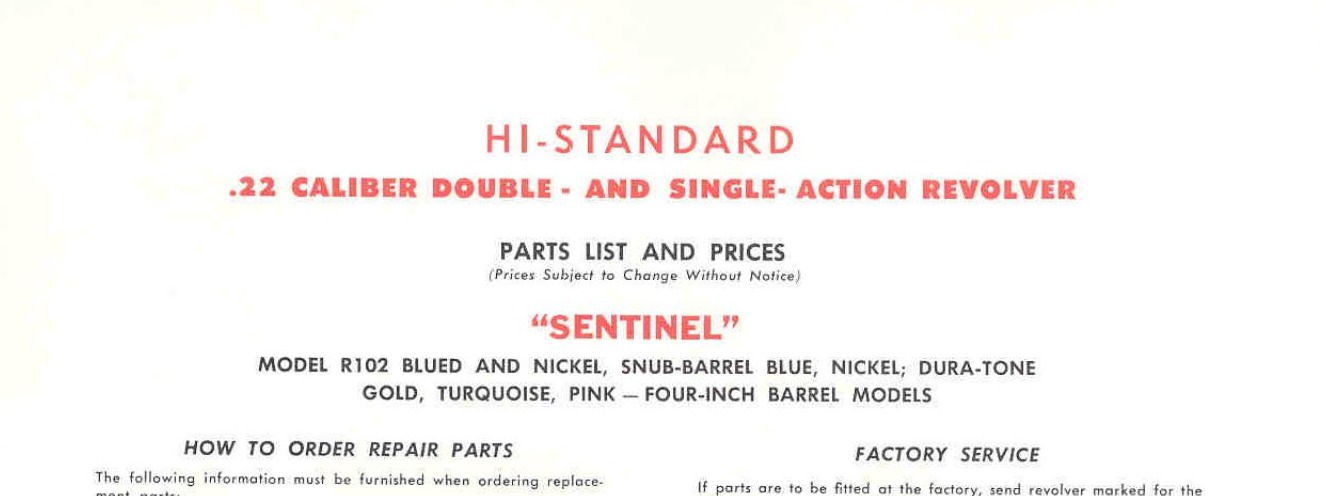
Inside, the colour guns have their own part numbers, and the list settles several things at once:
Table 1 — Inside, the colour guns have their own part numbers, and the list settles several things at once
| Part | Colour-gun entry, as printed in 1961 | Price |
|---|---|---|
| Frame | ”Frame, Snub Colored (Not Sold Separately)“ | — |
| Trigger guard | ”Trigger Guard, Snub Colored” | $6.00 |
| Crane assembly | ”Crane Assembly, Snub Colored” | $3.85 |
| Barrel, 2⅜ in | ”Barrel (2⅜”), Gold, Turquoise, Pink” | $6.75 |
| Barrel and sight assembly | ”Barrel & Sight Assembly (2⅜”), Colored, Gold, Turquoise, Pink” | $7.25 |
| Hammer | ”Hammer, Nickel, for Snub Colored Revolvers” | $4.75 |
| Trigger | ”Trigger, Nickel for Snub Colored Revolvers” | $3.75 |
| Ejector rod | ”Ejector Rod, Nickel, Snub Nickel, Snub Colored” | $1.50 |
| Grip | ”Grip, Round Butt, Bone, for Snub Colored” | $5.50 |
Three readings follow. First, the factory’s own word for the imitation-ivory grip was “Bone”, and at $5.50 it was the most expensive grip on the sheet — more than twice the $2.50 brown plastic grip. Second, the nickel hammer and nickel trigger confirm Gun Digest’s description from the maker’s side. Third, and least expected: one barrel part number covers all three colours. A steel barrel cannot be anodised, and the sheet does not say what finish the “Colored” barrel carried.
The answer turns up in a modern parts catalogue. Numrich’s Sentinel R-100/R-101 listing includes, as a distinct item, “Barrel, 2-3/8”, Gold Tone”, product number 877450 — priced at $49.36 and out of stock in the capture examined.6 And the auction photographs settle it visually: on a gold gun the barrel is gold-toned to match the frame, and on a turquoise gun it is turquoise. So the colour did run the length of the revolver, by some process applied to steel that no located source names — not by anodising, which reaches only the aluminium.
2.9 The Palette Was Not a Gun Palette
Gold, turquoise and pink are not colours that appear anywhere else in the 1957 firearms trade, and they are exactly the colours of the rest of the decade’s durable goods: anodised aluminium tumblers and cookware, camera and radio trim, and the gold-anodised aluminium cases of the body-worn hearing aids that Zenith was selling in the same years.
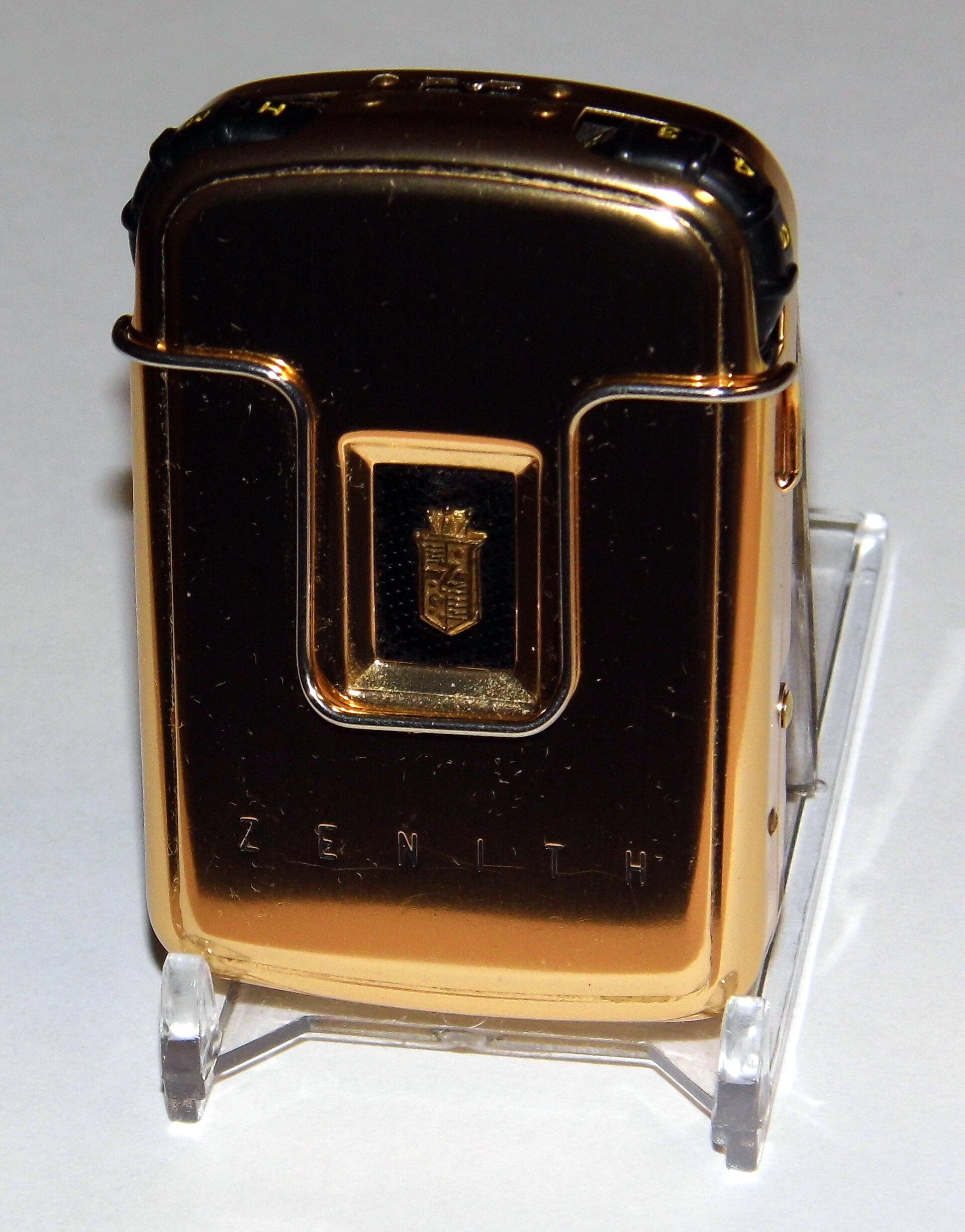
The claim sometimes made for these revolvers — that they were among the first handguns marketed to women by colour — is plausible and is not confirmed by any source located here; no High Standard advertisement aimed at women was found, and the claim is left as an open question in this dive’s README.md. What the documents do support is narrower and still interesting: the colour guns were sold cased, with the most expensive grips in the catalogue, at a time when the same company’s plain snub was a $40 fishing-kit gun. They were sold as presents.
2.10 Telling an Original Finish From a Re-Anodised One
Re-anodising is easy to buy and impossible to reverse: stripping takes the old oxide off, and with it a little metal, sharp edges and crisp lettering. There is no published High Standard finish specification to compare a gun against, so the tests below are inferences from how the process works and from what original guns show in the photographic record. They are stated as tests, not as certainties.
- Look at the markings. The frame carries roll-stamped model and serial markings, and the barrel a roll-stamped address. Stripping and re-anodising rounds the shoulders of stamped characters and softens the edges of the frame’s flats. Crisp, square-edged lettering with colour sitting evenly in and around it is the strongest single sign of an untouched frame.
- Expect a little unevenness, and be suspicious of perfection. A dyed casting is allowed by the governing specification to show “dye bleed-out or lack of color (or color uniformity)”.4 A sixty-year-old colour frame with absolutely uniform, saturated colour is more likely to have been redone than to have survived.
- Check that wear and colour agree. A gun with honest handling wear — bright edges on the frame corners, a worn patch where a hand sits, muzzle wear — should also show some dye fade on the flats. Heavy mechanical wear under perfect colour means the colour is newer than the wear.
- Compare the frame with the steel. On an original colour gun the cylinder, hammer and trigger are bright nickel and the barrel is colour-toned to match the frame. A colour frame paired with a blued barrel, or with a plain steel-grey cylinder, is a gun that has been assembled from parts — which is not a fault in a shooter, but it is not an original Dura-Tone.
- Look inside the frame window and under the grip. Areas that never see light or wear keep their original colour best; a marked difference in shade between the sheltered metal under the grip and the exposed flats is the fade the gun has actually taken. If the sheltered area is the same saturated colour as everything else, the whole frame has been done at once.
- Match the grips. The factory colour-gun grip is the one-piece round-butt “Bone” plastic with a medallion. White two-piece grips, or grips whose colour is a good match for modern ivory-coloured plastic, belong to a later rebuild.
None of these is conclusive on its own; three of them together usually are. And a re-anodised Sentinel is not worthless — it is simply not a collector’s original, and Volume 6 shows what the market pays for each.
2.11 Living With a Colour Gun
The care rules follow from the chemistry, and they differ from steel-gun habits.
- Strong alkaline cleaners attack anodising. So do many modern solvents and degreasers formulated for steel. The maker’s own instruction for these revolvers was kerosene or a good-quality cleaning solution, applied sparingly and wiped dry, with silicone gun oil for rust prevention on the steel parts.7 Nothing in that routine needs to touch the frame.
- The colour cannot be touched up. There is no anodising equivalent of cold blue for a scratch. A repair means stripping and re-dyeing the entire frame, which destroys originality (above) and removes metal from a frame whose dimensions matter to the fit of the lockwork.
- Store it out of the light. The one damage mechanism that will work on a gun sitting still in a display case is ultraviolet fading; 200 hours of continuous UV is the standard’s own test duration, and a sunny window will supply far more than that over a few summers.4
- Do not polish it. Polishing compound removes the oxide, and under the oxide there is nothing but grey aluminium.
Volume 3 turns from the outside of the gun to the inside, and to the mechanism Sefried claimed as his own.
References
Footnotes
-
William B. Edwards, “The First New Revolver in 50 Years”, Guns, June 1955, pp. 6–7 and 37, from the Internet Archive copy of the publisher’s PDF, https://web.archive.org/web/20120505205714/http://www.gunsmagazine.com/1955issues/G0655.pdf , retrieved 2026-09-19. ↩ ↩2 ↩3 ↩4 ↩5 ↩6 ↩7 ↩8
-
The High Standard Manufacturing Corporation, parts price list 997-99, “‘SENTINEL’ Model R102 …”, dated 1/61, from John Stimson Jr’s High Standard archive, https://www.histandard.info/manuals/hprevolvers/ , retrieved 2026-09-19. ↩ ↩2
-
Ed Buffaloe, “The High Standard Sentinel Revolver”, Unblinking Eye, https://unblinkingeye.com/Guns/Sentinel/sentinel.html , consulted 2026-09-19, citing Spacek (1998) and Waldinger (2009) among others. ↩ ↩2 ↩3 ↩4
-
MIL-A-8625F, Anodic Coatings for Aluminum and Aluminum Alloys, 10 September 1993, §§ 3.6, 3.6.1.1, 3.7.1.3 and 4.5.4. Obtained from everyspec.com, 2026-09-19. The specification is decades younger than the Sentinel and is cited only for the general description of dyed anodic coatings and their light-fastness test. ↩ ↩2 ↩3 ↩4
-
“HIGH STANDARD Sentinel Aluminum Frames”, Gun Values by Gun Digest, https://gunvalues.gundigest.com/high-standard/6301/sentinel-aluminum-frames/ , consulted 2026-09-19. The descriptive text is public; the values themselves are behind a login and are not used here. ↩ ↩2
-
Numrich Gun Parts Corporation, “High Standard Revolvers Sentinel R-101” catalogue page, as captured by the Internet Archive on 24 June 2025, https://web.archive.org/web/20250624194925/https://www.gunpartscorp.com/gun-manufacturer/high-standard/revolvers-hs/sentinel-r-101 . Prices and stock states are those of the capture date. ↩
-
The High Standard Manufacturing Corporation, parts price list 5509, “‘SENTINEL DELUXE’ Model R-106”, 1965, same archive. “Instructions for Operation and Care of Your ‘Sentinel’ Revolver” appears on the inner pages. ↩
Comments (0)