High Standard Sentinel · Volume 1
Hamden Builds a Revolver — Sears, Harry Sefried, and the 1955 Sentinel
How a Connecticut pistol house that had never made a revolver produced a nine-shot .22 with a die-cast aluminium frame in three months, at the request of its biggest customer
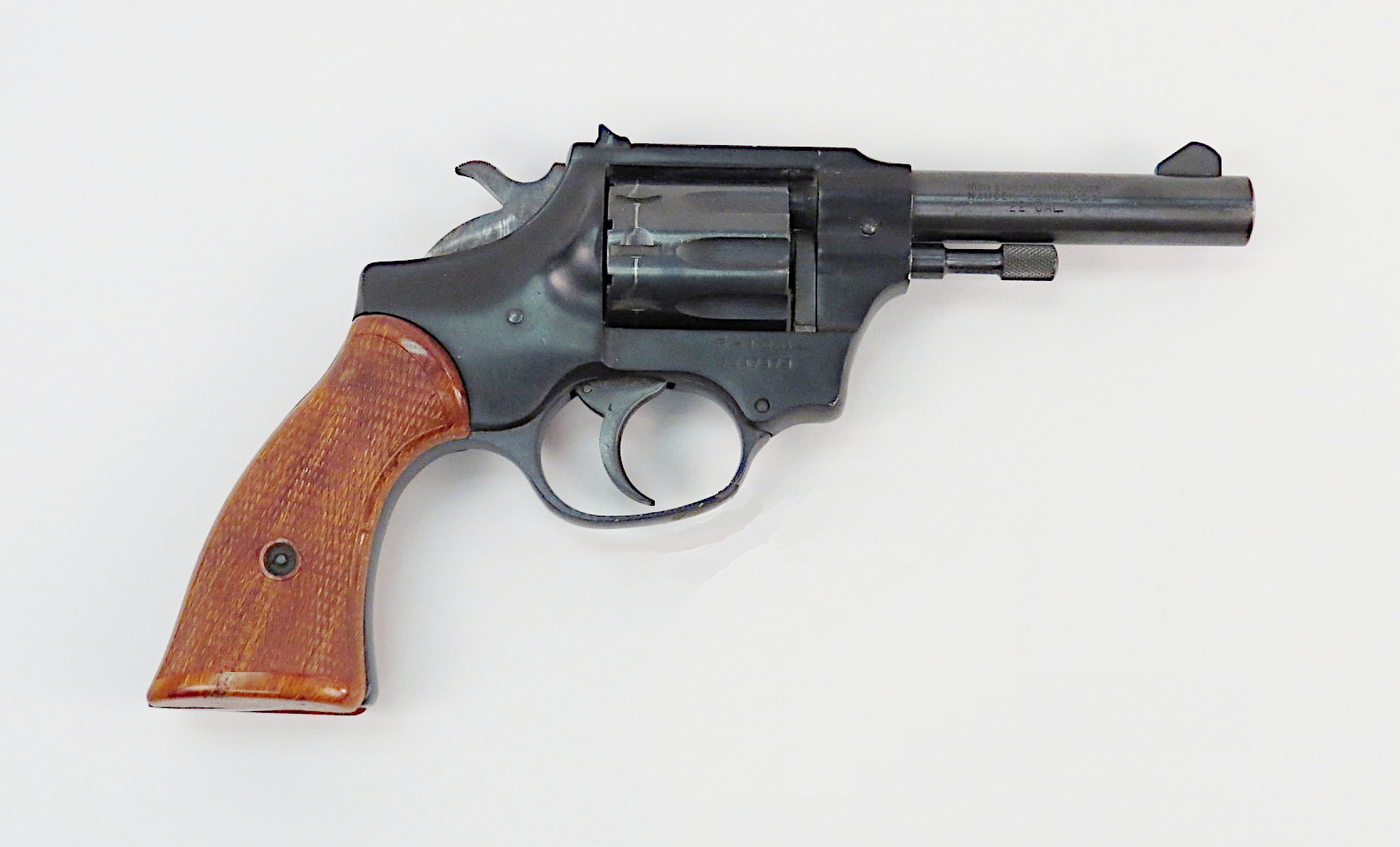
A revolver with an aluminium frame, nine chambers and no thumb latch was an odd thing in 1955, and the way it came about is odder still: a company that had built nothing but automatic pistols for a quarter of a century was asked by a mail-order house for a cheap fishing-tackle revolver, and handed the job to a 33-year-old engineer who finished the design in three months. The result stayed in production, in one form or another, for about thirty years, spawned a western-styled line, was sold under at least four other companies’ names, and in 1957 became the first American handgun offered in gold, turquoise and pink.
This volume is the history: the firm, the customer, the designer, and the gun’s first year. Volume 2 takes up the materials and the colour. Volume 3 is the mechanism, Volume 4 its upkeep, Volume 5 the identification of every model and private label, and Volume 6 the collecting and legal position.
1.1 What the Sentinel Was
Stated plainly, and from the maker’s own documents:123
- A nine-shot revolver in .22 Short, Long and Long Rifle, firing double action or single action.
- A swing-out cylinder with counterbored (recessed) chambers, released not by a thumb latch but by pushing the ejector rod forward.
- A frame die cast in aluminium and anodised, with a steel barrel and steel cylinder.
- One screw in the entire revolver, holding the grip on.
- About 21 ounces as introduced, with barrels that over the years ran 2⅜, 3, 4, 5 and 6 inches.
High Standard called it the “Sentinel” from the first sheet onward, and put an eagle over the name on its parts lists.4 The advertised feature list of 1955 reads like the era: “anodized aluminum frame, high-tensile carbon steel barrel and cylinder, single-stroke multiple ejection, a swing-out counterbored cylinder, a movable square-notched rear sight, a non-slip scored trigger, a diamond-checkered grip … and target accuracy”. The grip’s material went unmentioned in the advertising; it was plastic.5
1.2 The Company: Gun-Barrel Drills to Hamden
The High Standard Manufacturing Company was founded by Carl Gustav Swebilius, a Swedish-born gunsmith who had designed aircraft machine guns for Marlin-Rockwell during the First World War. The founding date is given two ways in the sources used here and they are not reconciled: Wikipedia says 1926, in New Haven; William B. Edwards, writing in Guns in 1955 with the company’s cooperation, says 1928 and spells the founder’s name Swebelius.63 Both agree on what the firm first sold — deep-hole gun-barrel drills, made by a handful of men in a garage — and on what changed it: in 1932 Swebilius bought the bankrupt Hartford Arms and Equipment Company, which had been making a Woodsman-style .22 automatic, and High Standard became a pistol maker.63
The pre-war Model B and Model C sold for fifteen to eighteen dollars. In 1939 British gun-barrel orders arrived and the plant turned into a barrel factory: Edwards lists .50 calibre Browning barrels for wing-mounted Hurricanes, and M1917 Enfield, 1903 Springfield and .30 and .50 Browning barrels for American forces.3 The company also built .22 training pistols for the services and, for the Office of Strategic Services, the suppressed HD-Military — the one High Standard product with a place in every history of clandestine arms.6 After the war the HD-Military sold commercially in numbers Edwards estimated at “approaching 100,000 pistols per year” from serial numbers — an inference of his, not a company figure.3
The plant that built the Sentinel was in Hamden, Connecticut, a suburb of New Haven, where High Standard worked from the mid-1940s until 1977; the parts sheets of the period are headed “THE HIGH STANDARD MANUFACTURING CORPORATION · HAMDEN · CONNECTICUT”, and by the 1970s the address on the sheets is 1817 Dixwell Avenue.476
1.3 Sears, Roebuck and the Tackle-Box Brief
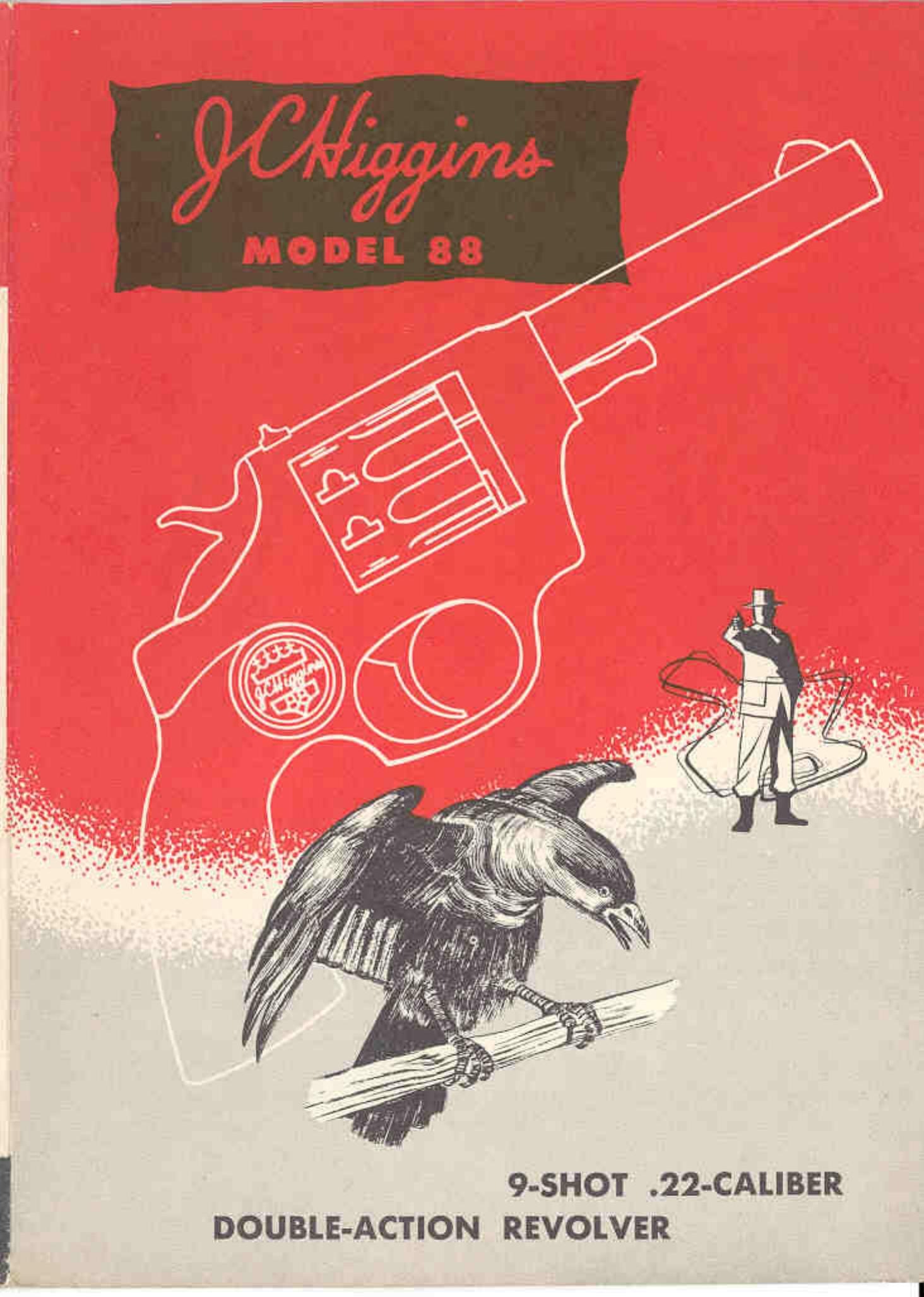
The Sentinel did not begin as a High Standard idea. According to Ed Buffaloe’s account, which rests on the standard collector literature, the line was introduced in 1955 at the request of Sears, Roebuck — a major customer that, he writes, also “owned quite a bit of High Standard stock”. Sears wanted an inexpensive kit gun or “tackle box” revolver for its J. C. Higgins house brand, and got one: the J. C. Higgins Model 88.5
The Sears connection is visible in the surviving paperwork. The Model 88’s own booklet is a Sears document, with a Sears model number (583.880), Sears ordering instructions and the note that “Hammer fall and trigger pull must be adjusted by skilled gunsmiths in Sears mail-order houses or by other competent gunsmiths”.8 It also carries an exploded view whose part numbers — 7100 barrel, 7104 barrel pin, 7127 hammer, 7138 hand — are High Standard’s own numbers, used unchanged on the Hamden parts sheets.84
What the front office actually asked for survives in Edwards’s interview with the designer. The brief was nine shots, a gun that could perhaps be loaded with .22 shot shells “and used for blasting snakes at ten feet”, and a low price. “Other than that,” Edwards wrote, “he had carte blanche.”3
1.4 Harry H. Sefried II
The designer was Harry H. Sefried II, 33 years old in 1955 and by then High Standard’s head of handgun design. Edwards’s profile of him is the fullest contemporary account located and the source of everything in this section.3
Sefried had been an Army Air Corps gunnery instructor from 1942 until a spinal injury invalided him out in 1944. He went to the Winchester works at East Alton for a job and was sent instead to New Haven by Winchester’s chief of research, Edwin Pugsley. He stayed five years, was mentored by Marsh Williams, worked on an autoloading .22 rifle and the Model 52’s “C” trigger, and — Edwards reports — had the highest patent record in the research department, “averaging one significant patent every six months”. He took five years of night-school engineering courses at Yale and never sat for a degree, choosing courses “that would help him be a better gun designer”.
When it became clear that Winchester would not put him on pistols, he resigned. Edwards gives the date of his arrival at High Standard as 1 April 1951 in one paragraph and says “when Harry walked into High Standard in 1950” three paragraphs later; the article contradicts itself and both readings are reported here.3 His first job there was to make the Dura-Matic, a design bought in from outside, cheap enough to sell — it was announced in 1954 at $37.50.
After the Sentinel, Sefried left for Sturm, Ruger in 1959 and spent the rest of his career there.5 The patent record shows what he took with him: a long series of Ruger patents on self-loading rifles, revolver cranes, cylinder retention and revolver ejectors, running from the mid-1960s to 1980.9 Buffaloe’s judgement is that the Sentinel “clearly served as the prototype for his later double action revolvers which were designed for Sturm Ruger”.5
1.5 Robert Hillberg: What the Link Is, and What It Is Not
The other designer in this story is Robert L. Hillberg, whose aluminium-framed Whitney pistol of 1956 is the hub’s flagship space-age handgun and has its own dive. Hillberg was at High Standard, in Hamden, as head of research and development from 1951; his work there included a tank machine gun that became the M37, a 9 mm double-action pistol for Army trials, a .22 self-loading rifle and a gas-operated shotgun, and — this is the point of contact — coordinating designs for Sears’s J. C. Higgins line, which High Standard made. He left in 1954 for the Bellmore-Johnson Tool Company, where the Whitney was designed that spring.10
So the two men were colleagues at the same plant, working for the same mail-order customer, in the same years. But no source located connects Hillberg to the Sentinel, and the chronology points the other way: Hillberg left in 1954, the revolver was handed to Sefried “less than a year” before June 1955, and every contemporary and collector account credits the design to Sefried alone.35 The Whitney dive’s own survey of kindred designs says the same.10 What the two guns share is not a designer but a building, a customer and a year in which a Connecticut pistol house decided that the future of cheap handguns was cast aluminium.
1.6 Three Months, and What It Cost
Edwards gives the development time twice, and the two figures describe different things: the whole programme took “a space of six months from front office requisition to final approval of the model”, while the design itself — “from the first mark on paper, to the completion of the model gun ready for approval” — took three months, during which Sefried was also running pistol development. Tooling was then cut by an outside contractor.3
The launch price is the first of this dive’s flat contradictions. Guns, in June 1955, prints $34.95 in the body of the article and “35 bucks” in its closing line. Buffaloe gives the 1955 blued MSRP as $37.50.35 The figures are given separately here and not averaged; $37.50 was also the announced price of Sefried’s Dura-Matic pistol the year before, which is a coincidence worth noticing and not an explanation.
Whatever the number, it worked. Edwards reports that advance orders “equalled the total of the first year’s planned production only a month after High Standard took the wraps off it”.3 A nickel finish followed in April 1956 at five or six dollars more.5
1.7 What Sefried Borrowed, in His Own Words
Sefried was candid about where the design came from, and his three admissions are the best short description of the gun:
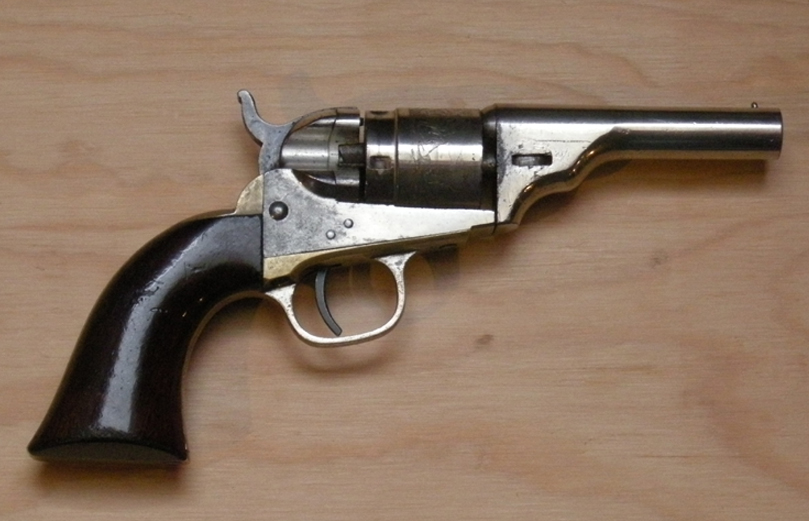
- The grip is a Colt. “I designed the Sentinel grip from the old Colt shape — just made a few changes,” he told Edwards, meaning the New Model .36 Pocket Pistol of 1862. A shooting acquaintance of Edwards’s, handed the new revolver the evening before, said it was “the first decent grip on a revolver since the Civil War”.3
- The absence of screws is a Mauser. “I liked the big Mauser pistol, made without any screws, no screwed-on side plate, or crane lock, so I tried to make the Sentinel like it.” The Sentinel has exactly one screw, and it holds the grip to the trigger guard.3 The hub’s Mauser C96 dive covers the pistol he meant.
- The cylinder lock is a Borchardt. “Just pull the pin forward a little, and the cylinder swings out to the left just like any other — that is straight off of that Borchardt revolver. Guess I must have studied those revolvers closer than anybody else at Winchester.” Edwards calls it “the Borchardt experimental revolver of 70 years ago”; Buffaloe dates that revolver to 1876. Either way it is an unbuilt Winchester experiment of the 1870s or 1880s that Sefried had examined in the factory collection.35
What he claimed as his own was the ratchet: “That drilled-hole ratchet on the Sentinel is mine — that’s going to be the basis for a nice little patent.”3 Volume 3 explains what it does, and Volume 3 also settles what became of the patent, because the answer is not the one the collector literature gives.
1.8 What the Press Found in 1955
Edwards shot a production sample and reported the results in the plain terms of the period. Firing double action at 20 yards on the Standard American target, he put “all nine shots on the paper in a regular spread about 4 inches diameter”. Sefried said he could shoot the gun “into an inch and a quarter at 75 feet, using a hand rest”, and deliberately withheld machine-rest groups: “No accuracy standards have yet been set up,” he said, arguing that a published group would only start arguments with owners whose guns did worse.3 That is an unusually honest refusal and it is quoted here because it is the only accuracy statement from the factory that exists in the sources located.
The two features the article keeps returning to are the grip, which “makes the back end of the gun a success”, and the moulded thumb rests cast into both sides of the frame behind the cylinder — a detail that a die-cast frame gets for nothing and a forged or machined one does not (Volume 2).3
1.9 The First Ten Guns
One paragraph in the 1955 article is worth more to a collector than the rest of it together:
“The first ten Sentinel revolvers run through the tools to check dimensions will one day be collector’s items. They were supposed to be ‘experimental’, but someone decided to give them serial numbers. The numbering machine was set up to put serials on their auto pistols, so the very first Sentinel revolvers have numbers in the 350,000 series. … The next Sentinel bore the number ‘1’ and they are being numbered all the way up in their own series.”3
So: ten pre-production Sentinels carry six-figure serials in the 350,000 range, out of the pistol book; production then restarted at 1. Edwards’s own review sample was No. 46. No source located says what became of the ten, and no surviving example of them was found in the auction record examined for Volume 6. It is a specific, checkable claim from the year of introduction, and it is repeated here so that anyone holding a Sentinel with a 350,xxx serial knows what may be in the safe.
1.10 The Line the Sentinel Started
The revolver that Sears asked for became a family. The short form, with the detail in Volume 5:
Table 1 — The revolver that Sears asked for became a family. The short form, with the detail in Volume 5
| Year | Development |
|---|---|
| 1955 | Sentinel introduced; R-100 series; also sold as the J. C. Higgins Model 88 |
| 1956 | Nickel finish (April); hammer and trigger revised mid-year for the R-101 |
| 1957 | The snub — a 2⅜ in barrel on a round butt — and, with it, the Dura-Tone colours |
| 1958 | The western-styled Double-Nine spun off the Sentinel line; sold by Sears as the J. C. Higgins Ranger Model 90 |
| 1961 | R-102 (spring-return ejector) and the R-104 Sentinel Imperial, with walnut grips and a ramp front sight |
| 1965 | R-106 Sentinel Deluxe |
| 1967 | R-107; R-108 snub with two-piece grips |
| 1969 | R-109 Kit Gun, the first with a fully adjustable rear sight |
| 1974 | Mark I (.22 LR) and Mark IV (.22 WMR) — the first steel frames in the line — and the Camp Gun |
Two more names belong in the list for completeness and are traps for the unwary. The Sentinel Mark II and Mark III are .357 Magnum revolvers that High Standard sold from mid-1973 to February 1975; they are rebadged Dan Wesson products. High Standard did not make them, and, as Buffaloe puts it, the persistent rumours that High Standard built the Dan Wesson revolvers “are completely untrue”.5 And in the second half of the 1950s High Standard licensed the Sentinel to Armscor, a subsidiary of Squires Bingham in the Philippines, which sold it as the Model P; Buffaloe suspects, but does not establish, that the parts were American and only the assembly was Philippine.5
1.11 The End of the Company That Built It
High Standard was bought by the Leisure Group in 1968 — the parts sheets of the 1970s carry “A Division of the Leisure Group, Inc.” under the Hamden address — and the Gun Control Act of 1968 and its aftermath made the following years hard.76 The company moved to East Hartford in 1977, was bought out by its president Clem Confessore in 1978, and had its assets auctioned in December 1984. The name and the target-pistol line were bought by the firm’s former national parts distributor, and in 1993 a new company in Houston, Texas acquired the assets and trademarks and began building target pistols there in 1994.6
The practical consequence for an owner is in Volume 4: the Service Department that the parts sheets tell you to write to, with its $6.50 minimum charge and its list of parts that “must be fitted at the factory”, has not existed for forty years.
References
Footnotes
-
The High Standard Manufacturing Corporation, “Parts List and Prices — ‘SENTINEL’ Model R102 Blued and Nickel, Snub-Barrel Blue, Nickel; Dura-Tone Gold, Turquoise, Pink — Four-Inch Barrel Models”, parts list 997-99, dated 1/61. Same archive. ↩
-
The High Standard Manufacturing Corporation, “Parts List and Prices — ‘SENTINEL DELUXE’ Model R-106 Blued and Nickel”, parts list 5509, 1965. Same archive. ↩
-
William B. Edwards, “The First New Revolver in 50 Years”, Guns, June 1955, pp. 6–7 and 37. Retrieved 2026-09-19 from the Internet Archive copy of the publisher’s PDF, https://web.archive.org/web/20120505205714/http://www.gunsmagazine.com/1955issues/G0655.pdf . The article was written with the company’s cooperation and quotes Sefried directly; the text here is taken from the scan and checked against context. ↩ ↩2 ↩3 ↩4 ↩5 ↩6 ↩7 ↩8 ↩9 ↩10 ↩11 ↩12 ↩13 ↩14 ↩15 ↩16 ↩17 ↩18 ↩19
-
The High Standard Manufacturing Corporation, “Parts Price List — .22 Caliber Model ‘R’ — ‘SENTINEL’”, parts list 990-55, undated. PDF from John Stimson Jr’s High Standard archive, https://www.histandard.info/manuals/hprevolvers/ , retrieved 2026-09-19. ↩ ↩2 ↩3
-
Ed Buffaloe, “The High Standard Sentinel Revolver”, Unblinking Eye, https://unblinkingeye.com/Guns/Sentinel/sentinel.html , consulted 2026-09-19. Cites Edwards (1955); Herbert G. Houze, “Harry H. Sefried II: An Overdue Appreciation”, Man At Arms, 27:5 (October 2005); Henry M. Stebbins, Pistols, A Modern Encyclopedia (Stackpole, 1961); James Spacek, Hi-Standard Pistols & Revolvers 1951–1984 (self-published, 1998); and Mickey Waldinger, “The Sentinel Snub 1957–1974”, High Standard Collectors’ Association Newsletter, XVIII:3 (September 2009). None of those five was obtained for this dive. ↩ ↩2 ↩3 ↩4 ↩5 ↩6 ↩7 ↩8 ↩9 ↩10
-
“High Standard Manufacturing Company”, Wikipedia, revision 1359530732 of 15 June 2026, consulted 2026-09-19. Tagged by Wikipedia as needing additional citations; used here only for the corporate chronology, and its 1926 founding date is given against Edwards’s 1928. ↩ ↩2 ↩3 ↩4 ↩5 ↩6
-
High Standard Sporting Firearms, “Parts Breakdown — Mark I Sentinel / Mark IV Sentinel, .22 LR and .22 Magnum”, parts list 53951, 4/74. Same archive. Header: “1817 Dixwell Avenue, Hamden, Connecticut 06514 · A Division of the Leisure Group, Inc.” ↩ ↩2
-
Sears, Roebuck and Co., “J. C. Higgins Model 88 — 9-Shot .22-Caliber Double-Action Revolver”, owner’s booklet and parts list 990.50, undated, Sears model number 583.880. Internet Archive item gunmanual_Jchiggins_88, https://archive.org/details/gunmanual_Jchiggins_88 , retrieved 2026-09-19. No copyright notice appears on any page. ↩ ↩2
-
US patents to Harry H. Sefried II, located through the Google Patents query endpoint, 2026-09-19: US 2,958,151 (High Standard, filed 1956); US 3,011,282 (High Standard, filed 1959); and for Sturm, Ruger US 3,239,959, US 3,240,121, US 3,611,606, US 3,668,800, US 3,683,536 (revolver crane), US 3,685,193 (revolver cylinder retaining means), US 3,783,545 and US 4,206,560 (long stroke ejector for a revolver). ↩
-
This hub’s Whitney Wolverine dive, Volumes 1 and 8, which set out Hillberg’s High Standard years from Don Findley’s profiles in Gun Digest (2008) and American Rifleman (2024) and from Guns, August 1956, and which state that no source connects Hillberg to the Sentinel. ↩ ↩2
Comments (0)