Home-Computer Light Guns · Volume 4
Sinclair and Amstrad — the Spectrum, the CPC, the Plus Range and GX4000
A computer with no latch at all and the guns that worked round it through a tape socket, a sound chip's port and the joystick interface; the CPC's 6845 on pin 47 of the expansion connector; and the Trojan Phazer on the Plus range
Sinclair and Amstrad are one volume because, from 1986, Amstrad owned the Spectrum, and the best-known gun for both lines, the Magnum Light Phaser, was sold for both. Technically they are opposites. The Spectrum’s video is generated by its ULA, which has no light-pen latch, so every Spectrum gun had to work without one. The Amstrad CPC used a Motorola 6845 CRT controller, which has a latch, but brought it out only on the expansion connector.
4.1 The Spectrum: no latch, so the game does the timing
No Sinclair or Amstrad document describing a Spectrum light-gun interface was found. What the period sources describe is the principle. Home Computer Advanced Course (1984), explaining the Stack Light Rifle:1
Light coming down the barrel is focused by a small plastic lens onto the photo-diode … The screen position that is being scanned at that moment is the position the rifle is pointing at.
and the consequence for the program: “the software must freeze the action and establish whether the target on the screen is aligned”. With no latch, a Spectrum game has two ways to find the gun’s aim, and both are the software school of History of Light Guns, Volume 3:
- Time the pulse. The Z80 polls the gun’s input in a tight loop after the frame interrupt. The loop count when the pulse arrives gives the line, because the program knows how long each line takes.
- Flash the targets. The game draws one target at a time (or blanks the rest) and asks whether the gun saw light, as the Zapper does. An emulator author describing the Gun Stick’s games reports exactly this: white rectangles flashed in sequence, a hit if the gun saw the rectangle during its frame.2
Which method each game used is not documented. The Games Machine review of the Cheetah Defender in January 1990 noted that the Defender’s games “avoid the screen glitches of the Sinclair gun”, which suggests the Magnum’s games flashed or blanked the screen visibly.3
4.2 Where a Spectrum gun plugs in
The Spectrum had no joystick port until the 128K +2, and its guns used whatever input each model offered. The Magnum Light Phaser’s manual lists them:4
Table 1 — Where a Spectrum gun plugs in
| Spectrum | Socket the manual names | What is behind it |
|---|---|---|
| 48K and 128K | ”the MIC socket” | The cassette interface; the gun needs its own 9 V battery |
| +2 and +3 | ”the AUX socket” | The sound chip’s I/O port (below) |
| Sinclair Action Pack gun | ”the socket marked ‘keypad’ or ‘Aux’ on the rear panel” | Same |
Plugging a gun into the cassette socket is less odd than it sounds: a software-timed gun needs only one input bit the Z80 can poll, and the cassette circuitry is read as a single bit. How the 48K reads a signal on its MIC socket, which is nominally the cassette output, is not explained in the manual. The 9 V battery (the manual names MN1604, 6LF22 and PP3 types) powers the gun’s amplifier, since the MIC socket supplies no power.
The 128’s keypad socket, renamed AUX on the +2 and +3, is the I/O port of the AY-3-8912 sound chip. Simon N. Goodwin’s “Tech Tips” in Crash No. 46 (1987) quotes the +3 manual: “the AUX socket supports two input lines and two output lines, connected to the AY-3-8912.”5 He gives the socket’s connections in order, with the notch on the left: a +12 V supply, input bit 5, output bit 1, input bit 4, output bit 0, and signal earth. Which of the two input bits the Magnum and the Defender use was not found.
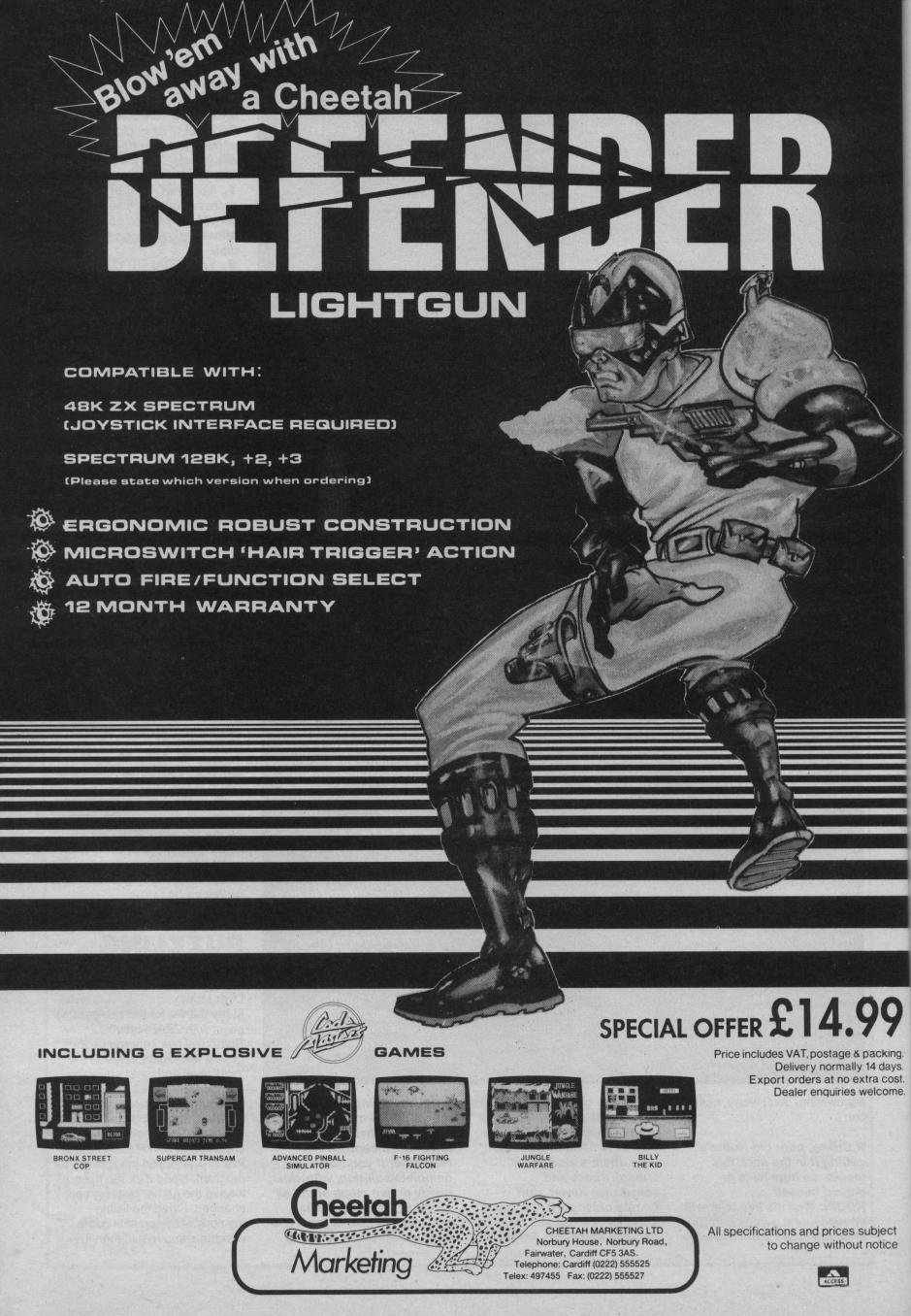
The Cheetah Defender’s advertisement adds the other route: “48K ZX SPECTRUM (JOYSTICK INTERFACE REQUIRED) / SPECTRUM 128K, +2, +3 (Please state which version when ordering)”.6 Crash’s preview confirmed that “The 128K/+2/+3 version … connects to the Speccy via the Keypad/Aux port”, with a 48K version for a joystick interface.3 The Gun Stick did the same in two versions: one for a Kempston interface (48K, Plus and 128K) and one for the Sinclair-standard joystick ports of the +2 and +3.7
4.3 The Spectrum guns
Stack Light Rifle (Stack Computer Services, 1984 reviews). A chromed pistol with clip-on scope, stock and barrel extension, £29.95 with three games, High Noon, Shooting Gallery and Grouse Shoot. Sinclair User (May 1984): “The main pistol is attached to 12ft of cable which ends in a dead-ended ZX81-size connector”. On the Spectrum version “the connector contains two chips and a couple of simple components”, the interface the machine lacked.1 Volume 1 shows it opened.
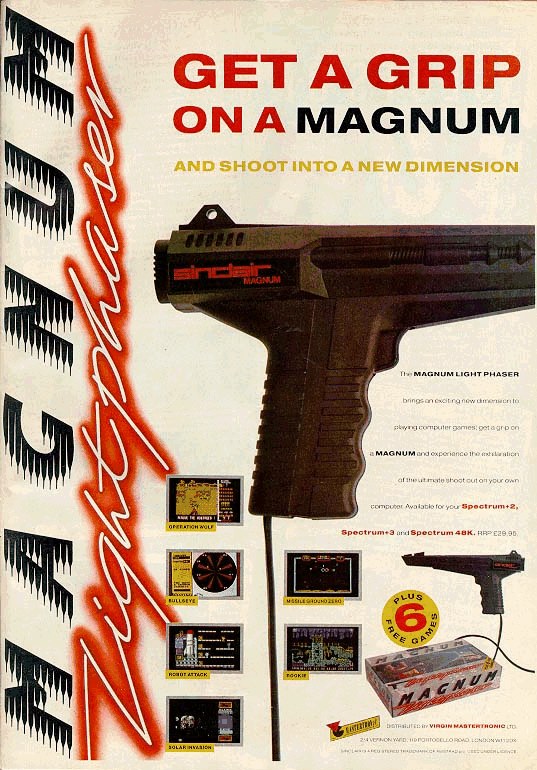
Magnum Light Phaser. The Sinclair-branded gun, sold boxed with six games and in Amstrad’s Sinclair Action Pack. Its advertisement: “Available for your Spectrum+2, Spectrum+3 and Spectrum 48K. RRP £29.95”, “Plus 6 free games”, distributed by Virgin Mastertronic.8 The manual lists the Action Pack’s games: Missile Ground Zero, Solar Invasion and Operation Wolf on side A; Rookie, Robot Attack and Bullseye on side B; it credits Ocean and Taito for Operation Wolf and Central Television for Bullseye.4 It recommends playing 2 to 4 feet from the television and warns that “Software designed for use with the Magnum Light Phaser is required for proper operation.”
Cheetah Defender (Cheetah Marketing, Cardiff, 1989). Previewed in Crash No. 69 (October 1989) at £24.95 with six Code Masters games, Bronx Street Cop, Supercar Trans-Am, Advanced Pinball Simulator, Billy the Kid, F-16 Fighting Falcon and Jungle Warfare, and a sliding switch for auto fire or weapon select.3 Your Sinclair (November 1989) described a dark grey body with red handgrips, heavier than the Magnum, with a longer lead. Its compatibility finding is the useful one: the Magnum gun worked with the Defender’s games, but the Defender did not work with the Magnum’s, and the reviewer, Jon Davies, guessed that Magnum games read the Cheetah gun “as if it were always aimed at the top right of the screen”. The later advertisement offered it at £14.99.6
Gun Stick (MHT Ingenieros S.L., Spain, 1988). Kempston and Sinclair-interface versions; also sold for the Amstrad, MSX and PC, and, according to ZXDB, the versions are often said to be identical inside and out; Ubi Soft marketed it in France. ZXDB lists 13 games.7 On the C64 its sensor sits on a joystick direction line with a stretched pulse (Volume 3), which is what lets one design serve machines with and without a latch.
4.4 Telling the 1989 guns apart
Table 2 — Telling the 1989 guns apart
| Feature | Magnum Light Phaser | Trojan Phazer | Cheetah Defender | Gun Stick |
|---|---|---|---|---|
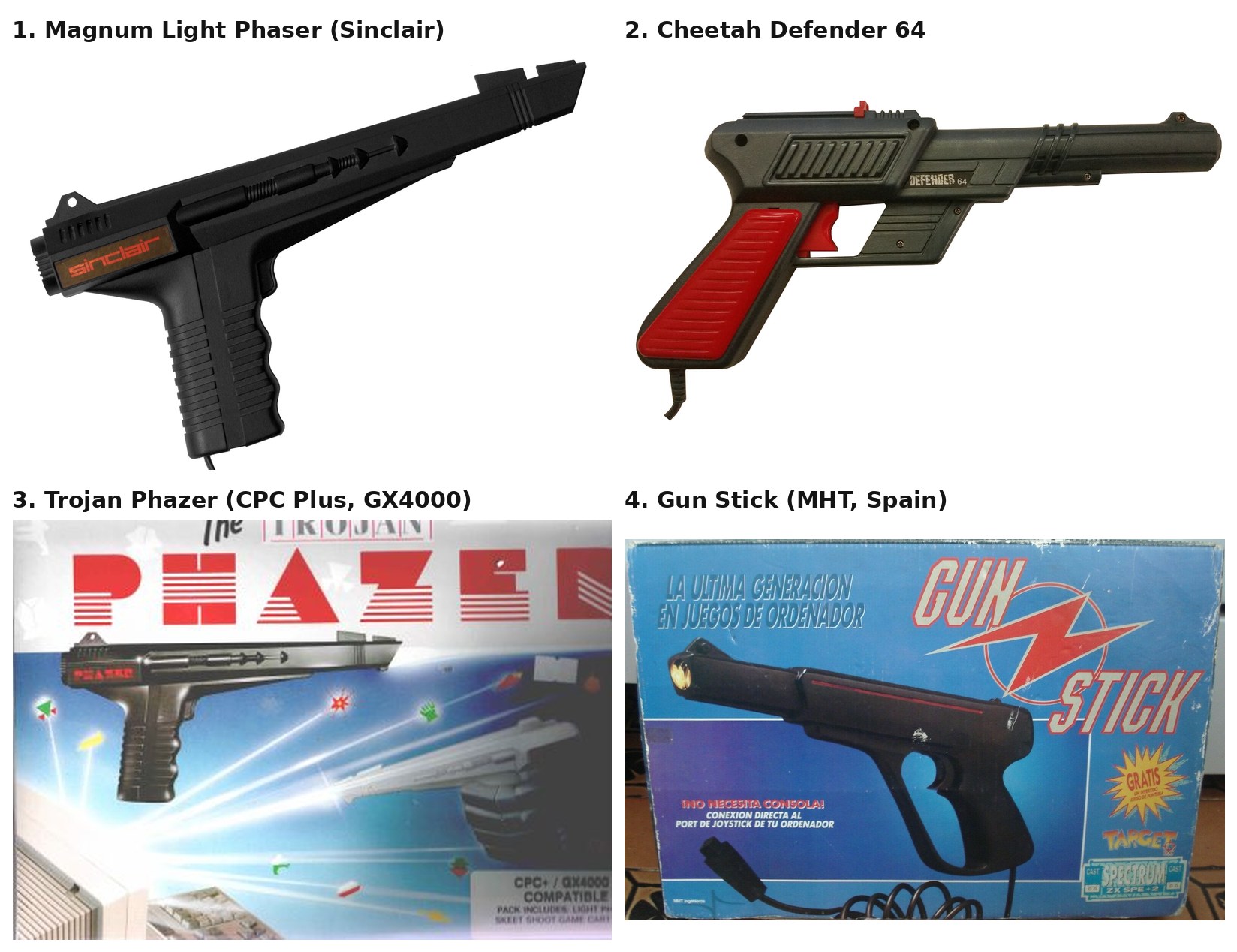
| Body | All black, slab-sided barrel with sight notch | Same shell as the Magnum (CPCWiki) | Dark grey with red grips; round barrel with ribs | Black, slim pistol; red line along the slide |
| Badge | ”Sinclair” in red on the frame (Spectrum version) | “PHAZER” on the frame | ”DEFENDER” (C64 version “DEFENDER 64”) | “Gun Stick” on box |
| Extra control | None | None | Sliding autofire / function switch | None |
| Plug, Spectrum | MIC jack (48K) or AUX (+2/+3) | — | Keypad/AUX (128K/+2/+3) or joystick interface | Kempston or Sinclair joystick plug |
| Plug, Amstrad | Expansion (464 “floppy disc” edge, 6128 “expansion”) | 6-pin AUX (Plus, GX4000) | — | Joystick |
| Look for | 9 V battery socket (Spectrum version) | CPC+ / GX4000 box, Skeet Shoot | Code Masters games | Spanish box, MHT Ingenieros |
The Magnum and the Trojan are the pair to watch: CPCWiki says both were made by Trojan in the same shell, differing in their connector and wiring.9 Read the plug and the badge, not the shape.
4.5 Spectrum light-gun games
Table 3 — Spectrum light-gun games
| Title | Gun | Source |
|---|---|---|
| High Noon, Shooting Gallery, Grouse Shoot | Stack Light Rifle | Sinclair User, May 1984 |
| Missile Ground Zero, Solar Invasion, Operation Wolf, Rookie, Robot Attack, Bullseye | Magnum Light Phaser | Magnum manual |
| Bronx Street Cop, Supercar Trans-Am, Advanced Pinball Simulator, Billy the Kid, F-16 Fighting Falcon, Jungle Warfare | Cheetah Defender (Code Masters) | Crash 69; advert |
| Acid Killer, Bestial Warrior, Cosmic Sheriff, El Equipo A, Guillermo Tell, Hunting Mix, Mike Gunner, Shooting Range: Mix I, Solo, Sootland, Space Smugglers, Target Plus, Trigger | Gun Stick | ZXDB entry 1000525 |
4.6 Amstrad CPC: the 6845 on the expansion connector
The CPC 464, 664 and 6128 drew their screens with a 6845 CRT controller, which has a light-pen strobe input and a pair of light-pen registers, R16 and R17. The 6845’s latch is unusual: it captures the memory address being displayed, not a horizontal and vertical count. Motorola’s application note AN-851 says the registers “will receive the current address appearing on the CRT control address lines following the recognition of the low-to-high transition of the light pen strobe (LPSTB) input”.10 How a program turns that address into a screen position is set out with the BBC Micro’s worked numbers in Volume 5.
Amstrad did not put the strobe on the joystick socket. The CPC6128 manual’s pinout of that socket is 1 up, 2 down, 3 left, 4 right, 5 spare, 6 fire 2, 7 fire 1, 8 common, 9 common 2: no pen line.11 The strobe is on the 50-way expansion connector, as pin 47, “L.PEN”, with +5 V on pin 27 and ground on pin 49, according to the manual’s connector drawing as transcribed in the MAME emulator’s source.12 That is why the Magnum manual sends CPC owners to the back edge: “Plug the lightphaser into the FLOPPY DISC socket” on the 464, whose expansion edge is labelled for the disc interface, and “into the EXPANSION socket on your Amstrad 6128”.4
Amstrad’s own pen, the LP-1, is named in the 6128 manual’s peripherals chapter: “The AMSTRAD Light pen model LP-1 may be connected to this socket.” In the scanned text that sentence sits at the end of the joystick paragraph, while the same chapter lists light pens among the devices for the expansion socket. Which socket the LP-1 used is not settled by the scan.
An emulator author who implemented the CPC guns reports that the Magnum drives the CRTC light-pen input and answers on I/O port &FBFE, and that the latch’s accuracy is “1 CRTC character (R9 lines in height - normally 8) and 2 bytes horizontally”.2 That is the 6845’s character-cell resolution: in the CPC’s usual modes a character is eight lines tall, so a 6845 gun knows its vertical aim only to the nearest eight lines unless the program does more work. The same author reports the Gun Stick’s CPC games flashing white rectangles in sequence: the gun ignores the latch on the CPC too.
4.7 CPC Plus and GX4000: the Trojan Phazer
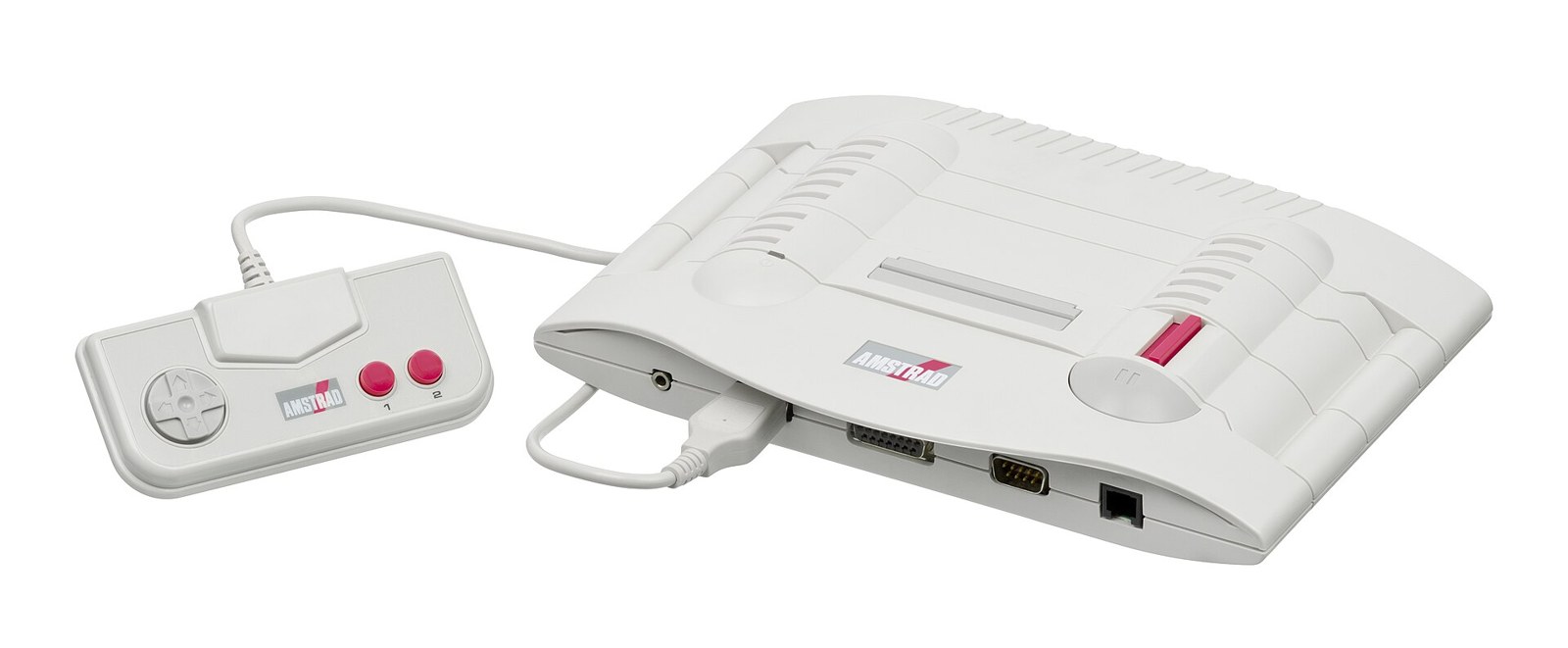
Amstrad’s 1990 Plus range and the GX4000 console, which share hardware, had a 6-pin AUX socket, and the Trojan Phazer was made for it. CPCWiki: “The Trojan connects to the CPC+/GX4000’s 6pin AUX socket”. Its light sensor goes to the CRTC light-pen input, and its trigger to joystick fire 2 (keyboard matrix row 9, bit 4), whereas the Magnum “merges” its trigger with the sensor signal on the older machines.9 Two cartridges supported it: Skeet Shoot, packed with the gun (the box reads “CPC+ / GX4000 compatible, pack includes light phazer, Skeet Shoot game cartridge”), and The Enforcer. The AUX socket’s pinout was not found.
4.8 What could not be verified
- How individual Spectrum games read the gun (software timing or flashed targets). Not documented by any source read; the Gun Stick’s flashing is an emulator author’s report.
- Which AY input bit the Magnum and Defender use on the 128’s keypad/AUX socket.
- The Magnum’s first release date. The manual and advertisement are undated. The Action Pack includes Ocean’s Operation Wolf, and the guns were reviewed together in 1989.
- The LP-1’s socket on the CPC, and the CPC Plus AUX pinout.
- The CPC expansion pinout is quoted from MAME’s transcription of the 6128 manual, because the manual’s connector drawing did not survive optical character recognition.
- “Same shell, both made by Trojan” for the Magnum and the Phazer is CPCWiki’s statement.
Sources
Footnotes
-
World of Spectrum, Hardware Feature 8, “Stack Light Rifle”, quoting Sinclair User, May 1984, and Home Computer Advanced Course, 1984, https://worldofspectrum.org/hardware/feat8.html, read 2026-10-19. ↩ ↩2
-
Caprice32 (Amstrad CPC emulator) issue #34, “Light gun support”, https://github.com/ColinPitrat/caprice32/issues/34, read 2026-10-19. Emulator developers’ findings. ↩ ↩2
-
ZX Spectrum Reviews (transcribed by Chris Bourne), “Defender Light Gun”: Crash No. 69, October 1989, pp. 12–13 (Richard Eddy); Your Sinclair No. 47, November 1989 (Philip Snout, Jon Davies); The Games Machine No. 26, January 1990, https://spectrumcomputing.co.uk/zxsr.php?id=1000110, read 2026-10-19. ↩ ↩2 ↩3
-
Magnum Light Phaser instructions (Sinclair Action Pack), Virgin Mastertronic, transcription at https://spectrumcomputing.co.uk/pub/sinclair/hardware-info/m/MagnumLightPhaser_Manual.txt, read 2026-10-19. ↩ ↩2 ↩3
-
Simon N. Goodwin, “Tech Tips”, Crash No. 46 (November 1987), https://crashonline.org.uk/46/tips.htm, read 2026-10-19. ↩
-
Cheetah Marketing, “Defender Lightgun” advertisement, Spectrum Computing hardware adverts archive, https://spectrumcomputing.co.uk/pub/sinclair/hardware-adverts/d/DefenderLightGun.jpg, read 2026-10-19. Undated. ↩ ↩2
-
Spectrum Computing (ZXDB) entry 1000525, “Gun Stick”, MHT Ingenieros S.L., 1988, https://spectrumcomputing.co.uk/entry/1000525/Hardware/Gun_Stick, read 2026-10-19. ↩ ↩2
-
Virgin Mastertronic, “Get a grip on a Magnum” advertisement, Spectrum Computing hardware adverts archive, https://spectrumcomputing.co.uk/pub/sinclair/hardware-adverts/m/MagnumLightPhaser.gif, read 2026-10-19. Undated. ↩
-
CPCWiki, “Trojan Light Phazer”, https://oldwiki.cpcwiki.eu/index.php/Trojan_Light_Phazer, read 2026-10-19. ↩ ↩2
-
Motorola, Application Note AN-851, “MC6845 CRTC Simplifies Video Display Controllers”, https://archive.org/details/bitsavers_motorolaapaMC6845CRTCSimplifiesVideoDisplayControl_9722748, read 2026-10-19. ↩
-
Amstrad, CPC6128 User Instructions, 1985, chapter 1 part 2 “Connecting your peripherals” and chapter 7 part 9 “Connections”, https://archive.org/details/amstrad-cpc-6128-user-manual, read 2026-10-19. ↩
-
MAME source,
src/devices/bus/cpc/cpcexp.h(Barry Rodewald; BSD-3-Clause), header comment “Pinout from CPC6128 User’s Manual”, https://github.com/mamedev/mame/blob/master/src/devices/bus/cpc/cpcexp.h, read 2026-10-19. ↩


Comments (0)