Sterling Mk 7 Para Pistol · Volume 4
The Law: Two Series, Two Legal Lives, in the United States, Michigan, Canada and Britain
Why the open-bolt A4 and A8 are machineguns that no private American can buy new, why the closed-bolt C4 and C8 are ordinary handguns until a butt, a foregrip or the wrong bolt changes that, what ATF Rulings 82-2, 82-8 and 83-5 actually say, and where Michigan, Canada and Great Britain put the gun today
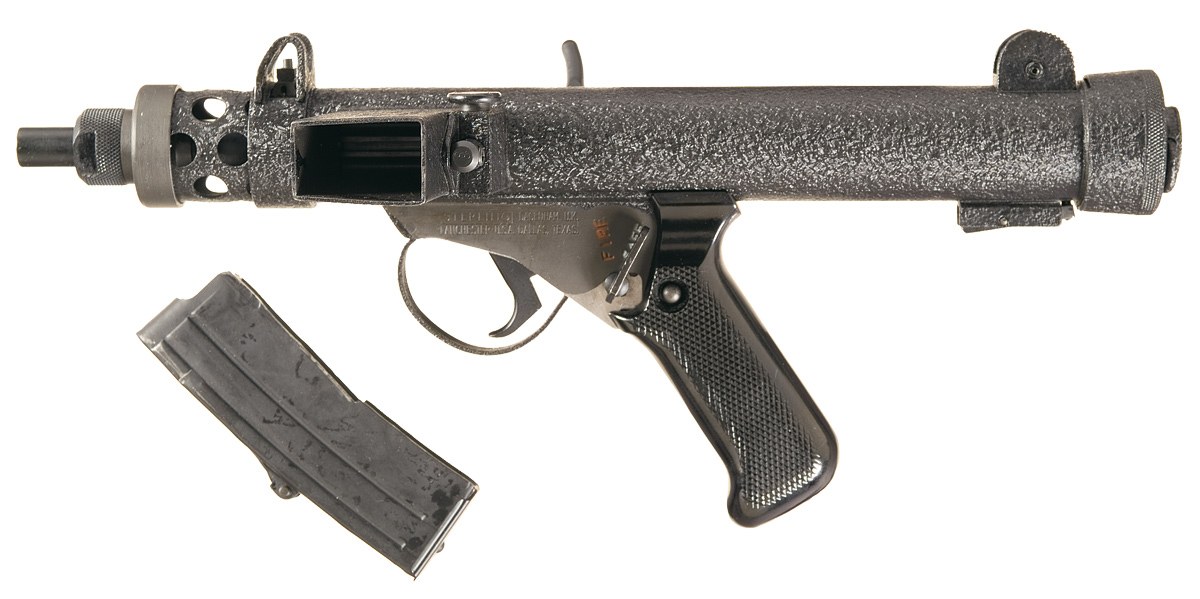
This volume states the law and quotes it. It is not legal advice, and it contains no build, replica or conversion content. The NFA’s general machinery (registration, the transfer process, the categories of machinegun, the 2026 tax changes) is set out in other dives of this hub and is linked, not repeated.
4.1 The short answer
Table 1 — The short answer
| A4, A8 (open bolt, single shot or automatic) | C4, C8 (closed bolt, single shot only) | |
|---|---|---|
| US federal, as made | Machinegun, 26 U.S.C. § 5845(b) | Handgun under the Gun Control Act; not an NFA firearm |
| Can a private person in the US acquire one? | Only a machinegun registered before 19 May 1986, and none was found | Yes, as an ordinary handgun |
| What changes the C’s status | — | a shoulder butt (short-barrelled rifle); a vertical foregrip (ATF: “any other weapon”); A-series bolt or trigger group in the same possession (machinegun parts) |
| Michigan | MCL 750.224 machine-gun felony, federal-licensee exception | pistol (under 26 in): licence or CPL route under MCL 28.422 |
| Canada | prohibited firearm | prohibited firearm, named in the Regulations |
| Great Britain | prohibited weapon, Firearms Act 1968 s. 5 | prohibited weapon, s. 5 |
4.2 The A4 and A8: machineguns
The maker says the A series fires “from the open bolt” with “the capability of firing single shot or automatic rapid fire”.1 That is the first prong of the federal definition. Under 26 U.S.C. § 5845(b) a machinegun is “any weapon which shoots, is designed to shoot, or can be readily restored to shoot, automatically more than one shot, without manual reloading, by a single function of the trigger.”2 The definition goes on to include “the frame or receiver of any such weapon”, any part or combination of parts “designed and intended … for use in converting a weapon into a machinegun, and any combination of parts from which a machinegun can be assembled if such parts are in the possession or under the control of a person.”2 The second sentence matters for the C series, below.
Federal law then closed the door on new ones. 18 U.S.C. § 922(o) makes it “unlawful for any person to transfer or possess a machinegun”, except for government possession and “any lawful transfer or lawful possession of a machinegun that was lawfully possessed before the date this subsection takes effect”, which is 19 May 1986.3 The MP 40 dive’s Volume 6 sets out the four resulting categories (transferable, pre-1986 dealer sample, post-1986 dealer sample, everything else) and the transfer process. They are not repeated here.
Taxes. Public Law 119-21 reduced the NFA making and transfer taxes to $0 from 1 January 2026 for every NFA firearm except machineguns and destructive devices. The machinegun tax did not change.4 The A series is untouched by it.
4.3 How an A-series gun entered the United States
The A series was made at Dagenham from late 1983 (Volume 1), so any A4 or A8 in the United States was imported. Importing any NFA firearm has been restricted since 1968 by 26 U.S.C. § 5844, which permits it only for government use, “for scientific or research purposes”, or “solely for testing or use as a model by a registered manufacturer or solely for use as a sample by a registered importer or registered dealer”.5
So an A-series Mark 7 could reach the US only as a government purchase or as a dealer sample. The sources agree:
- The US dealer PS Arms, which sold new A4s and A8s in the 2000s, wrote that “Live guns, imported upon ATF approval, are available only to LE agencies or Title II dealers with documentation”, and labelled a photograph “Sterling Mk7 Para Post ‘86 NFA … available for sale to FFL/SOT for use as a sales sample or for LE Agency use.”6
- Its price lists of 2001 and 2004 ($850 and $895 for an A4 or A8) are therefore prices for licensees and agencies, not for private buyers (Volume 2).7
A gun imported as a dealer sample before 19 May 1986 is a pre-1986 dealer sample, whose transfer rights are narrower than a transferable’s and turn on the paperwork. A gun imported after that date is a post-1986 dealer sample, which can never pass to a private person.8 Production of the A series began late in 1983, so a pre-May 1986 import is possible. None was found documented.
No transferable A-series Mark 7 was found. Searches on 2026-10-20 of Rock Island Auction and Poulin Auction listings found transferable Sterlings of earlier marks but no Mark 7. A private American cannot buy a new A4 or A8, and there is no evidence that a privately transferable one exists.
Collectors on a US forum report a C-series Mark 7, imported by Cassi Inc., that was made into a machinegun as a post-1986 dealer sample, and name Lanchester USA, Cassi Inc., Armscorp and Romar as importers of Mark 7s.9 This is forum testimony, recorded here only because it shows that a Mark 7 in the US can be a machinegun without being an A series. How it was done is not this dive’s subject. Making a machinegun after 19 May 1986 is lawful only for a licensed manufacturer with Special Occupational Tax status, for government or dealer-sample use. For anyone else it is the § 922(o) felony.
4.4 The C4 and C8: handguns as sold
The C series is the opposite design. The maker: “The C series fires from a closed bolt and has a floating firing pin. All closed bolt units fire in the single shot mode only.”1 The C4 at Rock Island in 2010 was catalogued as a “Pistol”, “semi-automatic, closed bolt civilian version”.10
As made, with no butt and no foregrip, a C4 or C8 is a handgun under the Gun Control Act’s definition: “a firearm which has a short stock and is designed to be held and fired by the use of a single hand” (18 U.S.C. § 921(a)(29)).4 It is not a machinegun and not any other NFA firearm. It was imported, as the “LANCHESTER U.S.A. DALLAS, TEXAS” line on the RIA gun shows (Volume 2). The import approval itself, and how the gun met ATF’s import criteria for handguns, were not found.
Its barrel length does not matter while it is a handgun. Federal law has no minimum barrel length for a pistol. The 16-inch threshold applies to rifles, which is why Sterling’s US-market Mark 6 carbine had a 16-inch barrel.11
4.5 ATF Rulings 82-2, 82-8 and 83-5, and where the C series stands
The C series went into production in late 1983, after ATF had published three rulings on open-bolt semi-automatics. They were read for this dive from ATF’s own PDFs, through Internet Archive copies captured on 15 December 2016, because atf.gov refuses scripted requests.12 The STEN dive’s Volume 10 tabulates them in full. What matters here is the test they share.
Table 2 — ATF Rulings 82-2, 82-8 and 83-5, and where the C series stands
| Ruling | Design held to be a machinegun | Features ATF named | Applies to |
|---|---|---|---|
| 82-2 | KG-9 pistol | ”blowback operated and which fires from the open bolt position with the bolt incorporating a fixed firing pin”; a disconnector that “a simple modification to it, such as cutting, filing, or grinding, allows the pistol to operate automatically” | KG-9s made on or after 19 January 1982 |
| 82-8 | SM10 and SM11A1 pistols, SAC carbines | the same, and “the barrels of the pistols are threaded to accept a silencer”; a disconnector and trip open to the same modification | those made or assembled on or after 21 June 1982 |
| 83-5 | YAC STEN MK II carbine | ”identical design characteristics to the original selective fire STEN submachinegun”; blowback, open bolt, fixed firing pin; a trip lever “modified to prevent more than one shot” that “bending, breaking or cutting” would undo | no date limit; the ruling has no § 7805(b) clause |
The reasoning is the same in all three. The NFA’s “designed” prong “includes weapons which have not previously functioned as machineguns but possess specific machinegun design features which facilitate automatic fire by simple alteration or elimination of existing component parts” (83-5), and the combination of blowback, open bolt and fixed firing pin “is normally not found in the typical sporting firearm” (82-2).12
Set that test against the two Mark 7 series:
- The A series does not need the rulings. It fires automatically as made, and is a machinegun under the first prong of § 5845(b).
- The C series has the blowback operation the rulings name, but not the open bolt or the fixed firing pin. It is the closed-bolt, floating-firing-pin design the rulings’ reasoning leaves alone. The Mark 6 carbine that shares its bolt and trigger group was, in Sterling’s words, made “to conform with U.S. Regulations”.17
- 82-8 named a threaded barrel as part of the SM10’s profile. The Mark 7 has “a factory threaded barrel”, by the dealer’s account (Volume 2).6 Whether C-series barrels were threaded was not found. A thread on its own has not been treated by ATF as making a closed-bolt pistol a machinegun in any document found; in 82-8 it is one feature in a list that turns on the open bolt.
No ATF ruling, letter or classification about any Sterling Mark 7 was found. The C series’ standing rests on its design and on the general rulings, not on a document naming it.
The timing is not evidence of the motive. The rulings came out in January 1982, June 1982 and 1983, and the C series entered production in late 1983, so it is tempting to say that Sterling closed the bolt because of them. No source found says so. Sterling’s own text gives “U.S. Regulations” as the reason for the Mark 6, without naming them. The 2020 company history has a chapter called “Closing the Bolt” and one on the Mark 7 “pistols”, which probably settle it, but that book was not read for this dive (Volume 1).
4.6 What turns a C-series pistol into something else
Three things change a C4’s or C8’s federal status. Each is a matter of law, and each is stated as law only.
1. A shoulder butt makes it a short-barrelled rifle. Sterling sold a fixed plastic butt for the Mark 7 on a special end cap, and a US dealer sold it as converting the “Mk7 Para SMG or pistol to PDW” (Volume 2).7 A C4 or C8 with that butt fitted is a rifle (a weapon “designed … and intended to be fired from the shoulder”) with a barrel under 16 inches, which the NFA calls a short-barrelled rifle (26 U.S.C. § 5845(a) and (c)).2 Making one requires ATF approval on a Form 1 before the butt goes on. Since 1 January 2026 the making tax is $0; registration and approval are unchanged.4 The AR pistol dive’s Volume 4 and the SIG P320-M17 dive’s Volume 5 cover the Form 1 and the pistol-brace history. Owning the butt and the pistol together, without approval, is the question the Supreme Court addressed in United States v. Thompson/Center Arms Co. (1992), which the P320 volume quotes.
2. A vertical foregrip makes it, in ATF’s view, an “any other weapon”. The A series came with a vertical foregrip as standard (Volume 2). ATF’s open letter of April 2006, “Adding a Vertical Fore Grip to a Handgun”, states that “by installing a vertical fore grip on a handgun, the handgun is no longer designed to be held and fired by the use of a single hand”, so that fitting one is “making” an NFA “any other weapon” that must be registered. The letter is quoted and discussed in the SIG P320-M17 dive’s Volume 5.4 Whether any C-series gun was imported with a foregrip is not recorded. The RIA C4 has none.
3. A-series parts in the same possession make a machinegun, in law. The difference between an A and a C is the bolt and the trigger group (Volume 3), and the A-series parts are the Mark 4’s, which are common. Section 5845(b) counts as a machinegun “any combination of parts from which a machinegun can be assembled if such parts are in the possession or under the control of a person.”2 The STEN dive’s Volume 10 sets out the constructive-possession analysis for exactly this pairing, a semi-automatic gun and the automatic parts of its parent design. The practical rule for a C-series owner is plain: no Mark 4 bolt, no Mark 4 trigger group, and no A-series parts in the same place as the pistol. A lever marked A, R and S on a gun stamped C4 or C8 (Volume 2) is a reason to stop and get the gun examined, not a curiosity.
Two other federal provisions are sometimes raised:
- 18 U.S.C. § 922(r) makes it unlawful “to assemble from imported parts any semiautomatic rifle or any shotgun” identical to one barred from import as non-sporting.3 It names rifles and shotguns, so it does not reach a C-series pistol as a pistol. Whether it bites on a lawfully registered short-barrelled rifle made from an imported C-series pistol was not established, and is a question for ATF or a firearms lawyer before the Form 1 is filed.
- The silencer. The Mark 7’s threaded barrel takes a silencer. A silencer is an NFA firearm in its own right. The suppressor law dive covers it.
4.7 Michigan
The A series. MCL 750.224(1)(a) prohibits “a machine gun or firearm that shoots or is designed to shoot automatically more than 1 shot without manual reloading, by a single function of the trigger”, a felony punishable by up to five years. Its exception, at subsection (3)(c), is framed around a person “licensed by the secretary of the treasury of the United States … to manufacture, sell, or possess a machine gun”, not around lawful federal registration in general. The MP 40 dive’s Volume 6 quotes the section and sets out the question that wording leaves open for a private holder of a registered transferable.8 For the Mark 7 the question is largely academic, because no transferable A series was found. The A4s and A8s known in the US are dealer samples, held by licensees.
The C series as a pistol. Michigan defines a pistol by length: MCL 28.421 makes it “a loaded or unloaded firearm that is 26 inches or less in length”.13 A C4 or C8 without a butt is far shorter than that. The dealer’s figures for the A series are 14.75 inches for the A4 and 18.5 inches for the A8, and the C series has the same casing and barrels (Volume 2). A C-series pistol is therefore subject to the ordinary Michigan pistol rules: a licence to purchase under MCL 28.422, or the concealed pistol licence exemption under MCL 28.422a with the seller’s sales record. The Borchardt C-93 dive’s Volume 8 quotes those sections.13
The C series with the butt. MCL 750.224b prohibits short-barrelled rifles, with an exception in subsection (3) for one “lawfully made, manufactured, transferred, or possessed under federal law”. Subsection (4) requires the holder of one that is “26 inches or less in length” to comply with MCL 28.422 or 28.422a. Subsection (5) requires the holder of one “greater than 26 inches in length” to carry a copy of the federal registration while transporting or using it.14 The AR pistol dive’s Volume 4 quotes the section in full. With Sterling’s plastic butt the dealer gives 25 inches for the A4 and 28.75 inches for the A8.6 If a C4 and C8 with the same butt measure the same, which is likely but not documented, a stocked C4 falls under subsection (4) and a stocked C8 under subsection (5). The butt took add-on spacers, so the length of an individual gun has to be measured, not assumed.
No Michigan provision on vertical foregrips was looked for in this dive. The federal “any other weapon” position above applies in Michigan as everywhere else.
4.8 Canada
Canada names the gun. The Regulations Prescribing Certain Firearms and Other Weapons … as Prohibited, Restricted or Non-Restricted (SOR/98-462) list it in Part 1 of the Schedule, “Prohibited Firearms”, under the heading “Former Prohibited Weapons Order, No. 11”:15
“42 The firearm of the design commonly known as the Sterling Mk 7 pistol, and any variant or modified version of it, including the Sterling Mk 7 C4 and Sterling Mk 7 C8.”
The entry names the semi-automatic C4 and C8 expressly, so there is no argument that the closed-bolt guns escape it. The same Part lists the “Sterling Mk 6 Carbine” (item 58, under Order No. 12), and “the Patchett MARK 1 and the Sterling L2A1 submachine guns, and any variants or modified versions of them, including the (a) Sterling MARK 4 Police Carbine; and (b) Sterling MARK 5 Police Carbine” (item 178).15 Every Sterling, of every mark and both modes of fire, is a prohibited firearm in Canada. The automatic A series is in any case prohibited as an automatic firearm.
4.9 Great Britain
In Great Britain every Mark 7 is a prohibited weapon under section 5 of the Firearms Act 1968, on more than one ground:16
- The A series under s. 5(1)(a): “any firearm which is so designed or adapted that two or more missiles can be successively discharged without repeated pressure on the trigger”.
- Both series under s. 5(1)(aba): “any firearm which either has a barrel less than 30 centimetres in length or is less than 60 centimetres in length overall”, the handgun prohibition inserted in 1997. A Mark 7 has a 4-inch or 7.8-inch barrel and is 38 or 47 centimetres long. Section 5(8) adds that “any detachable, folding, retractable or other movable butt-stock shall be disregarded in measuring the length”, so Sterling’s removable plastic butt does not lift it out.
- The C series also under s. 5(1)(ab), “any self-loading or pump-action rifled gun other than one which is chambered for .22 rim-fire cartridges”.
The Mark 7s on the British market today are deactivated guns, sold as such by specialist dealers (Volume 2).17 The rules for deactivated firearms, and for moving one between Britain and other countries, are outside this dive.
4.10 What is settled and what is open
Table 3 — What is settled and what is open
| Question | Status | Basis |
|---|---|---|
| Is an A4 or A8 a machinegun under US federal law? | Settled | it fires automatically as made; § 5845(b) |
| Can a private American buy a new one? | Settled: no | § 922(o); imports only as dealer samples or for government, § 5844 |
| Does a transferable A series exist? | Open; none found | searches 2026-10-20 |
| Is a C4 or C8 a handgun as made? | Settled | closed bolt, single shot, no butt; § 921(a)(29) |
| Does an ATF ruling address the Mark 7? | None found | 82-2, 82-8, 83-5 name other designs |
| Did Sterling close the bolt because of those rulings? | Not established | timing only; the 2020 history not read |
| Is a C with Sterling’s butt a short-barrelled rifle? | Settled | § 5845(a) and (c); Form 1 first |
| Is a C with a vertical foregrip an “any other weapon”? | ATF’s stated position since 2006 | ATF open letter |
| Are A-series parts with a C-series pistol a machinegun? | The statute’s combination-of-parts clause reaches it | § 5845(b); see the STEN dive’s constructive-possession analysis |
| Does § 922(r) touch a registered short-barrelled rifle made from a C? | Open | statute names rifles; not resolved here |
| Michigan, A series in private hands | Open wording; academic in practice | MCL 750.224(3)(c) |
| Canada | Settled: prohibited, C4 and C8 by name | SOR/98-462, Sched. Pt 1, item 42 |
| Great Britain | Settled: prohibited | Firearms Act 1968, s. 5(1)(a), (ab), (aba), (8) |
4.11 What could not be verified
- Any ATF classification letter, import approval or ruling about a Sterling Mark 7 of either series.
- Whether any A-series Mark 7 entered the US before 19 May 1986, and whether any is registered as transferable.
- Whether C-series barrels were threaded, and whether any C series was imported with a vertical foregrip.
- The overall length of a C4 or C8, with and without the butt; the A-series figures are used.
- Sterling’s reason for the closed-bolt design, which the 2020 company history probably gives.
- How § 922(r) applies, if at all, to a registered short-barrelled rifle made from an imported C-series pistol.
References
Footnotes
-
Sterling Armament Company Limited, User Handbook, Sterling Sub-Machine Gun 9-mm. Mk 4 (S.M.G. 9mm. L.2.A.3.), “Brief history” signed “DTEH 1984”, Mark 6, Mark 7 and Mark 8 entries on PDF p. 23. Scan at http://pdf.textfiles.com/manuals/FIREARMS/sterling_mk4_smg.pdf (accessed 2026-10-20). ↩ ↩2 ↩3
-
26 U.S.C. § 5845(a), (b), (c) and (e), https://www.law.cornell.edu/uscode/text/26/5845 (accessed 2026-10-24). Quoted verbatim. ↩ ↩2 ↩3 ↩4
-
18 U.S.C. § 922(o) and (r), https://www.law.cornell.edu/uscode/text/18/922 (accessed 2026-10-24). Quoted verbatim. ↩ ↩2
-
The hub’s SIG P320-M17 dive, Volume 5, /actual-firearms/pistols/sig-p320-m17/vol-5/ , which quotes ATF’s April 2006 open letter “Adding a Vertical Fore Grip to a Handgun”, 18 U.S.C. § 921(a)(29), United States v. Thompson/Center Arms Co., 504 U.S. 505 (1992), and 26 U.S.C. §§ 5811 and 5821 as amended by Pub. L. 119-21 § 70436. ↩ ↩2 ↩3 ↩4
-
26 U.S.C. § 5844, “Importation”, added by Pub. L. 90-618, title II, § 201, 22 October 1968; amended 1976. https://www.law.cornell.edu/uscode/text/26/5844 (accessed 2026-10-24). Quoted verbatim. ↩
-
PS Arms, flyer with plastic butt (dimensions with and without the butt; “Live guns, imported upon ATF approval …”), https://web.archive.org/web/20091027104827/http://geocities.com/psarms/LinkedFiles/SAMk7S.jpg , and photograph “Sterling Mk7 Para Post ‘86 NFA”, https://web.archive.org/web/20091027104939/http://geocities.com/psarms/LinkedFiles/SAMk7AwcMk9-m.jpg (both archived 2009-10-27; accessed 2026-10-20). ↩ ↩2 ↩3
-
PS Arms price lists archived 2001-11-28 (https://web.archive.org/web/20011128130133/http://www.geocities.com:80/psarms/StgPriceList.htm) and 2004-03-27 (https://web.archive.org/web/20040327114749/http://www.geocities.com:80/psarms/SAPriceList.htm), accessed 2026-10-20. ↩ ↩2 ↩3
-
The hub’s MP 40 dive, Volume 6, “The four categories” and “Michigan”, /actual-firearms/rifles/mp-40/vol-6/ , which quotes 18 U.S.C. § 922(o) and MCL 750.224. ↩ ↩2
-
Military Surplus Collectors Forums, “Converted Sterling Mk7 pistol”, https://www.milsurps.com/threads/converted-sterling-mk7-pistol.59246/ (accessed 2026-10-20). Collectors’ discussion, not a documentary source. ↩
-
Rock Island Auction Company, 30 April 2010, lot 891, “Sterling Armament Ltd Mk 7 C4 Pistol 9 mm”, https://www.rockislandauction.com/detail/49/891/sterling-armament-ltd-mk-7-c4-pistol-9-mm (accessed 2026-10-20). Photograph https://cdn.rockislandauction.com/dev_cdn/49/891.jpg . ↩
-
“The Sterling Submachine Gun”, Dillon Blue Press, August 2011, p. 41, https://dilloncdn.com/bluepress/Aug_11_classic_2.pdf (accessed 2026-10-20). ↩
-
Bureau of Alcohol, Tobacco and Firearms, ATF Rul. 82-2 (“The KG-9 pistol is a machinegun”), ATF Rul. 82-8 (“The SM10 and SM11A1 pistols and SAC carbines are machineguns”) and ATF Rul. 83-5 (“The YAC STEN MK II carbine is a machinegun”), each “[Status of ruling: Active]”. Read from ATF’s PDFs via the Internet Archive, captured 2016-12-15: https://web.archive.org/web/20161215162755if_/https://www.atf.gov/firearms/docs/ruling/1982-2-kg-9-pistol-nfa-weapon/download , https://web.archive.org/web/20161215163846if_/https://www.atf.gov/firearms/docs/ruling/1982-8-sm10-sm11a-pistols-and-sac-carbines-nfa-weapons/download and https://web.archive.org/web/20161215163941if_/https://www.atf.gov/firearms/docs/ruling/1983-5-sten-mk-ii-nfa-weapon/download (accessed 2026-10-24). Quoted verbatim. ↩ ↩2
-
The hub’s Borchardt C-93 dive, Volume 8, “Michigan”, /actual-firearms/pistols/borchardt-c93/vol-8/ , quoting MCL 28.421, 28.422 and 28.422a from legislature.mi.gov (consulted 2026-10-18). ↩ ↩2
-
The hub’s AR pistol (.300 BLK) dive, Volume 4, § 4.7, /actual-firearms/pistols/ar-pistol-300blk/vol-4/ , quoting MCL 750.224b from https://www.legislature.mi.gov/Laws/MCL?objectName=mcl-750-224b . ↩
-
Regulations Prescribing Certain Firearms and Other Weapons, Components and Parts of Weapons, Accessories, Cartridge Magazines, Ammunition and Projectiles as Prohibited, Restricted or Non-Restricted, SOR/98-462, Schedule, Part 1, items 42, 58 and 178, https://laws-lois.justice.gc.ca/eng/regulations/SOR-98-462/FullText.html (current to 2026-09-30; accessed 2026-10-20 and 2026-10-24). Quoted verbatim. ↩ ↩2
-
Firearms Act 1968, c. 27, s. 5(1)(a), (ab), (aba) and s. 5(8), as amended, https://www.legislation.gov.uk/ukpga/1968/27/section/5 (accessed 2026-10-20 and 2026-10-24). Quoted verbatim. ↩
-
Enfield Guns, “Sterling Mk7 Para Pistol A4 9mm”, https://www.enfieldguns.com/sterling-para-pistol (accessed 2026-10-20). ↩


Comments (0)