Sterling Mk 7 Para Pistol · Volume 2
Four Guns: The A4, A8, C4 and C8, Their Markings, Magazines and Accessories, and How to Tell Them Apart
The Mark 7 family set beside the Mark 4 it was cut from: the dimensions as the maker, a museum and a dealer give them, the factory markings with the US importer's name, the 10-, 15- and twin-stacked magazines, the foregrip, butt, scope buttons and silencer, and a side-by-side identification plate
2.1 The family at a glance
Volume 1 set out the maker’s own definition. The Mark 7 comes in four forms. Two are the “Military” Para Pistols, the A4 and A8, which fire from an open bolt, single shot or automatic. Two are the “Police” pistols, the C4 and C8, which fire from a closed bolt with a floating firing pin, single shot only. The 4 and 8 mean a 4-inch barrel and a 7.8-inch barrel.1 Every Mark 7 is a Mark 4 sub-machine gun with three changes: a short barrel casing, no folding butt, and a pistol’s role. This volume sets out what can be seen and measured. Volume 3 covers what is inside.
2.2 Dimensions: three sources, three sets of figures
Table 1 — Dimensions: three sources, three sets of figures
| Item | Sterling, 1984 history1 | PS Arms flyer (dealer, reproducing brochure copy)23 | IWM, A4 FIR 112284 | Mark 4, Sterling handbook1 |
|---|---|---|---|---|
| Barrel, A4 / C4 | 4 in | 4.25 in, 108 mm | 11 cm | — |
| Barrel, A8 / C8 | 7.8 in | 7.8 in, 198 mm | — | 7.8 in, 198 mm |
| Overall length, A4 | — | 14.75 in, 38 cm | 38 cm | 19 in butt folded, 27 in extended |
| Overall length, A8 | — | 18.5 in, 47 cm | — | |
| Overall length with plastic butt | — | A4 25 in; A8 28.75 in | — | |
| Weight, no butt | — | A4 5 lb (2.2 kg); A8 5 lb 4 oz (2.3 kg) | — | 6 lb (2.7 kg) |
| Weight with plastic butt | — | A4 6 lb 4 oz; A8 6 lb 8 oz | — | |
| Cyclic rate | — | A series “560 rounds per minute” | — | “550 r.p.m. approx.” |
Notes on the conflicts:
- The short barrel. The maker says “4 inch”. The dealer’s table says 4.25 in and 108 mm. 108 mm is 4.25 in, so the dealer’s two figures agree with each other. IWM measured 11 cm. These are probably different conventions, a nominal “4-inch” name against a measured length, but no source explains the difference. All three are given here, and none is chosen.
- The long barrel is the Mark 4’s barrel length. The A8’s 7.8 in (198 mm) is exactly the Mark 4 barrel in Sterling’s own handbook. The A8 does not have the Mark 4’s long perforated casing, though, so its barrel stands well forward of a short casing, as the dealer’s photograph shows (plate below, panel 2). That observation comes from the photograph and the published lengths. No source states it.
- Weight. The English-language Wikipedia gives 4.84 lb for the Para-pistol, without a citation.5 It is not used here.
- Cyclic rate. The dealer copy’s 560 rounds a minute for the A series and the handbook’s 550 for the Mark 4 are probably the same nominal figure. The handbook calls its figure approximate.
No dimension for the C4 or C8 was found apart from the RIA lot’s “4 inch round” barrel on a C4.6 In the photographs, the C4 appears to be the same length as the A4.
2.3 The identification plate
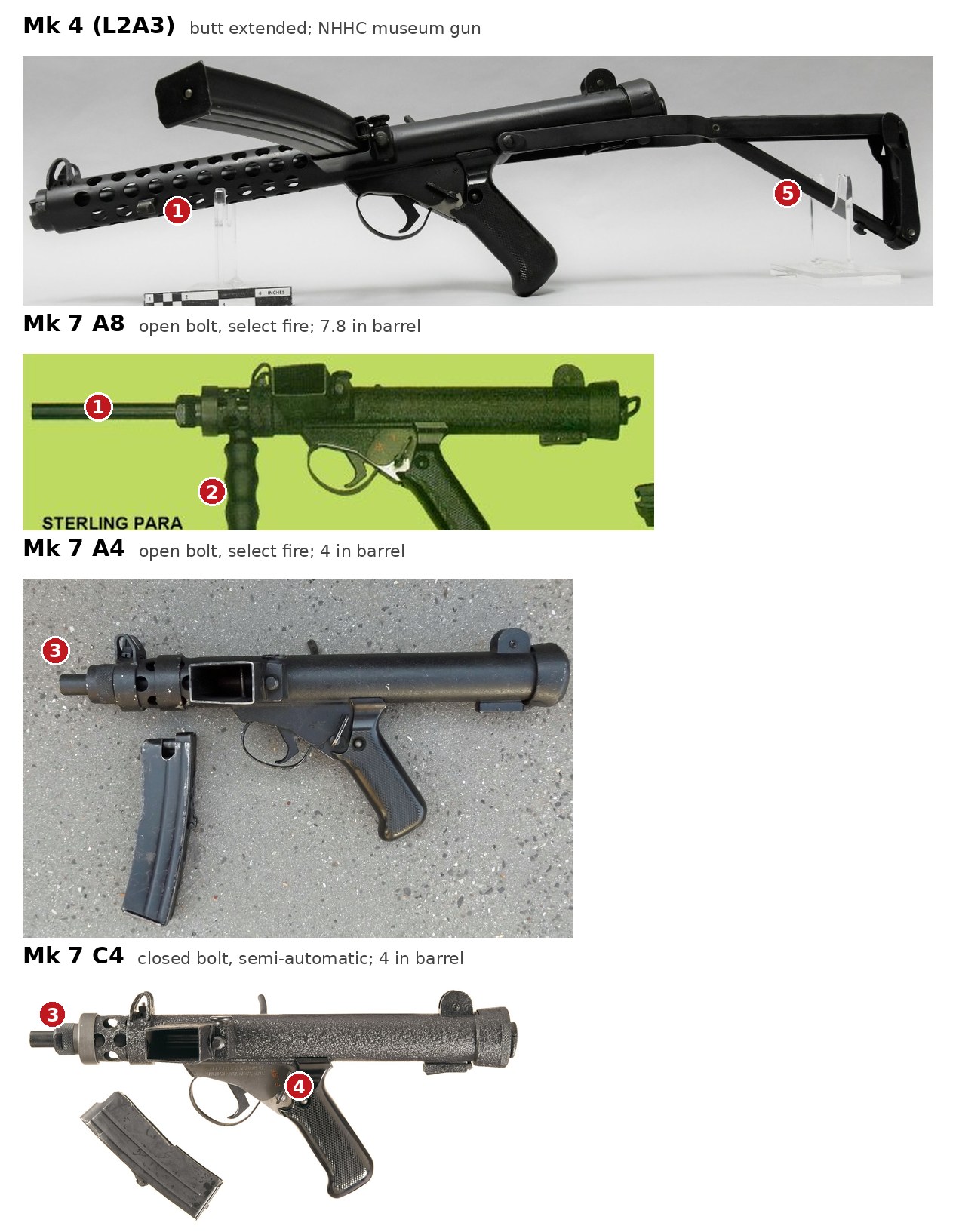
The identification rule applied to every photograph in this dive is set out in photo_credits.txt. In outline, a Mark 7 has a short barrel casing that stops just forward of the magazine housing, and no folding butt. An A is identified by a photograph’s own source label, by a vertical foregrip, or by the maker’s literature. A C is identified by its source label or by a two-position FIRE / SAFE change lever. No photograph of a C8 was found. The C8 has no panel, and no other gun stands in for it.
The A4 in panel 3 is a deactivated gun offered by a UK dealer, photographed without its foregrip. Its smooth finish differs from the textured “crackle” of the A8 and C4. The dealer does not say whether it has been refinished.7
2.4 Tell them apart
Table 2 — Tell them apart
| Feature | Mark 4 (L2A3) | Mark 7 A4 | Mark 7 A8 | Mark 7 C4 | Mark 7 C8 | Where to look |
|---|---|---|---|---|---|---|
| Barrel casing | long, perforated, to the foresight | short | short; barrel stands proud of it | short | short (by the maker’s description; no photograph found) | forward of the magazine housing |
| Barrel | 7.8 in inside the casing | 4 in nominal, threaded for the silencer | 7.8 in | 4 in | 7.8 in | muzzle |
| Butt | folding, under the body | none; optional fixed plastic butt on a special end cap | as A4 | none; same optional butt | as C4 | rear of the body |
| Foregrip | none | vertical, “fitted as standard” | vertical, standard | not recorded; the RIA C4 has none | not recorded | under the casing |
| Change lever | A (automatic), R (single shot), S (safe) | by parts, the Mark 4 trigger group (lever not legible in any photograph found) | as A4 | FIRE / SAFE (RIA C4) | not photographed | left of the pistol-grip top |
| Scope-rail buttons | none | none stated | none stated | ”two locating buttons on the upper side of the gun casing” (maker) | the same | top of the body |
| Bolt | open bolt, fixed firing pin | open bolt; the A8 bolt “same as Mk4” (dealer) | the same | closed bolt, floating firing pin (maker); Mark 6 bolt (dealer) | the same | inside; Volume 3 |
| Rear end cap | standard, with the butt lugs | ”has buffer to reduce impact on locking lugs” (dealer) | the standard Mark 7 cap | the standard Mark 7 cap | the standard Mark 7 cap | rear of the body |
Sources: the maker’s 1984 history, the Mark 4 handbook, the PS Arms flyers and the 2004 PS Arms parts list, and the RIA lot.1286
Two of these rows need caution.
- Scope-rail buttons. The maker says “all C series guns” have the two drilled and tapped locating buttons. Collectors on a US forum report Mark 6 and Mark 7 guns with and without them, and suggest the buttons were an importer’s option.9 One collector’s Lanchester-imported Mark 6 lacks them, and the Mark 7 discussed in that thread, a Cassi import, lacks them too. A C-series gun without the buttons is therefore not proof of anything.
- The foregrip. A foregrip can be fitted or removed in minutes, so it identifies nothing. Under US law, fitting one to a pistol has its own consequences (Volume 4).
The decisive difference between an A and a C is internal: an open bolt with a fixed firing pin and the automatic trigger group, against a closed bolt with a floating firing pin and the semi-automatic group. The A-series parts are the Mark 4’s, and the C-series parts are the Mark 6’s (Volume 3). A gun’s markings and paperwork, not its outside, say which it is.
2.5 Markings
The Imperial War Museums’ A4, FIR 11228, is the one Mark 7 whose markings have been published by an institution. IWM transcribes them as follows.4
Table 3 — Markings
| Where | Marking (IWM’s transcription) |
|---|---|
| top of magazine housing | STERLING PISTOL 9M/M MK7 and a serial number |
| underside of magazine housing | STERLING PATENT NOS 559469 566875 579660 686628 IN UK AND CORRESPONDING FOREIGN PATENTS |
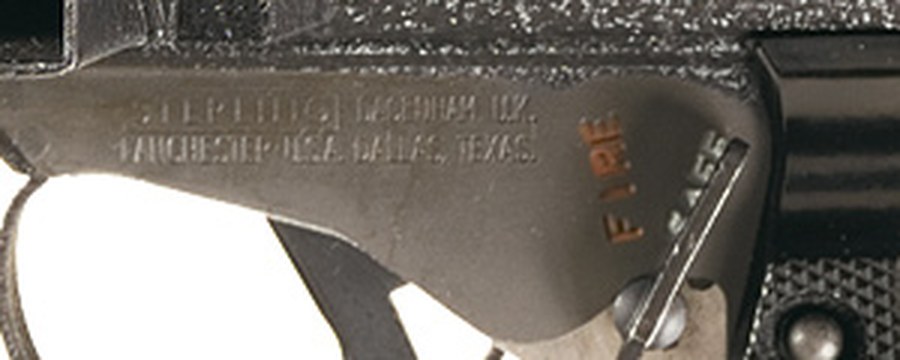
| left of trigger housing | STERLING DAGENHAM U.K. LANCHESTER U.S.A. DALLAS, TEXAS |
| magazine(s) | STERLING 2 X 15 |
| barrel and bolt | London proofs |
Points worth drawing out:
- “PISTOL … MK7” is the maker’s own name on the gun.
- The four patent numbers are British patents. The maker cites them as the gun’s patents, which suggests they are the Sterling’s basic patents rather than anything new to the Mark 7. They were not read for this dive, because British patents of the 1940s and 1950s could not be retrieved through the usual public services (see “What could not be verified”). One related document was read: George William Patchett’s US patent 2,510,831, Cartridge Magazine for Automatic Firearms, filed 16 April 1947 and granted 6 June 1950, which claims British priority of 18 April 1946.10 Which of the four British numbers it corresponds to was not established.
- “LANCHESTER U.S.A. DALLAS, TEXAS” on a gun in a British museum shows that the US importer’s line was put on at Dagenham, not added after import. The C4 sold by Rock Island Auction in 2010 has the same two lines on the left of the trigger housing.6 Lanchester U.S.A. was a Dallas importer of Sterling guns. No corporate history of it was found.
- “2 X 15” on the magazine identifies the twin-stacked pair of 15-round magazines (below).
2.6 The change lever: A, R, S against FIRE and SAFE
Sterling’s Mark 4 handbook describes a three-position change lever: A for automatic, R for single shot, and S for safe. At S the lever locks the trigger and sear whether the bolt is forward or back.1 By the parts list of a US dealer that sold new Mark 7s, the A series uses the Mark 4 trigger group (“Trigger Group, Mk4, also fits Mk3, Mk5, Mk7A”).8 So the A4 and A8 carry the same three-position lever. None of the photographs found shows an A-series lever’s letters legibly, so that is an inference from the parts list.
The C4 in the RIA photograph has a two-position lever, marked FIRE in red and SAFE.6 The Mark 6 semi-automatic trigger group that the same dealer listed as fitting the “Mk6, Mk7C, Mk8” is a different assembly, stamped “SINGLE SHOT” on the dealer’s photograph of it (Volume 3).811 A FIRE / SAFE lever is the clearest external sign of a C-series gun. A lever marked A, R and S on a gun stamped C4 or C8 means its trigger group is not the one it left the factory with, and that is a legal question before it is a collecting one (Volume 4).
2.7 Magazines
Sterling’s account of the Mark 4 magazine is in Volume 3. For the Mark 7 the company added shorter and paired magazines.
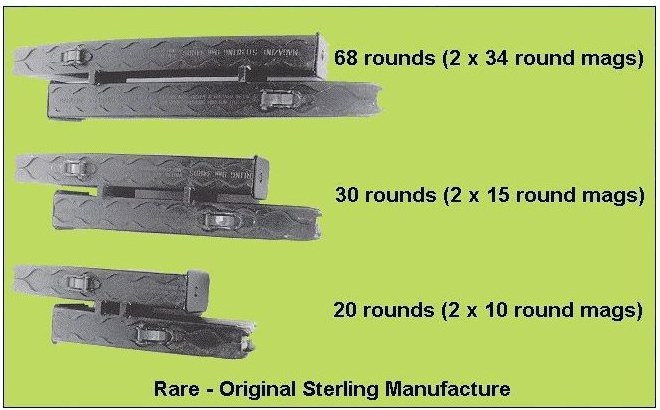
- Capacities: 10, 15 and 34 rounds. All three are shown in the dealer flyer that reproduces the brochure.2 The English-language Wikipedia, citing the 2020 company history, says Sterling introduced the 10 and 15-round magazines with the Mark 7 in 1983, together with “twin-stacked” versions of these and of the 34-round magazine.5 Blue Press puts the 10 and 15-round “guard” magazines in its Mark 4 account, “primarily to allow tank crews more mobility in cramped quarters”, without a date.12 Whether short magazines existed before the Mark 7 is therefore not settled.
- Twin-stacked magazines. These are two magazines permanently joined side by side and offset, so the second can be inserted by sliding the pair across. They came as 2×10 (20 rounds), 2×15 (30) and 2×34 (68). The flyer calls them “Twin stacked (Permanent)”, and a dealer page of 2004 calls them “Rare - Original Sterling Manufacture”.213 IWM’s magazines are marked “STERLING 2 X 15”.4
- Interchangeability. The 34-round magazine is the standard Sterling magazine. The Mark 7 takes the whole Sterling magazine range, as the flyer’s list shows.
2.8 Foregrip, butt, scope rail and silencer
- Vertical foregrip. “The A4 and A8 have a forward pistol grip fitted as standard which enables the user to have a rugged hold to have complete control of the gun in continuous rapid fire.”2 A dealer also listed a “Foregrip Strap, Mk7”.8 The English-language Wikipedia says the foregrip was “designed by Black & Decker”, citing a paywalled Key Military article that could not be read. That claim is not confirmed.5
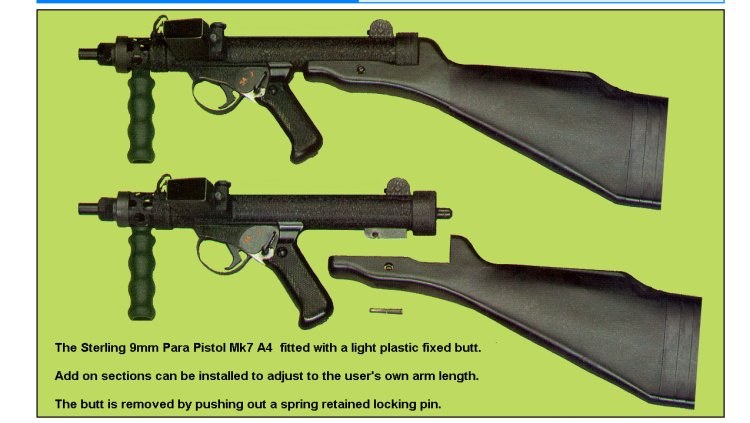
- Plastic butt. “The Sterling 9mm Para Pistol Mk7 A4 fitted with a light plastic fixed butt. Add on sections can be installed to adjust to the user’s own arm length. The butt is removed by pushing out a spring retained locking pin.”3 The dealer sold it “with special end cap for mounting stock”, describing it as converting “Mk7 Para SMG or pistol to PDW”, and sold butt spacers separately.8 Fitting this butt to a C-series pistol in the United States makes a short-barrelled rifle (Volume 4).
- Scope rail. The maker’s text: all C-series guns have “two locating buttons on the upper side of the gun casing … ready drilled and tapped and the Sterling scope rail fits on them direct. This rail will take most known makes of night and optical sights.”1 The dealer flyer lists a “Scope rail 12mm or 20mm” as an accessory for the A series.2 See the caution about missing buttons above.
- Silencer. The maker: “A suppressor/silencer is available for the A4 unit.” The flyer: “Silencer can be fitted (4.25” barrel version only).”12 A dealer photograph shows an A4 with an American aftermarket suppressor, the AWC Mk9, and states that “The Mk7 Para unlike the Mk4 SMG has a factory threaded barrel”.3 The AWC is not Sterling’s own silencer, and no photograph of a Sterling-made Mark 7 silencer was found. In the United States a silencer is itself an NFA firearm. The hub’s suppressor law dive covers the law.
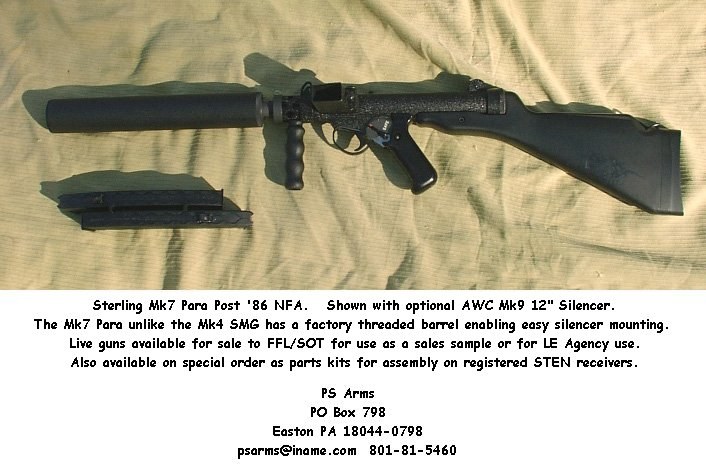
2.9 Finish
The dealer flyer says “Black crackle finish”, and Rock Island describes its C4 as “textured black”.26 The RIA C4 shows a heavily textured black paint over the body, with the trigger housing and barrel nut left in a plain dark finish. The Enfield A4 has a smoother black finish, and nothing on the dealer’s page says whether it is original.7
2.10 What survives, and what it has sold for
Prices are dated and attributed, because they mean nothing otherwise.
Table 4 — What survives, and what it has sold for
| Date | Item | Price | Source |
|---|---|---|---|
| 2001-11 | Mark 7 A4 or A8 “Para SMG”, new, wrinkle finish (post-1986 dealer sample) | $850; $975 with plastic butt | PS Arms price list8 |
| 2001-11 | Mark 7A or Mark 7C user manual | $25 each | PS Arms price list8 |
| 2004-03 | the same guns | $895; $1,045 with butt | PS Arms price list8 |
| 2010-04-30 | Mark 7 C4, near new, with user handbook | estimate $800–1,200; realised price behind a login | Rock Island Auction, lot 8916 |
The A-series prices apply only to buyers who can hold a post-1986 dealer sample: law enforcement agencies and licensed dealers with Special Occupational Tax status (Volume 4). They are not prices a private buyer could pay. No sale of a transferable A-series Mark 7 was found.
In museums, the IWM’s A4 (FIR 11228) is the one public example found. It has no image online.4 In Britain, A4s are on the market as deactivated guns.7
2.11 What could not be verified
- The reason for the 4 in / 4.25 in / 11 cm difference in the short barrel.
- Any photograph of a C8, or any dimension specific to the C series beyond “4 inch”.
- The A-series change lever’s markings on a photographed gun.
- Whether the C series was ever sold with the vertical foregrip fitted.
- The four British patents’ titles and inventors.
- The “Black & Decker” foregrip claim.
- The date of the short and twin-stacked magazines: 1983 with the Mark 7, per the second-hand report of the 2020 history, or earlier, per Blue Press.
References
Footnotes
-
Sterling Armament Company Limited, User Handbook, Sterling Sub-Machine Gun 9-mm. Mk 4 (S.M.G. 9mm. L.2.A.3.), with “Brief history” and nomenclature table signed “DTEH 1984”. Scan at http://pdf.textfiles.com/manuals/FIREARMS/sterling_mk4_smg.pdf (accessed 2026-10-20). Technical details on p. 4 of the handbook, change lever paras 3.3 and 5.1–5.3, Mark 7 entry on PDF p. 23. ↩ ↩2 ↩3 ↩4 ↩5 ↩6 ↩7
-
PS Arms, flyer “Sterling Para Pistol 9mm M7 A4 & A8 Military Version”, archived 2009-10-27, https://web.archive.org/web/20091027104838/http://geocities.com/psarms/LinkedFiles/SAMk7.jpg (accessed 2026-10-20). ↩ ↩2 ↩3 ↩4 ↩5 ↩6 ↩7 ↩8
-
PS Arms, flyer with plastic butt, https://web.archive.org/web/20091027104827/http://geocities.com/psarms/LinkedFiles/SAMk7S.jpg , and photograph “Sterling Mk7 Para Post ‘86 NFA” with AWC Mk9 silencer, https://web.archive.org/web/20091027104939/http://geocities.com/psarms/LinkedFiles/SAMk7AwcMk9-m.jpg (both archived 2009-10-27; accessed 2026-10-20). ↩ ↩2 ↩3
-
Imperial War Museums, “Sterling Para Pistol Mk 7 A4”, FIR 11228, https://www.iwm.org.uk/collections/item/object/30032527 (accessed 2026-10-20). The serial number IWM transcribes is omitted here. ↩ ↩2 ↩3 ↩4
-
“Sterling submachine gun”, English Wikipedia, raw text accessed 2026-10-20 (magazine paragraph citing Laidler, Edmiston and Howroyd 2020, pp. 299–300; Mark 7 paragraph citing Key Military). ↩ ↩2 ↩3
-
Rock Island Auction Company, 30 April 2010, lot 891, “Sterling Armament Ltd Mk 7 C4 Pistol 9 mm”, https://www.rockislandauction.com/detail/49/891/sterling-armament-ltd-mk-7-c4-pistol-9-mm (accessed 2026-10-20). Photograph https://cdn.rockislandauction.com/dev_cdn/49/891.jpg . ↩ ↩2 ↩3 ↩4 ↩5 ↩6
-
Enfield Guns, “Sterling Mk7 Para Pistol A4 9mm”, https://www.enfieldguns.com/sterling-para-pistol (accessed 2026-10-20). ↩ ↩2 ↩3
-
PS Arms price lists archived 2001-11-28 (https://web.archive.org/web/20011128130133/http://www.geocities.com:80/psarms/StgPriceList.htm) and 2004-03-27 (https://web.archive.org/web/20040327114749/http://www.geocities.com:80/psarms/SAPriceList.htm), accessed 2026-10-20. Dealer catalogue: parts compatibility as the dealer stated it. ↩ ↩2 ↩3 ↩4 ↩5 ↩6 ↩7 ↩8
-
Military Surplus Collectors Forums, “Converted Sterling Mk7 pistol”, https://www.milsurps.com/threads/converted-sterling-mk7-pistol.59246/ (accessed 2026-10-20). ↩
-
G. W. Patchett, US Patent 2,510,831, “Cartridge Magazine for Automatic Firearms”, filed 16 April 1947, granted 6 June 1950, British priority 18 April 1946. https://patentimages.storage.googleapis.com/pdfs/US2510831.pdf (accessed 2026-10-20). ↩
-
PS Arms, trigger-group photographs, archived 2009-10-27, https://web.archive.org/web/20091027105004/http://geocities.com/psarms/LinkedFiles/SATriggerGrps.jpg (accessed 2026-10-20). ↩
-
“The Sterling Submachine Gun”, Dillon Blue Press, August 2011, p. 41, https://dilloncdn.com/bluepress/Aug_11_classic_2.pdf (accessed 2026-10-20). ↩
-
PS Arms, “Twin Stacked Magazines”, archived 2004-04-08, https://web.archive.org/web/20040408173049/http://www.geocities.com:80/psarms/LinkedFiles/SATwinMags.jpg (accessed 2026-10-20). ↩


Comments (0)