Sterling Mk 7 Para Pistol · Volume 1
The Para Pistol: What \"Sterling Mk 7\" Means, and Sterling's Last New Gun, 1983–1988
The Sterling Armament Company's own account of its Mark 7: a cut-down Mark 4 sub-machine gun put into production in late 1983 as two pairs of guns, the open-bolt Para Pistol A4 and A8 and the closed-bolt Pistol C4 and C8, why it was made, who is recorded as buying it, and how the company ended five years later
1.1 What “Mk 7” names
“Sterling Mk VII pistol” refers to one product: the Mark 7 made by the Sterling Armament Company of Dagenham, Essex. It is the Sterling sub-machine gun with most of its barrel casing cut away, its folding butt removed, and a pistol name. The company’s literature writes the mark in Arabic numerals (“Mark 7”, “Mk7”). No Sterling product carrying a Roman “Mk VII” was found. The American firm Sterling Arms Corporation of Buffalo and Lockport, New York, which made small .22 and .380 pocket pistols, is a separate company. None of its pistols was found to carry a Mark 7 designation.
The maker stamped the name on the gun itself. The Imperial War Museums hold a Mark 7 A4, catalogue number FIR 11228. IWM records the marking on top of its magazine housing as “STERLING PISTOL 9M/M MK7”.1
The word “pistol” is the maker’s. It describes a gun with a pistol grip, no butt and a short barrel, and in the “A” forms it is a machine pistol. Two of the four forms fire automatically from an open bolt, exactly as the sub-machine gun does. The other two are closed-bolt semi-automatics.
1.2 The maker’s own description
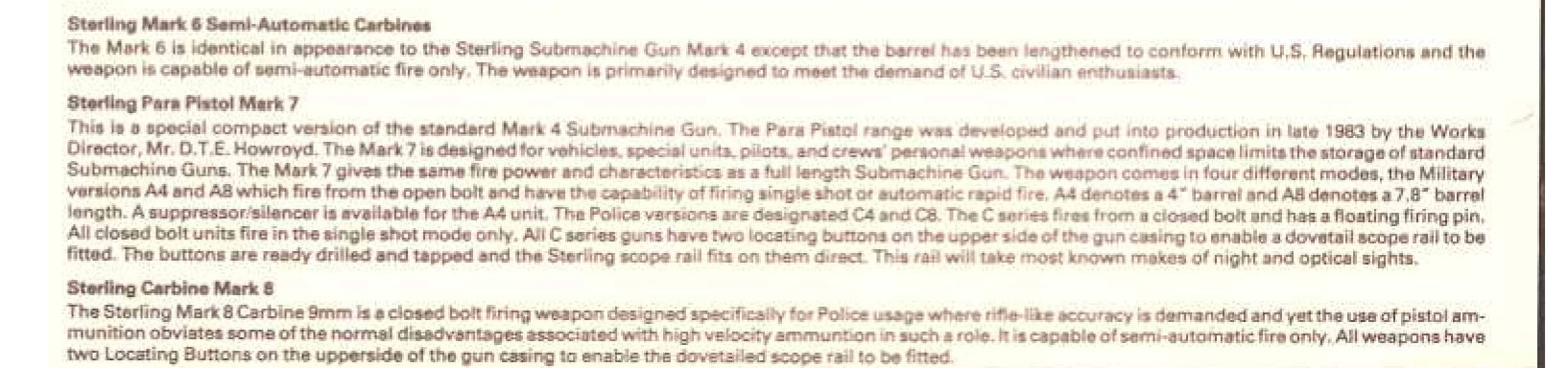
Sterling’s user handbook for the Mark 4 sub-machine gun closes with a two-page “Brief history of submachine guns and carbines”. It is signed “DTEH 1984”, the initials of D. T. E. Howroyd, Sterling’s Works Director. A scanned copy of the handbook is online.2 Its entry for the Mark 7 is the earliest and most direct statement found of what the gun is, and is given here in full:
This is a special compact version of the standard Mark 4 Submachine Gun. The Para Pistol range was developed and put into production in late 1983 by the Works Director, Mr. D.T.E. Howroyd. The Mark 7 is designed for vehicles, special units, pilots, and crews’ personal weapons where confined space limits the storage of standard Submachine Guns. The Mark 7 gives the same fire power and characteristics as a full length Submachine Gun. The weapon comes in four different modes, the Military versions A4 and A8 which fire from the open bolt and have the capability of firing single shot or automatic rapid fire. A4 denotes a 4” barrel and A8 denotes a 7.8” barrel length. A suppressor/silencer is available for the A4 unit. The Police versions are designated C4 and C8. The C series fires from a closed bolt and has a floating firing pin. All closed bolt units fire in the single shot mode only. All C series guns have two locating buttons on the upper side of the gun casing to enable a dovetail scope rail to be fitted. The buttons are ready drilled and tapped and the Sterling scope rail fits on them direct. This rail will take most known makes of night and optical sights.2
On the facing page, a table titled “Comparative reference numbers and nomenclature” sets the maker’s name for every Sterling against the British Government reference. The Mark 7 takes two lines, and the two lines use different names:
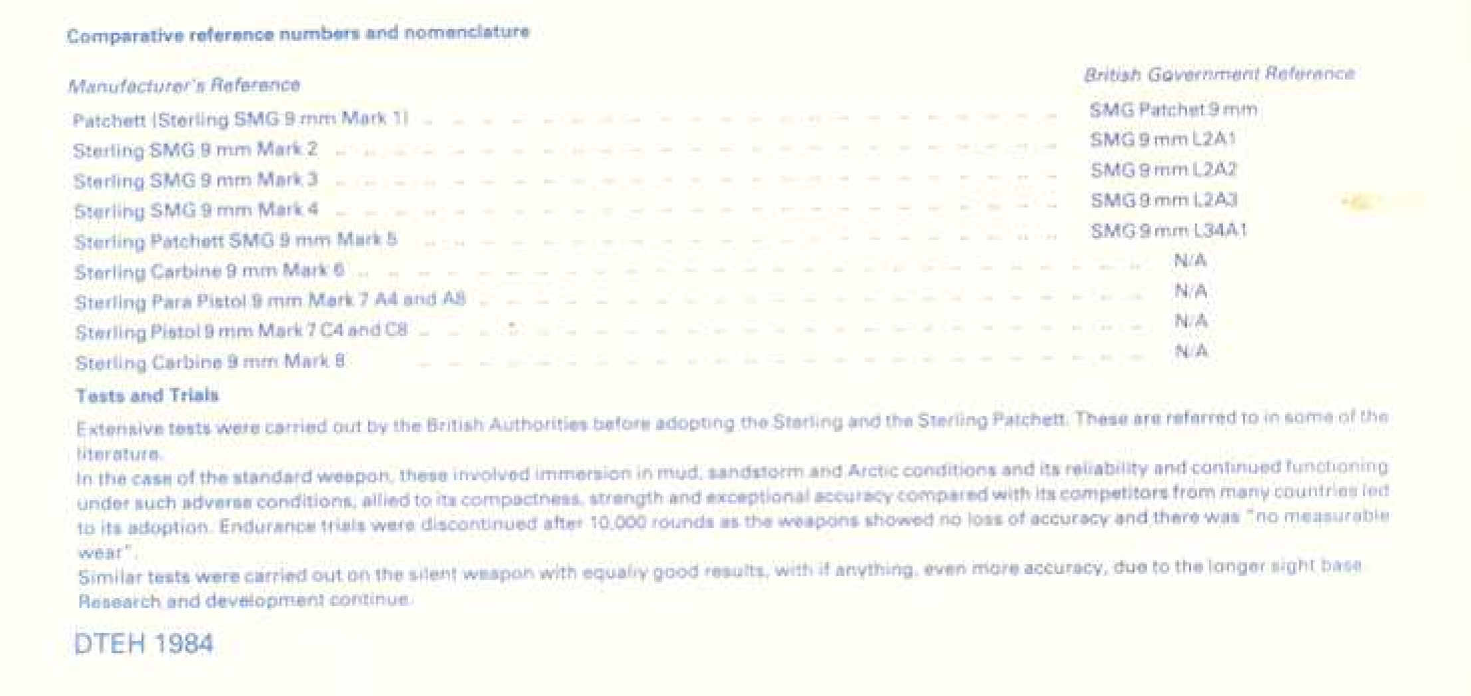
Table 1 — The maker's own description
| Manufacturer’s reference | British Government reference |
|---|---|
| Patchett (Sterling SMG 9 mm Mark 1) | SMG Patchet 9 mm |
| Sterling SMG 9 mm Mark 2 | SMG 9 mm L2A1 |
| Sterling SMG 9 mm Mark 3 | SMG 9 mm L2A2 |
| Sterling SMG 9 mm Mark 4 | SMG 9 mm L2A3 |
| Sterling Patchett SMG 9 mm Mark 5 | SMG 9 mm L34A1 |
| Sterling Carbine 9 mm Mark 6 | N/A |
| Sterling Para Pistol 9 mm Mark 7 A4 and A8 | N/A |
| Sterling Pistol 9 mm Mark 7 C4 and C8 | N/A |
| Sterling Carbine 9 mm Mark 8 | N/A |
Two facts follow from the maker’s text, and the rest of this dive depends on both.
- “Para Pistol” is, in the maker’s usage, the name of the open-bolt automatic pair, A4 and A8. The closed-bolt pair, C4 and C8, is listed as “Sterling Pistol 9 mm Mark 7”. The same paragraph uses “the Para Pistol range” for the whole family, so the looser usage is also the maker’s. Dealers and auction houses since have applied “Para Pistol” to all four.
- The letter is the action, and the number is the barrel. A means “Military”, open bolt, single shot or automatic. C means “Police”, closed bolt, floating firing pin, single shot only. 4 means a 4-inch barrel and 8 a 7.8-inch barrel, the Mark 4’s barrel length. Nothing Sterling published describes an open-bolt semi-automatic Mark 7.
The British Government column reads “N/A” for the Mark 7: in 1984 it had no British service designation, and none was found later.
1.3 The Sterling Armament Company, Dagenham
The same 1984 history gives the company’s own outline of its past. The account below follows it and notes where other sources differ.2
- The business “of Sterling Engineering began at the turn of the century”. In 1939 “the Lanchester machine carbine, which was based on the German MP 28 II, was designed by G.H. Lanchester, of the Sterling Engineering Company”. Over 100,000 were supplied to the Royal Navy and the Commonwealth navies. The company also made the De Lisle silent carbine.
- The Patchett. “Extensive work by Sterling’s design team under G.W. Patchett resulted in the Patchett Sub Machine Gun. Limited quantities saw service in Europe shortly before the end of World War II.” After the war, and after competitive trials held by the British Government, it was “adopted as the standard weapon for HM Forces as the Sub Machine Gun 9mm L2A3 in 1954”. The handbook adds that “L2A1 and L2A2 were earlier versions made in limited quantities between 1951 and 1953”.
- The Mark 4 (L2A3) “has been supplied, and is still being supplied, to the Armed and Police Forces of over 90 countries in the free world. More than 2 million Mark 4’s have been made.” The design “has not been changed in any marked degree since its introduction and current spare parts will fit any Mark 4 ever made”.
Two of these figures conflict with other sources, and both are given here.
- The L2A3’s adoption year. The maker’s 1984 text says 1954. Other references give 1956 for the L2A3; this hub’s E-11 dive, Volume 3 now shows the maker’s 1954 beside it. The two are not reconciled here. The maker’s sentence compresses the whole adoption into one year, and the authoritative chronology is in the 2020 company history, which was not read (see “What could not be verified”).
- How many were made. The maker claimed “more than 2 million Mark 4’s” in 1984. A 2011 article in Dillon’s Blue Press gives “approximately 400,000 Sterling subguns”, and the English-language Wikipedia article says “over 400,000” were made between 1953 and 1988.34 The maker’s figure comes from a sales handbook and may include licensed production in India and Canada. The others give no source for their figure. Neither is adopted here.
The company’s address on the handbook cover is Dagenham, Essex, with the cable address “STERLING, DAGENHAM, ENGLAND”.2
1.4 The marks before the Mk 7
The Mark 7 descends from a family of guns that shares one action. The maker’s descriptions are below. Volume 2 gives the identification detail.
- Mark 4 (L2A3): the open-bolt, selective-fire sub-machine gun. It has a 7.8-inch barrel inside a perforated casing, a butt that folds under the body, and a 34-round magazine fed from the left.2
- Mark 5 (L34A1): the silenced gun, made to a General Staff requirement that its “mechanical noise [be] unheard at 30 metres” and that it “not be recognised as a firearm at 50 metres”. Research and design were by G. W. Patchett.2
- Mark 6: “identical in appearance to the Sterling Submachine Gun Mark 4 except that the barrel has been lengthened to conform with U.S. Regulations and the weapon is capable of semi-automatic fire only. The weapon is primarily designed to meet the demand of U.S. civilian enthusiasts.”2 Blue Press calls it “a closed-bolt semiauto version for police forces and civilians” with a 16-inch barrel in its US export form.3
- Mark 8: “a closed bolt firing weapon designed specifically for Police usage where rifle-like accuracy is demanded”, semi-automatic only, with the same two scope-rail locating buttons as the C-series Mark 7.2
So by 1984 Sterling was selling one action in two forms. The open-bolt automatic was the military gun (Marks 4, 5 and 7A). The closed-bolt semi-automatic was the police and civilian gun (Marks 6, 7C and 8). The Mark 7 is the only mark offered in both forms under one number.
1.5 Why a pistol
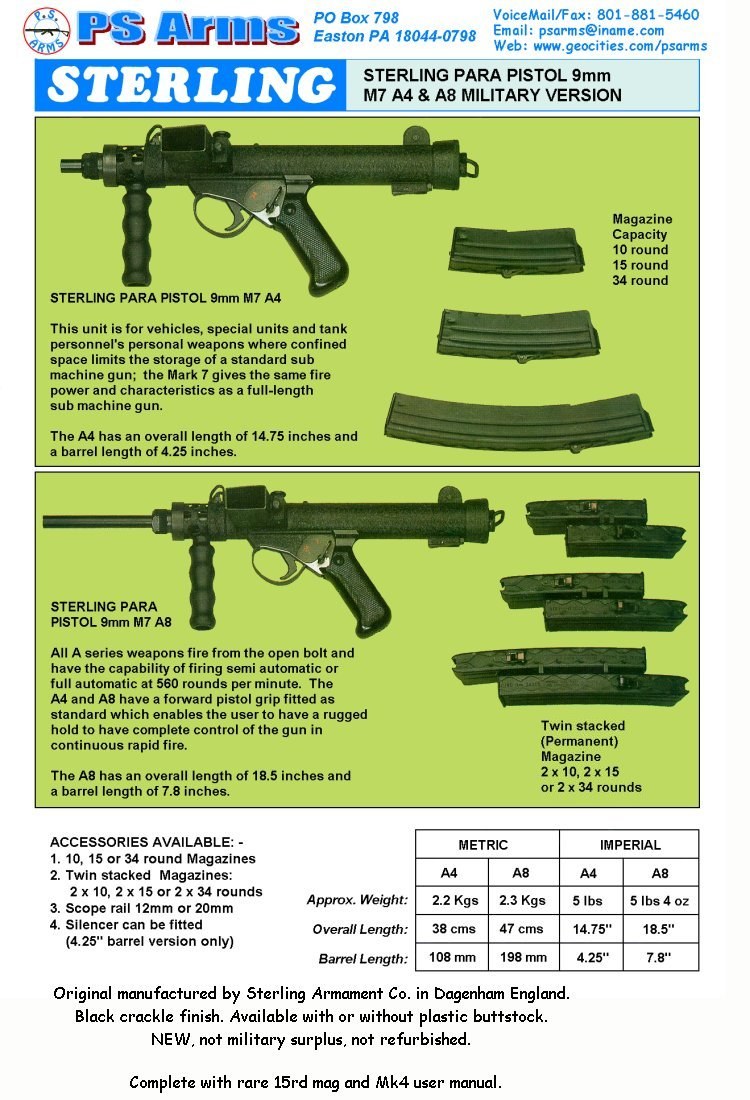
The maker’s reason, quoted above, is space. The gun is “for vehicles, special units, pilots, and crews’ personal weapons where confined space limits the storage of standard Submachine Guns”, and it “gives the same fire power and characteristics as a full length Submachine Gun”.2 A dealer’s flyer of about 2001–2009, which reproduces what reads as Sterling’s own sales copy, words it slightly differently: “This unit is for vehicles, special units and tank personnel’s personal weapons where confined space limits the storage of a standard sub machine gun”.5
Later accounts add uses that the maker does not mention.
- Dillon’s Blue Press (2011): “a variant issued to special forces and intelligence groups … commonly issued with the short 10- and 15-round magazines for better concealment.”3
- Enfield Guns, a UK dealer in deactivated weapons: “originally designed to provide paratroopers and non-infantry personnel, such as vehicle crews, with a compact, automatic backup/defence weapon.”6
The name “Para” suggests airborne troops, but the maker’s text does not mention parachutists and gives no reason for the name. Concealment and special-forces issue appear only in later secondary accounts, without a cited source.
The design choice is what Sterling’s own description implies. It removed what a vehicle crewman cannot stow and kept what fires the gun. The Mark 4’s body, bolt, return springs, trigger mechanism and magazine were retained, and a US dealer’s parts list confirms the shared parts (Volume 3). The length went: the A4 is 38 cm (14.75 in) overall against the Mark 4’s 69 cm (27 in) with the butt extended or 48 cm (19 in) folded.52 A vertical foregrip was “fitted as standard” on the A series, so the gun could still be held with two hands. An optional plastic butt was available for those who wanted to fire from the shoulder.57
1.6 The four guns in brief
Table 2 — The four guns in brief
| Bolt | Fire | Barrel | Maker’s name | Maker’s class | |
|---|---|---|---|---|---|
| A4 | open | single shot or automatic | 4 in (dealer table: 4.25 in, 108 mm) | Para Pistol 9 mm Mark 7 A4 | Military |
| A8 | open | single shot or automatic | 7.8 in (198 mm) | Para Pistol 9 mm Mark 7 A8 | Military |
| C4 | closed, floating firing pin | single shot only | 4 in | Pistol 9 mm Mark 7 C4 | Police |
| C8 | closed, floating firing pin | single shot only | 7.8 in | Pistol 9 mm Mark 7 C8 | Police |
Sources: the maker’s 1984 history and the PS Arms flyer.25 The barrel figures conflict, and the conflict is set out in Volume 2.
1.7 When it was made
Two start dates are in print, and they are three years apart.
Table 3 — When it was made
| Source | Date | Nature of source |
|---|---|---|
| Sterling, User Handbook history, signed DTEH 19842 | ”developed and put into production in late 1983” | the maker, written within a year of the event, by the man it names |
| en.wikipedia, citing Laidler, Edmiston and Howroyd (2020), pp. 299–3004 | ”when introducing the Mk 7 Pistol variant in 1983” | second-hand report of the company history |
| Enfield Guns (UK dealer)6 | “produced … for only 18 months from 1986 to 1988” | dealer listing, no source given |
This dive uses the maker’s late 1983. A text signed in 1984 cannot describe a gun that first appeared in 1986. The “1986 to 1988” figure circulates widely, mostly on airsoft retail pages that copy one another. It may be the period of a particular contract or importer, but no source says so. Production ended when Sterling closed in 1988 (below).
No production figure from the maker was found. A US dealer’s 2004 price list said “rare only 300 Mk7s made for SAS and Special Ops”. Its 2001 list said only “for Special Ops”.8 That claim has no source behind it and is not adopted here.
1.8 Who bought it
The record of Mark 7 buyers is thin, and this dive found no named military user.
- No British adoption. The maker’s own table gives “N/A” as the British Government reference for both Mark 7 pairs.2
- Special forces. Blue Press says special forces and intelligence groups. A US dealer’s list says “SAS and Special Ops”. Neither names a source, and neither claim could be confirmed.38
- The United States. Mark 7s carry a US importer’s mark from the factory. The IWM’s A4, a gun now in Britain, is stamped on the left of its trigger housing “STERLING DAGENHAM U.K. LANCHESTER U.S.A. DALLAS, TEXAS”.1 A C4 sold by Rock Island Auction in 2010 carries the same two lines in the same place (see the close-up in Volume 2).9 Collectors also name Cassi Inc., Armscorp and Romar as importers of Sterlings of this period, Cassi among them for the Mark 7. That comes from a forum discussion and is unconfirmed.10 The A-series guns that a US dealer offered new in the 2000s were sold, in its words, “only to LE agencies or Title II dealers” as post-1986 dealer samples (Volume 4).7
- Canada. Canadian federal regulations prohibit, by name, “the Sterling Mk 7 pistol, and any variant or modified version of it, including the Sterling Mk 7 C4 and Sterling Mk 7 C8”. A regulation that names the C4 and C8 implies that both reached the Canadian civilian market.11
Within the four forms, the evidence points to a split. The A series was sold to military and police customers and to US dealers in machine guns. The C series was sold to civilian buyers in North America, as the Mark 6 had been. That split is an inference from where each form turns up. No sales figures were found.
1.9 The end of the company
The sources agree that the Dagenham factory closed in 1988. They do not agree on who ended it, or when the company was sold.
- Enfield Guns: “Sterling Armament Company Ltd ceased trading in mid 1988.”6
- en.wikipedia: “Production ceased in 1988 with the closing of Sterling Armaments by British Aerospace/Royal Ordnance”, citing Matthew Moss’s 2018 Osprey book on the Sterling. The same article’s company page says “The company went bankrupt in 1988”, flagged “citation needed”.412
- Blue Press: “the Sterling factory fell on hard times and was sold to British Aerospace in 1989. At its peak, the factory had employed approximately 1600 men and women.”3
The usual account, a 1988 closure followed by a 1989 sale to British Aerospace, which owned Royal Ordnance, fits all three, but no primary document for either step was read. The Mark 8 carbine is numbered after the Mark 7, but the maker’s text gives no date for it, so whether the Mark 7 was the company’s last new gun is not established here.
The name has since been revived. The English-language Wikipedia records that James Edmiston, a former director of the original company, revived the Sterling Armament Company name in 2016, and that the new company is dormant according to its Companies House filings.12 Edmiston is a co-author, with Peter Laidler and David Howroyd, of the 2020 company history whose twelfth chapter is “The Sterling Mk. 7 ‘Pistols‘“.13
1.10 What this dive corrects
- The C series is the closed-bolt pair, not the open-bolt one. It is easy to assume that the semi-automatic C4 and C8 are open-bolt guns like their parent. The maker says the opposite. “C series fires from a closed bolt and has a floating firing pin. All closed bolt units fire in the single shot mode only.” The open-bolt guns are the A4 and A8, and both are selective fire.2 No Sterling source describes an open-bolt semi-automatic Mark 7.
- Production began in late 1983, not 1986. The source is the maker, writing in 1984.2
- “Para Pistol” is the maker’s name for the A series. In the maker’s nomenclature table the C series is “Sterling Pistol 9 mm Mark 7 C4 and C8”.2
- The Mark-to-L-number pairings. The maker gives Mark 2 = L2A1 and Mark 3 = L2A2, dates the Mark 7 to late 1983, and describes the Mark 8 as “a closed bolt firing weapon designed specifically for Police usage”.2 Some references pair Mark 3 with the L2A1 and date the Mark 7 after 1985; this hub’s E-11 Volume 3 did so until it was corrected from the maker’s table on 2026-10-24.
1.11 What could not be verified
- The 2020 company history, Laidler, Edmiston and Howroyd, A History of the Small Arms made by the Sterling Armament Company (Pen & Sword), was not read. Its Chapter 11, “Closing the Bolt”, and Chapter 12, “The Sterling Mk. 7 ‘Pistols’”, are the most authoritative account in print.13 Every figure in this dive should be checked against it when a copy is available.
- Any production total for the Mark 7, or for any one of its four forms.
- Any named military or police user.
- The origin of the name “Para”.
- The Mark 7 handbooks. Sterling issued a “Mk7A User Manual (SMG)” and a “Mk7C User Manual (semi-auto pistol)”, which a dealer was selling in 2001.8 No scan was found. This dive uses the Mark 4 handbook, which the same dealer shipped with new A-series Mark 7s (Volume 3).
References
Footnotes
-
Imperial War Museums, “Sterling Para Pistol Mk 7 A4”, catalogue number FIR 11228, https://www.iwm.org.uk/collections/item/object/30032527 (accessed 2026-10-20). The markings as transcribed by IWM are quoted in Volume 2. No image online. ↩ ↩2
-
Sterling Armament Company Limited, User Handbook, Sterling Sub-Machine Gun 9-mm. Mk 4 (S.M.G. 9mm. L.2.A.3.), Dagenham, Essex, with “Brief history of submachine guns and carbines” and “Comparative reference numbers and nomenclature” signed “DTEH 1984”. Scan (24 pp.) at http://pdf.textfiles.com/manuals/FIREARMS/sterling_mk4_smg.pdf (accessed 2026-10-20). The Mark 7 text is on PDF page 23, the nomenclature on page 24. Read from 300 dpi renders, because the scan’s text layer is unreliable. ↩ ↩2 ↩3 ↩4 ↩5 ↩6 ↩7 ↩8 ↩9 ↩10 ↩11 ↩12 ↩13 ↩14 ↩15 ↩16 ↩17
-
“The Sterling Submachine Gun”, Dillon Blue Press, August 2011, section 2, p. 41 (unsigned), https://dilloncdn.com/bluepress/Aug_11_classic_2.pdf (accessed 2026-10-20). ↩ ↩2 ↩3 ↩4 ↩5
-
“Sterling submachine gun”, English Wikipedia, raw text accessed 2026-10-20. Its Mark 7 date cites Laidler, Edmiston and Howroyd (2020), pp. 299–300, and its production end cites Moss (2018), p. 5. Neither book was read for this dive. ↩ ↩2 ↩3
-
PS Arms (Easton, Pennsylvania), flyer “Sterling Para Pistol 9mm M7 A4 & A8 Military Version”, GeoCities, archived by the Internet Archive on 2009-10-27: https://web.archive.org/web/20091027104838/http://geocities.com/psarms/LinkedFiles/SAMk7.jpg (accessed 2026-10-20). ↩ ↩2 ↩3 ↩4
-
Enfield Guns, “Sterling Mk7 Para Pistol A4 9mm”, https://www.enfieldguns.com/sterling-para-pistol (accessed 2026-10-20). ↩ ↩2 ↩3
-
PS Arms, flyer with the A4 fitted with the plastic butt, archived 2009-10-27: https://web.archive.org/web/20091027104827/http://geocities.com/psarms/LinkedFiles/SAMk7S.jpg ; and “Sterling Mk7 Para Post ‘86 NFA” photograph with an AWC Mk9 silencer, archived 2009-10-27: https://web.archive.org/web/20091027104939/http://geocities.com/psarms/LinkedFiles/SAMk7AwcMk9-m.jpg (both accessed 2026-10-20). ↩ ↩2
-
PS Arms price lists, “StgPriceList.htm” archived 2001-11-28, https://web.archive.org/web/20011128130133/http://www.geocities.com:80/psarms/StgPriceList.htm , and “SAPriceList.htm” archived 2004-03-27, https://web.archive.org/web/20040327114749/http://www.geocities.com:80/psarms/SAPriceList.htm (accessed 2026-10-20). ↩ ↩2 ↩3
-
Rock Island Auction Company, sale of 30 April 2010, lot 891, “Sterling Armament Ltd Mk 7 C4 Pistol 9 mm”, https://www.rockislandauction.com/detail/49/891/sterling-armament-ltd-mk-7-c4-pistol-9-mm (accessed 2026-10-20). ↩
-
Military Surplus Collectors Forums, thread “Converted Sterling Mk7 pistol”, https://www.milsurps.com/threads/converted-sterling-mk7-pistol.59246/ (accessed 2026-10-20). Collectors’ discussion, not a documentary source. ↩
-
Regulations Prescribing Certain Firearms and Other Weapons, Components and Parts of Weapons, Accessories, Cartridge Magazines, Ammunition and Projectiles as Prohibited, Restricted or Non-Restricted, SOR/98-462, Schedule, Part 1, item 42, https://laws-lois.justice.gc.ca/eng/regulations/SOR-98-462/FullText.html (current to 2026-09-30; accessed 2026-10-20). ↩
-
“Sterling Armaments Company”, English Wikipedia, raw text accessed 2026-10-20. ↩ ↩2
-
Peter Laidler, David Howroyd and James Edmiston, A History of the Small Arms made by the Sterling Armament Company (Barnsley: Pen & Sword, 2020), ISBN 9781526773302. Table of contents per the IPMS/USA review, https://reviews.ipmsusa.org/review/history-small-arms-made-sterling-armament-company (accessed 2026-10-20). Not read. ↩ ↩2


Comments (0)