Minebea PM-9 (M9) · Volume 4
How It Works, How It Is Kept, and How It Shoots
The M9 as the Ministry of Defense's specification describes it: four assemblies, an open-bolt blowback action with a telescoping bolt and no rate reducer, the safety functions, the field kit, the acceptance tests that are the only published reliability data, and its ammunition
4.1 What the sources are
No operator’s manual, armourer’s manual or exploded drawing of the M9 has been published. The weapon has one, since the specification lists among the documents to be delivered with each consignment a 取扱書, a handling manual, along with a history log and an inspection record for each gun.1 That manual was not found in any archive searched for this dive.
What has been published is the specification itself, DSP Y 1001B, and it is more informative than most. Its appended Table 1, “Structure and function”, describes every assembly and every safety function in a page.1 The Ground Self-Defense Force’s equipment page gives the operating principle.2 The 2012 Spear Head feature adds observations from handling service guns: the materials, the open bolt, the shape of the bolt and the feel of the controls.3 This volume is built from those three, and says so wherever it goes beyond them.
4.2 The four assemblies
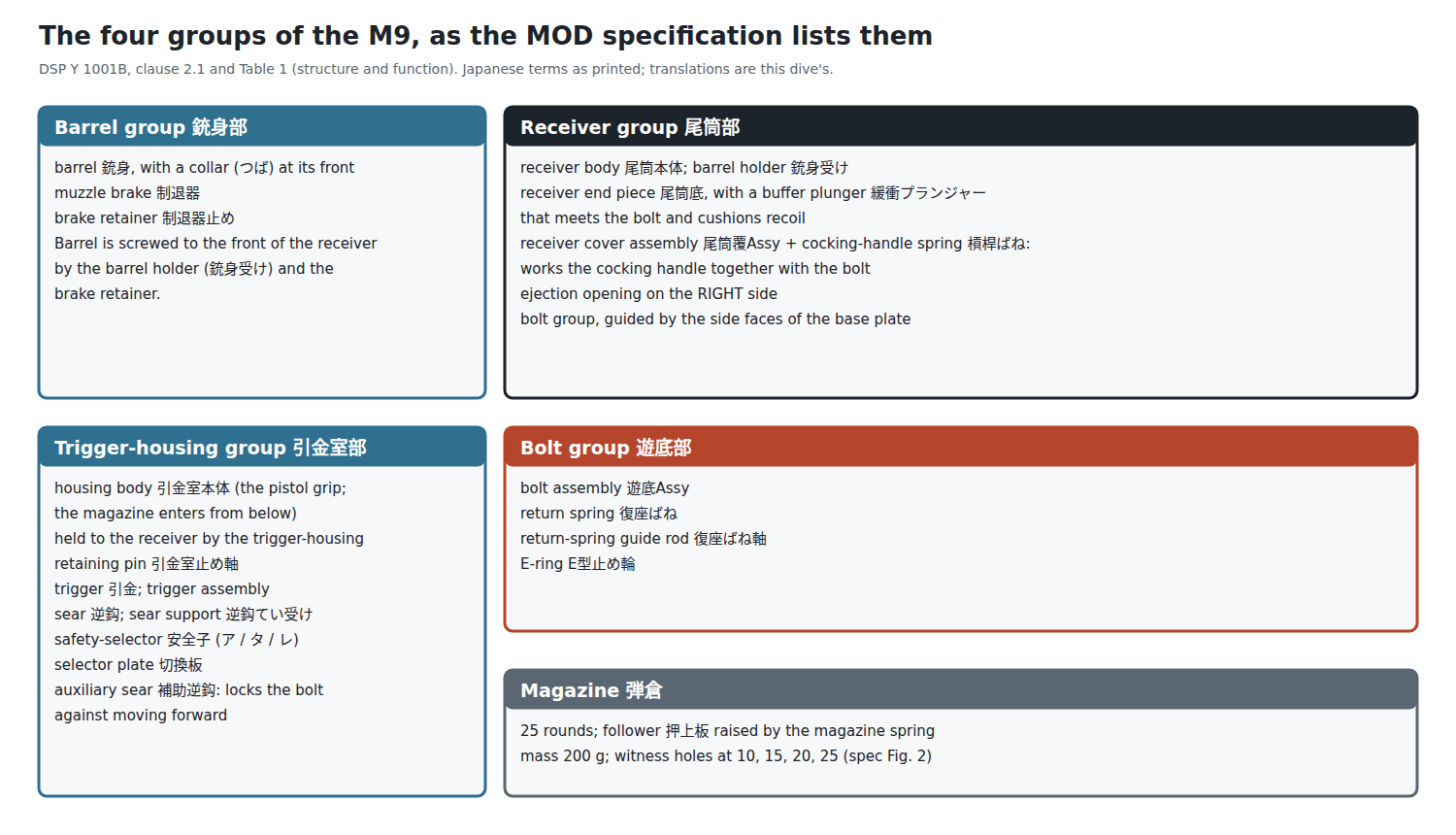
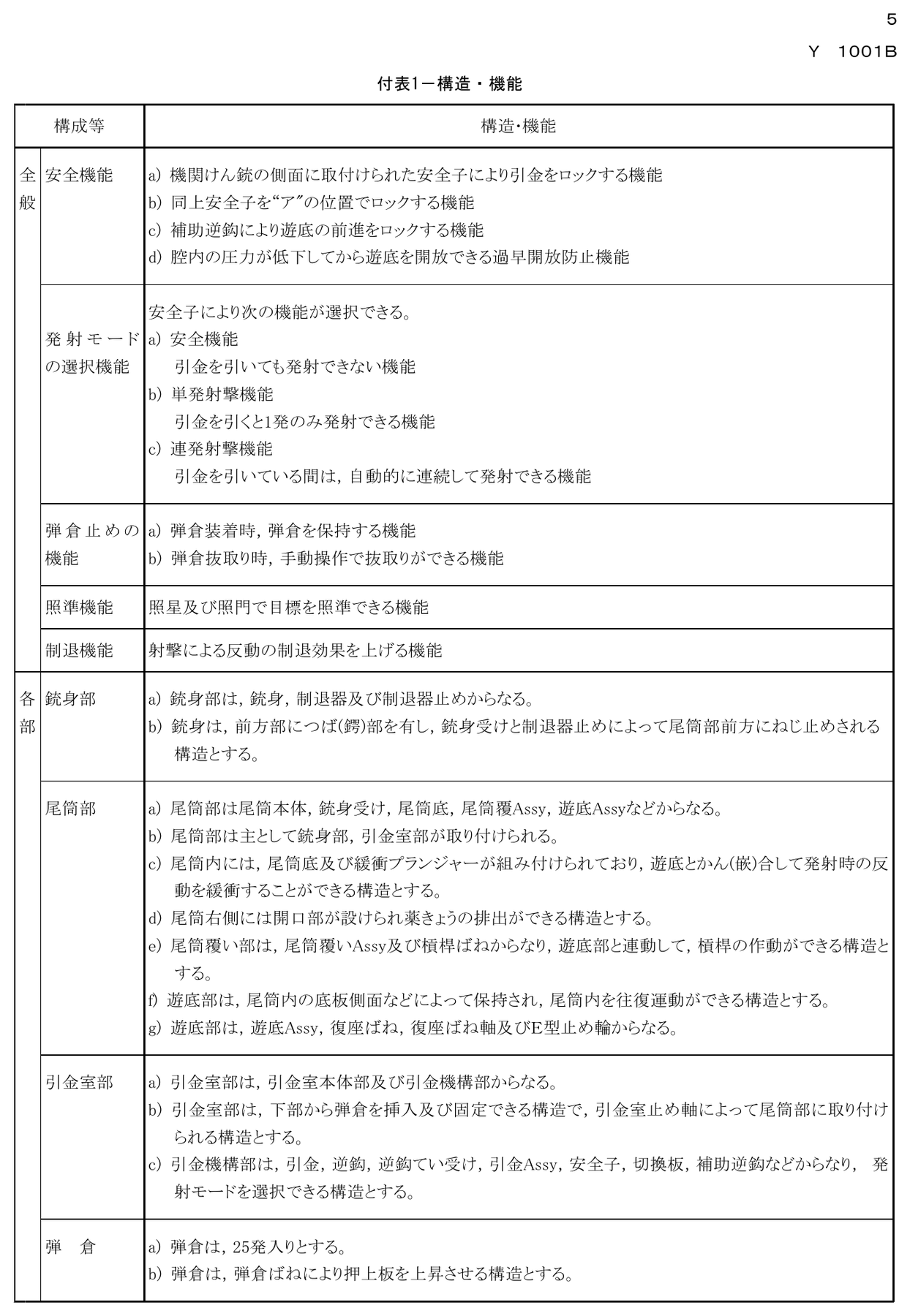
The specification divides the weapon into four groups: the barrel group (銃身部), the receiver group (尾筒部), the trigger-housing group (引金室部) and the magazine (弾倉).1
Barrel group. The barrel, the muzzle brake (制退器) and a brake retainer (制退器止め). The barrel has a collar at its front, and is “screwed to the front of the receiver by the barrel holder and the brake retainer”.1 In the photographs the knurled ring at the front of the receiver is the visible part of this arrangement (Volume 3). The barrel is 120 mm long with six grooves, right-hand, one turn in 250 mm.1
Receiver group. The receiver body, the barrel holder (銃身受け), a receiver end piece (尾筒底), the receiver cover assembly (尾筒覆Assy) and the bolt assembly. Inside the receiver, “the end piece and a buffer plunger (緩衝プランジャー) are assembled, and engage the bolt to cushion the recoil of firing”. The ejection opening is on the right. The cover group “consists of the cover assembly and the cocking-handle spring (槓桿ばね), and is linked with the bolt so that the cocking handle can be worked”.1 Spear Head reports that the main receiver and the grip frame are both machined from aluminium, and that the cover is a steel pressing.3 The specification’s finishing clause fits: steel parts are to be black-oxided and aluminium parts anodised.1
Bolt group. The bolt assembly, the return spring (復座ばね), the return-spring guide rod (復座ばね軸) and an E-ring. The bolt “is held by the side faces of the base plate inside the receiver and can move back and forth”.1 The specification’s shipping clause adds a revealing detail: for delivery, “the bolt is removed from the machine pistol and packed and shipped separately”.1 A gun without its bolt cannot fire.
Trigger-housing group. The housing body, which forms the pistol grip and takes the magazine from below, and the trigger mechanism: trigger, sear (逆鈎), a sear support, the trigger assembly, the safety-selector (安全子), a selector plate (切換板) and an auxiliary sear (補助逆鈎). The housing “is attached to the receiver by the trigger-housing retaining pin” (引金室止め軸).1
Magazine. Twenty-five rounds, with a follower (押上板) raised by the magazine spring.1
4.3 The cycle of operation
The Ground Self-Defense Force’s page gives the operating system as 単純吹き戻し式, “simple blowback”.2 Spear Head adds that the gun fires from an open bolt and uses an L-shaped bolt that wraps around the barrel.3 Neither the specification nor any other document read describes the bolt’s shape, and no drawing of it is published, so the telescoping bolt rests on the magazine. It is the standard arrangement of the type: the bolt’s mass is carried forward over the rear of the barrel, so the receiver can be short without making the bolt light. The hub’s MP 40 dive explains why the telescoping bolt is the Uzi’s defining feature and why the MP 40 does not have one.
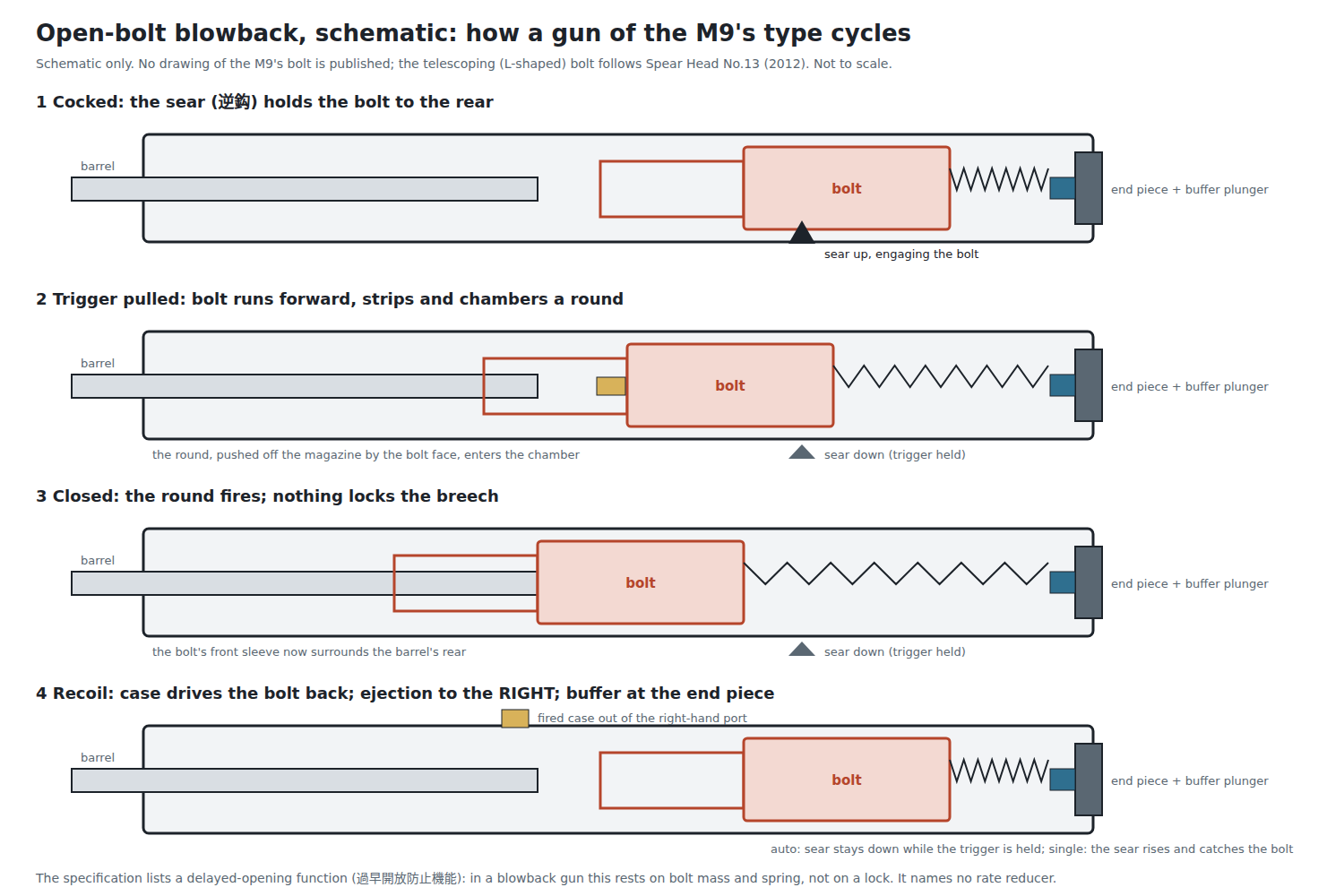
- Cocked. The cocking handle on the top cover is drawn back; Spear Head describes “a large cocking lever behind the front sight” which, pulled rearward, takes the bolt back until it stops, ready to fire.3 The sear holds the bolt at the rear against the compressed return spring.
- Trigger pulled. The sear releases the bolt. The return spring drives it forward; its face strips the top round from the magazine and pushes it into the chamber.
- Fired. The cartridge fires as the bolt closes. Nothing locks the breech. How the M9 fires the cartridge, whether by a fixed firing pin or a separate striker, is not stated in any source read.
- Recoil. The case drives the bolt rearward against the return spring; the empty case is extracted and ejected through the opening on the right (the specification names both actions but not the parts that perform them); the bolt meets the buffer plunger at the end piece. With the selector at レ and the trigger held, the bolt runs forward again and the cycle repeats. At タ the sear catches the bolt after each shot.
The specification describes the action from the user’s side as self-loading, and requires that “loading, chambering, closing, firing, opening, extraction, ejection and cocking” all proceed smoothly.1 That list is the closest thing to a published cycle in the ministry’s own words.
One phrase in the specification needs explaining. Among the safety functions it lists a 過早開放防止機能, “a function preventing premature opening”: “the bolt cannot open until the pressure in the bore has fallen”.1 In a simple blowback there is no lock to do this. The delay comes from the bolt’s mass and the spring, which the case must accelerate before the breech opens appreciably; the specification is stating a performance requirement, not naming a part. This reading is this dive’s; the specification does not elaborate.
4.4 Rate of fire, and the rate reducer that is not there
Some English descriptions credit the M9 with a rate reducer. Nothing in the specification supports it: its structure table lists every part of the trigger and bolt groups, and none of them is a rate-reducing device.1 The only part that acts on the bolt at the rear of its travel is the buffer plunger, whose stated purpose is to “cushion the recoil of firing”.1 The Japanese Wikipedia article, citing an article in Gun Professionals (2021) that was not read for this dive, says plainly that there is no rate-reducing mechanism.4 The Micro-Uzi, by contrast, carries a tungsten weight on its bolt “to slightly slow down the overly excessive rate of fire”, according to Modern Firearms.5
The published rates are these. They are not averaged.
Table 1 — Rate of fire, and the rate reducer that is not there
| Figure | Source | Status |
|---|---|---|
| 650 rounds a minute or more | Specification, Table 3 and acceptance test | A floor, measured on the first contract only1 |
| ”over 1,100 rounds a minute”; 25 rounds in about 1.3 s | Spear Head (2012) | Magazine statement, method not given3 |
| 1,100 rounds a minute | Modern Firearms | Encyclopedia entry, no source given6 |
| about 1,185 rounds a minute | Japanese Wikipedia, citing Elite Forces: JGSDF Part 1 | Book not read; reported only4 |
The specification’s 650 is a minimum, not a nominal rate. The magazine figures suggest a rate well above it, in the same class as the Mini-Uzi, which SWAT gave as “1,000 rpm plus” and 1,200 on its test gun.7 No measured rate from an official source has been published. At Spear Head’s figure, a 25-round magazine lasts about a second and a third.
4.5 The safety functions and the selector
The specification lists four safety functions:1
- “A function locking the trigger by the safety-selector (安全子) fitted to the side of the machine pistol.”
- “A function locking the same safety-selector in the ア position.”
- “A function locking the bolt against moving forward by the auxiliary sear (補助逆鈎).”
- The delayed-opening function described above.
The selector chooses between:
- ア (安全, safe): “pulling the trigger does not fire”;
- タ (単発, single): “one round only is fired when the trigger is pulled”;
- レ (連発, automatic): “fires continuously and automatically while the trigger is held”.1
On service guns the letters are stamped in that order from the rear forward, above a lever on the left of the trigger housing (Volume 3). Spear Head found the lever stiff, needing to be lifted out of the safe position before it would move: “not very good to operate”.3
Two things are absent. There is no grip safety: the specification’s list of safety functions does not include one, and none is visible in any photograph.1 The Uzi family has one (Volume 3). And there is no bolt hold-open: the specification does not mention one. The auxiliary sear’s function, to stop the bolt moving forward, is listed without explanation; the specification does not say whether it acts when the selector is at safe, when the bolt is closed, or in some other condition, and this dive does not guess.
4.6 Loading and the magazine
The magazine is a box holding 25 rounds, with a follower and spring.1 The specification’s drawing gives it as 170 mm long, 40 mm deep and 27 mm wide, with witness holes at 10, 15, 20 and 25 rounds, and a mass of 200 g; each gun is delivered with three.1 The magazine goes into the pistol grip from below and is held by a catch that releases “by manual operation”.1 The ribbed tab at the base of the grip in the photographs is presumably that catch (Volume 3).
Spear Head commented that 25 rounds is “a little less reassuring” than the 30 of the Mini-Uzi or the MAC-10, but that a longer magazine would hurt handling.3
4.7 Field strip and detail strip
No field-strip or detail-strip procedure for the M9 has been published. The handling manual that the specification requires was not found. A sequence reconstructed from photographs or from another weapon would be guesswork, and this dive does not give one.
What the specification does establish is the architecture any correct procedure must respect:
- Unloading first. It is an open-bolt weapon (Spear Head): with a magazine in place and the bolt to the rear, a slip of the sear or of the hand on the cocking handle fires it. Any procedure starts by removing the magazine and confirming an empty chamber with the bolt under control.
- The bolt group comes out as a unit. The specification treats the bolt, return spring, guide rod and E-ring as one group and ships the bolt separately from the gun, so it is designed to be removed without tools at the depot at least.1
- The receiver cover is an assembly with its own spring. The cocking-handle spring sits in the cover group, not in the bolt group.1
- The trigger housing is pinned. It leaves the receiver when the trigger-housing retaining pin is removed.1
- The barrel is held by a threaded nut and a retainer. It is “screwed to the front of the receiver” by the barrel holder and the brake retainer.1
- A tool is issued for a spring. The kit includes a ばね外し, literally “spring remover” (below). Its purpose is not stated; that a tool is needed for some spring suggests that at least one step of the soldier’s routine needs it.
For comparison only, the US Army Special Forces handbook of 1967 gives the Uzi’s field strip as: cover latch to the rear and lift off the cover; lift the bolt from the front and draw it forward out of the receiver with its recoil spring; press the barrel-nut lock, unscrew the nut and take out the barrel; remove the trigger-group retaining pin and lower the trigger group.8 The M9’s specification names the same four kinds of part, a cover, a bolt with its spring, a barrel held by a nut and a pinned trigger housing, but it does not follow that the M9 comes apart in the same order or by the same motions, and the Uzi sequence is not offered as the M9’s.
4.8 The kit issued with each gun
The specification lists the accessories and tools delivered with each gun.1
Table 2 — The kit issued with each gun
| Item | Japanese | Quantity |
|---|---|---|
| Sling | 負いひも | 1 |
| Cleaning brush | 手入れブラシ | 1 |
| Cleaning rod | 手入れ棒 | 1 |
| Magazine | 弾倉 | 3 |
| Storage case | 収納ケース | set by each order |
| Spring remover | ばね外し | 1 |
| Pouch for the spring remover, brush and rod | 収納品袋 | set by each order |
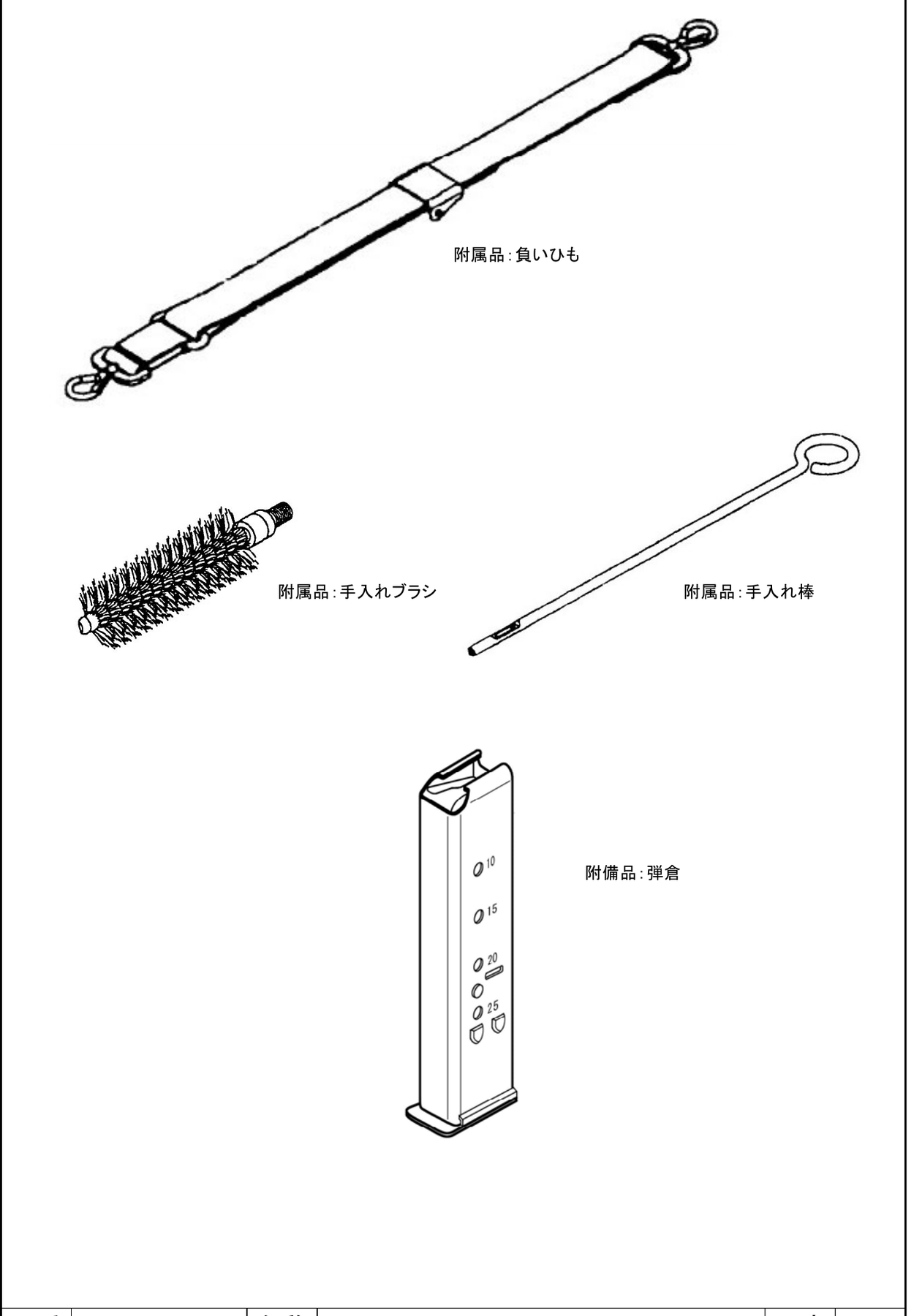
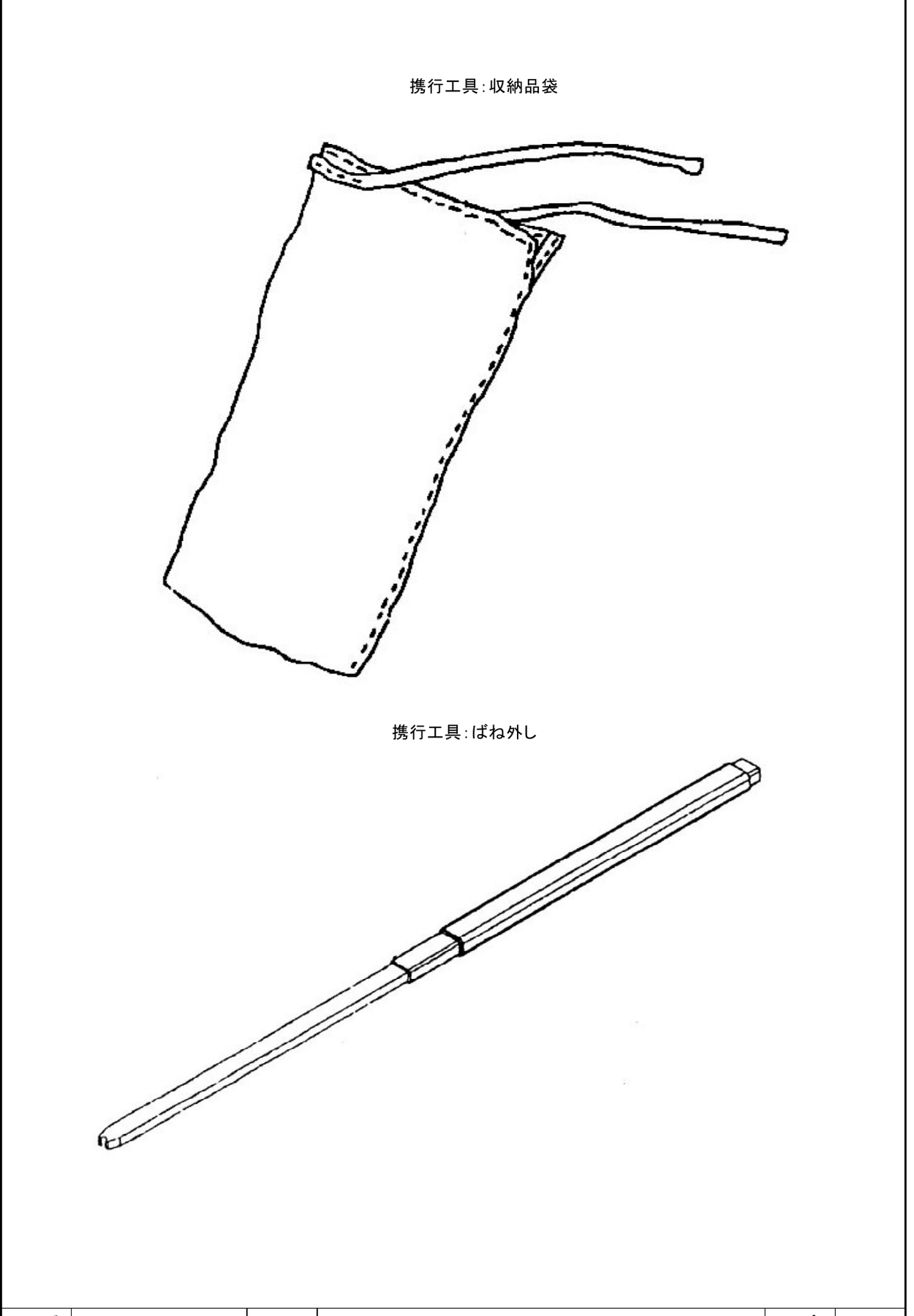
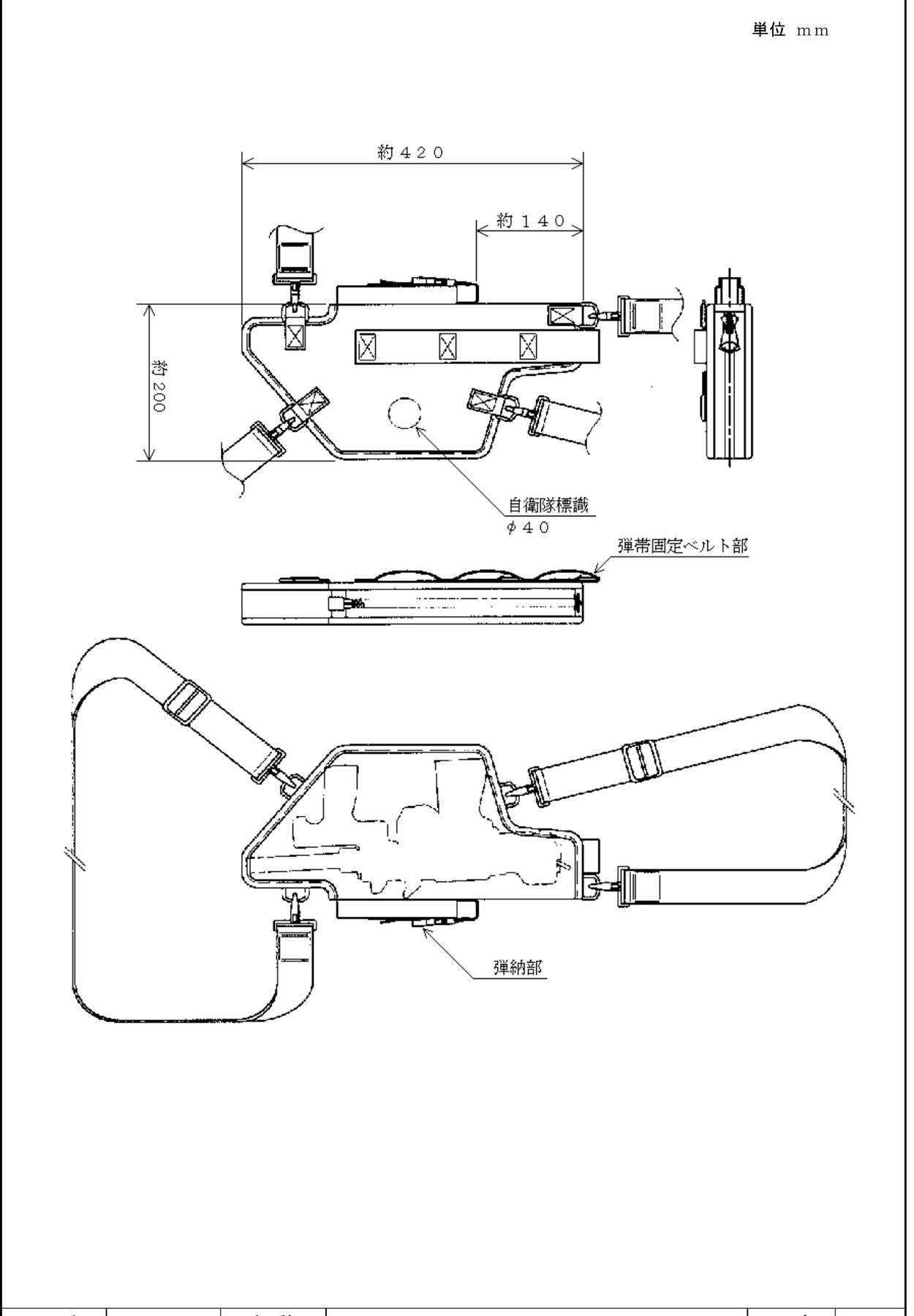
The storage case is the “storage case and other accessories” that the Equipment Bureau said were included in the fiscal 2000 unit price of ¥420,000 (Volume 2).9 The two-point sling hooks to the receiver’s left side and to the receiver end, according to Spear Head.3 Photographs of service guns often show a lanyard chain to the trigger guard (Volume 2), which the specification does not list.
4.9 Maintenance, wear and repair
Maintenance. No published cleaning or lubrication schedule exists for the M9. The kit is a bore brush and a one-piece rod, which implies cleaning from the muzzle or from the breech with the bolt out; the specification does not say which.1 The finishes are black oxide on steel and anodising on aluminium,1 neither of which tolerates abrasive cleaning well, but no M9-specific instruction on solvents or lubricants was found.
Records. Each gun is delivered with a history log (履歴簿) and an entry in the ground-weapon register (地上武器原簿), each with a copy of the gun’s own test target attached.1 The individual weapon’s history follows it through its service life on paper.
The only reliability figures. The acceptance tests in the specification are the nearest thing to published wear data.
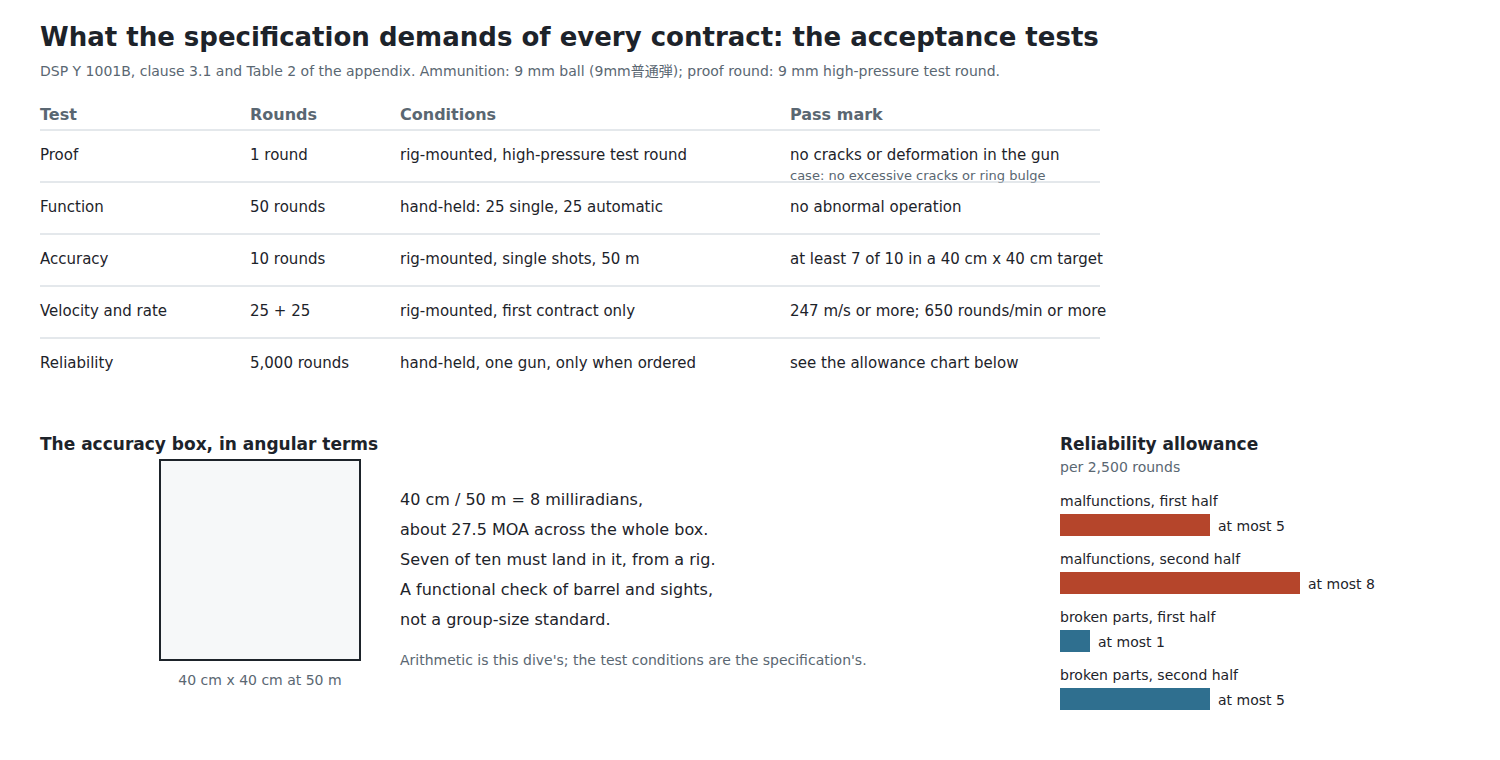
When a contract calls for it, one gun is fired 5,000 rounds by hand and is then not delivered. In the first 2,500 rounds it may have no more than 5 malfunctions and no more than 1 broken or unusable part; in the second 2,500, no more than 8 malfunctions and no more than 5 broken parts.1 The allowances say something about what the ministry expected: the stoppage rate is allowed to rise by about half in the second half of the test, and the breakage allowance fivefold. They are a contract floor, not a measured result, and no result has been published.
Repair. There is one maker, MinebeaMitsumi, the only firm holding the manufacturing permit for the weapon (Volume 1), and no parts are sold outside the ministry.10 What a unit may repair and what goes back to depot or maker is not recorded in any published source. No common failures or broken parts are documented; the “performed poorly” in a 2021 magazine article is unsupported by detail (Volume 2).
4.10 Accuracy
The specification’s accuracy requirement is a functional check, not a precision standard: fixed in a test rig and fired single shot with 9 mm ball, the gun must put at least 7 of 10 shots into a 40 cm by 40 cm target at 50 m, or the equivalent.1 The box is 8 milliradians across, about 27.5 minutes of angle; seven hits anywhere in it is the pass mark. That tests the barrel, the sights’ alignment and the action’s consistency, not the shooter.
How the weapon shoots in the hand is a different question, and only opinion is published. Spear Head argued that an open-bolt gun with the magazine in the grip pitches about the grip “like a see-saw” as the heavy bolt runs, that the foregrip and the long muzzle device are there to control it, and that without a stock full-automatic fire “must take considerable skill”. It put the useful combat range at “probably 40 to 50 metres”, little different from the 9 mm pistol’s.3 Published “effective range” figures for the M9 run from 50 to 100 m in Modern Firearms; the Japanese Wikipedia article cites a 2004 Japanese gun magazine for 100 m and a 2019 book for about 25 m.64 No official figure exists.
The sights are fixed, without adjustment, according to Spear Head.3 The Mini-Uzi has adjustable front and rear sights, which SWAT praised.7
4.11 Ammunition
The specification calls for 9mm普通弾, “9 mm ball”, the forces’ standard 9×19 mm round, supplied by the government for the contractor’s tests, together with a 9 mm high-pressure proof round for the proof test. It gives their stock numbers as 1305-200-1006-5 and 1305-200-0995-5.1 The weapon’s own stock number is 1005-281-5364-5, “including one magazine”.1
The minimum muzzle velocity required is 247 m/s, measured rig-mounted on the first contract.1 That is a floor for a 120 mm barrel, not a nominal velocity; no nominal figure for the M9 with service ball has been published.
The Self-Defense Forces’ 9 mm ammunition is made in Japan. The Acquisition, Technology and Logistics Agency’s contract records for January and February 2017 describe a “9mm J1 ball” as “the 9 mm pistol ball made lead-free”, and name Asahi Seiki Manufacturing of Owariasahi, Aichi, as the only firm holding the permits to make it.11 Whether J1 ball is issued for the M9 is not stated, and the round’s specification was not found.
The weapon is chambered and rifled for 9×19 mm and nothing else. The 1 in 250 mm twist is close to the 1 in 254 mm that SWAT recorded for the Mini-Uzi,7 which is to say ordinary for the cartridge.
4.12 What could not be verified
- The handling manual (取扱書), and any field-strip, detail-strip, cleaning or lubrication procedure.
- The shape and construction of the bolt, beyond Spear Head’s “L-shaped” description; the firing mechanism (fixed firing pin or striker).
- What the auxiliary sear does, and when.
- What the spring remover is for.
- A measured rate of fire, a measured muzzle velocity, or a published group size.
- Any record of failures, broken parts or repairs in service.
- Whether the 9 mm J1 ball is the M9’s issue round.
References
Footnotes
-
Ministry of Defense, 防衛省仕様書 DSP Y 1001B, 9mm機関けん銃 (SUBMACHINE GUN, 9MILLIMETER), established 31 March 2003, revised 21 March 2008, amendment slip of 20 July 2010; clauses 1.3, 2.1 to 2.10, 3.1, 4.3, 5.1, 5.2 and 5.4, appended Tables 1 and 2 and Figures 1 to 5: https://web.archive.org/web/20120420170752/http://www.mod.go.jp/j/procurement/chotatsu/nds/pdf/y/y1001.pdf (read in full 18 October 2026; translations are this dive’s). ↩ ↩2 ↩3 ↩4 ↩5 ↩6 ↩7 ↩8 ↩9 ↩10 ↩11 ↩12 ↩13 ↩14 ↩15 ↩16 ↩17 ↩18 ↩19 ↩20 ↩21 ↩22 ↩23 ↩24 ↩25 ↩26 ↩27 ↩28 ↩29 ↩30 ↩31 ↩32 ↩33 ↩34 ↩35
-
Japan Ground Self-Defense Force, equipment page “M9 エムナイン”, archived 25 March 2010: https://web.archive.org/web/20100325162700/http://www.mod.go.jp/gsdf/equipment/fa/0_26.html (accessed 18 October 2026). ↩ ↩2
-
YAS (text) and Argonaut (photographs), “9mm機関拳銃”, Spear Head No. 13 (Argonaut, August 2012), reproduced by Hyper Douraku, https://www.hyperdouraku.com/military/9mmmp/ (accessed 18 October 2026). ↩ ↩2 ↩3 ↩4 ↩5 ↩6 ↩7 ↩8 ↩9 ↩10
-
Wikipedia, “9mm機関けん銃” (Japanese), accessed 18 October 2026; its book and magazine citations were not read and are reported only. ↩ ↩2 ↩3
-
Maxim Popenker, “UZI / Micro UZI / Mini UZI”, Modern Firearms, https://modernfirearms.net/en/submachine-guns/israel-submachine-guns/uzi-micro-uzi-mini-uzi-eng/ (accessed 18 October 2026). ↩
-
Maxim Popenker, “Minebea M-9”, Modern Firearms, https://modernfirearms.net/en/submachine-guns/japan-submachine-guns/minebea-m-9-eng/ (accessed 18 October 2026). ↩ ↩2
-
“Evaluation of the Mini UZI”, SWAT magazine, January 1984, reproduced by UZI Talk, https://uzitalk.com/reference/pages/article_swat1984jan.htm (accessed 18 October 2026). ↩ ↩2 ↩3
-
US Army John F. Kennedy Center for Special Warfare, Special Forces Foreign Weapons Handbook (1967), entry “Israel, 9-mm No 2 Mk A (Uzi)”, field-strip procedure (central Library copy, OCR text read 18 October 2026). ↩
-
House of Representatives, Audit and Administrative Oversight Committee, Second Subcommittee, 21 April 2000, Oikawa Kōzō, https://kokkai.ndl.go.jp/txt/114704132X00220000421/83 (accessed 18 October 2026). ↩
-
Acquisition, Technology and Logistics Agency, monthly contract information, sole-source contracts above the threshold, fiscal 2017 (29zuikei_kijunijo.xlsx), row for 9mm機関けん銃 (20 March 2018), from https://www.mod.go.jp/atla/souhon/supply/jisseki/rakusatu/index3.html as archived 28 March 2019 (accessed 18 October 2026). ↩
-
The same series, fiscal 2016 (28zuikeikijunijou.xlsx), rows for 9mmJ1普通弾, Asahi Seiki Manufacturing, contracts of 31 January and 22 February 2017 (accessed 18 October 2026). ↩
Comments (0)