Minebea PM-9 (M9) · Volume 3
Telling Them Apart: The M9, Its Prototype, the Uzi Family and the Replicas
Reading an M9 from the outside, from the specification's own drawings and photographs of service guns; what separates it from the Uzi, Mini-Uzi, Micro-Uzi and UZI PRO; and how to recognise the airsoft copies that carry its markings
3.1 The one-line rule
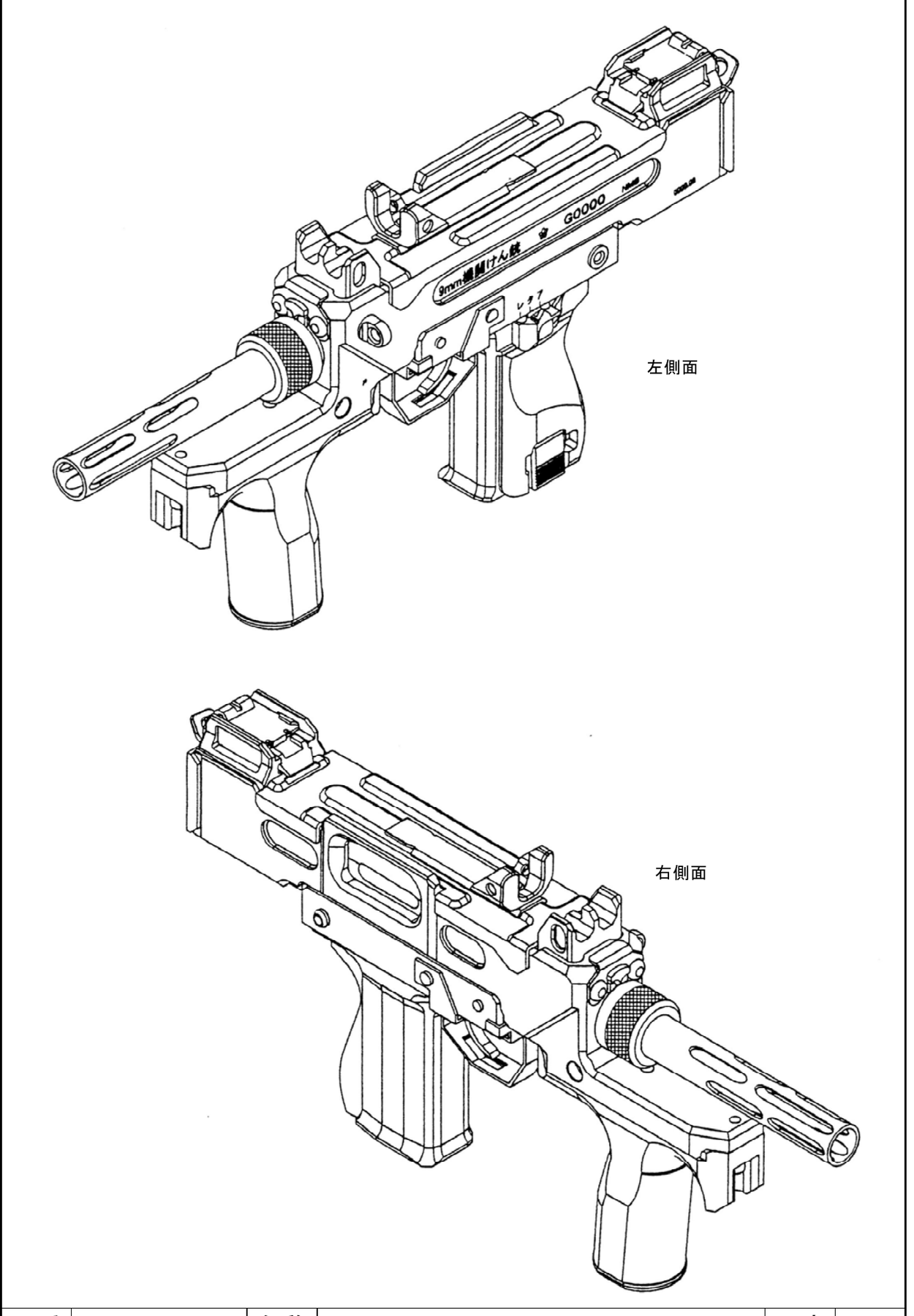
An M9 is a stockless 9 mm submachine gun with two vertical grips, the rear one holding the magazine, and a slotted tubular muzzle device projecting ahead of a knurled barrel nut. No member of the Uzi family combines those three features, and none of the Uzi family sources read for this dive describes a model with a fixed vertical foregrip. If a photograph shows the left side, the white-filled receiver marking 9mm機関けん銃 and the selector letters レ タ ア settle the matter.
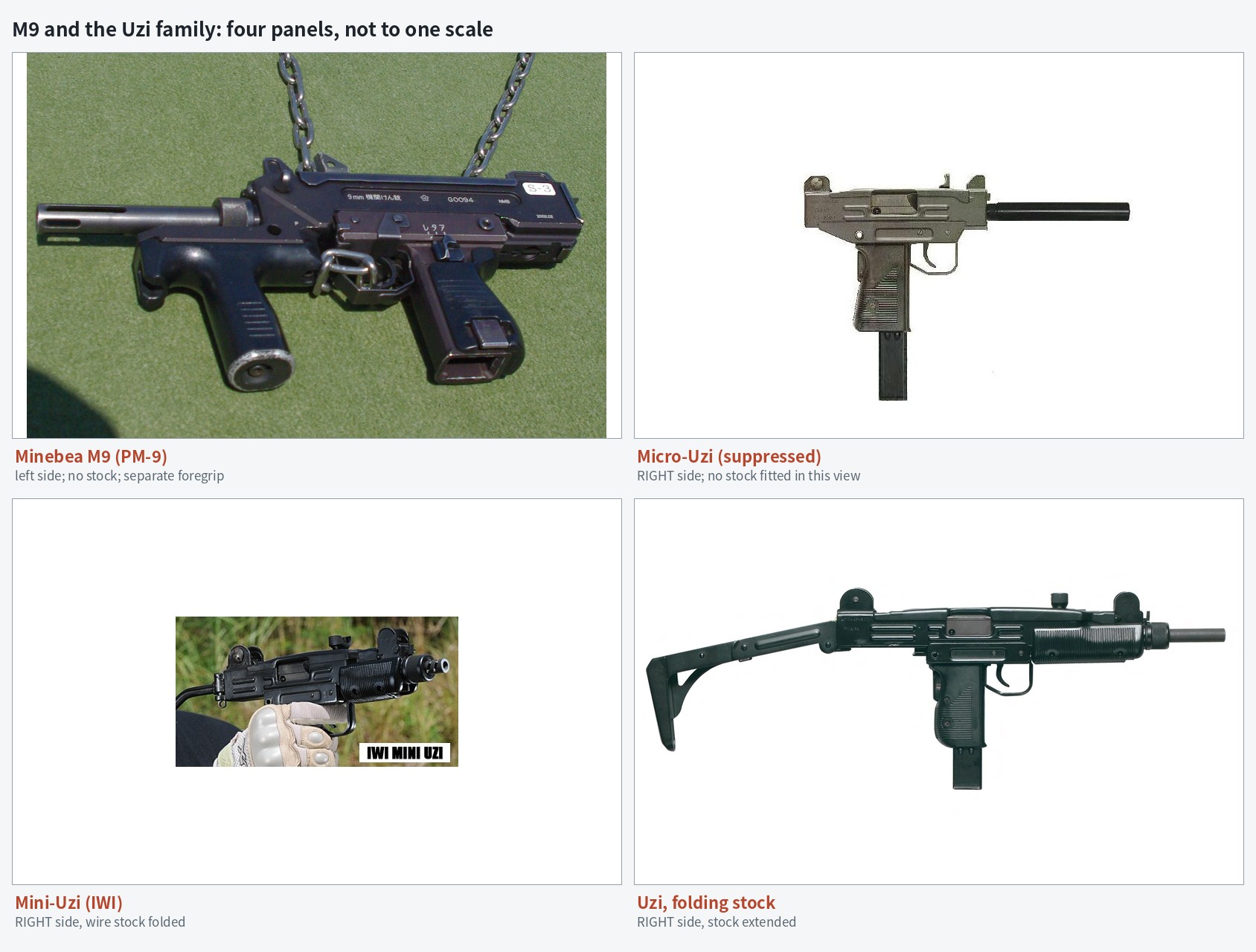
The plate shows the Uzi family from the right because no usable left-side photograph of a Mini-Uzi or Micro-Uzi was found. The M9’s identifying markings are on the left. Where a view of the same side is needed, the specification’s drawings and the length chart below supply it.
3.2 The left side, feature by feature
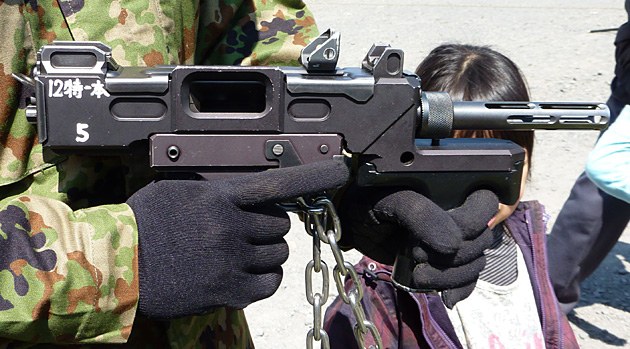
The clearest published photograph of a service M9 was taken at the Camp Utsunomiya open day on 8 April 2012 and released into the public domain by its photographer.1 Spear Head photographed the same gun, which it identifies as belonging to the 12th Artillery Unit.2
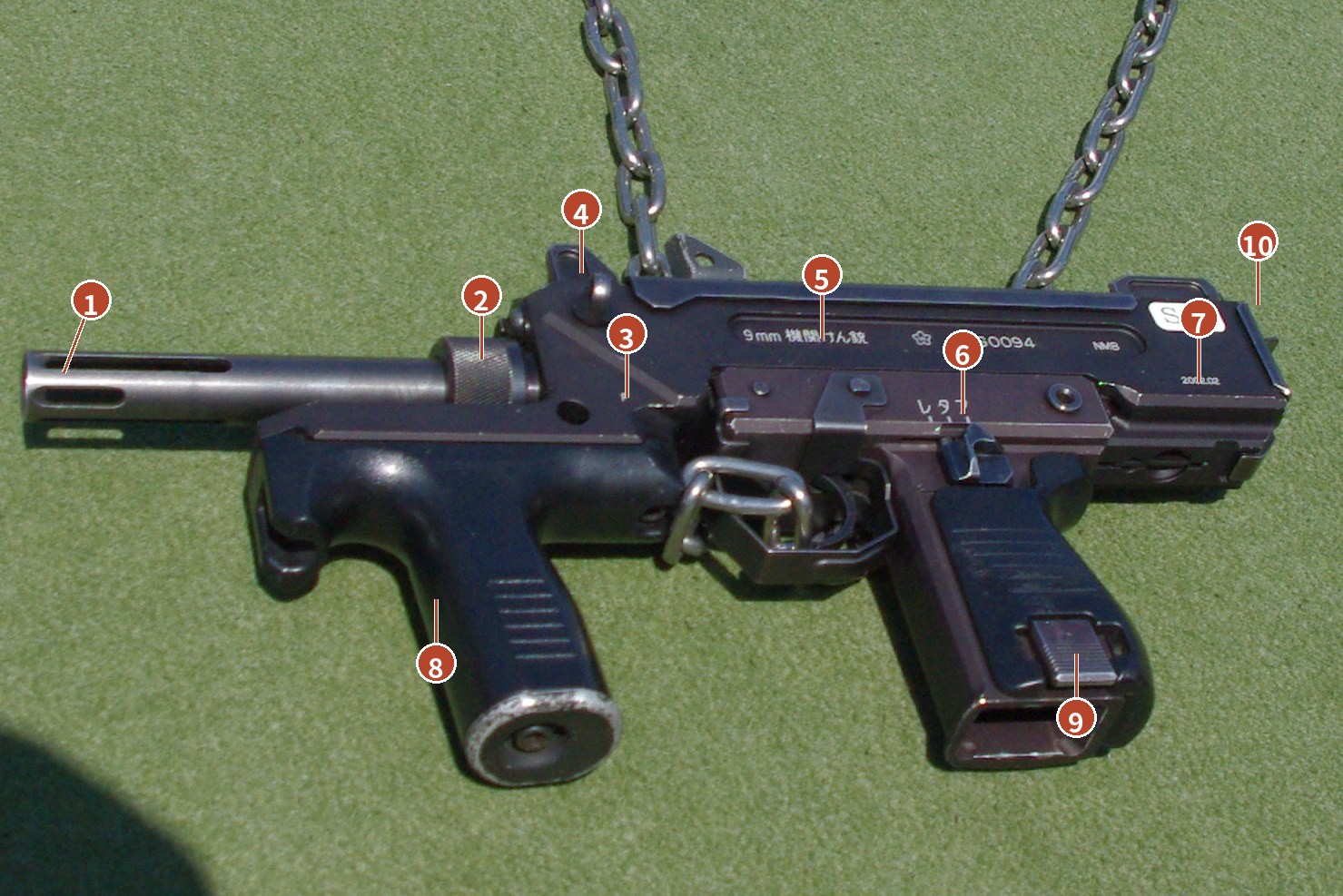
- Muzzle device. A tube with long slots in its sides, extending well ahead of the receiver. The specification calls it the 制退器, the term for a muzzle brake, and its structure table says it “raises the recoil-reducing effect of firing”; it is held by a separate retainer (制退器止め).3 English sources call it a flash hider. Spear Head calls it “a long flash hider” that also curbs muzzle rise.2 The Mini-Uzi’s muzzle brake, by contrast, is “two-vent”, in SWAT’s words: two ports cut near the end of the barrel or its cap, not a slotted tube.4
- Barrel nut. A large knurled ring at the front of the receiver. The specification describes the barrel as having a collar at its front and as being “screwed to the front of the receiver” by the barrel holder and the brake retainer.3 The Uzi family also secures its barrel with a knurled nut at the front of the receiver; on an Uzi, it is the barrel itself that protrudes beyond the nut, short and plain.5
- P mark. The specification requires a stamped “P” to show that the gun has passed its proof test.3 On the Utsunomiya gun it is on the receiver’s left side, above the foregrip, where the specification’s drawing also places it.
- Front sight. On top of the receiver, just behind the barrel nut, between two protective ears.
- Marking band. A recessed panel along the upper receiver, described below.
- Selector. A lever on the left side of the trigger housing above the grip, with the letters レ タ ア stamped above it. Spear Head calls it a slide-type lever and reads the positions from the rear as ア (安全, safe), タ (単発, single shot) and レ (連発, automatic): the order spells atare, “hit!”, which the magazine calls a Self-Defense Forces jinx.2 The specification’s drawing shows the same letters in the same order.3
- Delivery date. A small year and month stamped near the rear of the receiver: 2002.02 on the Utsunomiya gun. Spear Head gives “2001.03” as an example and calls it the delivery date.2
- Foregrip. A vertical grip under the front of the receiver, on a base that runs back under the barrel. The rear face of the gun has no stock and no provision for one.
- Grip heel. A ribbed tab at the base of the pistol grip, at the back of the magazine well. No document read for this dive names it; its position is that of a magazine catch, and the specification requires that the magazine be held when inserted and be removable “by manual operation”.3
- Rear sight. At the rear of the receiver, between protective ears. Spear Head says both sights are fixed, with no adjustment.2
3.3 The markings
The specification lists what must be stamped on the gun: “the maker’s trademark, the item name, a unique serial number, the mark of each Self-Defense Force, and other necessary markings”, plus the proof mark.3 On a service gun these appear as follows.
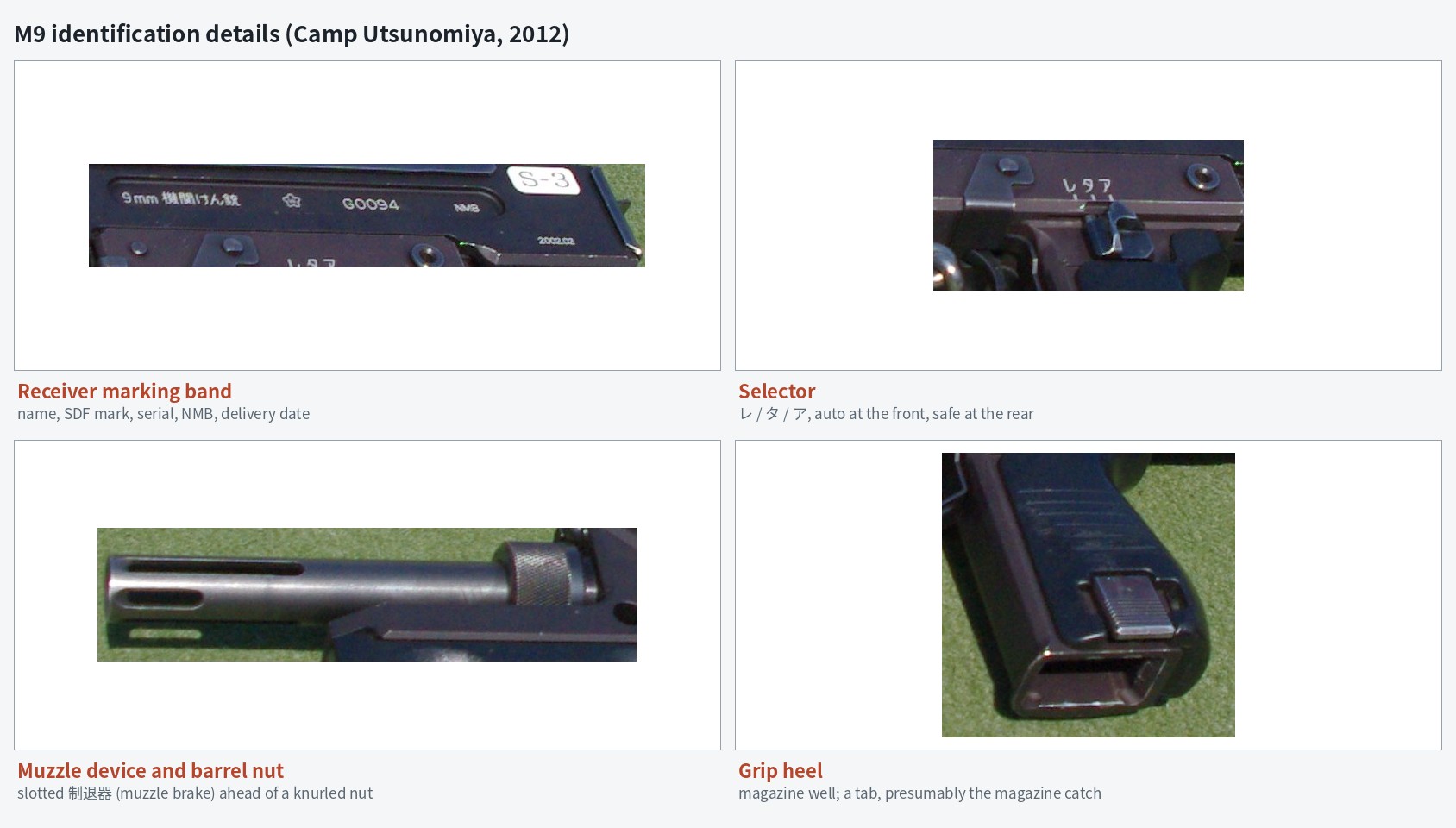
- 9mm機関けん銃, the item name, with けん in kana as the specification spells it.
- A cherry-blossom mark, the mark Spear Head identifies as a 桜 (cherry) emblem.2
- A serial number of a letter G and four digits. Spear Head describes the format; the specification’s drawing shows it as G0000.23 This dive does not discuss individual serials.
- NMB, the trademark of Nippon Miniature Bearing, Minebea’s original name (Volume 1).
- A year and month, the delivery date.
The marking band is the surest single identifier, because no other weapon carries it. It is also the feature a replica copies (below).
3.4 The right side and the top
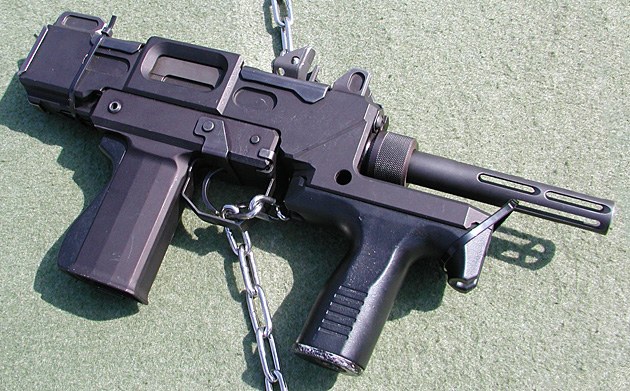
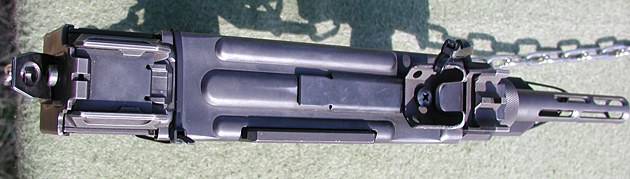
The right side has no markings in any photograph found. Three features identify it. The specification puts the ejection opening on the right side of the receiver.3 Spear Head reports that the grip panel is a single resin moulding covering the back and left of the grip frame, so that the right-hand side of the frame is bare metal, and that the grip feels “thick and angular”.2 And the cover over the top of the receiver is, by the same account, a steel pressing, with a large cocking lever behind the front sight.2
3.5 The specification’s drawings
The ministry’s specification includes two drawings of the weapon: isometric views of each side, and a dimensioned elevation with a top and rear view and the magazine.3 They are the only measured drawings of the M9 in the public record.
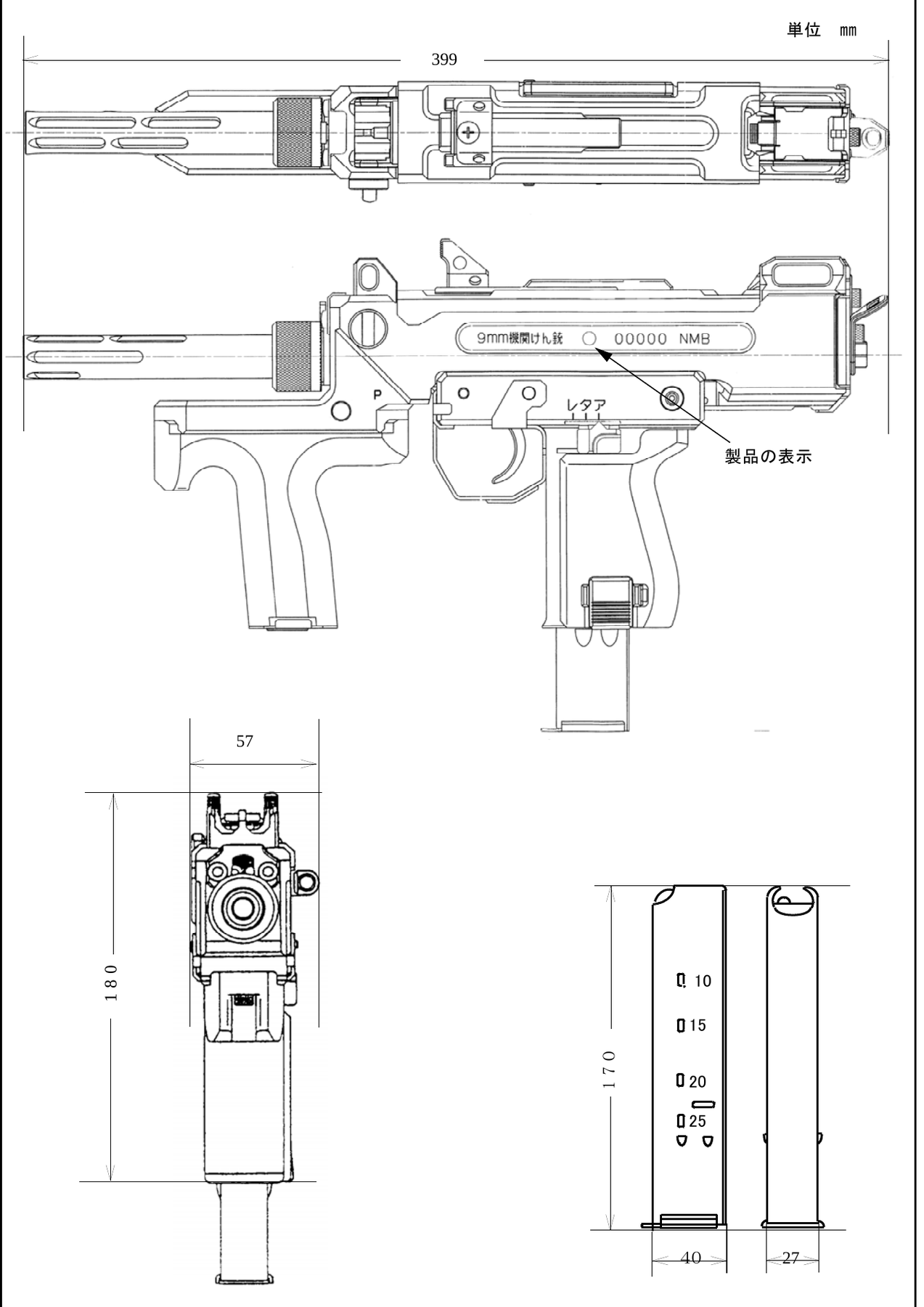
The length is the point of most disagreement in print. The specification and the Ground Self-Defense Force’s own equipment page both give 399 mm.36 Spear Head printed 339 mm in 2012, and the Japanese Wikipedia article now gives 339 mm too, citing the later Ground Self-Defense Force site.27 The drawing settles it: 399 mm, measured from the muzzle to the rear of the receiver.
3.6 Production guns and the prototype
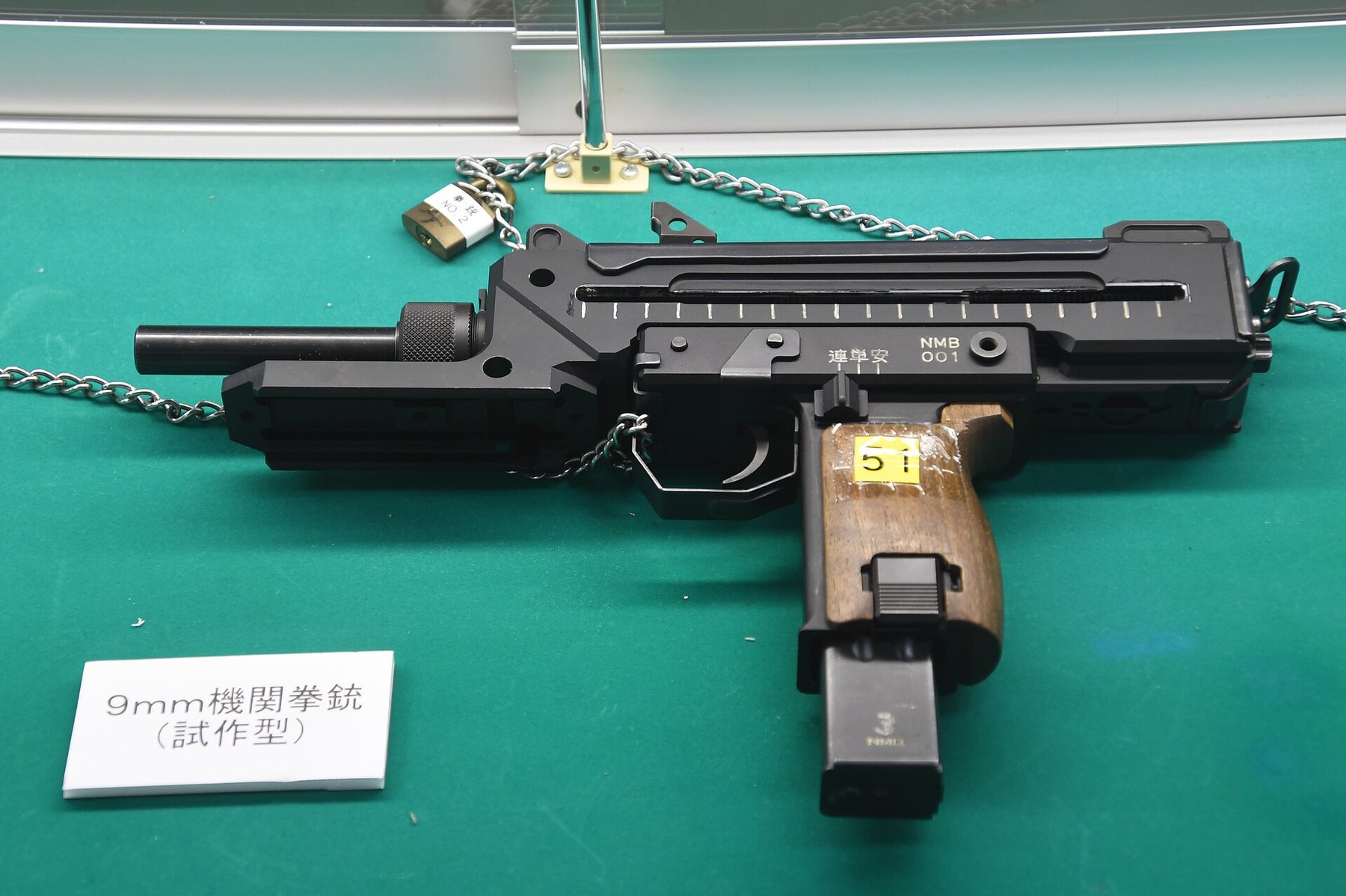
Table 1 — Production guns and the prototype
| Feature | Prototype (Tsuchiura museum) | Production guns |
|---|---|---|
| Pistol-grip panels | Wood | Black resin, one piece, wrapping the rear and left |
| Foregrip | None fitted on display | Fitted; resin |
| Selector markings | Different from production (Spear Head) | レ タ ア |
| Receiver marking | Includes NMB | Full marking band, serial and date |
The production details come from the photographs and from Spear Head; the prototype’s from the Commons photograph and Spear Head’s note that its “grip and selector markings differ from the production model”.82 Whether the prototype was designed without a foregrip is not recorded. The Japanese Wikipedia article says that some official images show brown grips and foregrips on service guns; a small Ground Self-Defense Force image with brown grips exists, but the point was not pursued, and no colour variant should be read as a separate model.7
3.7 The M9 and the Uzi family
The resemblance to the Uzi family is real and is the reason this volume exists. The layout is the same: a pistol grip holding the magazine near the middle of the gun, a short receiver with a top cover, a front-mounted barrel nut and an open-bolt blowback action (Volume 4). Spear Head calls the M9 “strongly influenced” by the Uzi.2 The differences are in every visible detail.
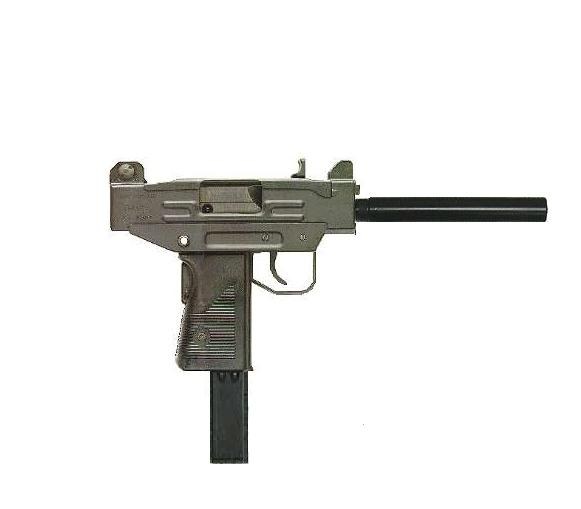
The Uzi has a long receiver with a separate front handguard of ribbed plastic, a short barrel projecting a little ahead of the nut, a box-shaped front sight guard at the front of the receiver, and a wooden or folding steel stock. The 1967 US Army Special Forces handbook gives its length as 26.2 inches with the stock extended; SWAT gave 47 cm folded and 64 cm with the fixed wooden stock.54
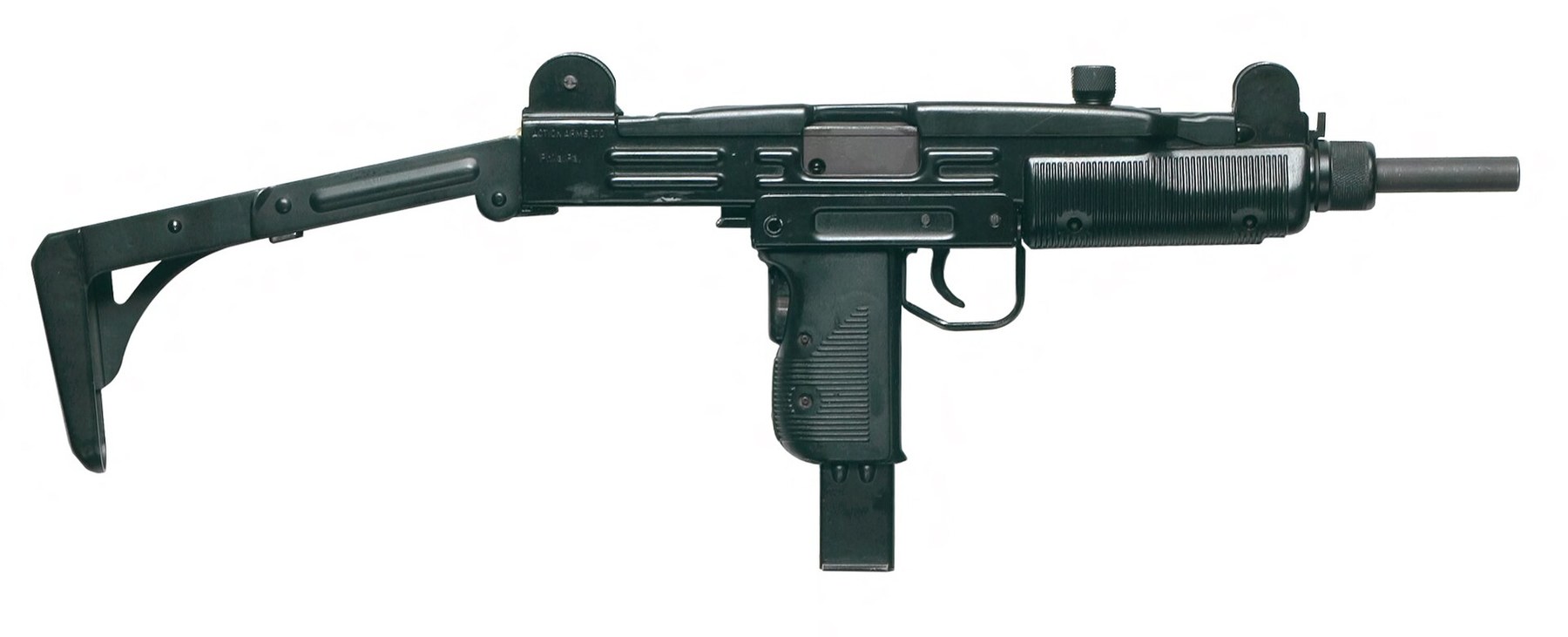
The Mini-Uzi shortens the receiver and adds a side-folding steel-rod stock. SWAT gave it as 36 cm folded and 60 cm extended, with a 197 mm barrel ending in a “two-vent muzzle brake”, and noted that it kept the Uzi’s grip safety, selector and magazine release.4
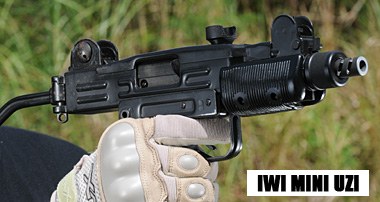
The Micro-Uzi is shorter still, with no handguard at all. Modern Firearms gives it as 250 mm folded and 460 mm extended, with a 117 mm barrel, and says that a tungsten weight is added to its bolt “to slightly slow down the overly excessive rate of fire”.9 Of the family it is the closest to the M9 in barrel length (117 mm against 120 mm) and the furthest in overall length.
The UZI PRO, IWI’s current model, is described by IWI’s American company as “a modernized Micro UZI” whose charging handle “has been moved from the top … to the left side of the receiver”, with a full-length rail on top and a polymer lower section with a second rail.10 Neither feature exists on the M9. It appears in Volume 5 as a lawful lookalike.
3.8 Tell them apart
Table 2 — Tell them apart
| Feature | M9 | Uzi | Mini-Uzi | Micro-Uzi | Where to look |
|---|---|---|---|---|---|
| Stock | None, and no attachment point | Wooden or under-folding steel | Side-folding steel rod | Side-folding steel | Rear of receiver |
| Front grip | Fixed vertical foregrip | Ribbed handguard on the receiver | Short handguard | None | Under the barrel |
| Muzzle | Long slotted tube ahead of a knurled nut | Short plain barrel ahead of the nut | Barrel with two-vent brake | Short plain barrel | Ahead of the receiver |
| Grip safety | None in the specification | Yes | Yes | Yes | Back of the pistol grip |
| Selector letters | レ タ ア | IMI or IWI letters, which vary with country and period | As Uzi | As Uzi | Left side, above the grip |
| Receiver marking | 9mm機関けん銃, cherry mark, G-serial, NMB, date | IMI/IWI markings | IMI/IWI markings | IMI/IWI markings | Left of the receiver |
| Barrel | 120 mm, 6 grooves | Longest of the family | 197 mm, 4 grooves (SWAT) | 117 mm (Modern Firearms) | Specification or source |
| Overall length | 399 mm | 640 mm fixed stock | 360 mm folded, 600 extended | 250 mm folded, 460 extended | Chart below |
Uzi-family figures are from SWAT (1984), the US Army Special Forces handbook (1967) and Modern Firearms, each as attributed above; the Uzi family’s selector letters are not tabulated here because they vary with country and period.459
3.9 Size, to one scale
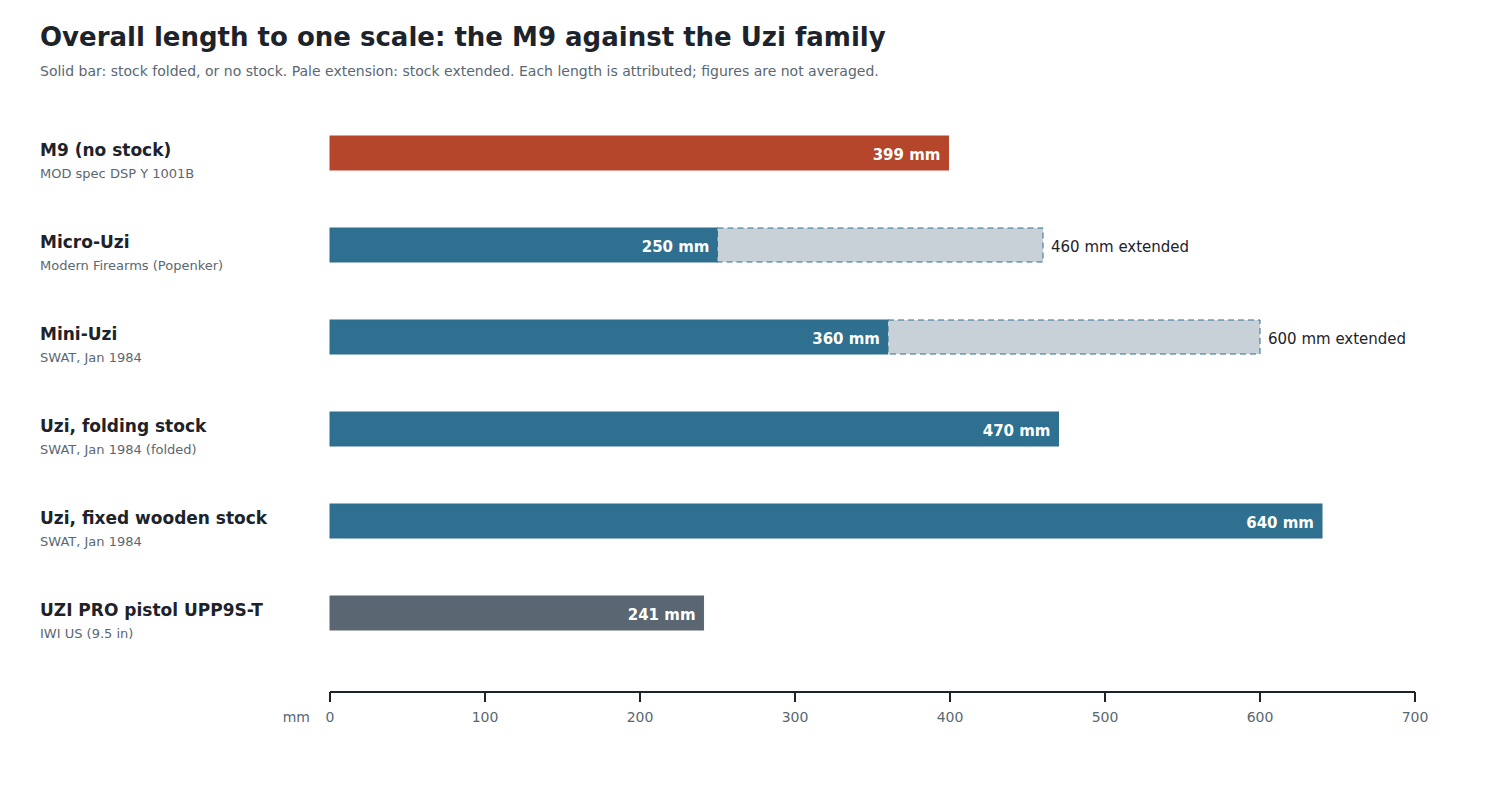
The chart corrects an impression the photographs give. The M9 looks like a Micro-Uzi with a foregrip, but at 399 mm it is longer than a Mini-Uzi with its stock folded and approaches a folded full-size Uzi. Most of the extra length is the muzzle device, which projects well ahead of the barrel nut. The M9 is also the heaviest of the compact designs: 2.8 kg without a magazine, by the specification, against 2.65 kg for the Mini-Uzi in SWAT’s evaluation.34
3.10 Replicas that carry the markings
The best-known M9 replicas are airsoft guns built in Japan, and they reproduce the markings. A series of photographs on Wikimedia Commons shows one: according to its owner’s description, a KSC M11A1 gas gun (KSC’s replica of the Ingram M11) fitted with a conversion kit by Elfin Knights Project and built to order by the custom shop Stengun Kōshō.11 Its receiver carries the marking band with the serial G0002, NMB and the selector letters.
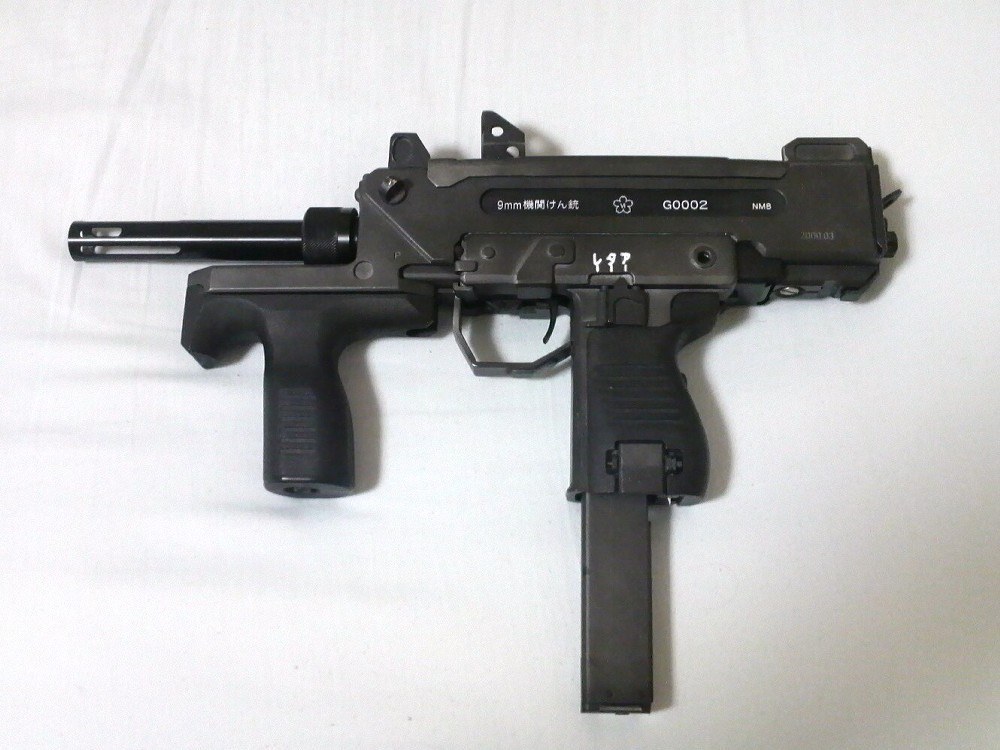
KSC’s own catalogue still lists the M11A1 gas blowback series, at a stated cycle of 20 shots a second.12 No mass-produced M9 replica was found on any maker’s page. How to tell such a conversion from the real weapon in a photograph cannot be stated with confidence from the sources read: the marking band is copied, and the replica in the Commons series is a close copy in outline. The surest evidence in practice is context, a uniformed service member at an official event as against a collector’s table. A photograph without context should be labelled “M9 or replica”.
The Ministry of Defense’s specification governs only real weapons. Its drawings are a better reference than any replica.
3.11 What could not be verified
- What the tab at the base of the grip is (presumed magazine catch; not named in any document read).
- Whether the prototype lacked a foregrip by design or only on display.
- The selector markings on the prototype, which Spear Head says differ but does not describe.
- Brown-gripped production guns as a distinct batch or variant.
- A dependable external difference between the real weapon and the best airsoft conversions.
- A left-side photograph of a Mini-Uzi or Micro-Uzi of known identity, for a same-side plate.
References
Footnotes
-
Los688, “Minebea 9mm submachine gun 20120408.jpg”, Wikimedia Commons, CC0, with the photographer’s description “9mm機関けん銃 2012年04月08日、宇都宮駐屯地で撮影”, https://commons.wikimedia.org/wiki/File:Minebea_9mm_submachine_gun_20120408.jpg (accessed 18 October 2026). ↩
-
YAS (text) and Argonaut (photographs), “9mm機関拳銃”, Spear Head No. 13 (Argonaut, August 2012), reproduced by Hyper Douraku, https://www.hyperdouraku.com/military/9mmmp/ (accessed 18 October 2026). ↩ ↩2 ↩3 ↩4 ↩5 ↩6 ↩7 ↩8 ↩9 ↩10 ↩11 ↩12
-
Ministry of Defense, specification DSP Y 1001B, 9mm機関けん銃, 2003, rev. 2008 and 2010, clauses 2.1 to 2.9, Table 1 and appended Figures 1 and 2: https://web.archive.org/web/20120420170752/http://www.mod.go.jp/j/procurement/chotatsu/nds/pdf/y/y1001.pdf (accessed 18 October 2026). ↩ ↩2 ↩3 ↩4 ↩5 ↩6 ↩7 ↩8 ↩9 ↩10 ↩11
-
“Evaluation of the Mini UZI”, SWAT magazine, January 1984, reproduced by UZI Talk, https://uzitalk.com/reference/pages/article_swat1984jan.htm (accessed 18 October 2026). ↩ ↩2 ↩3 ↩4 ↩5
-
US Army John F. Kennedy Center for Special Warfare, Special Forces Foreign Weapons Handbook (1967), entry “Israel, 9-mm No 2 Mk A (Uzi)”, characteristic data and field-strip procedure (central Library copy, OCR text read 18 October 2026). ↩ ↩2 ↩3
-
Japan Ground Self-Defense Force, equipment page “M9 エムナイン”, archived 25 March 2010: https://web.archive.org/web/20100325162700/http://www.mod.go.jp/gsdf/equipment/fa/0_26.html (accessed 18 October 2026). ↩
-
Wikipedia, “9mm機関けん銃” (Japanese), accessed 18 October 2026. ↩ ↩2
-
Hunini, “JGSDF 9mm Machine Pistol (Prototype) at museum of Camp Tsuchiura September 28, 2025”, Wikimedia Commons, CC BY-SA 4.0 (accessed 18 October 2026). ↩
-
Maxim Popenker, “UZI / Micro UZI / Mini UZI”, Modern Firearms, https://modernfirearms.net/en/submachine-guns/israel-submachine-guns/uzi-micro-uzi-mini-uzi-eng/ (accessed 18 October 2026). ↩ ↩2
-
IWI US, “UZI PRO”, https://iwi.us/firearms/uzi-pro/ (accessed 18 October 2026). ↩
-
Crescent moon, “9mmMP Airsoft Gun 20101202-01.jpeg” and companion files, Wikimedia Commons, CC BY 3.0, with the owner’s description of the build, https://commons.wikimedia.org/wiki/File:9mmMP_Airsoft_Gun_20101202-01.jpeg (accessed 18 October 2026). ↩
-
KSC, “M11A1 シリーズ”, https://www.ksc-guns.co.jp/gas/submachinegun/m11a1_series.html (accessed 18 October 2026). ↩


Comments (0)