Minebea PM-9 (M9) · Volume 2
In Service: Who Carries the M9, How Many Were Bought, and What They Cost
The users the government named, the 266 guns of the Ground Self-Defense Force's five-year buy, the Navy's specification and the later contracts at four times the price, and the imported submachine guns that followed
2.1 The short version
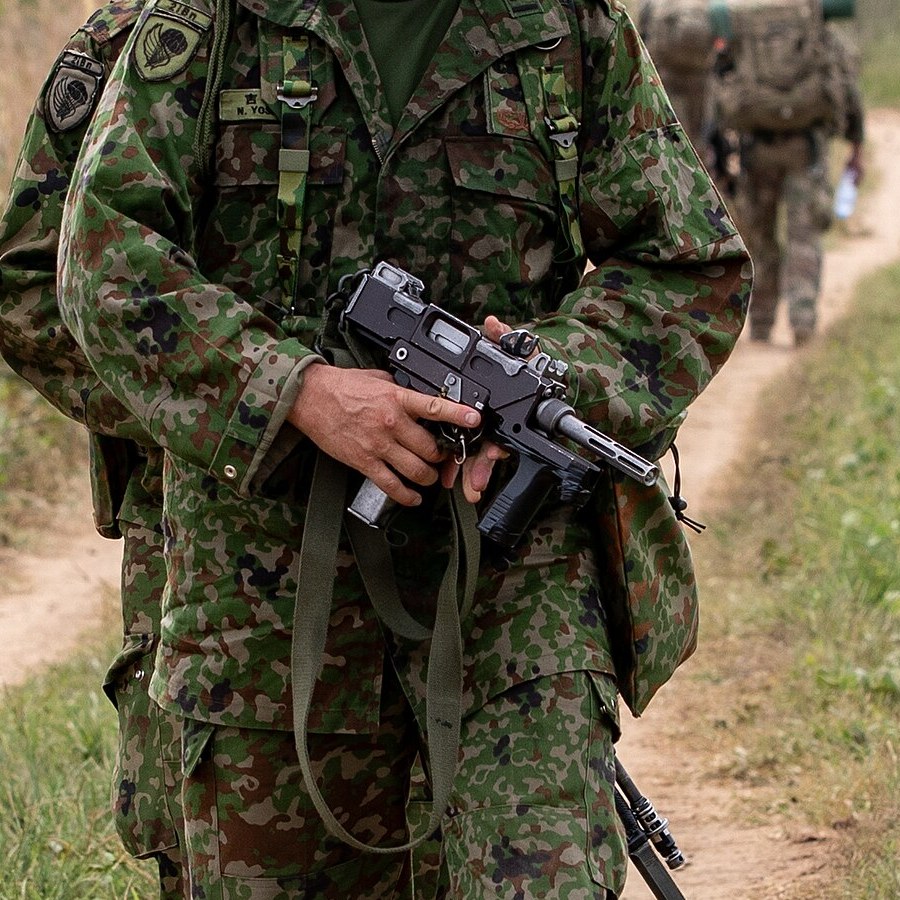
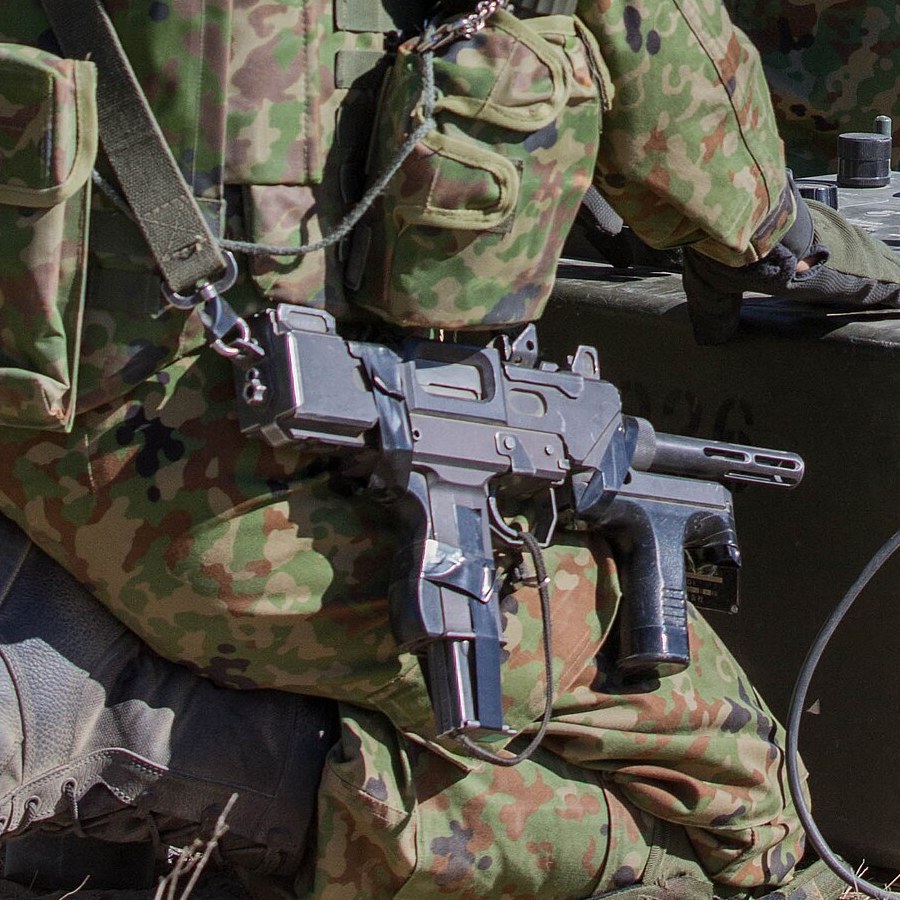
The M9 is one of the rarest service weapons of any major army. The Ground Self-Defense Force budgeted for 266 of them over five fiscal years, from 1999 to 2003, and bought no more. The weapon lived on in the other services: the current specification was drafted by the Maritime Self-Defense Force’s supply headquarters, and the defence ministry was still buying sets of four from MinebeaMitsumi in 2017 and 2018, at roughly four times the price per unit of the first deliveries. No contract for it appears in the ministry’s disclosures for fiscal 2023 onwards, while those same disclosures record purchases of imported 9 mm submachine guns whose makers are not named. Photographs show the M9 still carried by Japanese paratroopers in August 2024.
2.2 Who carries it
The government has described the users three times, each a little differently.
Table 1 — Who carries it
| Source | Users named |
|---|---|
| Ground Self-Defense Force equipment page (2010) | “commanders of airborne units, operators of unit-equipment weapons, and others”, for self-defence combat1 |
| Equipment Bureau, Diet, 21 April 2000 | the airborne brigade; commanders deployed with it in fiscal 19992 |
| Senior Vice-Minister Ishiba, Diet, 2 March 2001 | ”for example, the Airborne Brigade”; not every member of the forces3 |
The magazine Spear Head gave the most specific list in 2012: the anti-tank units of the 1st Airborne Brigade at Narashino, Chiba; the anti-tank company of the 12th Brigade at Sōmagahara, Gunma; and commanders in the Western Army, where it was issued to the Western Army Infantry Regiment. It reported that the airborne brigade’s gunners for the Type 87 and Type 01 anti-tank missiles carried it as a secondary weapon, and that the weapon “can be seen” on public display at the central review and at the 12th Brigade’s camp festivals.4
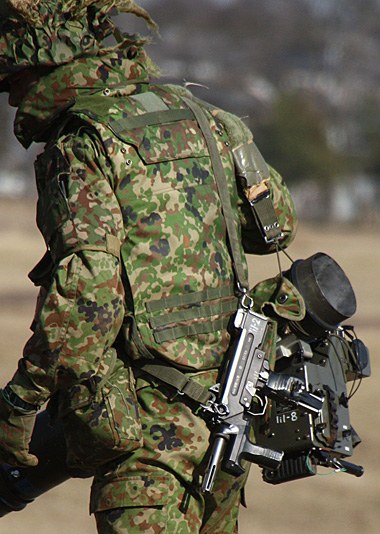
Spear Head also caught one of the M9s in its own photographs: a weapon on display at a Camp Utsunomiya open day belonging to the 12th Artillery Unit (第12特科隊).4 The same gun, recognisable by its display tag and its markings, is the subject of the Commons photograph used throughout Volume 3.
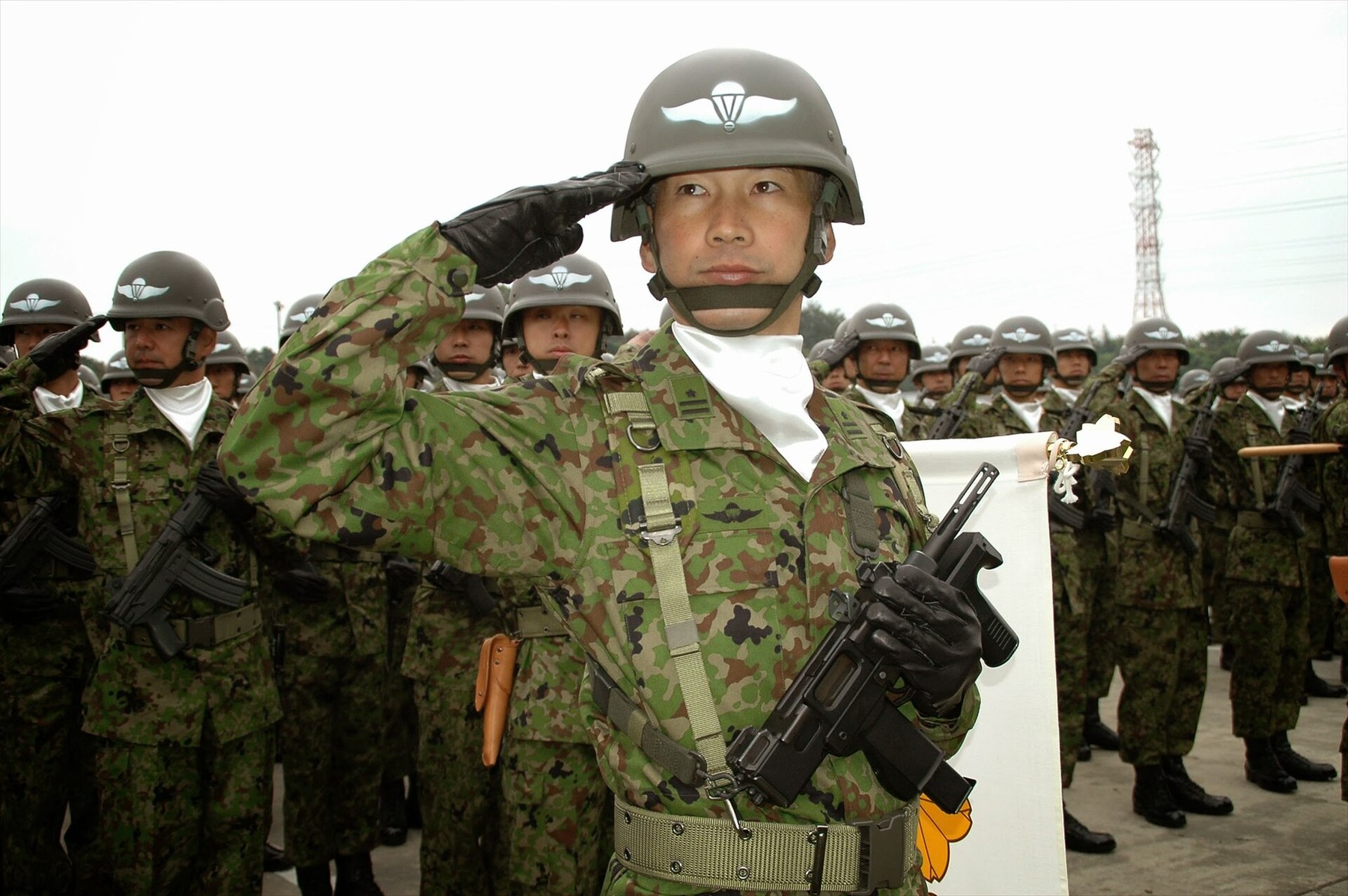
The magazine went further than the government in one respect. It reported that the weapon was also issued to the Air Self-Defense Force’s base-security instruction unit and to the Maritime Self-Defense Force, and that it appeared on the Maritime force’s procurement plan for fiscal 2012.4 That plan was not found for this dive, but the Maritime force’s ownership of the specification (below) makes its use of the weapon certain.
Two Diet answers are often cited as evidence of naval use and must be read carefully. On 18 April 2000 a Defense Agency vice-minister listed the personal equipment of the new Maritime Special Boarding Unit as including “machine pistols”, and on 14 December 2006 a vice-minister said that a destroyer’s 18-man boarding party used “mainly the pistols and machine pistols carried aboard”.56 Neither names a model. They are consistent with the M9 on Maritime ships but are not proof of it, and they are not counted here as such.
2.3 The Ground Self-Defense Force’s buy, year by year
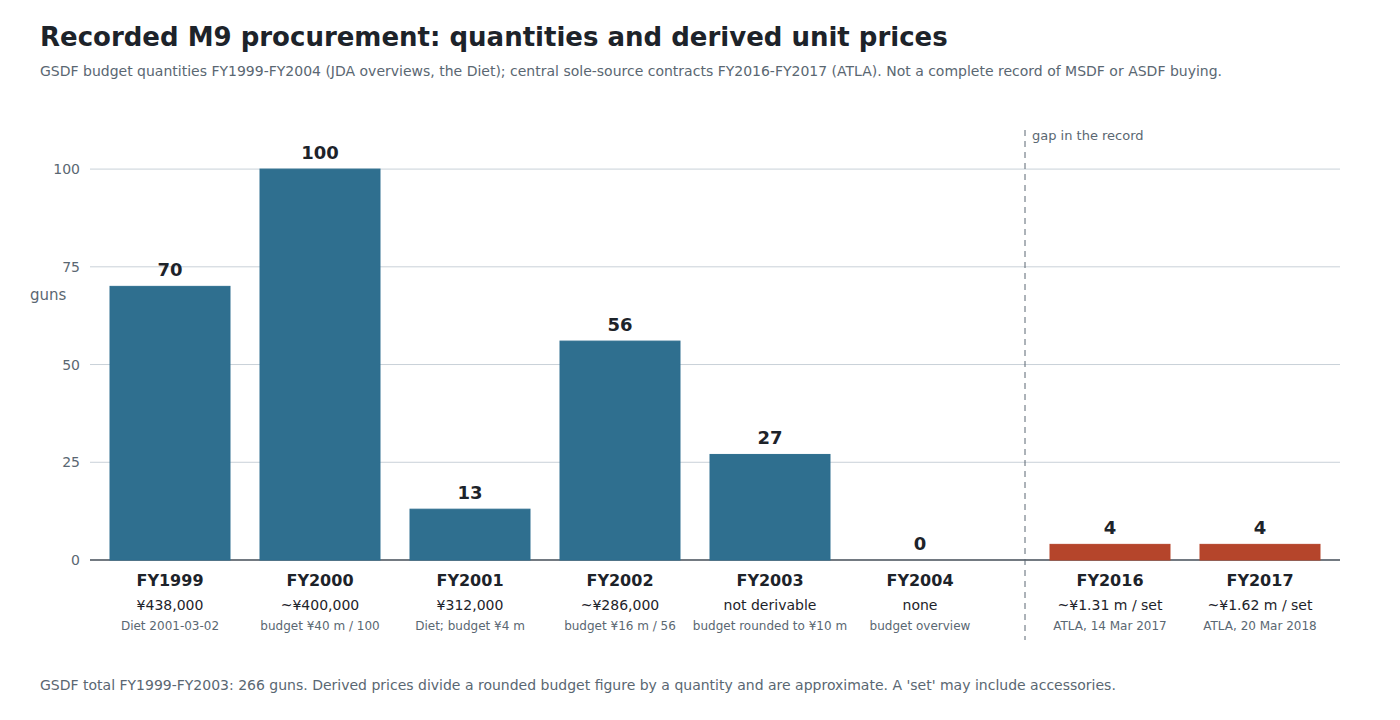
The Defense Agency’s annual budget overviews list the Ground Self-Defense Force’s front-line equipment by item, with the quantity and the amount. The 9 mm machine pistol appears in five consecutive years and then disappears.
Table 2 — The Ground Self-Defense Force's buy, year by year
| Fiscal year | Guns | Budget amount | Unit price | Source |
|---|---|---|---|---|
| 1999 | 70 | (prior-year column) | ¥438,000 average | Budget overview FY2000; minister in the Diet73 |
| 2000 | 100 | ¥40 million | about ¥400,000; ¥420,000 “including accessories such as the storage case” | Budget overview FY2000; Equipment Bureau in the Diet72 |
| 2001 | 13 | ¥4 million | ¥312,000 average (budget request) | Budget overview FY2001; minister in the Diet83 |
| 2002 | 56 | ¥16 million | about ¥286,000 (derived) | Budget overview FY20029 |
| 2003 | 27 | ¥10 million (rounded) | cannot be derived from a rounded figure | Budget overview FY200310 |
| 2004 | none | none | none | Budget overview FY200411 |
The total is 266 guns, which is also the figure Spear Head gives; it puts the five-year average at about ¥380,000.4 The budget amounts are given in hundreds of millions of yen to one or two decimal places, so a unit price divided out of them is approximate. The two prices the government stated outright, ¥438,000 for fiscal 1999 and ¥312,000 for the fiscal 2001 request, are the reliable ones.
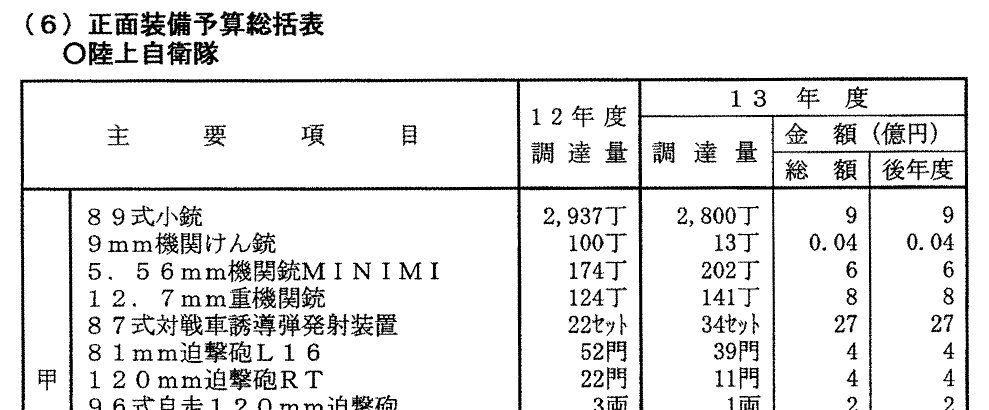
For scale: the same tables show the Ground Self-Defense Force buying 2,800 to 3,400 Type 89 rifles a year in the same period.811 The M9 was never a general issue weapon. The minister’s own answer in 2001 explains the small and irregular numbers: the agency was buying “the quantities needed as divisions are progressively reorganised”, and the 13 of fiscal 2001 reflected an unresolved question of how the weapon fitted with the other loads paratroopers carry.3
2.4 The Navy’s weapon now
The specification in force for the M9 is DSP Y 1001B, established on 31 March 2003, the last day of fiscal 2002, and revised in 2008 and 2010. Its colophon names the office that drafted it: 海上自衛隊補給本部武器部, the Weapons Department of the Maritime Self-Defense Force Supply Headquarters.12 A specification is drafted by the service that intends to keep buying the item. The Ground Self-Defense Force bought its last M9s in fiscal 2003; the Navy wrote the document under which the weapon would be bought from then on.
The specification’s markings clause points the same way. It requires each gun to carry “the maker’s trademark, the item name, a unique serial number, and the mark of each Self-Defense Force”, and the accessories table leaves the number of storage cases to be set by each order.12 It was written for more than one customer.
2.5 The later contracts
The Acquisition, Technology and Logistics Agency, which now handles the ministry’s central procurement, publishes monthly lists of the contracts it signs, with the reason for every sole-source award above a threshold. Two M9 contracts appear in the lists read for this dive.1314
Table 3 — The later contracts
| Contract date | Item | Quantity | Supplier | Amount (incl. tax) | Per set |
|---|---|---|---|---|---|
| 14 March 2017 | 9mm機関けん銃 | 4 sets (SE) | “formerly Minebea Co., now MinebeaMitsumi Inc.”, Miyota, Nagano | ¥5,248,800 | about ¥1.31 million |
| 20 March 2018 | 9mm機関けん銃 | 4 sets (SE) | MinebeaMitsumi Inc. | ¥6,475,680 | about ¥1.62 million |
The lists do not say which service the guns were for, nor what a “set” contains. The specification’s standard accessories, a sling, a bore brush, a cleaning rod, three magazines, a spring-removal tool and a pouch, would make a set of one gun with its kit (Volume 4), but that is an inference.12 The 2017 entry was signed in the month MinebeaMitsumi was formed, and the agency recorded both company names.
No M9 contract appears in the fiscal 2018 list, nor in any of the 41 monthly lists of sole-source contracts above the threshold for fiscal 2023 to August 2026 that were read for this dive.1516 Smaller contracts below the threshold and purchases by local supply offices are published separately and were not searched, so the absence does not prove that no M9 has been bought since 2018. It does show that no central contract of any size has been let in the recent years checked.
2.6 What it cost, and what that bought
The price was what the Diet noticed first. In April 2000 a member set it against a quoted foreign price of ¥30,000 to ¥40,000 for a submachine gun, and the Equipment Bureau’s answer was that nothing foreign was equivalent and an import would cost about ¥400,000 anyway.2 By 2001 the minister could point to a fall from ¥438,000 to ¥312,000.3 Spear Head in 2012 compared the five-year average of about ¥380,000 with a US retail price of about $900 for a Mini-Uzi and a police procurement price of about ¥250,000 for the H&K MP5, and blamed the small quantities.4
The later contracts make the point more sharply. At about ¥1.3 million and ¥1.6 million a set in 2017 and 2018, the per-unit price was three to five times that of the first deliveries. Part of the difference may be accessories, since a set probably includes them; part is the cost of making four guns at a time on a line that otherwise makes signal pistols and bomb racks. No document read for this dive breaks the price down.
Japanese small arms are expensive in general, and the M9 is not the extreme case. A member of the House of Councillors cited a 2018 Ministry of Finance document in 2023 for the licence-built MINIMI machine gun at ¥3.27 million each, 7.2 times the American price.17 The M9’s problem was less the price than the price in relation to a role that the forces were never sure they needed filled.
2.7 The verdict in print
No official assessment of the weapon’s performance has been published. Three published opinions exist, and they should be read as opinions.
The military journalist Kiyotani Shinichi wrote in Tōyō Keizai in 2021 that “MinebeaMitsumi’s submachine gun, the machine pistol, had a unit price of ¥440,000, was expensive and also performed poorly, so procurement was stopped partway through”.18 The price he gives is the first year’s, not a 2021 one, and procurement did not stop for the whole forces, as the 2017 and 2018 contracts show; but the Ground Self-Defense Force’s purchases did end after five years, which is presumably what he meant. He gives no source for “performed poorly”.
Spear Head was more specific and more measured. It found the selector stiff, needing a lift out of the safe position; the grip “thick and angular” and “not, to be polite, easy to hold”; the weight surprising for something called a pistol; and full-automatic fire at “over 1,100 rounds a minute” without a stock likely to need “considerable skill”, with 25 rounds gone in about 1.3 seconds. It estimated the useful range in combat at 40 to 50 metres, no better than the 9 mm pistol. It added that in semi-automatic fire the weight largely absorbs the recoil, so the weight “cannot simply be called a drawback”.4 Volume 4 sets these against the specification.
The Japanese Wikipedia article reports that commanders of units that received the weapon told authors of popular books that “the old 9 mm pistol or the folding-stock Type 89 would be far better”.19 The books were not read for this dive and the remark is reported, not relied on.
2.8 What came after
The disclosures and the magazine together sketch what replaced the M9 in the roles it did not keep.
- Folding-stock rifles. The tank crews for whom the M9 was first intended were given the folding-stock Type 89 instead (Spear Head).4
- An H&K evaluation, 2011. Spear Head reported that the fiscal 2011 procurement plan listed an H&K “new submachine gun” for “technical investigation”, “rumoured” to be the UMP or the MP7.4 The plan itself was not found.
- A 4.6 mm weapon. The agency has bought ammunition for a “4.6 mm submachine gun (B)” from Marubeni Aerospace under contracts of 27 November 2018, 20 February 2024 and later dates.1516 4.6 mm is the calibre of the H&K MP7, but the records do not name the weapon, and it is not identified here; the hub’s MP7 dive discusses the reliability of user lists.
- Imported 9 mm submachine guns. On 29 March 2024 the agency bought 74 “high-performance 9 mm submachine guns” (高性能9mm短機関銃) from the Tokyo importer Ginza Jūhōten for ¥125,840,000, about ¥1.7 million each. On 31 March 2026 it bought 29 sets of “submachine guns” from the Yokohama firm Fultum for ¥115,797,000, about ¥4 million a set; the same firm supplies the forces’ G28E2 sniper rifles.16 Neither record names the weapon or the user.
The pattern is clear even with the models unnamed: from the 2010s, when the forces want a submachine gun they import one through a trading house, and the domestic machine pistol is not bought.
2.9 Users outside Japan
None found. No record was found of any M9 leaving Japan in any capacity, by sale, gift or loan. The weapon appears abroad only in the hands of Japanese troops on exercises, as at Yakima in 2014 and in Indonesia in 2024 (photographs above).
2.10 What could not be verified
- The total number of M9s made. The Ground Self-Defense Force’s 266 are documented; the Maritime and Air Self-Defense Forces’ quantities are not, beyond the two four-set contracts.
- Which service received the 2017 and 2018 sets, and what a set contains.
- Whether any M9 has been bought since 2018 under a below-threshold or local contract.
- The Maritime force’s fiscal 2012 procurement plan and the fiscal 2011 H&K evaluation (Spear Head only).
- Issue to the Amphibious Rapid Deployment Brigade, the Special Forces Group, destroyers and submarines (circulating claims; no primary source found).
- The identity of the imported “high-performance 9 mm submachine gun” of 2024 and the “submachine guns” of 2026.
- Any official assessment of the weapon’s performance.
References
Footnotes
-
Japan Ground Self-Defense Force, equipment page “M9 エムナイン”, archived 25 March 2010: https://web.archive.org/web/20100325162700/http://www.mod.go.jp/gsdf/equipment/fa/0_26.html (accessed 18 October 2026). ↩
-
House of Representatives, Audit and Administrative Oversight Committee, Second Subcommittee, 21 April 2000, Shima Satoshi and Oikawa Kōzō (Director-General, Equipment Bureau), https://kokkai.ndl.go.jp/txt/114704132X00220000421/83 (accessed 18 October 2026). ↩ ↩2 ↩3
-
House of Representatives, Budget Committee, First Subcommittee, 2 March 2001, Saitō Toshitsugu and Ishiba Shigeru, https://kokkai.ndl.go.jp/txt/115105266X00220010302/19 (accessed 18 October 2026). ↩ ↩2 ↩3 ↩4 ↩5
-
YAS (text) and Argonaut (photographs), “9mm機関拳銃”, Spear Head No. 13 (Argonaut, August 2012), reproduced by Hyper Douraku, https://www.hyperdouraku.com/military/9mmmp/ (accessed 18 October 2026). ↩ ↩2 ↩3 ↩4 ↩5 ↩6 ↩7 ↩8
-
House of Representatives, Security Committee, 18 April 2000, Yoda Tomoharu, https://kokkai.ndl.go.jp/txt/114703815X00420000418/218 (accessed 18 October 2026). ↩
-
House of Councillors, Land, Infrastructure and Transport Committee, 14 December 2006, Ōmae Shigeo, https://kokkai.ndl.go.jp/txt/116514319X00720061214/42 (accessed 18 October 2026). ↩
-
Japan Defense Agency, budget overview, fiscal 2000, “(6) 正面装備予算総括表”, via WARP: https://warp.ndl.go.jp/20200514/20200501195546/www.mod.go.jp/j/yosan/yosan_gaiyo/2000/y2000.pdf (accessed 18 October 2026). ↩ ↩2
-
Japan Defense Agency, budget overview, fiscal 2001 (資料), the same table, via WARP: https://warp.ndl.go.jp/20200514/20200501195534/www.mod.go.jp/j/yosan/yosan_gaiyo/2001/shiryo.pdf (accessed 18 October 2026). ↩ ↩2
-
Japan Defense Agency, budget overview, fiscal 2002 (参考), p. 34, via WARP: https://warp.ndl.go.jp/20200514/20200501195518/www.mod.go.jp/j/yosan/yosan_gaiyo/2002/sankou.pdf (accessed 18 October 2026). ↩
-
Japan Defense Agency, budget overview, fiscal 2003, p. 24, via WARP: https://warp.ndl.go.jp/20200514/20200501195513/www.mod.go.jp/j/yosan/yosan_gaiyo/2003/gaiyou.pdf (accessed 18 October 2026). ↩
-
Japan Defense Agency, budget overview, fiscal 2004, Ground Self-Defense Force front-line equipment table (“9mm機関けん銃 27丁 − − −”), https://web.archive.org/web/20200723133405/https://www.mod.go.jp/j/yosan/yosan_gaiyo/2004/gaiyou.pdf (accessed 18 October 2026). ↩ ↩2
-
Ministry of Defense, specification DSP Y 1001B, 9mm機関けん銃, 2003, rev. 2008 and 2010, drafted by the JMSDF Supply Headquarters, Weapons Department: https://web.archive.org/web/20120420170752/http://www.mod.go.jp/j/procurement/chotatsu/nds/pdf/y/y1001.pdf (accessed 18 October 2026). ↩ ↩2 ↩3
-
Acquisition, Technology and Logistics Agency, monthly contract information, sole-source contracts above the threshold, fiscal 2016 (28zuikeikijunijou.xlsx), https://www.mod.go.jp/atla/souhon/supply/jisseki/rakusatu/index3.html as archived 28 March 2019 (accessed 18 October 2026). ↩
-
The same series, fiscal 2017 (29zuikei_kijunijo.xlsx), as above. ↩
-
The same series, fiscal 2018 (30zuikei_kijunijo.xlsx), as above. ↩ ↩2
-
Acquisition, Technology and Logistics Agency, 契約に係る情報の公表, monthly sole-source contract lists for fiscal 2023 (05_zuikei_kijunijo-04 to -03), fiscal 2024 (06_zuikei_kijunijo-04 to -03), fiscal 2025 (07_zuikei-04 to -03) and fiscal 2026 to August (08_zuikei-04 to -08), https://www.mod.go.jp/atla/souhon/supply/jisseki/rakusatu/index.html (41 files read 18 October 2026). ↩ ↩2 ↩3
-
House of Councillors, joint session of the Financial Affairs and the Foreign Affairs and Defense Committees, 30 May 2023, Takara Tetsumi, https://kokkai.ndl.go.jp/txt/121115372X00120230530/172 (accessed 18 October 2026). ↩
-
Kiyotani Shinichi, Tōyō Keizai Online, 15 April 2021, page 2, https://toyokeizai.net/articles/-/422914?page=2 (accessed 18 October 2026). ↩
-
Wikipedia, “9mm機関けん銃” (Japanese), accessed 18 October 2026; reported, not relied on. ↩
Comments (0)