Minebea PM-9 (M9) · Volume 1
Origins: From the Grease Gun to the M9
Why Japan's Self-Defense Forces wanted a machine pistol in the 1990s, how a bearing maker came to build it, what the government told the Diet about it, and what the record says about the Uzi licence that every English-language account repeats
1.1 What the weapon is called
The weapon that English-language references call the Minebea PM-9 has no such name in Japan. The Ministry of Defense’s specification calls it the 9mm機関けん銃, “9 mm machine pistol”, and gives the English title “SUBMACHINE GUN, 9MILLIMETER”.1 The Ground Self-Defense Force’s own equipment page gave the abbreviation M9 and the nickname エムナイン, “Em-Nain”, a phonetic reading of M9.2 The odd mixture of kanji and kana in the official name is a matter of script rules, not of meaning: the character 拳 (“fist”, as in 拳銃, “pistol”) was not on the list of characters for general use when the term was fixed, so laws and specifications spell the word in kana as けん.1 Later and less formal writing uses 機関拳銃 with the kanji.
“PM-9” appears in no Japanese government document found for this dive. English Wikipedia’s own article concedes that there is “no public record or confirmation” of the designation.3 It is used here only because a reader searching in English will meet it; the rest of this dive calls the weapon by its service abbreviation, the M9.
Two other points of naming matter later. First, 機関けん銃 is a generic term. The same word appears in Diet answers about the National Police Agency’s weapons, which are a different gun entirely; only passages that say “9 mm machine pistol” in a Self-Defense Forces context are used here as evidence about the M9. Second, “M9” is easily confused with the Beretta M9 pistol of the US armed forces. The two are unrelated.
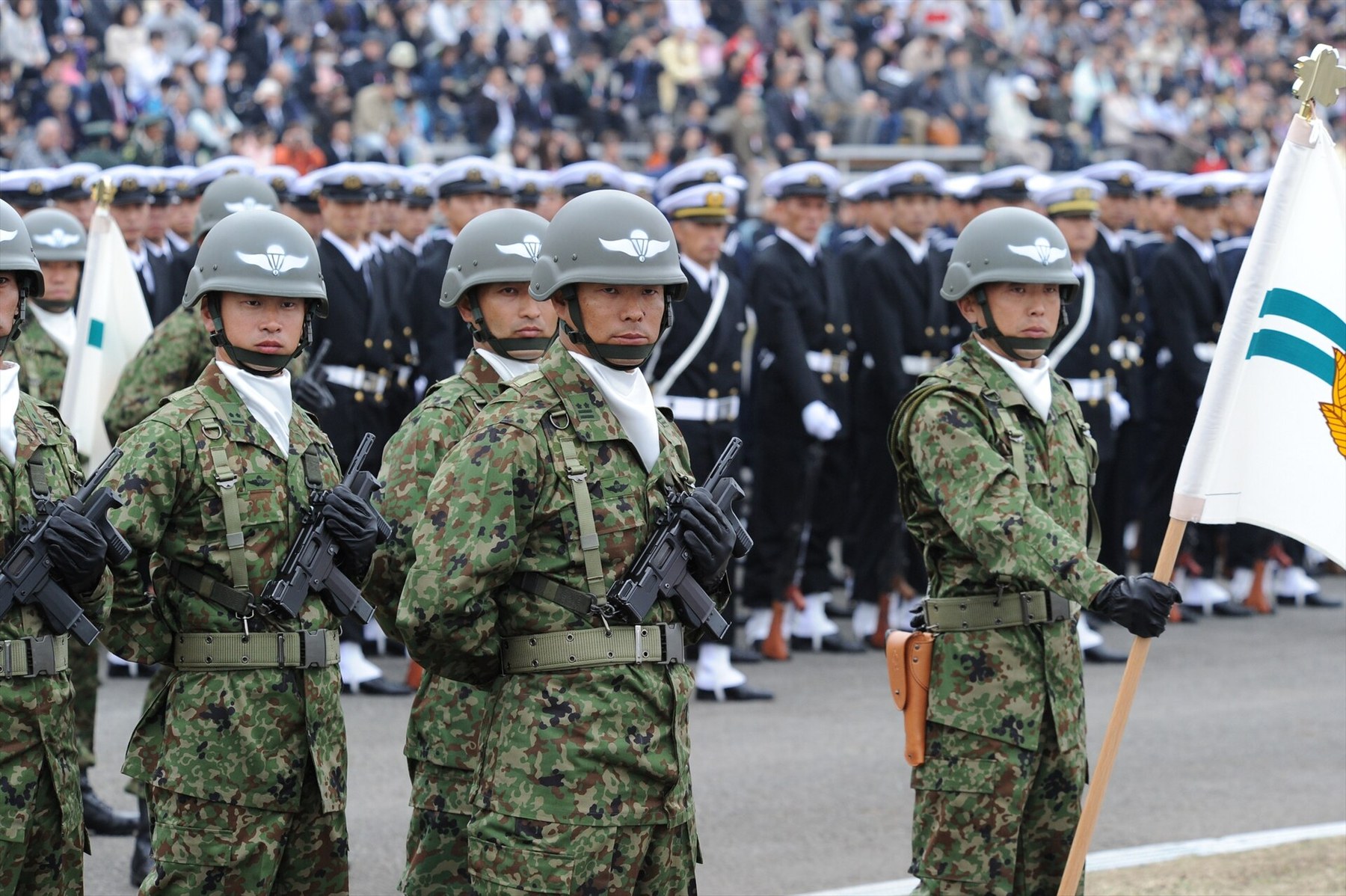
1.2 The submachine guns Japan had before
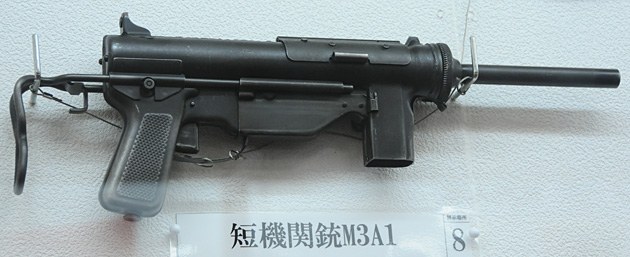
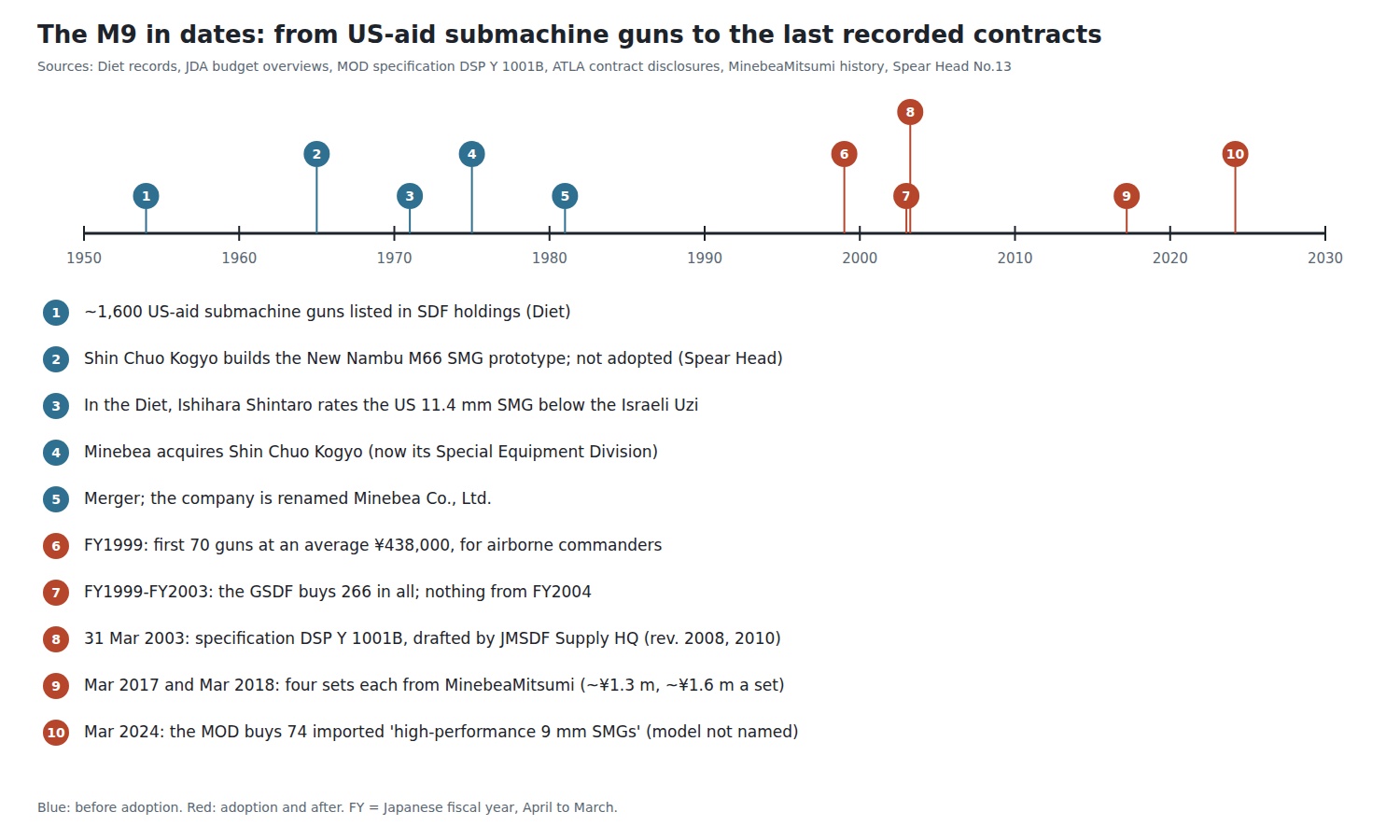
The Self-Defense Forces were armed at their founding with American weapons supplied under the mutual-defence aid programmes. A government witness told the House of Councillors’ Cabinet Committee on 1 June 1954 that the holdings then included 1,600 submachine guns, among 32,300 rifles and carbines.4 The submachine guns were the US M1 and M3 types in .45 ACP, called in Japanese service the 11.4 mm submachine gun after the bore of the cartridge.
By the early 1970s the Ground Self-Defense Force held more of them than it needed. Figures read into the record of the House of Representatives’ Audit Committee on 24 April 1973 gave an establishment of 3,900 submachine guns against 8,600 held, with 4,700 in reserve.5 A government witness to the Cabinet Committee on 8 June 1973 put the American supply at “about 8,600”.6
They were not admired. In the Budget Committee on 10 February 1971 the Diet member Ishihara Shintarō complained that the 11.4 mm weapon “supplied by America” was “markedly inferior in performance” to “the Israeli-made Uzi, which is already very high-performing and which even West Germany has adopted”.7 It is the earliest mention of the Uzi in the Diet’s records in connection with Japan’s own submachine guns, nearly three decades before the M9.
The one domestic attempt to replace them came early. According to the most detailed published account of the M9, a feature in the Japanese defence magazine Spear Head in 2012, Shin Chuo Kogyo built a prototype submachine gun at the Defense Agency’s request in 1965, the New Nambu M66, “styled like the S&W M76”; it was not adopted, because by then the world’s armies were turning from the submachine gun to the assault rifle.8 No government document about the M66 was found for this dive, and the account rests on the magazine.
The M3 lingered. When the M9 finally arrived it did not even replace it everywhere: the same Spear Head feature reports that the tank crews for whom the new weapon had first been intended were given the folding-stock version of the Type 89 rifle instead.8
1.3 Minebea: a bearing maker with a gun factory
The firm that builds the M9 began as a maker of tiny ball bearings. MinebeaMitsumi’s own history records the founding in July 1951 of 日本ミネチュアベアリング株式会社, Nippon Miniature Bearing Co., in Itabashi, Tokyo, as “Japan’s first specialist maker of miniature bearings”.9 The initials of that name survive as the trademark NMB, and NMB is what the M9’s receiver carries in place of a maker’s name (Volume 3).
Weapons came by acquisition. In July 1975 the company bought Tokyo Screw and “the defence-related equipment maker Shin Chuo Kogyo”, which its history says is “now the Special Equipment Division” (特機事業部). In October 1981 it absorbed four affiliated makers, Shin Chuo Kogyo among them, and renamed itself Minebea Co., Ltd. In 2017 it merged with Mitsumi Electric by share exchange and became MinebeaMitsumi Inc.9 The corporate history says nothing about firearms; the defence business appears only as a division name.
The Spear Head feature fills in the lineage. It traces Shin Chuo Kogyo back to Chuo Kogyo, the company run before the war by Nambu Kijirō, Japan’s best-known small-arms designer, and says that Minebea builds the Self-Defense Forces’ 9 mm pistol (the SIG Sauer P220) under licence and the New Nambu M60 revolver for the police. It states that the M9 was developed by Minebea and is made at its Ōmori plant in Ōta ward, Tokyo.8 The plant’s location could not be confirmed from a MinebeaMitsumi page.
What the government’s own records confirm is narrower and more useful. The Acquisition, Technology and Logistics Agency’s contract disclosures show Minebea and MinebeaMitsumi supplying the defence ministry with signal pistols, aircraft bomb and ejector racks, sonobuoy launchers and cartridge actuators, and, in 2017 and 2018, the M9 itself (Volume 2).1011 The 2021 description by the military journalist Kiyotani Shinichi in Tōyō Keizai sums up the arrangement: Japan’s small-arms makers divided the work, with “pistols and submachine guns MinebeaMitsumi”, rifles and mortars Howa, machine guns Sumitomo Heavy Industries, and larger guns Japan Steel Works.12
The legal frame explains why there is only ever one bidder. In Japan a firm may make weapons only under a permit from the Minister of Economy, Trade and Industry under the Weapons Manufacturing Law of 1953 (武器等製造法, Law No. 145). The specification requires the M9 to be made “in a factory holding permission under the Weapons Manufacturing Law”, and the agency’s sole-source justification for the 2018 contract says that the only holder of that permission for this weapon is MinebeaMitsumi.111
1.4 The requirement
No published document sets out the original requirement for the M9 in the Defense Agency’s own words. What exists is three government statements of what the weapon was for, made after it had been adopted.
The Ground Self-Defense Force’s equipment page, in its 2010 form, gave the purpose in one line: “for self-defence combat by commanders of airborne units, operators of unit-equipment weapons, and others” (空挺部隊の指揮官、部隊装備火器操作手などの自衛戦闘用).2 “Unit-equipment weapons” are crew-served weapons such as anti-tank missiles and recoilless guns, whose operators carry them in place of a rifle.
The Director-General of the Defense Agency’s Equipment Bureau, Oikawa Kōzō, told a Diet subcommittee on 21 April 2000 that the weapon had “the very special purpose” of “ensuring ease of carrying and handling so as not to hinder the primary mission” of airborne troops, and of “improving self-defence combat capability by automatic fire”.13
The clearest statement came from Ishiba Shigeru, then Senior Vice-Minister of the Defense Agency, on 2 March 2001:
“It is meant, for example, for the Airborne Brigade. When the airborne troops come down by parachute their posture is naturally unstable; if they are targeted by the enemy at that moment, it is to fire continuously. That is why the machine pistol was adopted. It is not that every member of the Self-Defense Forces carries one for self-protection.”14
Ishiba added that paratroopers also carry recoilless guns and other loads “weighing several kilograms”, that the interoperability of those loads with the machine pistol was still being studied, and that this was why the quantity was small, “though it may naturally increase in future”.14 It did not increase (Volume 2).
Spear Head gives a wider brief: a successor both to the M3A1 and to the 9 mm pistol, for rear units, vehicle crews and anti-tank units.8 The government statements are the better evidence for what the weapon was bought to do; the magazine’s account is better evidence for what it was first meant to replace.
One story should be set aside. Some books, according to the Japanese Wikipedia article, say that the M9 was developed to avoid problems over the weapons that units could take on United Nations peacekeeping deployments, and that it has no stock so as to count as a pistol for that purpose.15 Spear Head repeats the stock story as something “heard”, and says plainly that “the truth is not certain”.8 No government document found supports it, and the government’s own statements of purpose do not mention peacekeeping.
1.5 Adoption, and the Diet’s questions
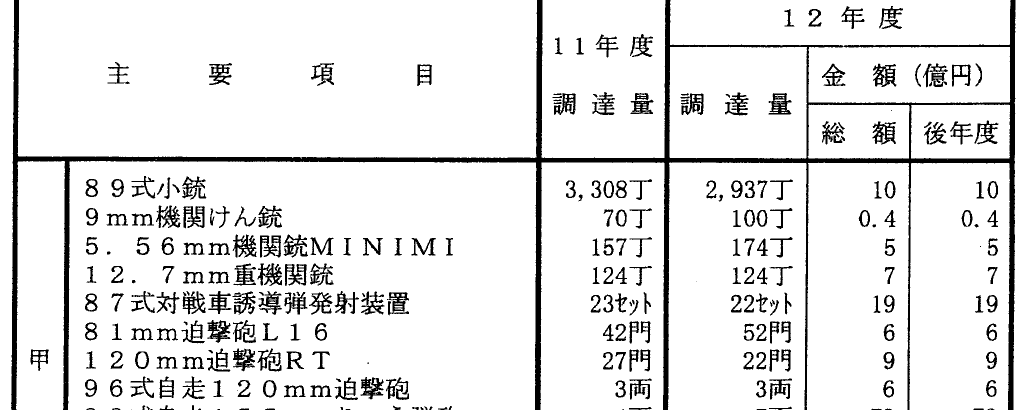
The M9 entered service in fiscal 1999, the Japanese fiscal year that ran from April 1999 to March 2000. The Defense Agency’s budget overview for fiscal 2000 lists the previous year’s procurement of 70 guns, and the Diet record confirms both the year and the users: on 21 April 2000 the Diet member Shima Satoshi said he understood that “in fiscal 1999 the 9 mm machine pistol was deployed for the commanders of the airborne units”.1613
The weapon is unusual among small arms in having been argued over in parliament on price. Shima put it directly: submachine guns were said to cost ¥30,000 to ¥40,000 abroad, so how much was the Defense Agency paying? Oikawa answered that the fiscal 2000 budget unit price was “about ¥420,000, including accessories such as the storage case”. Pressed on why, he said that “no equivalent item can be found among foreign countries’ equipment”, so that a comparison was difficult, but that if a similar item were imported it “would inevitably come to about ¥400,000”.13
The question returned the next year. On 2 March 2001 the Defense Agency’s Director General, Saitō Toshitsugu, told the Budget Committee’s first subcommittee that the agency was procuring the machine pistol “in the quantities needed as divisions are progressively reorganised”, and that procurement reform had cut the price: “the average procurement price in fiscal 1999, when 70 were procured, was ¥438,000; in the fiscal 2001 budget request, procuring 13, the average is held down to ¥312,000.”14 It is the only published unit price for the first year of production, and it comes from the minister.
The exchange produced one further remark of interest. Asked to compare the machine pistol’s price with that of the SIG Sauer pistol, Ishiba replied that the two had different uses: the machine pistol “can fire many rounds at once”, while the pistol “can only fire about five”. The questioner corrected him, as the P220 holds more than that, but Ishiba’s answer on what the machine pistol was for, quoted above, stands.14
1.6 The prototype
A prototype survives. It is displayed in the public-relations museum at Camp Tsuchiura, home of the Ground Self-Defense Force’s Ordnance School, labelled 9mm機関拳銃(試作型), “9 mm machine pistol (prototype)”.17
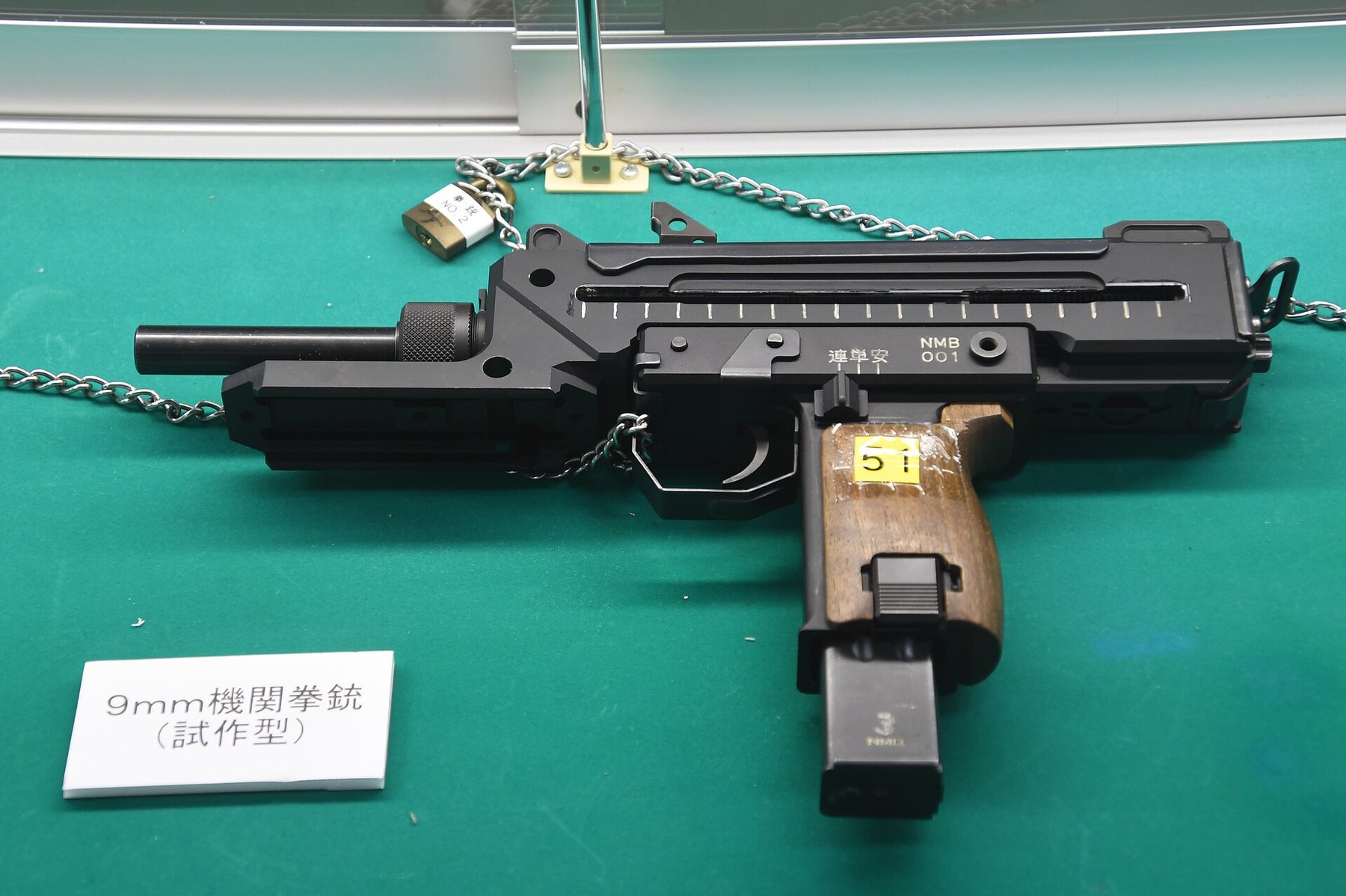
Two differences from production guns are visible in the photograph: wooden grip panels on the pistol grip, and no foregrip fitted. Spear Head adds that the prototype’s grip and selector markings differ from the production weapon’s.8 The receiver carries the NMB mark. Whether the foregrip was absent from the prototype design or has merely been removed for display cannot be told from the photograph, and no document says. Volume 3 sets out how to tell the prototype from production guns.
1.7 The Uzi question
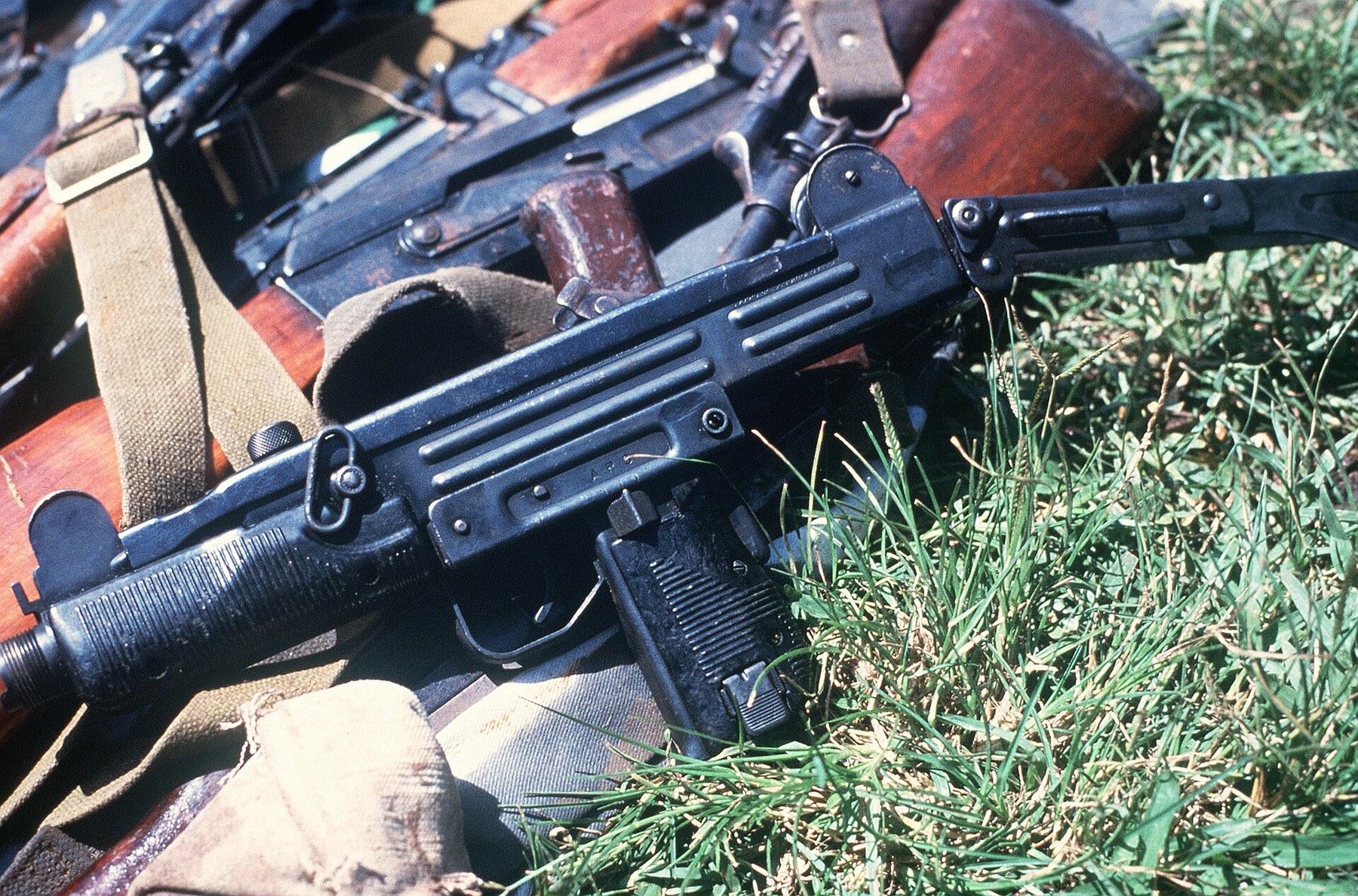
Nearly every English-language description of the M9 says that it is a licensed copy of the Israeli Mini-Uzi. The most widely copied form of the claim is Maxim Popenker’s Modern Firearms entry, which says the weapon “is based on Mini-Uzi submachine gun. It was produced under license from IMI (now IWI Ltd).”18 The entry cites no source for the licence.
The question deserves a careful answer, because the evidence is unusually good and it does not support the claim.
What would be expected if there were a licence. The Japanese defence ministry publishes its reasons for every sole-source contract above a threshold, and where a weapon is made under a foreign licence the reason says so. For the 5.56 mm MINIMI machine gun bought from Sumitomo Heavy Industries on 31 March 2017, the agency’s stated reason is that manufacture requires “a technical-assistance agreement with FN Herstal of Belgium, approved by the Belgian government”, together with the manufacturing permit, and that only Sumitomo meets both conditions. The same form of words, naming the US firm EDO Corporation, appears for aircraft bomb racks that MinebeaMitsumi builds under licence.1019
What the record shows for the M9. The agency’s reasons for the M9 contracts of 14 March 2017 and 20 March 2018 mention only the Weapons Manufacturing Law permit. The 2018 entry reads: “performance of this contract requires the permission of the Minister of Economy, Trade and Industry under Article 3 of the Weapons Manufacturing Law for the manufacture of the 9 mm machine pistol, and the only holder (or expected holder) of that permission is the contracting party, MinebeaMitsumi.” No technical-assistance agreement, with IMI or anyone else, is mentioned.1011
What the government told parliament. The Equipment Bureau’s Director-General said in April 2000 that “no equivalent item can be found among foreign countries’ equipment”.13 That is not the language a ministry uses about a licensed copy of a foreign weapon in widespread service.
What the weapon itself shows. The M9’s barrel is not a Mini-Uzi barrel. The ministry’s specification gives the M9 six grooves, right-hand, one turn in 250 mm, and a 120 mm barrel.1 SWAT magazine’s 1984 evaluation of the Mini-Uzi, written when IMI and its American importer were introducing it, gives four grooves, right-hand, one turn in 254 mm, and a 197 mm barrel.20 The M9 has no grip safety, which the Mini-Uzi kept from the Uzi; its safety functions as the specification lists them are a selector, an auxiliary sear and a delayed-opening function (Volume 4).1 Its receiver, according to Spear Head, is machined from aluminium, not pressed from steel.8 These are not the differences of a licence-built copy.
What the evidence allows. The design resembles the Uzi family in layout: the magazine in the pistol grip, an open-bolt blowback action, and (by Spear Head’s account) a bolt that telescopes over the barrel.8 Spear Head itself calls the M9 “strongly influenced” by the Uzi.8 Influence of that kind is common to a whole generation of compact submachine guns and implies no licence. The magazine’s own description is that the M9 is “close to” models such as the Mini-Uzi and the Ingram MAC-10.8
The conclusion this dive draws is limited to what the record shows. No Japanese government document found records a licence from IMI. The procurement records that name foreign licences for other Japanese-built weapons name none for this one, the government described the weapon to the Diet as having no foreign equivalent, and its barrel differs from the Mini-Uzi’s in rifling and length. The licence claim is unsupported. It cannot be proved that no agreement of any kind ever existed, but anyone repeating the claim needs a source, and none has been found.
1.8 What the received story gets wrong
The Modern Firearms entry is the root of most English-language accounts, and the Japanese record corrects it on several points.18
Table 1 — What the received story gets wrong
| Claim in circulation | What the record shows |
|---|---|
| ”Produced under license from IMI” | No licence in any government record found; the contracts that name licences for other weapons name none for the M9 (above). |
| Adopted “during early 1990s” | First procured in fiscal 1999 (70 guns), confirmed by the budget overview and the Diet.1613 |
| Issued to “tank, vehicle and artillery crews” | Issued first to the commanders of airborne units and to operators of crew-served weapons; the tank crews received folding-stock rifles instead.2148 |
| ”It seems that it is no longer made” | MinebeaMitsumi supplied the weapon under contracts of March 2017 and March 2018 (Volume 2).1011 |
| ”A flash hider on the barrel” | The specification calls the device a 制退器, a muzzle brake, and says its function is to “raise the recoil-reducing effect of firing”.1 |
| Overall length 339 mm (Japanese sources) | 399 mm in the specification and on the Ground Self-Defense Force’s own page; 339 mm appears to originate as a misprint in Spear Head (2012).128 |
Popenker himself hedges one point, writing that the weapon fires “from open bolt (presumably)”. Spear Head states it as open-bolt, and the specification’s auxiliary sear that “locks the bolt against moving forward” is consistent with it (Volume 4).18
1.9 What could not be verified
- The Defense Agency’s original statement of requirement, and the date development began. Spear Head says only “the 1990s”.
- Who designed the weapon at Minebea, and whether any foreign design assistance was bought. No document names a designer.
- The New Nambu M66 prototype of 1965, which rests on Spear Head alone.
- That the M9 is made at Minebea’s Ōmori plant in Tokyo (Spear Head; not on a MinebeaMitsumi page).
- The public competition said to have chosen the nickname “Em-Nain” (Japanese Wikipedia; no primary source found).
- Any peacekeeping motive for the design, which the only source that mentions it calls unconfirmed.
References
Footnotes
-
Ministry of Defense, 防衛省仕様書 DSP Y 1001B, 9mm機関けん銃 (SUBMACHINE GUN, 9MILLIMETER), established 31 March 2003, revised 21 March 2008, with amendment slip Y 1001B(1) of 20 July 2010; drafted by the JMSDF Supply Headquarters, Weapons Department. Archived copy: https://web.archive.org/web/20120420170752/http://www.mod.go.jp/j/procurement/chotatsu/nds/pdf/y/y1001.pdf (read in full 18 October 2026; translations are this dive’s). ↩ ↩2 ↩3 ↩4 ↩5 ↩6 ↩7 ↩8
-
Japan Ground Self-Defense Force, equipment page “M9 エムナイン”, https://www.mod.go.jp/gsdf/equipment/fa/0_26.html, as archived 25 March 2010, 8 August 2010 and 5 March 2021: https://web.archive.org/web/20100325162700/http://www.mod.go.jp/gsdf/equipment/fa/0_26.html (accessed 18 October 2026). The current GSDF equipment pages no longer list small arms. ↩ ↩2 ↩3 ↩4
-
Wikipedia, “Minebea PM-9” (English), accessed 18 October 2026. Used only for the statement about its own sourcing. ↩
-
House of Councillors, Cabinet Committee, 1 June 1954, Masuhara Keikichi (government witness). National Diet Library, Diet Record Search, https://kokkai.ndl.go.jp/txt/101914889X04919540601/177 (accessed 18 October 2026). ↩
-
House of Representatives, Audit Committee, 24 April 1973, Sakai Kōichi, https://kokkai.ndl.go.jp/txt/107104103X00919730424/83 (accessed 18 October 2026). ↩
-
House of Representatives, Cabinet Committee, 8 June 1973, Yamaguchi Eiichi (government witness), https://kokkai.ndl.go.jp/txt/107104889X02819730608/91 (accessed 18 October 2026). ↩
-
House of Representatives, Budget Committee, 10 February 1971, Ishihara Shintarō, https://kokkai.ndl.go.jp/txt/106515261X00319710210/189 (accessed 18 October 2026). ↩
-
YAS (text) and Argonaut (photographs), “9mm機関拳銃”, Spear Head No. 13 (Argonaut, August 2012), reproduced by Hyper Douraku, 21 August 2012, https://www.hyperdouraku.com/military/9mmmp/ (read in full 18 October 2026). The magazine’s claims are attributed to it throughout. ↩ ↩2 ↩3 ↩4 ↩5 ↩6 ↩7 ↩8 ↩9 ↩10 ↩11 ↩12 ↩13
-
MinebeaMitsumi Inc., “沿革” (corporate history), https://www.minebeamitsumi.com/corp/company/aboutus/history/ (accessed 18 October 2026). ↩ ↩2
-
Acquisition, Technology and Logistics Agency, monthly contract information, sole-source contracts above the threshold, fiscal 2016 (28zuikeikijunijou.xlsx), rows for 9mm機関けん銃 (contract of 14 March 2017) and 5.56mm機関銃MINIMI (31 March 2017); from https://www.mod.go.jp/atla/souhon/supply/jisseki/rakusatu/index3.html as archived 28 March 2019 (accessed 18 October 2026). ↩ ↩2 ↩3 ↩4
-
Acquisition, Technology and Logistics Agency, the same series, fiscal 2017 (29zuikei_kijunijo.xlsx), row for 9mm機関けん銃 (contract of 20 March 2018), as above. ↩ ↩2 ↩3 ↩4
-
Kiyotani Shinichi, “スクープ!住友重機械が機関銃生産から撤退へ”, Tōyō Keizai Online, 15 April 2021, page 2, https://toyokeizai.net/articles/-/422914?page=2 (accessed 18 October 2026). ↩
-
House of Representatives, Audit and Administrative Oversight Committee, Second Subcommittee, 21 April 2000: Shima Satoshi and Oikawa Kōzō (Director-General, Equipment Bureau, Defense Agency), speeches 82 to 85 and 98, https://kokkai.ndl.go.jp/txt/114704132X00220000421/83 (accessed 18 October 2026). ↩ ↩2 ↩3 ↩4 ↩5
-
House of Representatives, Budget Committee, First Subcommittee, 2 March 2001: Shutō Nobuhiko, Saitō Toshitsugu (Director General of the Defense Agency) and Ishiba Shigeru (Senior Vice-Minister), speeches 18 to 23, https://kokkai.ndl.go.jp/txt/115105266X00220010302/19 (accessed 18 October 2026). ↩ ↩2 ↩3 ↩4 ↩5
-
Wikipedia, “9mm機関けん銃” (Japanese), accessed 18 October 2026; used only to report what it says books claim. ↩
-
Japan Defense Agency, 我が国の防衛と予算 (budget overview), fiscal 2000, table “(6) 正面装備予算総括表, 陸上自衛隊”, via the National Diet Library web archive (WARP): https://warp.ndl.go.jp/20200514/20200501195546/www.mod.go.jp/j/yosan/yosan_gaiyo/2000/y2000.pdf (accessed 18 October 2026). ↩ ↩2
-
Hunini, “JGSDF 9mm Machine Pistol (Prototype) at museum of Camp Tsuchiura September 28, 2025”, Wikimedia Commons, with the photographer’s description “陸上自衛隊 9mm機関けん銃(試作型)。2025年9月28日 土浦駐屯地広報資料館内にて”, https://commons.wikimedia.org/wiki/File:JGSDF_9mm_Machine_Pistol_(Prototype)_at_museum_of_Camp_Tsuchiura_September_28,_2025.jpg (accessed 18 October 2026). ↩
-
Maxim Popenker, “Minebea M-9”, Modern Firearms, https://modernfirearms.net/en/submachine-guns/japan-submachine-guns/minebea-m-9-eng/ (accessed 18 October 2026). ↩ ↩2
-
Acquisition, Technology and Logistics Agency, the same series, fiscal 2018 (30zuikei_kijunijo.xlsx), rows for the BRU-47/A ejector rack, MinebeaMitsumi, as above. ↩
-
“Evaluation of the Mini UZI”, SWAT magazine, January 1984, with the ASAA/SWAT evaluation table; reproduced by UZI Talk, https://uzitalk.com/reference/pages/article_swat1984jan.htm (accessed 18 October 2026). ↩

Comments (0)