Rock Island Armory VR80 · Volume 5
50 to 150 Yards — the Slug Ballistics, and Why a 1-6× Fits
What the makers publish to 125 yards, what their own tables reveal about the 'high-velocity' load, and what an optic calibrated for a rifle does on a slug gun
The configuration documented here — a smooth-bore semi-automatic, a rifled choke tube, factory lead slugs, and a 1-6× low-power variable optic — is a bet on a particular band of range. Inside 50 yards a slug gun needs no magnification at all. Past about 150 yards a full-bore lead slug from a smooth bore is, on its makers’ own numbers, dropping and drifting fast enough that neither the load nor the optic is the limiting factor any more. The 50-to-150-yard band between is where the configuration either makes sense or does not, and it is the band this volume works through, from the ammunition makers’ own tables.
5.1 The Makers’ Own Tables
Federal and Remington publish velocity, energy, 10-mph wind drift and trajectory for each of their slug loads, to 125 yards and no further. All four loads relevant to the gun documented here are set out below, read from the makers’ product pages on 19 September 2026.1
Velocity (ft/s)
Table 1 — Velocity (ft/s)
| Load | BC (maker’s) | Muzzle | 25 yd | 50 yd | 75 yd | 100 yd | 125 yd |
|---|---|---|---|---|---|---|---|
| Federal Power-Shok 1 oz (F127 RS) — primary | .110 | 1,610 | 1,467 | 1,340 | 1,229 | 1,139 | 1,068 |
| Remington Slugger HV ⅞ oz (28600) — alternate | .055 | 1,800 | 1,498 | 1,252 | 1,083 | 978 | 904 |
| Remington Slugger 1 oz (20300) — reference | .075 | 1,560 | 1,363 | 1,203 | 1,085 | 1,004 | 942 |
| Remington AccuTip sabot (20727) — rifled barrels only | .145 | 1,850 | 1,728 | 1,612 | 1,502 | 1,401 | 1,310 |
Energy (ft-lb)
Table 2 — Energy (ft-lb)
| Load | Muzzle | 25 yd | 50 yd | 75 yd | 100 yd | 125 yd |
|---|---|---|---|---|---|---|
| Federal Power-Shok 1 oz | 2,521 | 2,092 | 1,746 | 1,469 | 1,262 | 1,110 |
| Remington Slugger HV ⅞ oz | 2,755 | 1,909 | 1,334 | 997 | 814 | 695 |
| Remington Slugger 1 oz | 2,367 | 1,807 | 1,406 | 1,145 | 979 | 864 |
| Remington AccuTip sabot | 2,926 | 2,553 | 2,222 | 1,928 | 1,677 | 1,466 |
Wind drift, 10 mph full value (in)
Table 3 — Wind drift, 10 mph full value (in)
| Load | 25 yd | 50 yd | 75 yd | 100 yd | 125 yd |
|---|---|---|---|---|---|
| Federal Power-Shok 1 oz | 0.3 | 1.6 | 3.7 | 6.6 | 10.4 |
| Remington Slugger HV ⅞ oz | 0.7 | 3.0 | 7.1 | 12.6 | 19.4 |
| Remington Slugger 1 oz | 0.6 | 2.5 | 5.6 | 9.8 | 14.9 |
| Remington AccuTip sabot | 0.3 | 1.1 | 2.4 | 4.4 | 7.0 |
Path, 100-yard zero, 0.5 in sight height (in) — the makers’ stated basis
Table 4 — The Makers' Own Tables
| Load | 25 yd | 50 yd | 75 yd | 100 yd | 125 yd |
|---|---|---|---|---|---|
| Federal Power-Shok 1 oz | +1.4 | +2.2 | +1.8 | 0 | −3.5 |
| Remington Slugger HV ⅞ oz | +1.5 | +2.5 | +2.2 | 0 | −4.4 |
| Remington Slugger 1 oz | +1.7 | +2.8 | +2.3 | 0 | −4.4 |
| Remington AccuTip sabot | +0.8 | +1.4 | +1.2 | 0 | −2.3 |
⚠ On Federal’s and Remington’s pages the path row prints four values under five column headings for the three Foster-type loads; the reading above places the missing value at the zero range, 100 yards, which is the only reading consistent with the stated zero. The AccuTip page prints all five.
⚠ Ballistic coefficients are each maker’s own figure and are not comparable across makers with any confidence: nominally similar full-bore lead slugs are credited with .055, .075 and .110. They are printed because the tables were computed from them.
5.2 The “High-Velocity” Load Loses Almost Everywhere
The owner’s record lists the Power-Shok as the primary load and the Slugger High Velocity as the alternate. The makers’ own tables settle which is better for this gun’s purpose, and it is not the one with the bigger number on the box.
⭐ The Slugger HV is faster only for the first few yards. It leaves the muzzle 190 ft/s ahead. By 25 yards the lead is 31 ft/s. By 50 yards it is 88 ft/s behind (1,252 against 1,340), and by 100 yards it is 161 ft/s behind (978 against 1,139). Its energy is already lower at 25 yards (1,909 against 2,092 ft-lb) and at 100 yards it carries 814 ft-lb against 1,262 — about 35 per cent less. Its wind drift at 100 yards is 12.6 inches against 6.6, almost double.
The reason is in the makers’ own ballistic coefficients: the lighter ⅞ oz slug is credited with half the Power-Shok’s BC (.055 against .110) and sheds velocity accordingly. For a slug gun set up with an optic to reach past 50 yards, the heavier, slower-starting load is the better one on every number the makers publish beyond 25 yards. The HV’s advantages — a little less recoil from a lighter slug, a flatter path over the first few yards — do not matter at the ranges the 1-6× is on the gun for.
5.2.1 Remington’s claim, against Remington’s table
Remington’s product page for the HV says: “The 7/8 oz. Slugger® High Velocity delivers 200 ft-lbs more energy at 50 yards with flatter trajectory on deer than standard 1 oz. slugs.”1
Remington’s own tables, read the same day, do not support it. At 50 yards the HV is listed at 1,334 ft-lb. Remington’s own standard 1 oz Slugger (item 20300) is listed at 1,406 ft-lb — 72 ft-lb more than the HV, not 200 less. Against Federal’s 1 oz Power-Shok the HV is 412 ft-lb behind at 50 yards. The claim may date from a different data set or a different comparison load; that could not be established. What the current tables show is the opposite of what the current page says.
5.3 Past 125 Yards: What Nobody Publishes
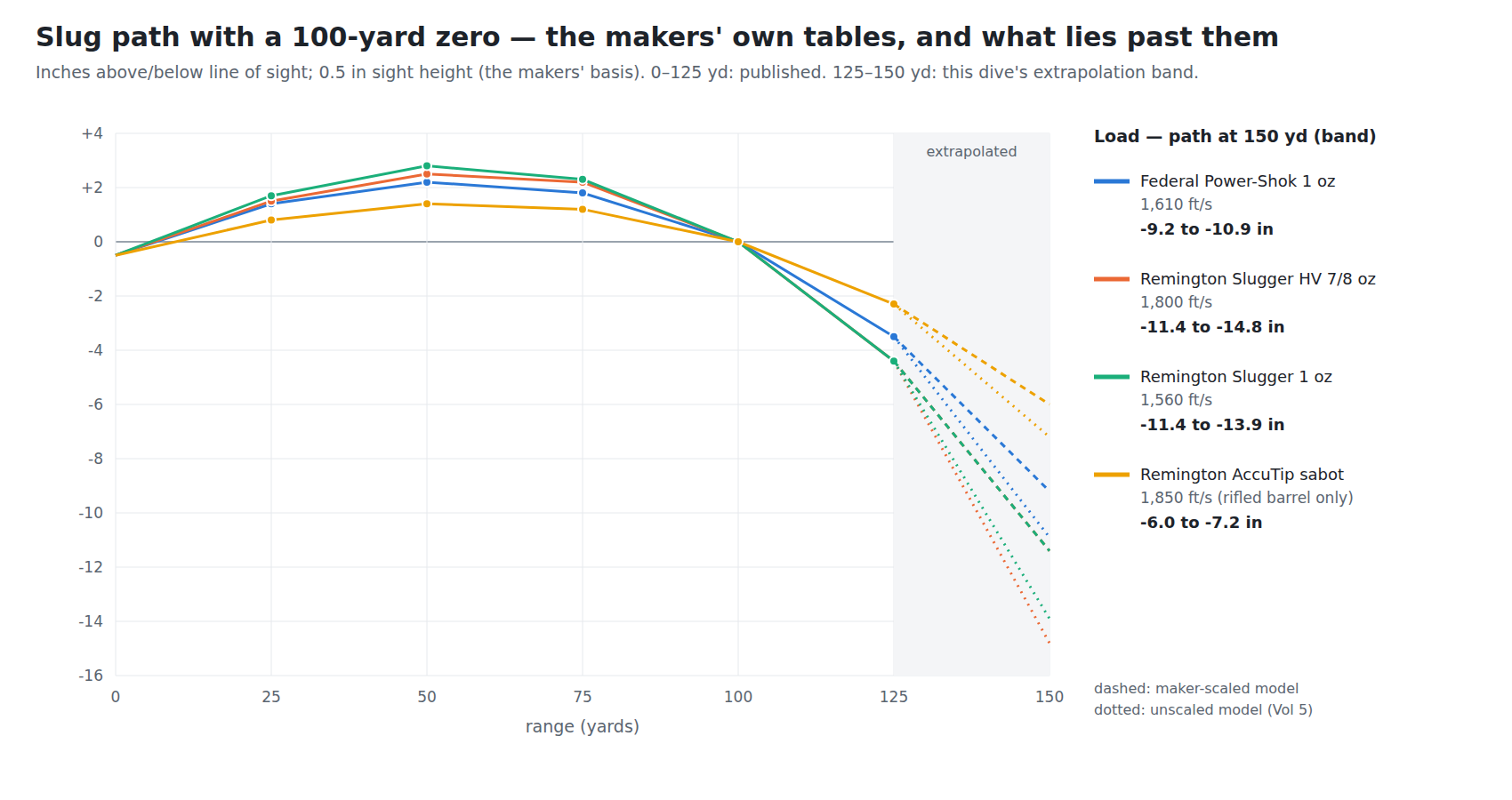
No figure for any of these loads at 150 yards is published by its maker. The numbers at 150 yards in this volume are therefore this dive’s own extrapolation, and the method is set out so it can be checked.
Method. For each load, the natural logarithm of velocity was fitted as a quadratic in range through the maker’s six published velocities. The fit reproduces the makers’ own figures to within 1.5–4.8 ft/s (14.8 ft/s for the HV, whose velocity falls fastest). Time of flight was integrated from the fitted velocity; gravity drop was computed from time of flight; the path was then referred to the line of sight for a given sight height and zero. The script is kept with the dive (04-templates/slug_ballistics.py).
⚠ The trajectory does not match the makers’, and the mismatch is systematic. Using the makers’ own stated basis — 0.5 in sight height, 100-yard zero — the model’s path is below the makers’ printed path at every published range, by a nearly constant factor: the makers’ figures are 0.77 to 0.85 times the model’s, depending on the load. Physics does not allow much latitude here; at the Power-Shok’s printed velocities the slug takes about 0.224 s to reach 100 yards, and gravity alone accounts for about 9.7 inches of drop from the bore line in that time. The makers’ tables were evidently computed by a model whose inputs — atmosphere, drag function, or velocity basis — they do not publish. This dive does not resolve the difference, and prints both:
Table 5 — ⚠ The trajectory does not match the makers', and the mismatch is systematic. Using the makers' own stated basis — 0.5 in sight height, 100-yard zero — the model's path is below the makers' printed path at every published range, by a nearly constant factor: the makers' figures are 0.77 to 0.85 times the model's, depending on the load. Physics does not allow much latitude here; at the Power-Shok's printed velocities the slug takes about 0.224 s to reach 100 yards, and gravity alone accounts for about 9.7 inches of drop from the bore line in that time. The makers' tables were evidently computed by a model whose inputs — atmosphere, drag function, or velocity basis — they do not publish. This dive does not resolve the difference, and prints both
| Load | 150 yd, maker-scaled | 150 yd, unscaled model | Velocity at 150 yd (model) | Energy at 150 yd (model) |
|---|---|---|---|---|
| Federal Power-Shok 1 oz | −9.2 in | −10.9 in | ~1,000 ft/s | ~980 ft-lb |
| Remington Slugger HV ⅞ oz | −11.4 in | −14.8 in | ~860 ft/s | ~630 ft-lb |
| Remington Slugger 1 oz | −11.4 in | −13.9 in | ~900 ft/s | ~790 ft-lb |
| Remington AccuTip sabot | −6.0 in | −7.2 in | ~1,220 ft/s | ~1,280 ft-lb |
The practical conclusion does not depend on which column is right. With a 100-yard zero, a Foster slug from this gun is about 3½ to 4½ inches low at 125 yards and something like 9 to 15 inches low at 150 — a drop large enough that a hold must be known, not estimated. The only numbers that should be trusted at 150 yards for the gun documented here are ones shot on paper from it (§5.8).
5.4 Wind, Not Drop, Is the Real Limit
Drop can be learned and held for. Wind cannot be known exactly in the field, and on the makers’ own tables it grows faster than drop does. A full-value 10-mph crosswind moves the Power-Shok 6.6 inches at 100 yards and 10.4 at 125; the HV 12.6 and 19.4.
A 5-mph misjudgement — the difference between “light breeze” and “no wind” — is half those figures: about 3 inches at 100 yards and 5 at 125 for the Power-Shok, and double that for the HV. On a deer-sized target that is the whole margin. The same conclusion was reached for the .450 Bushmaster in the hub’s .450 Bushmaster dive, whose Vol 5 §5.7 makes the case for a straight-walled rifle cartridge at similar ranges; a full-bore lead slug drifts more than that cartridge does, not less.
This, more than drop, is what makes roughly 125 yards a sensible working limit for this gun with the primary load and pushes 150 into the category of shots that need calm air and a confirmed hold. That is a judgement from the makers’ figures, not a published rule, and the owner’s own groups at distance are the better guide.
5.5 Why a 1-6×, and What It Can and Cannot Do Here
The optic fitted to the gun documented here is a Primary Arms SLX 1-6×24 second-focal-plane scope, Gen III, with an illuminated ACSS reticle (Vol 6). The general case for low-power variable optics — true 1× for both-eyes-open work, magnification for identification at distance — is made in the hub’s Types of Scopes dive, and the focal-plane distinction in its Vol 3. Neither is repeated here. What is specific to a slug gun is below.
The magnification matches the band. At 1× the optic behaves like a red dot, which suits the gun’s short-range and home-defence role and any close shot in cover. At 6× a 150-yard target appears as it would at 25 yards to the naked eye, which is ample to place a shot on a deer’s vitals and to see the hold. More magnification than 6× buys little on a load that drifts 10 inches at 125 yards in a moderate wind. Exit pupil at 6× is 24 ÷ 6 = 4 mm (arithmetic, not a maker’s figure).
⭐ The reticle is calibrated for a rifle, not for this load. Primary Arms’ own description of the Gen III 1-6× SFP describes the ACSS reticle as “designed for 5.56/5.45/.308”, with bullet drop, wind holds, moving-target leads and range estimation “very fast from 0-300 yards and very accurate from 300-800 yards”; a sister model’s ACSS was designed for .300 BLK and 7.62×39.2 No Gen III ACSS variant for 12-gauge slugs was found. The owner’s record does not say which variant is fitted. Either way, the reticle’s drop stadia are placed for a rifle cartridge’s trajectory, and a Foster slug’s is steeper. Its stadia are useful on this gun only as reference marks whose meaning has been found on paper: a note that “the second stadia is dead on at 125 with Power-Shok” is worth having; a belief that it is the “200-yard” mark is not.
And only at one power. In a second-focal-plane scope the reticle stays the same size while the image grows, so the stadia subtend what they are designed to subtend at one magnification only — Primary Arms says “BDC and ranging accurate at highest magnification setting”.2 Holds found on paper at 6× are valid at 6×. The centre chevron, the aiming point, is correct at any power; it is only the holdover marks that move.
Illumination. Primary Arms lists “Red illuminated with 11 brightness settings” and a CR2032 battery (the prose of a sister listing says 12; its feature list says 11).2
Mount height. The sight height of an optic on an AR-pattern top rail is far above the 0.5 inch the ammunition makers assume. The owner’s record describes the mount only as a “Primary Arms offset” mount, and the height of the optic above the bore on the gun documented here is not recorded (Vol 6). The zero tables below assume 2.6 inches as a stand-in and say so. The Luth-AR MBA-3 stock fitted to the gun documented here carries an adjustable cheek riser (Vol 6), which is what lets the eye meet an optic this high.
5.6 Choosing a Zero
From this dive’s model, with the stated caveats — unscaled, so the drops are if anything slightly pessimistic, and at an assumed 2.6 in sight height — the path for the primary load under three zeros is:
Table 6 — From this dive's model, with the stated caveats — unscaled, so the drops are if anything slightly pessimistic, and at an assumed 2.6 in sight height — the path for the primary load under three zeros is
| Power-Shok 1 oz, zero at | 25 yd | 50 yd | 75 yd | 100 yd | 125 yd | 150 yd |
|---|---|---|---|---|---|---|
| 50 yd | −0.7 | 0 | −0.7 | −3.1 | −7.5 | −14.4 |
| 75 yd | −0.5 | +0.4 | 0 | −2.2 | −6.4 | −13.1 |
| 100 yd | 0.0 | +1.5 | +1.6 | 0 | −3.7 | −9.8 |
And for the alternate load, for comparison:
Table 7 — And for the alternate load, for comparison
| Slugger HV ⅞ oz, zero at | 25 yd | 50 yd | 75 yd | 100 yd | 125 yd | 150 yd |
|---|---|---|---|---|---|---|
| 75 yd | −0.4 | +0.7 | 0 | −3.1 | −9.0 | −18.3 |
| 100 yd | +0.4 | +2.2 | +2.3 | 0 | −5.2 | −13.7 |
Three things follow.
- A 100-yard zero with the primary load keeps the slug within about 1½ inches of the line of sight from 25 to 100 yards, the whole of the gun’s everyday range, and leaves one hold to learn at 125 and one at 150.
- A 75-yard zero is flatter to 100 (−2.2 at 100) but costs more at 125 and 150; it suits a gun that will rarely be used past 100.
- Zeroing with one load and hunting with the other is a mistake. At 150 yards the two loads are, by the model, 3½ to 4½ inches apart on a 100-yard zero, and they drift differently in wind. The gun documented here has a primary load recorded; that is the one to zero with and carry.
5.7 Recoil, Briefly
The .450 Bushmaster dive computed free recoil for the owner’s two slug loads at a common rifle weight and found 28.3 ft-lbf for the 438-grain load and 27.3 for the 383-grain, against 18.0 for the .450 Bushmaster, and noted that a gas-operated action spreads the impulse in time (.450 Bushmaster Vol 5, §5.2). The same arithmetic applies here and is not redone; the weight of the gun documented here as configured — with an optic, a bipod and an aftermarket stock — is not recorded, and Armscor’s own published weights for the gun disagree with each other (Vol 1 §1.6). The Luth-AR soft 35-durometer pad fitted to the gun documented here is aimed squarely at this.
For the optic, the practical point is eye relief under a 28 ft-lbf impulse. Primary Arms’ archived Gen III listings that were read for this dive did not give an eye-relief figure; it should be taken from the scope’s own manual, and the optic mounted at the rear of its eye box rather than the front.
5.8 Zeroing the Gun Documented Here
A procedure fitted to this configuration, built from the points above rather than from any maker’s instruction (none exists for this combination):
- Confirm the rifled tube is fully seated and snug (Vol 4 §4.4), and confirm the gun is past its break-in (Vol 3 §3.5); a gas gun that is still short-stroking is not ready to zero.
- Pick the load and use one lot. Power-Shok, per the owner’s record.
- Set the optic to 6×, the only power at which the reticle’s marks mean what they are drawn to mean.
- Group at 25 yards from a rest, to get on paper. Expect the slug well below the chevron at this range: with a tall optic the slug is still climbing to the line of sight.
- Group at 50, then at the chosen zero — 100 yards for the reasons in §5.6 — with at least three-shot groups and a cool barrel between groups.
- Record the holds at 125 and 150 yards on paper, and note which reticle mark, if any, falls on each at 6×.
- Record the whole thing in the unit file (
00-inventory/), dated, with the load, lot, choke tube and optic setting. The zero belongs to this configuration; if the tube, the load or the mount changes, it has to be found again.
References
Footnotes
-
Federal Premium, “Power-Shok Rifled Slug, 12 Gauge, 438 Grain, 2-3/4 in, 1610 fps” (F127 RS), https://www.federalpremium.com/shotshell/hunting/big-game/power-shok-rifled-slug/11-F127+RS.html; Remington Ammunition, Slugger High Velocity (28600), https://www.remington.com/shotshell/slugger-rifled-slug/29-28600.html, Slugger 1 oz (20300), https://www.remington.com/shotshell/slugger-rifled-slug/29-20300.html, and AccuTip Sabot Slug (20727), https://www.remington.com/shotshell/accutip-sabot-slug/29-20727.html; all read 19 September 2026. All tables in §5.1 and the claim quoted in §5.2 are from these pages. ↩ ↩2
-
Primary Arms product pages as captured by the Internet Archive: “Primary Arms SLx 1-6x24mm SFP Rifle Scope Gen III ACSS 5.56 w/ Free Deluxe Scope Mount”, capture of 16 December 2021, https://web.archive.org/web/20211216180319/https://www.primaryarms.com/primary-arms-slx-1-6x24mm-sfp-rifle-scope-gen3-acss556-w-free-deluxe-scope-mount, and the Gen III ACSS 300BLK/7.62x39 listing, capture of 25 March 2022; read 19 September 2026. (primaryarms.com itself renders only with JavaScript and could not be read directly.) ↩ ↩2 ↩3
Comments (0)