Rock Island Armory VR80 · Volume 4
A Slug Through a Smooth Bore — Foster's Patent, the Rifled Choke Tube, and the Sabot Alternative
What the 1947 patent actually claims, what three inches of 1:35 rifling can do to a soft lead slug, and what nobody has measured
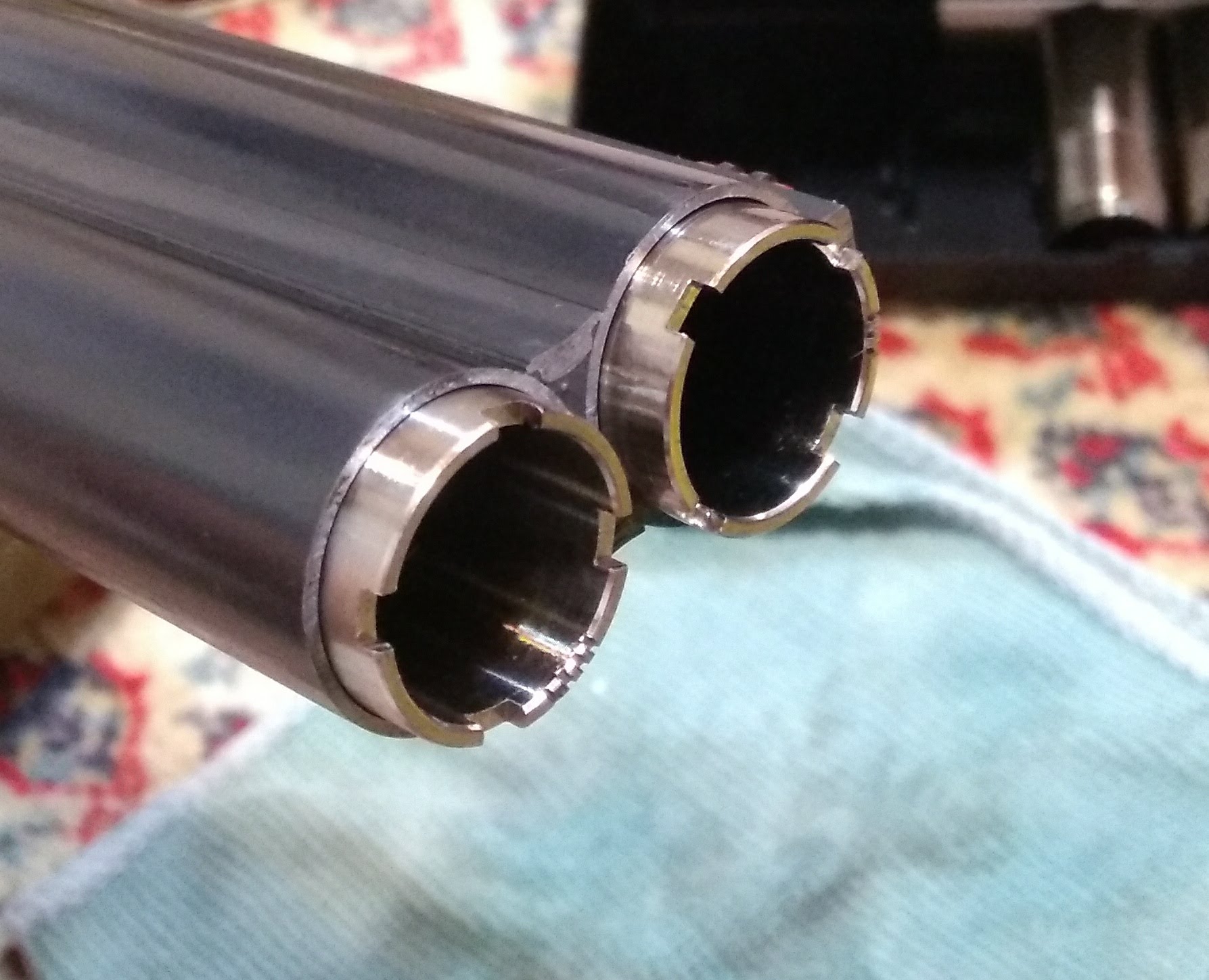
The gun documented here is a smooth-bore semi-automatic with a rifled choke tube screwed into its muzzle, loaded with full-bore lead slugs that both of their makers say are designed for smooth bores. That combination is common, cheap, and much argued over. The argument usually proceeds from half-remembered claims about how a “rifled slug” flies. This volume goes to the sources instead: the patent behind the slug, the choke maker’s own specification, the slug makers’ own statements about which barrels their loads are for, and RIA’s own rule about which of its chokes may pass a slug at all.
4.1 What the Gun Fires, and Through What
As documented in September 2026 the gun carries a Carlson’s rifled choke tube in the Beretta/Benelli Mobil thread and is recorded with two factory slug loads (Vol 6):
Table 1 — As documented in September 2026 the gun carries a Carlson's rifled choke tube in the Beretta/Benelli Mobil thread and is recorded with two factory slug loads (Vol 6)
| Primary load | Alternate load | |
|---|---|---|
| Load | Federal Power-Shok Rifled Slug, F127 RS | Remington Slugger High Velocity Rifled Slug, 28600 |
| Slug | 1 oz (438 gr) hollow-point lead | ⅞ oz (383 gr) lead |
| Muzzle velocity | 1,610 ft/s | 1,800 ft/s |
| Maker says it is for | ”Designed for use in smoothbore barrels" | "Designed for the avid deer hunter using smooth bore guns” |
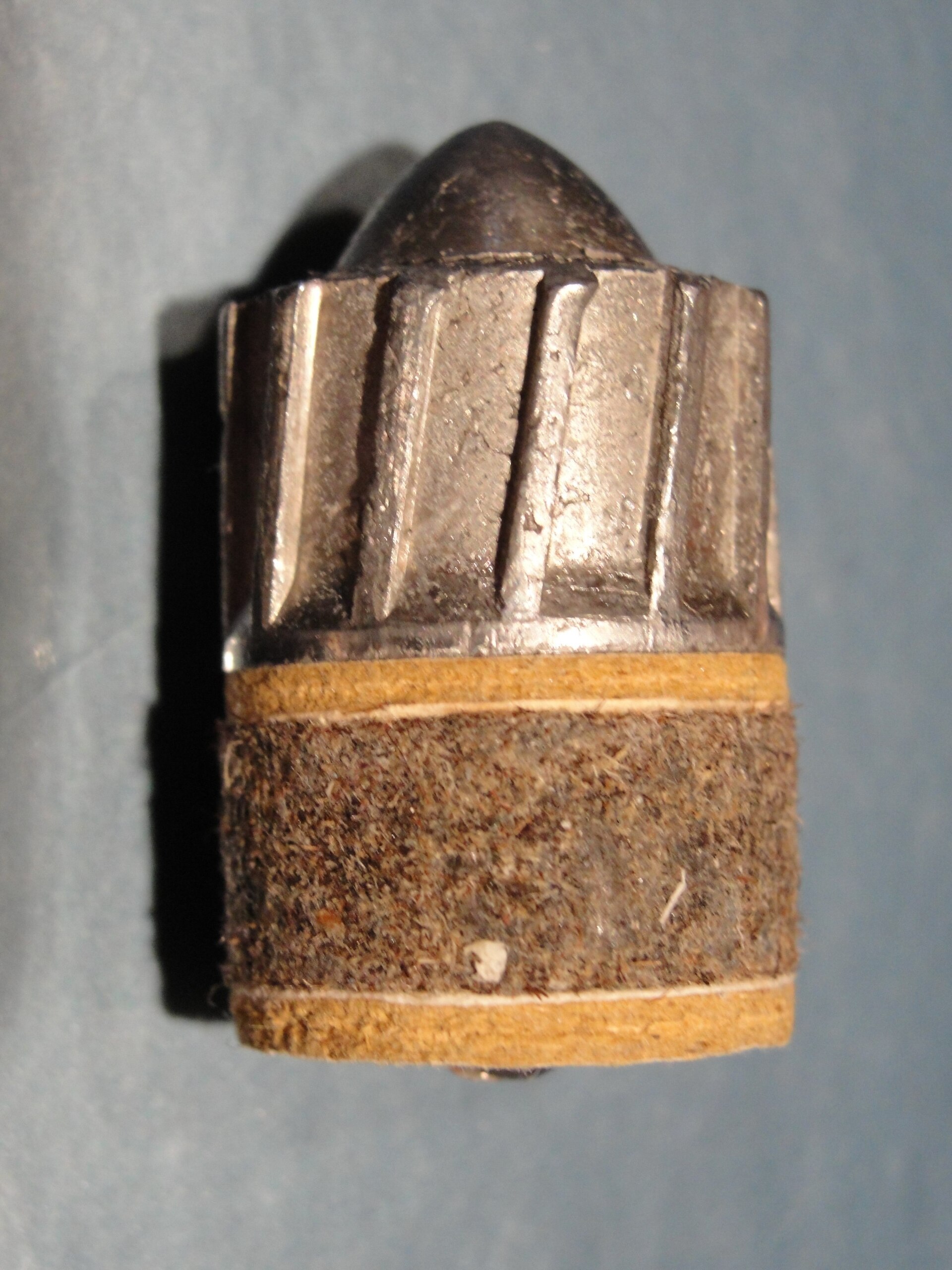
Both are full-bore ribbed lead slugs for smooth bores. Remington’s page calls its load a “high-velocity Foster-style lead slug”; Federal lists its bullet style as “Rifled Hollow Point” and does not use the Foster name.1 Federal publishes the weight both ways on the same page, “438 Grain” in the product name and “Shot Weight 1 oz” in the specifications; 1 oz is 437.5 gr, so the two agree. Remington’s ⅞ oz is 382.8 gr.1
The word “rifled” in both product names does not mean the slug is for a rifled barrel. Remington’s own 1 oz Slugger page states it outright: “RIFILING - For use in smooth bore shotguns only”.1 A “rifled slug” is a slug with ribs on it, for a smooth bore.
4.1.1 RIA’s rule on its own chokes
The VR80 ships with three screw-in tubes, and the manual’s choke table is short and specific:2
Table 2 — RIA's rule on its own chokes
| Marking | Choke | RIA’s note |
|---|---|---|
| ✱ | Full | ”Suitable for longer ranges (DON’T USE SLUGS!)” |
| ✱✱✱ | Modified | ”Suitable for medium ranges (DON’T USE SLUGS!)” |
| ✱✱✱✱✱ | Cylinder | ”Suitable for short ranges” |
The manual’s specification table calls the third tube Improved Cylinder, and its choke table calls it Cylinder; the five-star marking is the same. Either way, of the three factory tubes, only the most open one is cleared for slugs. The rifled tube documented here is a fourth option that RIA’s manual does not mention.
4.2 Foster’s Patent — What It Actually Claims
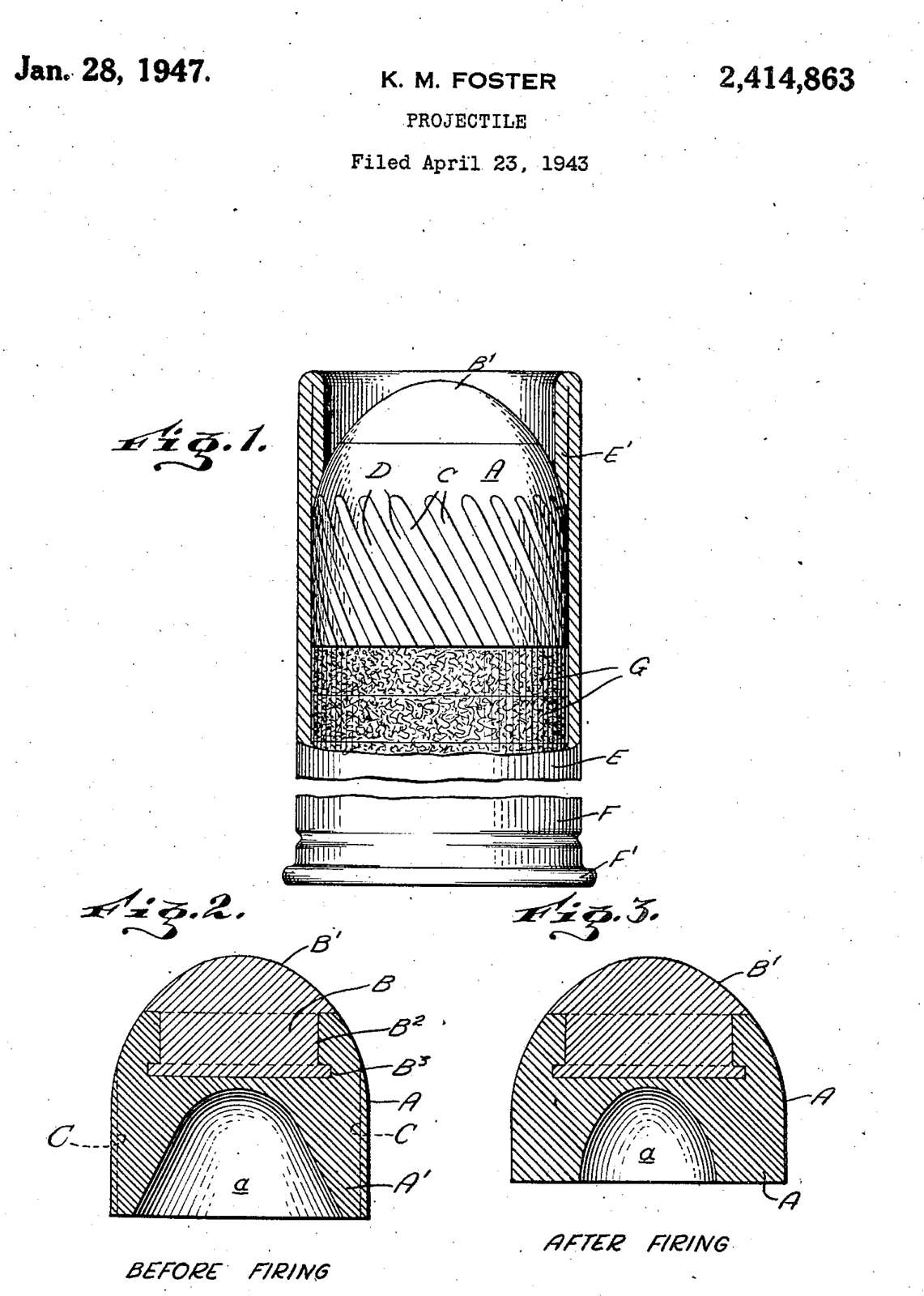
The Foster slug’s standard history credits Karl M. Foster with inventing it in 1931 and patenting it in 1947 under US Patent 2,414,863.3 The patent exists, and it is worth reading, because it does not say what the standard history implies.4
Bibliographic facts, from the patent’s own face: “2,414,863 · PROJECTILE · Karl M. Foster, Great Barrington, Mass., assignor of one-half to Frederick A. Pearson, Great Barrington, Mass. · Application April 23, 1943 … Patented Jan. 28, 1947.” One claim. ⚠ The year 1931 appears nowhere in the patent; its filing date is 1943. The 1931 invention date may be correct, but it rests on a secondary account, not on this document.
What it is for. The opening sentence reads: “a projectile of the type adapted for use in a smooth bore firearm and formed with rifling surface grooves, which produce a pattern of helical ribs, which by their frictional engagement with the barrel of the firearm and the cartridge shell from which the projectile is discharged, give the projectile a rotary movement about its own axis. The invention relates particularly to a projectile adapted for use in an ordinary shotgun employed for deer hunting and analogous purposes, and having either a cylindrical or a choked bore.”
⭐ What it claims is a composite projectile. The body is “of lead or some other soft, heavy metal”, and the nose is a separate core “of a material which is harder and of lower specific gravity … Advantageously … aluminum”, with a shank “embedded in and rigidly connected to” the lead. The stated objects are a lighter projectile — “not more than eighty percent of the weight” of an all-lead one of the same outline — for higher velocity and a flatter trajectory, and a hard nose “less apt to shatter”. The single claim requires the core, with “a specific gravity less than one-third that of said metal”.
The all-lead hollow-base slug that is sold today as a “Foster slug” is therefore not what the patent claims. It shares the patent’s hollow base, its helical ribs and its purpose, but not its defining element. Citing US 2,414,863 as “the Foster slug patent” without that qualification is the kind of shorthand that turns into a myth.
How Foster said it flew. Two passages bear directly on the rifled-choke question.
On stability, the patent relies on where the weight is, not on spin: the parts are “so relatively proportioned that the center of gravity of the projectile, when in the form shown in Fig. 3 [after firing], is approximately midway between the front end of the projectile nose and the plane of the projectile rear end. With the projectile … having its center of gravity located as described, the projectile has excellent ballistic properties and practically no tendency to turn end for end.” The deep base cavity is what puts the centre of gravity forward of where a solid cylinder of the same length would have it.
On spin, the patent says the ribs do impart rotation, and says something surprising about where: firing pressure “so enlarges the projectile as to insure a contact pressure and friction between the projectile ribs D and the surrounding cartridge and gun barrel surfaces which will give the projectile its desired rotary movement”, with the ribs pressed so hard that the grooves between them are “practically obliterate[d]”. And: “Test observations indicate that a significant portion of the rotative movement imparted to the projectile is given the latter while it is still in contact with the paper cartridge shell.”
Both popular versions of the “rifled slug” story are therefore wrong by the inventor’s own account. The ribs are not decorative — Foster designed them to turn the projectile and observed that they did. But they are not rifling either: they are flattened against the bore, much of the turning happens before the slug leaves the hull, and the patent gives no spin rate at all. The figure of 750 rpm that circulates in secondary sources was not traced to any primary source for this dive and is not repeated here as a fact.
4.3 Two Ways to Keep a Slug Point-First
A projectile flies point-first for one of two reasons, and every combination of slug and barrel in this volume is one or the other.
Drag stability. If the centre of pressure — roughly, where the air’s resistance acts along the projectile — lies behind the centre of mass, any yaw produces a restoring moment, as in a shuttlecock or an arrow. A hollow-base slug is built this way: the mass is forward, the hollow skirt is behind. Foster’s patent puts it in its own terms, attributing the projectile’s steadiness to where its centre of gravity lies after firing. Such a projectile does not need spin to be stable. Spin, if it has some, averages out asymmetries in its shape or density — a slightly off-centre cavity, a lopsided nose — so that they do not steer it consistently to one side.
Gyroscopic stability. If the centre of pressure lies ahead of the centre of mass, as it does on an ordinary pointed bullet, the projectile is statically unstable and will tumble unless it spins fast enough to hold its axis. That is the sabot slug’s situation: a sub-calibre, bullet-shaped slug in a plastic carrier that engages rifling. Remington’s AccuTip sabot says so on its own page: “SABOT SLUG - Designed for rifled barrels only”.1
The practical rule falls out: a full-bore Foster or Brenneke slug is for a smooth bore and does not need a rifled one; a sabot slug needs a rifled bore and should not be fired without one. Both slug makers print that rule on their own boxes. What a rifled choke tube does sits between the two, and is the subject of the rest of the volume.
4.4 The Tube Fitted to the Gun Documented Here
The owner’s record names a Carlson’s rifled choke tube, 12 gauge, Beretta/Benelli Mobil thread, and links Carlson’s own product page. That page gives:5
Table 3 — The Tube Fitted to the Gun Documented Here
| Maker | Carlson’s Choke Tubes, Atwood, Kansas |
| Item | 40050, “Beretta Benelli Mobil Rifled Choke Tubes” |
| Material | ”304 high stress stainless steel”, matte black |
| Twist | ”right hand rifle twist, which is 1 to 35” |
| Groove diameter | ”.730 of an inch in 12 ga” |
| Protrusion | ”.625 to 1.3 inches from the end of the barrel depending upon which type of firearm” |
| Price | $88.50, “Out of stock”, 19 September 2026 |
| Maker’s claim | ”If you’re looking for improved accuracy from a smooth bore barrel these fine choke tubes will improve your groups.” |
⚠ The owner’s record carries two different part numbers and a different diameter. Its choke entry reads “0.72 Inch Dia … 120050”; its own note on the same sheet reads “40050 - Beretta Benelli Mobil Rifled Choke Tube ($80.95) from Optics Planet”. Carlson’s page lists only item 40050 and a .730 in groove diameter; neither “120050” nor “.72” appears on it. The likeliest explanation is a retailer’s listing code and a rounded figure, but that could not be confirmed, and this dive uses Carlson’s own figures.
Why the thread matters. The VR80 manual never names its choke thread; it calls the tube a “Mobile Choke”.2 Two independent sources place the VR80 in the Beretta/Benelli Mobil family: Carlson’s interchange guide, which lists Armscor’s P12 and PAS12 and the .410 Rock Island Armory shotgun as taking “Carlson’s Beretta/Benelli Mobil style threads” (the owner’s record quotes that wording for the VR80), and Tooth and Nail Armory, whose VR80 packages shipped “3 Chokes (Beretta/Benelli Mobil)”.56 ⚠ Carlson’s static guide text does not name the 12-gauge VR80 itself. The rifled tube fitted to the gun documented here is the practical confirmation.
Fitting it. RIA’s instructions for any tube: “The threads of the choke tube and the internal threads of the barrel should be cleaned after each use and before installation of the tube. To install a tube, insert the tube into the barrel and tighten with your fingers. Once the tube is finger-tightened, tighten with the appropriate choke-tube wrench until the tube in snug. DO NOT over tighten or forcefully tighten with wrench.”2 The VR60 manual adds the warnings RIA dropped from the VR80’s: never fire “if the screw-in choke is not fully and tightly bottomed to the barrel threads, improperly installed or ‘cross-threaded’”, and never fire without a choke in place, which “will … damage the choke threads in the barrel”.2 Neither RIA nor Carlson gives a re-check interval; checking the tube for tightness between strings costs nothing.
4.5 What Three Inches of Rifling Can Do
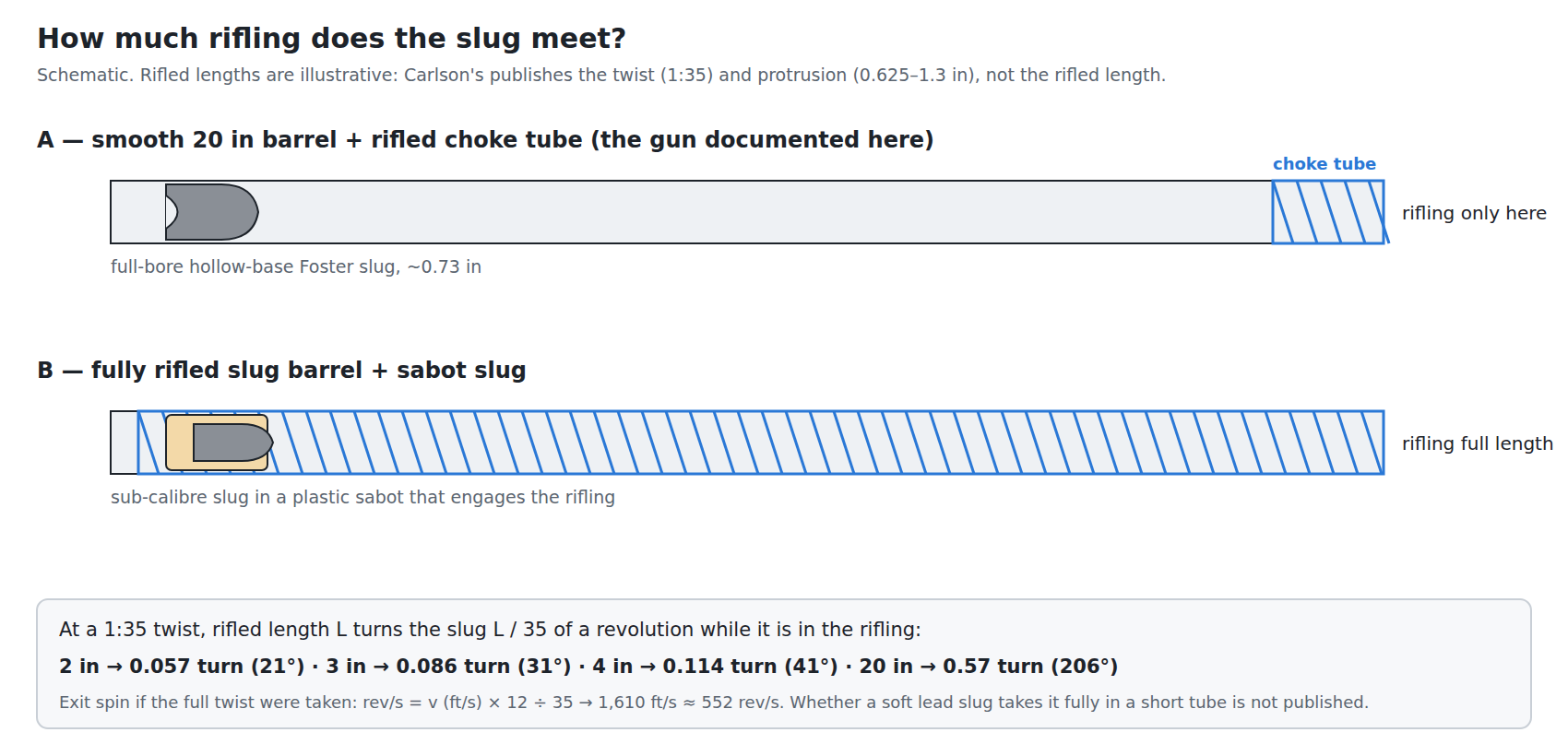
Carlson publishes the twist and the protrusion but not the length of the rifled section, so the arithmetic below is given as a function of it. The figures are this dive’s own.
The angle of engagement is small. A 1:35 twist turns a projectile through one revolution per 35 inches of travel. In a rifled section of length L inches, a slug that follows the rifling perfectly turns L/35 of a revolution while inside it: 2 in → 21°, 3 in → 31°, 4 in → 41°. A fully rifled 20-inch barrel of the same twist would turn it through more than half a revolution.
The spin rate is not small — if it is taken. Spin rate at the muzzle depends on the twist and the velocity, not on the length of rifling: revolutions per second = velocity (ft/s) × 12 ÷ twist (in). At 1:35 and 1,610 ft/s that is 552 rev/s, about 33,000 rpm; at 1,800 ft/s, 617 rev/s. A short tube could in principle deliver the full rate, because what sets it is the helix angle at the exit.
Whether it is taken is the unknown. To leave at the tube’s twist rate, the slug has to be accelerated in rotation from whatever the hull and bore gave it to 550 revolutions per second within a few inches, entirely through soft lead engraving on the tube’s lands. Carlson gives the groove diameter (.730 in) but not the land diameter, so the depth of engagement is unknown. A hollow-base slug upsets under pressure — the patent’s own Figure 3 — which favours engagement; soft lead stripping across the lands, rather than following them, works against it. No published measurement of the spin a Foster slug actually leaves a rifled choke tube with was found.
And what spin would do for it. The slug is already drag-stable (§4.3). Spin cannot make it more stable in the gyroscopic sense that a sabot needs; what it can do is average out its manufacturing asymmetries, which is exactly the job Foster assigned to his ribs. The case for a rifled tube is therefore a case about consistency — group size — rather than about stability, and it rises or falls on whether the tube adds meaningful spin to what the ribs and hull already gave.
What the tube does not do. It is not sold as a constricting choke. Carlson’s own table lists its constriction as “Rifled” with no diameter given, and the maker markets it for slugs, where RIA’s Full and Modified tubes — which exist to constrict — are barred from them.
4.6 What Has and Has Not Been Measured
The honest state of the evidence, as far as the sources read for this dive go:
Table 4 — The honest state of the evidence, as far as the sources read for this dive go
| Claim | Status |
|---|---|
| A Foster slug is designed for a smooth bore | ✅ both slug makers say so; Foster’s patent says so |
| The ribs impart some rotation | ✅ Foster’s patent, from his own test observations |
| A Foster slug flies point-first because of weight distribution, not spin | ✅ Foster’s patent (centre of gravity) |
| A rifled choke tube improves Foster-slug groups | ⚠ Carlson’s claim only; no test data published |
| A rifled choke is “nearly as accurate as” a rifled barrel | ❌ not supported by any primary source located |
| A sabot slug is stable from a rifled choke tube | ❌ neither maker says so; Remington says “rifled barrels only” |
| The spin a Foster slug leaves a rifled tube with | ❌ unmeasured in any source located |
⚠ Sabots through the rifled tube. Carlson’s rifled-tube page does not forbid sabot slugs, and Remington’s sabot page does not mention rifled choke tubes; each says only what it says. Firing a sabot slug through a short rifled tube asks a gyroscopically stabilised projectile to acquire all of its spin in a few inches of its travel. Nothing read for this dive supports doing it, and the configuration documented here does not.
This is the gap an owner with a chronograph and a bench can fill better than any source this dive located. The measurement that would settle the question for this gun:
4.7 The Rifled Barrel and the Sabot — the Road Not Taken
The alternative to a rifled tube is a fully rifled barrel and a sabot slug, and the makers’ own tables show what it buys (Vol 5 §5.1): Remington’s AccuTip sabot, BC .145 by Remington’s figure, keeps 1,401 ft/s at 100 yards against the Power-Shok’s 1,139 and drops 2.3 inches at 125 yards on a 100-yard zero against 3.5.1 It also costs $28.99 for five against $9.99 (makers’ own prices, 19 September 2026).
For the VR80 the question is academic in one respect: Armscor’s current VR80 listings show only 20-inch smooth-bore barrels with screw-in chokes, and no rifled VR80 barrel appeared in the parts subsidiary’s VR80 catalogue on 19 September 2026.7 A sabot shooter would need a different gun. The rifled tube is the only route to any rifling on a VR80, and the Foster slug is the load that route is built around.
References
Footnotes
-
Federal Premium, “Power-Shok Rifled Slug, 12 Gauge, 438 Grain, 2-3/4 in, 1610 fps” (F127 RS), https://www.federalpremium.com/shotshell/hunting/big-game/power-shok-rifled-slug/11-F127+RS.html; Remington Ammunition, “Slugger High Velocity Rifled Slug, 12 Gauge, 383 Grain, 2-3/4 in, 1800 fps” (28600), https://www.remington.com/shotshell/slugger-rifled-slug/29-28600.html, “Slugger Rifled Slug, 12 Gauge, 438 Grain, 2-3/4 in, 1560 fps” (20300), https://www.remington.com/shotshell/slugger-rifled-slug/29-20300.html, and “AccuTip Sabot Slug, 12 Gauge, 385 Grain, 2-3/4 in, 1850 fps” (20727), https://www.remington.com/shotshell/accutip-sabot-slug/29-20727.html; all read 19 September 2026. ↩ ↩2 ↩3 ↩4 ↩5
-
Armscor / Rock Island Armory, Users Manual VR80 Mag Fed Shotgun, 04/2020, p. 10, “Usage of Choke Tubes”, https://www.armscor.com/hubfs/RIA%20VR80%2004-2020.pdf; VR60 manual (2016), “Choke Set” and “Screw-in Choke Warning”, via https://www.armscor.com/resources/manuals/; both read 19 September 2026. ↩ ↩2 ↩3 ↩4
-
Wikipedia, “Shotgun slug”, read 19 September 2026 via the MediaWiki API. Used here only as the statement of the standard history that the patent is then checked against. ↩
-
K. M. Foster, “Projectile”, US Patent 2,414,863, filed 23 April 1943, granted 28 January 1947; image PDF from the USPTO, https://image-ppubs.uspto.gov/dirsearch-public/print/downloadPdf/2414863, read 19 September 2026. Quotations were transcribed from the page images. ↩
-
Carlson’s Choke Tubes, “Beretta Benelli Mobil Rifled Choke Tubes”, https://www.choketube.com/product/beretta-benelli-mobil-rifled-choke-tubes/, and “Choke Tube Interchange Guide”, https://www.choketube.com/choke-tube-interchange-guide/, both read 19 September 2026. ↩ ↩2
-
Tooth and Nail Armory, “Rock Island VR80 MAX” and “Rock Island VR80 Race” product pages, Internet Archive captures of 28 July 2021 and 27 September 2021, read 19 September 2026. ↩
-
Armscor, semi-automatic shotgun listing, https://www.armscor.com/semi-auto, and Advanced Tactical VR80 parts listing, https://advancedtactical.com/parts/shotgun-parts/vr-series-shotgun-parts/vr80-parts/, both read 19 September 2026. ↩
Comments (0)