Rock Island Armory VR80 · Volume 3
How It Works, and How to Keep It Working — Gas System, Break-In, Field Strip, Maintenance and Repair
A ring piston on the barrel, two interchangeable pistons, a load floor in writing, and a manual that stops at step twelve
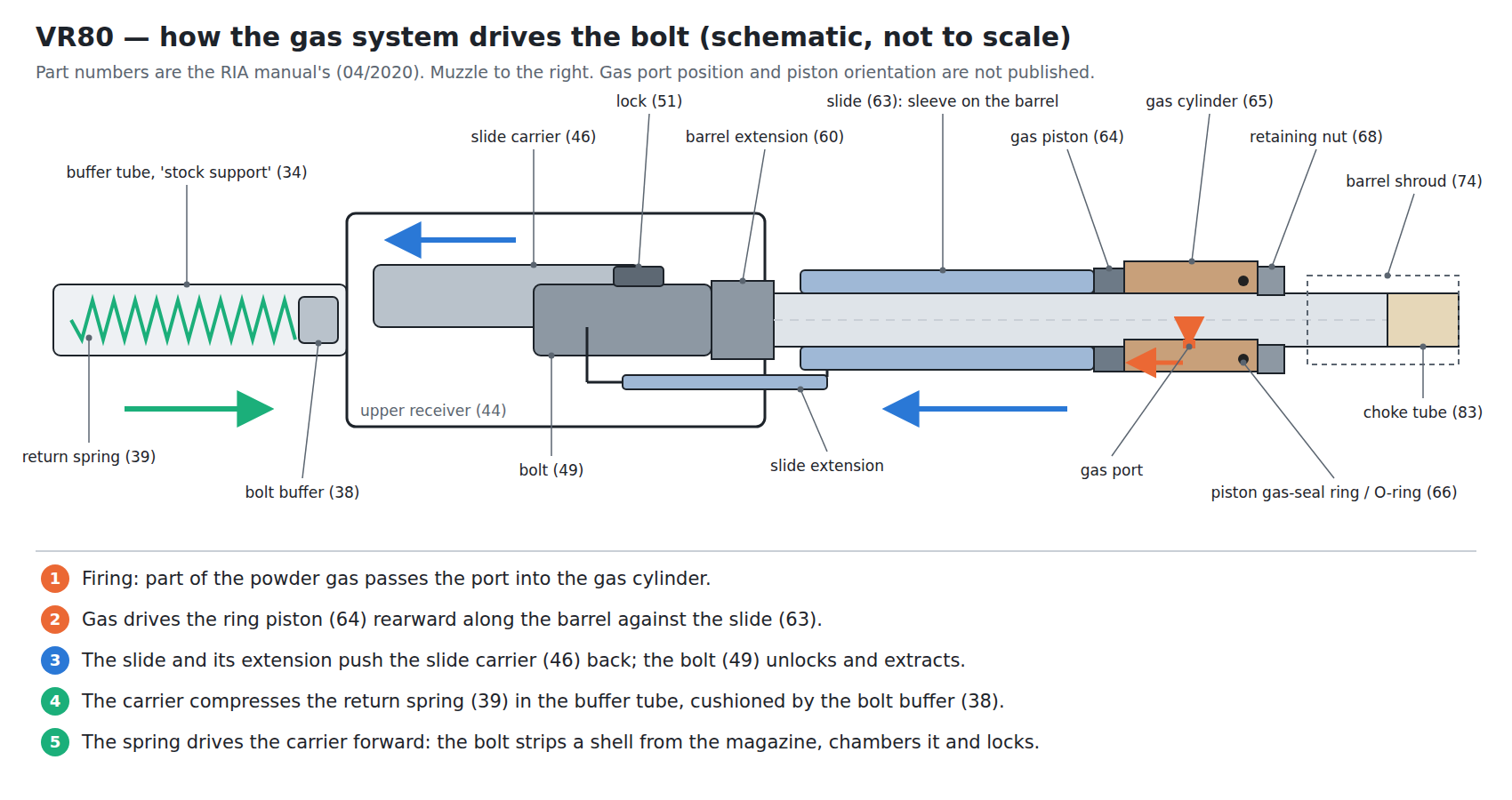
A gas-operated shotgun is simple in principle and particular in practice. It borrows a little of each shell’s gas to work the action, and whether it works depends on getting that little right: enough to drive the bolt fully to the rear and pick up the next shell, not so much that the action slams. The VR80 handles the range with two interchangeable pistons, a stated minimum load, and a break-in period. This volume describes the mechanism part by part, then sets out what the maker says about keeping it running — which is less than an owner will want — and what can reasonably be done about the gaps.
Every procedural statement below is attributed. Where RIA’s documentation is silent, the silence is recorded and nothing is supplied from memory; the hub has shipped invented disassembly sequences before, and a sequence the maker never published is a guess however confident it sounds.
3.1 The Sources, and What They Cover
Three documents from the maker exist, all linked from Armscor’s own manuals index:1
Table 1 — The Sources, and What They Cover
| Document | Date | What it contains |
|---|---|---|
| VR80 manual (“Users Manual VR80 Mag Fed Shotgun”) | 04/2020 | load and break-in advice (front page), specifications (the VR60’s — Vol 1 §1.6), parts list of 99 items, exploded view, a 12-step disassembly with photographs, the piston choice, choke use, warranty |
| VR80 manual, earlier edition | May 2018 | the same, without the load and break-in page |
| VR60 manual | September 2016 | a different gun, but the only cleaning procedure published for any VR-series shotgun |
Two further primary sources fill in details: Armscor’s own parts subsidiary, Advanced Tactical, whose VR80 catalogue names and prices nearly every part (and which, for gas-system parts, uses slightly different names from the manual), and the product pages of aftermarket makers. Neither is a service manual. No armorer’s manual, no detail-strip instructions, no lubrication chart and no torque table for the VR80 was located.
3.2 The Parts That Make It Run
The manual’s parts list numbers the mechanism in a way that follows the gun from the stock forward. The operating parts, with the manual’s names and — where it adds something — the parts store’s:12
Table 2 — The Parts That Make It Run
| Group | No. | Manual name | Parts-store name, and notes |
|---|---|---|---|
| Recoil system | 34 | Stock Support | ”VR80 - Buffer Tube” — steel, held by a “Buffer Castle Nut” |
| 38 | Bolt Buffer | ”VR60 / VR80 / VRBP100 - Bolt Buffer” | |
| 39 | Bolt Return Spring | ”VR80 - Main Return Spring” | |
| 40 | Lock Ring | — | |
| Bolt group | 46 | Slide Carrier | ”VR80 - Slide Carrier”; also sold as an assembly with the charging-handle retainer spring and 5 mm ball (parts 47–48) |
| 49 | Bolt | ”VR80 - Bolt Body” | |
| 50 | Buffer Bolt System | the “BufferBolt” feature credited to Derya’s patent (Vol 1) | |
| 51 | Lock | ”VR60 / VR80 / VRBP100 / Lion - Lock” — shared with Derya’s other semi-automatics | |
| 52–54 | Firing pin return spring, firing pin, retaining pin | shared with the VR60, VRBP100, Lion and Meriva | |
| 55–58 | Extractor, springs, pins | ”Extractor/Latch”, plungers | |
| 59 | Cocking Handle | the DAXOS handle (Vol 2) | |
| Barrel | 60 | Barrel with Barrel Extension | held to the upper by two M8 screws, parts 61–62 — “M8 x 1.25 x 16mm” (long) and “x 10mm” (short) in the parts store |
| Gas system | 63 | Slide with Slide Extension | the operating sleeve on the barrel and its rearward arm |
| 64 | Gas Piston | sold as “Gas Piston, Light” and “Gas Piston, Heavy” | |
| 65 | Gas Block | ”VR80 - Gas Cylinder”, “made of steel and is heat treated” | |
| 66 | Gas Block O-Ring | ”VR80 Piston Gas Seal Ring / O-Ring” | |
| 67 | Gas Block screw | ”Gas Cylinder Retainer”, sold in pairs | |
| 68 | Gas System Retaining Nut | ”VR80 - Gas System Retainer Nut” | |
| Front end | 69–73 | Fore End, Handguard and hardware | — |
| 74 | Barrel Shroud | screws onto threads at the front of the barrel and holds the handguard back against the receiver (§3.3) | |
| 83 | Mobile Choke | Vol 4 |
The table is the most complete statement of the VR80’s architecture that the maker publishes. It is also where the gun’s lineage shows: several bolt parts are listed by the parts store as common to the VR60, the VRBP100 bullpup and Derya’s Lion and Meriva shotguns.
3.3 How the Cycle Works
The manual describes none of this in words. The sequence below is read from the exploded view, the disassembly photographs and the parts list, and each step says which it rests on.
The gas system sits on the barrel. The disassembly photographs show the gas cylinder, piston and slide coming off the barrel forward as one group once the retaining nut and split rings are removed (steps 7–9), and the barrel then withdrawn forward out of the upper (step 12). There is no separate tube under the barrel as on the VR60 (Vol 2 §2.2). A maker of a VR80 muzzle brake independently describes the front end the same way: the barrel carries threads at the front, and the factory barrel shroud screws onto them and holds the handguard back against the receiver; with the brake fitted instead, “opposing split rings … push the hand guard up against the receiver”.3
Firing. Part of the powder gas behind the shell’s payload passes through a port in the barrel wall into the gas cylinder (65), which is clamped round the barrel and sealed by its O-ring (66). ⚠ The port’s position along the barrel and its diameter are not published.
The piston stroke. The gas drives the gas piston (64) — a ring that slides on the barrel, as the manual’s photograph of the two pistons shows (§3.4) — rearward against the slide (63). The slide is a sleeve on the barrel with an extension that reaches back into the upper receiver.
Unlocking and extraction. The slide extension drives the slide carrier (46) rearward. The carrier carries the bolt (49) and a separate locking piece, the manual’s “Lock” (51). ⚠ How the lock disengages — whether it tilts, cams or rotates out of engagement with the barrel extension — is not described or drawn in motion in any source read for this dive. The exploded view places it on the bolt; the parts store shows it is common to several Derya designs. Nothing more is claimed. The extractor draws the empty hull out of the chamber and it is thrown clear through the ejection port.
Recoil and return. The carrier travels back into the buffer tube behind the lower receiver, compressing the return spring (39) against the lock ring (40), with the bolt buffer (38) cushioning the end of travel. This is the AR-15’s architecture — spring and buffer in a tube behind the receiver — applied to a shotgun, and it is why the aftermarket can offer a hydraulic buffer for the VR80 as “a drop-in replacement for the standard buffer”.2 The spring then drives the carrier forward; the bolt strips the next shell from the magazine, chambers it, and locks.
Last round. The bolt catch (22) holds the action open on an empty magazine; a bolt-release lever lets it forward. The manual does not describe the hold-open, but it lists the bolt catch, its spring and pin, and the parts store sells an extended bolt-release lever for the VR80.2
3.4 Two Pistons, and the Load Floor
The VR80’s gas adjustment is not a dial or a valve. It is a part swap. The manual’s maintenance page shows two ring pistons, marked on their rims, and captions them:1
Light Loads Piston: 2¾” Shotshells · Heavy Loads Piston: 3” Shotshells (Magnum)
Both are sold separately by the parts store as “Gas Piston, Light” and “Gas Piston, Heavy” at $21.05 each (both out of stock on 19 September 2026).2 The manual assigns them by shell length, not by the power of the load. It says nothing about which piston a given gun leaves the factory with, how to tell them apart once fitted beyond the rim marking, or whether a heavy 2¾-inch load belongs on the heavy piston. ⚠ Which piston is fitted to the gun documented here is not recorded (Vol 6).
The 04/2020 manual opens, before its table of contents, with a boxed “RIA Recommendation For Semi Auto Shotgun Break In Procedures”. It is the most useful page in the document and is quoted in full:1
- Quality shotshells only
- Minimum 2 3/4”, 3 dram shotshell to be used
- Minimum velocity 1250 fps
- Minimum 1 1/8 oz of shot
- Expect some malfunctions in first 25-50 rounds
- Minimum of 250 rounds before trying lighter load
- Avoid light recoil or reduced recoil loads
- Due to variation in ammo and firearms some gun may work with lighter loads and some may not
- Please complete break in period of 100 rounds with recommended loads before sending warranty claim for cycling issues
- YouTube has several videos on customization for lighter loads however custom work may void warranty
The floor is written for shot loads — dram equivalent, ounces of shot. It does not say how a slug load compares. A defensible way to compare is by what the gas system is ultimately asked to move, which scales with the mass of the payload and its velocity. As an index only — this dive’s own, not RIA’s — the product of payload weight in grains and muzzle velocity:
Table 3 — The floor is written for shot loads — dram equivalent, ounces of shot. It does not say how a slug load compares. A defensible way to compare is by what the gas system is ultimately asked to move, which scales with the mass of the payload and its velocity. As an index only — this dive's own, not RIA's — the product of payload weight in grains and muzzle velocity
| Load | Payload | Velocity | Index (gr × ft/s) | Against the floor |
|---|---|---|---|---|
| RIA’s stated floor | 1⅛ oz shot (492 gr) | 1,250 ft/s | 615,000 | — |
| Federal Power-Shok rifled slug | 1 oz (437.5 gr) | 1,610 ft/s | 704,000 | above |
| Remington Slugger High Velocity | ⅞ oz (383 gr) | 1,800 ft/s | 689,000 | above |
| Remington Slugger 1 oz | 1 oz (437.5 gr) | 1,560 ft/s | 682,000 | above |
| Remington Managed-Recoil Slugger | 1 oz (437.5 gr) | 1,200 ft/s | 525,000 | below |
Velocities are the makers’ published figures, read 19 September 2026 (Vol 5).4 ⚠ The index ignores powder charge and pressure curve, both of which affect port pressure; it is a rough ordering, not a prediction. It agrees with the manual’s plain words in the one case that matters: a managed-recoil slug is exactly the “reduced recoil load” RIA says to avoid, and at 1,200 ft/s it is below RIA’s stated minimum velocity on its own terms. Both of the loads recorded for the gun documented here clear the floor with room.
3.5 Break-In: Four Numbers in One Document
The 04/2020 manual gives an owner four different round counts for breaking the gun in:1
Table 4 — Break-In: Four Numbers in One Document
| Where | What it says |
|---|---|
| front page | ”Expect some malfunctions in first 25-50 rounds” |
| front page | ”Please complete break in period of 100 rounds with recommended loads before sending warranty claim for cycling issues” |
| front page | ”Minimum of 250 rounds before trying lighter load” |
| warranty page | ”DUE TO THE FIT AND TIGHTNESS OF FIREARM, RIA RECOMMENDS A BREAK-IN PERIOD OF 500 ROUNDS.” |
The 2018 edition has only the last one; the front page was added later.1 Read together they are not strictly contradictory — they are thresholds for different things — but they are not presented as a sequence, and an owner reading only one page gets only one of them. A consistent reading, in the manual’s own terms:
- Up to 50 rounds, malfunctions are expected and are not evidence of a fault.
- At 100 rounds of loads above the floor, RIA will entertain a warranty claim for cycling.
- Not before 250 rounds should lighter loads be tried at all.
- RIA’s own recommendation for the full break-in is 500 rounds.
For a slug gun, those numbers carry a cost worth stating plainly. At the $9.99-per-five box price Federal showed for Power-Shok on 19 September 2026, 500 rounds of the owner’s primary slug is about $1,000. RIA’s recommendation is written for “shotshells” — target and field loads — and full-power birdshot above the floor is the economical way to run the break-in; nothing in the manual requires it to be done with slugs.
⚠ Tooth and Nail Armory, a specialist VR80 shop, advertised in 2021 that its reworked guns needed no break-in and ran “1200 fps 1-1/8oz target loads” — below RIA’s velocity floor — after “reliability work” whose content it did not publish.5 That is one shop’s claim for its own modified guns, not evidence about a factory VR80, and the work would void the factory warranty.
3.6 Field Strip: the Manual’s Twelve Steps
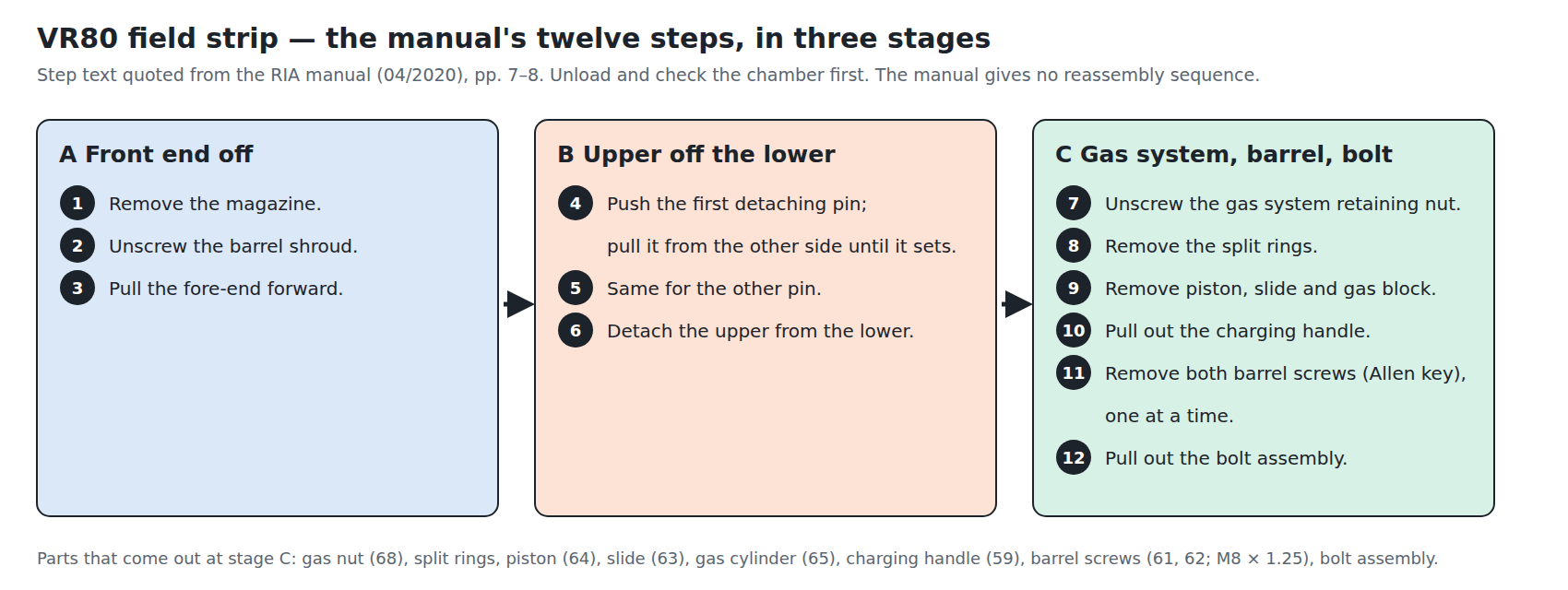
The sequence is quoted from the manual, pages 7–8, with its photographs described where they add something the text leaves out. Clear the gun first: the manual’s general warning is to do all disassembly “only when the firearm is unloaded” and to “check ejection port, loading port and chamber visually”.1
Stage A — front end.
- “Remove the magazine.”
- “Unscrew the barrel shroud by turning in arrow direction.” The photograph shows the long fluted shroud unscrewed at the muzzle end with the gun held vertically.
- “Pull the foreend in arrow direction.” Forward, off the barrel.
Stage B — upper from lower.
- “Push the detaching pin and pull from the other side until it sets.”
- “Push the other detaching pin and pull from the other side until it sets.” The pins are captive, as on an AR-15.
- “Detach upper from lower.”
Stage C — gas system, barrel and bolt.
- “Unscrew the gas system retaining nut by turning in arrow direction.”
- “Remove the split rings.”
- “Remove the piston, slide and has [gas] block by pulling in arrow direction.” The photograph shows the group sliding forward off the bare barrel.
- “Remove the charging handle by pulling it.” Out of the side of the bolt.
- “Remove both barrel screws with an allen wrench one at a time.” The photograph shows an Allen key engaged in the front of the upper receiver, with the gun held muzzle-up.
- “Pull out the bolt assembly in arrow direction.” The photograph shows the barrel being drawn forward out of the upper while the other hand moves the bolt assembly forward along the receiver.
What the manual does not give, and what an owner should therefore not assume:
- No reassembly sequence. The reverse of the twelve steps is the obvious reading, and the manual neither confirms nor qualifies it. Two points deserve care in the reverse direction: the orientation of the gas piston (the pistons are marked on their rims, but the manual does not say which face goes forward), and the barrel screws, which the parts store sells in two lengths — long and short, both M8 × 1.25 — and which must therefore go back into the holes they came out of.
- No torque values for the barrel screws, the gas-system nut or the shroud. Tooth and Nail Armory’s “Oops Kit” of 2021 included two replacement barrel set screws among “commonly lost or stripped parts”, which suggests the barrel screws are one of the places over-tightening shows up.5 Firm, not forced, and a correctly sized Allen key fully seated, is the only guidance that can be given without a published figure.
- Tooling. Armscor’s parts store sells a “RIA VR Series Disassembly Tool” whose large size “is designed for the VR80” ($8.99, 19 September 2026); what it engages is not stated on the listing.2
3.7 Detail Strip: Not Published
No detail-strip instructions for the bolt, trigger group, safety or magazine catch were located from RIA, Armscor, Advanced Tactical or Derya. The parts store’s listing for nearly every part carries the line “Proper gunsmith fitting required for accurate fit & safe function.”2
A correct detail-strip procedure, when one is written, must account for the following, all of which are established by the parts list or the parts store:
- Trigger group. The hammer rides on male and female pin sleeves (parts 9–10) around the hammer pin (12), retained with crescent washers (7, 13); the trigger pin (6) is given by the parts store as 6 mm. Tooth and Nail’s kit replaced the factory pins with anti-walk pins, retained by screws, which implies the factory retention was a known point of weakness.5
- Safety. A safety barrel (14) with two separate levers (15, 16), each held by a retaining screw (17, 18), plus a detent (19) and spring (20). Tooth and Nail’s Oops Kit included a replacement safety detent ball, spring, and a set screw “with nylon locking compound” — so the detent is retained by a set screw, and the ball and spring are the parts most likely to be lost when the safety comes apart.5
- Magazine catch. Button (27), catch (25), spring (26) and screw (28); the parts store lists a “Magazine Release Block” assembly with pin, spring and collet, and a separate lock screw (M6 × 1) shared with the barrel pivot pin.2
- Bolt. Firing pin (53) with its return spring (52) and retaining pin (54); extractor (57) with springs and pins (55, 56, 58); the lock (51); the charging-handle retainer spring and 5 mm ball (47, 48) in the slide carrier.
Until a procedure from the maker exists, the defensible practice is to go no further than the manual’s twelve steps for routine care and to treat anything beyond them as gunsmith’s work — which is also what the parts store’s own language says.
3.8 Cleaning and Lubrication
The VR80 manual contains no cleaning procedure and no lubrication instruction. Its only care guidance is about storage (below) and choke threads (Vol 4). The one cleaning procedure published for any VR-series gun is in the VR60 manual, and it is reproduced here because it is the closest the maker comes — with the caution that it was written for a different gas system.1
STEP 1. Disassemble your shotgun. STEP 2. Using a proper cleaning rod, run a solvent-wetted patch through the bore several times. This will then be followed by running dry patches through the bore to remove any debris or residue. STEP 3. If the bore is leaded to the extent that the above patch cleaning procedure did not remove the lead, then scrub the bore full length with a solvent-wetted brass bristle brush. When the leading is loose then repeat step #2. STEP 4. The surfaces of bolt carrier, ejector and inside surfaces of the receiver should be coated very lightly with non-penetrating lubricating oil. STEP 5. Reassemble the shotgun and wipe the exterior metal surfaces sparingly with an oiled cloth. Swab the bore with any oily patch before storing the firearm.
Its lubrication warning is directly relevant to a slug gun: “Firing a shotgun with oil, grease, or other debris partially obstructing the bore may result in damage … Never spray or apply lubricant on shotshells.” The bore should be dry before firing.
Two points follow for a VR80 used as a slug gun.
Leading. Foster slugs are soft, bare lead (Vol 4), and the VR60 step 3 — a solvent-wetted brass brush for a leaded bore — is the maker’s own answer to lead in the bore. A rifled choke tube adds a second place for it to collect: the manual’s choke page tells the owner to clean “the threads of the choke tube and the internal threads of the barrel … after each use and before installation of the tube” (Vol 4). Lead in the tube’s rifling is easier to see with the tube out.
The gas system. The VR60 lubrication step names the bolt carrier, ejector and receiver interior — and nothing in the gas system. That is consistent with running the piston, cylinder and slide clean and dry, but it does not say so, and no RIA document does. What can be said from the parts is where fouling will collect: on the barrel under the slide and piston, in the bore of the gas cylinder, around the O-ring, and in the gas port. Stage C of the field strip exposes all of them. A muzzle-brake maker describes its product as letting the handguard slip off “for cleaning gas system”, which confirms that owners clean it routinely.3 Anything firmer — solvents, scrapers, how dry is dry — would be supplied from general practice, not from the maker, and is left to the owner’s judgement.
Magazines. Advanced Tactical’s listing for the VR-series 21-round drum says “Maintenance Required: use dry silicone spray as lubricant”.2 That is the only magazine-care instruction the maker’s side publishes, and it is for the drum.
Storage, from both VR80 manuals: “When storing the gun for a prolonged period of time, it is necessary to oil it heavily with an acid-free lubricant. The external parts must be coated with an anti-rust oil or grease … Before usage, the shotgun must be cleaned and wiped dry again.” And: store “in rooms with a dry atmosphere”, never “encased in leather or anything that will attract and hold moisture”.1 White Cerakote does not change any of this; the barrel bore, the gas system and the internal parts are not coated.
3.8.1 An inspection schedule the maker does not publish
RIA gives no inspection interval and no wear limits. From what the maker’s own documents treat as consumable, a reasonable owner’s checklist is:
Table 5 — RIA gives no inspection interval and no wear limits. From what the maker's own documents treat as consumable, a reasonable owner's checklist is
| Item | Why it is on the list | Source of the concern |
|---|---|---|
| Return spring (39) | RIA’s warranty lists “Recoil Springs” among the things it will not cover; the parts store says it “should be replaced if it is damaged or worn out” | manual; parts store |
| Gas-seal O-ring (66) | a separate, cheap, listed part in the one place hot gas meets a seal | parts list; parts store |
| Pistons (64) | the gun’s only gas adjustment; confirm the fitted one is the intended one | manual |
| Barrel screws (61, 62) | two lengths; among the “commonly lost or stripped parts” | parts store; Tooth and Nail |
| Safety detent parts (19, 20) | lost on disassembly | Tooth and Nail |
| Trigger and hammer pins | factory pins replaced by anti-walk pins in specialist kits | Tooth and Nail |
| Magazines — lips, springs, followers | not covered by warranty if damaged; the only feed path | manual |
⚠ No replacement interval in rounds is published for any of these. None is supplied here.
3.9 When It Does Not Run: Diagnosis
The VR80’s malfunctions fall into three groups, and the maker’s own documents identify the cause of the first two. The table gives the symptom, what the maker says, and what an owner can check.
Table 6 — When It Does Not Run: Diagnosis
| Symptom | Likely cause | What the maker says | Owner’s check |
|---|---|---|---|
| Short-stroking: fails to eject, stovepipes, fails to pick up the next shell, does not lock open on empty | load below the gas system’s threshold; wrong piston; gun not broken in; fouled or dry-gummed gas system | ”Minimum velocity 1250 fps … Minimum 1 1/8 oz … Avoid light recoil or reduced recoil loads”; “Expect some malfunctions in first 25-50 rounds”; pistons assigned by shell length | confirm load is above the floor (§3.4); confirm the fitted piston; clean the gas system (§3.8); count rounds fired |
| Over-travel — violent ejection, battering, a harsh recoil impulse | heavy 3-inch loads on the light piston | the manual pairs 3-inch magnums with the heavy piston | fit the heavy piston for 3-inch loads |
| Failure to feed / double feed / nose-dive | magazine: lips, spring, follower; shell length in a magazine that feeds only 2¾ in; aftermarket magazine | warranty covers function “only with Factory Ammo and the Original Factory Magazine”; 9-, 19- and 21-round magazines “Will only feed 2 ¾ shells” | try a known-good factory 5-round magazine; confirm shell length; inspect lips and follower |
| Magazine will not seat or drop | a drum on a gun with a magwell; wrong model’s magazine | the 21-round drum “Will only fit VR80s WITHOUT magwells”; VR82 and VR60 magazines do not fit (the parts store says which fit which) | check the listing for the magazine in hand |
| Heavy, gritty trigger | factory characteristic | nothing | a specialist reported factory pulls “as high as 10 lbs”; the planned Mimtac is rated 4.0 lb (Vol 2) |
| Safety loose, lost detent | detent ball or spring lost; set screw backed out | nothing | the safety’s detent set screw uses a thread-locking insert |
| Barrel screws loose or stripped | over- or under-tightening; mixed lengths | nothing | long and short screws in their own holes; replace a stripped screw rather than force it |
⚠ The “reverse plugs” line in the warranty is not a VR80 failure mode; it is company boilerplate, most plausibly about the 1911 (Vol 1 §1.7).
Two cautions apply to every row. A cycling fault in the first 100 rounds is not yet a warranty fault, by RIA’s own terms. And a fault that appears after an aftermarket part goes in — a trigger, a buffer, a stock and tube — has two suspects, and RIA will reasonably point at the one it did not make.
3.10 What the Owner Fixes, and What Goes to RIA
The warranty page is the only statement of where the owner’s work stops, and it is strict. Quoted from the 04/2020 manual:1
Armscor’s warranty covers its firearms and parts. We offer limited lifetime warranty on our products for their intended purpose. As with any product, abuse, gunsmitting by an unqualified person and normal wear and tear are excluded. Additionally, if the firearm was modified and/or repaired by an unqualified gunsmith without permision from Armscor, then the warranty will be void.
Under “THIS IS HOW YOU VOID YOUR WARRANTY”: refinishing; misuse, mishandling, dropping; “Firing Remanufactured or Reloaded Ammunition”; incorrect reassembly; “Any addition of after market parts”; “Unauthorized repairs done by any other than Rock Island Armory”. Under “LIMITS ON WARRANTY (will not cover)”: finish and chemical damage; “After Market Magazines”; “Damage to Factory Magazines”; sights not installed by RIA; “Recoil Springs”. The page adds that shipping is not refunded, that “Gunsmithing services are available by registered Armscor Gunsmithers”, and that RIA reserves the right “to charge for labor, parts and shipping to return your RIA firearm back to factory specifications if it has been altered.”
Read against the rest of the dive, the division is this:
The owner’s side, within the warranty as written. The twelve-step field strip; cleaning; swapping the two factory pistons; fitting factory magazines; replacing a return spring (not covered by warranty in any case); fitting factory replacement parts bought from Armscor’s own parts store — though that store’s own line that “proper gunsmith fitting” is required is worth taking at face value for anything in the trigger group or safety.
RIA’s side. Anything in the first 100 rounds’ worth of cycling that persists past the break-in on recommended loads; any failure of the receiver, barrel, bolt or gas-system parts; anything requiring detail disassembly that the owner is not prepared to own the consequences of. Contact is [email protected]; returns go to 150 North Smart Way, Pahrump, Nevada.
The honest position for the gun documented here. As configured in September 2026 it already carries an aftermarket stock and receiver extension, recoil pad, choke tube, optic mount and bipod, and a Mimtac trigger is on hand to be fitted (Vol 6). Under the manual’s plain text the factory warranty was compromised by the first of those. The practical consequence is not that nothing can be sent back — a warranty department exercises judgement, and Armscor’s own subsidiary sells several of the parts in question (Vol 2 §2.6) — but that the factory’s help is at its discretion, and an owner should plan to diagnose and fix what the owner has changed. Keeping the factory stock, tube and trigger group, bagged and labelled, is cheap insurance: returning the gun to factory configuration before a warranty return removes the easiest reason to decline it.
3.10.1 Parts availability
Parts are available, and from the maker’s own side of the business. Advanced Tactical lists roughly a hundred VR80 parts, almost all branded “Derya Arms”, from a $1.80 charging-handle retainer spring to the gas cylinder, pistons, O-ring, bolt body, slide carrier, return spring, buffer tube and magazines in 2-, 5-, 9- and 19-round and 21-round-drum sizes.2 On 19 September 2026 several gas-system parts — both pistons, the gas-cylinder retainer — and the buffer tube were out of stock. An owner of a gas gun whose only adjustment is a piston swap would be wise to buy the second piston and a spare O-ring when they are in stock, not when they are needed.
⚠ Tooth and Nail Armory, once the principal specialist source of VR80 parts and rework and the source the owner’s own record names, is no longer trading at its old address (Vol 6 §6.3).
References
Footnotes
-
Armscor / Rock Island Armory: Users Manual VR80 Mag Fed Shotgun, 04/2020, https://www.armscor.com/hubfs/RIA%20VR80%2004-2020.pdf; the earlier VR80 manual (PDF created 17 May 2018) and the VR60 manual (PDF created 13 September 2016), both linked from https://www.armscor.com/resources/manuals/; all read 19 September 2026. ↩ ↩2 ↩3 ↩4 ↩5 ↩6 ↩7 ↩8 ↩9 ↩10
-
Advanced Tactical (“A Subsidiary of Armscor / Rock Island Armory”), VR80 parts listing https://advancedtactical.com/parts/shotgun-parts/vr-series-shotgun-parts/vr80-parts/, VR-series 12-gauge magazine listing https://advancedtactical.com/magazines/shotgun-magazines/vr-series-12-ga/, and product pages for the gas cylinder, gas-system retainer nut, main return spring, buffer tube, barrel retainer screw, disassembly tool, 21-round drum and the KynSHOT RB5022 hydraulic buffer; all read 19 September 2026. Prices and stock status are as shown on that date. ↩ ↩2 ↩3 ↩4 ↩5 ↩6 ↩7 ↩8 ↩9
-
TACCOM3G “VR80 Muzzle Brake”, product listing on Advanced Tactical, https://advancedtactical.com/vr80-muzzle-brake-by-taccom3g/, read 19 September 2026. ↩ ↩2
-
Federal Premium, “Power-Shok Rifled Slug, 12 Gauge, 438 Grain, 2-3/4 in, 1610 fps” (F127 RS); Remington Ammunition, Slugger items 28600, 20300 and 20290; all read 19 September 2026. Full citations in Vol 5. ↩
-
Tooth and Nail Armory product pages, Internet Archive captures: “Rock Island VR80 and VR82 Drop In Trigger (Curved)” (2 December 2023), “Rock Island VR80 Oops Kit” (20 April 2021), “Rock Island VR80 MAX” (28 July 2021), “Rock Island VR80 Race” (27 September 2021); read 19 September 2026. ↩ ↩2 ↩3 ↩4
Comments (0)