H&K PSG1 · Volume 7
Accuracy and Ammunition
What H&K claimed in its own words, where the famous 50-shot standard really comes from, what testers measured, the 7.62×51 the rifle was built around, and what the fluted chamber does to brass
The PSG1’s reputation rests on one word, accuracy, and is repeated more confidently than it is documented. This volume separates three kinds of statement that are usually run together: what H&K advertised, what a widely repeated standard says, and what people who shot the rifles measured. It then turns to the cartridge and to the one thing about the PSG1 that every handloader notices first, which is the state of its brass.
7.1 The claim in H&K’s own words
Every H&K statement about the family’s accuracy found for this dive is qualitative. None gives a group size, a distance, a number of shots or a named load.
Table 1 — The claim in H&K's own words
| Model | H&K’s words | Source |
|---|---|---|
| PSG1 A1 | ”the PSG1 has submoa accuracy, making it one of the most precise semi-automatic weapons in the world” | H&K Germany, English page, 20121 |
| PSG1 A1 | ”with a deviation of less than one minute of arc, [it] is regarded worldwide as one of the most precise semi-automatics” (mit einer Abweichung von weniger als einer Bogenminute) | H&K Germany, German page, 20122 |
| PSG1 A1 | ”the PSG1 is capable of sub-minute of angle accuracy” | H&K Inc., 20073 |
| PSG1 A1 | ”designed to deliver surgically accurate multiple shots to distant targets” | H&K catalogue, 20084 |
| MSG90 A1 | ”capable of minute of angle accuracy” (not “sub-”) | H&K Inc., 20075 |
| MSG90A1 | ”Accuracy is sub-MOA with match ammunition.” | H&K catalogue, 2008; H&K Inc., 2013 and 202446 |
| MSG90 A2 | No accuracy statement | H&K Germany, 2014/20157 |
| PSG1 | No accuracy statement | Factory booklet8 |
Two observations. The PSG1’s own booklet makes no accuracy claim at all. And the only qualifier H&K ever attached to a claim, “with match ammunition”, appears on the MSG90A1, not the PSG1. H&K’s American company described the MSG90 A1 as “minute of angle” in 2007 and “sub-MOA” from 2008; the PSG1 was always “sub”.
7.2 The “50 shots into 80 mm at 300 m” standard
The figure most often quoted for the PSG1 is a factory acceptance standard. Sniper Central, 2020: “The accuracy standard that all PSG-1’s must meet is 50 rounds of match ammo into an 80mm (3.14″) circle at 300m.”9 The Firearm Blog, 2016: “HK’s minimum accuracy requirement was 50 shots into a 3 inch circle at 300 meters (or 1 MOA).”10
Neither cites a source, and the figure was not found in any H&K document read for this dive: not the booklet, not H&K’s German or American product pages from 2007 to 2024, and not the 2008 catalogue. It may come from a document not found, such as the printed operator’s manual (Volume 4), or from the factory test target itself. Until it is found in one, it is a widely repeated secondary figure, not H&K’s specification.
The arithmetic, at least, is self-consistent. A circle 80 mm across at 300 m subtends 0.27 milliradian, which is 0.92 minute of angle. If the standard is real, it is a 50-shot circle, which is a much harder test than it sounds (below), and it is close to what H&K’s “less than one minute of arc” would mean.
7.3 The police requirement it was built to meet
The German federal police college study of 2001 (Volume 1) gives the police’s own requirement for a precision rifle: groups at 100 m “not over 20 mm”.11 That is 0.2 milliradian, about 0.69 minute of angle; the study does not say how many shots. Against it, the same study gives the interim GSG 9 rifle, the G3/SG1 with a standard G3 barrel, as grouping “about 40 mm at 100 m”.11 The PSG1’s purpose, in police terms, was to halve the group of a selected service rifle.
7.4 The factory test target
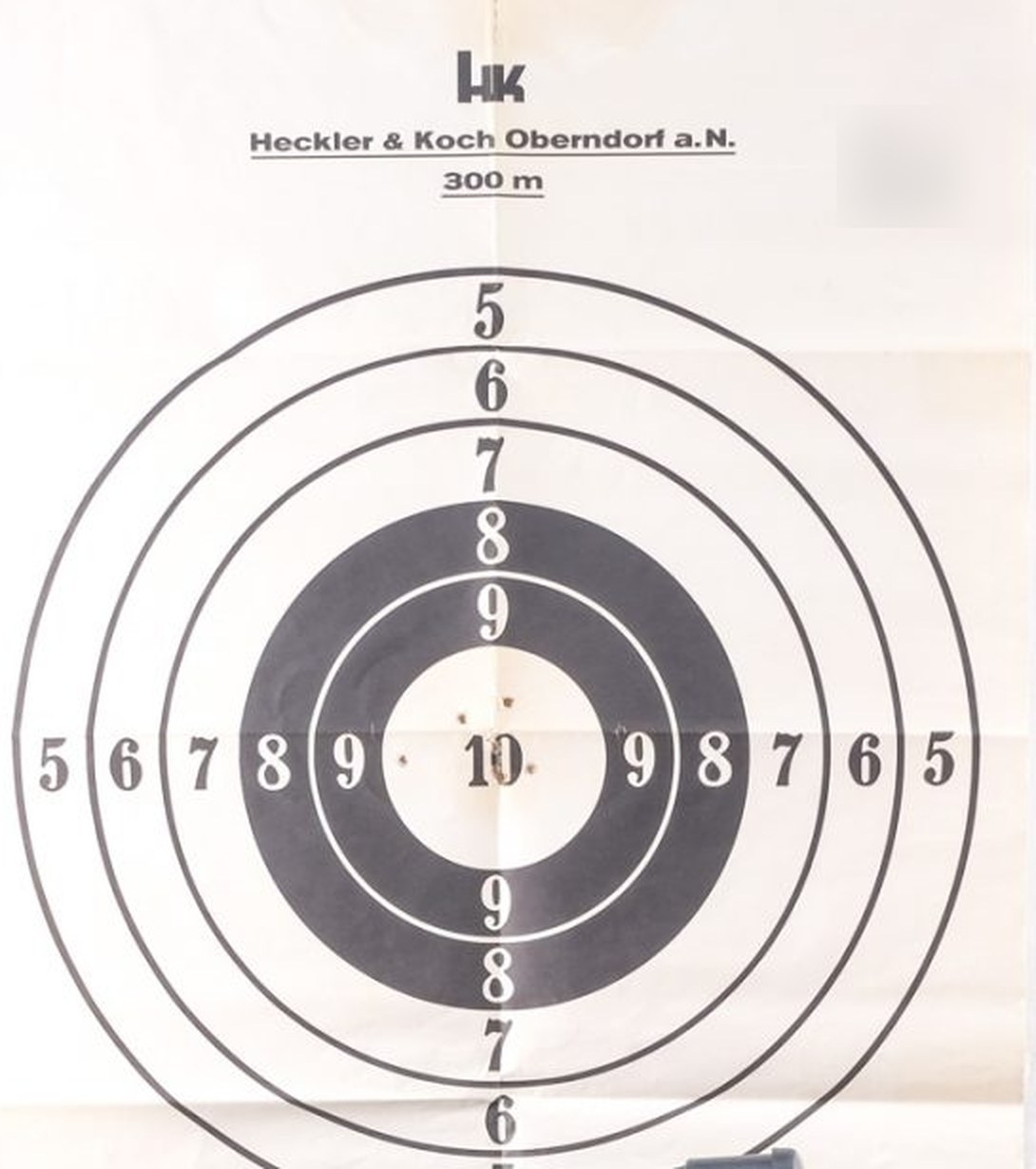
H&K shipped each PSG1 with a test target. The 2017 new-in-box rifle at James D. Julia came with “the original test target that was stamped, signed and dated at the factory”; Rock Island’s 2024 rifle came with a “test target”.1213 Neither catalogue describes what is on the target, the distance, the number of shots or the group size. A photograph of one would show what H&K actually tested to.
7.5 What testers measured
Table 2 — What testers measured
| Rifle | Result | Conditions | Source |
|---|---|---|---|
| PSG1 | Federal Gold Medal Match 168 gr: average .485 in (.46 MOA), best .306 in | 100 yd, sandbags, 6×, three-shot groups | Sniper Central, 202014 |
| PSG1 | HSM 168 gr HPBT Match: average .906 in (.87 MOA), best .741 in | Same | Sniper Central, 202014 |
| PSG1 | HSM 7.62 NATO 168 gr A-MAX: average .695 in (.66 MOA), best .589 in | Same | Sniper Central, 202014 |
| SAR M41 PSG (German PSG1 copy, conventional Lothar Walther barrel) | 15 mm (Remington 165 gr AccuTip) to 25 mm (147 gr ball); factory test target 9 mm | 100 m, seated from a rest, 12×, five-shot groups, seven loads | Deutsches Waffen-Journal, January 202315 |
| PTR MSG91 (US HK91-pattern precision model) | Best groups “close to 1 MOA” | Distance and shot count not stated | Shooting Illustrated, 201616 |
The Sniper Central figures are the only measured groups from a genuine PSG1 found. The reviewer’s summary was that the rifle is “sub .5 MOA” with Federal Gold Medal Match and “sub 1 MOA” with the other two loads; he also noted that every group was three shots, in a reply to a reader.14
7.6 Why the numbers cannot simply be compared
A three-shot group, a five-shot group and a 50-shot circle are different measurements, and the larger the sample the larger the group. The 50-shot circle in the repeated standard, if it is real, is the extreme spread of fifty shots; a rifle that holds 50 shots inside 0.92 MOA will print three-shot groups much smaller than that. Read the other way, a rifle that prints 0.5 MOA three-shot groups has not shown it can hold a 50-shot circle of any particular size. The hub’s Reloading Bench, Volume 22 covers the statistics of groups and how many shots a group needs before its size means anything.
The comparison that can be made is narrow and still useful: the one genuine PSG1 measured in print shot three-shot groups at 100 yards of about half a minute with match ammunition, consistent with H&K’s “sub-MOA” and the police’s 20 mm.
7.7 Claims that could not be checked
- A US Army comparison of about 1982 is said in several places to have found the PSG1 less accurate than the M21 and the M40A1, with a report number “AMSAA TR 461” attached. The report was not found; the US Defense Technical Information Center served an error page when it was sought. The claim is not repeated here as fact.
- “The most accurate semi-automatic rifle in the world” appears in many reviews and in H&K’s own phrase “one of the most precise semi-automatic weapons in the world”.1 It is a reputation, not a measurement.
7.8 What makes it accurate, and what limits it
The features that H&K documented (Volume 3) each address a known limit of the selected-G3 marksman rifle: a heavy free-floated barrel with polygonal rifling; a fixed telescope mount on welded bases; a two-stage trigger of about 1.5 kp; a stock adjustable to the shooter; and, by consistent secondary accounts, welded reinforcement of the receiver. The closing aid serves silence, not accuracy.
What limits it is less documented. The PSG1 is still a roller-delayed blowback, with a heavy bolt moving during the shot cycle and a case moving in the chamber while pressure is falling. Reviewers note practical limits more than mechanical ones: weight (8.1 kg without magazine by the booklet), a fixed 6× telescope with a drum that stops at 600 m, and a slippery cheekpiece in the wet.148 The Lithuanian Armed Forces’ verdict on the PSG1 for army use was that it was “too heavy, too sensitive to external influences” and that its range had been “specially reduced (adapted to urban conditions)”.17 No source found quantifies the effect of the roller action itself on accuracy, and this dive does not offer one.
7.9 The cartridge
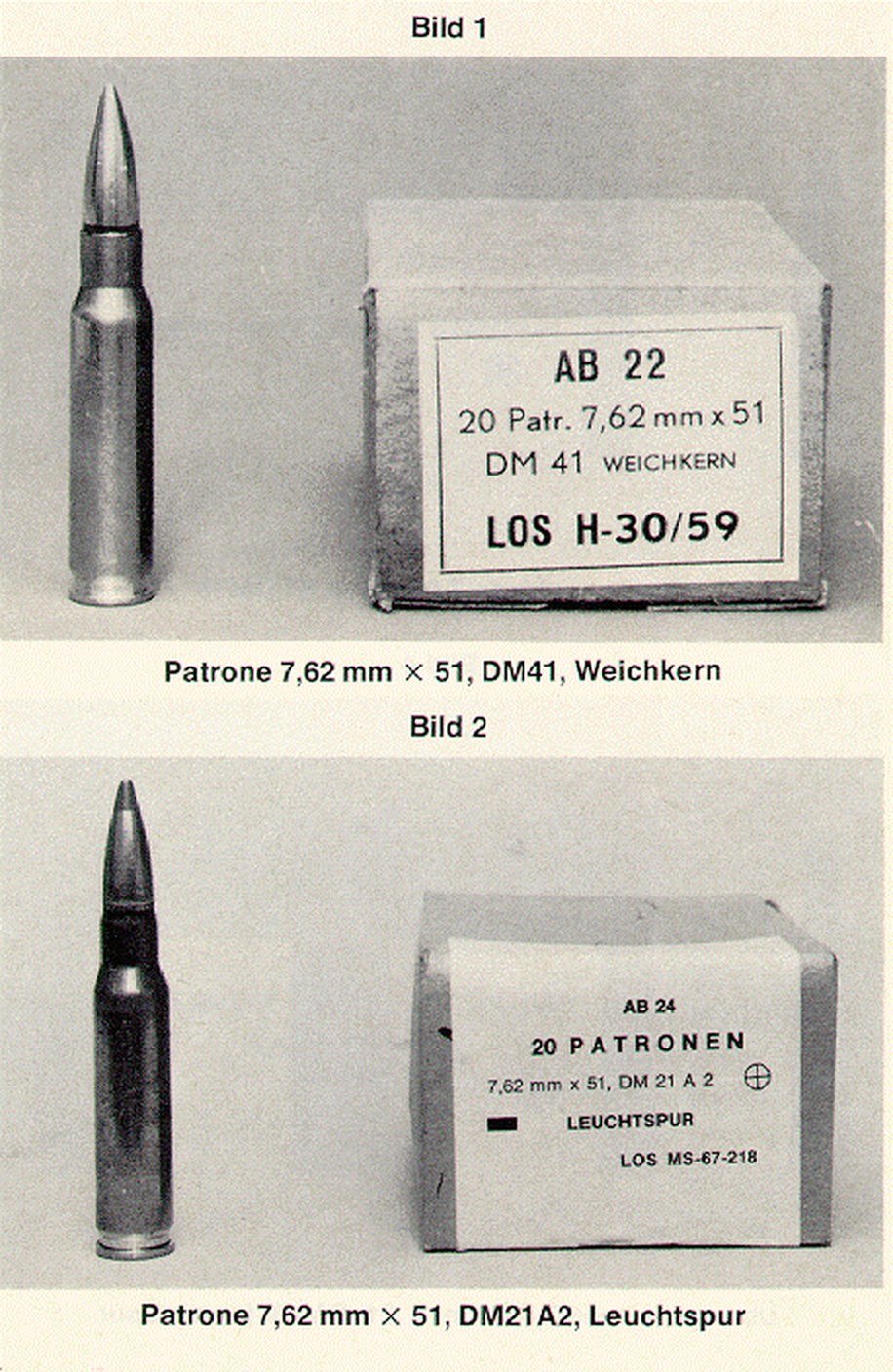
The PSG1 is chambered for 7.62×51 mm, which H&K’s booklet writes “7,62 mm x 51”.8 The G3 family was built around NATO service ammunition; the Bundeswehr regulation gives the G3’s muzzle velocity as 780 to 800 m/s and lists its service rounds, the ball round being designated DM41.18
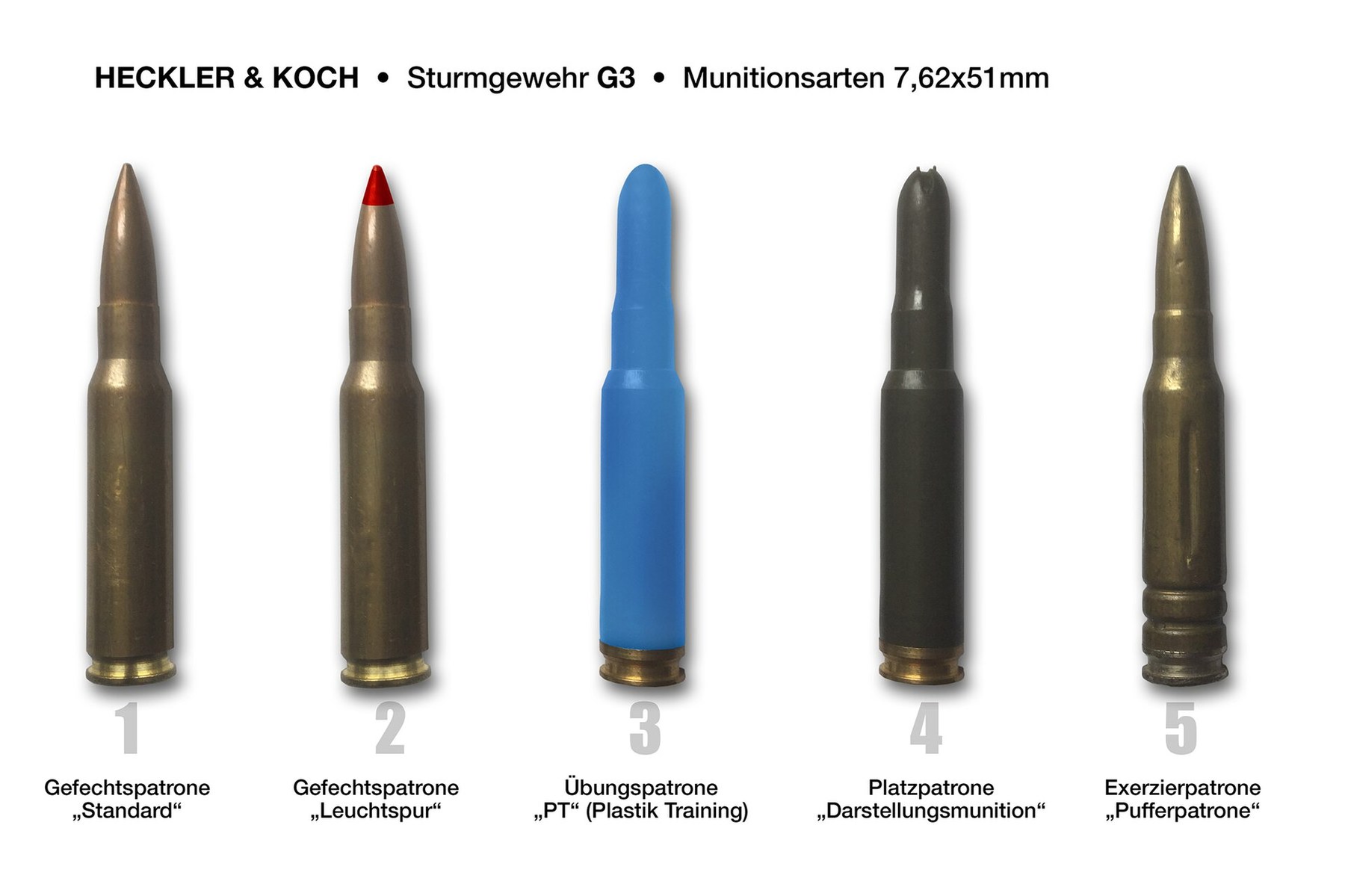
The commercial .308 Winchester and the military 7.62×51 are close but not identical; their chamber and pressure differences are covered elsewhere in the hub and not here. The PSG1’s American auction descriptions list it as “308 Win cal.” or “7.62 mm Nato (308)”, and the H&K booklet names only the metric round.1913
7.10 What H&K says about ammunition
Very little. The PSG1 booklet names no load. H&K’s only ammunition qualifier is the MSG90A1’s “with match ammunition”. The booklet’s telescope drum is graduated from 100 to 600 m for a load it does not name. H&K’s HK91 leaflet tells civilian owners to clear the bore of oil before shooting and is otherwise silent on ammunition.8420 No H&K statement for or against handloads, steel-cased ammunition, or particular bullet weights was found.
The loads testers used are therefore the only guide in print: Federal Gold Medal Match 168 gr gave the best groups in the Sniper Central test, ahead of two HSM 168 gr loads; the German copy grouped best with a 165 gr hunting bullet and worst with 147 gr ball.1415
7.11 What the fluted chamber does to brass
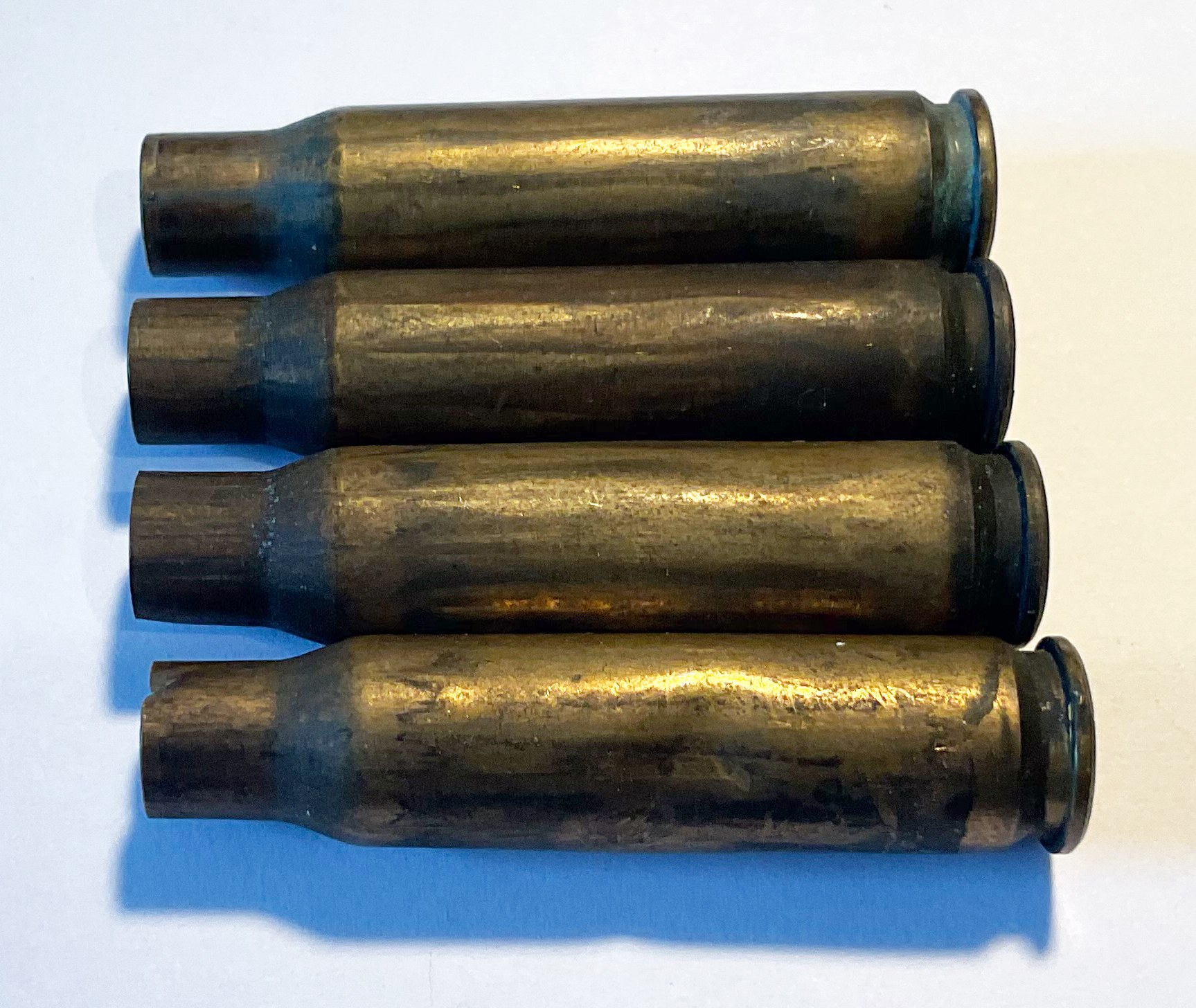
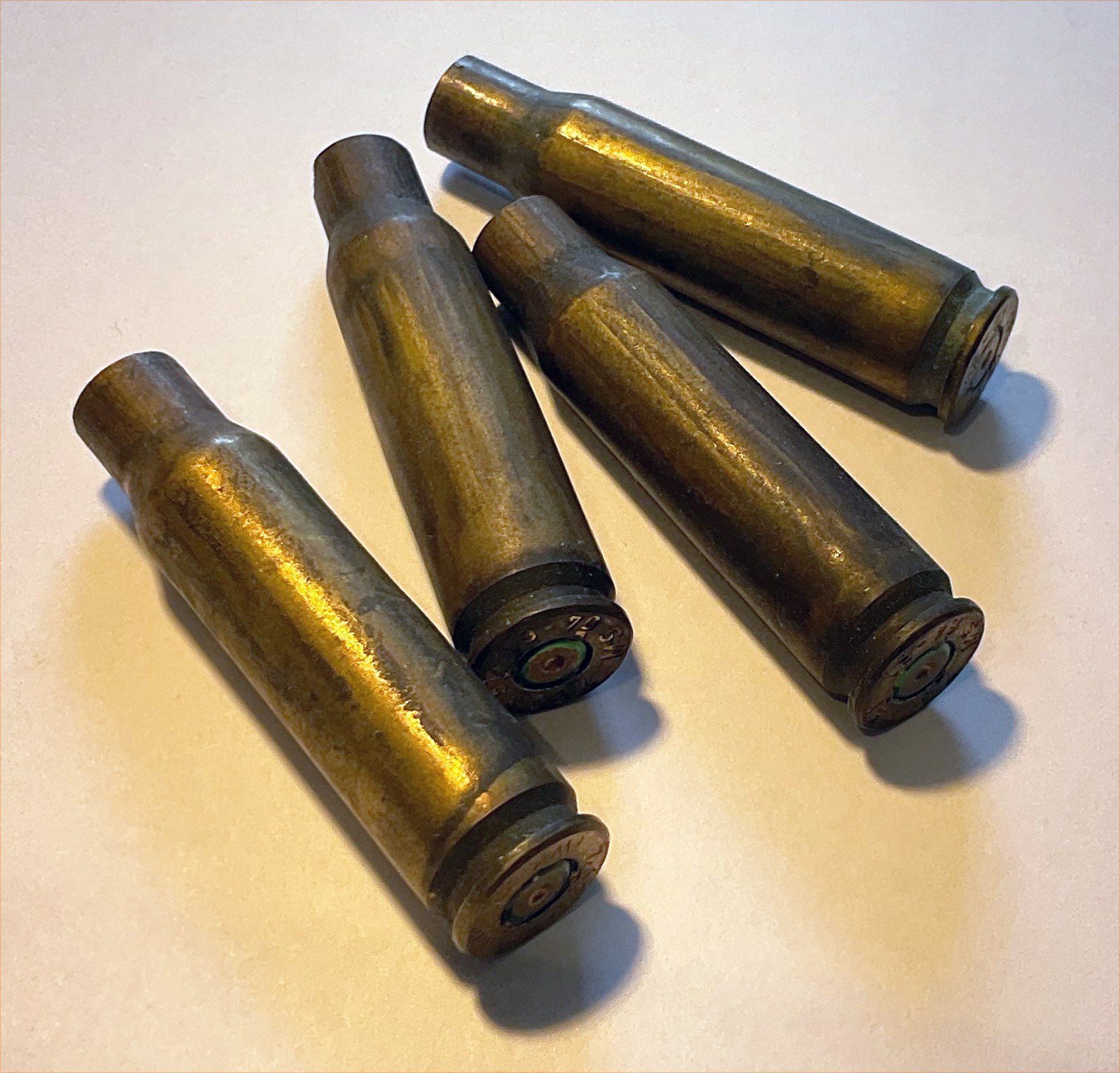
The PSG1’s chamber is fluted (Volume 3). The flutes let gas run back along the outside of the case so that it does not grip the chamber wall while the bolt is already moving. Gas carrying combustion residue into the flutes leaves its mark: a fired case from a fluted chamber carries a ring of lengthwise soot stripes, one for each flute.
- The Deutsches Waffen-Journal, on the German PSG1 copy in 2023: the relief grooves “exert gas pressure on the .308 Winchester case from outside during extraction so that it does not tear. The cases therefore have a characteristic striped look after ejection; in addition they are slightly dented.”15
- Sniper Central, on a genuine PSG1 in 2020: “mangled brass ejected 30+ feet from the rifle.”14
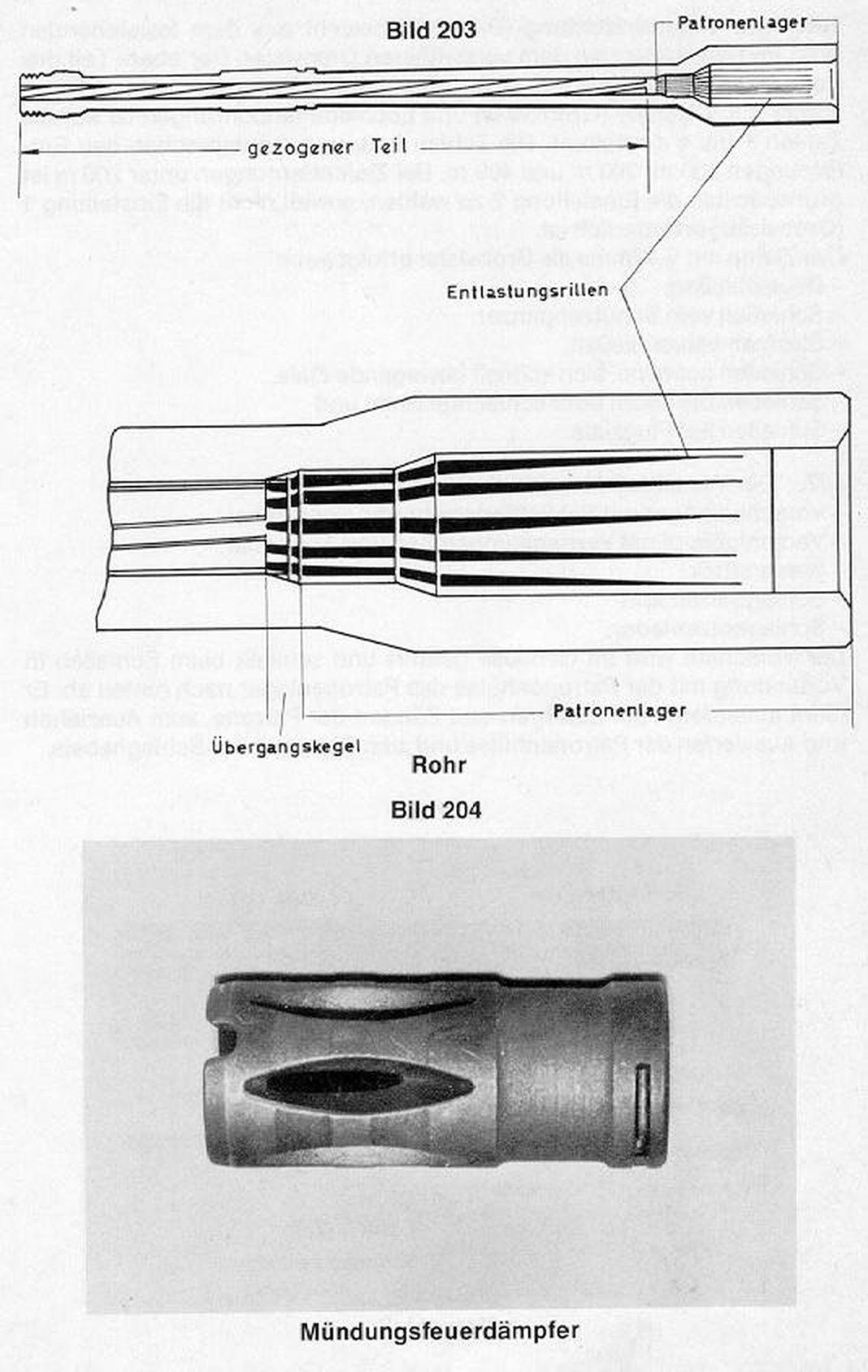
The photographs in this volume are of G3-fired cases. No photograph of PSG1-fired brass was found, and the PSG1’s flute count is not stated by H&K (Volume 3).
7.12 Ejection
The roller gun throws its cases hard and far. H&K says only that cases “are ejected to the right”.21 Sniper Central’s spec page says the PSG1 ejects cases “about 10 meters”, which can give away a position and makes the brass hard to recover; its review says “30+ feet”.914 The German copy has a welded case deflector to throw cases away from the shooter, and the Lithuanian Armed Forces say the MSG90A1’s case deflector “makes it possible to fire from the left shoulder”.1517 English Wikipedia says a brass catcher is needed on the PSG1 A1 to manage ejection; that is uncited.22 The Bundeswehr regulation treats the ejection pattern as a diagnostic: cases that start going out square or rearward instead of right and forward indicate wear (Volume 4).
7.13 Handloading for a roller-delayed rifle
No H&K document and no ammunition maker’s document read for this dive addresses handloading for the PSG1 specifically. What can be said is limited to what the mechanism and the hub’s own handloading dive establish:
- The brass is worked hard. The case moves in the chamber under residual pressure, floated by the flutes, and is then thrown several metres. Expect marked and dented cases, and a share that are not worth reloading. The hub’s Reloading Bench, Volume 15 sets out how cases die and when to retire them, and its retirement criteria apply here without change.
- Sizing. The Bench’s Volume 9 finds that small-base dies are for tight chambers and are not a general requirement for semi-automatic rifles; nothing found shows that the PSG1’s chamber is tight. Sizing practice is in Volume 12 and trimming in Volume 13.
- Inspection. The flute stripes look like soot deposits; whether they also leave a raised mark on the case body is not documented in any source found. A dent from ejection is a separate defect to inspect for. Neither has a published limit for this rifle.
- Load development. The Bench’s method (Volume 21) applies. One caution specific to a delayed-blowback action follows from H&K’s own description of the cycle, in which the gas pressure on the case head is what drives the bolt (Volume 3): a load far from the service load’s behaviour changes the bolt’s timing. H&K published no figure for how far is too far, and no charge weight appears in this dive.
7.14 What could not be established
- The “50 shots into 80 mm at 300 m” standard in any H&K document.
- What H&K’s factory test target records.
- The 1982 US Army comparison and its report.
- Any H&K statement on ammunition beyond “match ammunition” for the MSG90A1.
- The PSG1’s flute count; a photograph of PSG1-fired brass; any published case-life figure for brass fired in it.
References
Footnotes
-
Heckler & Koch GmbH, “PSG1 A1” overview, heckler-koch.com, Wayback capture of 17 August 2012, http://web.archive.org/web/20120817103631/http://www.heckler-koch.com:80/en/military/products/precision-rifles/psg1-a1/psg1-a1/overview/print.html, consulted 2026-10-18. ↩ ↩2
-
Heckler & Koch GmbH, “PSG1 A1” Produktbeschreibung, heckler-koch.com, Wayback capture of 14 February 2012, http://web.archive.org/web/20120214073624/http://www.heckler-koch.com:80/de/produkte/praezisionsgewehre/psg1-a1/psg1-a1/produktbeschreibung/print.html, consulted 2026-10-18. Translated for this dive. ↩
-
Heckler & Koch Inc., PSG1 general page, Wayback capture of 20 March 2007, http://web.archive.org/web/20070320220441/http://www.hk-usa.com:80/le_psg1_general.html, consulted 2026-10-18. ↩
-
Heckler & Koch (Ashburn, Virginia), Military & Law Enforcement catalogue, ”© HKDCS 01.12.08”, catalogue p. 19, http://photos.imageevent.com/smglee/cltactical/HK%20Military%20LE%20Catalog.pdf, consulted 2026-10-18. ↩ ↩2 ↩3
-
Heckler & Koch Inc., MSG90 A1 general page, Wayback capture of 22 February 2007, http://web.archive.org/web/20070222112912/http://www.hk-usa.com:80/le_msg90_general.html, consulted 2026-10-18. ↩
-
Heckler & Koch Inc., “MSG90A1”, Wayback capture of 21 June 2024, http://web.archive.org/web/20240621211859/https://hk-usa.com/hk-models/msg90a1/ (the same sentence on the 2013 page, capture of 7 November 2013, http://web.archive.org/web/20131107132327/http://www.hk-usa.com/military_products/msg90a1_general.asp), consulted 2026-10-18. ↩
-
Heckler & Koch GmbH, “MSG90 A2” overview, Wayback capture of 11 March 2015, heckler-koch.com, consulted 2026-10-18. ↩
-
Heckler & Koch GmbH, Kurzbeschreibung des Präzisionsschützengewehres PSG 1 (Oberndorf, n.d.), printed pp. 3, 45. Internet Archive collection “MManuals”, https://archive.org/download/MManuals/HkPsg1.pdf, consulted 2026-10-18. ↩ ↩2 ↩3 ↩4
-
Melvin Ewing, “HK PSG-1”, Sniper Central, 26 August 2020, https://snipercentral.com/hk-psg-1/, consulted 2026-10-18. ↩ ↩2
-
Alex C., “H&K PSG1 Sniper Rifle Overview”, The Firearm Blog, 18 February 2016, https://www.thefirearmblog.com/blog/2016/02/18/hk-psg1-sniper-rifle-overview/, consulted 2026-10-18. ↩
-
Gernot Pieper, “Analyse der derzeitigen Entwicklungstendenzen von polizeilichen Schusswaffen”, in Borsdorff and Möllers (eds.), ASPiBGS vol. 7 (Lübeck, 2001), pp. 36–39 and footnote 12, https://edoc.vifapol.de//opus/volltexte/2009/1229/pdf/band_07.pdf, consulted 2026-10-18. ↩ ↩2
-
James D. Julia, Inc., sale 1678, lot 396, 2017, Wayback capture of http://jamesdjulia.com/item/1678-396/, consulted 2026-10-18. ↩
-
Rock Island Auction Company, 25 August 2024, lot 3589, https://www.rockislandauction.com/detail/4092/3589/heckler-koch-psg1-semiautomatic-sniper-rifle-with-scope, consulted 2026-10-18. ↩ ↩2
-
Melvin Ewing, “H&K PSG-1 Full Review”, Sniper Central, 26 August 2020, https://snipercentral.com/hk-psg-1-full-review/, consulted 2026-10-18 (including the author’s reply in the comments that the groups were three shots). ↩ ↩2 ↩3 ↩4 ↩5 ↩6 ↩7 ↩8
-
Franz Keck, “Präzision mit Geschichte”, Deutsches Waffen-Journal, January 2023, pp. 20–25, https://www.schwabenarmsgmbh.de/index_htm_files/Testbericht%20DWJ%20Ausgabe%2001-2023%20SAR%20M41%20PSG.pdf, consulted 2026-10-18. Translated for this dive. ↩ ↩2 ↩3 ↩4
-
Michael O. Humphries, “Review: PTR Industries MSG 91 Rifle”, Shooting Illustrated, 27 December 2016, https://www.shootingillustrated.com/content/review-ptr-industries-msg-91-rifle/, consulted 2026-10-18. ↩
-
Lietuvos kariuomenė, “Snaiperinis šautuvas H&K MSG-90A1”, updated 17 April 2009, Wayback capture of 4 January 2016, https://web.archive.org/web/20160104000156/http://kariuomene.kam.lt:80/lt/ginkluote_ir_karine_technika/snaiperiniai_sautuvai/snaiperinis_sautuvas_hk_msg-90a1.html, consulted 2026-10-18. ↩ ↩2
-
Bundesministerium der Verteidigung, ZDv 3/13 Das Gewehr G3 (1978; amendment 38 of 1999), Nr 109 and Anlage 2. Wikimedia Commons, public domain per Commons, consulted 2026-10-18. ↩
-
Rock Island Auction Company, Premier Auction 9–11 December 2022, lot 3737, https://cdn.rockislandauction.com/flipbooks/87/BOOK3/files/basic-html/page338.html, consulted 2026-10-18. ↩
-
Heckler & Koch GmbH, The Selfloading Rifle HK 91 Cal. .308 (Oberndorf/Neckar, pre-1990). https://archive.org/download/MManuals/Hk91.pdf, consulted 2026-10-18. ↩
-
Heckler & Koch Inc., PSG1 A1 features page, Wayback capture of 28 March 2007, http://web.archive.org/web/20070328065452/http://www.hk-usa.com:80/le_psg1_features.html, consulted 2026-10-18. ↩
-
“Heckler & Koch PSG1”, English Wikipedia, https://en.wikipedia.org/wiki/Heckler_%26_Koch_PSG1, consulted 2026-10-18. ↩
Comments (0)