H&K PSG1 · Volume 1
Origins: Munich, the Missing Police Rifle, and the Roller-Delayed Inheritance
What is documented about why West German police wanted a precision semi-automatic, what is only repeated, and the G3 marksman rifle the PSG1 was built to outdo
1.1 The rifle in one paragraph
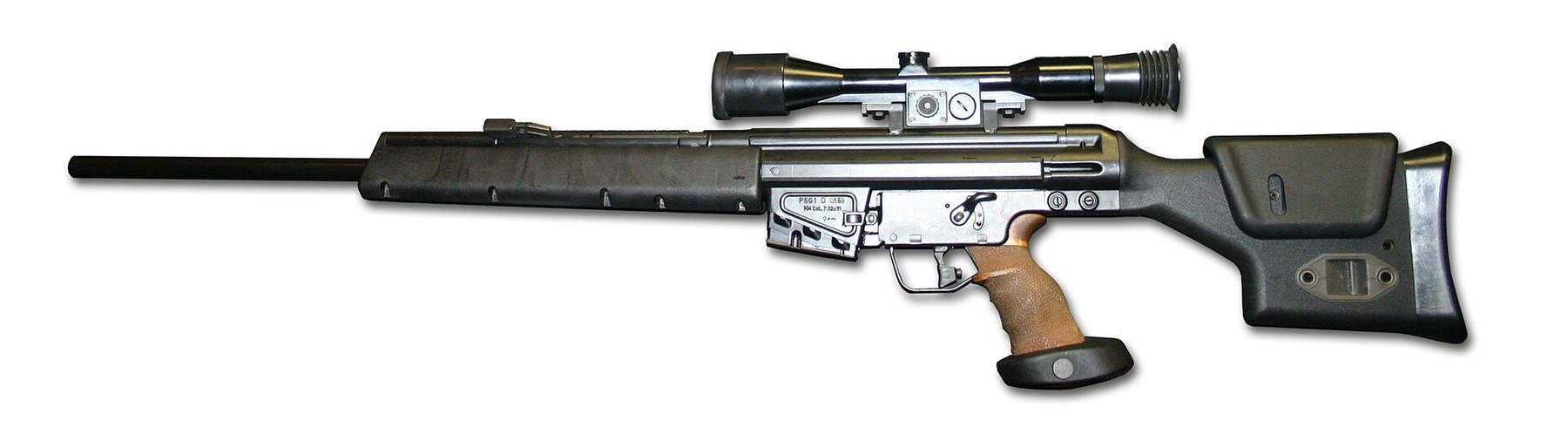
The Heckler & Koch PSG1 is a semi-automatic 7.62×51 mm precision rifle built on the working parts of the G3 service rifle: roller-delayed blowback, a fluted chamber, a stamped receiver, the G3’s bolt group, magazines and takedown. To that base H&K added a heavy 650 mm polygonal barrel, a receiver stiffened by welded-on reinforcement, a fixed telescope mount, a two-stage trigger of about 1.5 kp with an adjustable shoe, a grip with an adjustable palm shelf, a stock adjustable for length, comb height and cant, and a “closing aid” for seating the bolt silently.12 H&K’s own name for it is a police rifle, and its own literature describes no other purpose. Everything else in this dive follows from that combination: a service-rifle action asked to shoot like a target rifle, in a police role where a second shot might be needed quickly and a bolt must be closed without a sound.
1.2 What the name says
PSG stands for Präzisionsschützengewehr, “precision marksman’s rifle”, and the factory booklet’s title uses the word in full: Kurzbeschreibung des Präzisionsschützengewehres PSG 1.1 H&K’s German website of 2007, the oldest H&K product page found for this dive, headed the rifle “HECKLER & KOCH PSG1 SCHARFSCHÜTZENGEWEHR” and described it in one paragraph:
“To be able to aim and hit precisely even at long ranges under difficult operational conditions requires the best-trained marksmen and exceptionally precise rifles. The police precision sniper rifle PSG1 meets the demands for the highest precision. The PSG1 is a precision marksman’s rifle of superlatives. As a semi-automatic weapon it also offers the possibility of firing several shots at a target with the highest precision, even at long ranges.”3
The German phrase is Polizei-Präzisionsscharfschützengewehr: a police rifle, first and last. The page gives no date of introduction and mentions no event. H&K’s English pages of 2012 say the PSG1 was “developed especially for police special forces units”.4 Neither says when, or after what.
1.3 Munich and Fürstenfeldbruck, 5 and 6 September 1972
The events that the PSG1 is usually said to answer are well documented and are summarised here only as far as the rifle story needs them.
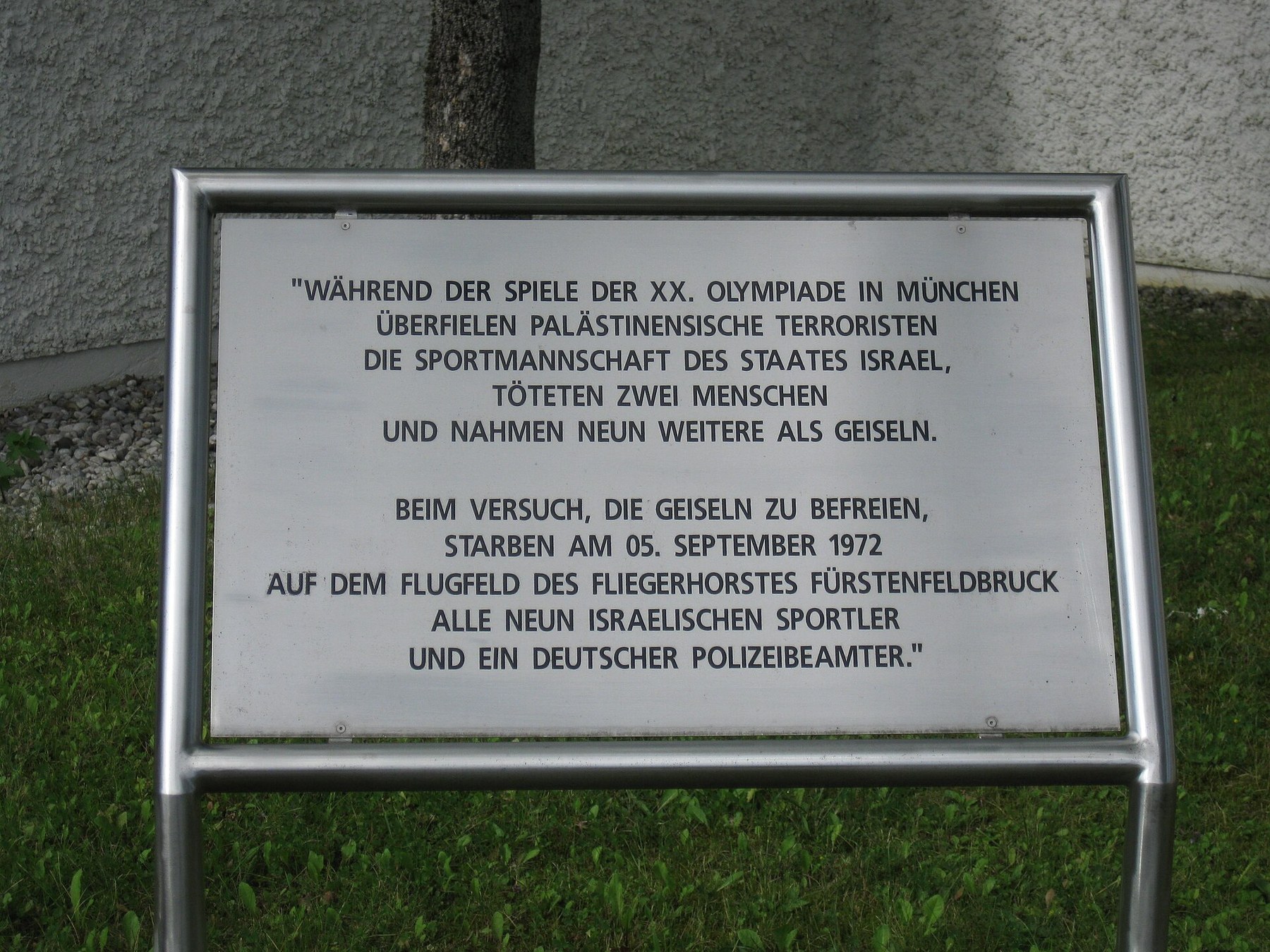
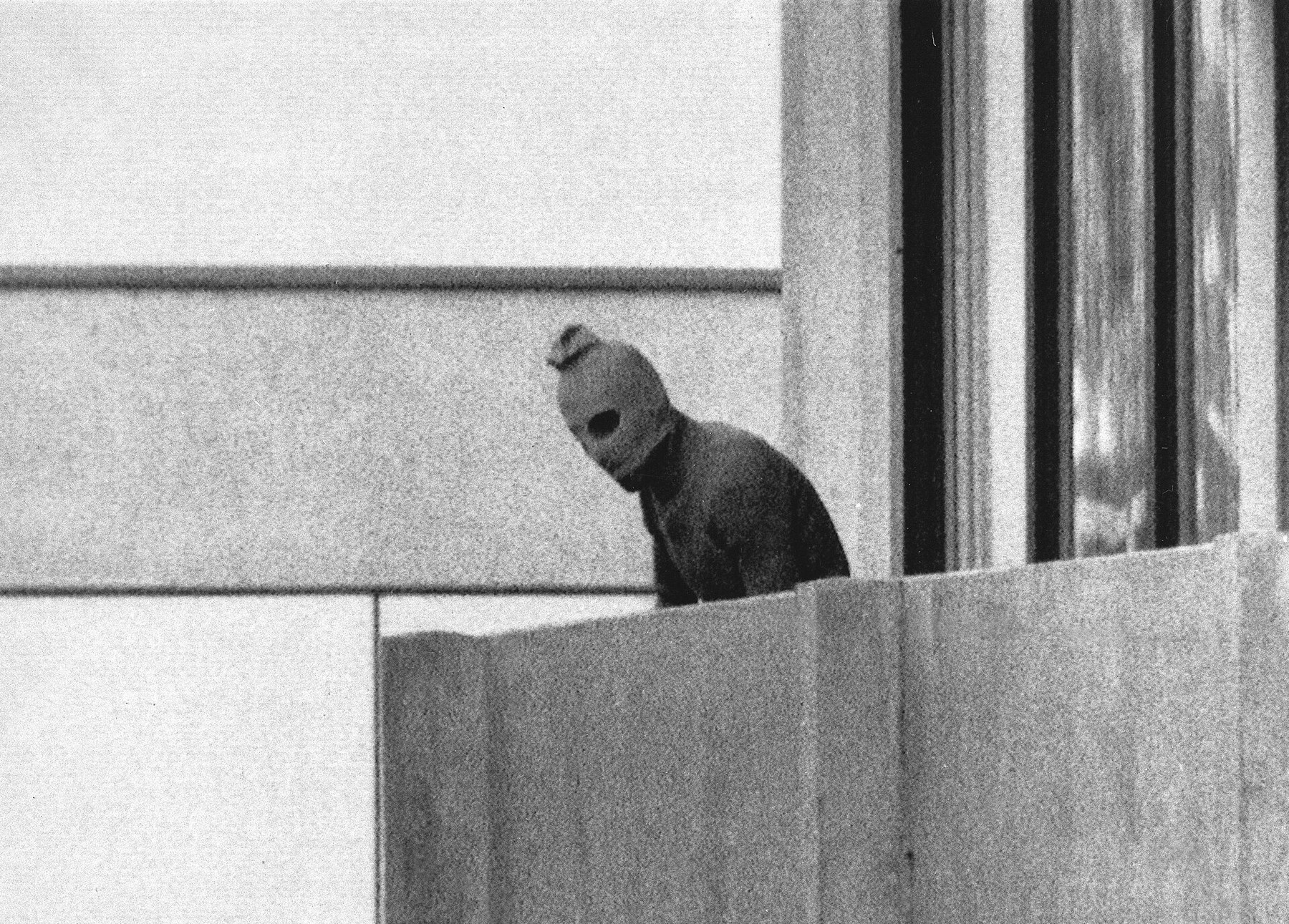
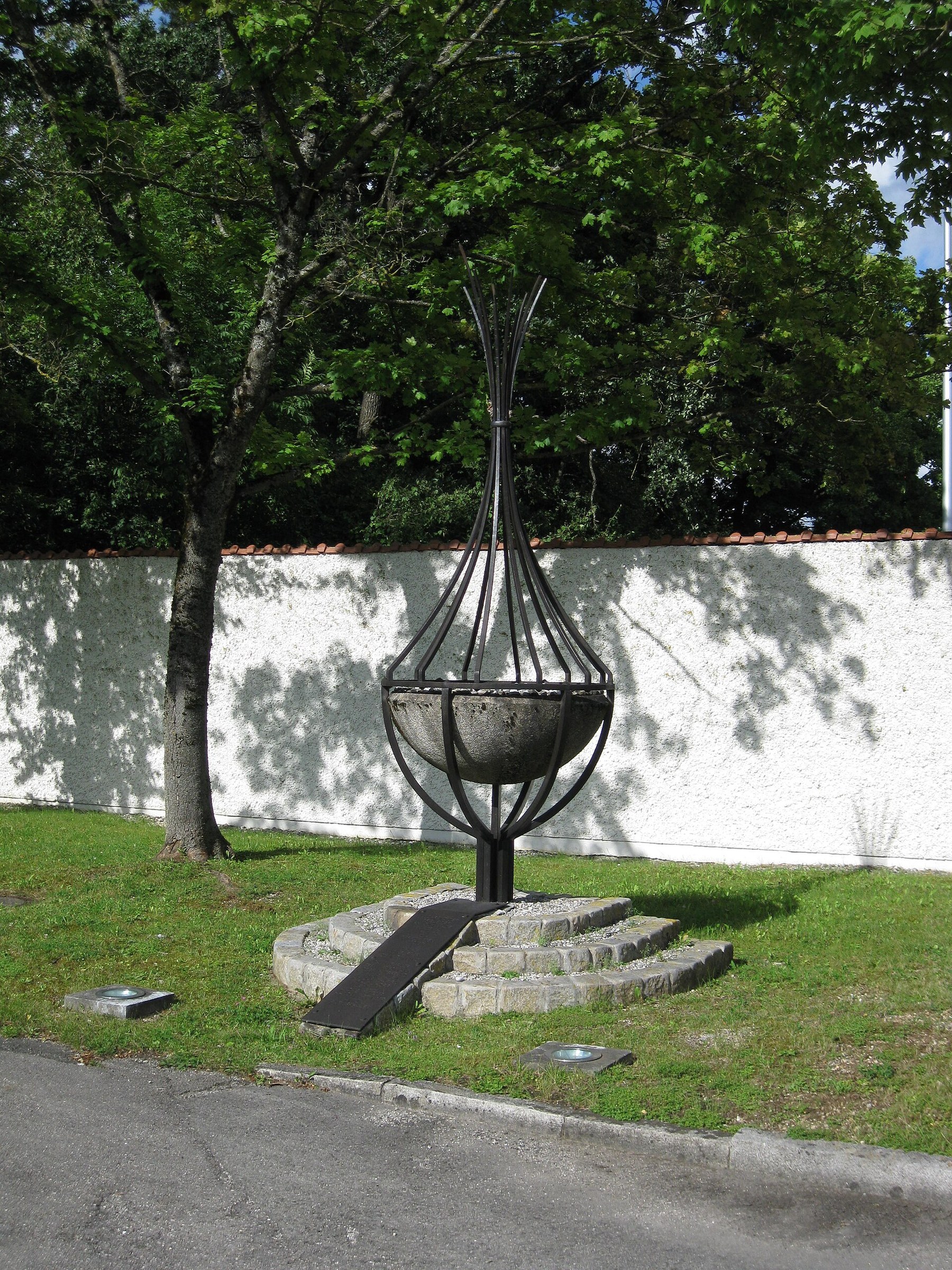
Early on 5 September 1972 eight members of the Palestinian group Black September broke into the Israeli team’s quarters at Connollystraße 31 in the Olympic village in Munich. Two members of the team were killed there and nine taken hostage. After a day of negotiation the hostage-takers and their hostages were flown by helicopter to the Fürstenfeldbruck air base, where the Bavarian police attempted a rescue on the night of 5 to 6 September. It failed. All nine hostages were killed, together with one police officer, Anton Fliegerbauer, and five of the eight hostage-takers.56 A memorial plaque at the air base gives the outcome in a sentence: “In the attempt to free the hostages, all nine Israeli sportsmen and one German police officer died on 5 September 1972 on the airfield of the Fürstenfeldbruck air base.”
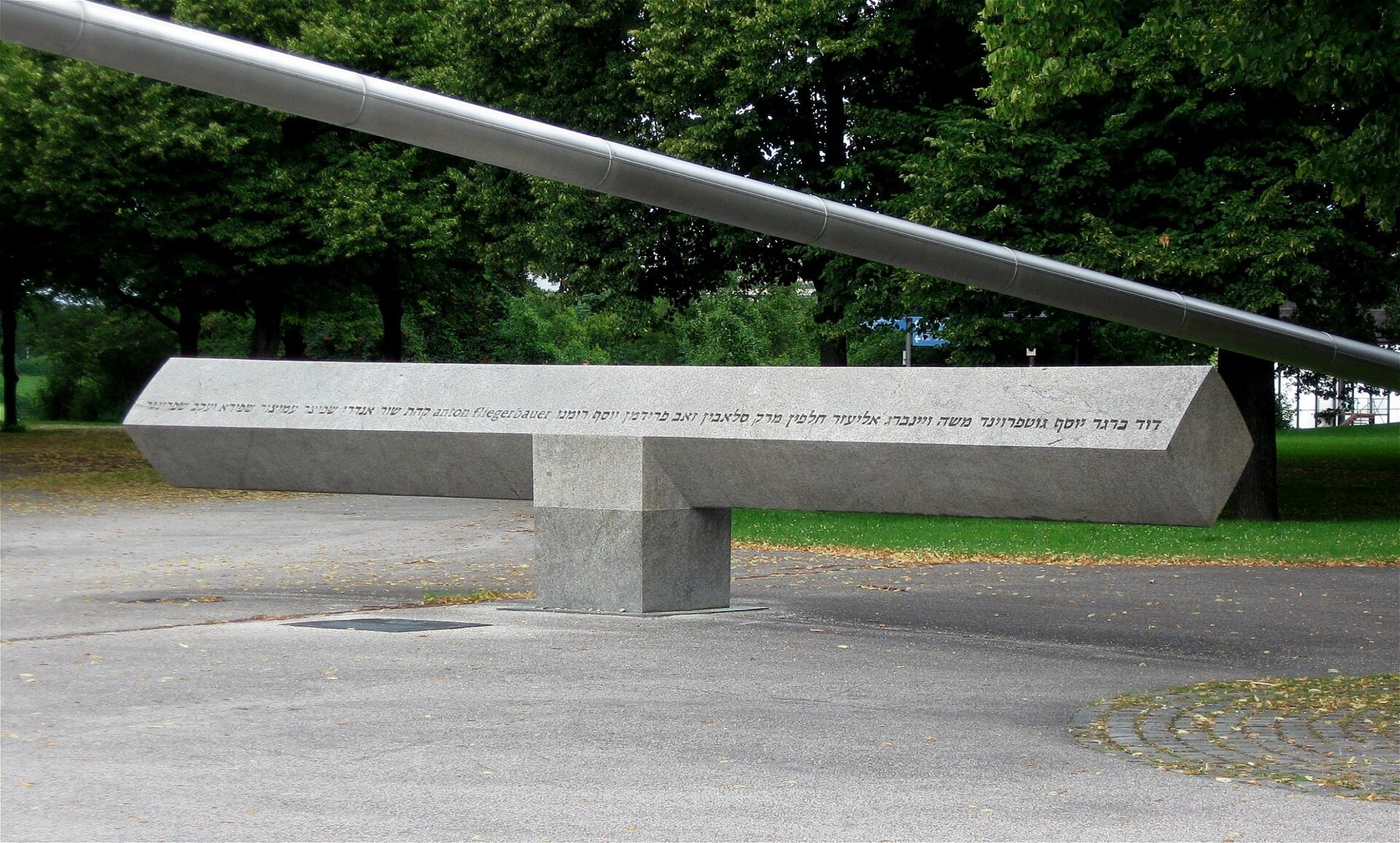
1.4 The marksmen: what they carried is disputed
What matters for a rifle history is what the police marksmen at Fürstenfeldbruck carried, and the published accounts disagree.
Telescope-sighted rifles. The Landkreis Fürstenfeldbruck’s official memorial site, written in 2022 from the Munich state archive’s prosecution files, says the five marksmen “were equipped with select-fire rifles that had telescopic sights” (Sie wurden mit Schnellfeuergewehren ausgerüstet, die über Zielfernrohre verfügten). It adds that radios were not available, so that the command could talk to the three marksmen on the tower but not to the two on the ground, and that the five “had performed well in shooting exercises before but were not specifically trained for such an operation”.7 The Deutsches Waffen-Journal in January 2023 agrees on the telescopes: “there were no marksmen, which is why police officers active in hunting and sport shooting were equipped ad hoc with telescope-sighted rifles.”5
Rifles without telescopes. English Wikipedia’s article on the massacre says the marksmen carried the G3 “without telescopic sights or night vision devices” and that “none of the rifles were equipped with telescopic or night vision sights”. The first sentence cites the same memorial page, which says the opposite; the second cites Simon Reeve’s book One Day in September (2000), page 116, which was not seen for this dive.6 German Wikipedia says the five were patrol officers “only makeshift equipped with selected Heckler & Koch G3 assault rifles”, that the Munich police already held Steyr SSG 69 sniper rifles but had no one trained on them, and that the marksmen had no night-vision equipment; those sentences carry no citations.8
What all the accounts share is the substance that matters here: there were no trained police marksmen in Bavaria in 1972; five officers were chosen on their range scores; they had select-fire service rifles (G3s, by most accounts) and no night sights, and two of them had no radio. Whether their rifles carried telescopes is disputed, and the archive-based memorial is the strongest single source found, against a book page not seen. The Bavarian government’s own report of 20 September 1972 was not read.
1.5 What changed afterwards
The memorial site’s account of the aftermath records the German press’s verdict, that “five precision snipers were too few, the police in general were poorly trained and the weapons were not suitable for the operation”, and the Bavarian police’s reply that it “could not have used its means any better”. The federal interior minister commissioned Ulrich Wegener of the Bundesgrenzschutz to form a counter-terrorist unit, GSG 9, which was ready in April 1973.7
The best German police-side account of what followed for the rifle is a study published in 2001 by the federal border police’s own college, written by a serving officer, Gernot Pieper:9
“In September 1972 the German police were literally shaken awake by the massacre of the Israeli Olympic team by Palestinian attackers. There were no operational concepts for such operations, let alone concepts for a planned and directed police sniper operation. Nor were there weapons suitable for this kind of operation. Specially trained marksmen did not exist either.”
“In 1972 action had to be taken quickly. With that in mind, the weapons market was searched for suitable solutions. A first attempt at GSG 9 to convert the G1 select-fire rifle in its inventory into a precision rifle proved unsuitable.”
The G1 was the Bundesgrenzschutz’s designation for the FN FAL. What GSG 9 adopted instead, Pieper continues, was a compromise: a three-man team of two marksmen and an observer, with one marksman armed with a Mauser SP 66 bolt-action rifle and the other with an H&K G3/SG1, the G3 marksman rifle, which he describes as grouping “about 40 mm at 100 m” with the standard 450 mm G3 barrel, weighing 5.54 kg with its telescope, and fitted with a bipod, a cheekpiece and a rubber butt pad. The state police special units (SEK) copied the team, some with the Steyr SSG 69 in place of the SP 66.9
He then sets out what the police needed from a precision rifle. The defining requirement was a fast second shot: a semi-automatic whose reloading does not disturb the shooter’s hold, or a bolt action with minimal movement. His footnote lists the requirements: groups at 100 m “not over 20 mm”; “as near as possible 100 per cent functional and shooter safety”; a stock individually adjustable in shape; and stable mounting for day and night sights.9 Every one of those is answered by a feature of the PSG1.
And then the sentence that comes closest to an origin statement from the police side:
“By the middle of the 1980s two semi-automatic models were available to the police that met the requirements for a precision marksman’s rifle”: the Walther WA 2000 and “the Heckler & Koch PSG 1 model in calibre 7.62 mm × 51, which was developed under the decisive influence of GSG 9.”9
Pieper adds that the PSG1 was in use “not only with GSG 9 and the SEKs, but in nearly all modern police units of the world that can afford the high system price”. He does not say that H&K was commissioned in 1972, gives no date for the start of development, and cites no written requirement. A search for one, a Pflichtenheft or technical guideline for a police precision rifle, found nothing; the same study does describe the formal requirement process for police pistols of the 1970s, so the absence for the rifle may be real or may be a gap in what is published.9
The Deutsches Waffen-Journal put the whole story in one sentence in 2023: the tragedy showed that “a special unit was needed for such situations, and a police marksman service had to be built up, for which a suitable rifle was needed. So came the founding of the counter-terrorist unit GSG 9, and Heckler & Koch began developing the HK PSG1.”5 That is the Munich origin story in its plainest published form. Pieper’s account supports its first half and the GSG 9 connection; it does not support “began developing” as an immediate sequel.
1.6 The Munich origin story: who tells it
The table sets out every source read for this dive that addresses the PSG1’s origin. It is ordered by how close each is to H&K.
Table 1 — The Munich origin story: who tells it
| Source | Date | What it says about Munich |
|---|---|---|
| H&K, PSG1 short description (factory booklet) | Undated | Nothing. No history at all.1 |
| H&K Germany, PSG1 product page (heckler-koch.de) | Captured 2007 | Nothing. “Police precision sniper rifle”; no date.3 |
| H&K, PSG1 A1 product pages (heckler-koch.com, English and German) | Captured 2012 | Nothing. “Developed especially for police special forces units.”4 |
| Gernot Pieper, federal border police college study | 2001 | Munich created the need for police marksmen and suitable weapons; the PSG1 was “developed under the decisive influence of GSG 9” and available by the mid-1980s. No date for development, no commission in 19729 |
| Landkreis Fürstenfeldbruck memorial site | 2022 | The rescue and its aftermath, including GSG 9; no mention of a rifle requirement or of H&K7 |
| Rock Island Auction Company, lot descriptions | 2021, 2022, 2024 | ”Said to have been developed at the request of West German police units following the Munich Massacre at the 1972 Summer Olympics”101112 |
| Deutsches Waffen-Journal, test of a German PSG1 copy | January 2023 | States it as fact, unsourced (quoted above)5 |
| The Firearm Blog, “H&K PSG1 Sniper Rifle Overview” | 18 February 2016 | ”The PSG1 was developed after the German government’s failure at the 1972 Munich Olympics.”13 |
| Sniper Central, PSG-1 review | 26 August 2020 | Munich “spurred” GSG 9; the PSG1 “developed in the 1980s”14 |
| Forgotten Weapons, Ian McCollum | 18 March 2017 | No mention of Munich; “Developed in the 1980s”2 |
| Modern Firearms, Maxim Popenker | Undated | No mention of Munich; “developed … by mid-1980s”15 |
| English Wikipedia, “Heckler & Koch PSG1” | Read 2026-10-18 | ”reportedly developed” after Munich; no citation on that sentence16 |
| German Wikipedia, “HK PSG1” | Read 2026-10-18 | Developed in the 1970s after the failed rescue; its only citation is the 2007 H&K page, which does not say so17 |
The pattern is clear. No H&K publication connects the PSG1 to Munich. The one German police source found connects Munich to the need for police marksmen and their rifles, and the PSG1 to GSG 9, but not the PSG1 to an order given in 1972. The auction house that sells the most PSG1s in the United States hedges the claim in every catalogue entry read. The sources that state it flatly are a German magazine and an American blog, neither citing anything, and the two encyclopedias, one of which cites a page that does not support it.
That is not the same as saying the story is false. With Pieper’s account the chain is documented at both ends: Munich exposed the lack of police marksmen and rifles, GSG 9 made do with a bolt rifle and a G3/SG1, and the PSG1 arrived by the mid-1980s, shaped by GSG 9. What the record does not show is the middle: a written requirement, a date on which the police asked H&K, or an H&K statement that the PSG1 is the answer.
1.7 When was the PSG1 developed? The dates in print
The published dates span seventeen years. They are given here separately because they cannot all be true.
Table 2 — When was the PSG1 developed? The dates in print
| Claim | Source |
|---|---|
| Designed 1968; in service 1972; produced 1972 to 2014 | English Wikipedia infobox16 |
| Developed “in the 1970s”; “produced since 1985” | German Wikipedia17 |
| ”Introduced in the 1970s” | The Firearm Blog, 201613 |
| ”Introduced in 1972 and produced for an impressive 43 years” | Athlon Outdoors, 202518 |
| ”Developed in the 1980s” | Forgotten Weapons, 2017; Sniper Central, 2020214 |
| ”Developed … by mid-1980s”, with GSG 9 and the KSK taking part | Modern Firearms15 |
| Available to German police “by the middle of the 1980s” | Pieper, federal border police college, 20019 |
| Introduced to the Bundesgrenzschutz in 1985 (and the G3 SG1 in 1975, with the Fero ZF4 telescope) | German Wikipedia’s list of Bundesgrenzschutz small arms, uncited19 |
Two of these can be tested. Popenker’s statement that the KSK took part in a development finished in the mid-1980s is impossible as written: the Bundeswehr’s Kommando Spezialkräfte was not formed until 1996. And a design year of 1968 would put the PSG1’s start before the Munich attack it is said to answer, which is why some later accounts cite it as evidence against the Munich story; but the 1968 figure has no source either.
The only physical evidence found is on rifles. H&K stamps a two-letter date code on its receivers, and Rock Island Auction Company read the code on one PSG1 as “IB”, which it gives as 1981; two other PSG1s it sold carried “KF”, which it gives as 1995.101112 The 1981 rifle needs a caution: the consignor attributed it to the builder Murray Urbach “from around 2001 using all factory parts”, so the receiver date need not be the date the rifle was assembled. If the auction house’s reading is right, a PSG1-marked receiver existed by 1981. Taken with Pieper’s “by the middle of the 1980s” and the uncited 1985 introduction date for the Bundesgrenzschutz, the dated evidence points to development in the late 1970s and police service from the early-to-mid 1980s. The “1972” in the English Wikipedia infobox, and in the articles that repeat it, has no source behind it. This dive does not convert one auction catalogue into a production date; the question stays open until an H&K document or a dated police acceptance record is found.
1.8 The rifle it was built to outdo: the G3 with telescope
Whatever the date, the rifle the PSG1 improved on is documented exactly, in the Bundeswehr’s own regulation for the G3. ZDv 3/13, issued on 13 December 1978, lists five versions of the service rifle, one of them the G3A3 ZF, “as the G3A3, but with telescope”.20 Its chapter on optical sights says:
“With the telescope fitted, the G3 rifle is used as a sniper’s rifle. The telescope, at fourfold magnification, allows accurate shooting up to a target range of 600 m.”
“Only weapons with very high accuracy are selected as sniper rifles. The rifle is issued to the unit with the telescope. Sniper rifle and telescope should always be used together. The telescope mount carries the rifle’s last digits.”20
That is the pre-PSG1 answer in the Bundeswehr’s own words: a selected service rifle with a 4× telescope on a clamp-on mount. The regulation names the telescope model FERO-Z24 among three in use, and states that the scope-to-mount screws “may be loosened only by weapons-repair personnel”.20 The mount clamps to the G3 receiver with claws, and the rifle itself is unchanged: the regulation says a telescope, an infra-red sight or an image-intensifier sight can be fitted “without modification of the rifle”.20
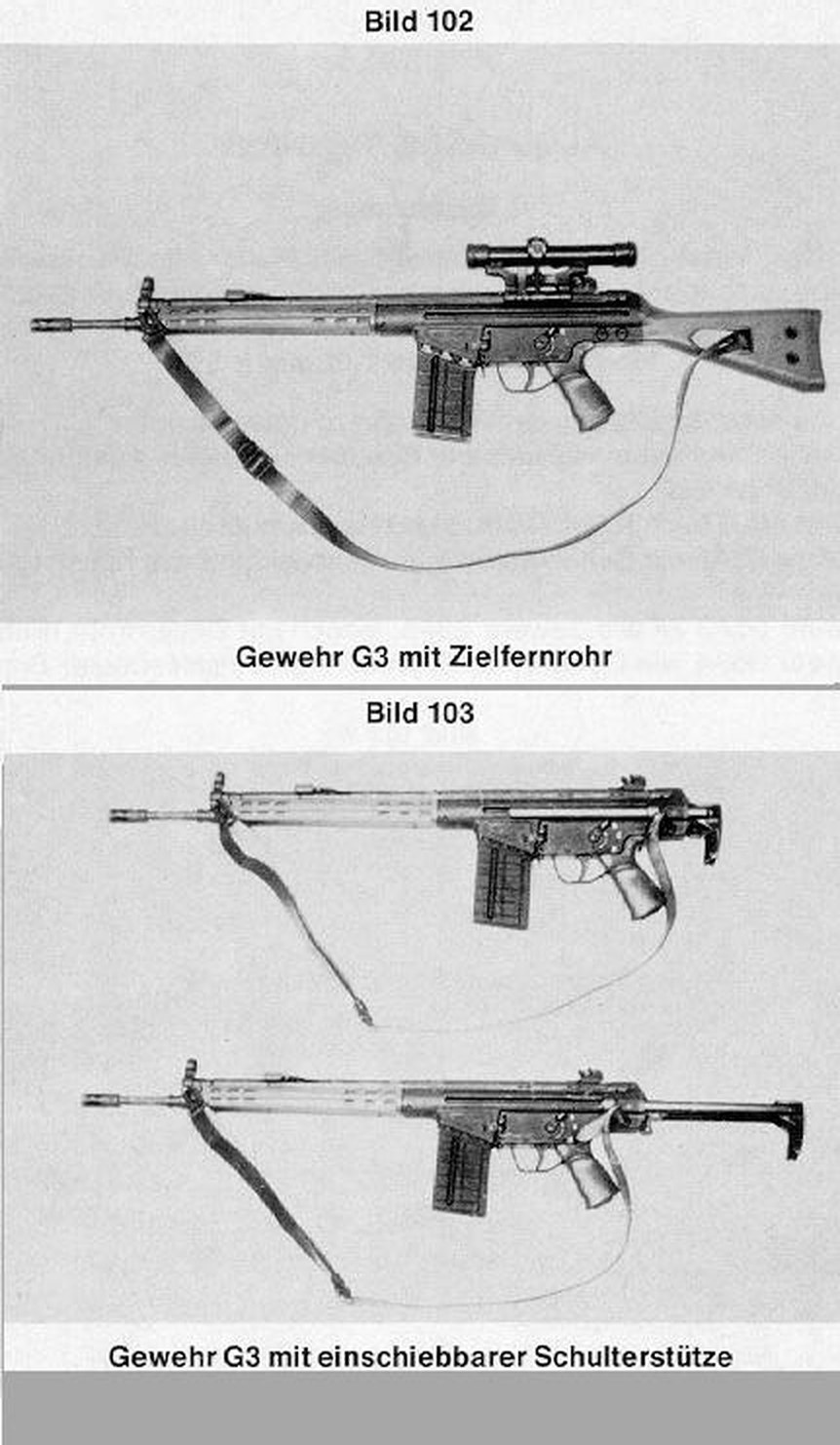
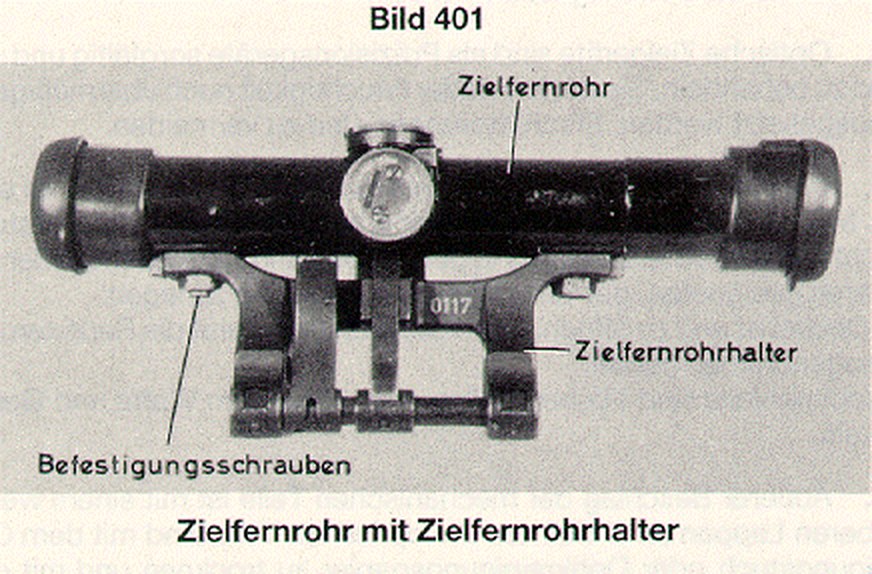
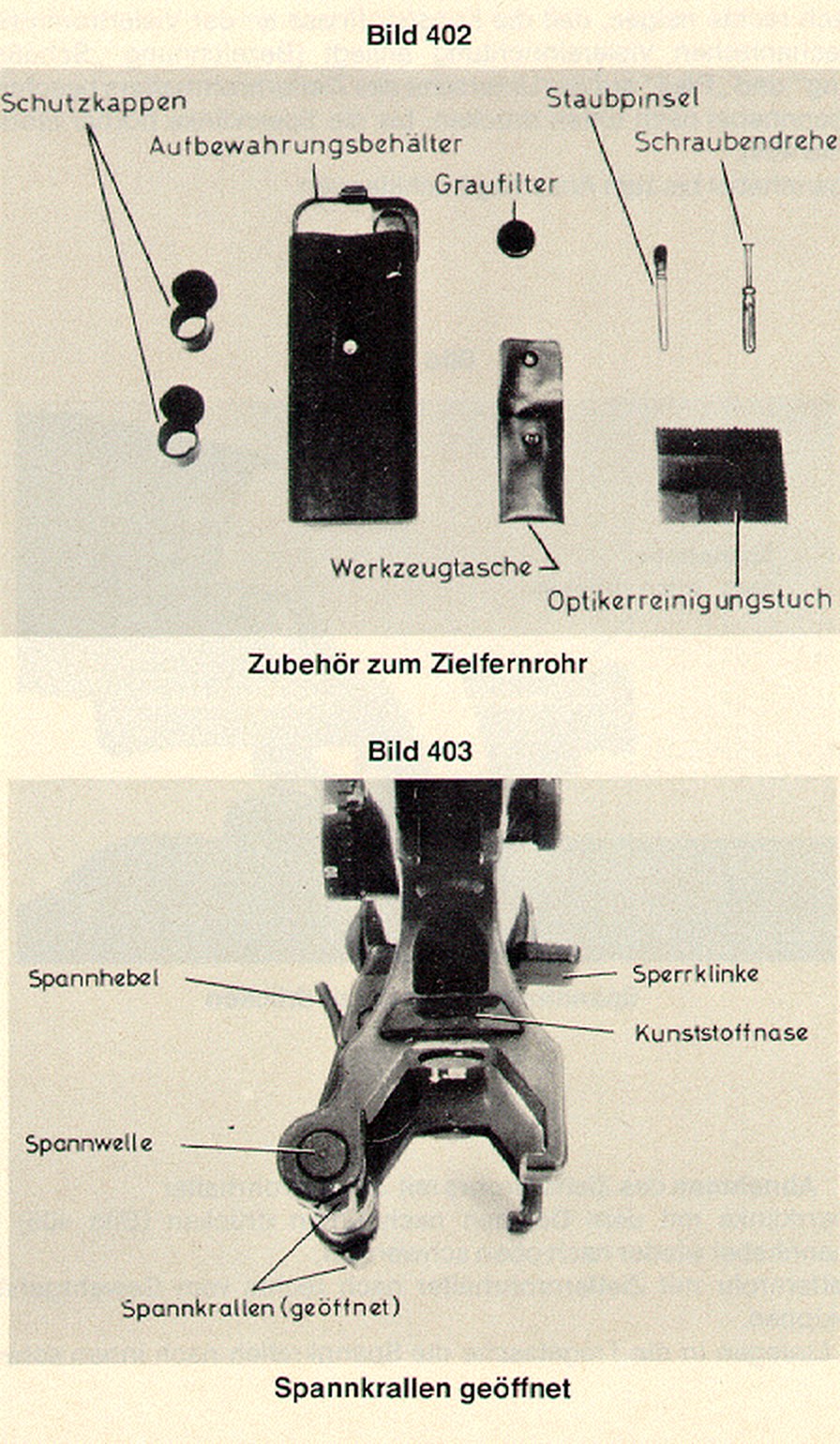
This was also the police’s interim rifle. The federal police college study describes the G3/SG1 issued to GSG 9 after 1972 as a G3 with its standard 450 mm barrel, a telescope, a bipod, an added cheekpiece and a rubber butt pad, weighing 5.54 kg and grouping about 40 mm at 100 m; the police requirement for the rifle that would replace it was 20 mm.9 Halving the group size of a selected service rifle is, in one number, what the PSG1 was asked to do.
A US Defense Intelligence Agency photograph of 1980, captioned “The West German H&K SSG sniper’s rifle”, shows a scoped G3-pattern rifle with a bipod.21 SSG is the German abbreviation for Scharfschützengewehr, sniper rifle; H&K’s commercial name for its accurised sniper G3 was G3SG/1. The agency’s caption names no model, and the photograph is reproduced here as a period image of the scoped G3 family rather than as an identified variant.
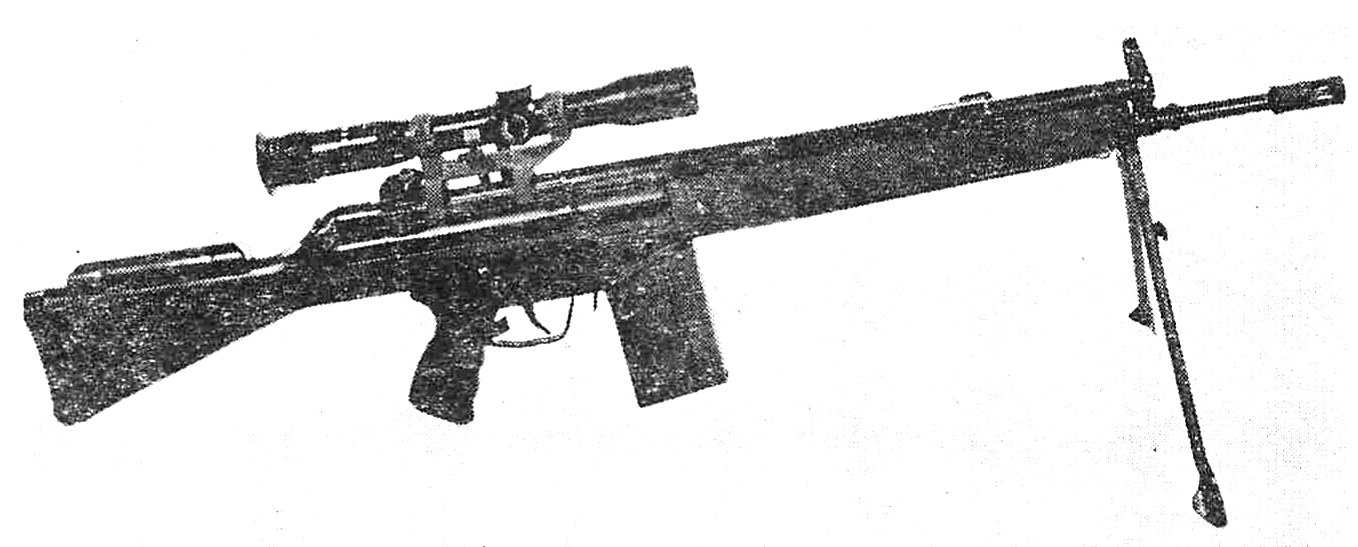
Read against that background, the PSG1’s changes are each a response to a limit of the selected-G3 approach. A selected rifle is accurate by luck of manufacture; the PSG1 has its own barrel and a stiffened receiver. A clamp-on mount can shift; the PSG1’s mount is fixed to bases welded to the receiver. A G3 trigger is a service trigger; the PSG1’s is a two-stage target trigger. A G3 bolt closes with a slam; the PSG1 has the closing aid. These are documented features (Volume 3). That each was a deliberate answer to a written police requirement is a reasonable reading, not a documented fact.
1.9 The roller-delayed inheritance
The PSG1’s action is not H&K’s invention and the dive does not re-derive its lineage at length; the outline is enough to show what H&K inherited and what it added.
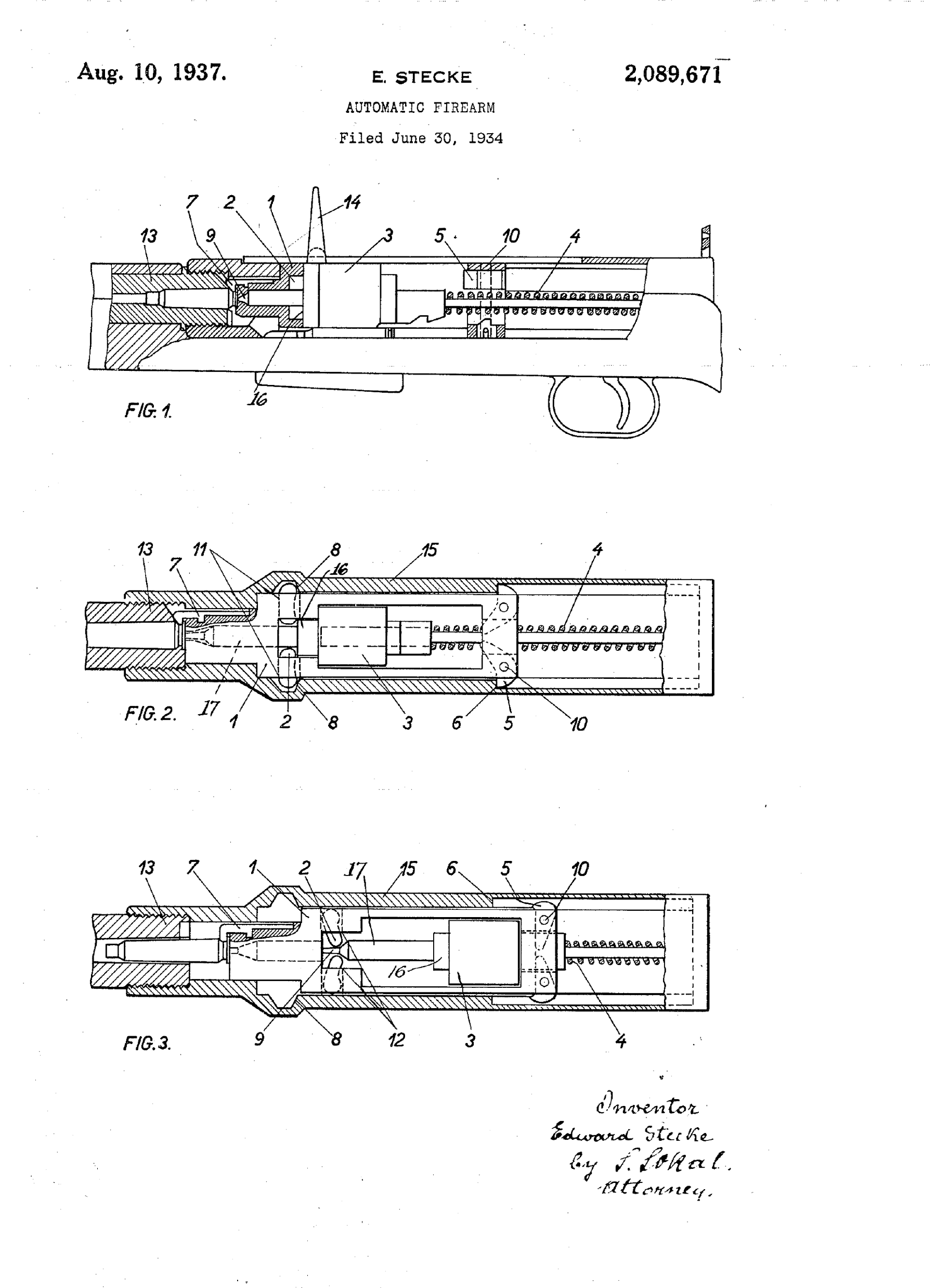
The problem the roller system solves is stated plainly in an early American patent for a delayed-blowback rifle, Edward Stecke’s of 1934: “the frictional resistance of a non-lubricated cartridge case relatively to the barrel chamber at the moment of maximum pressure in the chamber, is greater than the pressure on the bottom of the cartridge.”22 A full-power rifle cartridge cannot simply blow its bolt back, because the case is gripping the chamber at the moment the bolt would have to move. Every delayed-blowback design is an answer to that sentence, and the roller system’s answer has two parts: a mechanical delay, by rollers and a wedge, and a chamber whose flutes let gas reach the outside of the case so that it stops gripping (Volume 3).
The roller-delayed system that became the G3 began at Mauser in Oberndorf in the last years of the Second World War. Mauser’s earlier experimental rifles used rollers to lock the bolt: the Gerät 03, an attempt at a roller-locked G43 in 8×57 mm, and the Gerät 06, which locked with rollers and was operated by gas. According to Ian McCollum, an accident with automatic fire and bolt bounce suggested that the rollers alone could delay the bolt without any gas system. The result, the Gerät 06H, is a roller-delayed blowback rifle in which nothing locks: the rollers only slow the bolt down. It passed early prototype trials and was ordered into full development as the StG 45(M), but the 30-rifle trial batch was unfinished when the war ended.2324 Former Mauser engineers carried the system to Spain, where the state arms establishment CETME developed it into the CETME rifle. Germany adopted the CETME design, developed with Heckler & Koch, as the Bundeswehr’s G3 by the end of the 1950s; the Bundeswehr’s own training regulation for the G3 was in force by June 1961, because ZDv 3/13 cancels it.20 The dates in this paragraph other than 1961 are the commonly published ones and were not checked against primary sources for this dive.
Correction, 2026-10-20. Earlier versions of this paragraph called the StG 45(M) “a prototype whose rollers locked rather than delayed”, and said CETME turned it into a roller-delayed rifle. That had it backwards. The StG 45(M), or Gerät 06H, was already roller-delayed blowback; the roller-locked designs were its predecessors, the Gerät 03 and the gas-operated Gerät 06.2324 The museum placard in the Koblenz photograph below, as far as it can be read in the photograph, gives the action as a roller bolt with halbstarre Verriegelung (semi-rigid locking, the usual German description of a roller-delayed action) and calls the rifle the direct forerunner of the CETME rifle.
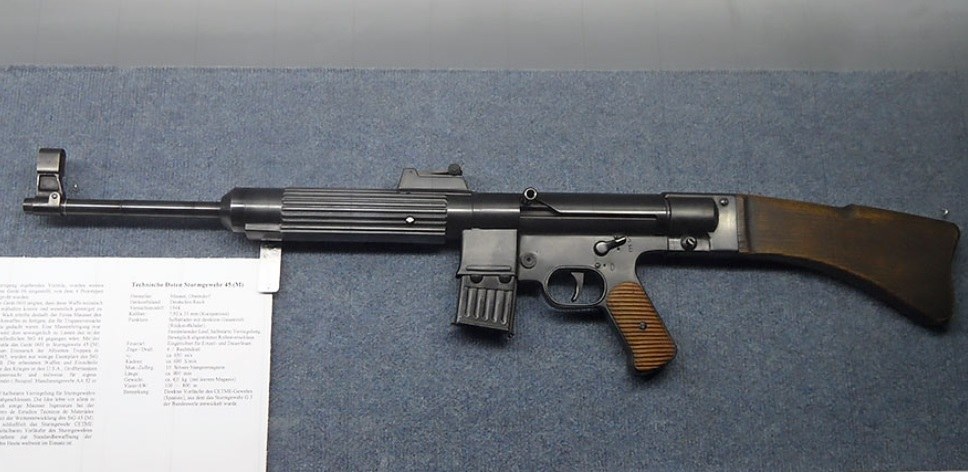
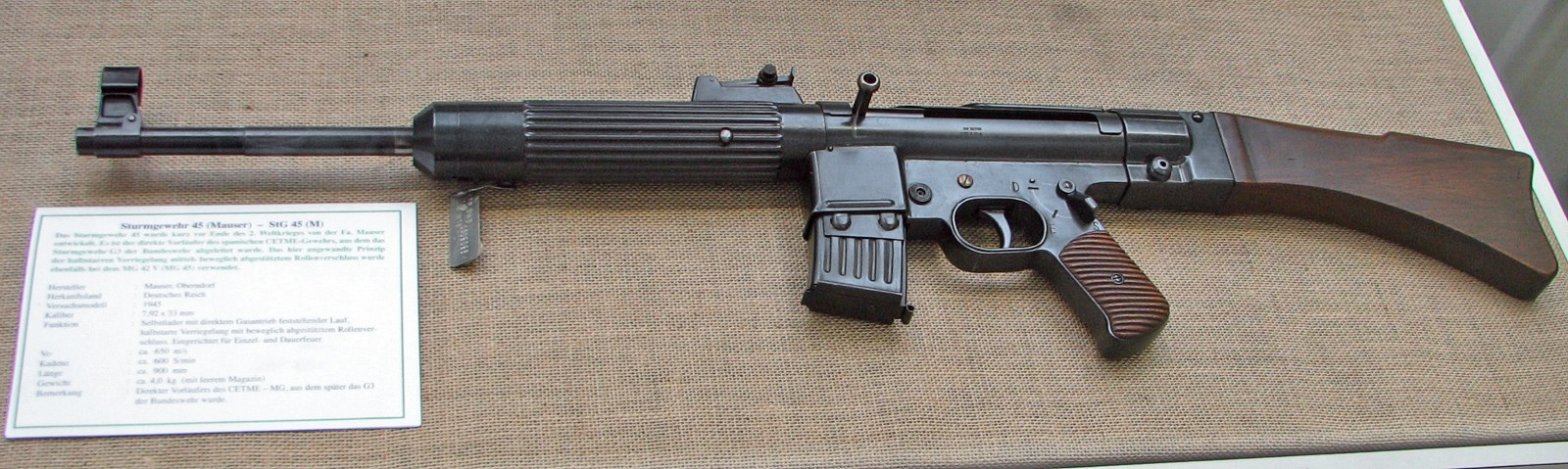
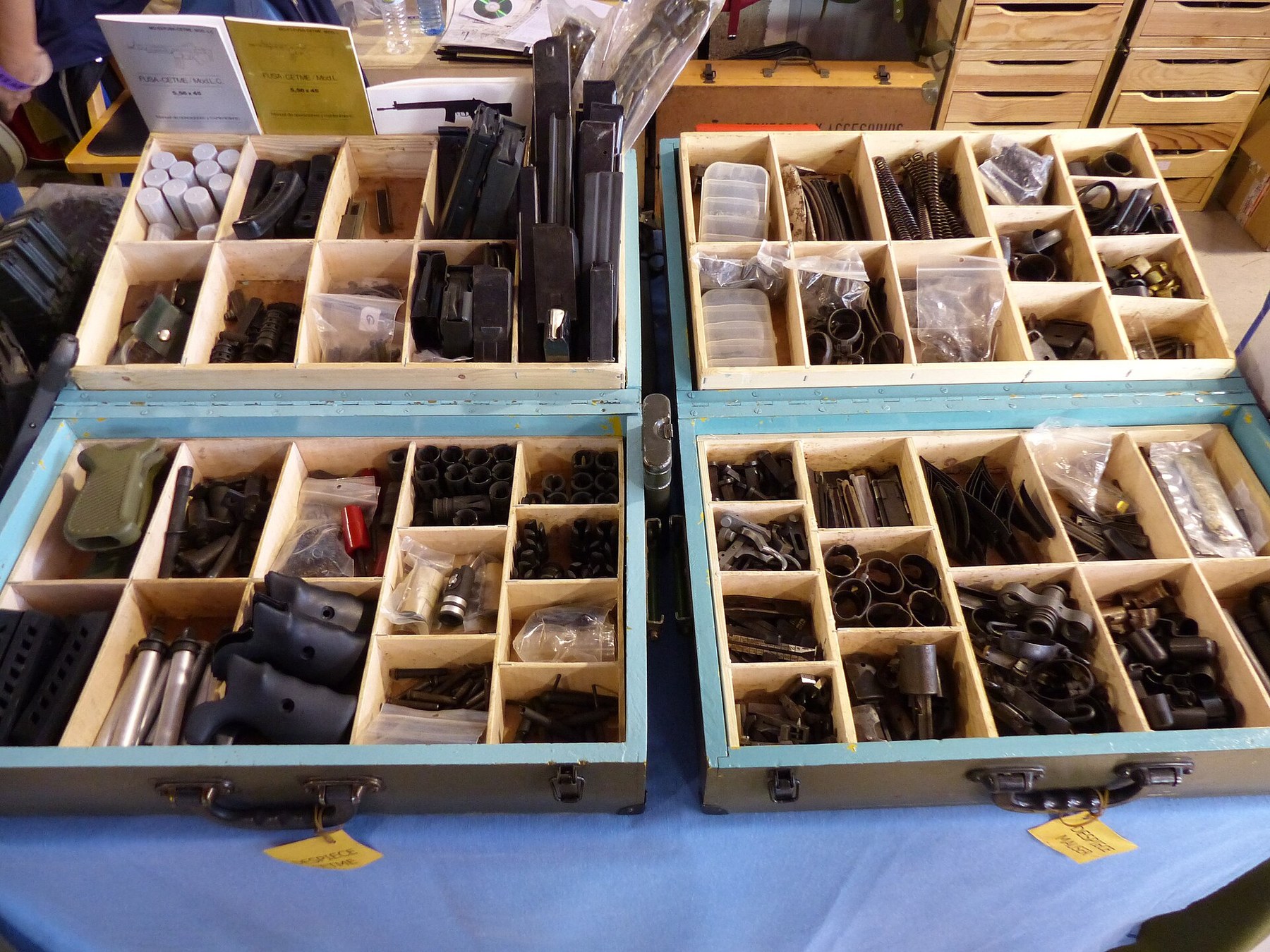
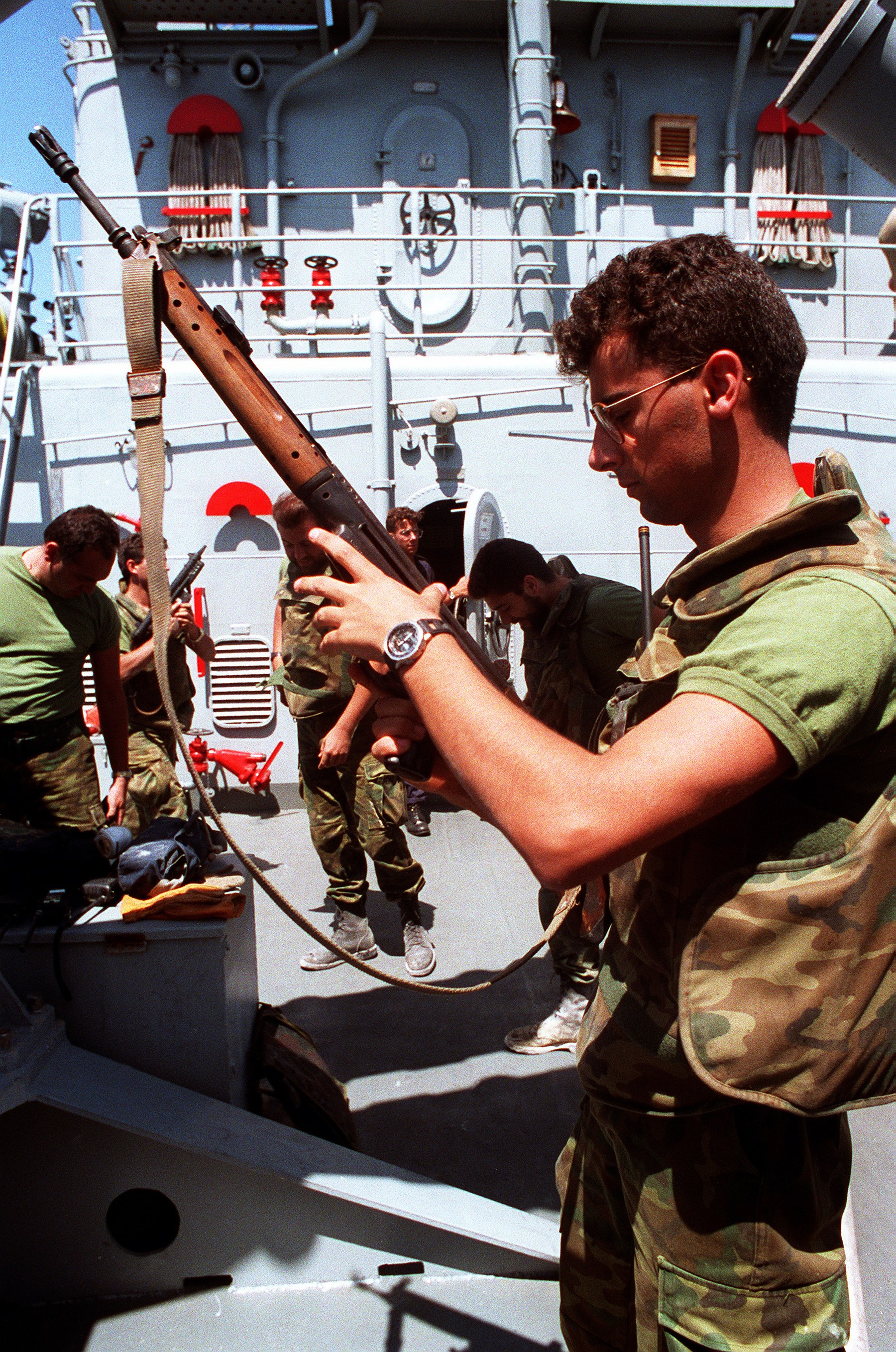
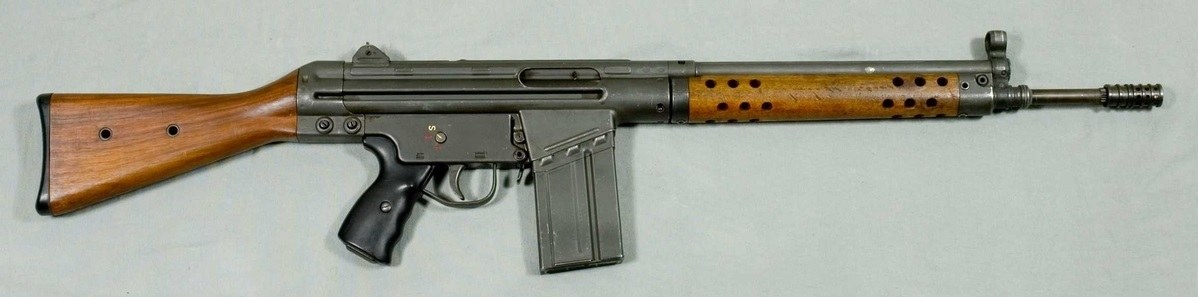
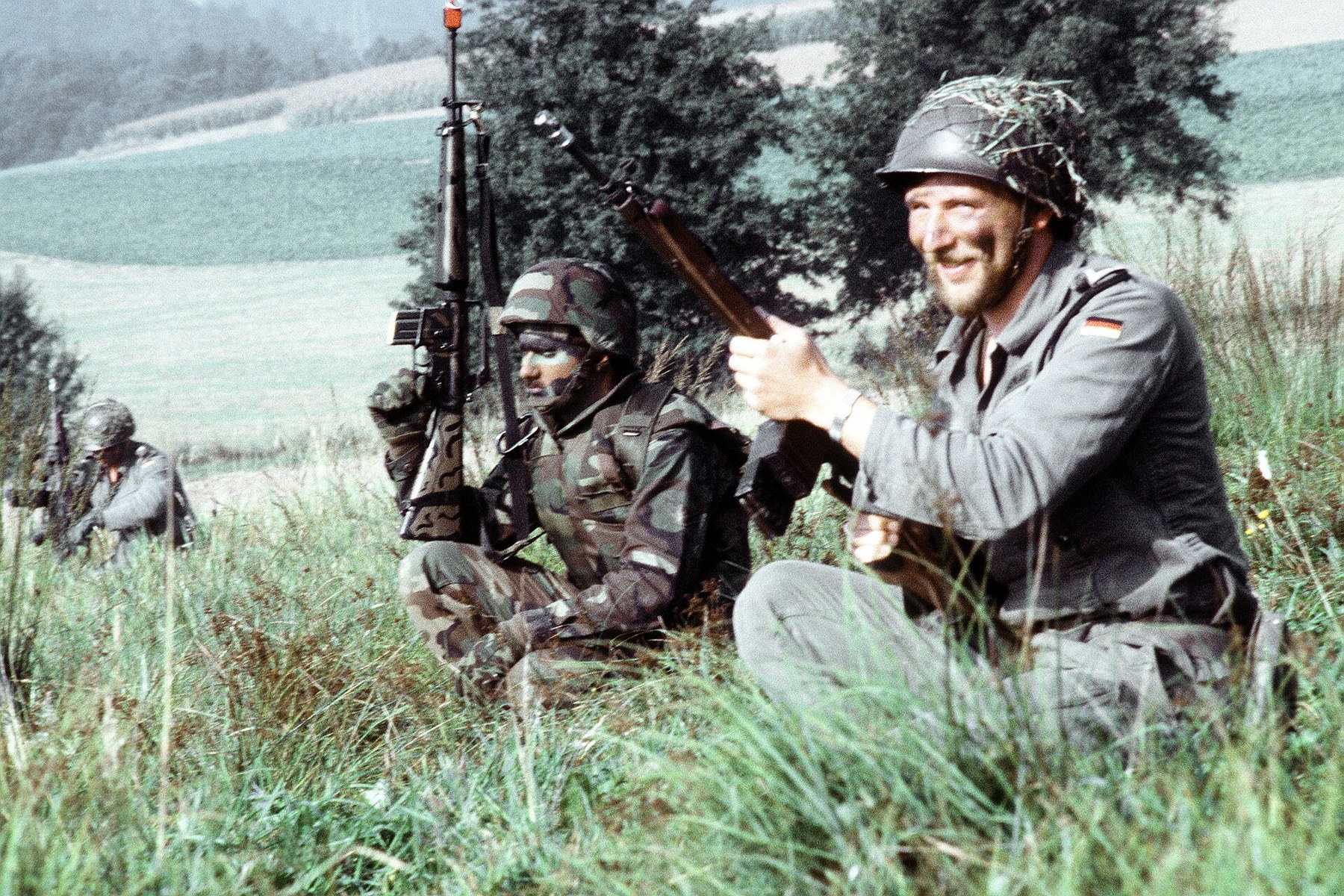
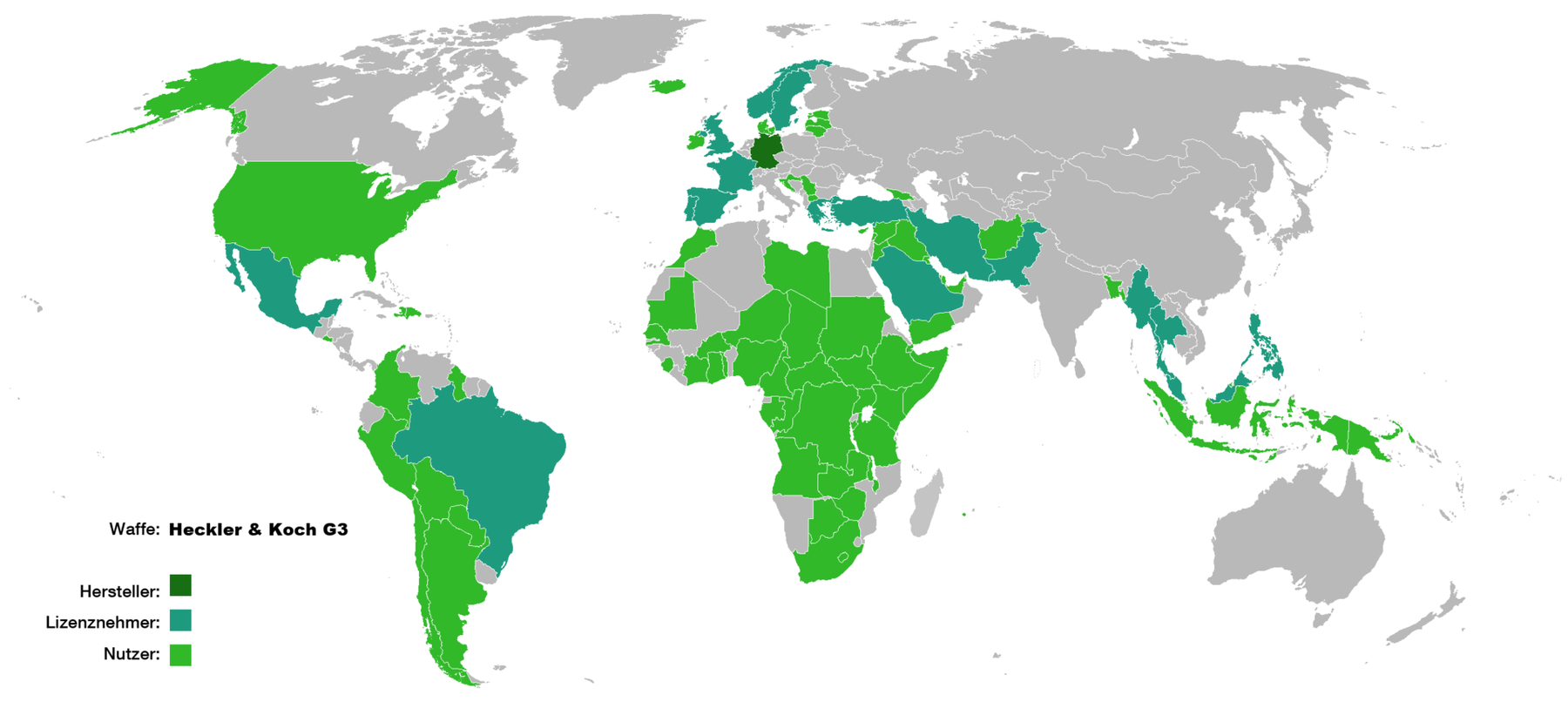
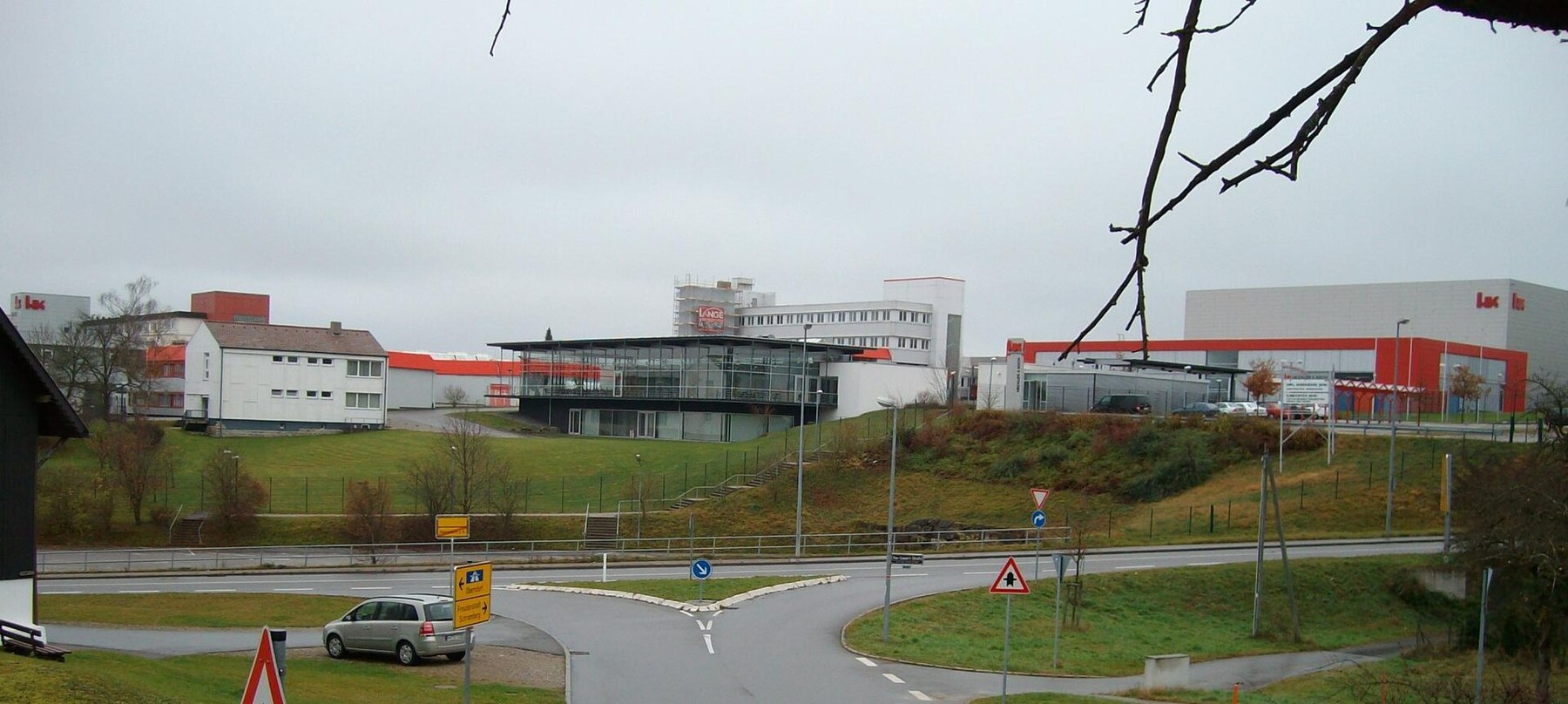
Heckler & Koch itself was founded in Oberndorf on 28 December 1949 by three former Mauser engineers, Edmund Heckler, Theodor Koch and Alex Seidel; the hub’s Mauser HSc dive, Volume 6 gives the company’s origins and the 2023 study of its founders’ wartime records, and they are not repeated here. The G3 made H&K one of the world’s large military-rifle makers. A map drawn by a Commons contributor shows the G3’s spread: made by H&K, built under licence in a dozen countries, and issued in many more.
1.10 Theodor Koch’s patents: the parts H&K already owned
The PSG1 is often described as a G3 “heavily modified”. It is more accurate to say that H&K spent the 1960s patenting the ingredients the PSG1 combines. Four US patents assigned to Heckler & Koch show it:
Table 3 — The PSG1 is often described as a G3 "heavily modified". It is more accurate to say that H&K spent the 1960s patenting the ingredients the PSG1 combines. Four US patents assigned to Heckler & Koch show it
| Patent | Inventor | Filed / issued | What it covers |
|---|---|---|---|
| US 3,283,435, “Breech closure” | Theodor Koch | German priority 30 October 1963; issued 8 November 1966 | A roller breech with a “supplementary mass” of heavy-metal granules in the bolt to stop it rebounding25 |
| US 3,566,745, “Automatic firearm bipartite semirigid bolt” | Stanly Jauch, Herbert Meidel | Priority 28 October 1967; issued 2 March 1971 | Bolt-head carrier, camming piece, rollers and a catch lever holding head to carrier26 |
| US 3,643,364, polygonal rifled barrel | Theodor Koch | Continuation of 26 September 1967; issued 22 February 1972 | Rifling as “a regular polygon with rounded sides and corners”27 |
| US 3,736,693, “Firearm barrel” | Theodor Koch | German priority 8 March 1967; issued 5 June 1973 | A chamber with “release grooves” formed by polygonal shaping, ending at “a cylindrical sealing surface at the cap end of the cartridge”28 |
The PSG1’s barrel is polygonal (H&K: “Polygon”), its chamber has relief grooves, and its bolt is held against rebound by a lever on the carrier (Volumes 3 and 4).1 Whether any of these four patents describes the PSG1’s production parts exactly is not established, and the dive does not claim it. They establish that the technologies were H&K’s own, in hand by the late 1960s.
1.11 The civilian line: HK41 and HK91
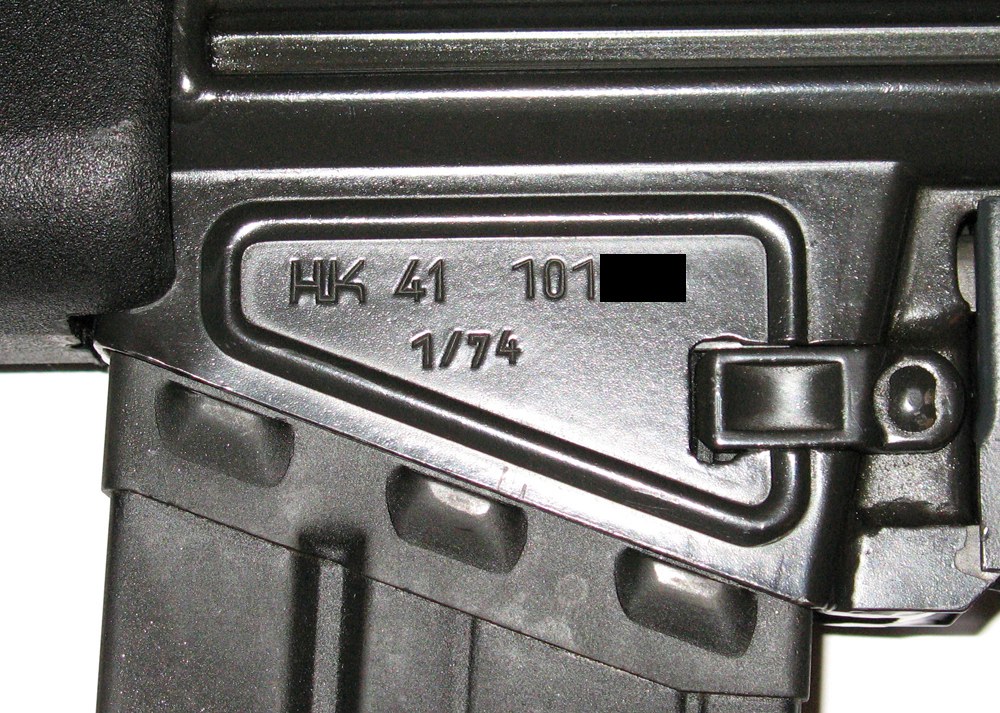
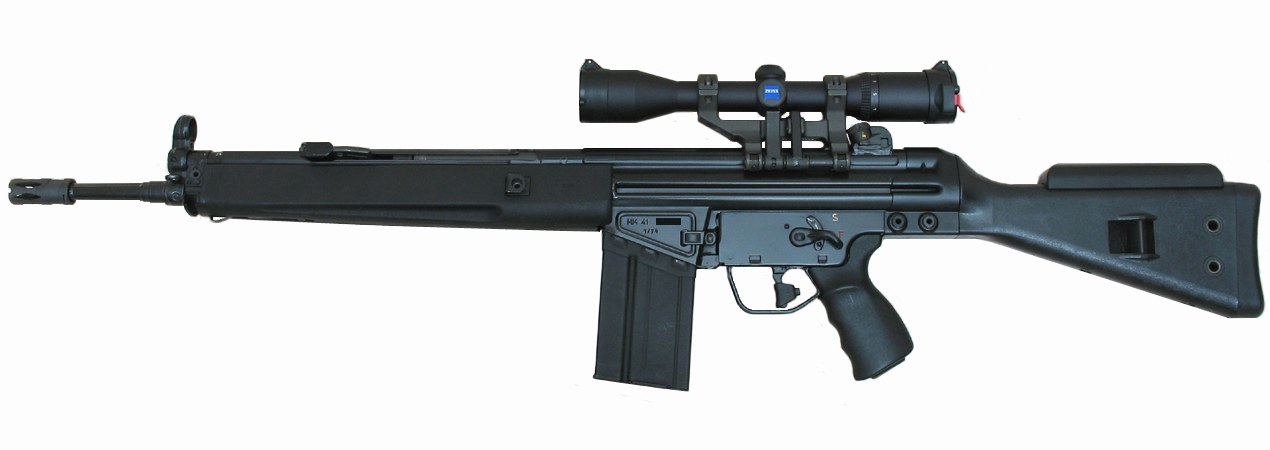
H&K also sold the G3 action to civilians as a semi-automatic, first as the HK41 and then, for the American market, as the HK91; Volume 5 identifies them. One HK41 receiver in a Commons photograph carries the marking “HK 41” with “1/74”, and an HK41 is shown fitted with a telescope, the civilian echo of the G3 marksman rifle.29 The HK91’s operator’s leaflet from Oberndorf lists a “Hensoldt 4×24” telescope “in HK special mount” as its optical sight.30 These rifles matter to the PSG1 story for two reasons: their parts are the parts American builders use for PSG1-pattern rifles today (Volume 9), and H&K’s American sales of the whole family were cut off by the import decisions of 1989 and 1998 (Volume 8).
1.12 Verdict on the origin
Set out plainly:
- Documented: the Bavarian police had no trained marksmen at Fürstenfeldbruck in 1972; the rescue failed; West Germany created GSG 9 (ready April 1973) and a police marksman service; GSG 9’s interim rifles were a Mauser SP 66 and a G3/SG1 grouping about 40 mm at 100 m; the police wanted 20 mm; the PSG1 was available to German police by the mid-1980s, developed “under the decisive influence of GSG 9” (federal police college, 2001); in H&K’s own words it is a police precision rifle.
- Repeated but not documented in sources read: that H&K was commissioned in 1972, or at any date, to answer Munich; a written police requirement; any year of development or introduction from H&K.
- Disputed: whether the Fürstenfeldbruck marksmen’s rifles had telescopes (the archive-based memorial and the Deutsches Waffen-Journal say yes; Reeve’s book, as cited by Wikipedia, says no).
The Munich connection is real in the sense that matters: the PSG1 answers a need that Munich exposed, and the unit created because of Munich shaped it. The popular version, in which H&K was handed an order in 1972, is not documented, and the dates in print that put the rifle in 1972 are wrong on the evidence found. Read the auction house’s hedge as accurate: said to have been.
1.13 What could not be established
- Any H&K document dating the PSG1’s development, and any written police requirement for it.
- The Bavarian government’s report of 20 September 1972, and Reeve’s page 116, which bear on the marksmen’s telescopes.
- The PSG1’s first production year. One auction catalogue’s reading of a 1981 date code is the only physical evidence found.
- Whether H&K’s 1960s patents describe the PSG1’s production parts.
- Primary dates for the StG 45(M), CETME and the G3’s adoption.
References
Footnotes
-
Heckler & Koch GmbH, Kurzbeschreibung des Präzisionsschützengewehres PSG 1 (Oberndorf, n.d.), printed pp. 2–6, 45. Internet Archive collection “MManuals”, https://archive.org/download/MManuals/HkPsg1.pdf, consulted 2026-10-18. H&K copyright; quoted in translation. ↩ ↩2 ↩3 ↩4
-
Ian McCollum, “The Ultimate German Sniper Rifle: the H&K PSG-1 at James D Julia”, Forgotten Weapons, 18 March 2017, https://www.forgottenweapons.com/the-ultimate-german-sniper-rifle-the-hk-psg-1-at-james-d-julia/, consulted 2026-10-18. ↩ ↩2 ↩3
-
Heckler & Koch, PSG1 product page, heckler-koch.de, Wayback Machine capture of 16 July 2007, https://web.archive.org/web/20070716032224/http://www.heckler-koch.de/HKWebText/detailProd/1929/114/4/16, consulted 2026-10-18. Translated for this dive. ↩ ↩2
-
Heckler & Koch, “PSG1 A1” overview, heckler-koch.com, Wayback capture of 17 August 2012, http://web.archive.org/web/20120817103631/http://www.heckler-koch.com:80/en/military/products/precision-rifles/psg1-a1/psg1-a1/overview/print.html, consulted 2026-10-18. ↩ ↩2
-
Franz Keck, “Präzision mit Geschichte”, Deutsches Waffen-Journal, January 2023, pp. 20–25 (test of the Schwaben Arms SAR M41 PSG). Copy published by the maker, https://www.schwabenarmsgmbh.de/index_htm_files/Testbericht%20DWJ%20Ausgabe%2001-2023%20SAR%20M41%20PSG.pdf, consulted 2026-10-18. Translated for this dive. ↩ ↩2 ↩3 ↩4
-
“Munich massacre”, English Wikipedia, https://en.wikipedia.org/wiki/Munich_massacre, consulted 2026-10-18 (wikitext read). Its “without telescopic sights” sentence cites the Fürstenfeldbruck memorial site, which says the rifles had telescopes; a second sentence cites Simon Reeve, One Day in September (2000), p. 116, not seen for this dive. ↩ ↩2
-
Dominik Aufleger, Anna Greithanner and Robert Wolff, Erinnerungsort Fürstenfeldbruck 1972 (Landkreis Fürstenfeldbruck, 2022), pages “Der Polizeieinsatz” and “Die Nachgeschichte”, https://www.erinnerungsort-fuerstenfeldbruck1972.de/police-operation-de and https://www.erinnerungsort-fuerstenfeldbruck1972.de/en/posthistory-de, consulted 2026-10-18. Based on Staatsarchiv München prosecution files. ↩ ↩2 ↩3
-
“Münchner Olympia-Attentat”, German Wikipedia, https://de.wikipedia.org/wiki/M%C3%BCnchner_Olympia-Attentat, consulted 2026-10-18. ↩
-
Gernot Pieper, “Analyse der derzeitigen Entwicklungstendenzen von polizeilichen Schusswaffen”, in Anke Borsdorff and Martin H. W. Möllers (eds.), Der Einfluss internationaler Entwicklung auf die Arbeitsfelder der Polizei, Arbeiten zu Studium und Praxis im Bundesgrenzschutz vol. 7 (Fachhochschule des Bundes für öffentliche Verwaltung, Fachbereich Bundesgrenzschutz, Lübeck, 2001), ISBN 3-930732-68-8, section 4.2 “Präzisionsgewehre”, pp. 36–39. https://edoc.vifapol.de//opus/volltexte/2009/1229/pdf/band_07.pdf, consulted 2026-10-18. Translated for this dive. ↩ ↩2 ↩3 ↩4 ↩5 ↩6 ↩7 ↩8
-
Rock Island Auction Company, Premier Auction 3–5 December 2021, Volume I, lot 661, catalogue p. 388, https://cdn.rockislandauction.com/flipbooks/84/BOOK1/files/basic-html/page388.html, consulted 2026-10-18. ↩ ↩2
-
Rock Island Auction Company, Premier Auction 9–11 December 2022, Volume III, lot 3737, catalogue p. 338, https://cdn.rockislandauction.com/flipbooks/87/BOOK3/files/basic-html/page338.html, consulted 2026-10-18. ↩ ↩2
-
Rock Island Auction Company, Bedford, Texas, 25 August 2024, lot 3589, https://www.rockislandauction.com/detail/4092/3589/heckler-koch-psg1-semiautomatic-sniper-rifle-with-scope, consulted 2026-10-18. ↩ ↩2
-
Alex C., “H&K PSG1 Sniper Rifle Overview”, The Firearm Blog, 18 February 2016, https://www.thefirearmblog.com/blog/2016/02/18/hk-psg1-sniper-rifle-overview/, consulted 2026-10-18. ↩ ↩2
-
Melvin Ewing, “H&K PSG-1 Full Review”, Sniper Central, 26 August 2020, https://snipercentral.com/hk-psg-1-full-review/, consulted 2026-10-18. ↩ ↩2
-
Maxim Popenker, “Heckler – Koch PSG1 sniper rifle (Germany)”, Modern Firearms, undated, https://modernfirearms.net/?p=7379, consulted 2026-10-18. ↩ ↩2
-
“Heckler & Koch PSG1”, English Wikipedia, https://en.wikipedia.org/wiki/Heckler_%26_Koch_PSG1, consulted 2026-10-18. ↩ ↩2
-
“HK PSG1”, German Wikipedia, https://de.wikipedia.org/wiki/HK_PSG1, consulted 2026-10-18. ↩ ↩2
-
Fred Mastison, “The Heckler & Koch PSG1: The Ultimate Precision Sniper Rifle”, Athlon Outdoors, 1 April 2025, https://athlonoutdoors.com/article/the-heckler-koch-psg1/, consulted 2026-10-18. ↩
-
“Liste der Handwaffen des Bundesgrenzschutzes”, German Wikipedia, https://de.wikipedia.org/wiki/Liste_der_Handwaffen_des_Bundesgrenzschutzes, consulted 2026-10-18. Uncited list. ↩
-
Bundesministerium der Verteidigung, ZDv 3/13 Das Gewehr G3 (Bonn, 13 December 1978; text current to amendment no. 38 of 8 January 1999), title page, Nr 102, 104, 406–410, Bild 102–103, 401–403. Wikimedia Commons, https://commons.wikimedia.org/wiki/File:ZDv_3-13_Das_Gewehr_G3_(1999).pdf, licence tag “Public domain” (German official work), consulted 2026-10-18. Translated for this dive. ↩ ↩2 ↩3 ↩4 ↩5
-
US Defense Intelligence Agency photograph, 18 September 1980, “The West German H&K SSG sniper’s rifle”, Wikimedia Commons, https://commons.wikimedia.org/wiki/File:HK_SSG.jpg, public domain (US government work), consulted 2026-10-18. ↩
-
Edward Stecke, US Patent 2,089,671, “Automatic Firearm”, filed 30 June 1934, issued 10 August 1937, p. 1. Public domain. https://patents.google.com/patent/US2089671A, consulted 2026-10-18. ↩
-
Ian McCollum, “WW2 Mauser Becomes Heckler & Koch: the StG-45(M), or Gerat 06H”, Forgotten Weapons, 20 July 2018, https://www.forgottenweapons.com/ww2-mauser-becomes-heckler-koch-the-stg-45m-or-gerat-06h/, consulted 2026-10-20. “The design for the Gerät 06H actually began with the Gerät 03, an attempt to make a roller-locked G43 rifle in 8x57mm. An accident with automatic fire and bolt bounce sparked the idea of roller-delayed blowback”. ↩ ↩2
-
Ian McCollum, “Gerat 06H”, Forgotten Weapons, 14 January 2011, https://www.forgottenweapons.com/gerat-06h/, consulted 2026-10-20. “The initial design (the Gerat 06) used rollers to lock the action, and a gas pistol to operate. It was determined that the rollers alone could function as a delayed blowback system”. ↩ ↩2
-
Theodor Koch, assignor to Heckler & Koch GmbH, US Patent 3,283,435, “Breech Closure”, filed 27 October 1964, German priority 30 October 1963, issued 8 November 1966. https://patents.google.com/patent/US3283435A, consulted 2026-10-18. ↩
-
Stanly Jauch and Herbert Meidel, assignors to Heckler & Koch GmbH, US Patent 3,566,745, “Automatic Firearm Bipartite Semirigid Bolt”, filed 25 October 1968, priority 28 October 1967, issued 2 March 1971. https://patents.google.com/patent/US3566745A, consulted 2026-10-18. ↩
-
Theodor Koch, US Patent 3,643,364, “Rifled Gun Barrel with the Interior Cross-Sectional Configuration Defining a Regular Curvilinear Polygon”, filed 7 November 1969 (continuation of 26 September 1967), issued 22 February 1972. https://patents.google.com/patent/US3643364A, consulted 2026-10-18. ↩
-
Theodor Koch, assignor to Heckler & Koch GmbH, US Patent 3,736,693, “Firearm Barrel”, German priority 8 March 1967, issued 5 June 1973; abstract quoted. https://patents.google.com/patent/US3736693A, consulted 2026-10-18. ↩
-
Michael Sullivan, “1974 HK41 Receiver” and “HK41 SG1”, Wikimedia Commons, https://commons.wikimedia.org/wiki/File:1974_HK41_Receiver.jpg and https://commons.wikimedia.org/wiki/File:HK41_SG1.jpg, public domain, consulted 2026-10-18. ↩
-
Heckler & Koch GmbH, The Selfloading Rifle HK 91 Cal. .308 (Oberndorf/Neckar, pre-1990). Internet Archive collection “MManuals”, https://archive.org/download/MManuals/Hk91.pdf, consulted 2026-10-18. ↩


Comments (0)