Flux Raider · Volume 3
How It Works — the Pistol Inside, the Hood Above, the Brace Behind
How the FCU and slide ride in the chassis, why a charging handle exists at all, the thumb pedal, the chassis safety, the two magazine wells, the brace mechanism and the recoil path
A Raider X does not change how a P320 fires. The striker, the sear, the barrel’s unlocking and the slide’s travel are exactly what they are in SIG’s own grip module; that machinery is covered in the SIG P320-M17 dive, Volume 2 and is not repeated here. What the chassis changes is everything the shooter touches and everything the recoil passes through after it leaves the slide. This volume takes those changes one at a time, from the published descriptions of the two companies involved and from the two patents that describe the chassis’s defining mechanisms.
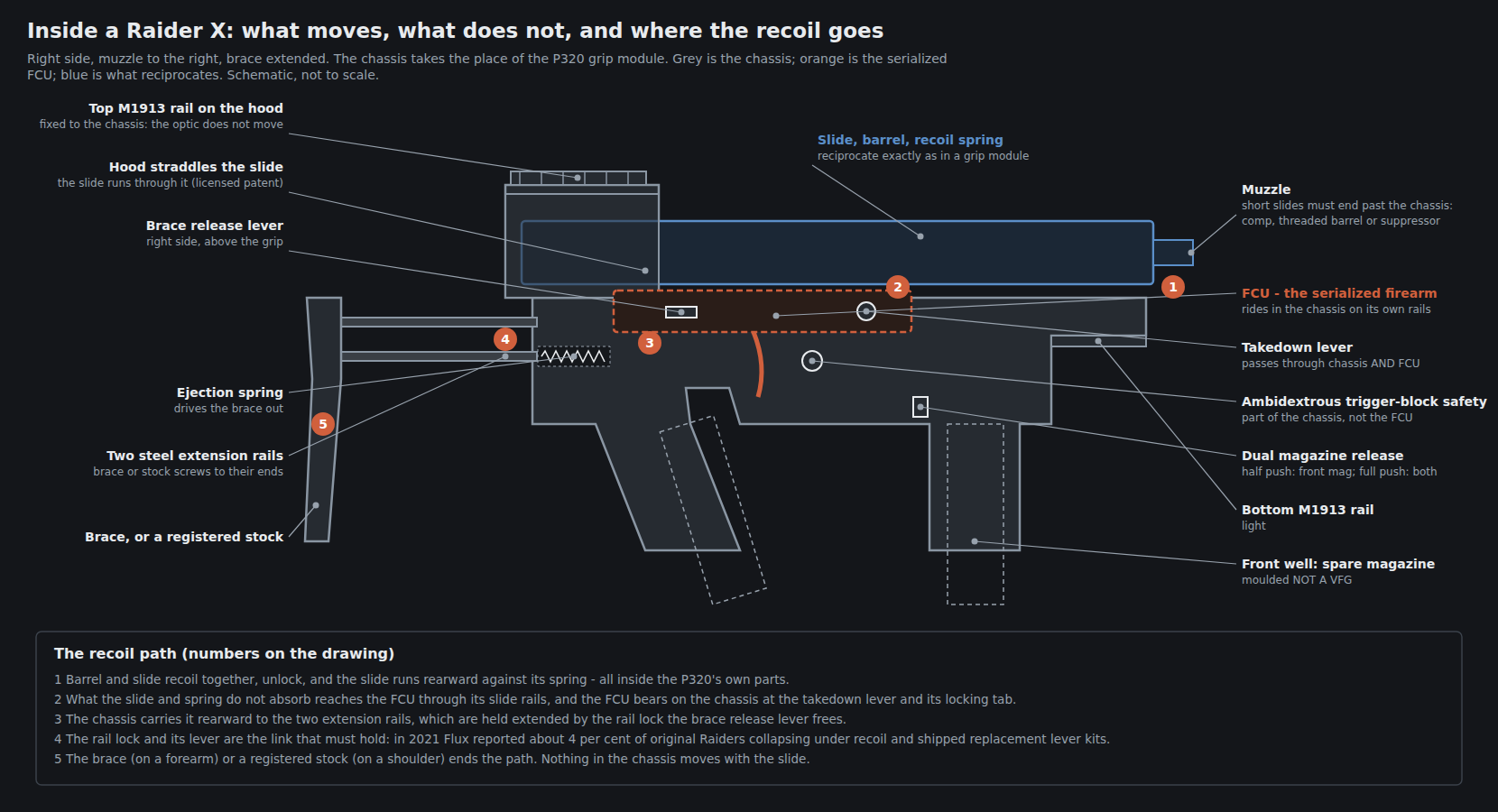
3.1 The Pistol Inside: an FCU Held as a Grip Module Would Hold It
The P320’s fire control unit is a stainless steel chassis of its own. It carries the trigger, the sear, the slide catch lever, the takedown lever’s bore and, critically, the four steel rails the slide runs on. The grip module SIG sells is a polymer shell that holds the FCU and gives it a grip, a magazine well and a dust-cover rail. It contributes nothing to the slide’s guidance.
The Raider X takes the grip module’s place and nothing else’s. Flux’s instruction is that the FCU and slide go in “the same way you would a standard grip module,”1 and SIG’s manual gives the sequence (Volume 5 quotes it in full): the FCU enters the rear of the chassis, is pressed down and pivoted into position on its front, and is locked by the takedown lever, which passes “through the chassis and Fire Control Unit, locking FCU in place.”2 The slide then goes onto the FCU’s rails from the front, exactly as on a factory pistol.
Three consequences follow.
The slide rides on the FCU, not on the chassis. Slide-to-rail fit, lock-up and the barrel’s position in the slide are SIG’s, unchanged. What the chassis can affect is how rigidly the FCU is held — which is why Flux’s improvement list for the Raider X includes “Improved dimensions to increase reliability of the various systems” — but it does not touch the slide.
Two parts pass through both. The takedown lever and the slide catch lever are FCU parts that must operate through holes and clearances in the chassis wall. SIG’s manual warns that on installation “You may need to maneuver the slide catch lever on the FCU past the brace release arm on the chassis.”2 The two levers sit next to each other, and that proximity explains a Flux accessory treated in Volume 6: an optional lever that lets the brace release also drop the slide, sold with the warning that it “may cause your brace/stock rails to collapse under recoil if not installed and tuned correctly.”3
The magazine catch is the chassis’s, not the pistol’s. Flux’s FAQ: “Instead of the traditional button press inwards, the primary magazine is released by pushing the mag release button forward.”1 The P320’s own reversible catch lives in the grip module, which is gone.
3.2 The Hood Above: a Non-Reciprocating Optic Mount
The raised structure over the rear of the slide is the feature that makes a Raider look like a Raider. Flux calls it the “Built in non reciprocating optic mount”; SIG lists it as “M1913 Rail — Top rail used for optic or accessory mounting.”42 It is two side walls rising from the chassis with a Picatinny-slotted roof between them, and the slide runs underneath the roof and between the walls.
The arrangement is not Flux’s invention and Flux says so. Its patents page lists a licence to US Patent 9,797,687, “Integrated optical sight mount,” filed by Trent Zimmer in 2016, whose abstract describes a mount “integrated into the frame of a handgun and used to position an optical sight over the slide,” supported by “a first side wall and a second side wall, each of which extend from the frame,” with an opening between them “so that the slide assembly of the handgun is able to pass therethrough without interference.”5 The patent was drawn around a Glock-pattern frame; the Raider’s hood is the same idea moulded into a chassis.
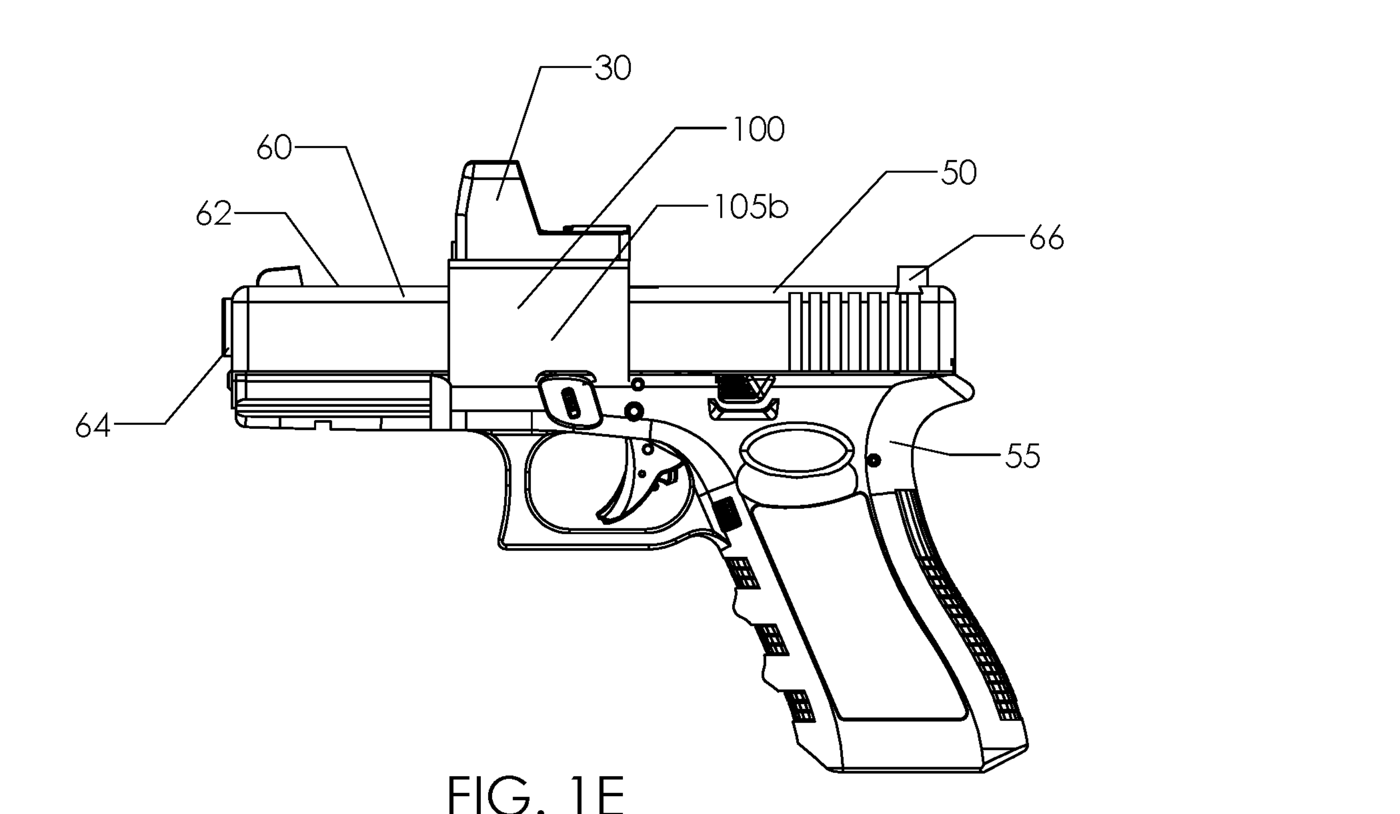
What it does to the sighting is already treated in the SIG P320-M17 dive, Volume 7: the optic experiences only the chassis’s recoil, not the slide’s acceleration; the dot sits higher over the bore than a slide-mounted one; and zero is held by the chassis rail rather than by the slide. Three further points belong to the chassis:
- The Raider X raised the hood. Flux’s improvement list: “Added slot to optic rail, raised it by 1mm and changed the front and rear ends, all to ensure full compatibility with all optics,” and “Inside of slide channel under optic rail raised by 1mm for compatibility with adjustable iron sights.”6 The second item is a clearance change: the slide’s rear sight passes under the hood roof on every shot.
- Two optics are known not to fit directly. “The only confirmed optics that do have issues directly mounting is the Holosun AEMS (tight installation fitment) and Eotechs with the QD latch (The QD latch will get stuck on the optic mount).”1
- SIG’s manual says “Slide mounted optic: No.” Its compatibility table lists a slide-mounted optic as incompatible with the Raider X. Flux’s FAQ is softer — the chassis keeps toolless takedown “unless you have a slide mounted optic/suppressor height sights” — and Flux’s own answer to anyone who wants the optic on the slide is the Chop Top, which has no hood.217 On a standard Raider X, the optic goes on the hood.
3.3 Why a Charging Handle Exists at All
A P320’s slide is gripped at its rear serrations. On a Raider X the rear of the slide is inside the hood, and the sides of the slide are flanked by the chassis walls and, below them, by the brace’s steel extension rails. The part of the slide a hand normally grasps is covered.
What remains exposed is the front of the slide, forward of the hood — which is where every Raider charging solution works. None of them is a chassis part; each replaces something on the slide:
Table 1 — What remains exposed is the front of the slide, forward of the hood — which is where every Raider charging solution works. None of them is a chassis part; each replaces something on the slide
| Product | Maker | Mounts in | Price, 19 Sept 2026 | Source |
|---|---|---|---|---|
| RipStik side charging handle | Tactical Development | the slide’s front-sight channel, left or right side | $95.00 blackout, $120.00 tritium | Tactical Development8 |
| F10 top charging handle | Tactical Development | the slide’s front-sight channel, on top | $95.00 | Flux9 |
| Velocity / Flux slide | Killer Innovations | its own dovetails at 3, 9 and 12 o’clock | $525.00 (out of stock) | Flux10 |
| Charger Grip Tape | Flux | laser-cut tape on the front of an M17 / full-size slide | $9.99 | Flux11 |
The F10’s listing, which Flux carries, tells the design history in one paragraph: “The F10 started out as what I thought was an ‘off the wall’ idea when doing the R&D for the side charging handle, the RipStik. I mentioned to Ben at the range, ‘what about a Mac10 top style charging handle?’ … Once prototyped it just felt right!” It adds that the F10 was “originally design[ed] for the Flux Raider” but fits “any P320 slide with a front sight channel.”9
The RipStik on the pistol documented in the P320 dive, and its maker’s installation cautions — pressed in “only … via the middle sight protrusion” with a sight pusher, never hammered — are covered in the SIG P320-M17 dive, Volume 4. What matters for planning is that a charging handle is a slide part. It moves with the slide to a new chassis, or stays behind with it; a second build needs its own unless the slide is being shared.
3.4 The Thumb Pedal
The Tactical Development Forward Operating Pedal — the “gas pedal” — is a thumb ledge that screws to the side of the chassis ahead of the grip. Its maker, the part and the mechanics of pushing the muzzle down with the support-hand thumb are in the SIG P320-M17 dive, Volume 4, which records that Tactical Development’s own page names only “the Flux Raider” and not the X.
Flux’s page for the same product closes that gap. It describes the pedal as “a thumb ledge for the P320 Flux Raider X and P320 Flux Raider MP17,” adds that “Thumb ledges give you more surface area for you to apply downforce and reduce recoil,” and specifies that “The left side of the slide is for right-handed shooters, and the right side of the slide is for left-handed shooters.” A 5/64-inch hex key installs it — the same key stored in the chassis.12 Flux also lists a smaller version, $19.89, that mounts “to the screw holes at the bottom of your Halo mount” for owners who fit Tactical Development’s forward Halo shroud (Volume 6).13
One legal detail belongs here because it is moulded into the chassis itself. The forward magazine well carries the letters NOT A VFG on its face, and Flux’s product text says the well “is designed and intended only as a spare mag carrier, not as a vertical grip. There is no designed texture for gripping. Furthermore, it is specifically designed so you cannot wrap your thumb around it like a vertical grip.”14 Volume 7 sets that statement beside what ATF has said about fore grips.
3.5 The Chassis Safety
The Raider X carries its own ambidextrous manual safety, and it is a chassis part, not an FCU part. SIG’s manual describes it: “The manual safety mechanically blocks the movement of the trigger, preventing release of the striker. To engage the manual safety, rotate the manual safety lever upward. The word SAFE will be visible. … Pressing up on the lever from either side will rotate the opposite lever upward.”2 It sits on the chassis side just above the trigger, with FIRE and SAFE moulded beside it.
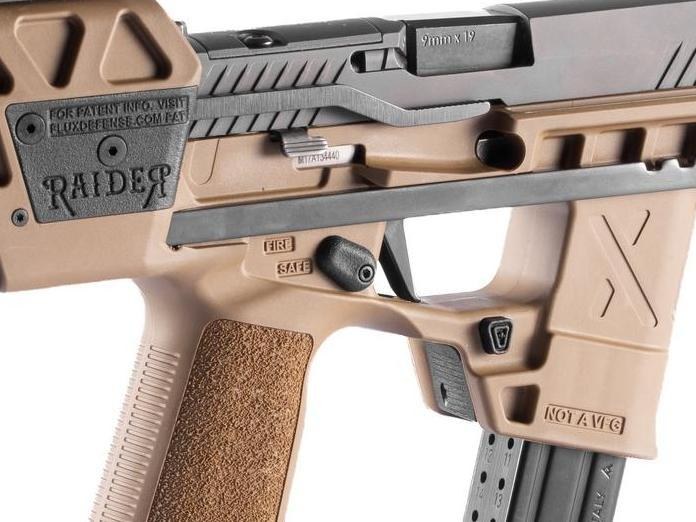
Four facts about it bear on every build.
- It is why the FCU’s own safety has to go. An M17 or M18 FCU carries SIG’s thumb-safety levers. The chassis has no cut-outs for them, and both makers exclude the combination: Flux, “M17/18 manual safeties must be removed and replaced with an OEM pin (simple mod)”; SIG’s compatibility table, “FCU w/ Manual Safety — No.”42 Volume 4 takes up what that means for buying a donor.
- It must be on FIRE when the FCU goes in or comes out. SIG: “IT IS VERY IMPORTANT TO PLACE THE SAFETY ON FIRE WHENEVER INSTALLING OR REMOVING THE FCU. FAILURE TO DO SO CAN CAUSE DAMAGE TO THE FCU AND/OR CHASSIS.”2 SIG gives no mechanism; the evident reading is that the chassis safety’s blocking surface occupies the space the trigger swings through when engaged, so an FCU cannot be seated or withdrawn past it.
- It depends on the trigger’s shape. Flux: “Safety mechanism does NOT work with all aftermarket triggers (Agency Arms) or forward set trigger kits! The Raider safety will NOT work with most adjustable triggers.” SIG: aftermarket triggers “may interfere with proper operation of the mechanical safety.” A 2021 Raider page added a list of overtravel-stop triggers that do not work: “Armory Craft, Gray Guns, Deres Dynamics, Apex, etc.”6215 A safety that blocks the trigger from outside the FCU can only block a trigger whose position it was designed around.
- One side of it can be removed. Flux sells a Safety Delete at $7.99 in two versions — “Right side delete (for RH shooters)” and “Left side delete (for LH shooters)” — “so you can tailor the Raiders safety to you.” It is a smooth button that replaces one of the two levers, leaving the safety operable from the other side.16 Armory Craft sells a similar part.
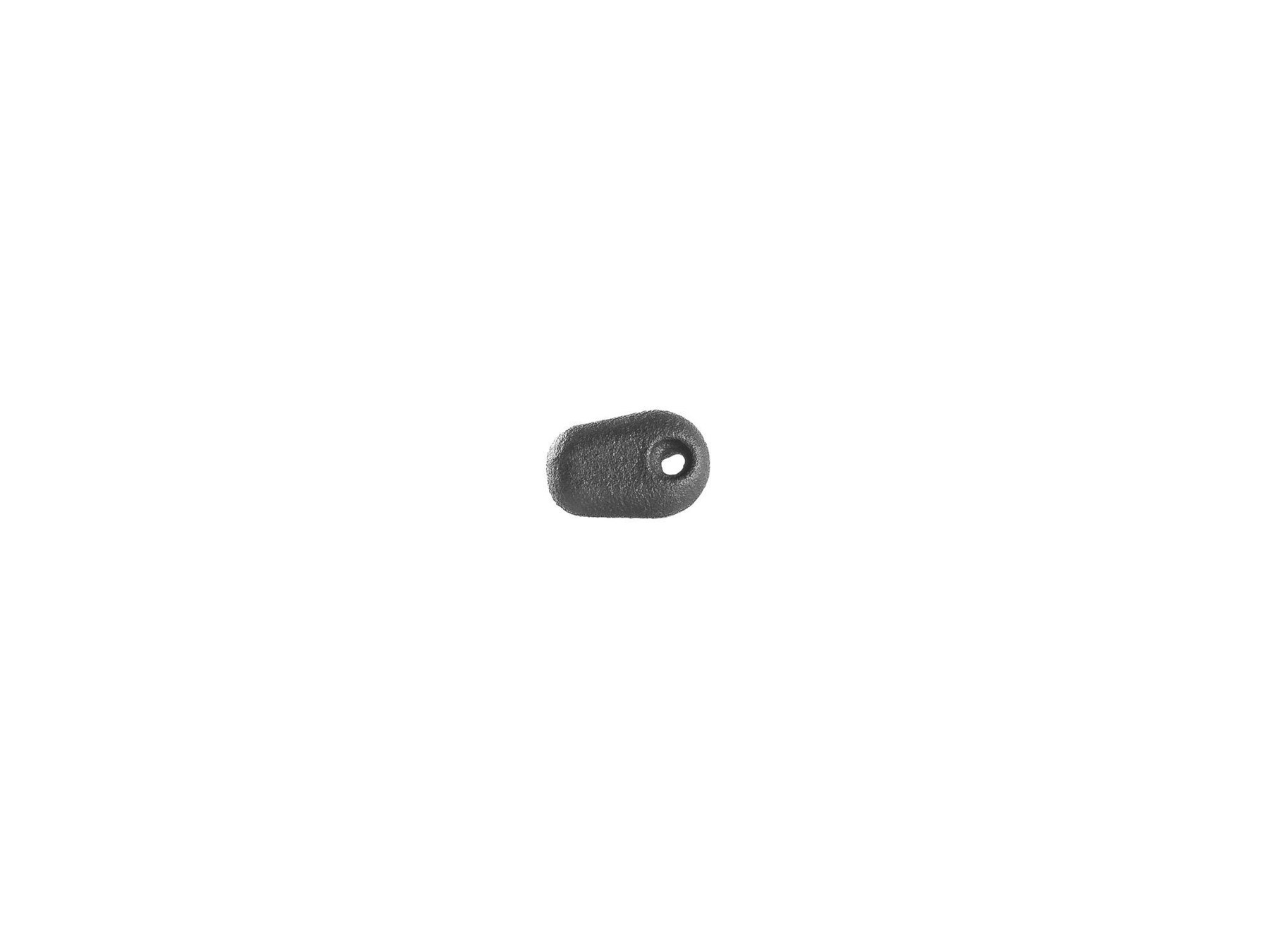
⚠ Two different parts share the name “safety delete.” One — SIG’s pin, or an aftermarket kit — fills the lever hole in an M17 or M18 FCU after its thumb safety is removed. The other — Flux’s $7.99 button, or Armory Craft’s “Safety Delete For The FLUX RAIDER Brace” — replaces one side of the chassis’s own safety lever. Armory Craft’s photographs show its button seated in the chassis beside the FIRE and SAFE markings, and its page notes the part is “incompatible with the Sig Sauer P320 Flux Legion,” a chassis-level statement.17 Ordering one when the other is meant is an easy error.
3.6 Two Magazine Wells
The Raider X has two wells. The rear one, in the grip, holds the magazine that feeds the pistol. The front one, ahead of the trigger guard, stores a spare. SIG’s control table names three releases:2
- a rear magazine release button on the right side;
- a rear magazine release switch on the left, pushed forward;
- the dual magazine release, a two-stage button: “Half push releases front magazine, full push releases both.”
The dual release is the chassis’s reloading system — Flux calls it the “Speedload System” and describes it as “patented.”4 With the rear magazine empty, a full press drops both magazines; the spare is then pulled from the front and inserted in the rear. SIG’s manual gives it as the fast-reload option in its partial-magazine procedure: “press the front magazine release button fully while holding the front magazine to quickly swap them.”2 Flux’s improvement list shows how much of the Raider X’s development went into this system: items 1, 5, 6 and 10 are all about magazines — an over-travel stop, a stronger catch spring “for … clearer division between mag releases,” better fencing and easier insertion.6
Magazine compatibility — 17 rounds and up, or the 10-round full-size; never the 15-round compact — is in Volume 4.
3.7 The Brace Behind: How It Deploys and Locks
The brace (or a registered stock) is fixed to the ends of two steel extension rails that slide in channels along the sides of the chassis body. A spring inside the chassis pushes them rearward; a lock holds them in either of two positions; a lever releases the lock.
Flux’s patent, US 11,156,433, describes the mechanism in detail, and although its drawings show an earlier embodiment it is the clearest published account of how the parts work together:18
- A compression spring sits over an adjustment member — “an elongate rod having a threaded distal end that engages a threaded nut disposed within the mounting housing and a head that can be rotated … to increase or decrease the spring tension.” The patent adds: “if the spring … loses its spring force over time, the adjustment member … can be tightened to increase the spring force.”
- A locking member with a pivoting bar registers its two ends in notches cut in the two rails: one pair of notches holds the brace collapsed, another holds it deployed. A second spring biases the bar into the locked position.
- Pressing the actuating member rotates the bar out of the notches; the compression spring drives the rails and brace rearward until the bar drops into the deployed notches.
- Even before the bar re-engages, “the friction fit between the elongate bodies … and the channels … holds the elongate bodies … in place.”
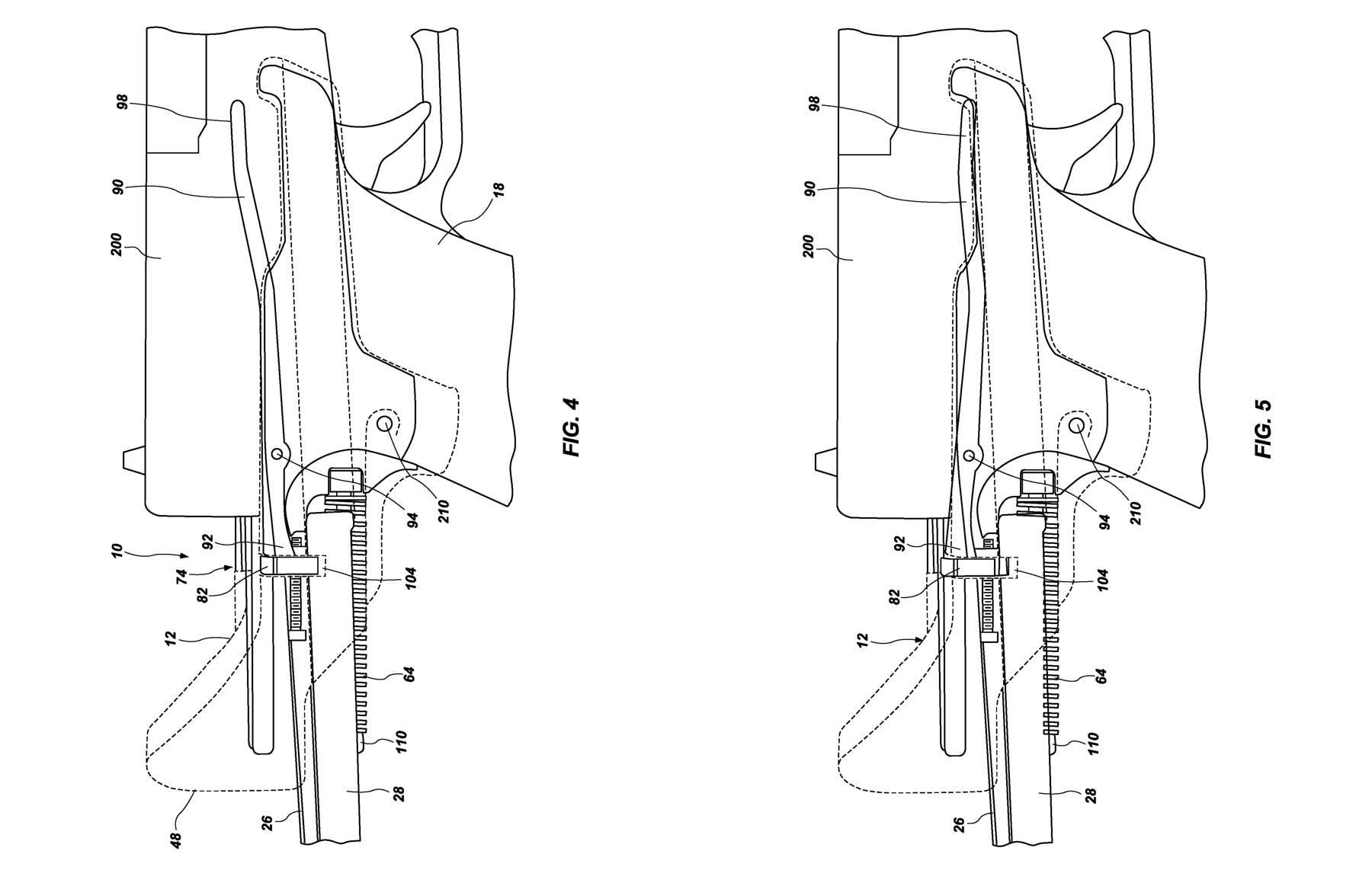
The production Raider X maps onto that description closely. SIG’s manual calls the actuator the “brace release lever” on the right side of the chassis above the grip, and warns the owner to be “mindful of the brace/stock deploying straight back.”21 Flux’s improvement list names the two components the patent describes: a “molded in insert for the ejection spring bolt” — the threaded anchor of the adjusting rod — and “Increased rail-lock spring force” — the spring that holds the locking bar in its notches.6 And Flux’s terms warn against the same part: “Never tamper with tightening of screws or try to modify brace – ejection spring is under tension and removal of bolt … could result in injury or blindness if bolt comes loose under pressure.”19
Collapsing is the reverse, done by hand. Flux: “hold the release lever down, and smack the brace/stock with your opposite hand. Be sure to fully compress the stock back into the ejection spring until you hear an audible click.”1 SIG adds the converse for deploying: “If brace does not fully extend pull it rearward until you hear an audible click,” and “ENSURE BRACE IS FULLY EXTENDED AND LOCKED IN POSITION PRIOR TO FIRING THE PISTOL.”2
Handedness. The standard brace is right-handed; Flux sells a left-handed brace kit separately, with a warning that applies to any brace or stock swap: “because our rails and braces are tuned to fit each other in production, there is a chance that installing the brace will change the performance of the spring loaded ejection. That means the rails and brace will need to be tuned to work together.”20 Volume 5 covers the tune service.
3.8 The Recoil Path
The drawing at the head of this volume numbers the path; in words:
- Inside the pistol. Barrel and slide recoil together, unlock, and the slide continues rearward against its recoil spring. All of this happens within SIG’s parts and is identical in a grip module.
- Into the FCU. What the slide and spring do not absorb reaches the FCU through its rails, and the FCU bears on the chassis at the takedown lever and the locking tab at its rear.
- Through the chassis. The polymer body carries the load rearward to the two extension rails.
- Through the lock. The rails are held in their deployed position only by the locking bar in its notches — which is why the 2021 Raider Fix (“SOME RAIDERS ARE COLLAPSING UNDER RECOIL - ONLY ABOUT 4%”) was solved with “REPLACEMENT LEVER KITS,” and why the Raider X increased “rail-lock spring force.”216
- Into the shooter. A brace bears on the forearm; a registered stock bears on the shoulder. Nothing in the chassis moves with the slide, and the optic on the hood moves only as the whole weapon moves.
The practical conclusion for maintenance is that the parts most worth inspecting on a Raider are not where the firing happens but at step 4. Volume 5 says what to look at.
3.9 Smaller Features
- Sling points. “On the Raider X, we have a QD plate that can be found on the left side of the optic hood. This will accept any standard QD socket. An additional QD point can be found on the brace or stock.” Flux recommends a single-point sling on the frame plate.1
- Spare battery. “Another feature of the Raider X is the spare battery tray located in the brace. It holds up to a CR2032 battery” — the cell used by many pistol red dots, including the DeltaPoint Pro on the build in the P320 dive.2
- Stored hex key. “There is a convenient 5/64” hex key stored in the Raider X chassis for maintenance purposes. To access it, extend the brace and you will see it at the back end of the chassis.”2
- Gas cap. The rear end cap of the chassis. Flux sells alternatives “for use with suppressors. This addition cuts off the gasses escaping directly backwards from the slide,” and in versions matched to brace or stock, because the stocks need their own caps.22
References
Footnotes
-
Flux Defense, “Frequently Asked Questions,” items 20, 25–30. https://fluxdefense.com/frequently-asked-questions (accessed 2026-09-19). ↩ ↩2 ↩3 ↩4 ↩5 ↩6 ↩7
-
SIG Sauer, SIG P320 Raider X Operator’s Manual, P/N 1304128-01 REV 02 (©2024): §2.3 compatibility table, §2.4 Table 1, §3.2, §3.7, §4.3, §7.4, §9.0, §10.0. https://www.sigsauer.com/media/sigsauer/resources/FLUX_RAIDER_BRACE_OPERATORS_MANUAL_1304128-01_REV_02_WEB_UPDATE_1.pdf (downloaded 2026-09-19). ↩ ↩2 ↩3 ↩4 ↩5 ↩6 ↩7 ↩8 ↩9 ↩10 ↩11 ↩12 ↩13 ↩14
-
Flux Defense, “Slide Drop Release Lever,” SKU 165-00001, $9.99. https://fluxdefense.com/shop/slide-drop-release-lever (accessed 2026-09-19). ↩
-
Flux Defense, “Raider X P320,” SKU X-RAIDER. https://fluxdefense.com/shop/raider-x (accessed 2026-09-19). ↩ ↩2 ↩3
-
US Patent 9,797,687 B2, “Integrated optical sight mount,” Zimmer, granted 24 October 2017; abstract quoted; figure 1E reproduced (US patent drawings, not subject to copyright restriction). https://image-ppubs.uspto.gov/dirsearch-public/print/downloadPdf/9797687 (downloaded 2026-09-19). ↩
-
Flux Defense, “RAIDER X FDE KIT – M17/P320,” SKU 161-00024: compatibility text and improvement list. https://fluxdefense.com/shop/raider-x-kit-m17-p320 (accessed 2026-09-19). ↩ ↩2 ↩3 ↩4 ↩5
-
Flux Defense, “Raider X Chop Top ‘El Camino’.” https://fluxdefense.com/shop/raider-x-chop-top-el-camino (accessed 2026-09-19). ↩
-
Tactical Development, “RipStik - Charging Handle for Sig Sauer P320.” https://tactical.dev/products/charging-handle-for-sig-sauer-p320 (accessed 2026-09-19 by the P320-M17 dive’s research). ↩
-
Flux Defense, “F10 Top Charging Handle” (Tactical Development), SKU 162-00005, $95.00; description quoted. https://fluxdefense.com/shop/f10-top-charging-handle (accessed 2026-09-19). ↩ ↩2
-
Flux Defense, “Killer Innovations Velocity Slide,” $525.00. https://fluxdefense.com/shop/velocity-slide-raider (accessed 2026-09-19). ↩
-
Flux Defense, “Charger Grip Tape,” SKU 165-00003, $9.99. https://fluxdefense.com/shop/charger-grip-tape (accessed 2026-09-19). ↩
-
Flux Defense, “Tactical Development Forward Operating Pedal,” $44.00 (out of stock 2026-09-19). https://fluxdefense.com/shop/tactical-development-forward-operating-pedal ↩
-
Flux Defense, “Forward Operating Pedal for Raider X Halo mount – Tactical Development,” $19.89. https://fluxdefense.com/shop/forward-operating-pedal-for-raider-x-halo-mount-tactical-development (accessed 2026-09-19). ↩
-
Flux Defense, “Raider X BLEM – P320.” https://fluxdefense.com/shop/raider-x-blem-p320 (accessed 2026-09-19). ↩
-
Flux Defense, “FLUX RAIDER (Brace),” Internet Archive capture of 24 September 2021. https://web.archive.org/web/20210924012048/https://www.fluxdefense.com/shop/raider ↩
-
Flux Defense, “Safety Delete,” $7.99. https://fluxdefense.com/shop/safety-delete (accessed 2026-09-19); first listed 21 July 2022 as “RAIDER SAFETY DELETE – PRE ORDER,” https://web.archive.org/web/20220813064207/https://fluxdefense.com/product/raider-safety-delete ↩
-
Armory Craft, “Safety Delete For The FLUX RAIDER Brace,” $9.95; text and product photographs. https://www.armorycraft.com/product-page/safety-delete-for-the-flux-raider-brace (accessed 2026-09-19). ↩
-
US Patent 11,156,433 B2, Griffith et al., granted 26 October 2021: detailed description of figures 4 and 5 and claims, quoted; figures reproduced. https://image-ppubs.uspto.gov/dirsearch-public/print/downloadPdf/11156433 (downloaded 2026-09-19). ↩
-
Flux Defense, “Terms and Conditions,” product-safety paragraph. https://fluxdefense.com/terms (accessed 2026-09-19). ↩
-
Flux Defense, “LH Brace Kit – Raider X P320,” SKU 165-00013, $49.99. https://fluxdefense.com/shop/lh-brace-kit-raiderxp320 (accessed 2026-09-19). ↩
-
Flux Defense, “Raider Fix Info,” Internet Archive capture of 4 September 2021. https://web.archive.org/web/20210904214915/https://www.fluxdefense.com/raiderfix ↩
-
Flux Defense, “Gas Cap,” SKU 165-00015, $19.99. https://fluxdefense.com/shop/gas-cap (accessed 2026-09-19). ↩
Comments (0)