Flux Raider · Volume 2
The Chassis as an Object — Materials, Construction and Dimensions
What the Raider X is made of and how, every dimension the makers publish, and what a CNC and 3D-printing lab can and cannot reproduce
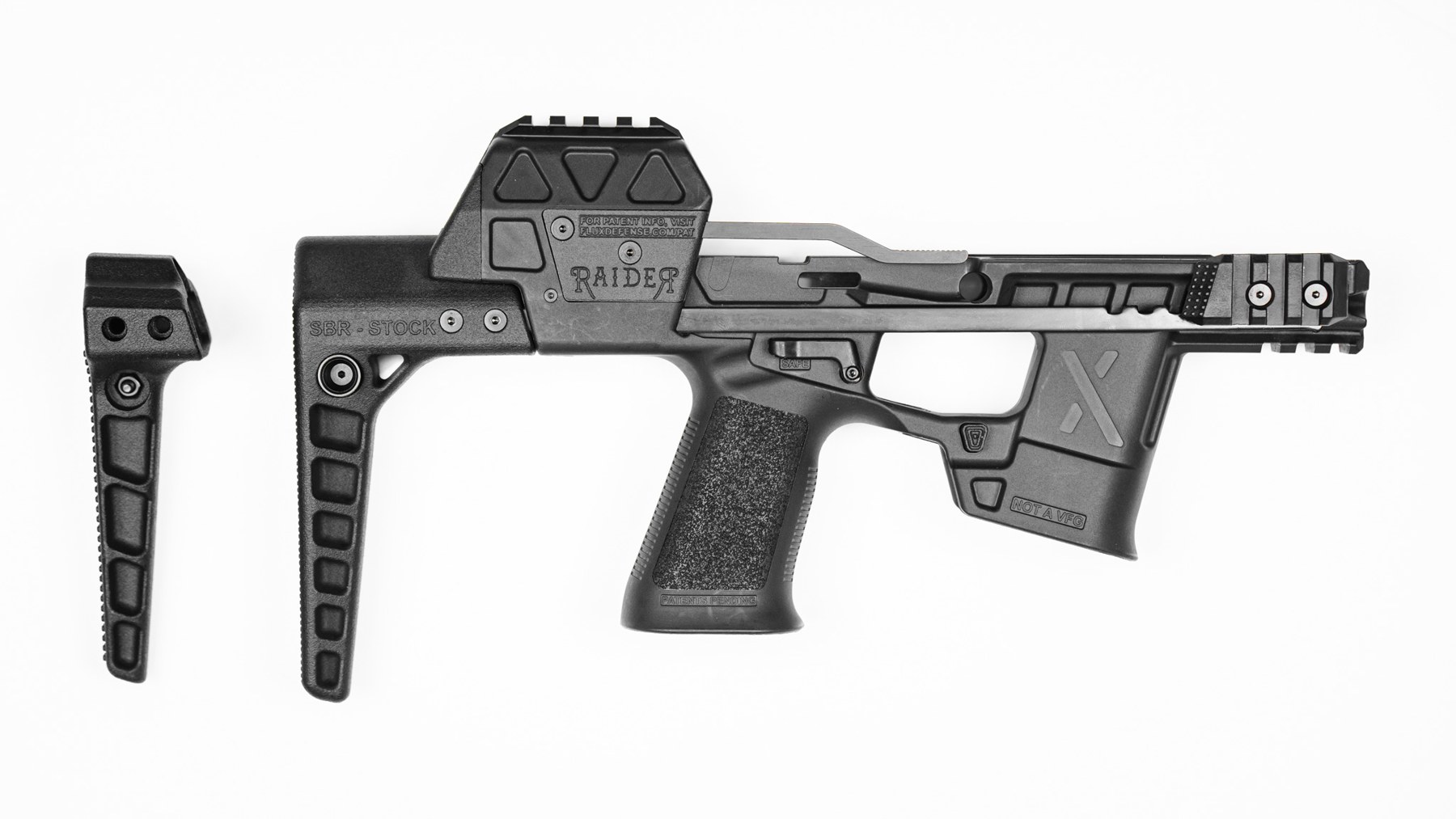
A Raider X is a moulded housing with steel inserted into it. Nothing on it is serialized, nothing on it is a firearm, and almost nothing about its construction is published. This volume collects what the two companies that describe it — Flux Defense, which designs and sells it, and SIG Sauer, which ships it on two factory pistols and publishes its manual — actually say about what it is made of and how big it is, and then answers the question a well-equipped shop asks next: could it be made here?
2.1 What the Makers Say It Is Made Of
The statements are few, and they are given here exactly.
Table 1 — What the Makers Say It Is Made Of
| Statement | Where |
|---|---|
| ”Advanced injection molded polymer.” | SIG, Raider X manual §2.21 |
| ”New Injection-molded advanced Polymer developed to replace metal” (2021); ”… to replace metal engine parts” (later 2021) | Flux, Raider product page2 |
| ”Chrome Moly Steel Nitride finish for maritime use.” | SIG manual §2.2; Flux Raider pages from 202112 |
| ”Mold is now single gate instead of dual to decrease chance of knit lines (weak points)“ | Flux, Raider X improvement list3 |
| ”Changed from pressed-in nut to molded in insert for the ejection spring bolt” | Flux, Raider X improvement list3 |
| ”Improved finish for decreased light reflection.” | Flux, Raider X improvement list3 |
| ”Price has jumped up … due to raw materials prices on our steel and polymer going up.” | Flux, Raider page, 20224 |
Three things follow directly, and a fourth is conspicuously missing.
The body is a single injection moulding. “Single gate” means the molten polymer enters the tool at one point. With two gates, two flow fronts meet somewhere inside the part and fuse imperfectly; that seam, a knit line, is weaker than the surrounding material, and Flux says in terms that moving to one gate was done to make the frame stronger. The same list’s third item says the threaded part that the brace’s spring bolt screws into is now moulded in — placed in the tool and encapsulated as the polymer is injected — rather than pressed in after moulding. A moulded-in insert is held by the polymer that shrank around it; a pressed-in nut is held by interference alone, and can walk out of its bore under repeated load.
The steel is chromoly, nitrided. Neither company says which parts are steel. The photographs answer part of the question: the two long extension rails that carry the brace are bright steel against the polymer body, and the brace patent describes them as “elongated bodies” sliding in channels in the housing.5 Springs, pins and the small levers of the brace release and the dual magazine release are not described at all.
The optic hood is part of the moulding. It is not a bolted-on rail: Flux’s own Chop Top is described as the Raider X “with the non-reciprocating optic mount removed,” and Flux’s warranty excludes “Cutting or altering the optic mount.”67 Both only make sense if the hood is the same piece of polymer as the rest of the chassis.
The polymer is not identified. No Flux or SIG page examined names the resin, its filler, or its grade. Glass-filled nylon is the usual material for firearm grip modules, and it would be a reasonable guess; it is not stated here as fact, because neither maker says it.
2.2 Generation by Generation
Table 2 — Generation by Generation
| MP17 (2019) | Raider (2021) | Raider X (2023–) | |
|---|---|---|---|
| Body | not stated | ”Injection-molded advanced Polymer developed to replace metal" | "Advanced injection molded polymer”; single-gate mould |
| Steel parts | not stated | ”Chrome Moly Steel. Nitride finish" | "Chrome Moly Steel Nitride finish” |
| Weight | ”2.8Lbs (With full size slide - empty)" | "18 oz (Chassis only) 40oz (assembled)" | "18 oz (chassis only), 40 oz (assembled)“ |
| Collapsed size | 10.75 L × 5.75 H × 1.6 W in | 11 L × 6 H × 1.7 W in | 11 L × 6 H × 1.7 W in |
| Extended length | not stated | not stated | 18 in |
| Spring-bolt anchor | — | pressed-in nut | moulded-in insert |
Sources: Flux’s product pages as captured in 2019, 2021 and 2024, the current Raider X blemished-chassis page, and SIG’s manual.8291
The Raider’s “replace metal” line implies that the MP17 before it used metal where the Raider uses polymer. Flux’s MP17 pages never say what the MP17 was made of, so that is an inference from a later page, and nothing more.
2.3 Every Published Dimension
2.3.1 The chassis
Table 3 — The chassis
| Dimension | Figure | Source |
|---|---|---|
| Weight, chassis only | 18 oz | Flux product page; SIG manual §2.2 |
| Weight, “assembled” | 40 oz | Flux blem and kit pages; SIG manual §2.2 |
| Length, collapsed | 11 in | same |
| Height | 6 in | same |
| Width | 1.7 in | same |
| Length, brace extended | 18 in | Flux blem page (“Extended length 18″”); SIG manual §2.2 |
The figure that matters most is the last. The SIG P320-M17 dive, Volume 4 records that “Flux does not publish the chassis’s overall length collapsed or extended”; Flux does, though not on the current main product page (the May 2024 version of that page carried it). It is on the Raider X blemished-chassis page and the law-enforcement kit pages, and SIG prints the same pair of figures in its manual.91
What “assembled” means is not defined by either maker. For scale, SIG lists its full-size 4.7-inch slide assembly alone at 12.2 oz without barrel or recoil assembly, so the 22-ounce difference is of the order of a P320’s slide, barrel, spring and FCU; neither maker says that is what the figure means.10 SIG’s factory P320-FLUX pistols are listed at 49.2 oz with magazine, 10.9 in collapsed, 1.6 in wide and 6.1 in high — a tenth of an inch different in each direction from Flux’s chassis figures, which is the scale of difference to expect between two companies measuring the same thing to different points.11
2.3.2 The stocks
Flux publishes a specification card for its three short-barrelled-rifle stocks. The figures are for the whole weapon, not the stock alone:12
Table 4 — The stocks
| Stock | Length of pull | Overall, collapsed | Overall, extended |
|---|---|---|---|
| SM (the “flush” stock) | 13.49 in | 11 in | 18.25 in |
| MD (the “+1.5 inch” stock) | 15 in | 12.5 in | 19.75 in |
| LG (the “+3 inch” stock) | 16.5 in | 14 in | 21.25 in |
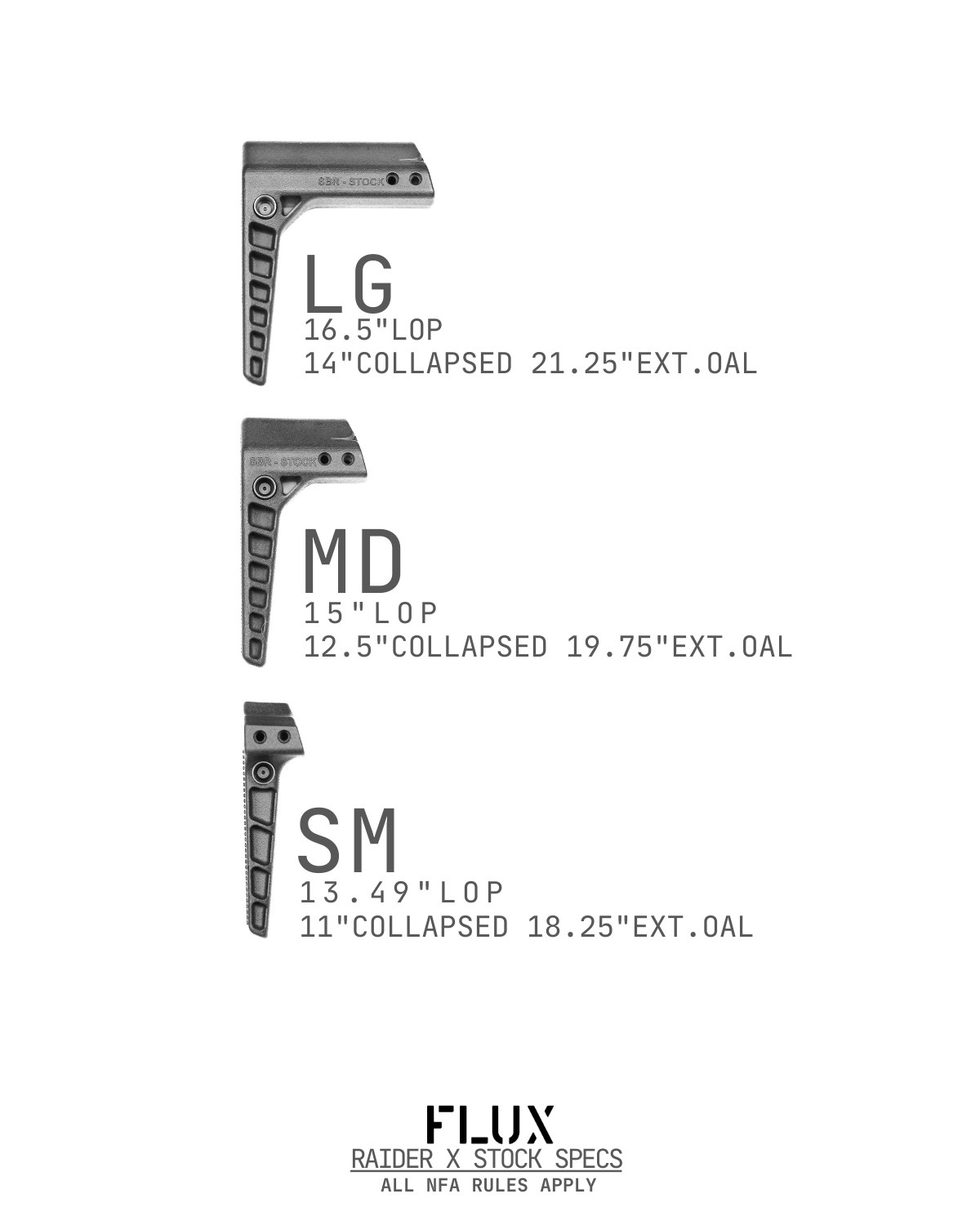
Two points in that table are easy to miss. The flush stock and the brace make a weapon of essentially the same length — 18.25 in against 18 in. What separates a registered short-barrelled rifle from a braced pistol here is not size; it is what the rear member is designed to do, which is the whole legal subject of the SIG P320-M17 dive, Volume 5. And every configuration, including the long stock extended, is under 26 inches, which is the length below which Michigan’s licensing act defines a firearm as a pistol. Volume 7 returns to that.
2.3.3 What is not published
No drawing, no tolerance, no rail-to-bore dimension, no height of the top rail over the bore, no thread size for any screw other than the 5/64-inch hex key that fits them, and no torque value for the chassis itself. The single torque figure Flux publishes anywhere in the Raider X line is for an accessory: the LORA lower rail, “tighten screw to 20in.lbs.”13
2.4 Could It Be Made Here?
The lab this series is written for has several CNC machines, several 3D printers, a 100-watt laser and a full gunsmithing bench. The question divides cleanly into three: what the law allows, what the patents allow, and what the engineering allows.
2.4.1 What the law allows
Nothing in firearms law stands in the way. The chassis is not a firearm: under 27 CFR 478.12(a)(4)(iv) the frame of a P320 is the fire control unit, and every other part, including whatever it is housed in, is a part. The SIG P320-M17 dive, Volume 5 sets out that regulation and its consequences in full. A shop-made chassis is therefore no more a regulated item than a shop-made grip panel. What goes on it is another matter: a stock on a sub-16-inch P320 makes a short-barrelled rifle no matter who made the stock.
2.4.2 What the patents allow
This is the real constraint, and it is routinely overlooked. Flux’s patents page lists two United States patents (Volume 1):14
- US 11,156,433 — the spring-deployed brace on two sliding rails. Filed 28 October 2019.
- US 9,797,687 — an optic mount rising from the frame on two side walls, through which the slide passes. Filed 21 September 2016; Flux licenses it from Unity Tactical.
United States patent law has no personal-use exception. The infringement statute, 35 U.S.C. § 271(a), applies to whoever “without authority makes, uses, offers to sell, or sells any patented invention, within the United States,” and the courts have kept the common-law experimental-use defence extremely narrow — in Madey v. Duke University, 307 F.3d 1351 (Fed. Cir. 2002), the Federal Circuit confined it to acts done “for amusement, to satisfy idle curiosity, or for strictly philosophical inquiry.” Making a working copy of the Raider’s deploying brace or its optic hood for one’s own use is making the patented invention. Whether any particular shop-made part falls within a claim is a question of claim construction that this series does not attempt; the point is only that “for my own use” is not an answer to it.
Both patents are young. A utility patent’s term runs twenty years from its filing date, which on their face carries US 9,797,687 to about September 2036 and US 11,156,433 to about October 2039, if the maintenance fees are paid. Flux’s page also says “Additional patents pending,” and the dual magazine release is described as “patented” by both Flux and SIG without a number being given; no such patent was located.
2.4.3 What the engineering allows
Set the patents aside and the engineering question has an unexpected answer: the difficult part is not the part anyone looks at.
The body. A five-axis or careful four-axis setup could mill a chassis body from aluminium billet, and Flux itself sells an aluminium chassis — the Raider 365 Aluminum — for the smaller P365. Polymer is harder. The Raider X’s properties come from being injection moulded in a production tool, and Flux’s own improvement list is an admission that even the maker’s first tool produced a frame weak enough at its knit lines to be worth re-gating. A printed body has no knit lines of that kind but has layer lines instead, running wherever the print orientation puts them, and no public load data exist for any part of this chassis against which a printed one could be compared.
The FCU interface. This is the hard part. The chassis must hold a SIG fire control unit exactly as a SIG grip module does — the locking tab at the rear, the takedown lever bore through both chassis and FCU, the clearance for the slide catch lever, the geometry that lets the trigger, the chassis safety and the magazine catch work together. SIG publishes none of those dimensions. Flux’s own list mentions “Improved dimensions to increase reliability of the various systems” between generations, which says the dimensions matter and says nothing of what they are. They can be measured from a grip module and a chassis on hand, but the measurement is the whole project.
The load path. The brace, its rails, its lock and its spring carry recoil through the chassis on every shot (Volume 3). In 2021 roughly one original Raider in twenty-five, by Flux’s own account, let go under recoil at exactly this point, and the fix was a replacement lever.15 That is a production part from the designer, failing at a rate the designer considered worth a free recall. A shop copy of the lock would need to be proven, not assumed.
2.4.4 Where the lab genuinely helps
- Fixtures and tooling for the owner’s own chassis: a padded vice block shaped to the body, a sight-pusher cradle for the RipStik-style handles that press into the slide, a jig to hold the chassis square while side-rail screws are thread-locked.
- Non-patented simple accessories: thumb ledges, rail covers, spare-magazine extensions, storage inserts. Several of these are sold by small makers precisely because they are simple (Volume 6); the lab can make them, although the purchase price of most is lower than the time.
- Measurement. The unpublished dimensions above — top-rail height over bore, the actual weight of the build as fitted, the collapsed and extended lengths of each configuration — are a morning with a height gauge and a scale, and the rail height in particular feeds directly into the close-range offset that the SIG P320-M17 dive, Volume 7 could not quantify.
- Diagnosis. A chassis that fails to lock, or a brace that will not deploy, is easier to understand on a bench with a bore scope and a spring gauge than from a forum thread. Volume 5 sets out what an owner may and may not adjust.
The honest summary is that the lab can make almost anything around a Raider X and should not make the Raider X. It is inexpensive relative to the fire control unit it carries, it is covered by a transferable lifetime warranty, and its two defining mechanisms are under patent into the late 2030s.
References
Footnotes
-
SIG Sauer, SIG P320 Raider X Operator’s Manual, P/N 1304128-01 REV 02 (©2024), §2.2 “Features.” https://www.sigsauer.com/media/sigsauer/resources/FLUX_RAIDER_BRACE_OPERATORS_MANUAL_1304128-01_REV_02_WEB_UPDATE_1.pdf (downloaded 2026-09-19). ↩ ↩2 ↩3 ↩4
-
Flux Defense, “FLUX RAIDER (Brace),” Internet Archive captures of 16 January and 24 September 2021. https://web.archive.org/web/20210116202620/https://www.fluxdefense.com/shop/mp17-raider ; https://web.archive.org/web/20210924012048/https://www.fluxdefense.com/shop/raider ↩ ↩2 ↩3
-
Flux Defense, “RAIDER X FDE KIT – M17/P320,” SKU 161-00024, improvement list items 2, 3 and 12. https://fluxdefense.com/shop/raider-x-kit-m17-p320 (accessed 2026-09-19). ↩ ↩2 ↩3
-
Flux Defense, “Flux Raider (Brace) – Sig P320,” Internet Archive capture of 8 July 2022. https://web.archive.org/web/20220708054241/https://fluxdefense.com/product/raider ↩
-
US Patent 11,156,433 B2, Griffith et al., granted 26 October 2021. https://image-ppubs.uspto.gov/dirsearch-public/print/downloadPdf/11156433 (downloaded 2026-09-19). ↩
-
Flux Defense, “Raider X Chop Top ‘El Camino’.” https://fluxdefense.com/shop/raider-x-chop-top-el-camino (accessed 2026-09-19). ↩
-
Flux Defense, “Frequently Asked Questions,” item 54. https://fluxdefense.com/frequently-asked-questions (accessed 2026-09-19). ↩
-
Flux Defense, “MP17 - Pistol Brace Version,” Internet Archive capture of 17 September 2019. https://web.archive.org/web/20190917001351/https://www.fluxdefense.com/shop/mp17-pistol-brace-version ↩
-
Flux Defense, “Raider X BLEM – P320”: “Overall Dimensions: When collapsed 11″L x 6″H x 1.7″W. Extended length 18″.” https://fluxdefense.com/shop/raider-x-blem-p320 (accessed 2026-09-19); the same text on the 24 May 2024 capture of the main Raider X page, https://web.archive.org/web/20240524102229/https://fluxdefense.com/shop/raider-x ↩ ↩2
-
SIG Sauer, “P320 Full-Size 9mm 4.7” Slide Assembly, SIG-LOC Ready, Black,” specification “Weight 12.2 oz”; Internet Archive capture of 27 October 2025. https://web.archive.org/web/20251027035942/https://www.sigsauer.com/p320-full-size-9mm-4-7-slide-assembly-sig-loc-ready-black.html ↩
-
SIG Sauer, “P320-FLUX LEGION,” specification table; Internet Archive capture of 27 July 2026. https://web.archive.org/web/20260727211102/https://www.sigsauer.com/p320-flux-legion.html ↩
-
Flux Defense, “Raider X Stock Specs” image on the SBR Stock Kit – Raider X P320 page. https://fluxdefense.com/shop/sbr-stock-kit-raiderxp320 (accessed 2026-09-19). ↩
-
Flux Defense, “LORA Rail,” SKU 162-00102, installation note. https://fluxdefense.com/shop/lora-rail (accessed 2026-09-19). ↩
-
Flux Defense, “Patents.” https://fluxdefense.com/pat (accessed 2026-09-19). ↩
-
Flux Defense, “Raider Fix Info,” Internet Archive capture of 4 September 2021. https://web.archive.org/web/20210904214915/https://www.fluxdefense.com/raiderfix ↩
Comments (0)