Beretta U22 Neos · Volume 6
The Carbine Kit, and the Law of Turning a Pistol into a Rifle and Back
What Beretta shipped in 2010 and not in 2004; why a pistol that becomes a rifle may become a pistol again while a rifle that becomes a pistol may not; ATF Ruling 2011-4 quoted in full; and the one way a Neos owner can make a registrable firearm by accident
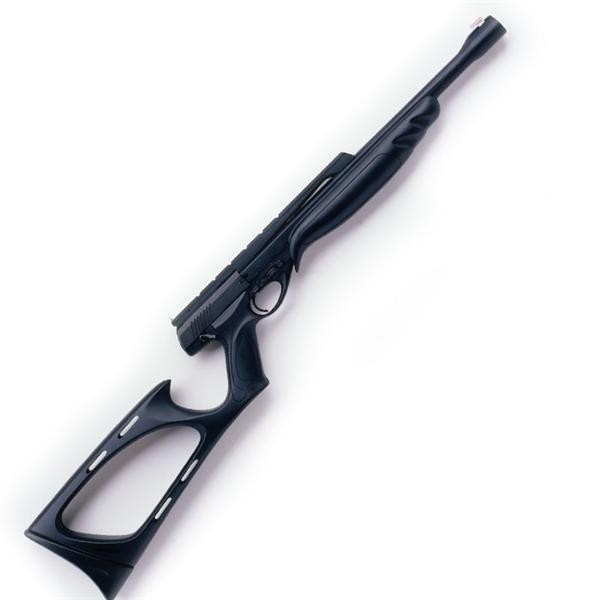
6.1 What Is in the Box
Beretta’s own description, from the press release and the store page:
“The U22 Neos Carbine Kit includes a barrel/fore-end/top rail assembly and a stock unit that easily replaces the pistol’s barrel and grip using the supplied multi-purpose tool. A TRUGLO™ orange fiber optic front sight is standard, as well as a fully adjustable aperture rear sight, to provide fast target acquisition. Both sights are removable and replaceable. The barrel features a built-in machined aluminum Weaver™-style rail that allows mounting of optics using standard mounts. The stock features a rubber butt plate, as well as attachment slots for future accessories.”1
“Uses pistol’s magazine, slide and receiver assembly.”2
“The Kit may be disassembled for easy and compact transportation.”1
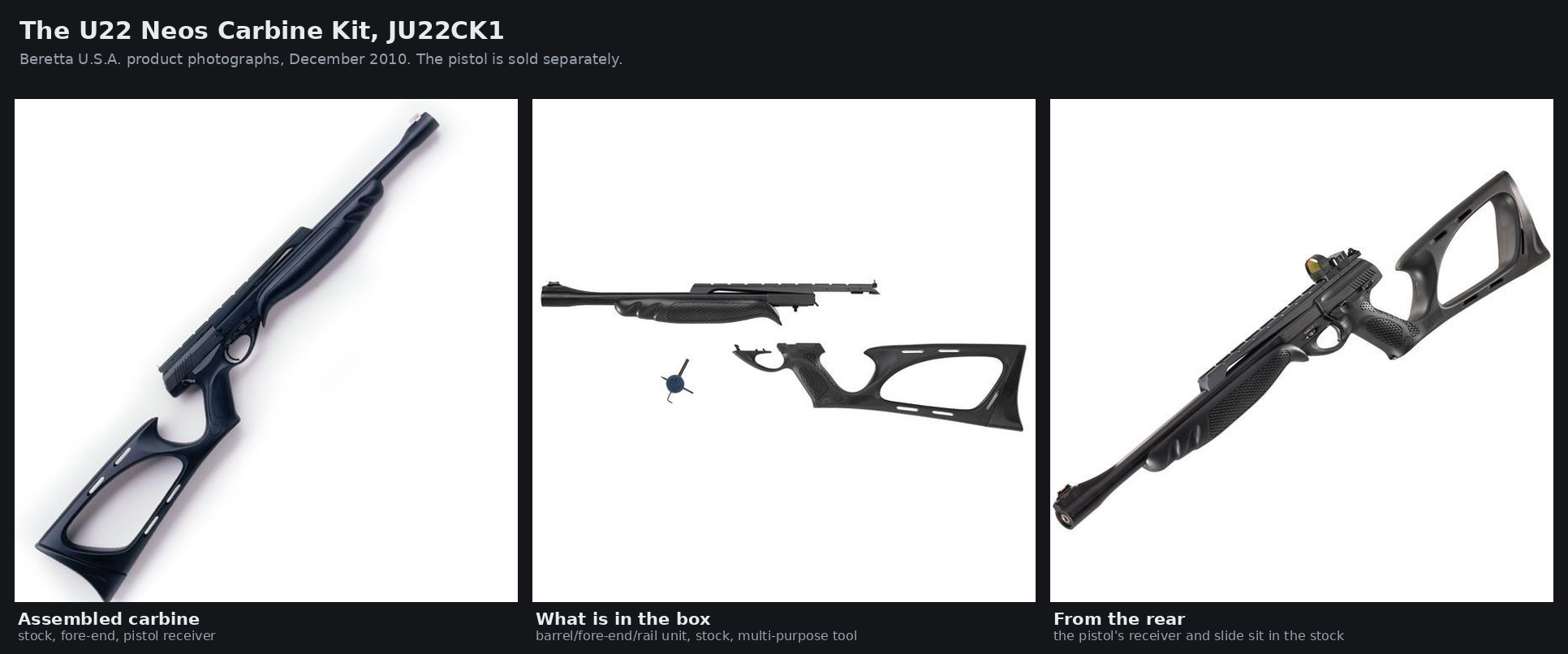
Stock number JU22CK1, $249.00 on Beretta’s own store in December 2010 — against $275 for the whole pistol seven months later.23
The mechanical point is that the kit replaces the two modules the pistol was designed to let go of. The grip comes off with one bolt; the barrel comes off with the barrel nut (Volume 4). Between them sits the receiver with its slide, striker and sear, unchanged, still wearing the serial number. Beretta’s carbine is the same firearm in different clothes, and Beretta says so in the line quoted above.
6.2 2010, Not 2004
🔴 The kit is routinely dated to 2004. It is not.
Beretta U.S.A.’s own press release is datelined ACCOKEEK, MD (February 3, 2010) and says the kit is “now shipping to dealers and distributors.”1 Beretta’s own product page, archived in December 2010, opens “New for 2010.”2 The 2004 instruction manual documents the modular system down to accessory slide assemblies, accessory grips with rubber inlays and three colours of replaceable sight blade, and mentions no stock and no carbine barrel anywhere.4
Wikipedia states 2004 and footnotes it to an AL.com post — which turns out to be a video item of 23 July 2012 that makes no date claim at all — while its own carbine-kit paragraph cites a press release dated 5 February 2010, two days after Beretta’s dateline.56 American Rifleman repeats “In 2004.”7 The whole 2004 tradition rests on nothing that says 2004.
Volume 1 sets out the timeline this correction sits in.
6.3 What Beretta Never Published About It
⚠ Beretta’s press release and store page give no barrel length, no assembled overall length and no weight for the carbine. Neither does any other source located here. Those figures are [UNVERIFIED] and none is stated in this dive.
What can be said with confidence, and why:
- The barrel must be 16 inches or more. Beretta sold the kit openly, by mail, to ordinary customers, with no registration and no tax stamp, and it printed a notice explaining that a barrel under 16 inches would make a short-barrelled rifle requiring NFA registration. A maker does not print that warning on a product that trips it.
- The assembled overall length must exceed 26 inches, which a 16-inch barrel plus a receiver plus a buttstock does by a wide margin.
- 🔴 Beretta’s own parts catalogue calls the result a rifle. The printed manual for the kit is listed as “Original Owner’s Manual for Rifle U22 NEOS CARBINE KIT .22lr”, stock number UD6A0307.8
6.4 Beretta’s Own Legal Notice
Printed on Beretta’s own product page for the kit, in full:
“NOTE: A rifle with a barrel less than 16 inches in length is classified as a ‘short barreled rifle’ and must be registered as such with the ATF in accordance with the National Firearms Act. Consult your local ATF office for registration information (some states do not allow registration of short barreled rifles; consult your local authorities for more information).”2
That notice is the whole of this volume in one paragraph, and the rest of it is the law behind each clause.
6.5 The Three Definitions That Decide Everything
Pistol, 27 CFR 478.11 and 479.11 — and the first three words are the ones that matter:
“A weapon originally designed, made, and intended to fire a projectile (bullet) from one or more barrels when held in one hand, and having (a) a chamber(s) as an integral part(s) of, or permanently aligned with, the bore(s); and (b) a short stock designed to be gripped by one hand and at an angle to and extending below the line of the bore(s).”9
ATF italicised “originally” itself when it quoted this definition in Ruling 2011-4.10
Rifle, 26 U.S.C. § 5845(c):
“a weapon designed or redesigned, made or remade, and intended to be fired from the shoulder and designed or redesigned and made or remade to use the energy of the explosive in a fixed cartridge to fire only a single projectile through a rifled bore for each single pull of the trigger, and shall include any such weapon which may be readily restored to fire a fixed cartridge.”11
NFA “firearm”, 26 U.S.C. § 5845(a), the two that bite here:
“(3) a rifle having a barrel or barrels of less than 16 inches in length; (4) a weapon made from a rifle if such weapon as modified has an overall length of less than 26 inches or a barrel or barrels of less than 16 inches in length.”11
And “make”, § 5845(i): “shall include manufacturing …, putting together, altering, any combination of these, or otherwise producing a firearm.”11
ATF measures a barrel “from the closed bolt (or breech-face) to the furthermost end of the barrel or permanently attached muzzle device”, by dowel rod; overall length is “the distance between the muzzle of the barrel and the rearmost portion of the weapon measured on a line parallel to the axis of the bore.”12
6.6 Thompson/Center, 1992
The Supreme Court has decided a case on almost exactly this fact pattern, and the differences from the Neos matter.
Thompson/Center made the Contender pistol and, for a short time, a kit that converted it into a rifle with either a 21-inch or a 10-inch barrel. ATF took the view that pistol and kit together were a short-barrelled rifle, and Thompson/Center paid the $200 making tax and sued for a refund.13
Justice Souter, for the plurality, held that the packaged pistol and kit had not been “made” into a short-barrelled rifle. The reasoning has two halves and both are load-bearing:
“the aggregation of separate parts that can be assembled only into a firearm, and the aggregation of a gun other than a firearm and parts that would have no use in association with the gun except to convert it into a firearm, constitute the ‘making’ of a firearm.”13
But where the parts could make either a regulated short-barrelled rifle or an unregulated 16-inch-plus rifle, the statute is ambiguous, and:
“The statutory ambiguity is properly resolved by applying the rule of lenity in respondent’s favor… Although it is a tax statute that is here construed in a civil setting, the NFA has criminal applications that carry no additional requirement of willfulness.”13
The Neos kit is an easier case than the Contender kit, because the ambiguity that saved Thompson/Center does not even arise. The Contender kit contained a 10-inch barrel; the Neos kit contains only a long one. A Neos owner with the kit is not in a position where the parts might make an NFA firearm — they make a rifle, and that is all the kit offers.
The hub’s SIG P320-M17 dive, Volume 5 quotes and applies Thompson/Center to a braced pistol with a stock in a drawer, and the ArmaLite AR-7 dive, Volume 7 applies it to the Explorer II pistol and rifle parts. Neither is restated here.
6.7 ATF Ruling 2011-4
🔴 This is the controlling document for the Neos carbine kit, and it postdates the kit by seventeen months. ATF Ruling 2011-4, “Pistols Configured from Rifles; Rifles Configured from Pistols”, approved 25 July 2011 and signed by Acting Director Kenneth E. Melson.10
The ruling opens by describing the question it was asked, and the description is the Neos kit:
“ATF has received requests from individuals to classify pistols that are reconfigured into rifles, for personal use, through the addition of barrels, stocks, and other parts and then returned to a pistol configuration by removal of those components.”10
And then, specifically:
“Other parts sets require that certain parts of the pistol, such as the pistol barrel and the slide assembly, be removed from the pistol frame prior to attaching the parts sets. Typically, a separate barrel is sold with the parts set, which is 16 inches or greater in length. The barrel is installed along with an accompanying shoulder stock. The resulting firearm has a barrel of 16 inches or more in length, and an overall length of 26 inches or more.”10
Its four holdings, in ATF’s own words:
Held, a firearm, as defined by the NFA, 26 U.S.C. 5845(a)(3), is made when unassembled parts are placed in close proximity in such a way that they: (a) Serve no useful purpose other than to make a rifle having a barrel or barrels of less than 16 inches in length (e.g., a receiver, an attachable shoulder stock, and barrel of less than 16 inches in length); or (b) Convert a complete weapon into such an NFA firearm, including — (1) A pistol and attachable shoulder stock; and (2) A rifle with a barrel of 16 inches or more in length, and an attachable barrel of less than 16 inches in length. Such weapons must be registered and are subject to all requirements of the NFA.
Held further, a firearm … is not made when parts in a kit that were originally designed to be configured as both a pistol and a rifle are assembled or re-assembled in a configuration not regulated under the NFA (e.g., as a pistol, or a rifle with a barrel of 16 inches or more in length).
Held further, a firearm … is not made when a pistol is attached to a part or parts designed to convert the pistol into a rifle with a barrel of 16 inches or more in length, and the parts are later unassembled in a configuration not regulated under the NFA (e.g., as a pistol).
Held further, a firearm, as defined by 26 U.S.C. 5845(a)(4), is made when a handgun or other weapon with an overall length of less than 26 inches, or a barrel or barrels of less than 16 inches in length, is assembled or produced from a weapon originally assembled or produced only as a rifle.10
The ruling’s explanatory paragraph is the clearest sentence anyone has written on the subject:
“Merely assembling and disassembling such a rifle does not result in the making of a new weapon; rather, it is the same rifle in a knockdown condition (i.e., complete as to all component parts). Likewise, because it is the same weapon when reconfigured as a pistol, no ‘weapon made from a rifle’ subject to the NFA has been made.”10
ATF’s public Q&A states the same conclusion in one line, and names the ruling:
“Can I lawfully make a pistol into a rifle without registering that firearm? — Assuming that the firearm was originally a pistol, the resulting firearm, with an attached shoulder stock, is not an NFA firearm if it has a barrel of 16 inches or more in length. Pursuant to ATF Ruling 2011-4, such rifle may later be unassembled and again configured as a pistol.”14
6.8 Applying It to a Neos
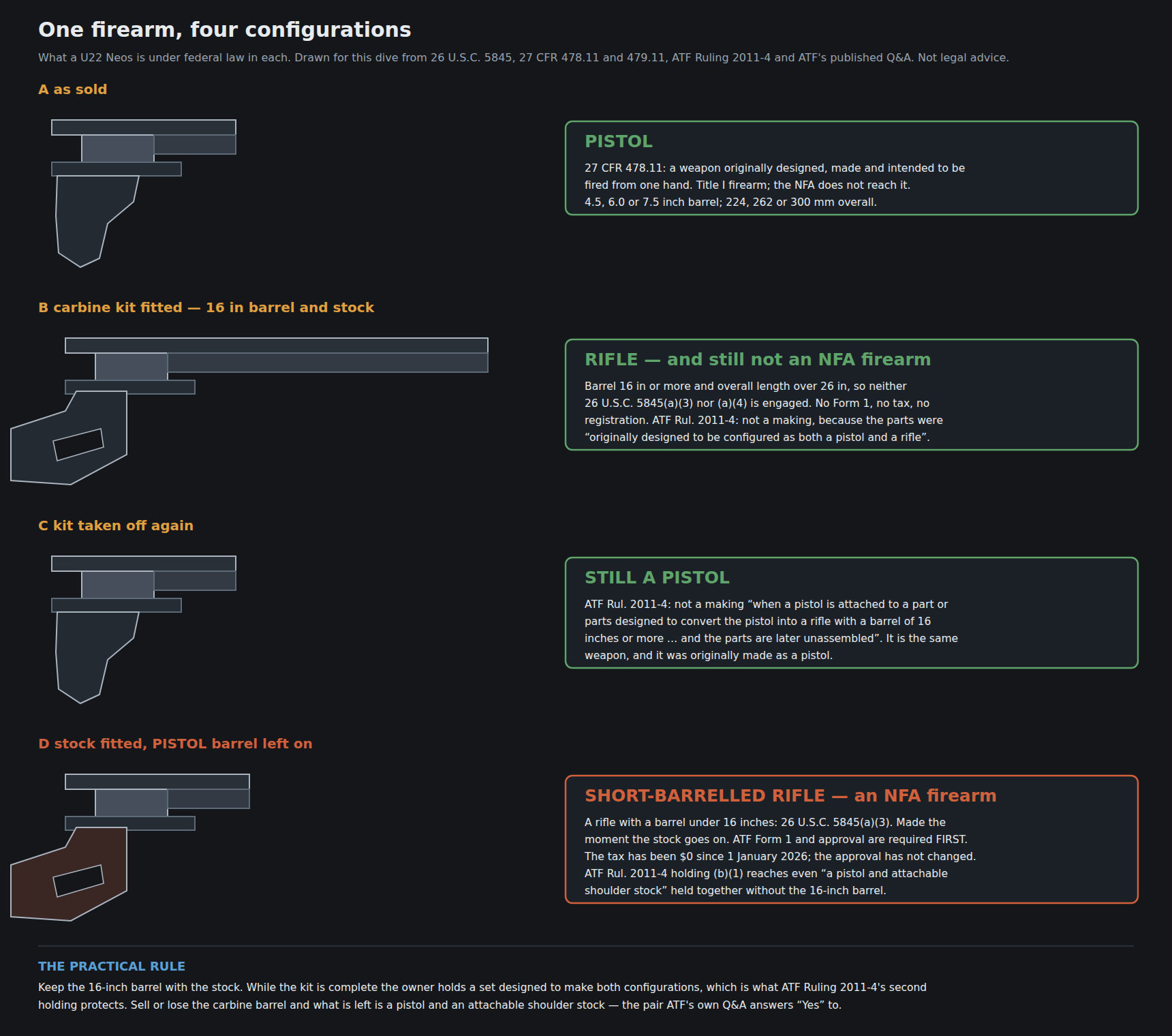
Configuration A — the pistol as sold. A pistol under 27 CFR 478.11. Title I firearm. No NFA involvement.
Configuration B — the carbine kit fitted. A rifle: 16-inch-plus barrel, over 26 inches overall, fired from the shoulder. Title I firearm. Not an NFA firearm, and no Form 1, tax or registration. This is the second “Held further”: the parts were designed to be configured as both, and they have been assembled in a configuration the NFA does not reach.10
Configuration A again — the kit taken off and the pistol reassembled. Still a pistol, and expressly not a “weapon made from a rifle”. That is the third “Held further”, and ATF’s Q&A confirms it.1014 The reason is in the pistol definition: the Neos was originally designed, made, and intended to be fired from one hand, and taking the stock off returns it to what it always was.
Owning the pistol and the complete kit at the same time. Not a making. The Contender case removes any doubt about the mere aggregation, and the Neos kit does not even carry the short barrel that created the ambiguity there.
6.9 The One Way to Get This Wrong
🔴 The kit is two independent parts, and nothing on the pistol stops an owner fitting one without the other.
The stock replaces the grip module — one bolt, one tool. The fore-end assembly replaces the barrel — one nut, no tool. They are separate operations on separate ends of the gun. Fit the stock while the 4.5-inch pistol barrel is still on and the result is a rifle with a 4.5-inch barrel, which is a short-barrelled rifle under § 5845(a)(3) and an NFA firearm made without approval. It takes about ninety seconds and there is no interlock.
And ATF’s position goes further than the assembled gun. Holding (b)(1) of Ruling 2011-4 says a firearm is made when unassembled parts in close proximity “convert a complete weapon into such an NFA firearm, including (1) a pistol and attachable shoulder stock”.10 Its public Q&A says the same:
“If a person has a pistol and an attachable shoulder stock, does this constitute possession of an NFA firearm? — Yes, unless the barrel of the pistol is at least 16 inches in length (and the overall length of the firearm with stock attached is at least 26 inches).”15
The second “Held further” is what keeps a Neos owner out of that, and it turns on the kit — parts “originally designed to be configured as both a pistol and a rifle.”10 So the practical rule follows:
⚠ Keep the 16-inch barrel with the stock. As long as the kit is complete, the owner holds a set designed to make both configurations and the ruling’s second holding applies. Sell the carbine barrel, lend it out, or lose it, and what is left is a pistol and an attachable shoulder stock — the exact pair ATF’s Q&A answers “Yes” to, and the exact pair holding (b)(1) names. Whether Thompson/Center’s rule of lenity would rescue that situation is a question no owner should want to be the test case for.
This dive takes no position on how a court would decide it. What it does say is that the difference between the safe case and the risky one is whether a particular steel tube is in the same house, and that is a cheap thing to get right.
6.10 Why a Rifle Cannot Go the Other Way
The symmetry people expect is not there, and the asymmetry is deliberate.
ATF’s Q&A on the reverse:
“Can I lawfully make a rifle into a pistol without registering that firearm? — No. A firearm that was originally a rifle would be classified as a ‘weapon made from a rifle’ if it has either a barrel less than 16 inches in length or an overall length of less than 26 inches. If an individual wishes to make an NFA firearm, they must first submit ATF Form 1 …, pay a $200.00 making tax, and receive approval of the application from ATF before converting the firearm.”16
The ruling explains why in terms of the definitions rather than policy: a short weapon produced from something “originally assembled or produced only as a rifle” is a weapon made from a rifle under § 5845(a)(4), and “such a weapon would not be a ‘pistol’ because the weapon was not originally designed, made, and intended to fire a projectile by one hand.”10
So the word that does all the work is originally, in the regulatory definition of a pistol. A U22 Neos passes that test forever, whatever is bolted to it this afternoon. A gun that left a factory as a rifle fails it forever.
Two consequences for a Neos owner:
- The carbine configuration does not convert the firearm into “a rifle” for this purpose, however plainly Beretta’s parts catalogue calls it one.8 What the firearm was originally made as is a fact about 2002 to 2023 in Accokeek, not about what is bolted on today.
- There is therefore no need to keep the carbine “temporary” or to document the order of assembly. The ruling’s language — “the same rifle in a knockdown condition” — contemplates the thing being taken apart and put back together indefinitely.10
6.11 If Somebody Actually Wants the Short-Barrelled Rifle
A stock on a 4.5-inch or 6-inch Neos is a legitimate thing to want; it is simply a registrable one. The route is a Form 1, approved before the stock goes on, not after.
Two points the hub covers elsewhere and does not restate:
- The making tax is now $0. Public Law 119-21 set the making and transfer tax on NFA firearms other than machineguns and destructive devices to $0 for calendar quarters beginning after 2 October 2025 — that is, from 1 January 2026. Approval before making is unchanged. The Suppressor Law dive, Volume 3 sets out what did and did not change, and the SIG P320-M17 dive, Volume 5 quotes the statute as amended.
- Michigan bans short-barrelled rifles at MCL 750.224b(1) and exempts, at subsection (3), a weapon lawfully made and possessed under federal law. A registered federal SBR is lawful there; an unregistered one is a state felony as well as a federal one, with no exemption available because there is no federal registration to be lawful under. The SIG P320-M17 dive, Volume 5 and the AR pistol .300 BLK dive quote the subsections.
6.12 Handgun or Long Gun at the Counter?
A separate question from the NFA, and one that comes up when a Neos changes hands in carbine form.
The Gun Control Act’s implementing regulation defines a handgun as:
“(a) Any firearm which has a short stock and is designed to be held and fired by the use of a single hand; and (b) Any combination of parts from which a firearm described in paragraph (a) can be assembled.”9
⚠ This dive’s reading, flagged as a reading: a U22 Neos receiver, with its pistol grip and pistol barrel anywhere in the transaction, is a combination of parts from which a handgun can be assembled, and the safest assumption for a transfer is that handgun rules apply — the higher minimum age at a dealer, and the prohibition on a dealer transferring a handgun to a non-resident. No ATF letter addressing the Neos specifically was located, and a buyer or seller should ask the dealer rather than rely on this paragraph.
6.13 California, and the Odd Year of 2011
A small curiosity with a real explanation.
Beretta advertised the carbine kit in December 2010 as “Now approved for sale in California.”2 Three months later, in March 2011, California certification for sale expired for every U22 Neos pistol model, and dealers there could no longer sell them.5
There is no contradiction. California’s Roster of Handguns Certified for Sale applies to handguns, and a maker must pay to keep a model on it. A carbine kit is not a handgun and never appears on that roster; its “approved for sale in California” refers to a different set of approvals. So from 2011 a Californian could buy the kit and not the pistol it goes on — which, for anyone who already owned one, was exactly the right way round.
References
Footnotes
-
Beretta U.S.A., press release, “Beretta Adds Carbine Kit for U22 Neos and Expands Versatility of Product”, dateline Accokeek, MD, 3 February 2010; Internet Archive capture of 7 April 2010, and the same text as reproduced by PoliceOne, capture of 2013. ↩ ↩2 ↩3
-
Beretta U.S.A. online store, “Beretta U22 Neos Carbine Kit .22LR”, stock no. JU22CK1, $249.00, Internet Archive capture of 28 December 2010. ↩ ↩2 ↩3 ↩4 ↩5
-
Beretta U.S.A. online store, “U22 Neos”, stock no. JU2S6, $275.00, Internet Archive capture of 18 July 2011. ↩
-
Beretta U.S.A. Corp., U22 NEOS Instruction Manual, Accokeek, MD, cover code UD6A0277-04/04, interior pages dated 4/23/04; Internet Archive capture of 26 December 2022, accessed 2026-09-19. ↩
-
“Beretta U22 Neos”, Wikipedia, revision 1370411866 of 21 August 2026, retrieved as wikitext 2026-09-19. ↩ ↩2
-
Joe Songer, “Beretta Neos U22 is a pistol and a carbine (Joe’s Outdoor Office video)”, AL.com, dated 23 July 2012 on the page; Internet Archive capture of 4 March 2016. The item is a video post and states no introduction date for the kit. ↩
-
Guy J. Sagi, “Beretta’s U22 Neos: A Legacy Gun Not Forgotten”, American Rifleman, 22 February 2023, retrieved 2026-09-19. ↩
-
Beretta U.S.A. online store, “Beretta Owner’s Manual for U22 NEOS CARBINE KIT .22lr”, stock no. UD6A0307, Internet Archive capture of 8 May 2016. ↩ ↩2
-
27 CFR § 478.11, definitions of “Pistol”, “Rifle” and “Handgun”; the identical NFA definitions appear at 27 CFR § 479.11. Current text retrieved from the eCFR renderer API, 2026-09-19. ↩ ↩2
-
ATF Ruling 2011-4, “Pistols Configured from Rifles; Rifles Configured from Pistols”, approved 25 July 2011, signed Kenneth E. Melson, Acting Director, Bureau of Alcohol, Tobacco, Firearms and Explosives. PDF from ATF’s own rulings library, Internet Archive capture of 24 January 2021, retrieved 2026-09-19. ↩ ↩2 ↩3 ↩4 ↩5 ↩6 ↩7 ↩8 ↩9 ↩10 ↩11 ↩12
-
26 U.S.C. § 5845(a)(3), (a)(4), (c) and (i). Retrieved from Cornell Legal Information Institute, 2026-09-19. ↩ ↩2 ↩3
-
ATF, National Firearms Act Handbook (ATF P 5320.8), chapter 2, §§ 2.1.2–2.1.4, archived PDF, retrieved 2026-09-19. ↩
-
United States v. Thompson/Center Arms Co., 504 U.S. 505 (argued 13 January 1992, decided 8 June 1992); syllabus and plurality opinion of Souter, J., https://www.law.cornell.edu/supremecourt/text/504/505 , retrieved 2026-09-19. ↩ ↩2 ↩3
-
ATF, “Can I lawfully make a pistol into a rifle without registering that firearm?”, atf.gov firearms Q&A, page last reviewed 23 January 2020; Internet Archive capture of 4 December 2023. ↩ ↩2
-
ATF, “If a person has a pistol and an attachable shoulder stock, does this constitute possession of an NFA firearm?”, atf.gov firearms Q&A, page last reviewed 13 April 2020; Internet Archive capture of 20 January 2024. ↩
-
ATF, “Can I lawfully make a rifle into a pistol without registering that firearm?”, atf.gov firearms Q&A, page last reviewed 30 January 2020; Internet Archive capture of 5 December 2023. ↩
Comments (0)