Beretta U22 Neos · Volume 3
How It Works — A Striker in the Receiver, a Barrel Held by a Nut
The full cycle of operation of a fixed-barrel blowback .22 whose firing pin does not live in the slide; what the ambidextrous safety actually blocks; the dovetail-and-nut barrel mount and its two clicks; the magazine; and the one material question Beretta never answered
3.1 Five Assemblies
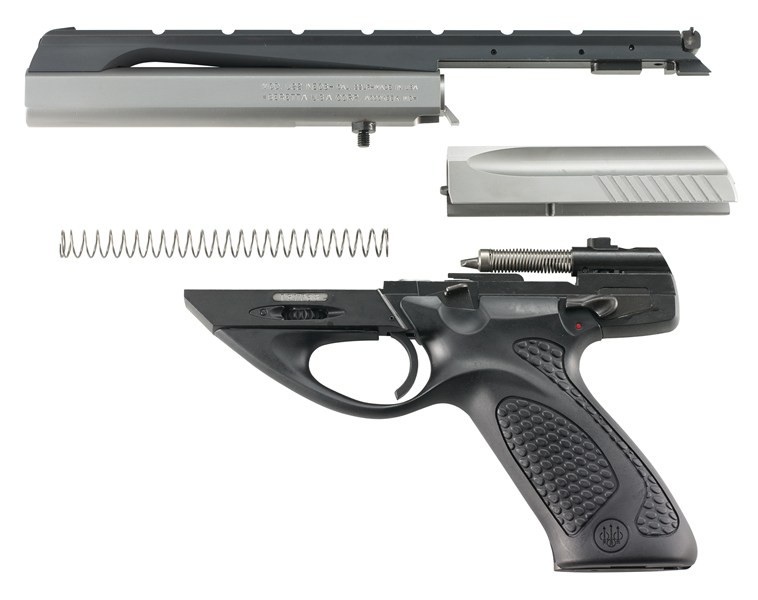
Beretta’s own description of the pistol is that it “is constructed of five modular parts that may be easily disassembled and reassembled without any tools.”1 The five, as the manual’s field-strip procedure separates them, are the magazine, the barrel unit (barrel, rail, front and rear sights), the slide, the recoil spring, and the receiver with its grip module.2 Two of those five — the barrel unit and the grip — were sold as accessories in other lengths and colours, and the inside cover of the manual advertises a spare slide as well.2
Nothing in the list is remarkable except where the firing mechanism sits.
3.2 What Kind of Action This Is
The Neos is a simple blowback, fixed-barrel, single-action semi-automatic. Beretta’s specification line is “Semiautomatic, slide blow back”.2
There is no locking system. The barrel is bolted to the receiver and does not move. The breech is held shut only by the inertia of the slide and the pressure of the recoil spring, and it begins to open as soon as the pressure in the case exceeds what that inertia and that spring will hold — which, with a .22 Long Rifle cartridge, is early enough that the bullet is long gone and late enough that the case has re-contracted off the chamber wall. This is the ordinary arrangement for a rimfire self-loading pistol and it is the reason .22 pistols are cheap.
Wikipedia’s Design section describes the arrangement accurately: “The pistol does not have a full-length slide (i.e., the barrel is uncovered) and it functions by cycling the rear portion of the action. The breech does not lock upon closing, but is held closed by a recoil spring… This configuration is similar to the Colt Woodsman and its successors.”3
Single action means what it says: “The user must pull the slide all the way back and release it to cock the pistol and feed the first round into the chamber.”2 There is no second-strike capability, and the only way to re-cock after a misfire is to work the slide.
3.3 The Striker Lives in the Receiver, Not the Slide
🔴 This is the one genuinely unusual thing about the Neos’s mechanism, and it is not described in any secondary account located.
On almost every rimfire self-loader a reader is likely to have handled, the part that strikes the rim either rides in the bolt — a firing pin driven by a hammer behind it, as on the Ruger Mark series and the Browning Buck Mark — or is a striker carried inside the slide. On the Neos, the striker is a long inline firing pin that lives in the receiver, behind the slide, and the slide cocks it.
Three of Beretta’s own documents establish it:
- The manual puts the cocking indicator on the receiver. “Cocked firing pin indicator: (Fig. 1-B) Is located in the rear of the receiver. When the indicator is visible (flush with the rear surface of the receiver) the firing pin is cocked.”2 A firing pin carried in the slide cannot show itself through the back of the receiver.
- The manual’s cleaning section groups the firing pin with the recoil spring, not with the slide. Under “RECOIL SPRINGS and SPRING GUIDE”: “Lightly oil the recoil spring (Fig. 15-M), firing pin guide (Fig. 15-N), firing pin spring (Fig. 15-P) and firing pin (Fig. 15-Q).” The separate “SLIDE” paragraph mentions only “the breech face, extractor and the slide surfaces that engage the receiver.”2 There is no firing pin in the slide’s cleaning list.
- Beretta’s own recall photographs show the striker being withdrawn forward out of the receiver, with the grip still on the gun and the slide already off. The disassembly sequence it published in 2010 reads: “Disassemble your NEOS per your owners manual. — Support the front end of the firing pin and release the trigger. — Remove the firing pin and spring. — Separate the firing pin and spring.”4 The photographs accompanying those steps show a hand drawing a long steel rod and a coil spring forward and out of the top rear of the receiver.
The field-strip photograph at the head of this volume shows the same thing from the side: with the barrel, slide and recoil spring off, the striker and its spring stand exposed at the top rear of the receiver.
What this means in use. The slide is a plain breechblock — a mass with an extractor, a breech face and a pair of rails. Its rear face picks up the striker’s cocking shoulder as it travels back and pushes the striker rearward against its spring until the sear catches it. When the trigger releases the sear, the striker runs forward through a bore in the back of the slide and its tip meets the rim. The striker is therefore stationary during firing except for its own short travel, and it is not accelerated by the slide’s recoil.
⚠ The sentence above about the sequence of cocking is this dive’s reading of Beretta’s photographs and text, not a quotation. No Beretta document consulted describes the cocking action step by step, and no armourer’s manual for the Neos was found. What is documented is where the parts are; the order in which they act is inferred from that and from the geometry, and is set out here so a reader can check it against a pistol.
3.4 The Cycle of Operation
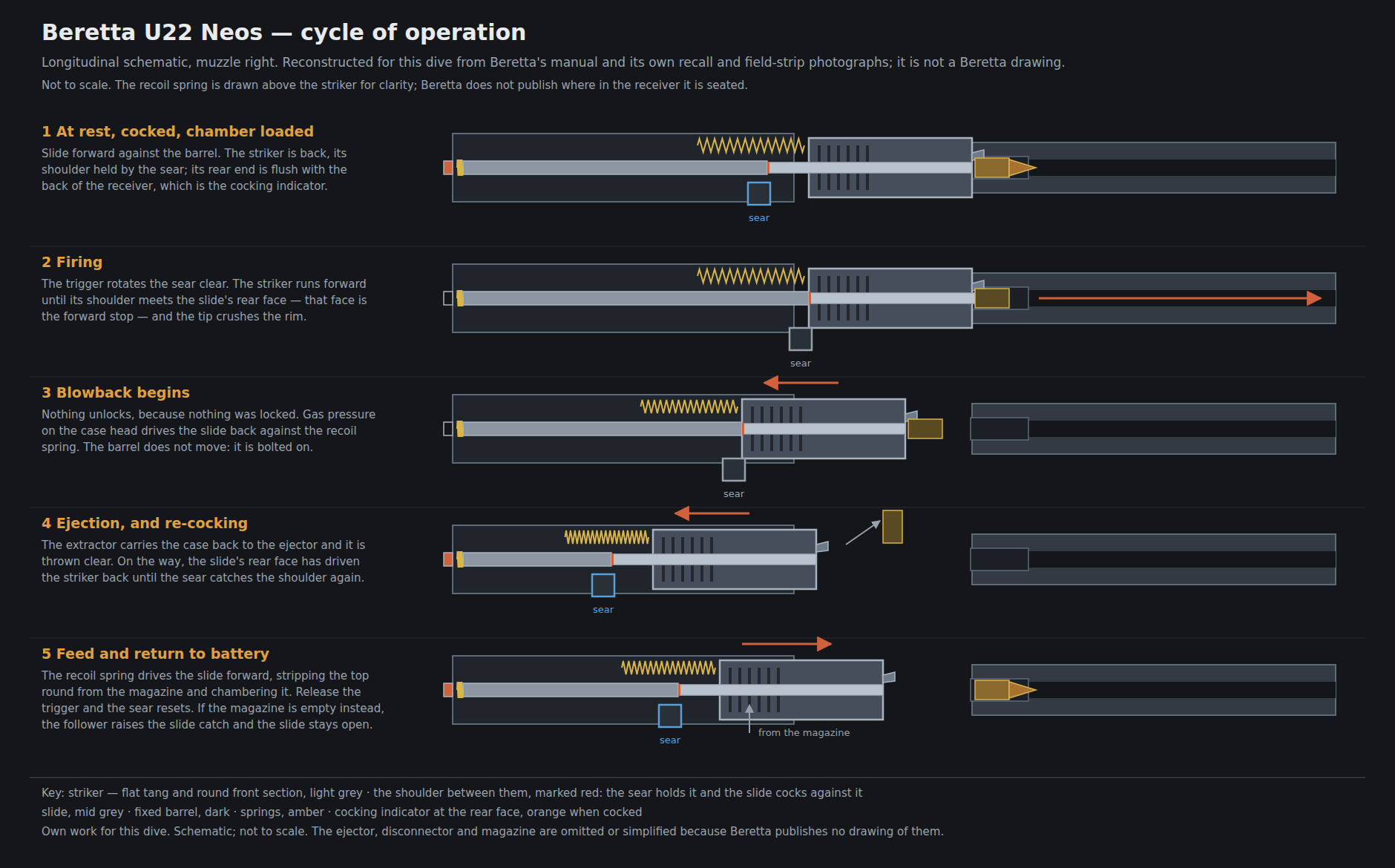
1 — At rest, cocked, chamber loaded. The slide is forward against the barrel’s breech end, held there by the recoil spring. The striker is back, its shoulder caught on the sear, and its rear end is flush with the back of the receiver where the shooter can see and feel it. The safety, if engaged, is blocking the sear.
2 — Firing. The trigger rotates the sear out of engagement. The striker spring drives the striker forward; the tip passes through the slide’s breech face and crushes the cartridge rim against the chamber mouth. The priming compound in the rim fires, the powder burns, the bullet leaves.
3 — Unlocking, which does not happen. There is nothing to unlock. Pressure in the case pushes the case head against the breech face, and the whole slide starts rearward against the recoil spring the instant that force exceeds the spring’s preload and the slide’s inertia will allow. The barrel does not move, because it is bolted on.
4 — Extraction and ejection. The extractor on the slide’s breech face carries the case rearward; the case strikes a fixed ejector and is thrown clear of the port. On the way back the slide picks up the striker’s cocking shoulder and drives the striker to the rear until the sear catches it. If the magazine is empty, the follower raises the slide catch and the slide stays open.
5 — Feeding and return. The recoil spring drives the slide forward. The breech face strips the top cartridge from the ten-round straight-stack magazine, runs it up the feed ramp into the chamber, and the extractor snaps over the rim. The pistol is cocked and ready, and the trigger must be released to reset the sear.
3.5 The Sear, and What the Safety Blocks
Beretta’s specification table has one line on the safety and it is the important one:
“Safety — Manual, ambidextrous, blocks sear.”2
That is a sear block, not a striker block and not a trigger block. The lever does not put anything in the striker’s path; it holds the sear where it is so the trigger cannot move it. The manual adds that the safety “can be engaged either with the pistol in the cocked (ready to fire) or uncocked condition”, that pushing the lever down hides a red dot, and that the lever “also acts as a tactile indicator”.2
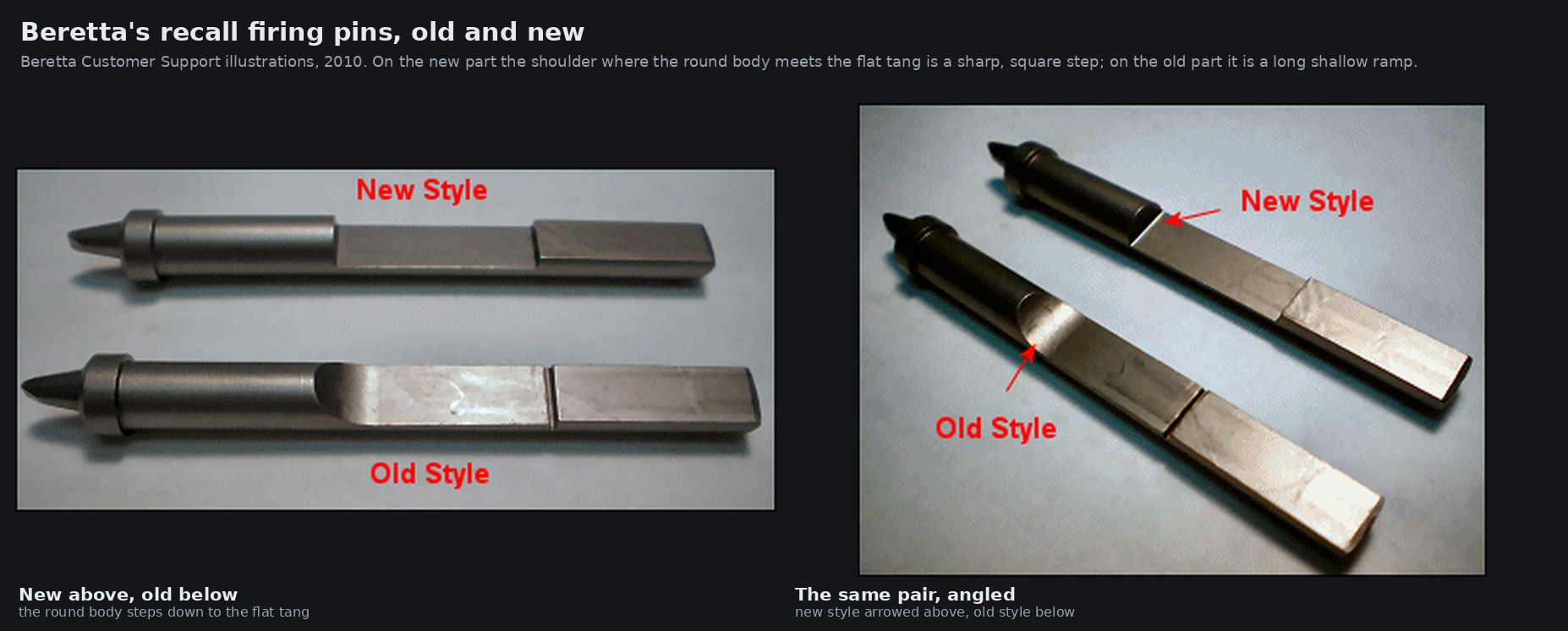
🔴 This is the design fact that makes the 2010 recall intelligible. Beretta’s recall notice says the pistol “will fire even if the safety is activated and, in some cases, the pistols may fire if the safety is moved from the OFF to the ON position”, and that the fix was a replacement firing pin assembly.5 Beretta’s own identification page then names the difference between the old and new parts: “the New Style firing pin has a much sharper cut in the shoulder in the front area of the firing pin.”4
So the defect lived in the engagement geometry between the striker’s shoulder and the sear, and the sear is the only thing the safety holds. A striker whose shoulder is a long shallow ramp rather than a square step can sit on its bearing surface with less engagement than a square shoulder would give; if that hold is marginal, blocking the sear does not guarantee the striker stays put, and the small movement of applying the safety can be enough to shed it. A safety that blocked the striker directly would have caught this; a sear block cannot.
⚠ That explanation is this dive’s reasoning from Beretta’s two statements — the safety blocks the sear, and the cure was a firing pin with a sharper shoulder — and not a quotation from Beretta. Beretta never published a root cause. The inference is offered because it is checkable: the two documents are quoted above, and the shoulder they describe is photographed. Anyone who can put an old and a new firing pin side by side can test it. Beretta explicitly warned owners not to test the fault itself: “Do not experiment with your Neos pistol to see if it has the potential safety issue.”5
3.6 The Cocked Firing Pin Indicator, and What It Does Not Tell You
The striker’s rear end is the indicator: flush with the back of the receiver means cocked; recessed means not cocked.2 Because the striker is in the receiver rather than the slide, the indicator does not move when the slide does, which is why it works at all.
Beretta prints a warning about it in capitals, and it is worth repeating because the indicator invites exactly the wrong conclusion:
“THE COCKED FIRING PIN INDICATOR DOES NOT TELL THE USER WHETHER THE PISTOL IS LOADED. A ROUND CAN BE IN THE CHAMBER WHETHER OR NOT THE INDICATOR IS VISIBLE. RETRACT THE SLIDE TO SEE IF THE PISTOL IS LOADED.”2
For the loaded check, the manual offers a partial retraction: “With the pistol uncocked and the safety engaged, the slide can be opened slightly to allow the user to check if there is a round in the chamber.”2 Each pistol also shipped with an orange chamber plug that holds the slide slightly open and shows visibly that the chamber is empty — with the caution that it “should not be used as an alternative to locking the pistol.”2
3.7 No Magazine Disconnect, and the Pistol Says So
The Neos has no magazine disconnect. Pull the magazine with a round chambered and the pistol will still fire. Wikipedia notes the consequence positively: the absence “accommodates single-shot operation with direct chamber loading”, which is a real convenience on a target range.3
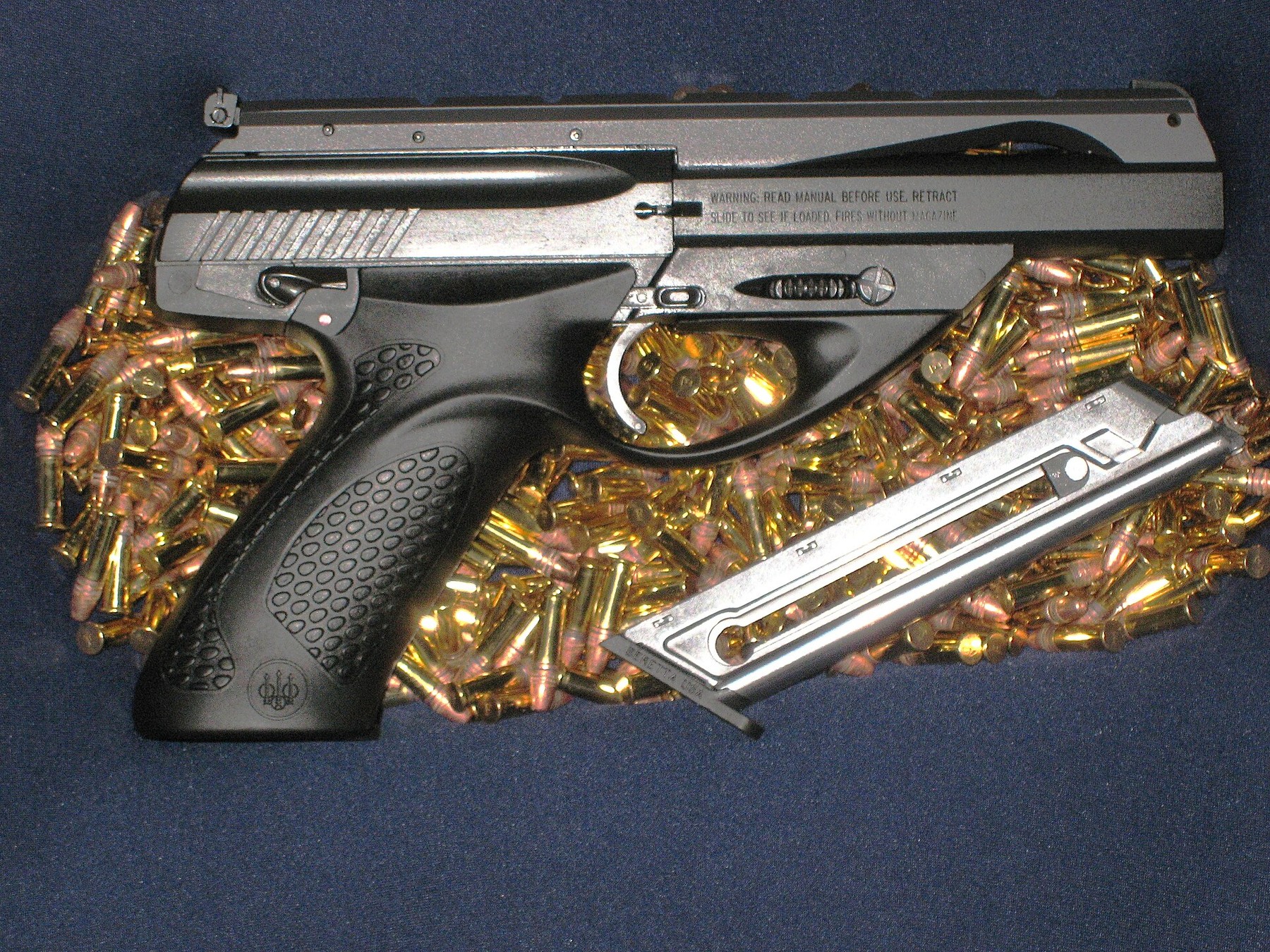
What makes this worth a paragraph is that Beretta roll-marked the warning on the gun. The right side of the receiver carries the legend:
“WARNING: READ MANUAL BEFORE USE, RETRACT SLIDE TO SEE IF LOADED. FIRES WITHOUT MAGAZINE”
3.8 The Barrel Mount: a Dovetail, a Nut and Two Clicks
The barrel unit attaches at two points, and the manual’s assembly instruction names both:
“When re-installing the barrel, start by fitting the rear dovetail into seat in the frame assembly, then rotate the barrel downward to engage the barrel nut.”2
So: a dovetail at the rear, which locates the barrel vertically and laterally and takes the rearward thrust, and a large knurled nut at the front, which clamps it down. The nut cannot turn until a spring-loaded barrel nut lock button is pressed in — Beretta’s Figure 2-J, the cross-slotted head on the right side of the receiver — and the nut unscrews clockwise when the pistol is held upright, which is the opposite of the reflex.2
🔴 The one torque specification Beretta publishes for the whole pistol is a notice, not a number:
“NOTICE: When re-installing the barrel, the barrel nut (Fig. 1-K) should be tightened two (2) clicks beyond finger tight.”2
The nut is detented, and the detents are the specification. That is a sensible answer for a pistol whose barrel is meant to come off in the field: a number would need a wrench, and the whole point is that no tool is required. It also means a Neos assembled by feel alone, without counting, is not assembled to specification — and a barrel that is not clamped consistently is a barrel that does not shoot consistently, even though the sights come off with it.
The manual also asks for one drop of oil in a place most owners will not think of: “Lightly oil the threaded barrel stud.”2
3.9 The Rifling
Beretta’s table gives six grooves, right-hand, pitch 350 mm / 13.8 in — one turn in 13.8 inches — for all three barrel lengths.2 Paco Kelly independently reported the twist in 2003 as “one in under 13-3/4-inch”, which is the same figure read off a barrel rather than a table.6 The two agreeing is worth noting because almost nothing else about this pistol has two independent measurements behind it.
The relationship between .22 Long Rifle twist rates, bullet weights and what actually shoots well is the subject of the hub’s .22 Rimfire dive and is not re-derived here.
3.10 The Magazine
Ten rounds, straight stack, stainless steel. Beretta’s own descriptions: “The magazine is a straight stack design, which will contain ten (10) rounds of 22 Long Rifle (22LR) ammunition”; “The single stack, 10-round stainless-steel magazine features an easy-grip knob that allows you to compress the spring from outside, thereby making loading extremely quick and easy.”21 The manual calls the same feature an “oversized magazine loading button”.2 Two magazines came in the box.2
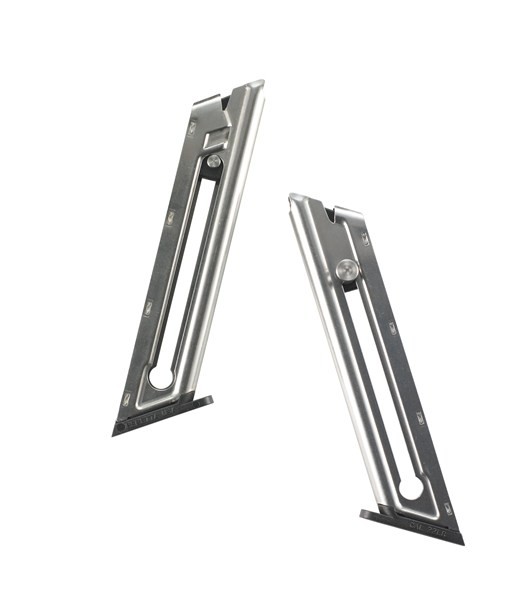
🔴 One ammunition restriction, stated as a notice and easy to miss:
“NOTICE: 22 Short and 22 Long ammunition should not be used.”2
That is a magazine and feed-geometry restriction, not a pressure one. A straight-stack ten-round magazine dimensioned around the .22 Long Rifle cartridge will not reliably feed a shorter case.
3.11 The Sights
Both sights are on the barrel unit, and both are removable and replaceable.2 The rear is fully adjustable and sits recessed in the rear of the rib; the front is a blade at the muzzle end. Beretta’s contrast scheme is deliberate: “To aid sighting under low light conditions, the rear sight aperture has a white border, while the front sight is matte black for contrast.”2
Changing the rear blade is not a job to attempt without reading the manual first. The windage screw must come out completely, and a brass rear sight removal tool then goes into the windage screw hole, slot upward, to compress a spring and free the blade — which must be replaced with “the left side of the blade (the one with the round ‘hook’ shape) in first.”2 The DLX adds a set screw at the front sight to make blade changes easier.2
3.12 What the Receiver Is Made Of
⚠ This dive could not answer the question, and the reason it could not is itself worth recording.
The receiver is unquestionably a distinct component. It carries the serial number, the slide rails, the sear, the striker and the safety; the grip module bolts to it; and Beretta’s carbine-kit page says the kit “uses pistol’s magazine, slide and receiver assembly” while replacing the barrel and the grip.7 It is the part that is the firearm.
What it is made of is another matter. Beretta’s specification table has one line: “Receiver — Fiberglass reinforced technopolymer.”2 But every other statement Beretta ever made applies that phrase to the grip:
- the manual’s own feature list, eight pages earlier: “The newly designed grip frame, made of fiberglass-reinforced technopolymer…”2
- beretta.com, 2015 and 2023: “The ergonomic grips are constructed of super-durable fiberglass-reinforced technopolymer with non-slip inserts.”1
- berettausa.com, 2011: “The ergonomic grips in fiberglass reinforced technopolymer with anti-slip finish.”8
American Rifleman records “the frame was constructed from fiberglass-reinforced polymer”.9 Wikipedia’s Design section puts it in “the grip and trigger guard assembly … attached to the receiver with a single bolt”, which is not the same part as the receiver.3
The pistol is widely described in the shooting press as having an aluminium frame with a polymer grip module. No Beretta document located says that. The only part Beretta ever calls aluminium is the machined Weaver rail on the carbine kit’s barrel.10
So the position taken here is: the receiver is a separate serialised component whose material is not stated by its maker in any document found, and the spec table’s single line naming it as technopolymer is inconsistent with everything else Beretta wrote. Nothing further is asserted. The question is settleable in ten seconds by anyone holding one — a magnet and a look at an unseen corner — and it is the first thing this dive would ask an owner to do.
3.13 What Is Not Documented
Also worth naming, because these are the points at which an account of this mechanism would otherwise start inventing:
- The ejector. Its form and location are not shown or described in the manual, and no parts diagram was found. This volume says “a fixed ejector” because the case must strike something; where it is mounted is not stated here.
- The disconnector. A single-action self-loader must have one, or it would fire as fast as the slide returns. The manual never names it.
- The sear’s own shape and pivot, and how the ambidextrous safety bars reach it from both sides.
- A factory detail-strip sequence beyond the firing-pin removal published for the recall. Beretta’s manual says the opposite: “No further disassembly should be necessary for proper cleaning and maintenance of the pistol. Any further disassembly is not recommended and should be done by a competent gunsmith.”2 Volume 4 covers what that leaves an owner able to do.
- Trigger pull weight from the factory. Beretta states only that it is “pre-set at the Beretta factory and is not adjustable.”2 Jeff Quinn measured his sample at “just under four and one-half pounds”, which is one gun, in 2008.11
References
Footnotes
-
Beretta, “U22 Neos”,
beretta.com/en-us/u22-neos/, Internet Archive capture of 1 March 2023. ↩ ↩2 ↩3 -
Beretta U.S.A. Corp., U22 NEOS Instruction Manual, Accokeek, MD, cover code UD6A0277-04/04, interior pages dated 4/23/04; Internet Archive capture of 26 December 2022 of
beretta.com/assets/12/29/Neos_Manual.pdf, accessed 2026-09-19. Specification table p. 19; safety and operational features pp. 15–17; DLX pp. 18, 27–28; field stripping and assembly pp. 29–33. ↩ ↩2 ↩3 ↩4 ↩5 ↩6 ↩7 ↩8 ↩9 ↩10 ↩11 ↩12 ↩13 ↩14 ↩15 ↩16 ↩17 ↩18 ↩19 ↩20 ↩21 ↩22 ↩23 ↩24 ↩25 ↩26 ↩27 ↩28 ↩29 -
“Beretta U22 Neos”, Wikipedia, revision 1370411866 of 21 August 2026, retrieved as wikitext 2026-09-19. ↩ ↩2 ↩3
-
Beretta Customer Support, “Visual Characteristics of the U22 Neos Firing Pins”,
berettasupport.com/neos/neos_identification.htm, Internet Archive capture of 18 September 2010. ↩ ↩2 -
Beretta U.S.A. Corp., “Recall Notice – Beretta Neos Pistols”, PDF at
berettasupport.com/neos/RecallNotice.pdf, Internet Archive capture of 22 September 2010. ↩ ↩2 -
Paco Kelly, “Beretta’s New Space Handgun – The U22 NEOS”, GunBlast.com, 10 May 2003, retrieved 2026-09-19. ↩
-
Beretta U.S.A. online store, “Beretta U22 Neos Carbine Kit .22LR”, stock no. JU22CK1, Internet Archive capture of 28 December 2010. ↩
-
Beretta U.S.A. online store, “U22 Neos”, stock no. JU2S6, Internet Archive capture of 18 July 2011. ↩
-
Guy J. Sagi, “Beretta’s U22 Neos: A Legacy Gun Not Forgotten”, American Rifleman, 22 February 2023, retrieved 2026-09-19. ↩
-
Beretta U.S.A., press release, “Beretta Adds Carbine Kit for U22 Neos and Expands Versatility of Product”, Accokeek, MD, 3 February 2010; Internet Archive capture of 7 April 2010. ↩
-
Jeff Quinn, “Beretta’s New Pink U22 Neos .22 Long Rifle Auto Pistol”, GunBlast.com, 17 June 2008, retrieved 2026-09-19. ↩
Comments (0)