Beretta U22 Neos · Volume 2
The Look — Giugiaro, the Ray Gun, and What the Shape Actually Follows From
The one modern factory pistol with a named industrial-design house on it: who Giugiaro Design were, what Beretta does and does not claim, which of the Neos's famous lines are consequences of its modular architecture, which are pure styling, and where that puts it beside the Whitney Wolverine and the Nylon 66
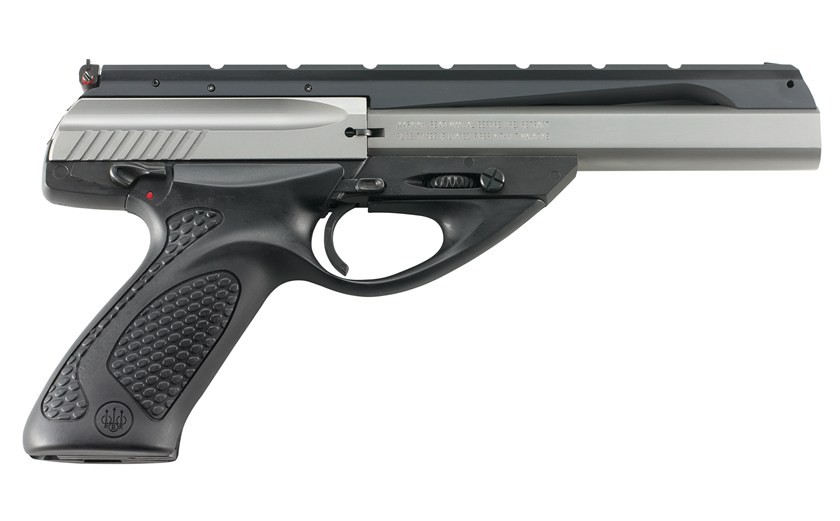
Among the guns this hub files as “space age”, the U22 Neos is the odd one out in a specific way: it is the only one whose maker hired a named industrial-design house to style it, said so in the owner’s manual, and then advertised the result under the heading “Cool, Futuristic Design”.1 The Whitney Wolverine’s designer was an aircraft armament engineer who also drew the outside. The Nylon 66’s shape came out of a moulding shop and a marketing department. The Neos’s shape was bought, from Turin, by a company in Maryland.
This volume asks the question the Whitney dive’s Volume 4 asks of its own subject — what does the shape follow from? — and gets a different answer, which is why the pairing is worth making.
2.1 The Claim This Volume Tests
Stated so that it can be checked:
The Neos’s silhouette follows from its modular architecture — a decision about what the product is, not about how it is manufactured — and the freedom that architecture left over was handed to an outside styling house and spent on pure surface.
If that is right, then (a) each of the pistol’s most-remarked features should be traceable either to the modular brief or to nothing but taste, with no third category; (b) the parts that do the work should be conventional; and (c) Beretta’s own documents should describe the arrangement as two separate purchases, engineering and styling. All three hold.
2.2 What Beretta Said, Four Times
Beretta stated the designer relationship in four documents over twenty years, and the wording drifts in an instructive direction.
2004, the instruction manual, in the DESCRIPTION section:
“Safety, affordability, modular construction, easy maintenance, performance (accuracy, reliability and durability), modern styling and innovation were all goals for Beretta’s first 100% American designed and manufactured pistol.
Styling and ergonomics were a result of close collaboration between Beretta and world renowned Giugiaro Design stylists. The U22 NEOS reflects a sleeker look and feel, guaranteed to appeal to a new generation of Beretta enthusiasts.”2
2011, the Beretta USA store page, under a heading in capitals:
“SOPHISTICATED. In the unmistakable design and style of Giugiaro. The valuable collaboration between Beretta’s engineers and noted Italian designer continues to fruition.”3
2015 and 2023, beretta.com, under the heading “Cool, Futuristic Design”:
“Even while designing a plinking pistol to be used for informal shooting, Beretta did not cut corners. The lines of the Neos bear the unmistakable flavor of renown Italian designer Giugiaro—the same mind behind several of our most attractive offerings. The result is a sleek and ergonomic rimfire pistol that feels as good in the hands as it pleases the eyes.”41
Read the three in sequence. In 2004 the credit is to a firm — “Giugiaro Design stylists”, plural — for a defined scope, styling and ergonomics, in collaboration. By 2011 the firm has become “noted Italian designer”, singular. By 2015 it is “the same mind”, and the collaboration has dropped out of the sentence altogether. That is a normal marketing evolution and it is also how a corporate credit turns into a personal one.
Two further things in the 2004 wording deserve attention.
“Styling and ergonomics” is a scope, not a flourish. Ergonomics means the grip and the reach to the controls. It does not mean the mechanism, and Beretta does not claim it does.
“Beretta’s first 100% American designed and manufactured pistol” sits three sentences from an Italian styling credit, in the same paragraph, and the company evidently saw no contradiction. That is the fact this volume turns on: to Beretta, styling was a separable purchase. The 2011 page says the same thing from the other end — “Beretta’s American design staff started with a clean sheet when drawing up this new line of .22 pistols.”3 Maryland drew the gun; Turin drew the outside of it.
2.3 What Beretta Never Said, and the Credit That Got Invented
🔴 No Beretta document located names Giorgetto Giugiaro personally as the designer of the U22 Neos. The manual credits “Giugiaro Design stylists”. The later pages credit “Giugiaro” as a brand. Neither names an individual, and neither says who at the firm drew it.
Wikipedia’s infobox for the pistol reads designer = Giorgetto Giugiaro (styling) and cites the instruction manual for it.5 The manual does not support the personal attribution. The claim may well be true — it is exactly the sort of thing a design house’s principal would have signed off — but it is not sourced to what it says it is sourced to, and it is repeated everywhere downstream.
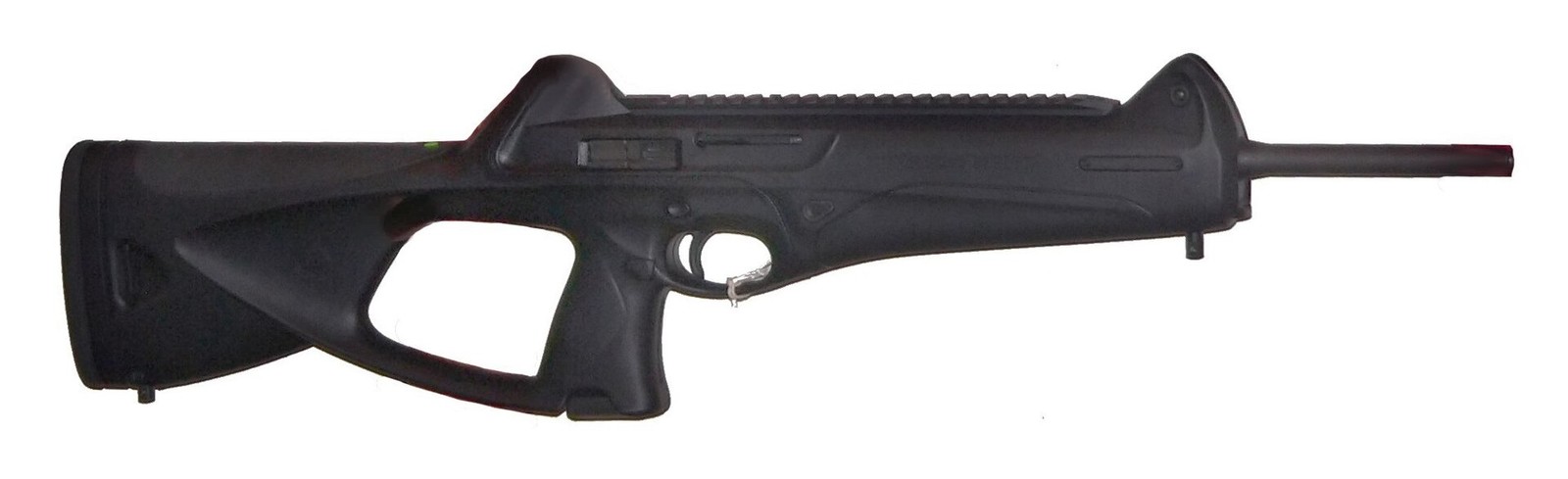
The same caution applies to the companion claims. Wikipedia’s article on Giugiaro lists, under a heading “Firearms”, the Beretta Neos (2002), the Beretta Cx4 Storm (2003) and a Beretta UGB25 shotgun.6 🔴 Those three entries carry no citation except a bare Beretta USA product URL attached to the shotgun, and the list files the Cx4 Storm under “Submachine Guns”, which it is not. Wikipedia’s own articles on the Cx4 Storm and the Px4 Storm do not mention Giugiaro at all.7 Beretta’s own copy gestures at the connection — “the same mind behind several of our most attractive offerings” — and names none of them.1
So the honest position, and the one taken here: Giugiaro Design styled the Neos, Beretta says so in its own manual, and everything beyond that — which individual, and which other Beretta products — is asserted in the secondary literature without a source that could be found.
2.4 Giugiaro, and the Business of Styling Other People’s Engineering
Giorgetto Giugiaro was born on 7 August 1938, began as a stylist in Fiat’s Special Vehicle Design department in 1959, moved to Bertone from 1959 to 1965 and Ghia from 1965 to 1967, and founded his own studio, Italdesign, in 1968. He was named Car Designer of the Century in 1999, took six Compasso d’Oro awards including a lifetime award in 1984, and left the company bearing his name in 2015 to found GFG Style in Turin with his son Fabrizio.6
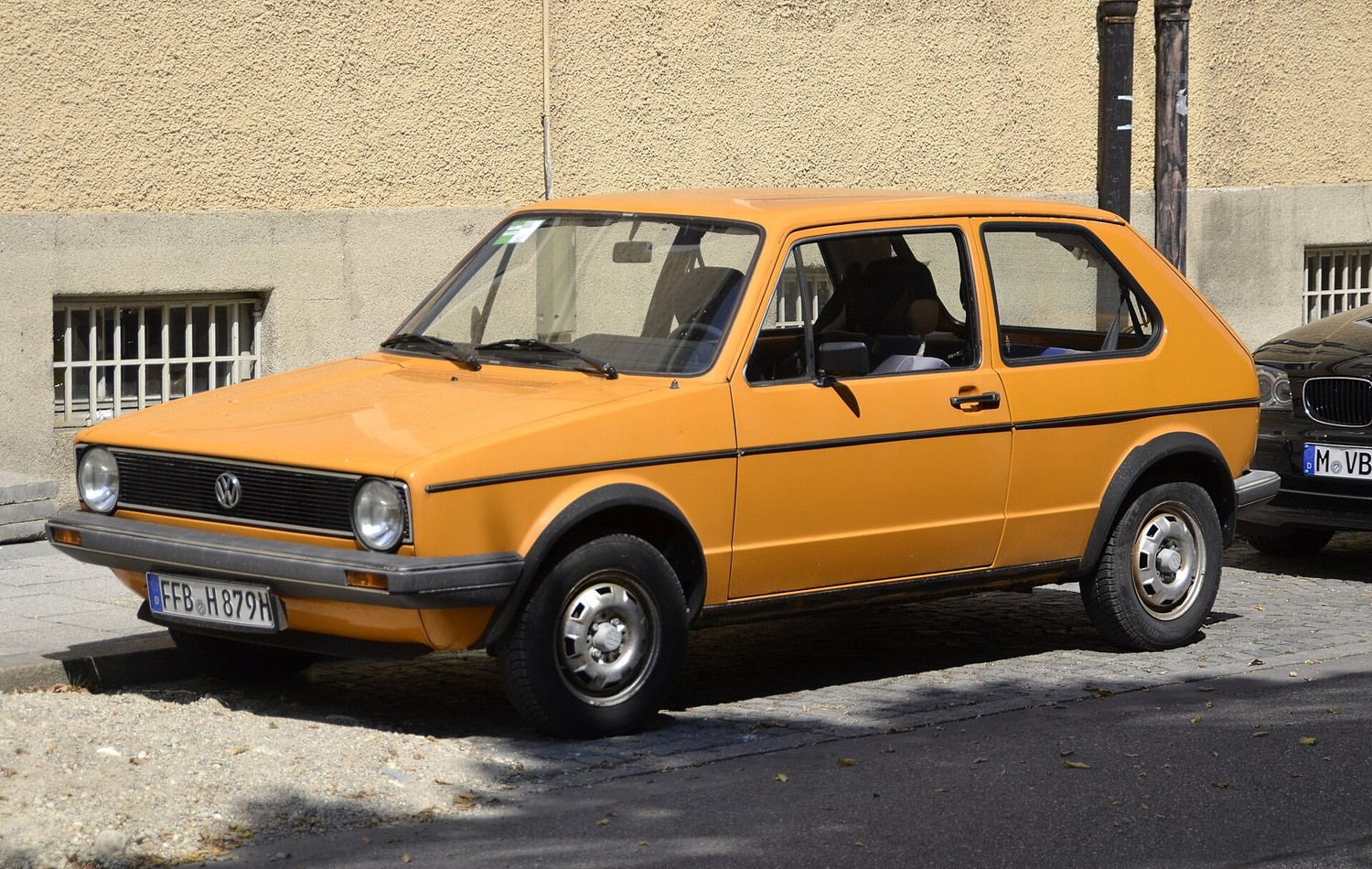
The car work is the famous part: the Volkswagen Golf Mk1 of 1974, the Lotus Esprit of 1976, the BMW M1 of 1978, the DMC DeLorean of 1981 — the “folded paper” period of flat planes and hard creases — and the curvier 1990s work that followed.6
The part that matters more for a pistol is the other half of the business. Giugiaro’s studio styled objects whose engineering belonged entirely to the client: Nikon camera bodies from the EM of 1979 and the F3 of 1980 onward through the F4, F5, F6 and the digital bodies; Seiko watches, mostly racing chronographs; office furniture for Okamura; the navigation promenade at Porto Santo Stefano in 1983; a pasta shape, Marille; and — in 2003, the same year the Neos was being reviewed as a space gun — the organ of Lausanne Cathedral, about seven thousand pipes.6
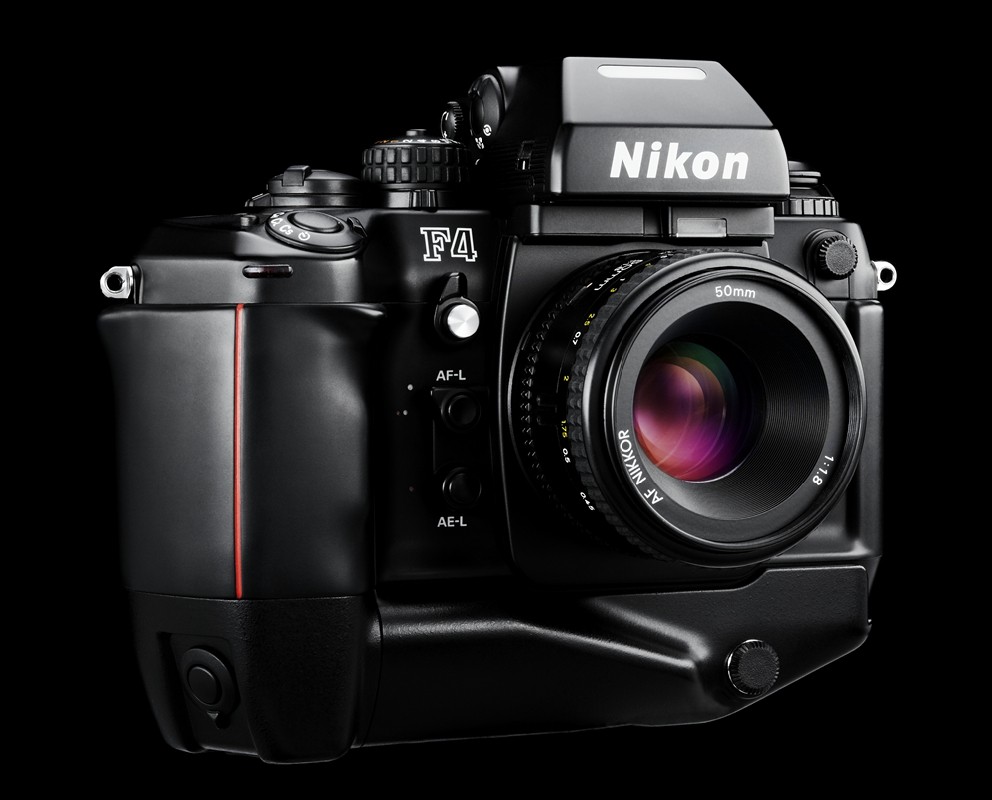
That is the model Beretta bought. Nobody thinks Giugiaro designed the F3’s shutter. What the studio supplied was the exterior of an object whose internals were fixed by somebody else — and in the Nikon case, famously, the grip and the red stripe. The Neos is the same transaction applied to a .22 pistol, and Beretta’s own scope statement, “styling and ergonomics”, says exactly that.
It also explains why the Neos looks like no other Beretta. The company’s in-house design language of the period — the open-top slide of the 92 series, the rounded Cheetah, and later the Px4 — has a family resemblance the Neos shares nothing of.
2.5 The Architecture Came First
Before any line was drawn, Beretta had settled a layout that fixed most of the pistol’s proportions. The manual states it as a design goal — “modular construction” — and the inside cover is given over to a photographic plate captioned “U22 NEOS MODULAR SYSTEM — BARRELS, SLIDES, SIGHTS AND GRIPS EASILY INTERCHANGE TO PERSONALIZE PISTOL”.2 The 2015 and 2023 pages repeat it: “constructed of five modular parts that may be easily disassembled and reassembled without any tools.”41
Four architectural decisions follow from that goal, and between them they draw the pistol:
- A fixed barrel that is a removable unit, held to the receiver by a large knurled barrel nut at the front and a dovetail at the rear.
- The sights and the optic rail mounted on the barrel unit, not on the receiver or the slide — because otherwise changing the barrel loses the zero. Beretta says so in as many words: “Since the sight system is mounted on the barrel unit, you don’t lose zero when the barrel is changed or removed for cleaning.”2
- A blowback breechblock, not a slide that wraps the barrel — the barrel is fixed, so the reciprocating part only has to be a breech.
- A grip module that is a separate shell, carrying the trigger, the trigger guard and the magazine well, and bolted to the receiver.
Every one of those is a decision about the product, not about the process. Nothing here is a consequence of casting or moulding, which is the whole difference from the Whitney and the Nylon 66.
2.6 What the Shape Follows From
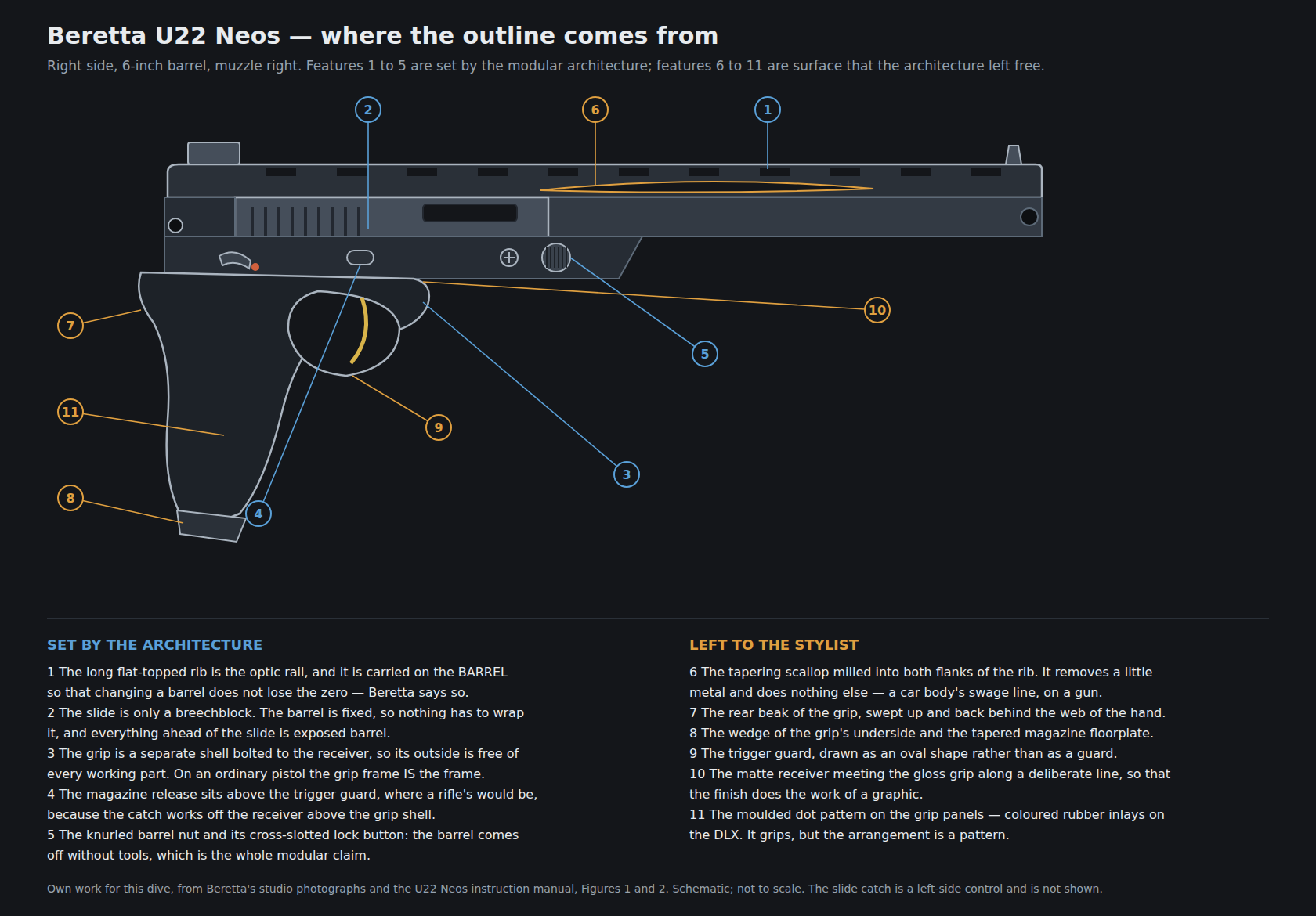
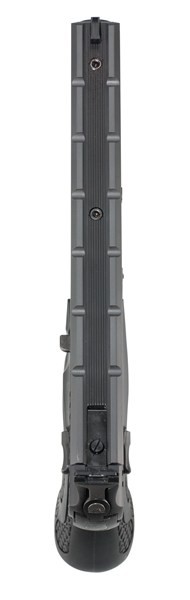
The long flat-topped rib is the optic rail, and the optic rail is on the barrel because of the zero. This is the single most “ray gun” element of the pistol and it is the most thoroughly determined one. The rail must start at the front sight and reach back to the rear sight; the rear sight must be far enough back to give a usable sight radius — 189, 227 or 265 mm depending on barrel;2 and the whole assembly must be one rigid piece with the barrel so that removing and refitting it returns to zero. The result is a beam of metal running the full length of the gun, standing above and past the slide, slotted for weight. No conventional pistol has that outline because no conventional pistol needs it.
🔴 This is also where the best recent article on the Neos goes wrong. American Rifleman writes: “All models had Weaver-style rail atop the slide.”8 The rail is on the barrel. Beretta’s manual is explicit, the reason is the zero-retention argument above, and the company’s own photographs show the rib running the full length of the barrel unit and over the slide, which does not touch it. Put the rail on the slide and the case for the modular system collapses — a reciprocating optic mount is not a sight base.
The short, buried slide gives the pistol its forward thrust. Because the barrel is fixed, the slide has nothing to enclose. It is a breechblock with an extractor and a set of finger serrations, occupying about the middle third of the pistol’s length, and the exposed barrel ahead of it is what produces the long, low, nose-heavy silhouette. This is not new; Wikipedia’s Design section correctly notes the configuration “is similar to the Colt Woodsman and its successors”.5 What is different is that on a Woodsman the exposed barrel is bare, and on the Neos the barrel wears the rail, which doubles its visual mass.
The grip can be any shape at all, because it is a shell. The grip module carries the trigger, the trigger guard and the magazine; the receiver above it carries the striker, the sear, the slide rails and the serial number, and the two are joined by a single bolt.52 That frees the exterior of the grip entirely from the working parts. The Neos’s deeply raked, finger-grooved grip with its swept underside is possible because nothing structural is in the way. On a conventional .22 pistol the grip frame is the frame, and its outside is limited by what has to be inside it.
The magazine release is above the trigger guard, where a rifle’s would be. Beretta’s own Figure 2 labels it H, on the right side, immediately above and forward of the trigger, under the shooter’s trigger finger.2 It is there because the grip is a shell and the catch works off the receiver above it. It is the one control that makes the Neos feel odd in the hand to a pistol shooter, and it is a consequence of the architecture rather than a choice about ergonomics.
The controls cluster in a strip along the receiver’s lower edge, for the same reason: the barrel nut and its cross-slotted lock button at the front, the magazine release above the trigger, the slide catch behind it, the small ambidextrous safety at the rear. Four controls in a row along one line, because there is only one line where the receiver is accessible between the barrel above and the grip below.
2.7 Where It Is Pure Styling
Strip out everything in the previous section and a great deal is left over, all of it surface, and all of it the part that was bought in Turin.
The scalloped sweep cut into both flanks of the barrel rib. A long, tapering crescent milled into the side of the rib, running from just ahead of the slide toward the muzzle. It removes a small amount of metal and does nothing else. It is a car body’s swage line, transferred to a gun, and it is the most literally Giugiaro thing on the pistol.
The grip’s rear beak. The back of the grip module sweeps up and rearward into a point behind the web of the hand, well above where any working part is.
The wedge of the grip’s underside, tapering forward and down toward the trigger guard, and the tapered magazine floorplate that finishes it.
The oval trigger guard, which is drawn as a shape rather than as a guard.
The transition between the matte receiver and the gloss grip module. The two parts meet along a deliberately drawn line, with the matte surface reading as machinery and the gloss as bodywork — the finish doing the work of a graphic.
The dot matrix on the grip panels, which in the standard pistol is moulded texture and in the DLX is a set of coloured rubber inlays.2 It grips, but the arrangement is a pattern.
None of these is worse for being styling. The point of separating them is that on the Whitney the equivalent list is empty — there, the curves are the casting.
2.8 The Inox Two-Tone Is a Finish, Not a Form
The Inox differs from the standard pistol in exactly one respect that the eye sees: the barrel and slide are stainless steel rather than blued.5 The rail on top of the barrel stays black, so the Inox reads as a bright gun wearing a dark stripe. It is a striking effect and it is entirely a finish decision: nothing about the shape changes, and Beretta’s spec table gives the same material line — “Alloy steel, matte finish, stainless or blued” — for both.2
This is the same category the Nylon 66 dive puts colour in when it distinguishes a moulded-in pigment from a moulded-in form. A finish can transform how an object reads without touching what it is.
2.9 Against the Whitney and the Nylon 66
Three guns, three different answers to the same question.
Table 1 — Against the Whitney and the Nylon 66
| Whitney Wolverine, 1956 | Remington Nylon 66, 1959 | Beretta U22 Neos, 2002 | |
|---|---|---|---|
| Who drew the outside | the engineer who drew the inside | the maker’s own people | an outside styling house |
| What the form follows | the manufacturing process — one aluminium casting around a fixed barrel | the mould, in the details; convention, in the silhouette | the product architecture — modularity and a barrel-mounted sight |
| What the styling is for | to look modern, and it came free with the method | to look like walnut, so buyers would accept plastic | to look unlike every other .22 in the case |
| Where the plastic or metal is | the frame is the casting and is the whole exterior | the stock and receiver are one moulding | the grip is polymer; the parts that do the work are steel |
The Whitney is the pure case, and its dive proves it from the makers’ own 1956 words: the cast frame “enabled many noteworthy style variances hitherto impossible with practical machining methods on solid forgings, thus enhancing the graceful contour lines.”9 There, the look and the construction are one decision.
The Nylon 66 is the inverse: a moulding whose details are construction showing through, but whose silhouette was deliberately aimed at conventionality — a rifle told to look like walnut so that buyers would not reject the plastic.10
The Neos is neither. Its form is not a by-product of how it was made, and it is not a disguise. Its major masses are steel and are shaped the way they are because of where the sights had to go and what had to come off without tools. The polymer part — the one place a moulding argument could be made — is the least determined component on the gun, precisely because it carries nothing.
⚠ A refinement to a published sibling. The Whitney dive’s Volume 8 lists the Neos among the Whitney’s kindred designs and characterises it, with the Nylon 66, as a “styled moulding” against the Whitney’s construction-driven form.11 The contrast it draws is right; the term is loose as applied to the Neos. Nothing that gives the Neos its outline is moulded: the rib, the rail, the slide and the barrel are steel, and the only moulding on the pistol is the grip. The better description is a styled architecture — a shape set by a product decision and then finished by a stylist. That is a third category, and this dive’s reason for existing beside the other two.
2.10 A Ray Gun and a Running Shoe
The two things the American press reached for in 2003 were both consumer products.
Paco Kelly’s GunBlast review of 10 May 2003 was headlined “Beretta’s New Space Handgun”. His first recorded reaction to the pistol was “This thing is for outer space!” — and his second was that it looked like a running shoe, a comparison he walked back after shooting it.12 American Rifleman, looking back in 2023, wrote that “it wore a back-to-the-future 31st century look” and that “some traditionalists immediately labeled the pistol’s looks as futuristic.”8
There is a direct parallel in the Whitney dive. In 1956 Robert Hillberg justified his own styling by listing what he was measuring pistols against: “We have new dishwashers, refrigerators, cars, even railroads, but many guns built today are 30 years behind the times.”9 Forty-seven years later a reviewer reached for a spaceship and a sneaker. In both cases the vocabulary comes from outside the gun trade, which is the point: a gun styled by an industrial-design house invites comparison with industrial design, and the trade press obliges.
2.11 Did the Look Sell It?
The evidence is mixed and none of it is a sales figure, because no production total for the Neos was found (see Volume 1).
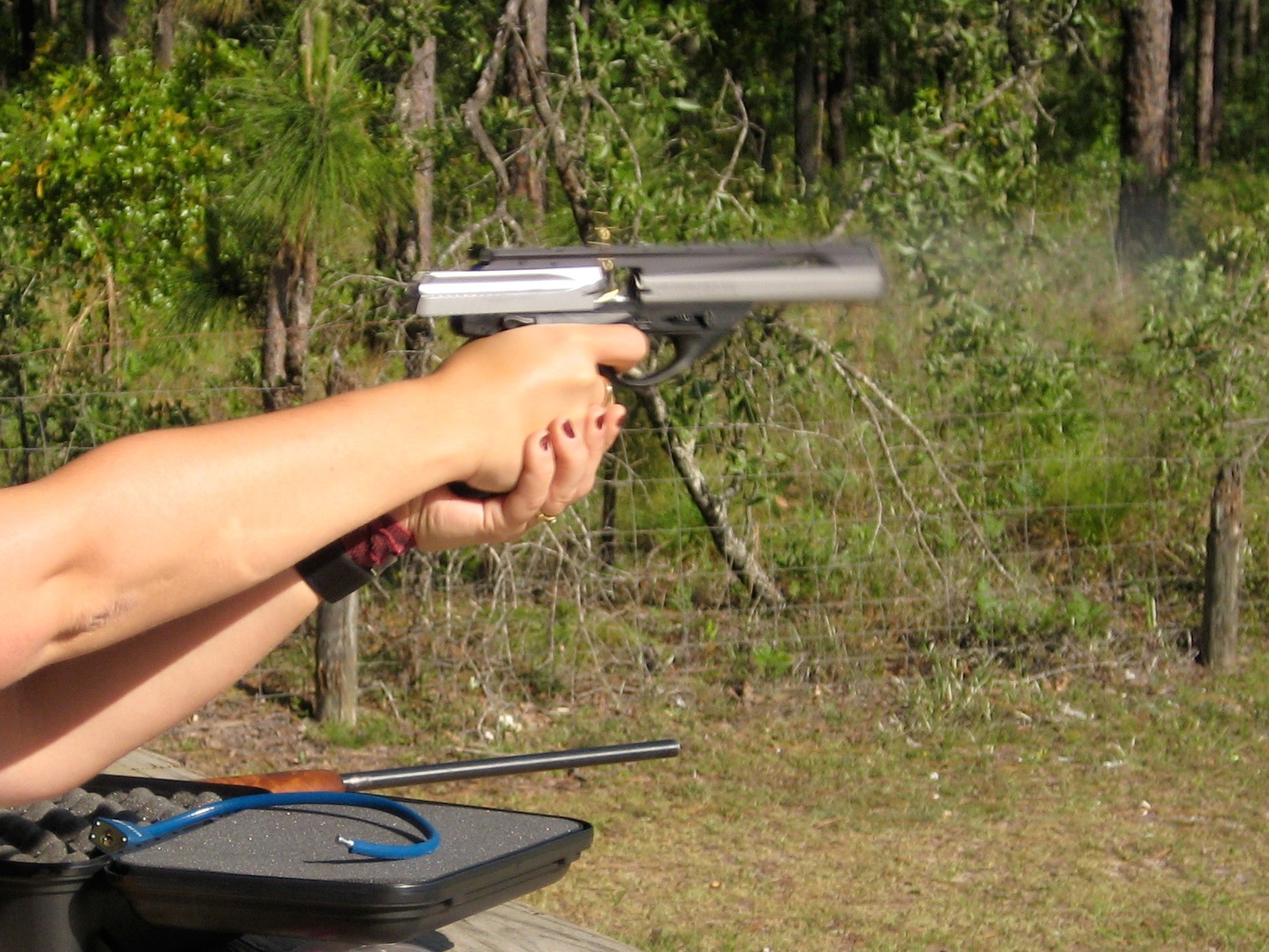
Against the look: the pistol drew immediate resistance. American Rifleman’s retrospective says the futuristic labelling “led to scattered claims the gun was out of sync with the rimfire’s legacy.”8 A .22 pistol’s traditional buyer is a traditional buyer.
For the look: the same article records that “gun owners sang a different tune after they handled one in the store or witnessed the performance on the firing line,” and that “the exotic looks enticed more than a few experienced and knowledgeable gun owners into adding another rimfire to their safes.”8 Kelly’s own progression — outer space, running shoe, then “the grip looks weird but works extremely well” — is the same story in one review.12
And the pistol lasted about twenty-one years in the catalogue, which for a $250 rimfire is a long run. The look did not kill it. Whether it sold it cannot be shown from anything published.
What can be said is narrower and more interesting. Beretta bought styling as a line item, from a firm whose business was styling other companies’ engineering, and got a pistol that is instantly identifiable at fifty feet and that no one has ever confused with anything else. Twenty-four years later the hub can find exactly two photographs of it on Wikimedia Commons and still recognise it in both.
References
Footnotes
-
Beretta, “U22 Neos”,
beretta.com/en-us/u22-neos/, Internet Archive capture of 1 March 2023. ↩ ↩2 ↩3 ↩4 -
Beretta U.S.A. Corp., U22 NEOS Instruction Manual, Accokeek, MD, cover code UD6A0277-04/04, interior pages dated 4/23/04. Internet Archive capture of 26 December 2022 of
beretta.com/assets/12/29/Neos_Manual.pdf, accessed 2026-09-19. Figure letters cited are from the manual’s own Figures 1 and 2 on pages 12 and 13. ↩ ↩2 ↩3 ↩4 ↩5 ↩6 ↩7 ↩8 -
Beretta U.S.A. online store, “U22 Neos”, stock no. JU2S6, Internet Archive capture of 18 July 2011. ↩ ↩2
-
Beretta, “U22 Neos”,
beretta.com/en-us/u22-neos-/, Internet Archive capture of 5 April 2015. ↩ ↩2 -
“Beretta U22 Neos”, Wikipedia, revision 1370411866 of 21 August 2026, retrieved as wikitext 2026-09-19. ↩ ↩2 ↩3 ↩4
-
“Giorgetto Giugiaro”, Wikipedia, retrieved as wikitext 2026-09-19, together with the sources it cites for the biography, the awards and the industrial-design commissions. ↩ ↩2 ↩3 ↩4
-
“Beretta Cx4 Storm” and “Beretta Px4 Storm”, Wikipedia, retrieved as wikitext 2026-09-19 and searched for “Giugiaro” and “Italdesign”: no occurrences in either article. ↩
-
Guy J. Sagi, “Beretta’s U22 Neos: A Legacy Gun Not Forgotten”, American Rifleman, 22 February 2023, https://www.americanrifleman.org/content/beretta-s-u22-neos-a-legacy-gun-not-forgotten/ , retrieved 2026-09-19. ↩ ↩2 ↩3 ↩4
-
Firearms hub, Whitney Wolverine dive, Volume 4, “The Look — A Casting, a Jet Fuselage, and ‘Modern as Tomorrow’”, quoting the Bellmore-Johnson booklet as reproduced in Guns, August 1956. ↩ ↩2
-
Firearms hub, Remington Nylon 66 dive, Volume 6, “The Look — A Moulding That Was Told to Look Like Walnut”. ↩
-
Firearms hub, Whitney Wolverine dive, Volume 8, “Kindred Designs”. ↩
-
Paco Kelly, “Beretta’s New Space Handgun – The U22 NEOS”, GunBlast.com, 10 May 2003, https://www.gunblast.com/Paco_Beretta-NEOS.htm , retrieved 2026-09-19. ↩ ↩2
Comments (0)